
By Nora Mishanec,Breaking & Enterprise Reporter
Updated Feb 20, 2025 (SFChronicle.com)
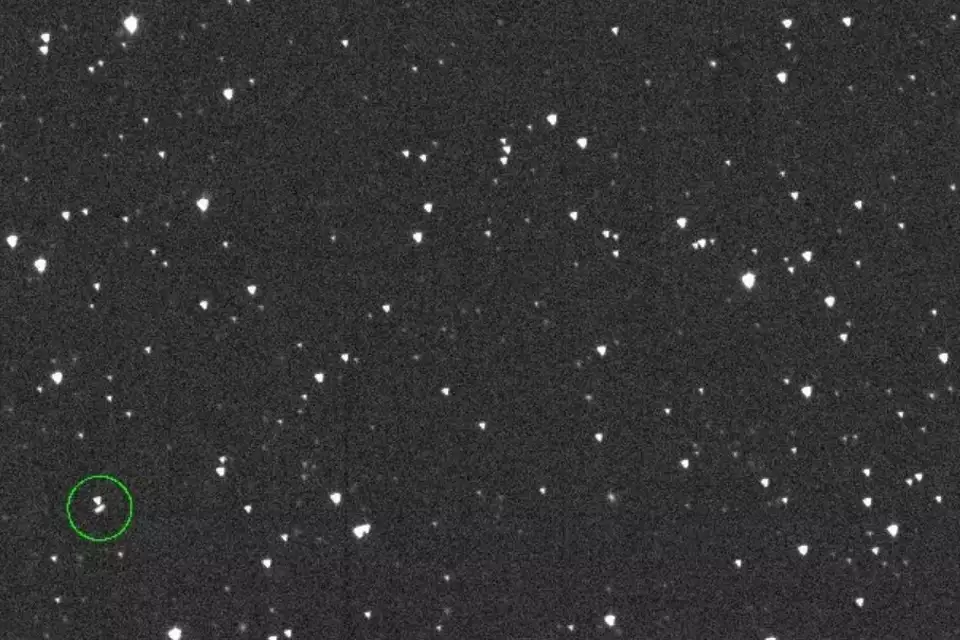
Asteroid 2024 YR4 (circled in green) is what NASA scientists call a “near-Earth asteroid,” meaning it is orbiting relatively close to our solar system.ATLAS
Scientists are projecting a small but significant chance that an asteroid could strike the Earth on Dec. 22, 2032.
Asteroids — the rocky remnants left from the formation of the solar system about 4.6 billion years ago — rarely approach Earth. And this one, named Asteroid 2024 YR4, is especially noteworthy: It has the highest probability of hitting our planet that NASA has ever recorded for an object of its size or larger.
Here’s what to know:
What is Asteroid 2024 YR4?
Asteroid 2024 YR4 is what NASA scientists call a “near-Earth asteroid,” meaning it is orbiting relatively close to our solar system. It was first reported Jan. 27 by the NASA-funded Asteroid Terrestrial-impact Last Alert System (ATLAS) in Chile.
Soon after, the space agency announced that the asteroid is on a path to strike Earth in eight years, on Dec. 22, 2032. It has not been given an official name.
The asteroid is estimated to measure between 130 and 300 feet. That’s relatively small. Some asteroids are miles wide, while others measure less than 40 feet.
What is the probability that the asteroid will hit the Earth?
NASA considers Asteroid 2024 YR4 to have a “very small chance of Earth impact” in 2032. Data collected on Tuesday indicated that it has a 3.1% chance of striking our planet — the highest impact probability the agency has ever recorded.
But new NASA data collected overnight and released Wednesday reduced the probability to 1.5%.
That’s still significant for two reasons. NASA is required to notify other U.S. government agencies whenever it detects an asteroid with more than 1% chance of hitting the Earth. An asteroid of this size is large enough to cause “localized damage” in the event that it were to strike, so the space agency must publicize the risk, however unlikely it may be.
The risk factor could keep changing as scientists continue to study the space rock’s size and trajectory. NASA’s James Webb Space Telescope is expected to closely observe the asteroid in March.
Where could the asteroid strike?
Scientists are still determining the asteroid’s exact trajectory.
“Each additional night of observations improves our understanding of where the asteroid could be on Dec. 22, 2032 and underlines the importance of gathering enough data so that our planetary defense experts can determine future risk to the Earth,” Molly Wasser, an outreach coordinator at NASA’s Goddard Space Flight Center, wrote in a blog post on Wednesday.
Could it cause damage?
In short, yes.
The most famous and well-studied impact occurred at the Chicxulub Crater off the coast of the Yucatan Peninsula in Mexico, where it is widely believed that a large asteroid crashed into Earth’s surface 65 million years ago — causing the extinction of the dinosaurs.
Other large asteroids have left craters, including Arizona’s Meteor Crater, or Barringer Crater, a kilometer-wide divot in the desert of northern Arizona.
Even asteroids that do not strike can still have an impact. In February 2013, a house-size asteroid exploded in the atmosphere over Chelyabinsk, Russia, resulting in a blast that shattered windows, damaged buildings and injured more than 1,600 people, according to NASA.
Reach Nora Mishanec: nora.mishanec@sfchronicle.com
Feb 19, 2025|Updated Feb 20, 2025 8:27 a.m.
BREAKING & ENTERPRISE REPORTER
Nora Mishanec is a San Francisco Chronicle breaking news and enterprise reporter. She joined the paper in 2020 as a Hearst fellow and returned in 2022 after a stint at The Houston Chronicle.