
By Julie Johnson, ReporterJan 14, 2025 (SFChronicle.com)
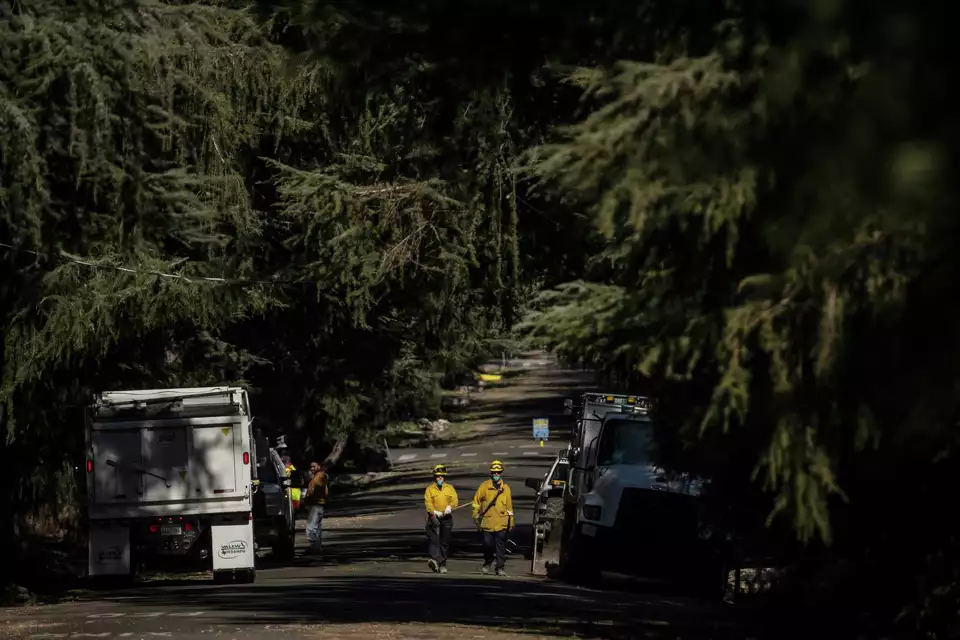
Firefighters walk along Santa Rosa Avenue in Altadena (Los Angeles County) on Monday, Jan. 13. Locals credit the cedar trees — which are less flammable than vegetation such as pine needles — that line the street with sparing homes in the neighborhood from being destroyed by the Eaton Fire. Stephen Lam/The Chronicle
ALTADENA, Los Angeles County — A towering river of green flows through Altadena and marks where the Eaton firestorm inexplicably blew by and left rows of homes untouched.
Over 100 cedars native to the Himalayan mountains line Santa Rosa Avenue, which is known by locals and on historical markers as Christmas Tree Lane. The mile-long avenue is lit up in December with thousands of colorful holiday lights strung up in the trees.
“These trees protected our little pocket,” said Kevin Van Vreede, 58, whose home still stands on nearby Sacramento Street.
The Eaton Fire turned block after block of Altadena into ashen ruins. But these shaggy Dr. Seuss cedars still stand where they have grown since their 19th century planting. Embers didn’t take hold in their needles — even with about 20,000 lights, wires and electrical boxes hung high in their boughs.
The species — deodar cedar — is roughly translated as “trees of God” in Hindi, and some neighbors said that detail rings with a little more weight after the smoke cleared and they emerged, standing.
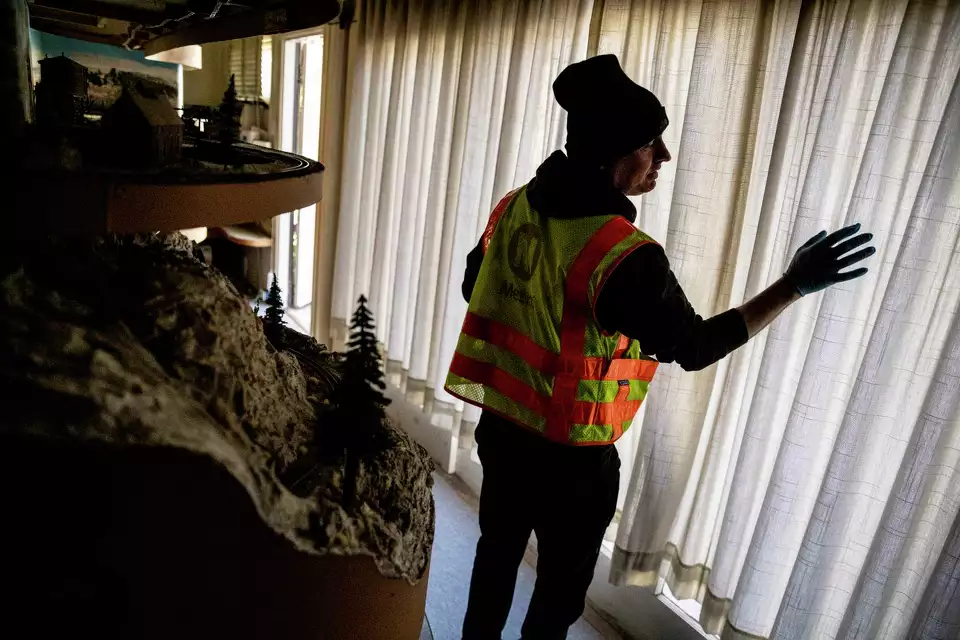
Rob Caves opens a curtain near a miniature train display at his intact home in Altadena after the Eaton Fire on Monday.Stephen Lam/The Chronicle
Christmas Tree Lane resident Rob Caves, 37, theorized the tree bark contained special “fire-resistant sap.”
Across the street, Michael Russell, 60, was hosing down his ash-covered roof, and he mused that the mile-long stand of cedars could have created a wind break.
They and others defied evacuation orders to protect their homes and this symbol of Altadena with garden hoses.
Mike Miguel, 70, whose metal-roofed home stands at the end of the lane, said he was evacuating as flames and smoke bore down on the neighborhood, “but then a voice in my head told me to go back.”
“These trees are a symbol of the city — they survived so we can survive,” said Scott Wardlaw, president of the all-volunteer Christmas Tree Lane Association.
The Eaton Fire destroyed at least 2,700 structures and killed 15 people, and the fire as of Tuesday morning was 35% contained. Damage estimates aren’t complete, and authorities are still searching for human remains.
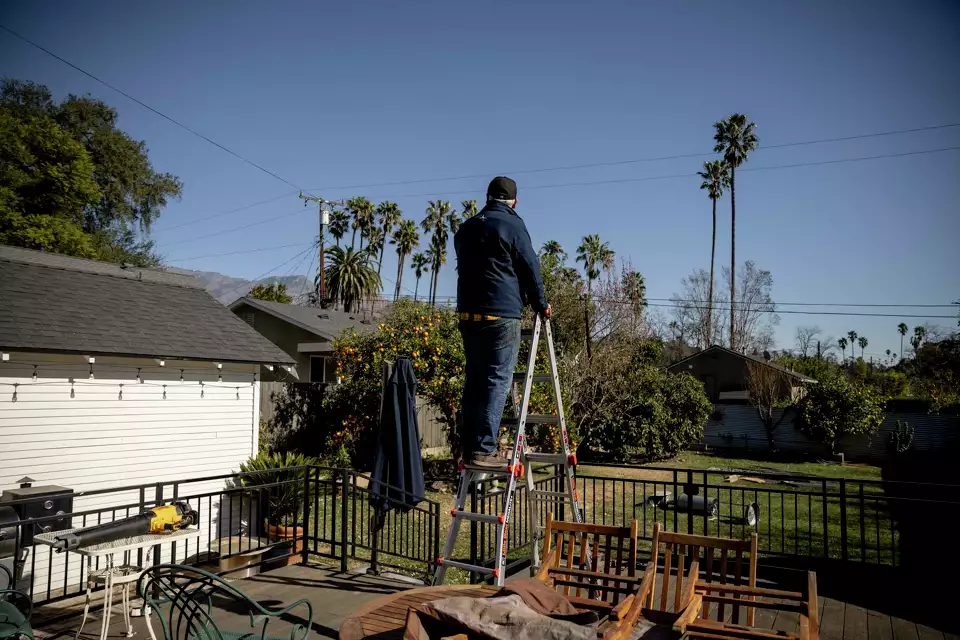
Lifelong Altadena resident Mike Russell climbs a ladder he used when he witnessed the initial glow from the fast-moving Eaton Fire in Altadena. Russell’s home survived the fire despite the widespread destruction in the close-knit community.Stephen Lam/The Chronicle
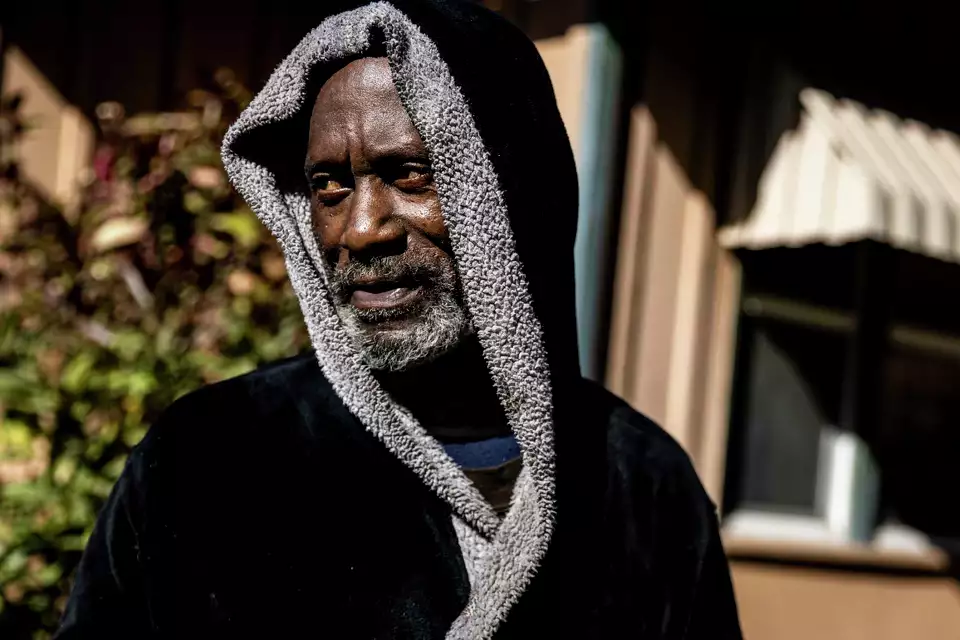
John Robinson, 66, who lives on Mendocino Avenue at the corner of Christmas Tree Lane, remained at the Altadena home his mother bought decades ago as the Eaton Fire ravaged though the community. “We’re just fortunate,” he said standing in the front yard of his intact house. “There’s devastation everywhere.”Stephen Lam/The Chronicle
Christmas Tree Lane is within the uneven path of the fire’s southern edge. Flames leapfrogged some homes and decimated others, including properties along the northern end of Santa Rosa Avenue.
Wardlaw took a more practical view of why Altadena’s jewel, which draws thousands of onlookers in December, still stands: Wildfire is fickle.
“My own speculation is that’s luck of the draw,” he said.
Bill Stewart, retired director of Berkeley Forests, part of University of California Cooperative Extension, said all plants burn, but cedar trees are generally less flammable than other types of vegetation such as pine needles, which have especially incendiary resin in their needles. And he said mature, well-maintained trees are far more resistant to fire than younger ones.
“They are lucky they planted those trees and not others,” Stewart said.
Still, the trees are not a panacea: Some California communities do not want them planted in fire-prone areas.
That decision was made in the 1880s by Altadena’s founder John Woodbury, who wanted to create an enclave at the base of the San Gabriel Mountains apart from bustling Pasadena.
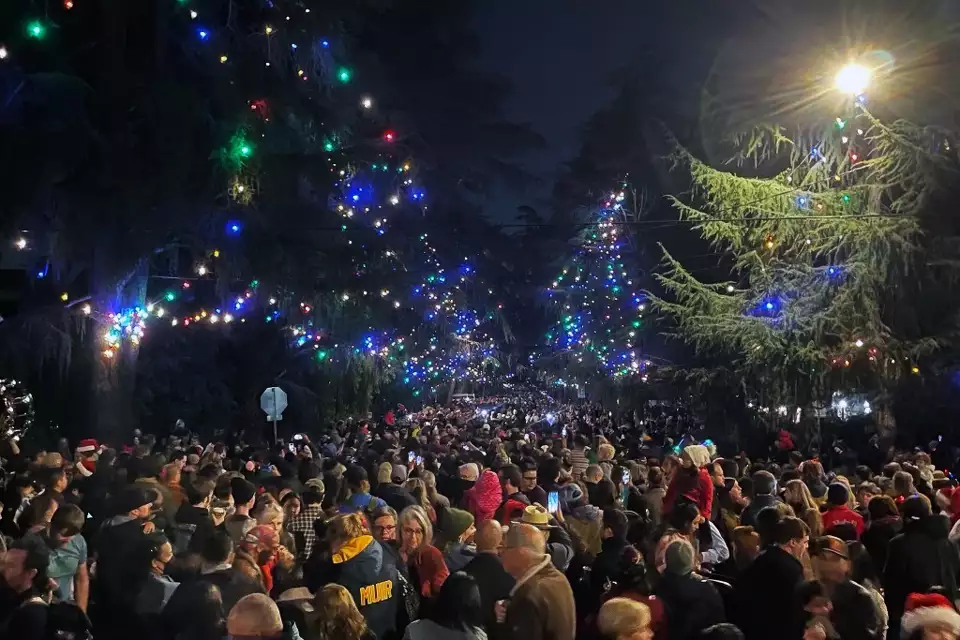
A crowd fills the street to see the light decorations on Christmas Tree Lane in Altadena prior to the Eaton Fire in that begun in early January.Courtesy of Deb Halberstadt
They were first lit up for Christmas time around 1920, and the tradition continued. It was designated a historic landmark by the state of California in 1989.
Strings of lights are hauled up each December with ropes and pulleys and connected to electrical boxes affixed to each tree trunk about 20-25 feet from the ground. Southern California Edison maintains the electrical boxes, and the nonprofit association run by volunteers maintains the lights and pays the electricity bill, Wardlaw said.
Just last month, slow caravans of onlookers clogged these festive blocks. Wardlaw said the lights were only turned off for the season the night before the Eaton Fire ignited.
And they can be lit again next December and give something familiar when so much else is gone.
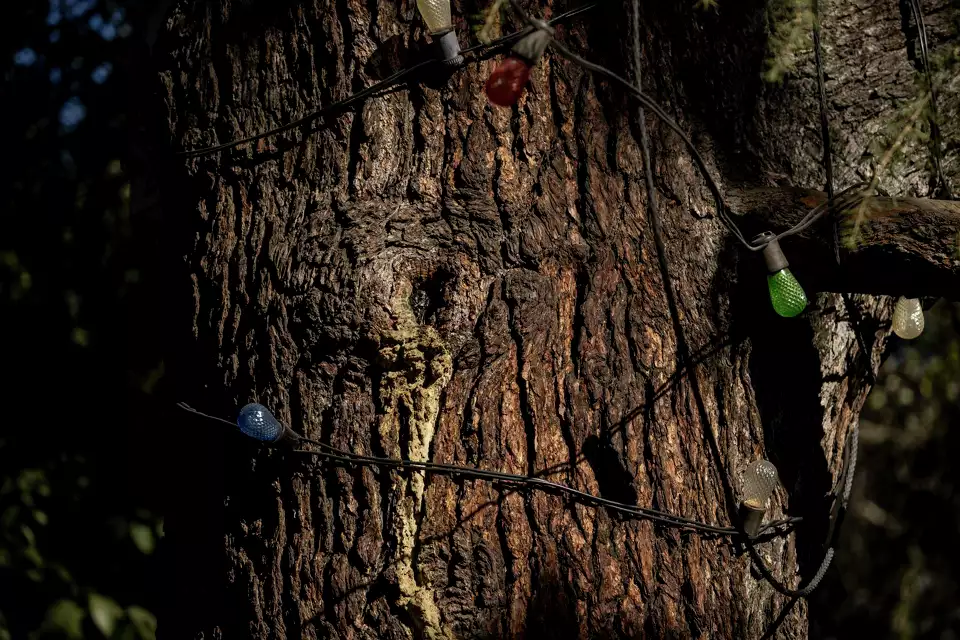
String lights are still wrapped around a deodar cedar tree along Santa Rosa Avenue, known locally as Christmas Tree Lane, on Monday, Jan. 13, after the Eaton Fire swept through the neighborhood in Altadena.Stephen Lam/The Chronicle
Reach Julie Johnson julie.johnson@sfchronicle.com
Jan 14, 2025
REPORTER
Julie Johnson is a reporter with The Chronicle’s climate and environment team. Previously she worked as a staff writer at the Santa Rosa Press Democrat, where she had a leading role on the team awarded the 2018 Pulitzer in breaking news for coverage of 2017 wildfires.