
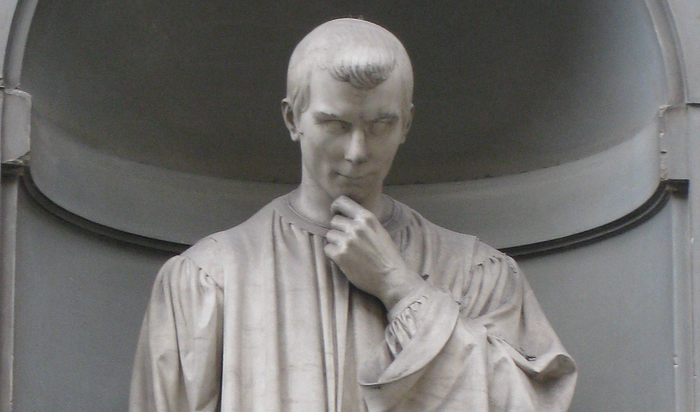
Machiavelli taught more than cold-blooded attainment

3 days ago (mitch-horowitz-nyc.medium.com)
“A Prince should, therefore, understand how to use well both the man and the beast.” — The Prince, chapter XVII
Political philosopher Leo Strauss (1899–1973) considered Niccolò Machiavelli a “fallen angel” of realpolitik. “To recognize the diabolical character of Machiavelli’s thought,” Strauss wrote in his 1958 Thoughts on Machiavelli, “would mean to recognize it as a perverted nobility of a very high order.”
Machiavelli himself may have issued a preemptive rejoinder, noting in the final chapter of The Prince: “God will not do everything himself.” The philosopher extolled human agency, whether flawed or refined, as a matter of “free will” and a proper means of securing “such share of glory as belongs to us.” Although Machiavelli leaned safely on the religious vocabulary of his Renaissance era, it is no stretch to call him a humanist.
Since its posthumous publication in 1532, Machiavelli’s treatise on claiming and holding power has been synonymous with deception, ruthlessness, and even brutality. For centuries, “Machiavellian” has connoted cunning amorality. I have inveighed against recent popular works such as The 48 Laws of Power, which endorse morally neutral, sneaky, or manipulative methods of personal advancement.
How, then, can I justify reconsidering The Prince, a book considered the urtext of reptilian attainment?
A fresh look often reveals the unexpected. Machiavelli imbued The Prince with a greater sense of purpose and ethics than is commonly understood. Although Machiavelli unquestionably endorses absolutist and, at times, ultimate ways of dealing with adversaries, he repeatedly notes that these are last resorts when civic governance proves unworkable. He justifies deception or faithlessness only as a defense against the depravity of men, who shift alliances like the winds. This logic by no means approaches Christ’s dictum to be “wise as serpents and harmless as doves,” but it belies the general notion that Machiavelli was a one-note schemer.
Moreover, the philosopher emphasizes rewarding merit (not family, sycophants or hacks); leaving the public to its own devices as much as possible (the essential ingredient, he writes, to developing culture and economy); trusting subjects enough to allow them to bear arms — and even arming them yourself if confident in their loyalty (as a good leader should be, he says); surrounding oneself with wise counselors (the true measure of a ruler’s ability); rejecting and not exploiting civic divisions (which weaken the whole nation); and striving to ensure the public’s general satisfaction.
One of the most striking parts of The Prince for me is when Machiavelli expounds on the best kind of intellect among leaders:
There are three scales of intelligence, one which understands by itself, a second which understands what it is shown by others, and a third, which understands neither by itself nor by the showing of others, the first of which is most excellent, the second good, but the third worthless.
This has always been my favorite passage of Machiavelli’s. To add a further wrinkle to his observation, here is an alternate translation — I challenge you to consider what place you occupy on its scale:
There exist three kinds of intellects: that belonging to the one who can do the thing itself, that belonging to the one who can judge the thing, and that belonging to the one who can neither do nor judge. The first is excellent, the second is good, and the third is worthless.
For these reasons and more, some modern critics suggest that The Prince is actually a satire or subversion of monarchy: that under the guise of writing a guide to bloody knuckled politics, Machiavelli instead sends up the actions of absolute rulers and covertly calls for more republican forms of government while laying traps for tyrants. [1] I think that assessment stretches matters. But it is equally mistaken to conclude that Machiavelli was a narrow-eyed courtier. On balance, Machiavelli was a pragmatic tutor — sometimes morally conflicted and counseling of graduated application of his principles in the interest of promoting the unity, stability, and integrity of nation states, chiefly his own Italy, in a Europe that lacked cohesive civics and reliable international treaties. His harsher ideas were then considered acceptable quivers in the bow of statecraft; in reading him, you will also detect his efforts to leaven sword-thrusts with insights about the vicissitudes of human nature, fate, and virtue.
These latter themes appear more fully in Machiavelli’s Discourses on Livy, posthumously published in 1531, one year prior to his better-known Prince. Discourses is the more epic and ambitious of the two works and at least as quotable.
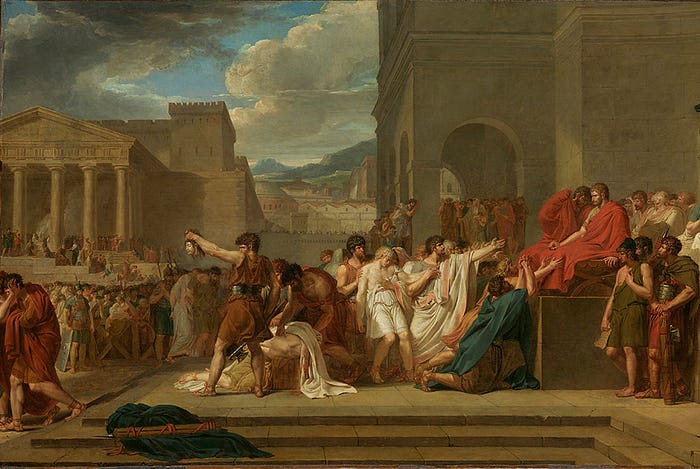
Lest I paint too mild a picture of the strategist of statecraft, however, let me add this passage from Book I, chapter XVI, of Discourses in which the author references the semi-legendary founder of the Roman Republic, Lucius Junius Brutus (d. circa 509 B.C.), who condemned his two sons to death for supporting monarchism: “Now, to meet these difficulties and their attendant disorders, there is no more potent, effectual, wholesome, and necessary remedy than to slay the sons of Brutus.” (Emphasis in the original, translated in 1883 by N.H. Thomson.) And from Book II, chapter XIII: “…the Romans, from the time they first began to extend their power, were not unfamiliar with the art of deceiving, an art always necessary for those who would mount to great heights from low beginnings; and which is the less to be condemned when, as in the case of the Romans, it is skillfully concealed.”
Due to the controversial nature of his writings on power and his direct appeal to rulers, Machiavelli saw just one of his political and strategic books published during his lifetime: Art of War (1521), a Socratic-style dialogue on conflict. That effort shares some correspondences with the Ancient Chinese work of the same title — not yet known in the West — particularly in Machiavelli’s observations: “In war, discipline can do more than fury” and “To know in war how to recognize an opportunity and seize it is better than anything else. [2] For parallel study, see my The Art of War: Landmark Edition (G&D Media, 2021).
Although Machiavelli was considered amorally ruthless in matters of shaping and breaking alliances, he used The Prince to inveigh against needless divisiveness and animus: “I do not believe that divisions purposely caused can ever lead to good…” He extolled excellence in government — and the leader who fosters it:
The choice of Ministers is a matter of no small moment to a Prince. Whether they shall be good or not depends on his prudence, so that the readiest conjecture we can form of the character and sagacity of a Prince is from seeing what sort of men he has about him. When they are at once capable and faithful, we may always account him wise, since he has known to recognize their merit and to retain their fidelity. But if they be otherwise, we must pronounce unfavorably of him, since he has committed a first fault in making this selection.
Machiavelli held that the finest rulers retain power not by sneakiness but intelligence, tough-mindedness, and refinement through personal trial: “They who come to the Princedom…by virtuous paths, acquire with difficulty, but keep with ease.”
I advise experiencing The Prince through the lens of your own ethical sights and inner truths; sifting among its practical lessons; taking in its tough observations about human weaknesses; and using it as a guide to the realities — and foibles — of human nature.
Read by everyone from the humanist Voltaire (who opposed Machiavellianism) to the monster Stalin, The Prince has developed a mystique rivaling any modern work. Toward the end of his life, hip hop artist Tupac Shakur (1971–1996) adopted the name Makaveli after reading the Italian philosopher’s work. The rapper explained in an interview: “That’s what got me here, my reading. It’s not like I idolize this one guy Machiavelli. I idolize that type of thinking where you do whatever’s gonna make you achieve your goal.” [3] That accounting probably captures some aspect of the motives of many contemporary readers of Machiavelli.
That said, I believe that some who encounter The Prince today will recognize subtleties missing from the value-free rationalism prominent in some precincts of our culture. To use spiritual language, I personally see Machiavelli as a voice of the Left-Hand Path. In a philosophical sense, the term left-hand is rooted in the Vedic Sanskrit vamachara for “left-handed attainment.” The Left-Hand Path is an ethical and spiritual outlook that might be described as, “My Will Be Done.” This concept could be seen as a more honest philosophical antonym to The Lord’s Prayer invocation, “Thy Will Be Done,” which is often invoked with the same meaning covertly or, just as often, unconsciously. And, of course, to really evince will — versus automatized drives that lead the individual as magnetism does filaments — requires a measure of search rarely encountered today.
Again Leo Strauss from his Thoughts on Machiavelli: “Paganism is characterized by satisfaction with the present, with the world and its glory…” I think Abrahamic religion has been too contented to dismiss rather than integrate this attainment-based current, which is equally universal, on both intimate and macro scales, as religion’s salvational one. Within the work of Machiavelli it is possible to detect a bridge between the two: glory and realization.
Finally, I offer a lesson from The Prince suggested in its pages but made plainer in the life of its author: apparent failure may conceal lasting victory. The work that eventually transformed Machiavelli into a near-household name would probably never have been written were the author and statesman not summarily fired, imprisoned, and banished following the fall of the Florentine Republic in 1512 and subsequent return of the aristocratic Medici family. Machiavelli, considered a loyalist of the deposed regime, was exiled to near-poverty on his family farm in southeast Italy. The former diplomat, a man who previously enjoyed entry to Europe’s royal courts, struggled beneath twin burdens of boredom and obscurity.
Resorting to his pen, Machiavelli sought to demonstrate his continued relevance and even indispensability by writing Discourses and The Prince, dedicating the latter to the “magnificent” Lorenzo di Piero de’ Medici (even as his treatise condemned flatterers) in hopes the new ruler or his successors would restore the author’s position. Although the Vatican enlisted Machiavelli for a few political consultations before his death in 1527, the statesman’s rehabilitation never fully occurred. But the literary productivity of exile granted the philosopher what no official appointment could: posterity.
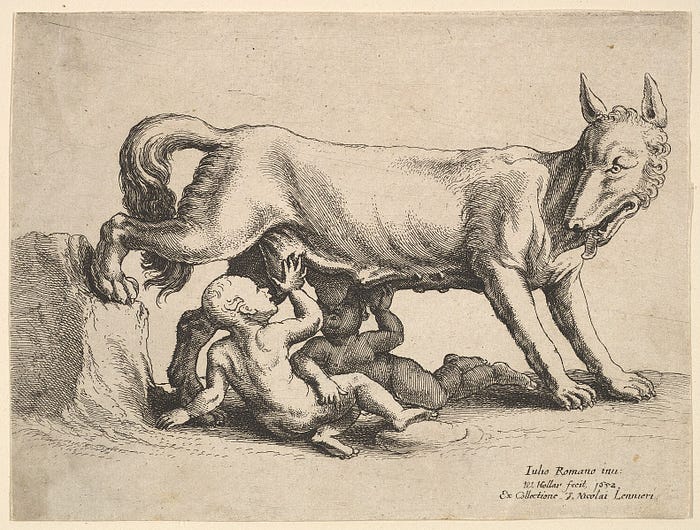
In that vein, consider Machiavelli’s note in chapter VI of The Prince, when referencing Rome’s legendary founder Romulus who was said to be cast out on a rock as an infant with his twin brother Remus and raised by a she-wolf: “It was fortunate for Romulus that he found no home in Alba, but was exposed at the time of his birth, to the end that he might become king and founder of the City of Rome.” As with Machiavelli and Romulus, fortune often hides within seeming reversals.
Not all of Machiavelli’s advice remains pertinent or possible in today’s world; nor, I venture, would most readers wish to act on all of it. But his overarching principles warrant careful scrutiny and evaluation. As alluded, their relevance and applicability rest with the reader’s discretion.
Notes
[1] E.g. see “How Machiavelli Trolled Europe’s Princes: Machiavelli’s advice for rulers was ruthless and pragmatic — and he may have intended for it to secretly destroy them” by Erica Benner, The Daily Beast, May 6, 2017.
[2] Art of War by Niccolò Machiavelli, translated, edited, and with a commentary by Christopher Lynch (The University of Chicago Press, 2003).
[3] “Why Tupac Changed his Name to Makaveli,” TupacUncensored.com, November 4, 2022.

“Treats esoteric ideas & movements with an even-handed intellectual studiousness”-Washington Post | PEN Award-winning historian | Censored in