
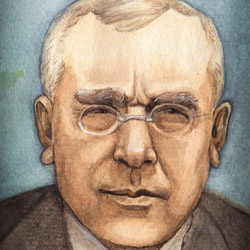
PETER OUSPENSKY
20TH CENTURY MATHEMATICIAN & PHILOSOPHER

INTRODUCING PETER OUSPENSKY
Piotr Demianovich Ouspensky (March 4, 1878–October 2, 1947) was a Russian philosopher who rejected the science and psychology of his time under the strong suspicion that there had to exist superior systems of thought. In his youth, he studied mysticism and esotericism and traveled extensively in search of ancient wisdom, sensing that past ages knew more than his present one. “I felt that there was a dead wall everywhere,” he commented in one of his early biographical notes. “I used to say at that time that professors were killing science in the same way as priests were killing religion.”
When Ouspensky met George Gurdjieff and was introduced to the Fourth Way in 1915, he realized that the barrier towards knowledge lay in oneself; one couldn’t find the truth without simultaneously laboring to live the truth. Real knowledge could only come with sufficient preparation for receiving it. Ouspensky spent the rest of his life laboring to make the Fourth Way principles his own and to share them with like-minded people. In so doing, he became an agent of truth for his age, carrying the wisdom of the pre-World War era into the middle of the twentieth century.
OUSPENSKY’S EARLY YEARS
Ouspensky was born in Moscow in 1878 in a middle class household that was fond of the arts. In his autobiographical accounts he describes himself as atypical, a disinterest in behaving like other children, and an early inclination towards more mature topics like the natural sciences. His lucid memory of these very early years extended to even before the age of two:
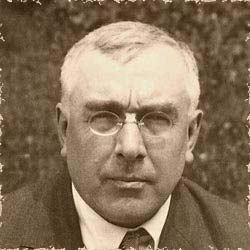
Peter Ouspensky
[MAURICE NICOLL] But I am sure that you remember your life far better than I remember mine, and that your life has had more meaning.
[OUSPENSKY] Yes, but not quite in the way you mean. I have noticed how much you have forgotten. In my case, as a child I did not play with toys. I was less under imagination. I saw what life was like at a very early stage. i
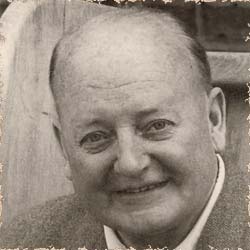
Maurice Nicoll
These precocious qualities appear to have crystallized in his youth both a steadfast dissatisfaction with the schooling system and, later in his adolescence, an unwavering sense of disapproval towards the academic and scientific establishment. The impulse to take personal ownership of his studies began to be apparent as early as the age six, with Ouspensky choosing to be self-taught in the sciences instead of pursuing formal education, with a particular fascination with the theory of the fourth dimension.
Behind this impulse, however, lay the more indelible mark left on his psyche in repeated experiences of déjà vu between Ouspensky and his younger sister, then five and three years of age, in which he recounts how they were able to remember small events before them having yet occurred.

[OUSPENSKY] How can you speak to mother, grandmother, about former lives even when you learn to talk? They will lock you up. I remembered very well. I was very lonely. I had to wait for sister to be born and then to learn to speak, three, four years perhaps, before I had someone to talk to.
Then it used to happen often like this: she used to look out of window and tell me about people she saw. There was very good combination in our street, policeman first, then postman, like that. She used to know who would come round corner because she remembered.
She would say (only we used our own baby language), “Now there will be policeman.” I say, “And now will come tax collector,” and he came. When we did this often I said to her, “Shall we tell mother, grandmother?” And little sister would say, “What use to tell mother, grandmother? They don’t know, they don’t understand anything.” Just think, I was five, she was three. ii
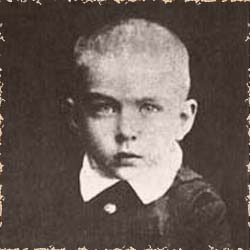
Ouspensky in Childhood
These experiences undoubtedly contributed to the very early conviction in the young Ouspensky of the existence of a veiled reality behind which stood a much different world with radically different meanings towards life than what was ordinarily understood by the adults around him. It was the inherent seed in him that expressed itself in later years of studies and personal development, and never in fact ceased.

OUSPENSKY’S SEARCH
The theory that we live and repeat the same life over and over again represented to the young Ouspensky a living truth, and was inextricably linked and energized by his fascination with higher dimensions. By the age of 27, he wrote a novel titled A Strange Life of Osokin which encapsulated his understanding of the laws governing eternal recurrence and the possibility of change.
Two years later, Ouspensky discovered Theosophy and was introduced to the many branches of esotericism, with entirely new approaches to the pursuit of higher realities. His study of Theosophical literature drew him into psychology, personal experiments, and exotic travels, all of which was conveyed in a series of publications and lectures on topics including the Tarot and Yoga, attracting a considerable audience.
[OUSPENSKY] I discovered the idea of esotericism, found a possible angle for the study of religion and mysticism, and received a new impetus for the study of “higher dimensions”. iii
Ouspensky’s acclaim reached new heights with the publication of Tertium Organum, hailed as a masterpiece in addressing the problem of higher dimensions, and established the now 34 year old as a preeminent philosopher. However, these worldly achievements always appeared to be of secondary interest to him, as the deeper yearning ingrained in his character since childhood made it impossible to settle for the commonplace. Throughout his life, Ouspensky would constantly insist on reaching for nothing short of direct access to the miraculous.
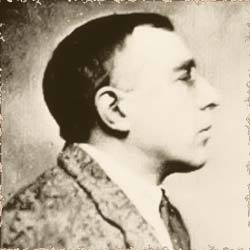
Ouspensky in 1912
Ouspensky’s literary success did not blind him to the fact that experiencing higher dimensions was altogether superior to writing a bestseller on them. He resolved to seek out the miraculous in actual practice, by coming in direct contact with schools that possessed knowledge and practical methods. And so his search continued.
[OUSPENSKY] When I went away I already knew I was going to look for a school or schools. I had arrived at this long ago. I realized that personal, individual efforts were insufficient and that it was necessary to come into touch with the real and living thought which must be in existence somewhere but with which we had lost contact. This I understood; but the idea of schools itself changed very much during my travels and in one way became simpler and more concrete and in another way became more cold and distant. I want to say that schools lost much of their fairy-tale character. iv
MEETING GURDJIEFF
From 1913 to 1914, Ouspensky traveled in search of a school, the majority of this time devoted to India, and while he was successful in obtaining a better understanding of the types of schools that existed, he remained no closer to discovering one suitable to his search. He had planned to continue his search in the Middle East when the trip was cut short by the outbreak of the First World War, requiring him to return home.
Soon after his return to a politically-turbulent Russia, Ouspensky organized lectures to share what he had discovered in India with the aim of gathering like-minded people who were interested in his spiritual pursuits. At one such lecture, held in Moscow, he was approached by two of Gurdjieff’s pupils, who informed him of a group engaged in occult investigations and experiments. They invited him to meet their teacher. While Ouspensky had a poor first impression about the prospect and responded with disinterest, he agreed to the meeting after some insistence by one of the pupils.
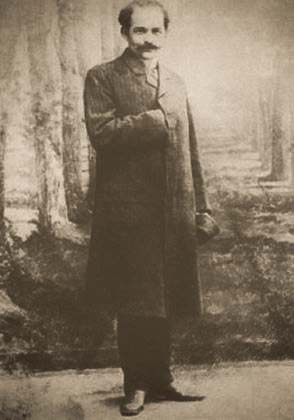
Gurdjieff (1908-1910?)
[OUSPENSKY] In the spring of 1915 I met in Moscow a strange man who had a kind of philosophical school. This was George I. Gurdjieff. He and his ideas produced a very great impression on me. Very soon I realized that he had found many things for which I had been looking in India. I realized that I had met with a completely new system of thought surpassing all I knew before. This system threw quite a new light on psychology and explained what I could not understand before in esoteric ideas and ‘school principles’. iii
[OUSPENSKY] In his explanations I felt the assurance of a specialist, a very fine analysis of facts, and a system which I could not grasp, but the presence of which I already felt because Gurdjieff’s explanations made me think not only of the facts under discussion, but also of many other things I had observed or conjectured. iv
[OUSPENSKY] I saw without hesitation that in the domain [psychology] which I knew better than any other and in which I was really able to distinguish the old from the new, the known from the unknown, Gurdjieff knew more than all European science taken as a whole. v
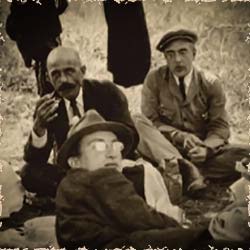
Gurdjieff and Ouspensky Circa 1915
Ouspensky immediately recognized in Gurdjieff the quality of teacher and school that had eluded him throughout all his personal study and seeking abroad. He soon helped form the early St. Petersburg group that Gurdjieff would regularly travel to from Moscow, and became a member of Gurdjieff’s inner circle for several years, playing a key role in establishing the school from the Russian Revolution up until the formation of the institute at Fontainebleau.
Ouspensky’s recollection of this period has been meticulously documented in his book In Search of the Miraculous: Fragments of an Unknown Teaching, published posthumously, and widely held to serve as a masterful introduction to the teachings of Gurdjieff.
To be continued…
SOURCES
- Psychological Commentaries by Maurice Nicoll
- Conversation of Ouspensky with Gerald Palmer (1946)
- Autobiographical Note
- In Search of the Miraculous by Peter Deminaovich Ouspensky
- P. D. Ouspensky Memorial Collection, Sterling Memorial Library, Yale University
(ggurdjieff.com)