
(Image credit: Getty Images)

By Rachel Nuwer 14th June 2023 (BBC.com)
Brendan was once a leader in the US white nationalist movement. But when he took the drug MDMA in a scientific study, it would radically change his extremist beliefs – to the surprise of everyone involved. Rachel Nuwer investigates what happened.
In February 2020, Harriet de Wit, a professor of psychiatry and behavioural science at the University of Chicago, was running an experiment on whether the drug MDMA increased the pleasantness of social touch in healthy volunteers. The day was proceeding like any other Tuesday when Mike Bremmer, de Wit’s research assistant, appeared at her office door with a concerned look on his face.
The latest participant in the double-blind trial, a man named Brendan, had filled out a standard questionnaire at the end. Strangely, at the very bottom of the form, Brendan had written in bold letters: “This experience has helped me sort out a debilitating personal issue. Google my name. I now know what I need to do.”
Seeing this cryptic message, both Bremmer and de Wit were worried. “We really have to look into this,” de Wit said. They googled Brendan’s name, and up popped a disturbing revelation: until just a couple of months before, Brendan had been the leader of the US Midwest faction of Identity Evropa, a notorious white nationalist group rebranded in 2019 as the American Identity Movement. Two months earlier, activists at Chicago Antifascist Action had exposed Brendan’s identity, and he had lost his job.
De Wit was now very worried. She’d just given a drug to a disgraced white supremacist, she realised, and had apparently inspired him to do who knows what out in the world. “Go ask him what he means by ‘I now know what I need to do,'” she instructed Bremmer. “If it’s a matter of him picking up an automatic rifle or something, we have to intervene.”
This experience has helped me sort out a debilitating personal issue. Google my name. I now know what I need to do – Brendan, MDMA trial participant
A murderous spree turned out to be the opposite of what Brendan had in mind. As he clarified to Bremmer, love is what he had just realised he had to do. “Love is the most important thing,” he told the baffled research assistant. “Nothing matters without love.”
When de Wit recounted this story to me nearly two years after the fact, she still could hardly believe it. “Isn’t that amazing?” she said. “It’s what everyone says about this damn drug, that it makes people feel love. To think that a drug could change somebody’s beliefs and thoughts without any expectations – it’s mind-boggling.”
Over the past few years, I’ve been investigating the scientific research and medical potential of MDMA for a book called “I Feel Love: MDMA and the Quest for Connection in a Fractured World“. I learnt how this once-vilified drug is now remerging as a therapeutic agent – a role it previously played in the 1970s and 1980s, prior to its criminalisation. If this comes to pass, MDMA – and other psychedelics-assisted therapy – could transform the field of mental health through widespread clinical use in the US and beyond, for addressing trauma and possibly other conditions as well, including substance use disorders, depression and eating disorders.
But could MDMA transform people’s beliefs too? MDMA does not seem to be able to magically rid people of prejudice, bigotry, or hate on its own. But some researchers have begun to wonder if it could be an effective tool for pushing people who are already somehow primed to reconsider their ideology toward a new way of seeing things. While MDMA cannot fix societal-level drivers of prejudice and disconnection, on an individual basis it can make a difference. In certain cases, the drug may even be able to help people see through the fog of discrimination and fear that divides so many of us.
MDMA cannot magically change the most entrenched extreme political views, but at the right moment, it may open some people’s minds to alternatives (Credit: Getty Images)
When De Wit told me the story about Brendan, I wanted to hear more about what happened directly from the horse’s mouth, so in December 2021 I paid Brendan a visit (he asked that his last name not be revealed, as he’s trying to distance himself from his past). As I rode the elevator up to his apartment in a luxury high-rise overlooking Lake Michigan, I felt a flutter of nervousness. I was unsure of what kind of person I would be meeting, and had even half-jokingly texted a couple of friends to let them know where to come looking for me in case I disappeared. What I didn’t expect was how ordinary the 31-year-old who answered the door would appear to be: blue plaid button-up shirt, neatly cropped hair, and a friendly smile.
After politely hanging up my coat, he explained that, back when he was a white nationalist leader, cultivating an air of ordinariness had been exactly the point. “I really wanted it to be for guys making a good amount of money, who are educated and who could feel comfortable joining these sorts of communities,” he said. “I wanted to normalise it.”
Read more:
- The worldview-changing drugs poised to go mainstream
- How psychedelic drugs might treat depression
- The surprising downsides of empathy
Brendan grew up in an affluent Chicago suburb in an Irish Catholic family. He leaned liberal in high school but got sucked into white nationalism at the University of Illinois Urbana-Champaign, where he joined a fraternity mostly composed of conservative Republican men, began reading antisemitic conspiracy books, and fell down a rabbit hole of racist, sexist content online. Brendan was further emboldened by the populist rhetoric of Donald Trump during his presidential campaign. “His speech talking about Mexicans being rapists, the fixation on the border wall and deporting everyone, the Muslim ban – I didn’t really get white nationalism until Trump started running for president,” Brendan said.
Brendan joined Identity Evropa to connect with others who shared his views. He attended the notorious “Unite the Right” rally in Charlottesville and quickly rose up the ranks of his organisation, first becoming the coordinator for Illinois and then the entire Midwest. He travelled to Europe and around the US to meet other white nationalist groups, with the ultimate goal of taking the movement mainstream.
Brendan likely would have continued in this vein were it not for his identity becoming public. A group of anti-fascist activists published identifying information about him and more than 100 other people in Identity Evropa. He was immediately fired from his job and ostracised by his siblings and friends outside white nationalism.
Brendan attended the notorious “Unite the Right” rally in Charlottesville in 2017 (Credit: Getty Images)
When Brendan saw a Facebook ad in early 2020 for some sort of drug trial at the University of Chicago, he decided to apply just to have something to do and to earn a little money. At one of the visits, he was given a pill. He didn’t know it, but he’d just taken 110mg of MDMA. At the time, Brendan was “still in the denial stage” following his identity becoming public, he said. He was racked with regret – not over his bigoted views, which he still held, but over the missteps that had landed him in this predicament.
About 30 minutes after taking the pill, he started to feel peculiar. “Wait a second – why am I doing this? Why am I thinking this way?” he began to wonder. “Why did I ever think it was okay to jeopardise relationships with just about everyone in my life?”
Just then, Bremmer came to collect Brendan to start the experiment. Brendan slid into an MRI, and Bremmer started tickling his forearm with a brush and asked him to rate how pleasant it felt. “I noticed it was making me happier – the experience of the touch,” Brendan recalled. “I started progressively rating it higher and higher.” As he relished in the pleasurable feeling, a single, powerful word popped into his mind: connection.
It suddenly seemed so obvious: connections with other people were all that mattered. “This is stuff you can’t really put into words, but it was so profound,” Brendan said. “I conceived of my relationships with other people not as distinct boundaries with distinct entities, but more as we-are-all-one. I realised I’d been fixated on stuff that doesn’t really matter, and is just so messed up, and that I’d been totally missing the point. I hadn’t been soaking up the joy that life has to offer.”
As he relished in the pleasurable feeling, a single, powerful word popped into his mind: connection
That night Brendan reached out to Chicago Antifascist Action and connected with the specific activist, “S”, who had gone undercover in Identity Evropa before revealing Brendan’s identity (S asked me not to reveal his name, to ensure he can continue his undercover work as an activist.)
At first, S was sceptical when Brendan claimed that MDMA had made him want to prioritise connecting with other people above all else. But he was heartened when Brendan started taking steps that seemed to indicate his sincere commitment to change. Brendan hired a diversity, equity, and inclusion consultant to advise him, enrolled in therapy, began meditating, and started working his way through a list of educational books. S still regularly communicates with Brendan and, for his part, thinks that Brendan is serious in his efforts to change. “It’s been a couple years we’ve been working together, trying to disconnect him from things that were harmful and reconnect him with positive reinforcement and get him ideologically educated,” S told me. “I think he is trying to better himself and work on himself, and I do think that experience with MDMA had an impact on him. It’s been a touchstone for growth, and over time, I think, the reflection on that experience has had a greater impact on him than necessarily the experience itself.”
Brendan is still struggling, though, to make the connections with others that he craves. When I visited him, he’d just spent Thanksgiving alone. He also has not completely abandoned his bigoted ideology, and is not sure that will ever be possible. “There are moments when I have racist or antisemitic thoughts, definitely,” he said. “But now I can recognise that those kinds of thought patterns are harming me more than anyone else.”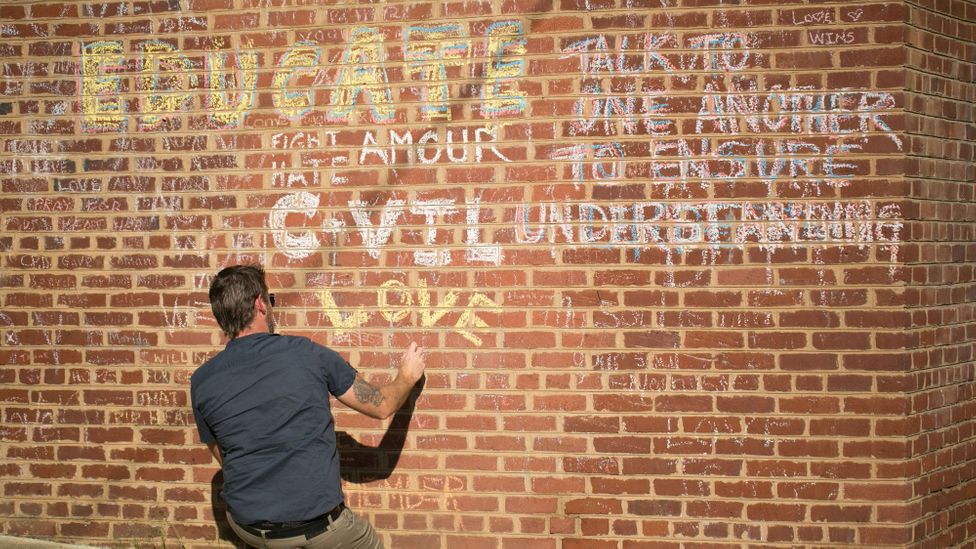
Messages on a wall calling for compassion after violence at the Unite the Right rally in 2017 (Credit: Getty Images)
While Brendan’s experience is outside the norm, it’s not without precedent. In the 1980s, for example, an acquaintance of early MDMA-assisted therapy practitioner Requa Greer administered the drug to a pilot who had grown up in a racist home and had inherited those views. The pilot had always accepted his bigoted way of thinking as being a normal, accurate reflection of the way things were. MDMA, however, “gave him a clear vision that unexamined racism was both wrong and mean,” Greer says.
Rare as they might be, stories such as these are worth examining for the implications they give about MDMA’s potential ability to “influence a person’s values and priorities”, as de Wit and several co-authors wrote in a case study they published about Brendan in 2021 in the journal Biological Psychiatry. If “extremist views [are] fueled by fear, anger and cognitive biases”, the researchers posed, “might these be targets of pharmacological intervention”?
Encouraging stories of seemingly spontaneous change appear to be exceptions to the norm, however, and from a neurological point of view, this makes sense. Research shows that oxytocin – one of the key hormones that MDMA triggers neurons to release – drives a “tend and defend” response across the animal kingdom. The same oxytocin that causes a mother bear to nurture her newborn, for example, also fuels her rage when she perceives a threat to her cub. In people, oxytocin likewise strengthens caregiving tendencies toward liked members of a person’s in-group and strangers perceived to belong to the same group, but it increases hostility toward individuals from disliked groups. In a 2010 study published in Science, for example, men who inhaled oxytocin were three times more likely to donate money to members of their team in an economic game, as well as more likely to harshly punish competing players for not donating enough. (Read more: “The surprising downsides of empathy.“)
The same oxytocin that causes a mother bear to nurture her newborn also fuels her rage when she perceives a threat to her cub
According to research published this week in Nature by Johns Hopkins University neuroscientist Gül Dölen, MDMA and other psychedelics – including psilocybin, LSD, ketamine and ibogaine – work therapeutically by reopening a critical period in the brain. Critical periods are finite windows of impressionability that typically occur in childhood, when our brains are more malleable and primed to learn new things. But Dölen and her colleagues’ findings likewise indicate that, without the proper set and setting, MDMA and other psychedelics probably do not reopen critical periods, which means they will not have a spontaneous, revelatory effect for ridding someone of bigoted beliefs.
Anecdotally, some members of the Taliban, for example, use MDMA to channel a connection to the divine during prayer chants, according to a drug activist based in Kabul who I interviewed for my book. In the West, plenty of members of right-wing authoritarian political movements, including neo-Nazi groups, also have track records of taking MDMA and other psychedelics. This suggests, researchers write, that psychedelics are nonspecific, “politically pluripotent” amplifiers of whatever is going on in somebody’s head, with no particular directional leaning “on the axes of conservatism-liberalism or authoritarianism-egalitarianism.”
That said, a growing body of scientific evidence indicates that the human capacity for compassion, kindness, empathy, gratitude, altruism, fairness, trust, and cooperation are core features of our natures. If MDMA, with proper preparation, can nudge us toward embracing this state of being, then the idea of using the drug as an aid to help make the world a more loving, less hateful place may be more than just a pipe dream. As Emory University primatologist Frans de Waal wrote, “Empathy is the one weapon in the human repertoire that can rid us of the curse of xenophobia.”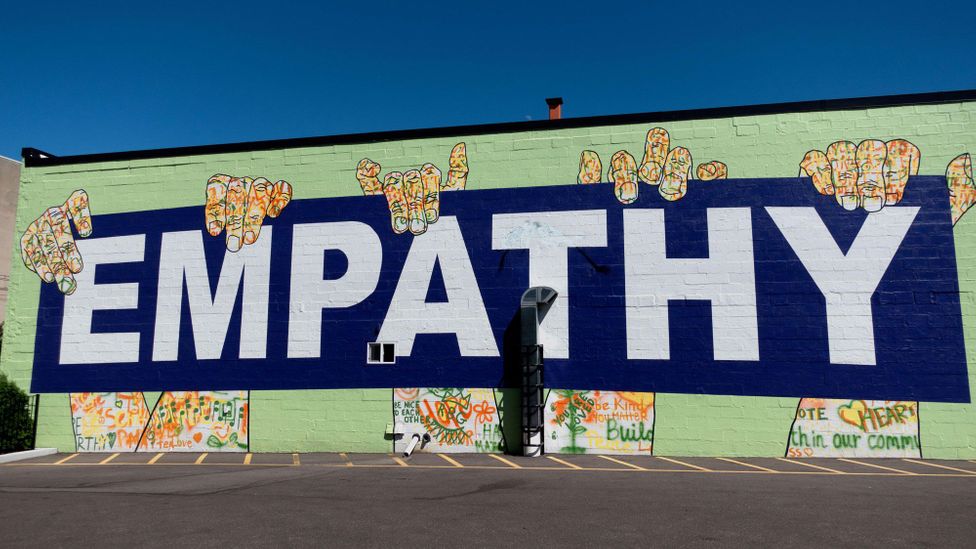
Could MDMA nudge some people to a greater sense of empathy and compassion for others? (Credit: Alamy)
Natalie Ginsberg, the global impact officer at the Multidisciplinary Association for Psychedelic Studies (Maps) – a non-profit group that has been spearheading research on MDMA – remembers standing next to the Washington Monument in DC at the Catharsis Festival right after the 2016 election, talking with Maps’s founder Rick Doblin at 1:00 or 2:00 in the morning about the possibility of using MDMA to facilitate a dialogue between Republicans and Democrats. Ginsberg also envisions using the drug in workshops aimed at eliminating racism, or as a means of bringing people together from opposite sides of shared cultural histories to help heal intergenerational trauma. “I think all psychedelics have a role to play, but I think MDMA has a particularly key role because you’re both expanded and present, heart-open and really able to listen in a new way,” Ginsberg says. “That’s something really powerful.”
“If you give MDMA to hard-core haters on each side of an issue, I don’t think it’ll do a lot of good,” Doblin adds. “But if you start with open-minded people on both sides, then I think it can work. You can improve communications and build empathy between groups, and help people be more capable of analysing the world from a more balanced perspective rather than from fear-based, anxiety-based distrust.”
In 2021, Ginsberg and Doblin were coauthors on a study investigating the possibility of using ayahuasca – a plant-based psychedelic – in group contexts to bridge divides between Palestinians and Israelis, with positive findings. They hope to undertake a similar study using MDMA in the future.
MDMA is not going to end war, bigotry, and polarisation any more than it will permanently transform anti-social octopuses into social butterflies. But there could be a role for it and other psychedelics to play to help people better see each other as fellow human beings. “I kind of have a fantasy that maybe as we get more reacquainted with psychedelics, there could be group-based experiences that build community resiliency and are intentionally oriented toward breaking down barriers between people, having people see things from other perspectives and detribalising our society,” says psychiatrist Franklin King at Massachusetts General Hospital and Harvard Medical School. “But that’s not going to happen on its own. It would have to be intentional, and – if it happens – it would probably take multiple generations.”
Based on his experience with extremism, Brendan agreed with expert takes that no drug, on its own, will spontaneously change the minds of white supremacists or end political conflict in the US. “A lot of these guys who end up in these movements have a history of doing MDMA,” he pointed out. But he does think that, with the right framing and mindset, MDMA could be useful for people who are already at least somewhat open to reconsidering their ideologies, just as it was for him. “It helped me see things in a different way that no amount of therapy or antiracist literature ever would have done,” he said. “I really think it was a breakthrough experience.”
*Rachel Nuwer is a freelance science journalist and the author of I Feel Love: MDMA and the Quest for Connection in a Fractured World, from which this article is adapted.
RECOMMENDED ARTICLES
- Are ‘addictive personalities’ real?
- How to hallucinate without drugs
- The drugs that transform your worldview
- America’s opioid addiction – explained
Is there such a thing as an addictive personality?
Share using EmailShare on TwitterShare on FacebookShare on Linkedin
(Image credit: Getty Images)

By Isabelle Gerretsen8th May 2023
The term “addictive personality” is widely used. Are some people really more prone to developing an addiction?
During the 1990s, the term “addictive personality” was used by some pharmaceutical companies – and, perhaps ironically, to promote addictive painkiller drugs.
While marketing the opioid prescription drug OxyContin, for example, US pharmaceutical company Purdue Pharma instructed their representatives to tell doctors that only people with an “addictive personality” were at risk of becoming addicted, despite knowing that it was highly addictive and widely abused. Highly addictive drugs such as OxyContin and the opioid fentanyl are blamed for fuelling the opioid crisis in the US, which caused more than half a million deaths between 1999 and 2020.
The idea that your personality determines whether or not you become addicted to a substance would have “suited the pharmaceutical industry very well”, says Ian Hamilton, associate professor in addiction at the University of York in the UK. “It kind of lets them off the hook. The message is: ‘if you’re weak enough to develop a problem with our product, it’s due to your personality, it’s nothing to do with us’.”
But is there such a thing as an addictive personality? Are some people really more prone to developing an addiction?
Many psychiatrists and addiction experts say there is no scientific evidence supporting the idea. They also warn that the concept is harmful as it suggests that people have little to no control over whether they become addicted.
They do note that there are some links between certain personality traits and addiction, but these are far more complex than the “addictive personality” claim often indicates.
Mark Griffiths, distinguished professor of behavioural addiction at Nottingham Trent University in the UK, describes the “addictive personality” as a “complete myth”.
“For there to be such a thing as an addictive personality, what you’re saying is that there’s a trait that is predictive of addiction and addiction alone,” says Griffiths. “There is no scientific evidence that there is a trait that predicts addiction and addiction alone.”
The addictive personality “is a black-and-white way of thinking about something that’s highly complex”, says Anshul Swami, a psychiatrist in adult mental health and addictions at Nightingale Hospital in London. “There is no one personality type [predictive of addiction] and there is no one person who is the same as another addict.”
https://emp.bbc.com/emp/SMPj/2.49.3/iframe.html
Fentanyl: The synthetic opioid devastating the US
That’s not to say that certain personality traits are not associated “with the acquisition, development and maintenance of addictive behaviours”, says Griffiths.
Neuroticism, for example, tends to be associated with many forms of addiction. Neuroticism is one of the Big Five personality traits and is defined as the extent to which a person reacts to perceived threats and stressful situations. Highly neurotic people are anxious and prone to negative thoughts. According to an analysis of 175 studies, substance abuse disorders are associated with high levels of neuroticism and low levels of conscientiousness (the extent to which a person exhibits self-control). Research has found that behavioural addictions, such as internet and exercise addiction and compulsive buying, are also associated with neuroticism.
“If you’re neurotic, you’re highly anxious,” says Griffiths. “People tend to use addictive behaviours or substances as a way to manage their neurotic traits. Most addictions are about coping and are symptomatic of other underlying problems, such as depression or neuroticism.”
There is no single trait that predicts addiction and addiction alone – Mark Griffiths
But there is no research showing that all people with addictions suffer from neuroticism, says Griffiths. “I can find many people who are neurotic and aren’t addicts. Neuroticism is associated with, but it is not predictive of, addiction.”
As Hamilton points out it can be “fiendishly difficult” to untangle which comes first when it comes to a substance dependency. “What you see is elevated rates of depression or anxiety among people who become dependent on drugs. But then it becomes chicken and egg. Was it neuroticism which led the person to the drug, or did their addiction to cocaine over a long period of time lower their mood?”
You might also like:
- Why some people’s pain is ignored
- The family secrets kept by generations
- How Germany treats parental burnout
“Addictions are very nuanced and multifactorial,” says Swami. Research shows that addictions can be influenced by both genetics and a wide range of environmental factors, including peer pressure, early exposure to substances and physical or sexual abuse.
A 2018 study found that the ancient retrovirus HK2, which lies close to the gene involved in the release of the chemical dopamine, is more frequently found in drug addicts. People suffering from substance abuse disorders were up to two to three times more likely to have HK2 integrated in their genome, indicating a strong association with addiction, the researchers concluded.
Swami says this study does not provide any evidence that some people have a more “addictive personality” than others.
“This HK2 preliminary finding does not explain why an increasing number of patients in later life develop addiction,” he says. “If they had it and it was associative or causative it would surely express sooner.”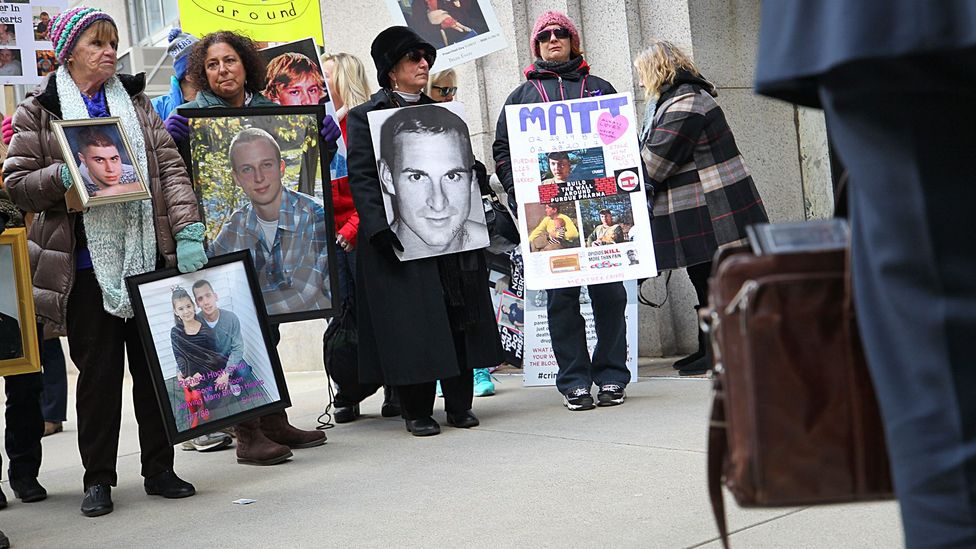
Highly addictive drugs such as OxyContin and the opioid fentanyl are blamed for fuelling the opioid crisis in the US (Credit: Getty Images)
Gender is another risk factor for addiction. In the US, 11.5% of men and boys have a substance abuse addiction compared to 6.4% of women and girls. There are several reasons, says Hamilton. “Men, particularly teenage boys, tend to be bigger on risk-taking and more impulsive,” he says. Impulsivity is another trait associated with addiction. But Hamilton warns that there may be significant data gaps as women are less likely to seek treatment due to childcare issues and stigma.
Research shows that a person’s environment and upbringing also strongly influences their risk for addiction. One study found that opiate users were 2.7 times more likely to have a history of childhood abuse, either sexual, physical or both, than non-opiate users. People who experienced four adverse childhood experiences, such as physical, sexual or emotional abuse or loss of a parent, were three times as likely to report having alcohol problems in adulthood, according to a 2022 study.
“Psychosocial factors like violence, sexual abuse and emotional neglect are strongly associated with addiction,” says Swami. “Many people will say ‘I’ve got a history of addiction, it’s because of my genetics’. But when you drill down in their clinical history, you find that there was a lot of drinking, neglect, abuse, trauma and deprivation. That has been passed down from generation to generation and has surfaced as an addiction.”
Despite the lack of scientific evidence to support it, the term “addictive personality” continues to be widely used. “We’ve got to be careful with language as people do internalise it,” says Hamilton. “The idea of the addictive personality robs you of any hope… it says that this is the trajectory you have to go down and that you have no control over it.
Swami agrees that the concept is unrealistically “fatalistic”. “It stops people from taking responsibility and ownership of their problem and finding constructive solutions to getting better,” he says.
Griffiths says many people with addictions will use the idea of the addictive personality as a “justification for their behaviour”. “When someone says ‘I’ve got an addictive personality’, what they’re actually saying is ‘I can never be cured’,” he says.
“Addictions are highly complex biological, psychological, social illnesses, just like every other illness on the planet,” says Swami. “Everyone is looking for a simple answer, but there isn’t one.”
BBC Future attempted to get comment from Purdue Pharma, but the company has been restructured after bankruptcy proceedings.
The life-changing effects of hallucinations
Share using EmailShare on TwitterShare on FacebookShare on Linkedin
(Image credit: Emmanuel Lafont/BBC)
By William Park6th October 2022
Illusions brought on by drugs, lights and disease are giving us new insights into the inner workings of our brains. William Park ventured into his own induced hallucination to find out more.
The Huichol tribe from the Sierra Madre Occidental mountains in Mexico can speak to spirits. They leave our Earthly plane to visit animals and ancestors with the assistance of a small, green cactus.
The cactus, called peyote, is cut into discs and chewed raw to release a hallucinogen. A peyote trip starts with a “growing sense of euphoria”, followed by a heightened sense of the noises around, before the tipper is plunged into a world of vivid dreams – at least that is how anthropologist Barbara Myerhoff described her experience after taking peyote with members of a Huichol tribe in western Mexico in her book Peyote Hunt.
Peyote contains mescaline – a psychedelic compound that can produce hallucinations similar to the effects of taking magic mushrooms. The discs taste “unspeakably bitter-sour” and “revolting” explains Myerhoff, but she adds that she lost her awareness of time, and instead started to skip from one vivid, self-contained dream to another. “Although I discovered that I couldn’t move, I was able to remain calm when it occurred to me that this was of no consequence because there was no other place that I wanted to be,” she writes, noting that she found the experience not in the least scary, but deeply moving.
Psychedelics have been used in religious ceremonies, before war and for recreation in the Americas for centuries. For example, ayahuasca, a hallucinogenic drink made from certain brewed vines or shrubs, has been consumed by indigenous peoples in South America during religious and healing rituals for perhaps as long as 1,000 years. The Olmecs – one of the earliest Mesoamerican civilisations – and Maya people from Mexico are also thought to have used the neurotoxin from cane toads to hallucinate in their rituals. They believed they could speak to ancestors after taking a very small dose of dried toxin (too much would be fatal).
Why were these psychedelics used in rituals? Possibly because they elicit in the user a sense of awe and wonder. Medium to high doses of similar hallucinogens generate lasting feelings of bliss and insightfulness and a sense of profound spiritual enlightenment.
In the 1950s and 60s, there was a great deal of interest in psychedelics as a treatment for disorders from depression and alcohol addiction to schizophrenia. The US even ran experiments under the names Project MKUltra and Project MKDELTA to see if LSD could be used as a truth drug. While research into the therapeutic benefits of hallucinogens was largely paused after LSD was criminalised in the late 60s, there has recently been a renewal of interest in using hallucinogens such as ketamine and LSD as therapeutic treatments, with a spate of new studies.
Peyote is still eaten for its hallucinogenic properties (Credit: Emmanuel Lafont/BBC)
But ingesting substances is not the only pathway to experiencing hallucinations. Visual auras are a form of visual hallucination that typically accompany migraines. Fevers can also trigger hallucinations – they are a commonly reported symptom in malaria, for example, and were also reported by some patients during the Covid-19 pandemic. Certain illnesses like dementia, schizophrenia and some eye diseases can also cause hallucinations – sometimes called altered visual experiences – says Prem Subramanian, a professor of ophthalmology at the University of Colorado. Musical hallucinations have also been reported in association with hearing loss in some people. Grief too has been linked with hallucinations, with people reportedly hearing and even seeing a deceased partner.
But it’s also possible for people to hallucinate if exposed to certain bright or flickering lights.
Exactly why we see these illusions is something of a puzzle, but we are now starting to unravel what happens in the mind during visions by comparing drug-, stimulus- and disease-induced hallucinations.
For example, the brilliance of snow might explain why some explorers and mountaineers claim to see strange figures following them during whiteouts. Sir Ernest Shackleton mentioned the sensation in his 1919 Antarctic expedition diary, South, saying that “during that long and racking march of 36 hours over the unnamed mountains and glaciers of South Georgia, it seemed to me often that we were four, not three”.
One explanation for this particular illusion could be the Ganzfeld effect. If exposed to a continuous, uniform stimulus (for example, staring at a single wavelength of light) our brains try to make sense of the signal, and add in information which isn’t there – generating hallucinations. You can see some of the BBC Reel team trying out the effect for themselves.
The Dreamachine
Because light-induced illusions can be created in controlled environments, they might help researchers to discover the origin of hallucinations. The fact that flickering lights on closed eyes causes visions of colours, shapes and movement is “one of the oldest findings in neuroscience”, says Anil Seth, a professor of neuroscience at the University of Sussex, and the lead scientist on the immersive art-and-science project Dreamachine.
The fact that flickering lights on closed eyes causes visions of colours, shapes and movement is one of the oldest findings in neuroscience
Created as a tool to capture the diversity of the public’s inner minds by using strobing lights to induce hallucinations, the Dreamachine has been touring the UK during 2022. It is based on a little-known invention from 1959 by the same name. With the promise of being able to experience psychedelic hallucinations without drugs, I ventured in.
The machine itself is a two-storey high, blue, octagonal box. About 20 participants are led through a curtain and into a circular central room. Around the edge of the room are curved seats that recline back so that the participants can stare upwards towards the ceiling. In the centre of the ceiling is a flat, white disc that gives off a gentle glow, around which there is a ring of large lights – the kind you might see in a theatre.
I lie back in the seat. The experience begins with some slow electronic music coming from the speakers behind me. The lights fade up and I’m surprised by just how bright they are. I’m squeezing my eyes shut but it’s still a little bit unpleasant. Through my eyelids, the bright white light looks pinky orange. Then the lights start to strobe.
The pinky orange alternates with flashes of blue, which is the result of “bleaching desensitisation“. If you’ve ever accidentally looked at a bright light for too long and noticed smudgy blotches in your vision for a period afterwards it’s the same effect. The light receptors in your retina are over stimulated and take a short while to recover.
In the Dreamachine, the orange and blue colours start to overlap, and after a few minutes I notice that I’m seeing stripes and criss-cross patterns. These kinds of effects, caused by strobe lighting, are called flicker phosphenes, and are visually similar to the simple hallucinations that drugs can induce. These simple geometric patterns probably originate in the primary visual cortex.
Light-induced hallucinations produced by the Dreamachine range from simple geometric patterns to more complex landscapes and shapes (Credit: Emmanuel Lafont/BBC)
Seth says that the frequency of the strobing determines the strength of the hallucination by syncing with the frequency of brainwaves in this region of the brain. “The most effective frequencies of the strobe lights are at around 10-15 Hz. [This] frequency range is similar to the alpha rhythm in the brain, which is very prominent over the visual cortex,” he says. Other research suggests that the frequency might also determine the shapes seen. At 20–30 Hz, some people report spirals, waves, concentric circles, and lines, while at 10 Hz, zigzags, honeycombs, and rectangles.
“There’s a lot of disagreement about what the alpha rhythm does,” adds Seth. “It becomes more prominent when you close your eyes and when you’re relaxed. Some [neuroscientists] say it’s just an idling state of the brain when it’s doing nothing. Others argue that it’s very deeply involved in how we perceive the world – that each cycle of an alpha rhythm, each 100-millisecond period, is a frame of visual perception.”
Nobody exactly knows quite how the Dreamachine works, we just know that it does – Anil Seth
As the music changes, the stripes I can see become waves. I start to see little white spots, like a universe of stars, swirling behind the coloured waves. Then the music changes and the colours follow. The scene now looks like a desert landscape – beiges and browns stretching off into the distance – except with dark tower blocks on the horizon which I am flying towards. I have no idea if the frequency of the strobing has changed, but the shapes I can see are continually in flux.
“Nobody exactly knows quite how the Dreamachine works, we just know that it does,” says Seth. He speculates that it might be because the brain is not expecting any visual input – the eyes are closed – yet is getting some information because the light is so bright. “It’s trying to make sense of that visual input, but it can’t make much sense of it.”
“One of the most interesting focus groups was with visually impaired people – not totally retinally blind but people with severe visual issues – it was a really, profoundly moving experience,” he says. “They seem to report similar things to what we’re seeing in the general public. And that, for me, is pretty fascinating.”
Like in a dream, I have a sense that time is moving forwards, but I have no idea how long the machine has been running or how long is left. At one point I notice that I’m barely paying attention to what I’m seeing anymore and I wonder if I had briefly fallen asleep. But I snap back into the moment.
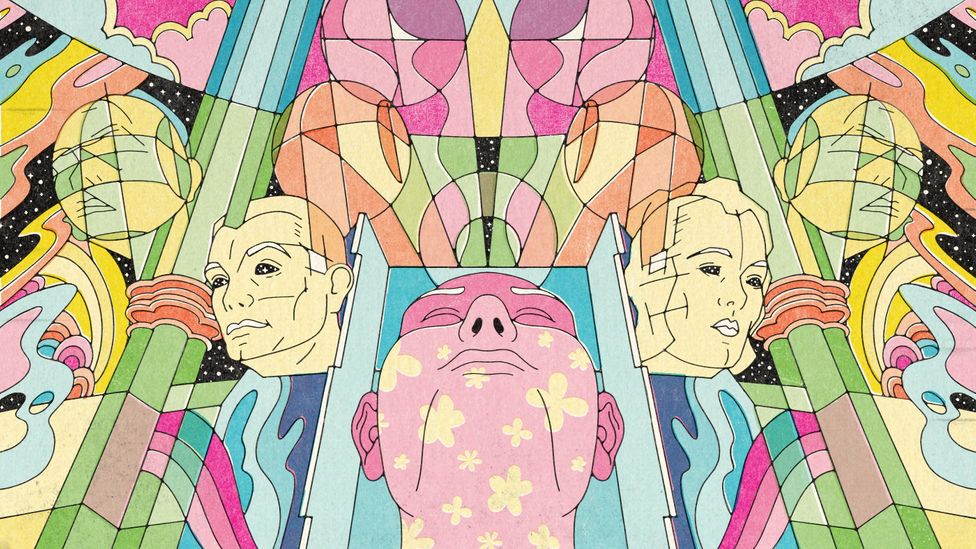
The desert has now been replaced by multicoloured geometric shapes, like a simple kaleidoscope or an abstract, tessellated stained glass window. There are bright lime greens, yellows, blues and reds. The shapes move towards me, as though the window is breaking apart. I am reminded of the guide at the start who explained that all the colours I can see are generated by my brain. It’s the most compelling part of the experience yet, and when the scene changes to something else I miss the colourfulness of the stained glass.
Why the brain creates colours, shapes and patterns in the Dreamachine is still not clear – but that is what Seth and his colleagues are trying to work out. He says that the patterns people see are very related to aspects of the wiring of the primary visual cortex. “It’s almost as if the strobe light is activating these visual regions.”
Colour vision is a fascinatingly subjective experience. The viral #thedress photo from 2015 that divided the internet is a case in point, says Seth. So, the age-old question of whether you and I see the same colours has a simple answer – we don’t. In fact, our own perception of colours continually changes.
In summer, the colour yellow shifts slightly towards green, and in winter it shifts towards red, for example. This might be because during the summer we see more green light reflected from vegetation. We compensate for the extra green we are seeing, which means that a greenish yellow looks more like pure yellow in the summer, explains Lauren Welbourne, a psychologist at the University of York in the UK.
“This idea of having different experiences of the shared environment isn’t just confined to the Dreamachine, it’s happening everywhere and all the time,” says Seth, who is also the author of Being You: A New Science of Consciousness. “We all have a unique perceptual experience, a unique inner universe. Very little is known about this kind of inner diversity.”
Exploring that inner diversity is part of Seth’s next project. He and a team of scientists and philosophers are collecting a snapshot of the public’s uniqueness in a perception census, designed to bring out the variety of the public’s subjective experiences with a few simple questions.
Back in the Dreamachine, the music and lights fade away, and the guides tell us the experience is over. I compared my experiences with another participant, and while there were similarities – a sense of 3D space, swirling stars and galaxies, and geometric shapes – it’s also clear that our journeys through our minds were quite different. It’s this inner uniqueness that Seth and his colleagues hope to capture in their census.
A complex picture
While the simple colours and patterns I saw were interesting, they pale in comparison to the vivid testimonies of people who have drug-induced or medical hallucinations. Why might those visions be so much more complex?
Ayahuasca and cane toad toxin contain the neurotransmitter DMT, which is closely related to serotonin, melatonin, and psilocybin – the latter of which is the chemical that gives magic mushrooms their hallucinogenic properties. Serotonin and melanin have a role in controlling sleep, while serotonin is also responsible for feelings of hunger, our mood and for feeling rewarded.
The hallucinations produced by drugs are often more complex and can leave the tripper with profound feelings (Credit: Emmanuel Lafont/BBC)
The links between serotonin and substances like DMT and psilocybin might go some way to explain how these psychedelics work. DMT, psilocybin and the lab-made hallucinogen LSD all activate serotonin receptors in our brains. Activation of these serotonin receptors by hallucinogenic drugs appears to be one cause of complex visual hallucinations, and some of the trippier effects of psychedelics.
In one study, participants were given controlled doses of LSD and another chemical called ketanserin, which blocks serotonin receptors, to see what role these receptors have in psychedelic trips. With the receptor unblocked, participants found that previously meaningless music became meaningful and profound after taking LSD. Blocking the receptor with ketanserin prevented these meaningful feelings.
It might explain why psychedelic trips are often accompanied by profound feelings, suggests Katrin Preller, assistant professor at the University of Zurich, who is the lead author of the paper. In a later study, Preller found that LSD leads to an increase in the connectivity of the brain networks associated with our senses, which could explain why our senses become heightened.
Drug-induced hallucinations tend to range from brightly colored geometric shapes like lattices, cobwebs, tunnels, and spirals to scenes or landscapes which can contain people, animals, spirits, aliens and monsters. There are similarities between the former types of hallucinations and the aura that migraine sufferers will be familiar with.
“Hallucinations that come from the primary visual cortex are more unformed,” says Subramanian. “They are going to be sparkles, lights and shapes.” Migraine auras are a common medical example of this, he adds, and much less frequently he sees brain tumour patients with similar symptoms.
But complex hallucinations can be bizarre and frightening, containing scary images of faces, people or objects. While sometimes drug-induced, these hallucinations can also be a symptom of several diseases, from schizophrenia to dementia.
One of the more curious examples of disease-related hallucinations is Charles Bonnet syndrome, which is the result of eyesight loss. Damage to the retina, or anything that can reduce light passing through the eye, like a cataract, can cause patients to see hallucinations, which can range from geometrical patterns to disembodied faces and costumed figures. It is not known how vision loss causes these hallucinations, but it is thought that as the eyesight deteriorates the brain starts to compensate for the missing information and spontaneously creates made up images.
Charles Bonnet syndrome is sometimes called “phantom vision” and has been compared to phantom limb syndrome, where amputees believe they still have their missing limb.
Certain medical conditions can produce visual hallucinations, but the reasons why are poorly understood (Credit: Emmanuel Lafont/BBC)
Another visual oddity is palinopsia, where people see the same image frozen for a brief period of time. For example, if you stare at a chair on one side of the room, and then looked over to the other side, it might appear that the chair has teleported across the floor. This is caused by delays in the retina refresh rate. The photopigments in our retinas take a fraction of a second to refresh after being stimulated. Usually this happens very quickly – it’s why movies shot at 30 frames per second look like seamless movement. But in palinopsia patients, the refresh rate slows significantly, meaning images can get stuck in the vision.
Unlike induced hallucinations – which require an external stimulus like a drug or light – Charles Bonnet syndrome and palinopsia are examples of released hallucinations that happen spontaneously. Subramanian says that errors in the normal process by which vision is regulated can create visions.
“Even patients with what we might think of as mild to moderate visual impairment can have these release hallucinations,” he says. “There are a good number of patients who have glaucoma or macular degeneration, who experienced visual hallucinations, but they don’t want to tell anyone about it, because then they think they’re crazy. And so it’s very important that doctors who take care of those patients be alert to the fact that it’s relatively common for them to experience these hallucinations.”
Subramanian urges anyone experiencing hallucinations that are outside of the ordinary not to ignore them and to seek medical advice to make sure there’s nothing abnormal.
There were no lasting effects of my time in the Dreamachine. Unless there is a reason why flashing lights might cause you problems, light-induced hallucinations can be a revealing and interesting experience.
Understanding why each of our experiences in the Dreamachine will be slightly different might remain out of reach for now, but perhaps Seth and his colleagues will get us a little closer to knowing the full range of our inner experiences.
* William Park is a senior journalist for BBC Future and tweets at @williamhpark
The worldview-changing drugs poised to go mainstream
Share using EmailShare on TwitterShare on FacebookShare on Linkedin
(Image credit: Getty Images)

By Ed Prideaux6th September 2021
The growing legitimacy of psychedelics as therapies promises to transform how we view the extraordinary, writes Ed Prideaux.
It was 1971 when Rick Doblin first took LSD. A Saturday afternoon in Florida, a few weeks into his freshman year. Four years had passed since the Summer of Love – when millions of young people descended on San Francisco, London and beyond in a haze of music and drugs – but the psychedelics still flowed through campus.
LSD, or Lysergic Acid Diethylamide-25, is a chemical trickster. Mimicking the morphology of serotonin, it locks in the synapses of the brain’s 5-HT2A receptors to trigger a manifest wave in cognition: extraordinary ruptures in vision, patterns of thought, belief, and emotion.
Within an hour, the trickster’s games make themselves known. A sense of strangeness hard to put in words descends. Shapes and kaleidoscopes may appear and dance in synchrony. Synaesthetic connections – when you can hear or taste colours – could emerge. Depending on one’s dose, by the drug’s peak you may be thrown into an entirely altered dimension: a weird place filled with entities, snakes, designs behind-the-eyes, DNA strands, and a radically enhanced appreciation for art and aesthetics. Or something far darker.
Doblin’s world hummed, throbbed, droned. After floating through the campus dining hall, he made his way back to a private dorm for an inward-facing trip. Glancing at his friend – also surging on LSD – Doblin was struck by a fresh vision. Not merely deducing his co-pilot’s thoughts and emotions, Doblin could see them plain as day. His friend’s comfort, benefaction, warmth, were visible like arms and legs.
Transformative experiences aren’t like most experiences, even our most dramatic ones
Doblin wished he could feel so free. He was decomposing. In his own LSD rotoscope, Doblin had become a boy again – no longer the man – and the imbalance of emotion and intellect that drove his life in the everyday were sensible. Yet he was this way for a reason, Doblin realised. And this meant it wasn’t set in stone. He could change things. He could be free.
For the philosopher LA Paul, what Doblin experienced can be described as a “transformative experience”. These aren’t like most experiences, even our most dramatic ones. What makes them distinct is how they change a person: their preferences, ideas and identities are turned upside-down. When Doblin entered his first trip, he perhaps hadn’t realised that the next day he would not be the same.
Afterwards, Doblin knew he was on to something. He’d take more trips – many of which were destabilising – but the essential promise was clear. Evangelising the therapeutic potential of psychedelic drugs became his life’s mission.
After taking psychedelics in the 1970s, many people like Rick Doblin felt changed (Credit: Getty Images)
Doblin is today the founder and executive of a non-profit organisation called the Multidisciplinary Association for Psychedelic Studies (Maps), which aims to bring psychedelic drugs closer to mainstream use in medicine and beyond. It advises scientists how to conduct trials and win funding, as well as working closely with regulators.
Now the efforts of Doblin and others are finally paying off. In the last 10 years, psychedelic drugs like LSD, magic mushrooms, DMT, a host of “plant medicines” – including ayahuasca, iboga, salvia, peyote – and related compounds like MDMA and ketamine have begun to lose much of their 1960s-driven stigma. Promising clinical trials suggest that psychedelics may prove game-changing treatments for depression, PTSD and addiction. The response from the psychiatric community, far from dismissive or even sceptical, has been largely open-armed. The drugs may well mark the field’s first paradigm shift since SSRIs in the 1980s.
The “psychedelic renaissance” promises to change far more about our societies than simply the medical treatments that doctors prescribe
In 2017, for example, the US Food and Drug Administration designated MDMA a “breakthrough therapy“, which meant it would be fast-tracked through to the second stage of Phase-3 trials. Doblin, whose organisation was instrumental in achieving the designation, hopes it will achieve FDA approval by 2023.
Psychedelics remain Schedule-1 drugs federally in the US and Class-A in the UK, but rules are relaxing. Along with Austria and Spain in the EU, psilocybin mushrooms have been decriminalised in Washington DC and a host of other US cities, and legalised for therapy in Oregon, where LSD has also been decriminalised. A California bill to decriminalise LSD and psilocybin passed several crucial committee stages and will be decided next year. A vote to federally sponsor psychedelic research recently made its way to Congress.
In anticipation of this shift, psychedelic drug developers and clinical providers are attracting significant investment. Business reports describe “psychedelic euphoria” and a “Shroom Boom“.
This phenomenon is known as the “psychedelic renaissance” – and it promises to change far more about our societies than simply the medical treatments that doctors prescribe. Unlike other drugs, psychedelics can radically alter the way people see the world. They also bring mystical and hallucinatory experiences that are at the edge of current scientific understanding. So, what might follow if psychedelics become mainstream?
You may also like:
- Are digital drugs the future of medication?
- The unexpected magic of mushrooms
- The medications that change who we are
This wave of psychedelic enthusiasm in psychiatry isn’t the first. They were originally heralded as wonder drugs in the 1950s.
Across some 6,000 studies on over 40,000 patients, psychedelics were tried as experimental treatments for an extraordinary range of conditions: alcoholism, depression, schizophrenia, criminal recidivism, childhood autism. Participants included artists, writers, creatives, engineers and scientists. And the results were promising. From as little as a single LSD session, studies suggested that the drug relieved problem drinking for 59% of alcoholic participants. Experimenting with lower, so-called “psycholytic” doses, many therapists were amazed by LSD’s power as an adjunct to talking therapy.
For many years, psychedelics were difficult to study in scientific trials (Credit: Getty Images)
It wouldn’t last. By October 1966, LSD was banned in California, with federal restrictions to follow in 1970 under the Controlled Substances Act. Several alarming myths made their ways into government campaigns: claims of LSD-induced chromosome damage, mutant babies, that tallying five, six (or seven) trips made you “legally insane”, were propagated to school kids just like Doblin (although he’d only shirk the warnings in time).
This affected science, too. Apart from a handful of remnant groups in Canada and the US, the entire field of psychedelic science would dry up for decades. Regulators restricted access. Funders lost appetite. At the height of the crackdown from the 1970s to the 1980s, Doblin’s attempts to launch psychedelic research led to closed doors and real difficulty securing jobs.
Conventional narrative traces the crackdown to the career of Timothy Leary, a Harvard scientist who became the counterculture’s biggest proponent of LSD in the mid-to-late 1960s. A scandal at his Harvard Psilocybin Project in 1963 – in which his co-director was accused of dishing out psilocybin to undergraduates – would mark the first shots of a more sensationalist reaction in the media. Soon after, regulators would grow distressed by LSD’s black market currency “outside the lab”, which Leary’s post-Harvard advocacy – including claims that LSD could give women “thousands of orgasms” and excite revolution against the establishment – did much to furnish.
That’s not the whole story, though. Some medical historians pin the blame for the backlash on the rise of the Randomised Controlled Trial (RCT) methodology. This is now the standard way to run clinical trials, and its introduction raised questions about just how scientific “psychedelic science” really was among regulators. RCTs involve comparing two groups of people: one which has taken a drug, and another which has not. The participants aren’t meant to know which group they are in, but that’s difficult with psychedelic substances.
The Good Friday Experiment of 1962 – a session held in a church with seminary students to test psilocybin’s capacity for inducing mystical experiences – provides an illustrative example. One half of the subjects were given the active drug, the other a placebo (and all double-blinded), yet within 30 minutes it was plainly obvious who’d got which. Those dosed wandered around the grounds in a daze envisioning God, one of the participants told me – while the placebo group (including him) just “twiddled their thumbs and read the hymnal”.
Psychedelics can change a person: their preferences, ideas and identities (Credit: Getty Images)
Between the 1980s and mid-2000s, flares of change amid the crackdown were seen. But the recent psychedelic renaissance has blown the doors off. It began with a landmark study in 2006 at Johns Hopkins University, headed by Roland Griffiths: a scientist who’d made his name studying caffeine. Griffiths and his co-authors attempted a replication of the Good Friday Experiment of more 40 years before. The results were striking.
“It is remarkable”, Griffiths wrote, “that 67% of the volunteers rated the experience with psilocybin to be either the single most meaningful experience of his or her life or among the top five most meaningful experiences of his or her life.” In other words, rivalling the profundity of marriage, childbirth, career highs, and other deep rites of passage.
While the challenges of conducting robust clinical trials have not gone away, regulators are now more open to psychedelic trial results than they once were.
The shifts in the cultural value and meaning of psychedelics in the last decade have been remarkable
Meanwhile, private clinics are beginning to open around the world. Awakn, a clinic in Bristol, offers infusions of ketamine as a treatment for depression, PTSD, eating disorders and addiction: while not classically psychedelic like LSD, high doses of ketamine can trigger powerful visionary experiences with therapeutic potential.
As the anthropologists Tehseen Noorani and Joanna Steinhardt write, “there are still limits to the enthusiasm for psychedelic healing. Still, the shifts in the cultural value and meaning of psychedelics in the last decade have been remarkable”.
If current trends continue, it may be a matter of time until psychedelic-assisted psychotherapy is green-lighted by regulators. In a decade’s time, might clinics and hospitals feature Psychedelic Session Rooms kitted out with cushions, incense, candles and paintings? Will doctors prescribe pills of psilocybin or LSD, manufactured by big pharma, with side effects including “ecstasy”, “changes in metaphysical beliefs”, and “acute panic”? Could we see the high-street version of psychedelic clinics – perhaps with names like “Pala”, “Indigo” or “Oasis”?
It’s difficult to know how it will play out, but if therapeutic psychedelics become more common, it may be only the start of a significant transformation in cultural and scientific attitudes.
Psychedelic culture
The psychedelic renaissance in medicine has been running parallel to a broader mainstreaming across culture, which the drugs haven’t experienced since the early 1960s. In Europe and North America, recreational use is rising – with use of LSD rising by 50% from 2015 to 2018 in the US – psychedelic-themed media are getting popular, influencers and celebrities are emerging as users, and the drugs are de-stigmatising in a way that their pioneers could likely never have foreseen.
Some have suggested calling the drugs “ecodelics” due to their propensity to connect a person to nature (Credit: Getty Images)
This mainstreaming has changed who is having psychedelic experiences, says Erik Davis, a writer and long-standing psychedelic commentator. Psychedelics in the 20th Century were confined to underground groups: hippies, hackers, Silicon Valley, spiritual communities, rave culture, environmentalists. Nowadays, though, appetite is coming from unexpected groups: wellness communities, hip hop culture, the political right, cryptocurrency enthusiasts, Wall Street traders, financiers, and everyday people looking to remedy their mental health.
It’s possible that we’ll soon see the effects appear in broader culture, just as we did in the music, writing, art and politics of the 1960s and 1970s. Yet it’s unlikely that any psychedelicised culture will look the same – nor feel the same to psychedelic users – because the world we live in now is so different.
To understand why, it helps to draw on a concept proposed by the social scientist Ido Hartogsohn, called the “collective set and setting”. One part of a drug experience depends on immediate individual factors – personal mindset, local environment, or the presence of others. But broader social forces make an impact too: the zeitgeist, media headlines, bigger cultural conversations. The 1960s had an entirely different “collective set and setting” compared with today. People didn’t just live differently, they tripped differently, too.
How might a major societal shift like, say, climate change feed into people’s experiences?
Consider all the different influences of the present day. Technology and artificial intelligence. Political conflict. A broader sense that society is heading in “the wrong direction”. The surveillance state. Off-the-record, one scientist I interviewed has already observed an emerging trend of “apocalyptic” trips, and not least during the broader pressures of Covid-19. “Messianic” trips are emerging in parallel: experiences in which one glimpses their own personal salvific role in effecting systems change.
How might climate change feed into people’s experiences? It depends on the individual, but when consumed in the right context, the drugs can significantly enhance one’s connection to nature. One of the most famous examples in this vein is the co-founder of Extinction Rebellion, Gail Bradbrook, who was inspired to start the movement by an experience on iboga.
For this reason, one social scientist has proposed calling them “ecodelics”. Another researcher interviewed for Vice magazine raised the idea of bringing pro-environmental cues to psychedelic sessions – the idea being to leverage the mind’s pivotality to increase nature-relatedness, and even dampen climate change scepticism.
Mystical experience
Under the surface, a still-more radical effect is appearing. In clinical trials and recreational use alike, psychedelics often produce states of “mystical experience” or “ego dissolution”: a peak consciousness characterised by bliss and goodwill, interconnection, a sense of the “sacred”, a possible “loss of self”, or even encounters with spiritual entities and God(s). What happens if more people start having them? And how might we understand their nature better than we currently do?
For researchers, the mystical experience is core to how the drugs produce such impressive results. It’s seen all the time in papers and reports. The greater the mystical experience, studies suggest, the greater the derived therapeutic benefit. Questionnaires to measure, track, and better-understand the mystical experience are proliferating.
Some believe that science alone is not equipped to help society understand the effects of psychedelics (Credit: Getty Images)
But science and psychiatry have cast suspicions on the mystical experience for centuries. “Even at the optics level, it’s a horrible name,” says Matt Johnson, a psychedelic scientist at John Hopkins University, “because ‘mystical’ sounds like you have a crystal ball and you’re casting a spell. For some people, it draws up a connotation of the medieval.”
This means that despite the role of spiritual experience in the cultural fabric – underpinning epiphanies of science, art, and religion for millennia – they have been chronically under-studied. People are reluctant to share their stories for risk of stigma, pathology, or diagnosis. Losing one’s sense of self, for example, may be diagnosed as “depersonalisation”, and a transformative shift to spiritual beliefs may be interpreted as the florid outpourings of a mental breakdown.
Outside psychedelic usage, more people have had mystical experiences than you might think. From 1962 to 2009 – the last year of available data – the number of Americans who reported a lifetime mystical experience more than doubled to half the population.
With this in mind, researchers may need to get better at understanding how they work and what they entail. For example, the notion that there is a single defined mystical experience at all has come under question. It’s not obvious how its core traits – the boundless, sacred, timeless, blissful – piece together. “There’s a good chance those are going to occur together, but just because something occurs together doesn’t mean it’s part of the same thing,” says Johnson.
As the author Jules Evans points out in The Art of Losing Control, the unitive character of the clinical mystical experience – that sense of losingone’s ego and becoming “one with everything” – also leaves out half the picture. A third of DMT smokers, 17% of LSD takers, and 12% of psilocybin users report encountering external entities. In neoshamanic rituals with ayahuasca, daime and iboga, these entities are anchors of the peak experience.
He received a clutch of octopus eggs that were laid inside his head. He interpreted this as an auspicious occasion
One subject in a study on ayahuasca, for example, describes a prototypical meeting: “He received a clutch of octopus eggs that were laid inside his head. He interpreted this as an auspicious occasion, and wrote that he believed the eggs symbolised a source of wisdom. He recognised the octopus as a benign ally right away.”
Psychedelics are often defined by the hallucinations they evoke (or, more accurately, pseudohallucinations), too. These hallucinations drove clinicians in the first wave of the 1950s to deem LSD a “psychotomimetic”, or psychosis-mimicking drug: a move that makes sense, as with its tendencies for casting extraordinary visions and hearing voices.
What might the future hold for psychedelics? (Credit: Getty Images)
If hallucinatory experiences were to be mainstreamed, not just de-stigmatised, this could mark a radical shift, says Davis, since they are more often associated with pathological conditions such as schizophrenia. He suggests it would be the culmination of the modern “neurodiversity” movement, which recognises conditions like autism or hearing voices as differences on a spectrum, and not discrete problems to be solved.
For Davis, understanding the extraordinary experiences of psychedelics shouldn’t – and can’t – be the sole domain of science. Some have suggested that literature and poetry may be a useful adjunct to scientific questionnaires. Others have called for theologians to join the table, too. After all, without a broader approach, he warns that some may undergo strange experiences that resist any “model” – and which could worsen their mental health more than enhancing it.
Coming down
Psychedelics offer something that few other things can: an experience well beyond what our everyday reality could conceive or expect. How the mainstream will handle its trip isn’t clear. Therapeutic mainstreaming may put big issues on the table, but one wonders whether the medical establishment can handle them alone. “The interest in industry, especially for clinicians in medicalisation, is to downplay all of that. What they want is a soothing, healing, restorative situation,” says Davis.
But the mystical, hallucinogenic and transformative experiences coupled with these drugs are likely to change far more than that for many. “Psychedelics are like philosophical probes,” Davis explains. “Even if you’re not a philosophical person, you have to suddenly deal with [things] the next day. ‘Well, what the hell was that? What do I make of that? Was I given a glimpse of true reality when I got the message to stop drinking alcohol? Am I going to take that seriously? Does that make me crazy?'”
For Rick Doblin – still in the echoes of that first transformative trip – the possibilities of psychedelics are far-reaching, and go beyond the clinical setting. With his organisation Maps, he wants to “legitimise psychedelics not just for patients but for all of us who are struggling with a world on fire… to try to make it so we don’t destroy the place. The tactic, you could say, is [to] medicalise it. But that’s not the end goal.”
(Contributed by Gwyllm Llwydd)