
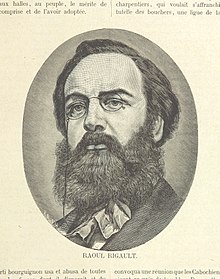
Raoul Rigault Drawing, by H.D. Justesse

If there was one issue over which the people of Paris instinctively and almost unanimously sympathized with Rigault, “this was his violent anticlericalism,” according to the historian, Alistair Horne.[9] As chief of police, he searched and investigated churches for evidence of sympathy with Versailles (as with most forms of Revolution in Western Europe, this evidence meant any hidden arms). The arrest of Archbishop Darboy was done at the hand of Rigault. The following famous dialogue took place between a Jesuit and Rigault…
Rigualt: What is your profession?
Priest: Servant of God.
Rigault: Where does your master live?
Priest: Everywhere.
Rigault (to Clerk): Take this down: X, describing himself servant of one called God, a vagrant.[10]
One historian of the Paris Commune wrote that, “Atheism was a cardinal tenet of Blanqui’s faith, and his disciple Rigault was an adept at priest-baiting.”[11]
Death

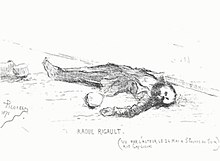
Execution of Raoul Rigault, drawing by Georges Pilotell
After the Paris Commune, he was “simply executed with a bullet in the skull, on the street of Gay-Lussac on Wednesday, May 24, 1871.”[12] According to a more detailed account, Rigault had worn his National Guard uniform that day, in order to shame those who refused to keep up the fight. In this outfit, he was instantly picked up. At gunpoint by a Versailles officer, he was ordered to shout, “Long Live Versailles!” He responded, “You are assassins! Long live the Commune!” and was immediately shot.[13]