

Glad to have you here! I write on Science, Philosophy, Psychology, and Society. Welcome!
Aug 17, 2022 (medium.com)
An analysis of Dostoyevsky’s thoughts to make you think
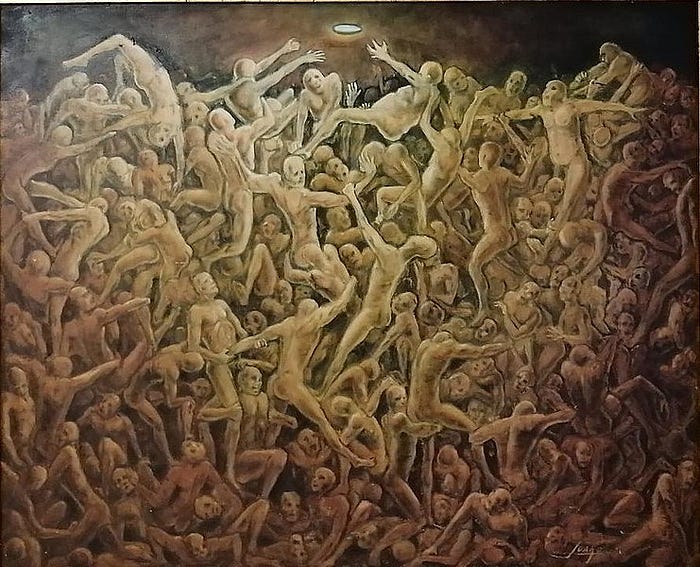
“If God does not exist, then everything is permitted.”
This was the famous affirmation made by the character Ivan Karamázov in the novel The Brothers Karamázov, by Fiódor Dostoiévski, in the 19th century.
Then, a question arises from the affirmation: If God Does Not Exist, Is Everything Permitted? The question comes because it assumes that if God does not exist, if one can escape from the law of men, then this person will be sure that he won’t be judged by anyone afterward. For an apparent reason, this idea has roots in the thought of an immortal soul.
A brief pause to clarify a matter of semantics: the God that we are talking about here is assumed to be the Christian-Judaic God. A guy that knows everything about everyone and is in every place, sitting on the clouds, judging us. This idea goes in contrast to a Universal God: something towards Spinoza’s God, where you and I are part of it.
If this Christian-Judaic ever judging God is there, to follow the logic inside the question “If God Does Not Exist, Is Everything Permitted?”, then an immortal soul must exist. It must be like that, as an immortal soul can sustain an eternal judgment.
It is not everybody that accepts that if God does not exist, everything is permitted because people understand that we are moral beings, besides being subjects to the law. Here, our capacity to create norms and laws evidently gives us proof of moral consciousness.
Some will go even further and affirm that people that need God to hold their impulses and violent behavior are moral idiots, as they are not capable of achieving a “moral development,” a consequence of organized and rational life. Seculars and atheists of every kind can think like that.
Of course, people that are non-believers can have constructive moral behavior, inclusively, for the fear and shame of not having them.
It is worth betting that sometimes “irrational values,” such as fear and shame, contribute more to moral behavior than rational thought.
In juxtaposition, also religious people can (and they do) act immorally, with violence, especially when they are subjected to fanatism. This happens in both Christianity and Islamism.
Despite my understanding that, indeed, not everybody can have a proper education to flourish in their rationale (thus, religion can help them achieve moral behavior), I also observe that the prevalence of moral behavior happens much more because of peer pressure inside a religious group than of religion itself.
Dostoyevsky is making a question more profound than the shallow “Are believers or not believers more or less moral?” — This is a minor question.
Dostoyevsky is giving us a hint toward nihilism.
“If God doesn’t exist, everything permitted” means that if you’re a good person in life, but somehow you end up miserable, in the sum total of the cosmos, you’ve made a wrong choice because if you were a bad person and could have some advantage from it, it wouldn’t make any difference at the end of the day, as there wouldn’t be an absolute ground for what a good person means. Psychopaths and sociopaths must constantly think like that.
This question is a nihilistic question. The character who asks it, Ivan Karamazov, is also the one who architects his father’s death in the novel “The Brothers Karamazov”; therefore, it is the same that preaches the creed according to which there is no more in life than atoms — therefore, we are alone in this massive hole that is the universe.
Then, here we are, dialoguing with the “Nihilism” devil and its denial of any more significant meaning for things, beyond what we invent.
Would we be able to construct meaning by ourselves, just as we can build bridges?
This is one of the most recurrent questions in the modern world, even in the silence and solitude of a sleepless night. I personally think that Dostoevsky is correct, although I do not share his faith in God, the Christian God.
So, if God does not exist, is everything permitted?
No!
But, well, for some people, yes.
What do you think about that?
You can get full access to every story on Medium for just $5/month by signing up through this link.