
From Wikipedia, the free encyclopedia
| FM-2030 | |
|---|---|
| Born | Fereidoun M. Esfandiary October 15, 1930 Brussels, Belgium |
| Died | July 8, 2000 (aged 69) New York City, New York, U.S. |
| Resting place | Cryopreserved at Alcor Life Extension Foundation |
| Occupation | Writer, philosopher, teacher, consultant |
| Nationality | Iranian-American |
| Education | University of California, Los Angeles |
| Genre | Science fiction, futurology |
| Literary movement | Transhumanism |
| Notable works | Are You a Transhuman? |

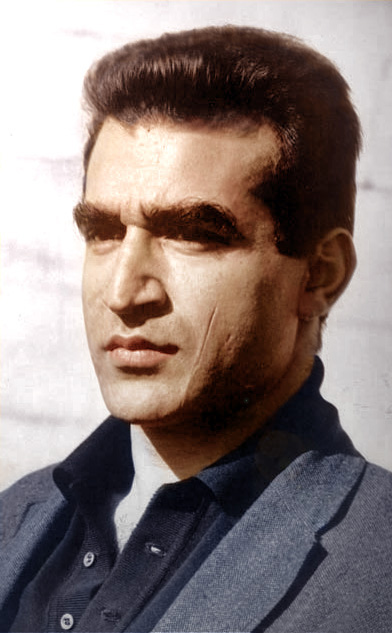
FM-2030 (originally born as Fereidoun M. Esfandiary; Persian: فریدون اسفندیاری); October 15, 1930 – July 8, 2000) was a Belgian-born Iranian-American author, teacher, transhumanist philosopher, futurist, consultant and Olympic athlete.[1]
He became notable as a transhumanist with the book Are You a Transhuman?: Monitoring and Stimulating Your Personal Rate of Growth in a Rapidly Changing World, published in 1989. In addition, he wrote a number of works of fiction under his original name F.M. Esfandiary.
Early life and education
The son of an Iranian diplomat, he travelled widely as a child, having lived in 17 countries by age 11; then, as a young man, he represented Iran as a basketball player and wrestler at the 1948 Olympic Games in London.[2] He then started his college education at the University of California, Berkeley, but later transferred to the University of California, Los Angeles, where he graduated in 1952.[3] Afterwards, he served on the United Nations Conciliation Commission for Palestine from 1952 to 1954.[4]
Name change
In the mid-1970s F.M. Esfandiary legally[2] changed his name to FM-2030 for two main reasons: firstly, to reflect the hope and belief that he would live to celebrate his 100th birthday in 2030; secondly, and more importantly, to break free of the widespread practice of naming conventions that he saw as rooted in a collectivist mentality, and existing only as a relic of humankind’s tribalistic past. He viewed traditional names as almost always stamping a label of collective identity – varying from gender to nationality – on the individual, thereby existing as prima facie elements of thought processes in the human cultural fabric, that tended to degenerate into stereotyping, factionalism, and discrimination. In his own words, “Conventional names define a person’s past: ancestry, ethnicity, nationality, religion. I am not who I was ten years ago and certainly not who I will be in twenty years. […] The name 2030 reflects my conviction that the years around 2030 will be a magical time. In 2030 we will be ageless and everyone will have an excellent chance to live forever. 2030 is a dream and a goal.”[5]
Personal life
He was a lifelong vegetarian and said he would not eat anything that had a mother.[6] FM-2030 once said, “I am a 21st century person who was accidentally launched in the 20th. I have a deep nostalgia for the future.”[7] He taught at The New School, University of California, Los Angeles, and Florida International University.[1] He worked as a corporate consultant for Lockheed and J. C. Penney.[1] He was also an atheist.[8] FM-2030 was, in his own words, a follower of “upwing” politics, in which he meant that he endorsed universal progress.[9][10] He had been in a non-exclusive “friendship” (his preferred term for relationship) with Flora Schnall, a lawyer and fellow Harvard Law Class of 1959 graduate with Ruth Bader Ginsburg, from the 1960s until his death.[11]
Death
On July 8, 2000, FM-2030 died from pancreatic cancer and was placed in cryonic suspension at the Alcor Life Extension Foundation in Scottsdale, Arizona, where his body remains today. He did not yet have remote standby arrangements, so no Alcor team member was present at his death, but FM-2030 was the first person to be vitrified, rather than simply frozen as previous cryonics patients had been.[6] FM-2030 was survived by four sisters and one brother.[2]
More at: https://en.wikipedia.org/wiki/FM-2030