
Professor Markus Gabriel thinks there is more to the world than meets the eye.
Gem Jackson · Feb 13 · Medium.com
I remember sitting in my grandfather’s car a few years ago in a gray car park. I was in the second year of my undergraduate philosophy degree, and we were discussing careers. As an engineer and a thoroughly practical man, he wasn’t convinced of the merits of my degree choice.
“But what can you do with philosophy, Gem?” he asked me. “What has philosophy ever achieved?”
I doubt meeting Professor Markus Gabriel would do much to change his impression of the subject.
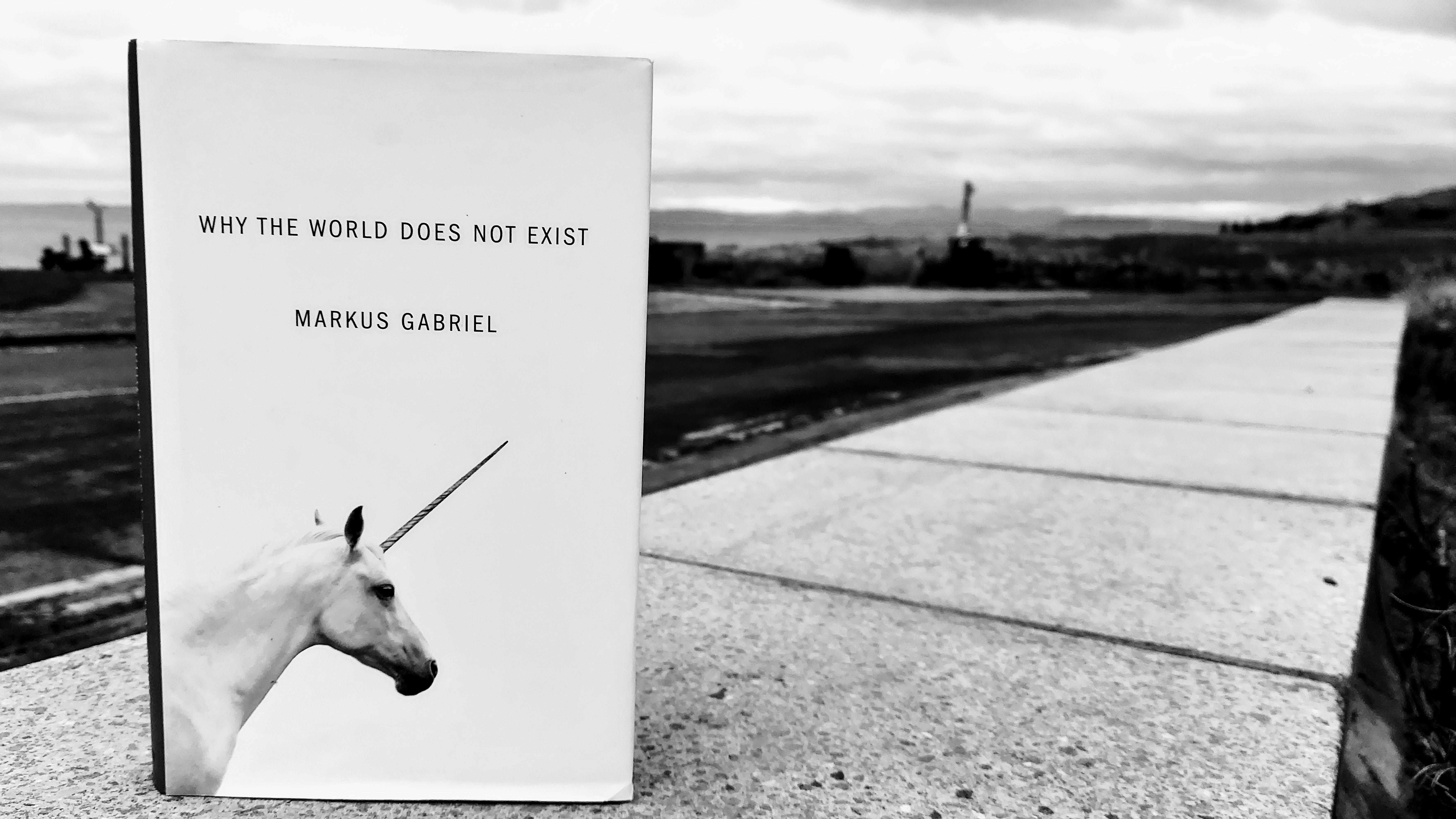
Professor Gabriel is a philosopher who accepts the existence of unicorns, but sincerely refutes the existence of the world. He is a leading figure of the New Realism school of thought, which seeks to reconcile a common sense understanding of the world as it appears with the somewhat unintuitive ‘many realities’ claims of the anti-realists. That’s my understanding, anyway.
This goes a long way to explain the clickbait title of his 2015 book, ‘Why The World Does Not Exist’. Yet Gabriel isn’t proposing some cheap linguistic trick. On page one of the book, he doubles down on the titular claim:
“In this book I will develop the outlines of a new philosophy, which follows from a simple, basic thought, namely the idea that the world does not exist. As you will see, this does not mean that nothing exists at all. There are planets, my dreams, evolution, the toilet flush, hair loss, hopes, elementary particles, and even unicorns on the far side of the moon, to mention only a few examples. The principle that the world does not exist entails that everything else exists. For this reason, I can already announce that I will claim, as my first principle, that everything exists except one thing: the world.”
‘Why The World Does Not Exist’ is Gabriel’s bold attempt to build something from first principles. It is his attempt to build a new metaphysics for the twenty-first century.
As someone interested in philosophy, I couldn’t possibly resist such a title. Unsurprisingly, I do not believe Gabriel is successful in his central claim (did anyone really expect otherwise?). However, in laying out his position he makes some powerful and persuasive arguments for how we should and should not make sense of the world around us.
The Argument: Why the World Does Not Exist
Professor Gabriel makes the argument for his outlandish claim in the first half of the book. As we live in an age of abundant free media where content is king, there is also a TEDx Talk where he summarizes the main tenets of his position. In the second half, he addresses the implications of his conclusion.
To understand why the world does not exist, says Gabriel, we must understand what it means for something to exist. It is not sufficient to equate existence with material presence in the universe. To do so would leave only an anemic fraction of what we understand the world to be.
Facts, for instance, have no material existence. It is true that the Earth is bigger than the moon, but the fact that the Earth is bigger than the moon cannot be located anywhere in particular. Facts don’t have weight or color or smell or taste. The same is true of numbers, names, and all manner of intangibles.
So it is that Gabriel defines existence in terms of fields of sense. A thing exists in so far as it makes sense in relation to something else. Physical objects exist in relation to each other. The fact of the Earth’s comparative size compared to the moon exists in relation to those objects.
In this way, all sorts of things take on existence. Witches exist in relation to Macbeth, Faust, and thousands of Halloween costumes. Democracy exists in relation to the organization of hundreds of governments.
Having settled the nature of existence, Gabriel moves on to defining the world. An initial distinction made is between what he terms the world and the universe. The universe is the Spatio-temporal domain investigated by the natural sciences. It is a place of stellar objects, phylum, and sub-atomic particles. It is not the realm of mundane facts and relationships. The universe contains Saturn and its moons, but it does not contain my love of Nick Cave.
The world, by contrast, is the maximal container of all facts; our widest possible intellectual container, which we abstractly fill with everything that is and has been in all senses. The world, argues Gabriel, contains all the fields of sense that in any way meaningfully exist. In this, he is resting Heidegger’s formulation of the world as “the domain of all domains” (p45).
The thrust of Gabriel’s argument is found in a section enticingly titled ‘the super-thought’, demonstrating that if nothing else, he has an acute knack for philosophical marketing. It’s a dizzying exercise in mental-gymnastics encompassing, amongst other things, Hegel, set-theory, and Seinfel.
I will attempt a summary of the main point. Consider there exists a super-thought. A thought that encompasses, at once, all things that exist, including itself. In his TEDx lecture, Gabriel likens this Hegelian concept to a list of all facts that exist and therefore all of existence. For this list to be complete, it should also contain itself. If that is the case, there pops into existence another fact, that the super-thought list contains itself. Unfortunately, this necessarily leads to a further fact, that it is a fact that the super-thought list contains itself. This then leads to… well, hopefully, you can see where this is going.
Gabriel’s argument will be familiar to anyone with a passable knowledge of Hilbert’s Hotel. It is a reductio ad absurdem argument that aims to succeed by showing the absurdity entailed by its denial. If the world exists, suggests Gabriel, you must accept the absurdity of this infinite regress.
All this leads us back to Gabriel’s initial claim. Everything we can think of has some kind of meaningful existence, if only in a particular field of sense. Yet the object-container for all things that do exist, the world, cannot itself exist without leading to a breakdown of logic.
“Everything exists except one thing: the world.”
Why Gabriel is Wrong, but We Shouldn’t Mind
Let’s be clear. The world exists. Well, insofar as I was ever sure it existed, this book hasn’t changed my mind on the issue. But I didn’t really expect it to, and I don’t think Professor Gabriel did either.
There’s a lot to be taken from the first half of the book. The discussion of fields of sense is interesting and creates both an epistemological and ontological framework that feels worth exploring. Similarly, Gabriel’s bona fides as an academic and a ‘public thinker’ are well demonstrated as he effortlessly synthesizes the scholarly ideas of Derrida, Kant and Spinoza with cultural touchstones ranging from The Matrix to Faust to Black Mirror.
Yet, this isn’t just a smart polemic. It’s an academic argument, steeped in the language of technical philosophy (‘mereology’, ‘a fortiori’…) It seems only appropriate to ask, therefore, why is Gabriel’s argument not convincing?
Ultimately, it comes down to Gabriel making unsurprising use of linguistic sophistry in the first half of his book. His stated aim is to convince us that the world does not exist, only in order to do so, he spends significant effort shifting the definition of world. The reason his title, ‘Why The World Does Not Exist’ is so compelling is that most ordinary people’s understanding of world largely refers to either the planet Earth or our immediate surroundings. In that sense, suggesting the world does not exist is akin to arguing that we may be trapped in the Matrix or we may be no more than a brain in a vat.
Instead, Gabriel’s project could better be understood as an attempt to more fully define the word ‘reality’ or ‘totality of existence’. Perhaps I’ve misunderstood his argument. I’m open to this suggestion as my copy of the book was marred by a significant number of blank pages in place of the proper copy (come on Polity, seriously?) Yet even if every page were present and correct, I suspect the argument would remain unsatisfying.
Not least because many of the central claims are not especially novel. Much time is spent dismissing a definition of the world as simply the totality of objects, before introducing the concept of fields of sense. This isn’t a widely held definition, which Gabriel must appreciate as he quotes the opening parts of Wittgenstein’s Tractatus to prove his point (see section 1.1 on p27) That definition of the world as the totality of facts, not objects, is therefore at least a century old.
Heck, when Gabriel riffs on the existence of intangible ideas, I couldn’t help but feel the late, great fantasy writer Terry Pratchett did it better.
“Take the universe and grind it down to the finest powder and sieve it through the finest sieve and then show me one atom of justice, one molecule of mercy.” — (Death, speaking in The Hogfather)
However, once the book kicks into the second half, it really starts to shine. Gabriel presents a robust defense of a pluralistic approach when investigating the world. He doggedly rejects the scientific reductionism so popular in the age of STEM.
“Thus, the failure of the scientific worldview lies not in science per se but in an unscientific conception that deifies science and brings it into the suspicious neighbourhood of poorly understood religion. This is why contemporary scientistic neo-atheism is a sect: it has faith in a vaguely defined concept, “science,” or “the scientific method,” with a super-object (the universe) answering all questions (if asked in the language of mathematics).”
I can’t help but see a parallel with fellow German philosopher Wittgenstein. In 1927, Wittgenstein accepted an invitation from the Vienna Circle to meet. Wittgenstein, the ultra-reductivist author of the Tractatus, which ends with the immortal line “Whereof one may not speak, thereof one must remain silent”, was to meet his protégés.
The Vienna Circle were logical positivists, inspired by Wittgenstein and determined to replace nonsensical pseudo-religious gibberish with hard science and logic. At the meeting, Wittgenstein faced the wall and read passages from Tagore, a Bengali mystical poet (Edmunds & Eidinow, p121). One interpretation is that Wittgenstein was suggesting that there are areas of investigation other than the material universe, and when venturing into those realms, a language other than mathematics and logic is needed. Those familiar with Wittgenstein’s later work may recognize the direction of travel here.
This ultimately, I suggest, is Gabriel’s point. Unwrapping the hyperbolic language, we are left with a straightforward argument: there are many domains of existence, each with its own language of investigation. To narrow our understanding of existence to a single domain is to put on blinders and to seek a ‘domain of domains’ with unified language of inquisition is fruitless.
Instead, we ought to adopt something like Stephen J. Gould’s concept of NOMA — Non-Overlapping Magisteria — and acknowledge that examination of the world demands more than just the scientific method. Mathematics, philosophy, heuristics, poetry; they all have something to contribute when it comes to understanding the full range of things that exist in the world.
This is a wholly worthwhile position and Gabriel provides an eloquent, thoughtful, and imaginative philosophical argument to support it, so that by the end of the book I was persuaded. Maybe not that the world didn’t exist, but of the flawed position of scientific reductionism and the value in embracing a broader understanding of what it is to exist.
‘Why The World Does Not Exist’ is a strange book. It’s almost (but not quite) misleading in how it draws you in. It’s equal parts frustrating and satisfying, though thankfully ends on the latter. It’s a demanding read that challenges you to think about the content while equipping the reader with all the necessary tools to do so.
In the end, isn’t that what we want from philosophy? To take us from the mundanities of everyday life, really drill down into our fundamental ideas and concepts, and to leave us with a richer, fuller appreciation of our place in the world?
A world that I’m afraid to say, Professor Gabriel, probably does still exist.
The Apeiron Blog — Big Questions, Made Simple.
We know that Philosophy can seem complicated at times. To make things simple, we compile together the best articles, news, reading lists — and other free resources to guide you on your journey. To continue with us, follow us on Medium and sign up to our free mailing list.The Apeiron Blog
Exploring philosophy — to find truth & better ourselves along the way.Follow
WRITTEN BY
Gem Jackson
Writer and educator in law and philosophy. Also wrote a book.

The Apeiron Blog
An easy to read philosophical space that aims to elicit discussion and debate on matters of the universe.