
SFChronicle.com By Tony Bravo • tbravo@sfchronicle.com • @TonyBravoSF
Feb. 11, 2004 – San Francisco issues same-sex marriage licenses, creating ‘Winter of Love’
At the State of the Union address on Jan. 20, 2004, President George W. Bush described the possible steps he would take to prevent the spread of same-sex marriage in the U.S., following a November 2003 ruling by the Massachusetts Supreme Court that cleared the way for marriage equality in the state. San Francisco Mayor Gavin Newsom was attending the speech in Washington, D.C., that night as a guest of house minority leader Nancy Pelosi. Following the address, Newsom called his chief of staff, Steve Kawa, a gay man, and said that he wanted to do something.Show less »
On Feb. 11, Newsom directed city clerk Nancy Alfaro to begin issuing marriage licenses to same-sex couples. It was an act that made the 36-year-old mayor a national figure and forever tied the office of the city attorney, led by Dennis Herrera, to one of the most significant civil rights victories of the LGBTQ community in the early stages of the 21st century. The first to be married in San Francisco City Hall were longtime activists Del Martin and Phyllis Lyon, founders of the lesbian civil and political rights organization the Daughters of Bilitis. With that, the “Winter of Love” was born.
During the month-long period, same-sex couples flocked to the building for their marriage licenses on new, gender-neutral forms. It was one of the first times many gay people saw two men or two women in their bridal finery together, no doubt showing some younger members of the community what they could believe possible in their own lives. The Winter of Love was more than a political reaction to President Bush by Mayor Newsom: It was a volley that brought the issue right to the heart of the American discussion.
Between Feb. 11 and March 11, 4,037 same-sex couples were married from 46 states and eight countries, including comedian Rosie O’Donnell, who flew from New York to San Francisco to marry her then-partner Kelli Carpenter in a ceremony officiated by City Treasurer Susan Leal.
The weddings lasted until the Supreme Court of California issued a stay ordering the County of San Francisco to cease the weddings. In August, the California Supreme Court ruled that the marriage licenses issued were legally void. In 2008, another same-sex marriage ban, Proposition 8, was passed by California voters after the overturning of 2000’s Proposition 22 — which was passed in 2000 and defined marriage in California between one man and one woman. That ban was eventually overturned in 2012 by the U.S. Ninth Circuit Court of Appeals in San Francisco and marriages resumed in June 2013 following additional legal victories.
By June 2015 the effect of Newsom’s rebellion had national impact as the Obergefell v. Hodges ruling by the U.S. Supreme Court made marriage equality the law in the United States. The law, and the cultural mind-set, finally caught up to California.
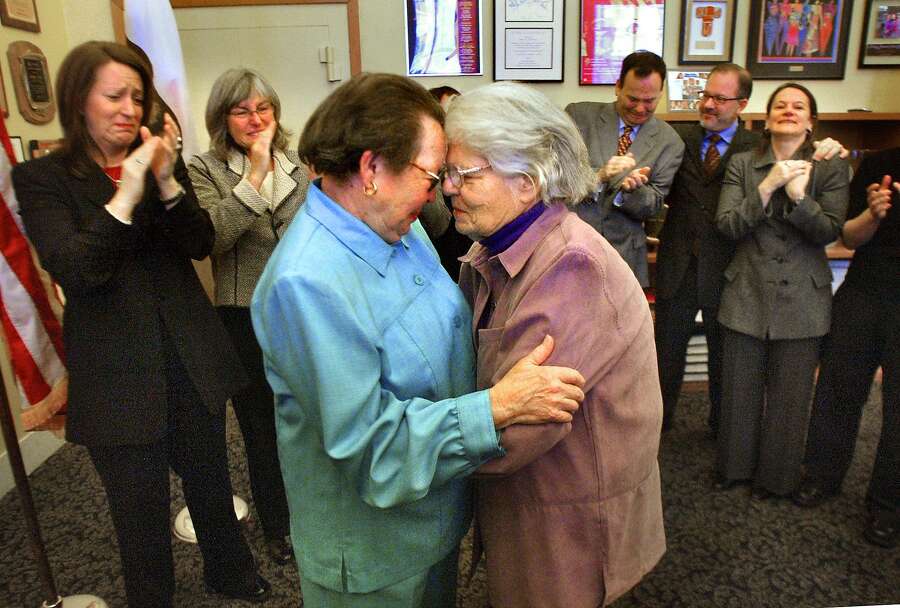
Liz Mangelsdorf / The Chronicle 2004