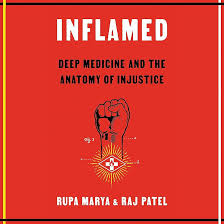
(Image from Amazon.com)
“Cancer is, in essence, a wound that does not heal.”
–Rupa Marya & Raj Patel from Inflamed: Deep Medicine and the Anatomy of Injustice paraphrasing the paper “Tumors: Wounds That Do Not Heal” by Dvorak

The phrase “medicine is a social science on a grand scale” is most associated with Rudolf Virchow, a 19th-century physician who helped found modern public health. He meant that illness is not just a biological event inside an individual body; it is deeply shaped by the structure of society itself.
The implications are enormous.
Health outcomes are strongly affected by:
So if two populations have different life expectancies, the explanation often lies as much in economics and politics as in biology.
For example:
Medicine therefore cannot fully succeed by treating isolated patients one at a time.
Virchow argued that when physicians confront widespread disease, they eventually confront:
In that sense, public health becomes political whether people want it to or not.
This does not necessarily mean partisan politics. It means that health depends on collective social organization.
If medicine is social, then:
Modern public health, epidemiology, and social medicine all grew partly from this insight.
The phrase challenges the idea that health is solely a matter of personal responsibility or moral virtue.
A person may make excellent choices and still suffer because of:
Conversely, privilege itself can function like a health intervention.
Virchow and later thinkers sometimes treated social breakdown almost like pathology:
These can be seen not merely as individual failures but as symptoms of broader social conditions.
That idea influenced later thinkers ranging from Michel Foucault to Frantz Fanon to contemporary public-health researchers.
If health is socially produced, then societies may bear collective responsibility for preventable suffering.
That raises difficult questions:
Virchow’s statement ultimately expands medicine from:
“How do we treat disease?”
to:
“What kind of society produces health or illness?”
Yes — that’s a perceptive extension of Rudolf Virchow’s idea.
Once medicine becomes linked to society, it also becomes linked to the metaphors a society uses to understand itself. And one of the strongest metaphors in modern medicine has been warfare:
That language is not accidental. It reflects political and cultural assumptions about order, danger, purity, borders, and enemies.
Thinkers like Susan Sontag explored this in Illness as Metaphor. She argued that militarized language can distort how we think about illness, making patients feel as though they’ve failed in battle or are somehow morally implicated in disease.
There are several implications to your observation:
Modern immunology often imagines the body as:
So microbes become analogous to foreign armies or infiltrators.
This can be medically useful — the immune system really does distinguish self from non-self — but culturally it can reinforce broader social habits of thinking in terms of enemies and exclusion.
Societies sometimes project medical anxieties onto human groups:
Historically, people have often described unwanted groups using disease metaphors:
That is one reason disease metaphors in politics can become dangerous.
The “attack the invader” framework works reasonably well for some infections:
But it breaks down with:
In autoimmune disorders, for example, the body attacks itself. The “enemy” is no longer foreign. That complicates the whole metaphor of pure self versus outside invader.
Modern biology increasingly recognizes:
Your body contains trillions of nonhuman organisms essential for survival. So life is not simply defense against outsiders; it is also coexistence.
That shifts the metaphor from:
fortress under siege
to something more like:
ecosystem seeking balance.
Virchow’s deeper point was that medicine always carries hidden assumptions about:
So the language of medicine can reveal a society’s unconscious political imagination.
Thinkers like Michel Foucault later explored how medical systems can become intertwined with social control, classification, and surveillance — not merely healing.
So yes: the “foreign invader” model in medicine is partly biological, but also partly cultural and political. And once you notice it, you begin seeing how deeply war metaphors shape modern thought about both bodies and societies.
Video And Discussion
Disclaimer, Salon Calvin will not have you sitting through a full production of the play, nor quoting Shakespeare that evening, worry not about that!
Calvin is inviting you to a fun-filled and insightful conversational evening to engage you in a play that explores the powers of Anger /Revenge; Mercy/Forgiveness or what we call in the Prosperos “Give-For”; Compassion/[Love – through the devices of magic, dreams, and love.
This Certainly will not a dry reading of Shakespeare, but a fun participatory experience.
We will start with a DVD on the Tempest, presenting viewpoints from the cast members, historical records, and tidbits about Shakespeare writing of the play. The DVD gives a grasp and understanding of the play as told by cast members from their relationship with the play.
Note: the Prosperos School obtains its name from this play.
Followed by a Segue into a fun-filled discussion, with insights and comments from the Salon members about the presentation.
Event: Salon Calvin evening
Date: Friday, May 01, 2026
Time: 4:30 pm to about 7 pm Pacific Time (check your time zone for your correct time)
Where: Over Zoom
Link Zoom Link – https://us02web.zoom.us/j/89922643702
By Invitation only …And for those who have attended Calvin’s Salon events before, you know it is going to be a good time…
See you there
Calvin
(Astrobutterfly.com)
The 2 ‘troublemakers’ – Uranus and Pluto – are all over the May transits.
May 2026 starts on a Pluto tone with the Full Moon in Scorpio square Pluto, followed by Pluto retrograde. Hello Pluto!
As we move through the month, the atmosphere becomes increasingly Uranian – starting with the New Moon in late Taurus (conjunct Uranus), then followed by Mercury and Sun conjunct Uranus.
At the end of the month, we get back to Pluto, who’s pushing us toward long-overdue spring cleaning of old identities from the Capricorn era.
And if this all sounds a bit much – and it might definitely feel that way – remember that Uranus, now in Gemini, is moving into a trine with Pluto.
These 2 aren’t just wreaking havoc for the fun of it – they have a plan. It all makes perfect sense up there on Olympus.
It will make sense to us too, a little further down the road.
In the meantime, May asks us to trust the process. If something is falling apart, it’s because it was supposed to. If an opportunity knocks, answer the door. Let the Universe do its work – and trust that the chaos has a plan.

But let’s take a look at the most important transits of the month:
On May 1st, 2026, we have a Full Moon at 11° Scorpio. This Full Moon is T-squaring Pluto, its ruler, Mars, is square Jupiter, and cherry on top, Mercury is conjunct Chiron. That’s a loaded Full Moon chart!
Whatever has been bottling up in your life will now erupt like a volcano, creating a much-needed clearing of the air.
As with any Full Moon on the Taurus-Scorpio axis, themes of give-and-take come into focus. Who’s doing what? Who’s giving more? Who’s been keeping score? This is a moment to look at the balance of your exchanges with others.
With Mercury conjunct Chiron, some of these conversations may touch old wounds, and that’s okay. Sometimes the eruption is also the healing.
On May 3rd, 2026, Mercury enters Taurus – and we will all feel an exhale. Mercury has had a rough stretch: retrograding through Pisces, then getting pinballed by all those planets in Aries.
Now he’s finally found a safe house in Taurus, where even Uranus has left the building, having just moved into Gemini.
Enjoy it while it lasts, though. Mercury is already applying to a tense square with a stationary Pluto, pushing for (even more) resolution in the wake of the Full Moon.
On May 6th, 2026, Pluto goes retrograde at 5° Aquarius. As usual, when a slow-moving planet like Pluto changes direction, its energy intensifies.
This doesn’t have to be a Plutocalypse – although when Pluto shows up, we know we have no choice but change.
The more we recognize what actually needs to go, the more empowering the process becomes. Pluto only feels like destruction when we’re clinging to something that was already done.
May 14th, 2026 – Sun is conjunct Mercury at 23° Taurus, which means we are mid-way through the Mercury cycle, and experienced the “Full Mercury” phase of the current cycle.
Early ideas and projects that have been taking root in the last couple of months are starting to show their first real growth above the soil.
On May 16th, 2026, Mars is conjunct Chiron at 28° Aries. Since 2018, Chiron in Aries has been helping us heal our wound of identity – and with Mars, the planet of self-assertion joining in, old wounds resurface.
The Mars-Chiron transit can bring back situations where we felt disempowered, bullied, or dismissed. Times when our boundaries were crossed and we either didn’t know how to hold them, or felt we weren’t allowed to.
This is the final Mars-Chiron conjunction in Aries (at least for the next 4+ decades). Looking back now, we can recognize that the struggles – the times we were walked over, treated as if we don’t matter
– and all the stories we’ve been telling ourselves along the way that ‘there must be something wrong with me’ – were never true.
This is where it ends. No more crossing the line. Who we are and what we want matter. And as long as you’re not trampling on someone else’s right to the same, we don’t have to accept anything that won’t let us be ourselves.
That’s what Chiron in Aries has been building toward all these years. Soon, Chiron will move into Taurus and bring other areas to heal.
On May 16th, 2026, we have a New Moon at 25° Taurus.
The New Moon is conjunct Mercury and Uranus, and sextile Jupiter in Cancer. The New Moon ruler, Venus, is sextile Mars.
This is one of the more auspicious New Moons out there – strong aspects, supportive flow, and just enough Uranus to shift how we see things.
At the New Moon in Taurus, we begin to see opportunities that were always right in front of our noses, but somehow didn’t recognize their potential.
Now, with a few small tweaks and a reframe, we can make something real out of them. Eureka!
On May 16th, Mercury enters Gemini – its home sign – and conjuncts Uranus the very next day.
This is our very first Mercury-Uranus conjunction in Gemini, and it will not go unnoticed.
Whether it comes from the outside, through a surprising announcement, or from within – as a shift in how you see things – things will start to click in a new way.
On May 21st, 2026, the Sun enters Gemini – happy birthday to all Geminis out there!
This is the first Gemini season in almost 80 years with Uranus in the sign. If you have planets or the Ascendant in Gemini, or if you know people who do, the shift will be quite obvious.
This Gemini season, expect to feel freer, lighter, and less ‘boxed in’, especially in the area of life ruled by Gemini in your chart.
On May 26th, 2026, Pluto is square Mars and trine the Sun.
This Pluto one-two calls for a deeper kind of spring cleaning. Whatever has been running on ‘I can’t do this’ becomes visible for what it is – an excuse – as we use it to fuel a version of ourselves that no longer needs it.
On May 31st, 2026, we close the month with a Full Moon at 9° Sagittarius, trine Neptune and Saturn in Aries, square the Nodes.
Having ‘survived’ Uranus and Pluto, something has shifted – and now there’s space to breathe, to look around, and to wonder.
We may find ourselves in what feels like a completely different place, even if it’s the same living room, the same commute, or the same life.
When our perspective shifts, we stop reacting from where we’ve been, and start recognizing what’s actually calling us forward.
~ Roy T. Bennett
Roy T. Bennett is a thought leader. He loves sharing positive thoughts and creative insight that has helped countless people to live a successful and fulfilling life. He realizes that he should spread these thoughts by writing and inspire you to believe in yourself, your abilities and your own potential….
Books The Light in the Heart: Inspirational Thoughts for Living Your Best Life
Residence South Africa
New Thinking Allowed with Jeffrey Mishlove Apr 28, 2026 Biological Systems, Health and Healing Michael J. Shea, PhD who holds a doctorate in somatic psychology from the Union Institute and a master’s degree in Buddhist Psychology from Naropa University. He has taught at the Upledger Institute, the Santa Barbara Graduate Institute, and the International University for Professional Studies. He is a craniosacral therapist, licensed massage therapist, and educator with the Shea Educational Group that is a center for the study of the human heart. He is author of Somatic Psychology and Biodynamic Craniosacral Therapy – Volumes 1 through 5; Myofasical Release Therapy: A Visual Guide to Clinical Application; Myofascial Release Therapy and Biodynamic Craniosacral Therapy: The Heart of the Practice; The Biodynamics of the Immune System: Balancing the Energies of the Body with the Cosmos; and The Biodynamic Heart: Somatic Compassion Practices for a Clear and Vital Heart. His website is sheaheart.com. Michael describes the vital role of the vagus nerve in regulating physiology, safety, emotions, and overall health. He explores how turning inward—feeling the heart and meeting fear—can open the door to a deeper awareness of ourselves and reality. He shares simple ways to support vagal tone, fostering greater joy, compassion, wholeness, and wisdom. 00:00:00 Introduction 00:03:19 Anatomy of the vagus nerve 00:05:08 Polyvagal theory and safety 00:09:39 Relationship to the heart 00:14:22 Empathy, wisdom, and compassion 00:23:23 Four types of safety 00:34:59 Intuition and discernment of thoughts and feelings 00:44:40 Food, immune system, and digestive health 00:58:17 Bliss, pleasure, and sexuality 01:14:57 Conclusion New Thinking Allowed CoHost, Emmy Vadnais, OTR/L, is a licensed occupational therapist, intuitive healer and coach, and spiritual guide based in St. Paul, Minnesota. Emmy is the founder of the Intuitive Connections and Holistic OT communities. She is the author of Intuitive Development: How to Trust Your Inner Knowing for Guidance With Relationships, Health, and Spirituality. Her website is https://emmyvadnais.com (Recorded on March 5, 2026)
adam28xx Aug 30, 2020 Twenty years ago, on 30 August 2000, Michael Tilson Thomas conducted Stravinsky’s “The Rite of Spring” in London’s Royal Albert Hall, so this video counts as a 20th Anniversary tribute! … This same performance was previously uploaded here in its two separate parts but the 20th Anniversary provides an ideal opportunity to hear the work uninterrupted. The San Francisco Symphony, of which MTT had become Music Director five years earlier, was making its Proms debut. It was attended by a 5,000-strong highly enthusiastic audience and their rousing reception prompted two encores, by Prokofiev and Stravinsky. both introduced by MTT himself. A memorable occasion indeed!

Daniel Torok/White House
Trump’s second inaugural portrait, taken in January 2025
By Hafiz Rashid
April 28, 2026 (NewRepublic.com)
Donald Trump’s picture could soon be on every new U.S. passport.
The State Department is finalizing a plan to put the president’s face in the travel document, The Bulwark reports, citing two sources with knowledge of the passport redesign, one of whom provided pictures. The new passports will include Trump’s second inaugural portrait superimposed over the Declaration of Independence, along with his signature in gold.

According to The Bulwark, there will be a “limited run” of 25,000 of these Trump passports, which are still waiting to be approved. While the current U.S. passport includes an image of Mount Rushmore, which has the heads of four presidents, this would be the first stand-alone image of a U.S. president, living or dead, in a passport. No foreign passports have included pictures of heads of state, and U.S. passports have previously carried the signature of the secretary of state, but not the president.
Trump has made a habit of putting his name on things in his second term as president, from the U.S. Institute of Peace to the Kennedy Center for the Performing Arts. He’s put banners with his face on federal buildings and created a website for prescriptions called TrumpRx.gov.
This new passport is supposedly part of the 250th anniversary of American independence, and comes as the Treasury Department hopes to produce two coins with Trump’s face on them: a $1 coin with Trump’s face on it for general circulation and a commemorative coin that would be “as large as possible.” The president seems intent on having Americans feel shame every time they open their wallet or travel overseas.Share This Story
Deranged Trump Rants Edited Out of 60 Minutes Interview After Shooting
By Mike Wall
Tue, April 28, 2026 (Space.com via Yahoo.com)
Powered by Yahoo Scout. Yahoo is using AI to generate key points from this article. This means the info may not always match what’s in the article. Reporting mistakes helps us improve the experience.

NASA chief Jared Isaacman wants to restore Pluto to its former glory.
In 2006, the International Astronomical Union (IAU) stripped Pluto of its planethood, reclassifying the icy world as a “dwarf planet.” The decision was controversial, and not just because it forced schoolchildren around the world to learn a new mnemonic for our solar system’s major denizens.
Little Pluto was beloved and remains so, especially in the United States. After all, it’s the only planet discovered by an American, Clyde Tombaugh, who made the historic find in 1930 using imagery captured by Lowell Observatory in Arizona. Twenty years on, many Pluto lovers are still fighting the IAU’s decision, claiming it was unscientific and inconsistently applied.

The IAU defined a planet according to three newly pronounced criteria: It has to orbit the sun, be massive enough to be spherical, and clear its orbit of debris. Pluto fell short on the third count, according to the IAU, as it shares space in the distant Kuiper Belt with many other dwarf planets. But Earth shares orbital space with lots of asteroids, as does Jupiter, Pluto-planet advocates note. So why was Pluto singled out?
We now know that such Pluto defenders include Isaacman, a billionaire private astronaut and tech entrepreneur who became NASA chief this past December.
Isaacman testified about the White House’s 2027 NASA budget request today (April 28) before the U.S. Senate Committee on Appropriations. At the very end of the hearing, Republican Sen. Jerry Moran asked the NASA administrator his thoughts on Pluto, noting that Tombaugh hailed from Moran’s home state of Kansas.
“Senator, I am very much in the camp of ‘make Pluto a planet again,'” Isaacman replied.
“And I would say, we are doing some papers right now on, I think, a position that we would love to escalate through the scientific community to revisit this discussion and ensure that Clyde Tombaugh gets the credit he received once and rightfully deserves to receive again,” the NASA chief added.
As those words indicate, all NASA (or any Pluto advocates) can do on the matter is escalate the discussion. The ultimate decision on Pluto’s status lies with the IAU, a global society of professional astronomers that defines celestial objects and assigns official names to them and their surface features.

 Popular Mechanics

 Popular Science

Top Urologist Breaks Silence on the $24 Billion Prostate LieMens Health Research Magazine
A significant escalation occurred in July 2015, when NASA’s New Horizons spacecraft returned the first-ever up-close imagery of Pluto. Those photos revealed a stunningly diverse world with towering mountains, vast nitrogen-ice glaciers and other jaw-dropping features, including a now-famous heart-shaped landform that mission scientists dubbed Tombaugh Regio.
(Contributed by Janet Cornwell, H.W., m.)

 Space
Space