The aim of science is to illuminate the mysteries of nature and discover the elemental truths pulsating sublime and indifferent beneath the starry skin of the universe. The aim of art is to give us a language for wresting meaning from the truth and living with the mystery. Creativity in both is a style of noticing, of attending to the world more closely in order to love it more deeply, of seeing everything more and more whole — a word that shares its Latin root with “holy.”
This is why the greatest visionaries bend their gaze beyond the horizon of their discipline and of their era’s givens to take in the vista of life as a totality of being. How inseparable Einstein’s passion for the violin was from his physics and Goethe’s passion for morphology from his poetry, how difficult to tell where Kepler the mind ends and Kepler the body begins.
There are few visionaries in the history of our species who have changed our understanding of nature and our place in it more profoundly than Jane Goodall (April 3, 1934–October 1, 2025) — something she was able to do in large part because she never saw science as a walled garden separate from the wilderness of life. Formed by her love of books since childhood, she placed the raw material of literature — compassion — at the center of her scientific work, drawing on her passion for artistic creativity to make her revelatory discovery of chimpanzee tool use — that selfsame impulse to bend the world to the will that sparked human creativity when we descended from the trees to the caves to invent fire and figurative art.
Jane Goodall with the young chimp Flint at Gombe (Photograph: Hugo van Lawick, Goodall’s first husband, courtesy of Jane Goodall Institute)
It is lovely to be in an artistic atmosphere again. I realize now, more than ever before, that I can never live wholly without it. It feels so heavenly to be able to just sit in front of the fire & talk for hours — of cabbages & kings — poetry, literature, art, music, philosophy, religion. It’s wonderful, marvellous, terrific… I will stop now, because I have to wash my hair.
Shampoo, song, and science — all of it the stuff of life, intertwined and integrated, lest we forget that only an integrated human nature can begin to apprehend nature itself — that “great chain of causes and effects” in which “no single fact can be considered in isolation,” in the lovely words of Alexander von Humboldt, who knew that artists too are all the greater for taking a passionate interest in the realities of nature subject to science. It was Humboldt who first conceived of nature as a system, who saw “the unity and harmony of this stupendous mass of force and matter.” It was Jane Goodall whose science revealed that kinship is the software the system runs on, and whose life reminds us that just the kinship within a creature — the unity and harmony between all parts and passions of a person — is as essential to being fully alive as the kinship between creatures.
What’s a season if you’ve only circled the sun a few times? And can’t really remember what it was like at this time last year?
A young child’s sense of time must be overwhelmingly abstract. Time is the ever-present now. While the rhythms and routines mark the daily cycle—breakfast and bedtime, bathtime and naptime—beyond a day, the cycles become too vast to comprehend. Our four-year-old still doesn’t understand what a week is, let alone a month or the phases of the moon. “Why is it a weekend?” he asks, as we head to the forest instead of daycare.
Seasons mark time and in their distinct elements make it tangible. Akin to how you might walk the land to learn it, you try to catch time in the act of passing, seeking understanding. Seasonal practices allow you to enter time as if it were space. By providing structure and consistency, practices create moments. We were here at this time last year, do you remember? See the buds? They’re almost here again.
To take our kid into the seasons, I try to show him time as a space, a place we can go. When he can’t remember this time last year, his mother and I call up stories and images. We talk about what happened last year, and what might come this year. This may be one reason I document our practices, to create a record for reference.
We have a name, place, and time for each of our seasonal practices. And we have more than four. The practices reflect cycles in the land where we live, and orient us to the ephemeral—the shifting, changing, only-here-for-so-long.
This is how I try to teach our kid where we live, and figure it out for myself. This is how we learn the land, in space and time.
Snow Line
Wherever snow lies, we can sense the season, but we search for snow line—the exact place where the world turns white.
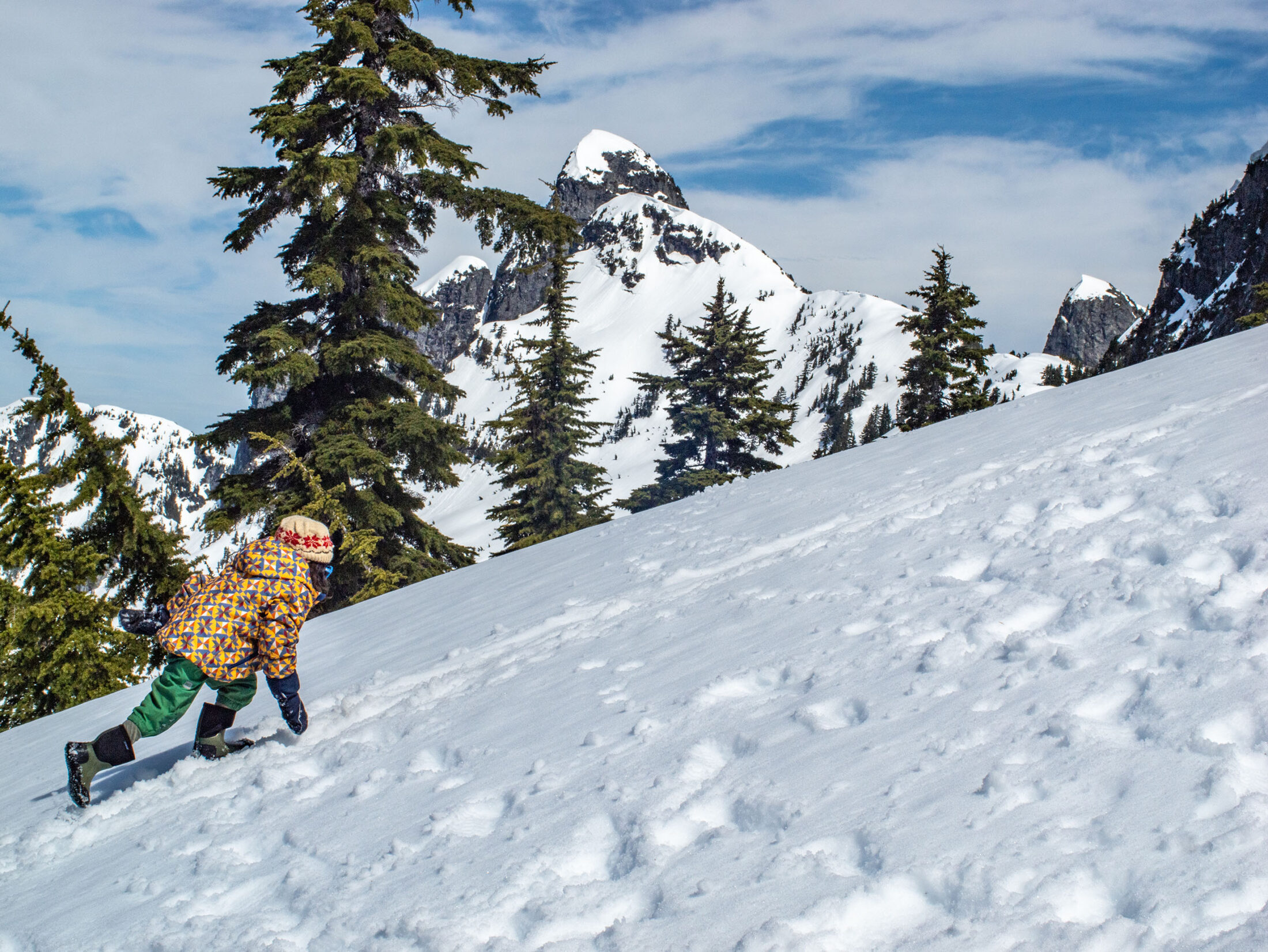
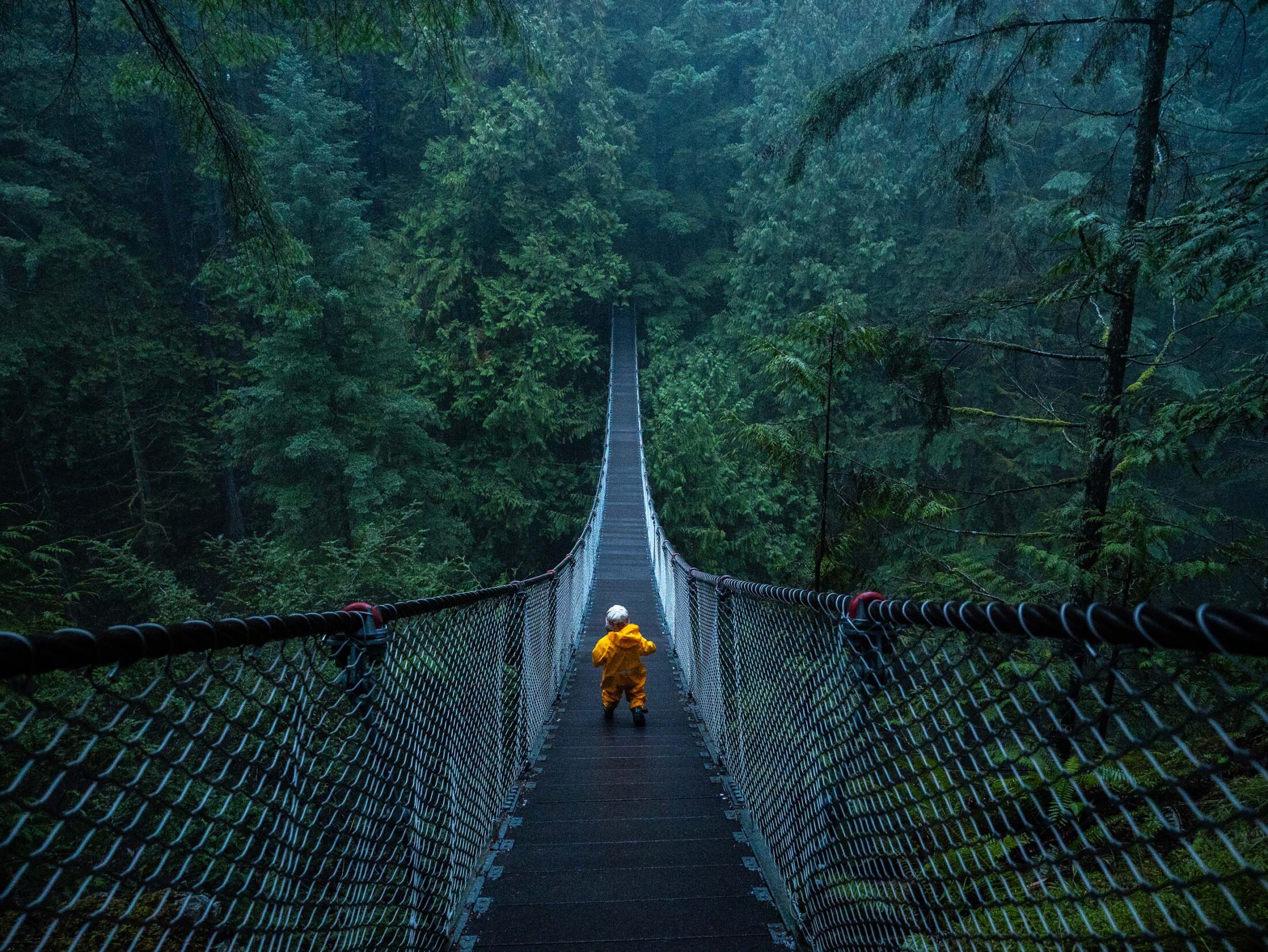
When the days are short in the temperate rainforest, there is a line through the Doug firs and cedar. A curtain that marks the threshold between worlds of white and green. On the way up, the white feels right, like mountains should be capped with snow, the world growing brighter as you go higher. But coming down, it’s the intensity of the color, the too-green of the rainforest in the rainy season, that jolts you every time. After all the white, the almost monochrome of winter mimicking moonlight, to enter such color feels impossible. A hallucination. How can the very same mountain, at once, be so green?
This time of year, we climb to the snow line of a favorite mountain, continue into the snow, and then come back down again, to feel this sensation. Our seasonal practices are this simple.
Meeting the Migration
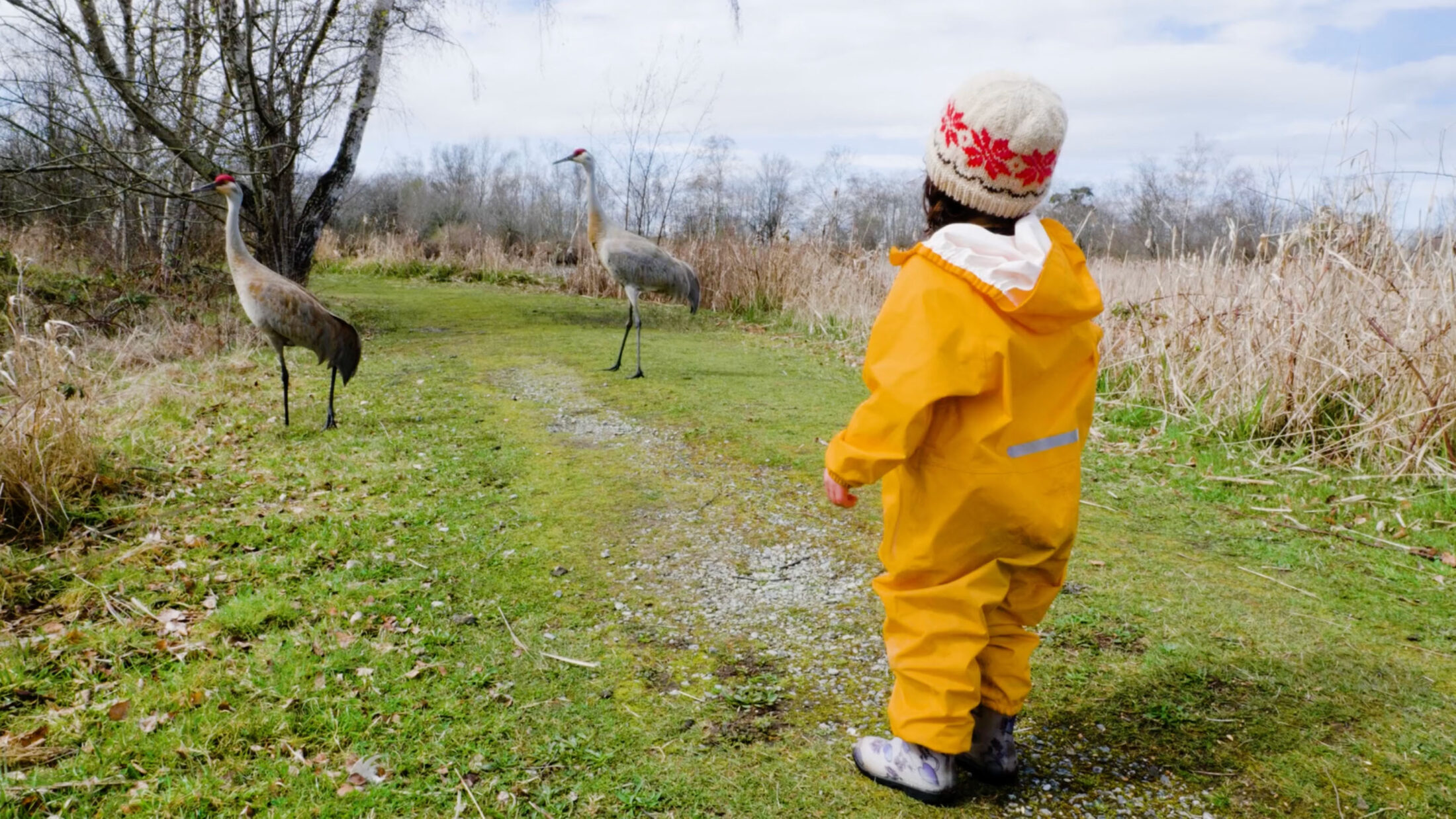
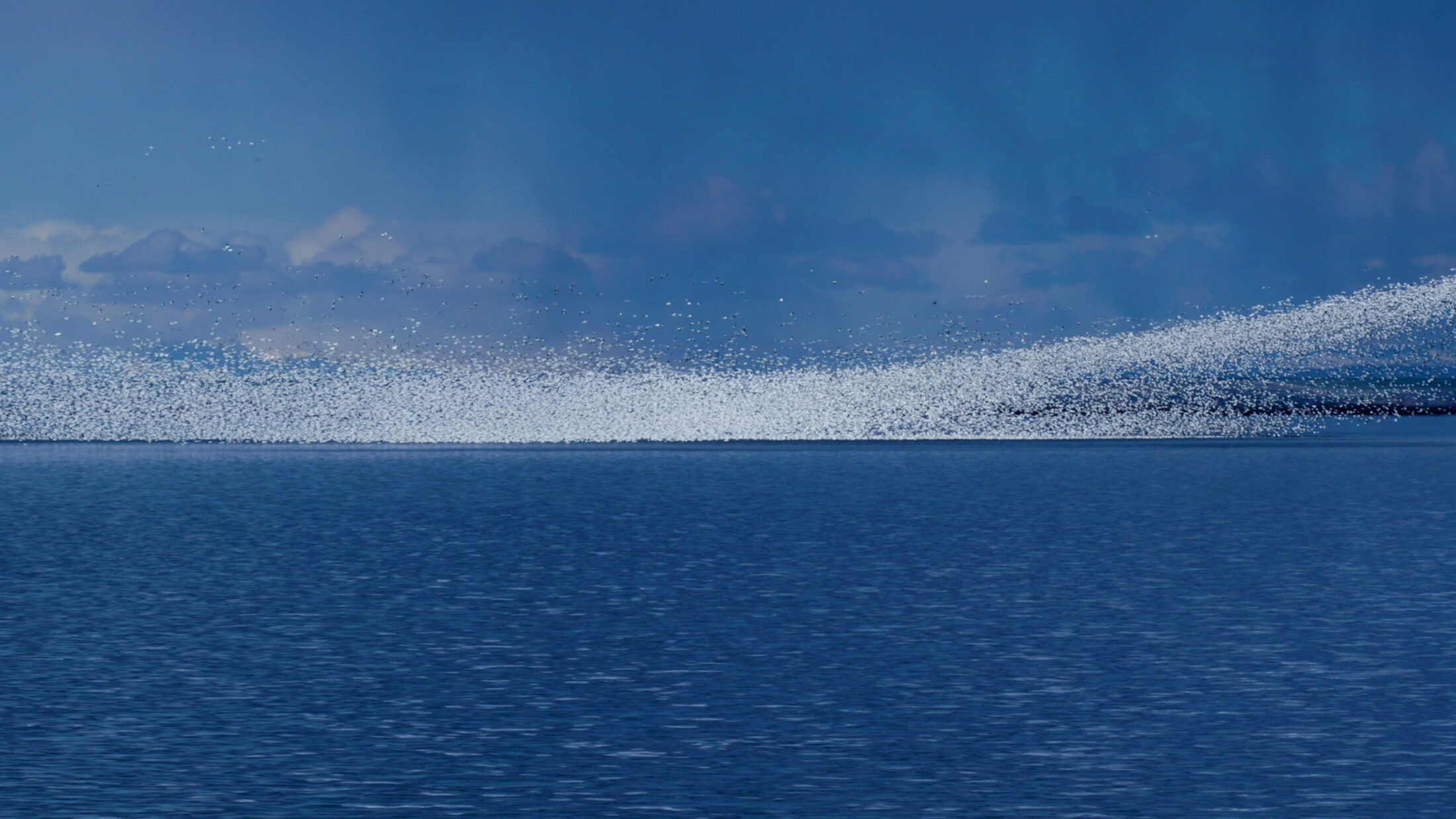
When animals wash across the land, we go to meet the migration. We camp at stopover sites, nestled between swaths of soybeans, to watch sandhill cranes and snow geese fill the sky. We wade into marshlands and stumble onto swans, floating off a delta island where the river meets the sea. We ferry to gulf islands to see the sea explode with all who come to feast on herring, streaks of deep-green seawater turning tropical turquoise in the haze of eggs. A few seasons later, we walk up rivers, greeting chinook, then pink, sockeye, chum, and finally zombie coho spawning out in the snow.
Barry Lopez describes migration as the land breathing. He sees it as one great breath, the light and animals drawn north, inhaled, held, then released south with an exhale. With your face in the wind of wing beats, in the pulsing of a thousand dunlins, in the bursts and blasts of hundreds of snow geese, it can feel like the land is breathing before you.
To the child, you can try to explain how far these birds have traveled, and how much farther they will go. What they’ll eat, where they’ll sleep, and how they find their way. You can try to describe how the salmon’s physiology changes as they leave the river for the sea, their years in the ocean, how they’ve come home to die. But the facts only make comprehension even harder. How can this be happening? All these geese are on their way from California to Chukotka?
The sense of bewilderment that migrating wildlife can bring offers a way “of merging with other systems of space and time,” as Jack Halberstam explains. The animals arrive and everything changes. The same place is a different world.
This practice is about letting wildness bewilder us.
Sakura
We live on unceded land, shared by the xwməθkwəy̓əm (Musqueam), Sḵwx̱wú7mesh (Squamish), and səlilwətaɬ (Tsleil-Waututh) Nations, whose seasonal sites and practices overlap here. The relationship between these Nations and their land sets the tone of this place. When we are welcomed at events, hear the songs, and encounter the unique aesthetic that emerged from this region; when we learn the proper names of our streams and mountains, seashores and great volcano, we feel more connected here.
The Sḵwx̱wú7mesh have more than a dozen names for the seasons, including temlháwt’ (herring time), tem tsá7tskay (plant shoot time), and ten eshcháwm (salmon spawning). Hən̓q̓əmin̓əm̓ (the language spoken by xwməθkwəy̓əm and səlilwətaɬ) includes as many, such as tem ćəm̓əx (herring roe), təm liĺə (salmonberry), and təmθə́qəy̓ (sockeye) seasons. Nearby, across the Salish Sea and among the islands, W̱SÁNEĆ (Saanich) seasons include Pexsisen (blossoming), Penáwen (harvest seaweed), and a series of salmon seasons: Ćenŧeki, Ćenhenen, Ćentáwen, and Ćenqolew. The Sockeye returns to Earth. The Humpback (Pink) returns. The Coho. The Dog (Chum) Salmon.
To learn how to live here, my partner and I look to First Nations friends and co-workers: artists and authors, in particular, among the many nations of the Stó:lō, the Salish Sea, the temperate rainforest stretching from the Klamath to the Alsek. We read their writing and watch their films, attend their events and shows, and their ideas linger. Years ago, we went to see a Lawrence Paul Yuxweluptun exhibit, in which he was calling for the renaming of British Columbia, noting how changing the name “will change our idea of where we are.” Ever since, I am careful in how I refer to our mountains, rivers, and sea, our volcano, spots, and places, especially when speaking of them with the kid.
I work for a Nation in the north and get to drop in on culture camps and fish camps, visit with gathered families, join hunts, and help pack out meat. I learn not only what to do on the land (and when), but how to behave as we do so. I get so many ideas from colleagues and friends, observing what they do, how they practice. I note how they change their practices too: for example, in response to communal concern for chinook or caribou.
But no matter how much my partner and I learn, as immigrants we carry cultures from afar. The traditions and practices we learned as children do not connect us to the land here, or its seasons, in the same way. We want to share our traditions with our children—and not be the ones to cleave them from their ancestors—but what sense do these distant practices make here?
We’re raising our children over a thousand miles from where each of us grew up, and farther from the lands of our great-grandparents. And all around us, many others are too. Their ways become part of living here as well. Together, we start to share each other’s seasonal practices. This is another way to learn to live here. To remember, while also adapting.
This practice is about learning the cultures of the land, and of each other. By attending seasonal festivals, and by sitting with the sakura, we honor practices outside our own.
Plucking as Prayer
Two years ago, snow line hung higher than ever. Our snowpack, the source of our water, was the lowest on record. The sakura seemed confused, blooming out of sync. Old trees lost large branches to unusually heavy, late, wet snows.
Four years ago, a week after the kid turned one, a heat dome descended upon us. Over twelve days, the heat killed over six hundred people. Most were elderly, and lived alone. All but a dozen died inside. Biologists at the University of British Columbia estimate a billion sea creatures perished: mussels, clams, and barnacles boiled alive as the dome refused to lift. Mobile and fortunate, we fled to a mountain river one day, tidal flats the next, seeking sanctuary from the heat. The sense of relative climate security we’d developed, nestled on our wet, temperate coast, instantly shattered. We came home and suffocated. Lingering in our memory is the feeling of heat that would not abate, even in the evening. How our bodies would not cool down, could not cool down, even at night. We found relief in the cold mountain water, and the slight sea breeze, but we don’t live or work there. We had to come home, and home was a hot you could not escape.
Where others have traditions to teach, classes for their children, very old stories to tell, I have but a feeling.
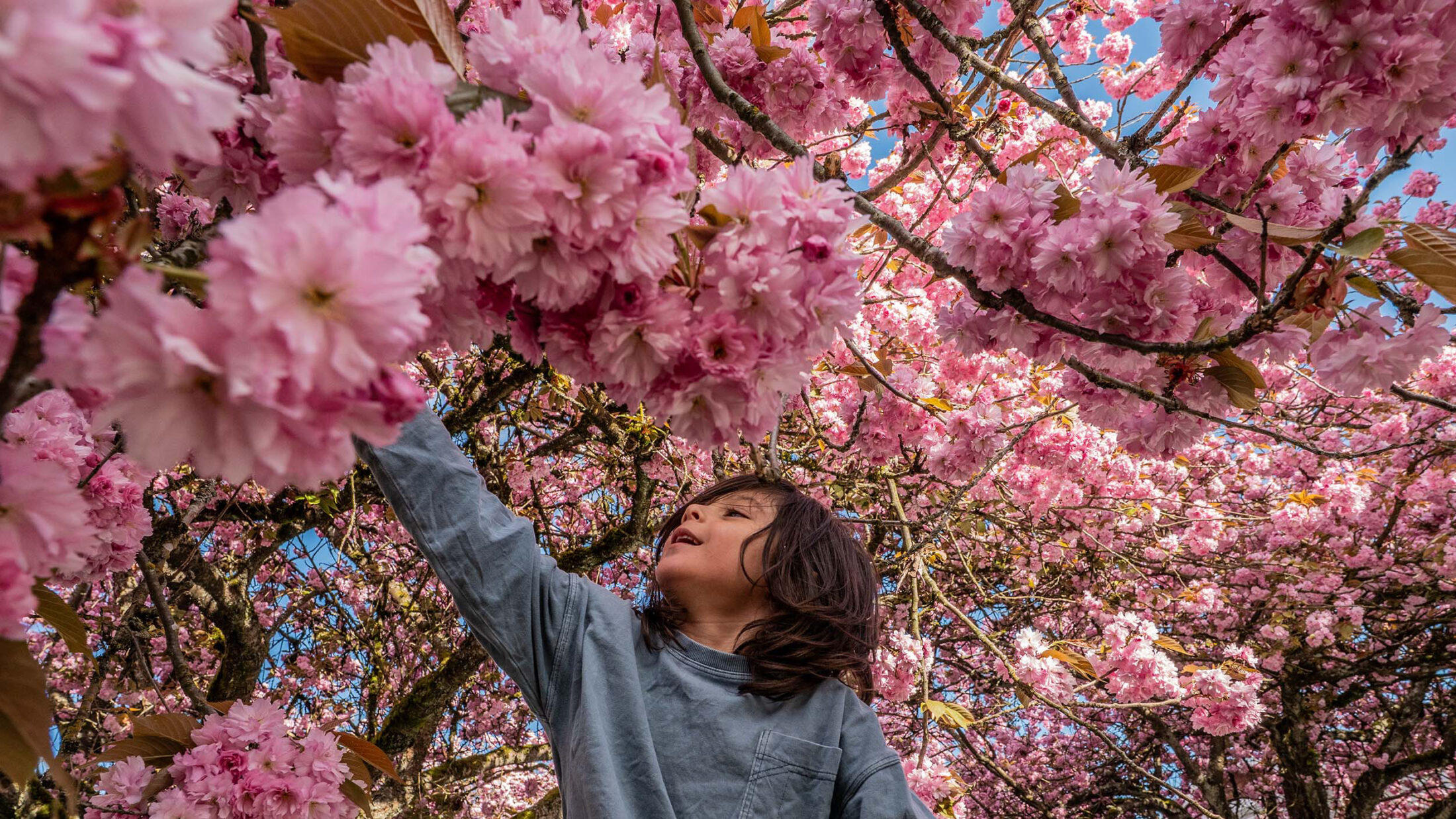
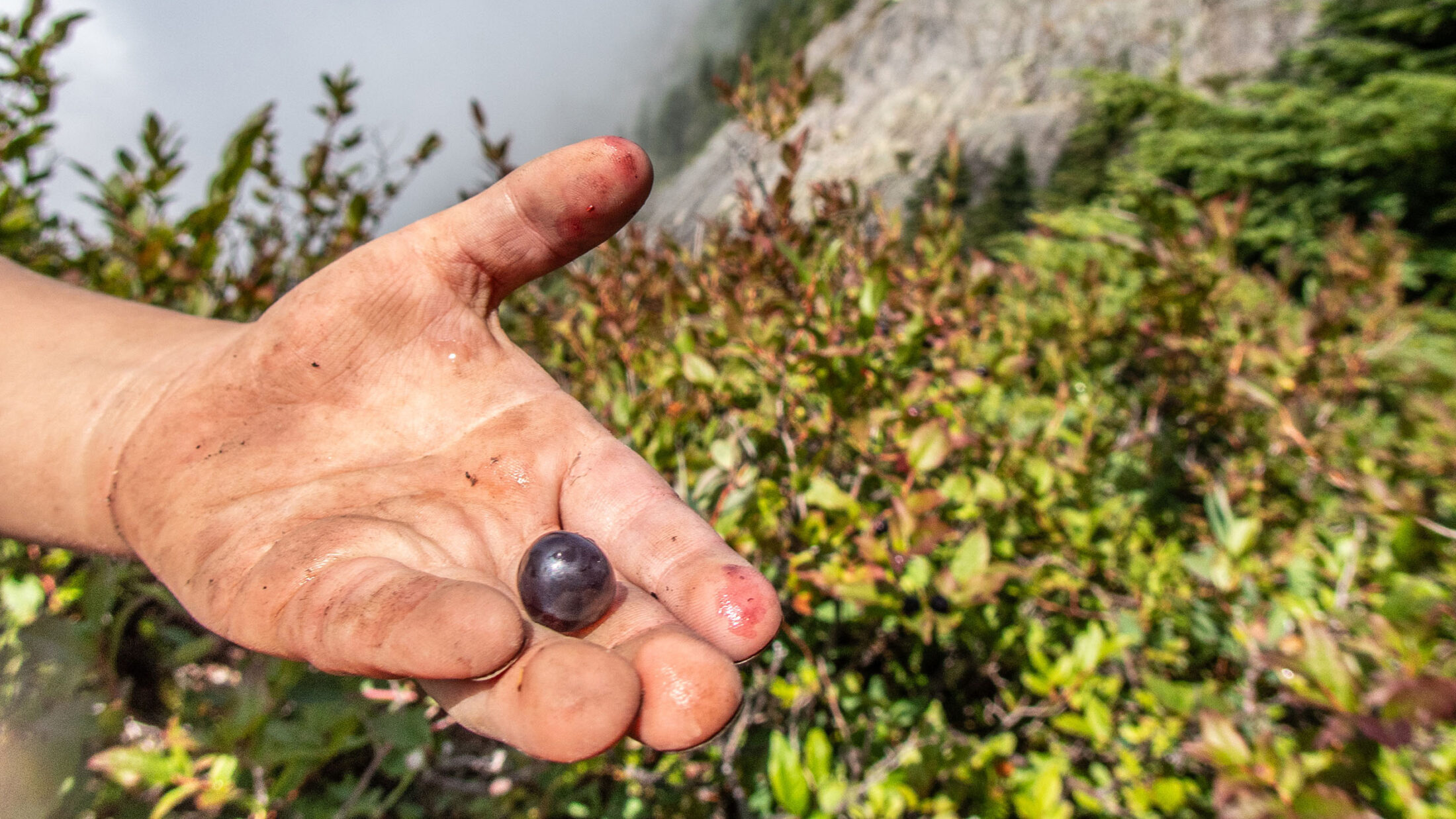
This time of year, it’s hard not to think of the heat dome. Or the wildfire smoke the years before and after. But this season can be glorious too. Rainy season, snow season, sky season, even salmon season, are all slippery and unpredictable. Not so with berry season. We notice as soon as the berry buds arrive, then return day after day in anticipation of the first fruit. Once the salmonberries show up, the rest follow fast. Thimbleberries, strawberries, salal, blackberries; red and purple and baby blue huckleberries, which taste a bit like banana. There may be no practice the kid enjoys more, no season easier to celebrate.
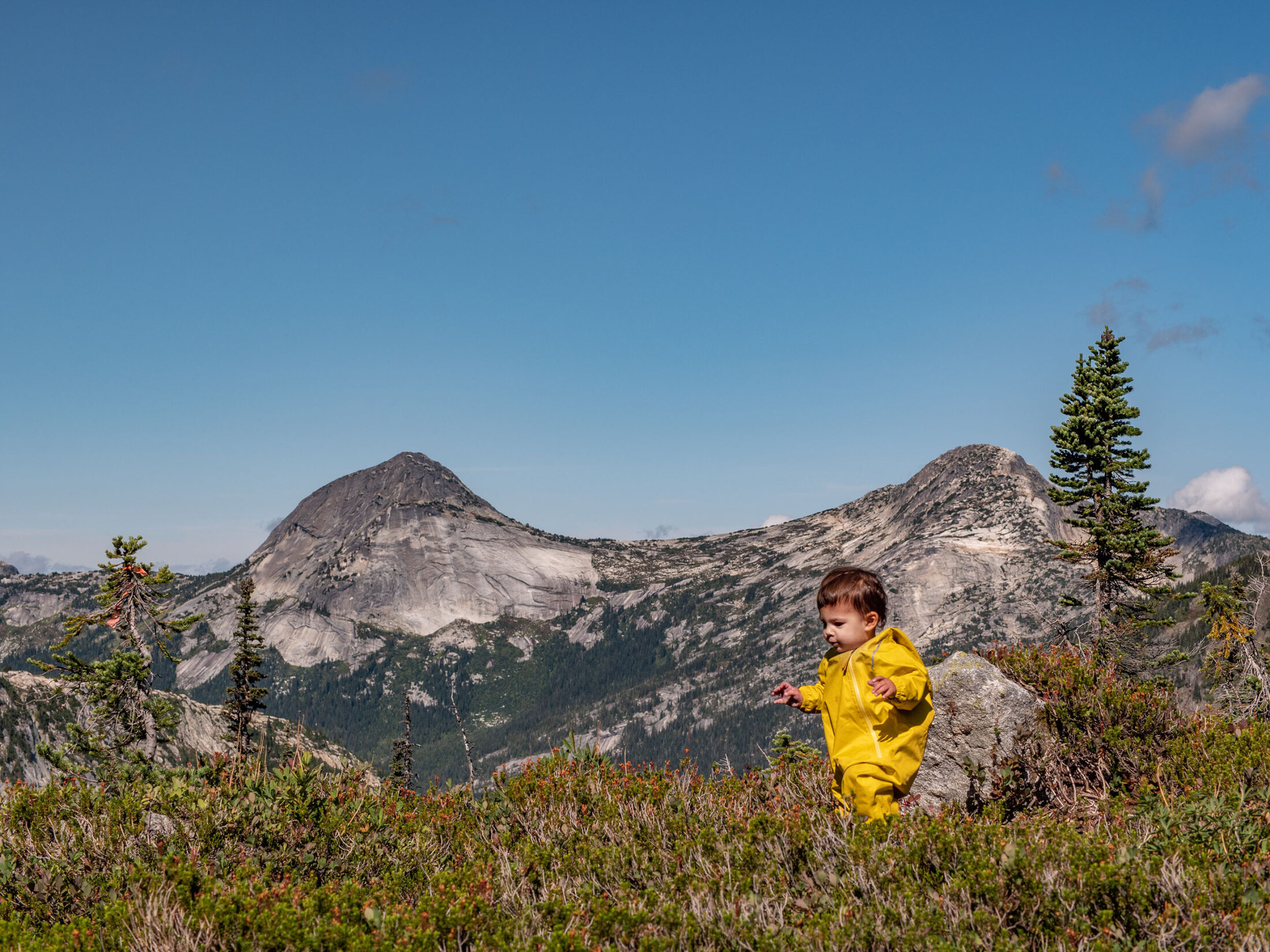
The practice is so simple: pick, pluck, pop it in your mouth. Taste the wild land, the short season. The best part may be how each berry tastes slightly different, distinct from the berry beside it, from itself if you were to pick it next week; how, in high mountain meadows, you literally wade through berry bushes, swimming in sweetness.
This practice is about intimacy with the land. Berry season is when you take it into the body.
A SHARED LANGUAGE
Many sense the mystical in the mountains. Trying to get the kid to feel the tingle too, you step into the numinousness, hoping the kid will follow, but only fall further in.
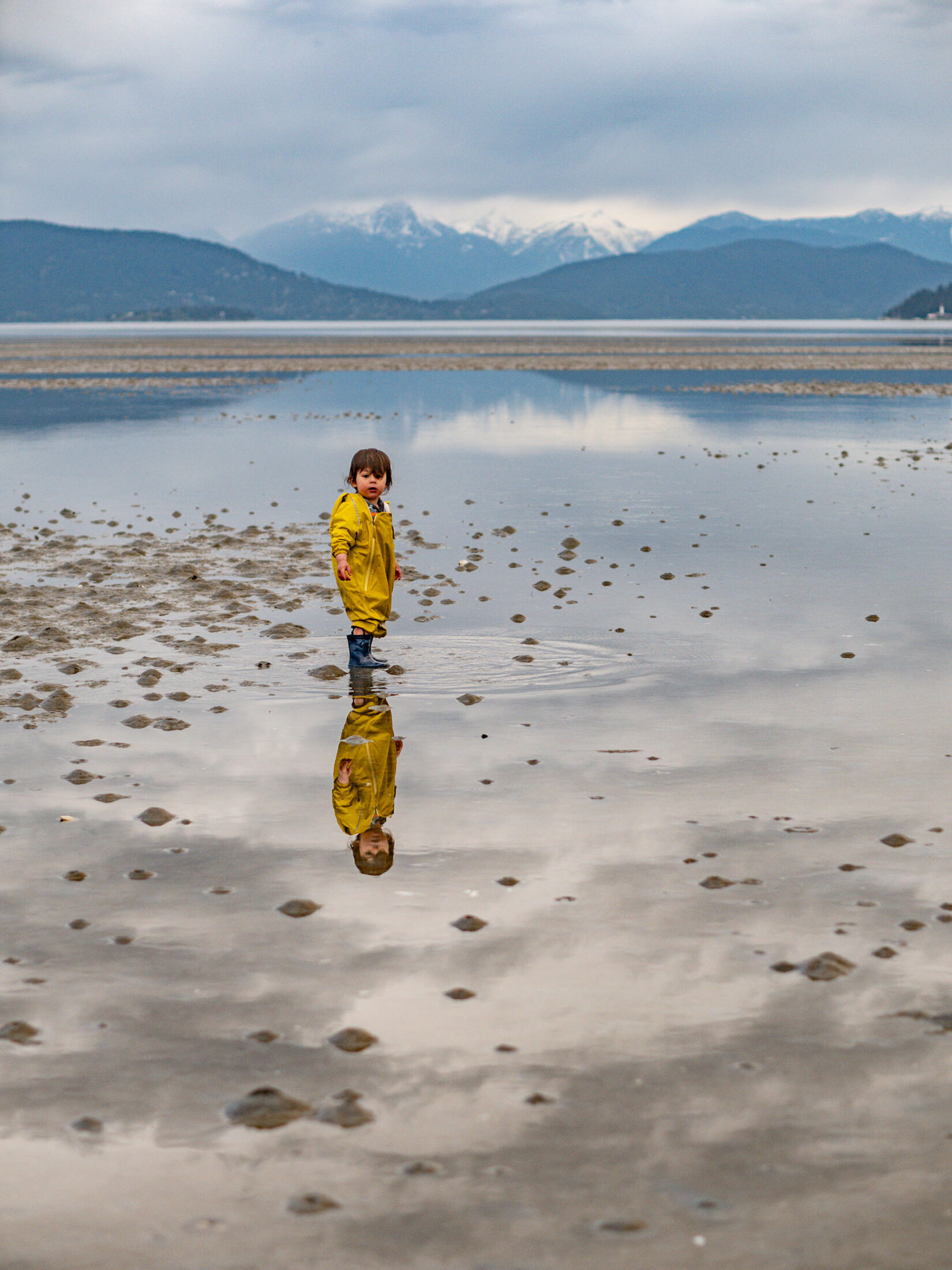
Watch a young child amble along an intertidal island, even as the shimmering sea slips in to reclaim it. The child, oblivious to the beauty, kneels to poke at a periwinkle, turns over a twisting mudflat snail shell in search of a hermit crab. At the edge of awe and aww is ecstasy. The sole sensation is of love, for the world, for the child, for how they inhabit each other.
If you must understand something to teach it, how do you pass on that which you lack the language to understand? Where others have traditions to teach, classes for their children, very old stories to tell, I have but a feeling. A sense of the spirits or souls of the land. I am reluctant to try and name any of this. But without names, unable to articulate this sense, how do I share it with our children?
The purpose of our practices is to create the time and space where the kids just might sense something too, in part through the way the seasonal shifts make the land feel so very alive. Our practices ask only this: go meet the season. We pray through pilgrimage, to snow line, to snow geese; to surreal sakura and thousand-year-old cedars; to salmonberries and salmon streams. This is how I learned to love the land, the seasons, the world. I hope, through these practices, our children come to love them too.
By returning to the same places at the same times each year—marshlands in the migration, sidewalks in the sakura, rainforests in the rain—our practices mature into rituals. But we lack community, a shared language. I worry that when our children are grown, they won’t have others to practice with. Even among those who love the land as they do, they may not recognize each other’s rituals.
I present our practices here in hope that others might do the same, and together we might develop prayers and practices our children someday share.
CREDITS
Featuring Rumi Amir Written, Narrated & Directed by adam amir Produced by adam amir & Noal Amir Executive Producer Emmanuel Vaughan-Lee Director of Photography adam amir Edited by adam amir Original Music Composed & Performed by Phillip Hermans Vocals Performed by Riga Amir Sound Design & Mix by Phillip Hermans Additional Sound Recording by Sunny Tseung Dall’s Porpoise Footage by Dr. Eric Keen, courtesy of Luke Padgett
A young priest was in charge of the garden in a famous temple. He had been given the job because he loved the flowers, shrubs, and trees.
Next to the temple there was another, smaller temple where there lived an older priest. One day, when the young priest was expecting some special guests, he took extra care in attending to the garden. He pulled the weeds, trimmed the shrubs, combed the moss, and spent a long time meticulously raking up and carefully arranging all the dry autumn leaves.
As he worked, the older priest watched him with interest from across the wall that separated the temples.
When he had finished, the young priest stood back to admire his work. “Isn’t it beautiful,” he called out to the older priest. “Yes,” replied the old man, “but there is something missing. Help me over this wall and I’ll put it right for you.”
After hesitating, the young priest lifted the old fellow over and set him down.
Slowly, the old priest walked to the tree near the center of the garden, grabbed it by the trunk, and shook it. Leaves showered down all over the garden.
“There,” said the old man, “you can put me back now.”
Oh never weep for love that’s dead Since love is seldom true But changes his fashion from blue to red, From brightest red to blue, And love was born to an early death And is so seldom true.
–Elizabeth Siddal, “Dead Love”
Elizabeth Eleanor Siddall, better known as Elizabeth Siddal (July 25, 1829 – February 11, 1862), was an English artist, art model, and poet. Siddal was perhaps the most significant of the female models who posed for the Pre-Raphaelite Brotherhood. Their ideas of female beauty were fundamentally influenced and personified by her. Wikipedia
We are living at a time of great chaos and confusion where fear and violence seem to be tearing our country apart. Wounded and rageful men are at the center of the storm. Anger turned outward can lead to murder, turned inward it can lead to suicide. In my last article, “From Artificial Intelligence (AI) to (RI) Real Intimacy: Getting the Love You’ve Always Wanted,” I shared ways this has impacted my own family and cited the work of other experts including Richard V. Reeves, Founder of the American Institute for Boys and Men.
These are challenging issues, and it is easy to get caught up in media-driven solutions that do not offer in-depth understanding that can lead to practical solutions. In an earlier article, “Warriors For the Human Spirit: Finding Your Path of Contribution in a World Out of Balance,” I offered some of my own findings from my book, The Warrior’s Journey Home: Healing Men, Healing the Planet. I quoted Buddhist scholar Chögyam Trungpa who said,
“Warriorship here does not refer to making war on others. Aggression is the source of our problems, not the solution. Here the word ‘warrior’ is taken from the Tibetan pawo which literally means ‘one who is brave.’ Warriorship in this context is the tradition of human bravery, or the tradition of fearlessness. Warriorship is not being afraid of who you are.”
The History of Humanity and Our Place in the Community of Life on Planet Earth
Who are we and what does it mean to be human these days? In her extensively researched and authoritative new book, The Arrogant Ape: The Myth of Human Exceptionalism and Why It Matters, primatologist and Harvard Professor Dr. Christine Webb, says that classifying humans as Homo sapiens sapiens — the wisest of the wise — may be more arrogance and wishful thinking that evolutionary fact.
Humans are a very new group of animals who have been recently added to the community of life.
“If we condense earth’s 4.6-billion year history into a 46-year timeline, humans have existed for only four hours, and the Industrial Revolution began just one minute ago.”
To begin to understand what it means to be human and the challenges we face today we must greatly broaden our perspective. In their book, The Universe Story, cosmologist Dr. Brian Swimme and cultural historian Dr. Thomas Berry detail the following: history:
Our home planet Earth was formed 4.6 billion years ago.
Lifefirst appeared in the oceans 4.0 billion years ago.
Plants and animals began evolving 550 million years ago.
Humans emerged 2.6 million years ago.
For most of human history humans saw themselves as equal partners in the community of life. When did things start to go wrong? In their book, Nurturing Our Humanity: How Domination and Partnership Shape Our Brains, Lives, and Future, Dr. Riane Eisler, President of the Center for Partnership Studies and anthropologist Dr. Douglas P. Fry say,
“Nomadic foragers — also called nomadic hunter-gatherers — constitute the oldest form of human social organization, predating by far the agricultural revolution of about 10,000 years ago.”
Eisler and Fry describe our earliest human ancestors as “The Original Partnership Societies” and say they shared the following characteristics:
Overall egalitarian
Equality, respect, and partnership between women and men.
Nonacceptance of violence, war, abuse, cruelty, and exploitation.
Ethics that support human caring, prosocial cooperation, and flourishing.
They contrast partnership systems with ones based on characteristics of domination:
Rigid top-down rankings, hierarchies of domination are maintained through physical, psychological, and economic control in familial, religious, political, economic and other social institutions.
Ranking of one form of humanity over the other. Theoretically, this could be the female half over the male half, but historically it has been the ranking of males over females, and with this, the idealization of traits that are in domination systems equated with masculinity, such as “manly” conquest and “heroic” violence.
The cultural acceptance of abuse and violence, from child-and-wife beating to slavery and warfare.
Beliefs that rankings of domination are inevitable, even moral.
The Myth of Human Exceptionalism Underlies Our Deepening Disconnection With the Community of Life on Planet Earth
In The Arrogant Ape, Christine Webb offers a great deal of evidence to demonstrate that most of our current problems are caused by the false belief that humans are above and apart from the rest of the community of life on planet Earth:
“Human exceptionalism — a.k.a. anthropocentrism or human supremacy — is at the root of the ecological crisis. This pervasive mindset give humans a sense of dominion over Nature, set apart from and entitled to commodify the earth and others species for our own exclusive benefit. And its back-firing on us today, spurring forest fires, sea level rise, mass extinctions, and pandemics like the coronavirus.”
Thomas Berry believes the very survival of humanity is at risk.
“So long as we are under the illusion that we know best what is good for the earth and for ourselves, then we will continue our present course, with its devastating consequences on the entire Earth community. We never knew enough. Nor were we sufficiently intimate with all our cousins in the great family of the earth. Nor could we listen to the various creatures of the earth, each telling its own story. The time has now come, however, when we will listen or we will die.”
Returning to Our Partnership Roots and Reconnecting With the Natural World
In my years working with people addicted to drugs, I learned that the addictive mindset comes to believe that the solution to their pain and suffering is their alcohol, cocaine, or some other drug or activity that promises relief, but offers more pain and suffering. Addicts become like confused homing pigeons flying faster and faster in the wrong direction. Recovery begins when we give up our mistaken belief that we can fix our problem on our own and admit with humility that we need to rely on a higher power.
Our old story tells us that to survive and thrive we must dominate nature. The new story, or more accurately, a return to an earlier story that we were living for more than 99% of human history was a story indigenous cultures all over the world are still enacting and if we can let go of our arrogance we can once again find the peace and prosperity that is our birth right.
Christine Webb says,
“This pivotal ecological moment can be seen either optimistically or pessimistically, but I favor neither. Instead, I tend toward hope. Optimism and pessimism are probabilistic; they proclaim to know the odds, and await a better or worse future. Hope, on the other hand, centers on potential and uncertainty — it’s about not knowing. In other words, hope is more aligned with humility.”
She concludes saying,
“Hope arises when we realize that human exceptionalism is not an inherent trait, not a bias we’re born with. Rather, it’s a role we’ve assumed thanks to a cultural story we’ve inherited.”
We each can do our part to enact a new story, but first we need to let go of the old one. The good news is that we are not alone and together we can change our lives and the world for good. I appreciate your feedback and ideas. I invite you to visit me at MenAlive.com or drop me an email to Jed@MenAlive.com.
Best Wishes,
Jed Diamond
Founder and VHS (Visionary Healer Scholar) of MenAlive
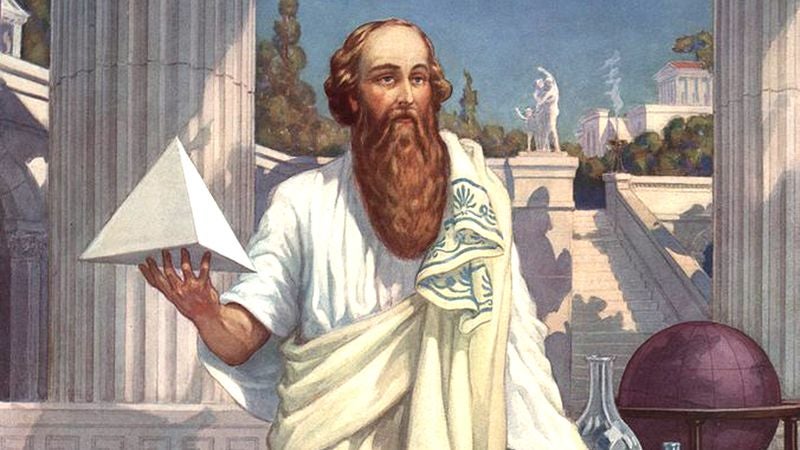
CAMBRIDGE, MA—A trove of recently unearthed documents dating back to the sixth century B.C. has revealed that the ancient Greek philosopher and mathematician Pythagoras wrote dozens of elaborate, unhinged conspiracy theorems pertaining to triangles, researchers announced Wednesday.
Upon examining a cache of papyrus scrolls found while excavating a site near the modern Italian city of Crotone, a team of historians and classical scholars at Harvard University discovered previously unknown writings by Pythagoras and others that suggest the philosopher was obsessed with proving triangles played a powerful but highly secretive role in the world he inhabited, controlling nearly every aspect of life.
“These conspiracy theorems shed new light on this historic figure, who was apparently suspicious of the fact that all triangles have interior angles adding up to 180 degrees, believing this was evidence that they were united in hiding some sort of covert agenda,” said Professor Janet Boisvert, who found among the artifacts an alternative version of the Pythagorean theorem in which Pythagoras concluded that the square of the hypotenuse of a right triangle was equal to the sum of “all the lies embodied by these cursed triangles!” “One scroll is 35 feet long and contains nothing but a rambling series of postulates attempting to demonstrate the existence of a triangle with three obtuse angles that he thought was being kept under wraps by the government.”
“Pythagoras also stayed up every night for two years working on formulas he believed would prove the Great Pyramid at Giza was a hoax perpetrated by pro-triangle propagandists,” she added.
According to Boisvert, Pythagoras’ fixation on conspiracy theorems was described in the written accounts of his students, who recalled visiting his private study and finding the walls, the tables, and nearly every available surface covered in intricate equations and charts depicting hundreds of scalene, isosceles, and equilateral triangles. One student noted that Pythagoras always seemed worried by the sheer number of triangles he saw around him, and he became extremely distraught one day upon realizing that quadrilaterals, which he had until then considered innocuous, were in fact nothing more than two triangles combined.
This paranoia is further corroborated by the diary entry of a goatherd who described an elderly mathematician wandering the streets of Metapontum and warning complete strangers about the sails of ships, the shapes of their own noses, and the encroaching power of the trigonocracy.
“We are now able to conclusively identify Pythagoras as the unnamed figure in the Histories of Herodotus who storms into a polis council meeting waving pages scrawled with formulas and screaming, ‘Triangles are all around us, hidden in every shape, and I have the proofs!’ before being escorted out,” Boisvert said. “He continued to demand the truth from local magistrates, having hypothesized that triangles had a fourth, invisible side that those in power didn’t want him to know about.”
“It’s likely that by this point, his obsession with conspiracy theorems had begun to take a toll on his home life,” she continued. “We know an increasingly isolated Pythagoras was left by his wife and four children around 515 B.C., shortly after he accused they themselves of being triangles.”
Documents indicate Pythagoras went on to live a hermetic existence in the foothills of Mount Parnassus, until the realization that even the mountain itself had a triangular shape eventually drove him to suicide.
FIVE MINUTE NEWS Oct 5, 2025 THE WEEKEND SHOW with MeidasTouch Political Science Professor Corey Brettschneider joins Anthony Davis to explain the parallels between Trump’s White House and the turbulence of past administrations and gives some hope on how, ultimately, the people will win out over the President, in the restoration of America, it’s laws and it’s values.
Image caption,Nigel Hawthorne in the National Theatre production of The Madness of George III
Modern medicine may help us to discover the real reasons behind King George III’s erratic behaviour, writes historian Lucy Worsley.
George III is well known in children’s history books for being the “mad king who lost America”.
In recent years, though, it has become fashionable among historians to put his “madness” down to the physical, genetic blood disorder called porphyria. Its symptoms include aches and pains, as well as blue urine.
The theory formed the basis of a long-running play by Alan Bennett, The Madness of George III, which was later adapted for film starring Nigel Hawthorne in the title role.
However, a new research project based at St George’s, University of London, has concluded that George III did actually suffer from mental illness after all.
Using the evidence of thousands of George III’s own handwritten letters, Dr Peter Garrard and Dr Vassiliki Rentoumi have been analysing his use of language. They have discovered that during his episodes of illness, his sentences were much longer than when he was well.
A sentence containing 400 words and eight verbs was not unusual. George III, when ill, often repeated himself, and at the same time his vocabulary became much more complex, creative and colourful.
These are features that can be seen today in the writing and speech of patients experiencing the manic phase of psychiatric illnesses such as bipolar disorder.
Mania, or harmful euphoria, is at one end of a spectrum of mood disorders, with sadness, or depression, at the other. George’s being in a manic state would also match contemporary descriptions of his illness by witnesses.
They spoke of his “incessant loquacity” and his habit of talking until the foam ran out of his mouth. Sometimes he suffered from convulsions, and his pages had to sit on him to keep him safe on the floor.
The researchers have even thrown doubt on one of the key planks in the case for porphyria, the blue urine. George III’s medical records show that the king was given medicine based on gentian. This plant, with its deep blue flowers, is still used today as a mild tonic, but may turn the urine blue.
So maybe it wasn’t the king’s “madness” that caused his most famous symptom. It could have simply been his medicine.
I interviewed the researchers at St George’s for a new documentary series, Fit To Rule: How Royal Illness Changed History.
In this series, I re-examine our kings and queens as individual members of the human race, rather than just as impregnable icons of splendour and power. They suffered many of exactly the same biological and psychological weaknesses as the rest of us – only with rather more serious consequences.
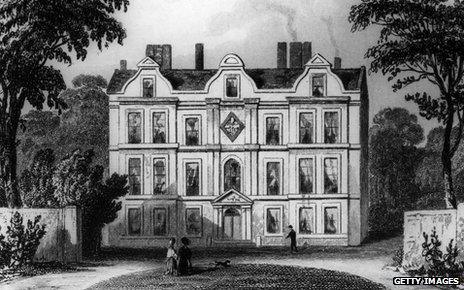
George III’s recurring bouts of illness caused him to withdraw from daily business to recuperate out of the public eye at secluded Kew Palace, near Richmond.
Each time he withdrew to Kew, this triggered a crisis – who was to make decisions in his absence?
His son, the Prince of Wales, with whom George III had a terrible relationship, wanted to be appointed regent, and to act as the king in everything but name. But the future George IV was very much associated with the political opposition, and the government was determined to keep him out.
Strikingly, although the crisis caused a good deal of arguing, it was in fact resolved quite easily. This was partly because the king just got better (despite the bizarre and sometimes inhumane treatments given to him by the royal doctors) and partly because he was, by this stage in British history, a constitutional king.
When the Hanoverians had been invited over from Germany in 1714 to take the throne after the failure of the Stuart line, they came at the invitation of Parliament. Parliament therefore held the whip hand over them, and the powers of the monarchy declined.
But despite his illness, George III was a dedicated and diligent king, and won the respect of his politicians. In fact, when his illness drove him off the political scene, they realised how much they needed his calming effect on their squabbles.
It is counter-intuitive to suggest it, but royal health issues can actually strengthen the monarchy, not least by creating sympathy and affection for an afflicted individual.
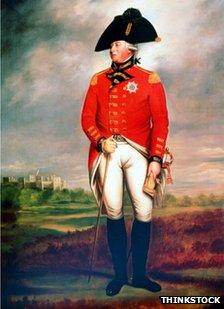
Image caption,George III ruled for 60 years
Garrard also points out how the explanations or diagnoses that we come up with for patients in the past reflect our own current attitudes to sickness and health. One of the reasons that the porphyria argument caught on is because it seemed to remove the supposed stigma of mental health issues from the Royal Family.
And yet, as Garrard notes, porphyria opened up a different set of problems, because as an hereditable illness, George IV, and indeed other members of the Royal Family, became candidates for diagnosis too.
The research project still continues, but Garrard is already confident of one thing. “The porphyria theory is completely dead in the water. This was a psychiatric illness.”
But it certainly did not stop George III from being a successful king. In a prosperous, industrialising Britain, it was growing more important for a monarch to reign rather than rule, providing background stability rather than aggressive leadership.
With his 60-year reign, George III certainly provided continuity, and I believe that his short episodes of illness tend unfairly to diminish our views of him.
Out of the night that covers me, Black as the Pit from pole to pole, I thank whatever gods may be For my unconquerable soul. In the fell clutch of circumstance I have not winced nor cried aloud. Under the bludgeonings of chance My head is bloody, but unbowed. Beyond this place of wrath and tears Looms but the Horror of the shade, And yet the menace of the years Finds, and shall find, me unafraid. It matters not how strait the gate, How charged with punishments the scroll, I am the master of my fate: I am the captain of my soul.
This poem is in the public domain.
William Ernest Henley, born August 23, 1849, was an influential British poet, perhaps best known for his poem “Invictus” (1875). He is the author of A Song of Speed (D. Nutt, 1903), Hawthorn & Lavender with Other Verses (D. Nutt, 1901), and For England’s Sake: Verses and Songs in Time of War (D. Nutt, 1900), among others. He died in Woking, England, on July 11, 1903.
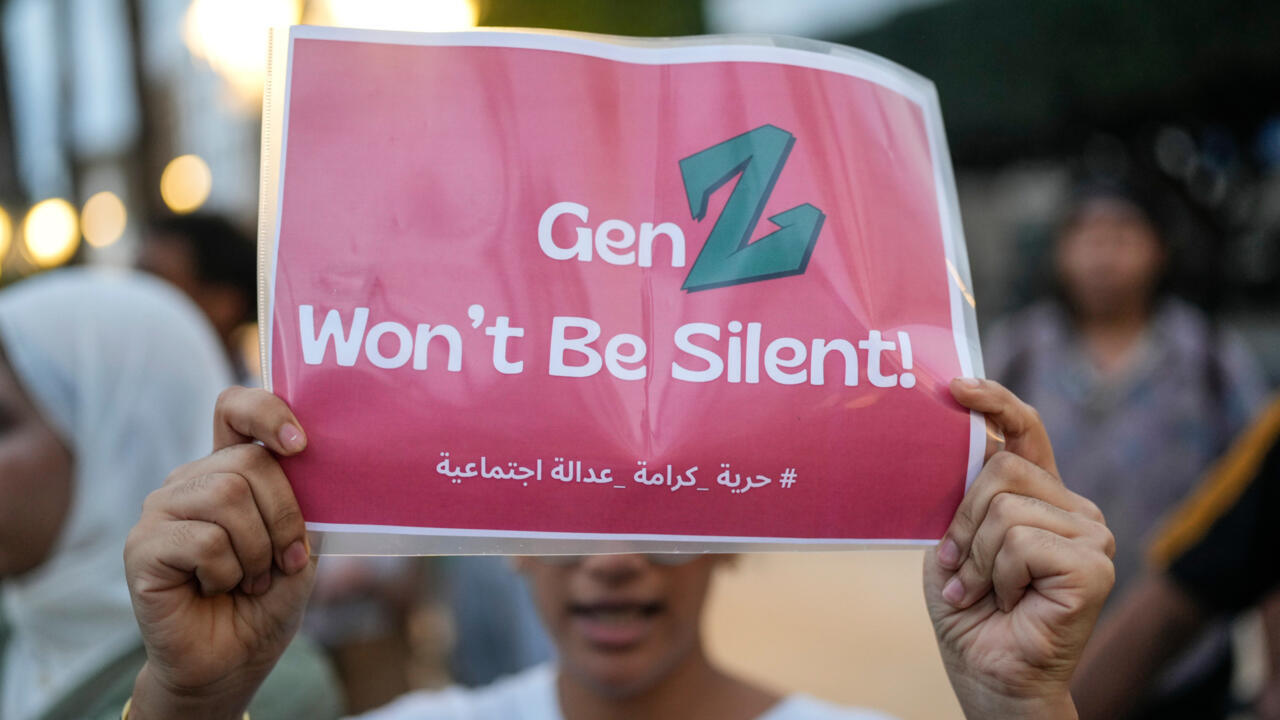
Members of Moroccan online youth collective GenZ 212 protested for the eighth consecutive day on Saturday, demanding better public health and education services. The online group, which has more than 180,000 members on Discord, insists on the nonviolent nature of its protests, and the gatherings since then have been largely peaceful.
Members of a Moroccan online youth collective protested for the eighth consecutive day on Saturday, demanding better public health and education services.
The demonstrations in the usually stable North African kingdom have bucked the perception of young Moroccans as being politically disengaged, and have been organised since last Saturday by GenZ 212, a group active on the web platform Discord.
In Tetouan, in the north of the country, hundreds of people gathered, chanting slogans such as “The people want an end to corruption” and “Freedom, dignity and social justice”, local media reported.
In the western city of Casablanca, protesters shouted “The people want education and health”, while in the capital, Rabat, a dozen people gathered in front of parliament, an AFP photographer said.
GenZ 212, whose founders remain anonymous, earlier on Discord called for protests in 14 cities between 6:00 pm (1700 GMT) and 9:00 pm.
They want reforms to social services, particularly healthcare and education, as well as an end to corruption and the resignation of Prime Minister Aziz Akhannouch, whose tenure ends next year.
On Friday evening, hundreds of people rallied in numerous cities, including Rabat and Agadir.
Two days earlier, there were reports of violence in several smaller towns, with three people killed by police “in legitimate defence” after they allegedly tried to storm a station in the village of Lqliaa, near Agadir, the authorities said.
GenZ 212, which has more than 180,000 members on Discord, insists on the nonviolent nature of its protests, and the gatherings since then have been largely peaceful.
The rallies follow on from isolated protests that broke out in mid-September in several cities after reports of the deaths of eight pregnant women at the public hospital in Agadir who had been admitted for cesarean sections.
Demonstrators have seized on the deaths as evidence of the public health sector’s shortcomings, feeding wider discontent over social inequalities.
(FRANCE 24 with AFP)
Consciousness, sexuality, androgyny, futurism, space, the arts, science, astrology, democracy, humor, books, movies and more

It is lovely to be in an artistic atmosphere again. I realize now, more than ever before, that I can never live wholly without it. It feels so heavenly to be able to just sit in front of the fire & talk for hours — of cabbages & kings — poetry, literature, art, music, philosophy, religion. It’s wonderful, marvellous, terrific… I will stop now, because I have to wash my hair.