Is Life a Form of Computation?

Alan Turing and John von Neumann saw it early: the logic of life and the logic of code may be one and the same.

Image source: Miguel Romero, Adobe Stock

By: Blaise Agüera y Arcas

(thereader.mitpress.mit.edu)

In 1994, a strange, pixelated machine came to life on a computer screen. It read a string of instructions, copied them, and built a clone of itself — just as the Hungarian-American Polymath John von Neumann had predicted half a century earlier. It was a striking demonstration of a profound idea: that life, at its core, might be computational.
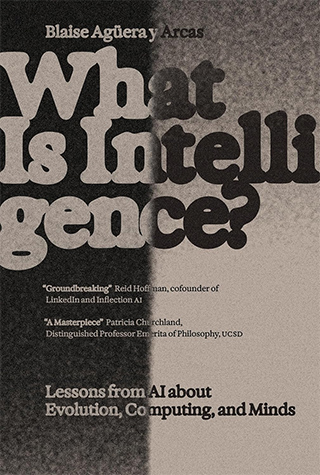
This article is adapted from Blaise Agüera y Arcas’s book “What Is Intelligence?” An open access edition of the book is available here.

Although this is seldom fully appreciated, von Neumann was one of the first to establish a deep link between life and computation. Reproduction, like computation, he showed, could be carried out by machines following coded instructions. In his model, based on Alan Turing’s Universal Machine, self-replicating systems read and execute instructions much like DNA does: “if the next instruction is the codon CGA, then add an arginine to the protein under construction.” It’s not a metaphor to call DNA a “program” — that is literally the case.

Of course, there are meaningful differences between biological computing and the kind of digital computing done by a personal computer or your smartphone. DNA is subtle and multilayered, including phenomena like epigenetics and gene proximity effects. Cellular DNA is nowhere near the whole story, either. Our bodies contain (and continually swap) countless bacteria and viruses, each running their own code.

It’s not a metaphor to call DNA a “program” — that is literally the case.

Biological computing is “massively parallel,” decentralized, and noisy. Your cells have somewhere in the neighborhood of 300 quintillion ribosomes, all working at the same time. Each of these exquisitely complex floating protein factories is, in effect, a tiny computer — albeit a stochastic one, meaning not entirely predictable. The movements of hinged components, the capture and release of smaller molecules, and the manipulation of chemical bonds are all individually random, reversible, and inexact, driven this way and that by constant thermal buffeting. Only a statistical asymmetry favors one direction over another, with clever origami moves tending to “lock in” certain steps such that a next step becomes likely to happen.

This differs greatly from the operation of “logic gates” in a computer, basic components that process binary inputs into outputs using fixed rules. They are irreversible and engineered to be 99.99 percent reliable and reproducible.

Biological computing is computing, nonetheless. And its use of randomness is a feature, not a bug. In fact, many classic algorithms in computer science also require randomness (albeit for different reasons), which may explain why Turing insisted that the Ferranti Mark I, an early computer he helped to design in 1951, include a random number instruction. Randomness is thus a small but important conceptual extension to the original Turing Machine, though any computer can simulate it by calculating deterministic but random-looking or “pseudorandom” numbers.

Parallelism, too, is increasingly fundamental to computing today. Modern AI, for instance, depends on both massive parallelism and randomness — as in the parallelized “stochastic gradient descent” (SGD) algorithm, used for training most of today’s neural nets, the “temperature” setting used in chatbots to introduce a degree of randomness into their output, and the parallelism of Graphics Processing Units (GPUs), which power most AI in data centers.

Traditional digital computing, which relies on the centralized, sequential execution of instructions, was a product of technological constraints. The first computers needed to carry out long calculations using as few parts as possible. Originally, those parts were flaky, expensive vacuum tubes, which had a tendency to burn out and needed frequent replacement by hand. The natural design, then, was a minimal “Central Processing Unit” (CPU) operating on sequences of bits ferried back and forth from an external memory. This has come to be known as the “von Neumann architecture.”

Turing and von Neumann were both aware that computing could be done by other means, though. Turing, near the end of his life, explored how biological patterns like leopard spots could arise from simple chemical rules, in a field he called morphogenesis. Turing’s model of morphogenesis was a biologically inspired form of massively parallel, distributed computation. So was his earlier concept of an “unorganized machine,” a randomly connected neural net modeled after an infant’s brain.

These were visions of what computing without a central processor could look like — and what it does look like, in living systems.

Von Neumann also began exploring massively parallel approaches to computation as far back as the 1940s. In discussions with Polish mathematician Stanisław Ulam at Los Alamos, he conceived the idea of “cellular automata,” pixel-like grids of simple computational units, all obeying the same rule, and all altering their states simultaneously by communicating only with their immediate neighbors. With characteristic bravura, von Neumann went so far as to design, on paper, the key components of a self-reproducing cellular automaton, including a horizontal “tape” of cells containing instructions and blocks of cellular “circuitry” for reading, copying, and executing them.

Designing a cellular automaton is far harder than ordinary programming, because every cell or “pixel” is simultaneously altering its own state and its environment. Add randomness and subtle feedback effects, as in biology, and it becomes even harder to reason about, “program,” or “debug.”

With characteristic bravura, von Neumann went so far as to design, on paper, the key components of a self-reproducing cellular automaton.

Nonetheless, Turing and von Neumann grasped something fundamental: Computation doesn’t require a central processor, logic gates, binary arithmetic, or sequential programs. There are infinite ways to compute, and, crucially, they are all equivalent. This insight is one of the greatest accomplishments of theoretical computer science.

This “platform independence” or “multiple realizability” means that any computer can emulate any other one. If the computers are of different designs, though, the emulation may be glacially slow. For that reason, von Neumann’s self-reproducing cellular automaton has never been physically built — though that would be fun to see!

That demonstration in 1994 — the first successful emulation of von Neumann’s self-reproducing automation — couldn’t have happened much earlier. A serial computer requires serious processing power to loop through the automaton’s 6,329 cells over the 63 billion time steps required for the automaton to complete its reproductive cycle. Onscreen, it worked as advertised: a pixelated two-dimensional Rube Goldberg machine, squatting astride a 145,315-cell–long instruction tape trailing off to the right, pumping information out of the tape and reaching out with a “writing arm” to slowly print a working clone of itself just above and to the right of the original.

It’s similarly inefficient for a serial computer to emulate a parallel neural network, heir to Turing’s “unorganized machine.” Consequently, running big neural nets like those in Transformer-based chatbots has only recently become practical, thanks to ongoing progress in the miniaturization, speed, and parallelism of digital computers.

In 2020, my colleague Alex Mordvintsev combined modern neural nets, Turing’s morphogenesis, and von Neumann’s cellular automata into the “neural cellular automaton” (NCA), replacing the simple per-pixel rule of a classic cellular automaton with a neural net. This net, capable of sensing and affecting a few values representing local morphogen concentrations, can be trained to “grow” any desired pattern or image, not just zebra stripes or leopard spots.

Real cells don’t literally have neural nets inside them, but they do run highly evolved, nonlinear, and purposive “programs” to decide on the actions they will take in the world, given external stimulus and an internal state. NCAs offer a general way to model the range of possible behaviors of cells whose actions don’t involve movement, but only changes of state (here, represented as color) and the absorption or release of chemicals.

The first NCA Alex showed me was of a lizard emoji, which could regenerate not only its tail, but also its limbs and head! It was a powerful demonstration of how complex multicellular life can “think locally” yet “act globally,” even when each cell (or pixel) is running the same program — just as each of your cells is running the same DNA. Simulations like these show how computation can produce lifelike behavior across scales. Building on von Neumann’s designs and extending into modern neural cellular automata, they offer a glimpse into the computational underpinnings of living systems.


Blaise Agüera y Arcas is a VP/Fellow at Google, where he is the CTO of Technology & Society, and the founder of Paradigms of Intelligence, an organization dedicated to fundamental AI research. He is the author of “What Is Intelligence?,” from which this article is adapted. An open access edition of the book is available here.

Scofield Reference Bible

From Wikipedia, the free encyclopedia

Scofield Reference Bible
1917 edition of the Scofield Bible
Other namesKJV Scofield Study Bible
LanguageEnglish
Complete Bible
published
1909
Online asScofield Reference Bible at Wikisource
AuthorshipCyrus I. Scofield (editor)
Derived fromKing James Version
Revision1917
PublisherOxford University Press
Religious affiliationDispensationalism
Websitescofieldbible.org
showGenesis 1:1–3showJohn 3:16

The Scofield Reference Bible is a widely circulated study Bible. Edited and annotated by the American Bible student Cyrus I. Scofield, it popularized dispensationalism at the beginning of the 20th century. Published by Oxford University Press and containing the entire text of the traditional, Protestant King James Version, it first appeared in 1909 and was revised by the author in 1917.[1]

Features

Scofield Reference Bible, page 1115. This page includes Scofield’s note on John 1:17.

The Scofield Bible had several innovative features. Most important, it printed what amounted to a commentary on the biblical text alongside the Bible instead of in a separate volume, the first to do so in English since the Geneva Bible (1560).[2] It also contained a cross-referencing system that tied together related verses of Scripture and allowed a reader to follow biblical themes from one chapter and book to another (so called “chain references”). Finally, the 1917 edition also attempted to date events of the Bible. It was in the pages of the Scofield Reference Bible that many Christians first encountered Archbishop James Ussher‘s calculation of the date of Creation as 4004 BC; and through discussion of Scofield’s notes, which advocated the “gap theory,” fundamentalists began a serious internal debate about the nature and chronology of creation.[3]

Legacy

The first edition of the Scofield Bible (1909) was published only a few years before World War I, a war that destroyed a cultural optimism that had viewed the world as entering a new era of peace and prosperity; then the post-World War II era witnessed the creation of a homeland for Jews in Palestine. Thus, Scofield’s premillennialism seemed prophetic. “At the popular level, especially, many people came to regard the dispensationalist scheme as completely vindicated.”[4] Sales of the Reference Bible exceeded two million copies by the end of World War II.[5]

The Scofield Reference Bible promoted dispensationalism, the belief that between creation and the final judgement there would be seven distinct eras of God’s dealing with man and that these eras are a framework for synthesizing the message of the Bible.[6] Largely through the influence of Scofield’s notes, many fundamentalist Christians in the United States adopted a dispensational theology. Scofield’s notes on the Book of Revelation are a major source for the various timetables, judgements, and plagues elaborated on by popular religious writers such as Hal LindseyEdgar C. Whisenant, and Tim LaHaye;[7] and in part because of the success of the Scofield Reference Bible, twentieth-century American fundamentalists placed greater stress on eschatological speculation.

The Scofield Bible significantly influenced the Christian Zionist movement. Referring to Scofield’s interpretation of Genesis 12:3 (“I will bless them that bless thee and curse him that curseth thee”), John Hagee, the founder of Christians United for Israel (CUFI), argued that “The man or nation that lifts a voice or hand against Israel invites the wrath of God.”[8]

Later editions

Notes in the 1917 Scofield Bible

The 1917 Scofield Reference Bible notes are now in the public domain, and the 1917 edition is “consistently the best selling edition of the Scofield Bible” in the United Kingdom and Ireland.[9] In 1967, Oxford University Press published a revision of the Scofield Bible with a slightly modernized KJV text, and a muting of some of the tenets of Scofield’s theology.[10] Recent editions of the KJV Scofield Study Bible have moved the textual changes made in 1967 to the margin.[11] The Press continues to issue editions under the title Oxford Scofield Study Bible, and there are translations into French, German, Spanish, and Portuguese. For instance, the French edition published by the Geneva Bible Society is printed with a revised version of the Louis Segond translation that includes additional notes by a Francophone committee.[12]

In the 21st century, Oxford University Press published Scofield notes to accompany six additional English translations.[13]

More at: https://en.wikipedia.org/wiki/Scofield_Reference_Bible

Aion (deity)

From Wikipedia, the free encyclopedia

This article is about the Hellenistic deity. For the Gnostic concept of God, see Aeon (Gnosticism).

Aion depicted as a young man with wings attached to his temples, standing in the circle of the zodiac, with Terra and four putti (representing the seasons) nearby, Roman mosaic, Sentinum, c. 200–300 AD[1]

Aion (from Hellenistic Greekαἰώνromanized: aiónlit.‘long period of time’, [ai̯ˈɔːn]) is a Hellenistic deity associated with time, the orb or circle encompassing the universe, and the zodiac. The “time” which Aion represents is perpetual, unbounded, ritual, and cyclic: The future is a returning version of the past, later called aevum (see Vedic Sanskrit Ṛtú). Philosophically and mythologically, especially in the context of the mysteries, Aion is understood as the ontological personification of eternity : the time of indestructible permanence [2][3], which is in essence the duration of the fact of Existence, understood as eternal and immutable.[4]

This kind of time contrasts with empirical, linear, progressive, and historical time that Chronos represented, which divides into past, present, and future.[5]: 274 

Aion is thus a god of the cyclic ages, and the cycle of the year and the zodiac. In the latter part of the Classical era he became associated with mystery religions concerned with the afterlife, such as the mysteries of Cybele, the Dionysian mysteriesOrphic religion, and the Mithraic mysteries. In Latin, the concept of the deity may appear as AeternitasAnna Perenna, or Saeculum.[5]: 274  He is typically in the company of an earth or mother goddess such as Tellus or Cybele, as on the Parabiago plate.[5]: 274 

Iconography and symbolism

Aion is usually identified as the nude or mostly nude young man within a circle representing the zodiac, symbolic of eternal and cyclical time. Examples include two Roman mosaics from Sentinum (modern–day Sassoferrato) and Hippo Regius in Roman Africa, and the Parabiago plate. But because he represents time as a cycle, he may also be presented as an old man. In the DionysiacaNonnus associates Aion with the Horae and says that he:changes the burden of old age like a snake who sloughs off the coils of the useless old scales, rejuvenescing while washing in the swells of the laws [of time].[6]

The imagery of the twining serpent is connected to the hoop or wheel through the ouroboros, a ring formed by a snake holding the tip of its tail in its mouth. The 4th century CE Latin commentator Servius notes that the image of a snake biting its tail represents the cyclical nature of the year.[8]

Detail from the Parabiago plate depicting Aion; Ajax is shown holding up the zodiac from below, and Tellus (not shown) appears on the plate outside of this image, just past the bottom left of the picture, reclining among her children by Aion.

In his 5th century work on hieroglyphicsHorapollo makes a further distinction between a serpent that hides its tail under the rest of its body, which represents Aion, and the ouroboros that represents the kosmos, which is the serpent devouring its tail.[9]

Identifications

Martianus Capella (5th century CE) identified Aion with Cronus (Latin Saturnus), whose name caused him to be theologically conflated with Chronos (“Time”), in the way that the Greek ruler of the underworld Plouton (Pluto) was conflated with Ploutos (Plutus, “Wealth”). Martianus presents Cronus-Aion as the consort of Rhea (Latin Ops) as identified with Physis.[7]: 137 

In his highly speculative reconstruction of Mithraic cosmogony, Franz Cumont positioned Aion as Unlimited Time (sometimes represented as Saeculum, Cronus, or Saturn) as the god who emerged from primordial Chaos, and who in turn generated Heaven and Earth. Modern scholars call this deity the ‘leonto‑cephaline‘ figure – a winged, lion-headed, nude male, whose torso is entwined by a serpent. He typically holds a sceptre, keys, and / or a thunderbolt. Nobody knows for sure who he was or what he represented, but aside from the lion-head, depictions of him have Aion’s icons; in rare instances, his statue appears in mithrea with the human head, and with the lion-head gone, he is indistinguishable from Aion.[10]: 78 The figure of Time “played a considerable, though to us completely obscure, role” in Mithraic ritual and theology.[10]: 128 

Aion is identified with Dionysus in Christian and Neoplatonic writers, but there are no references to Dionysus as Aion before the Christian era.[11] Euripides, however, does call Aion a ‘son of Zeus‘.[12]

The Suda identifies Aion with Osiris and Adonis (probably because originally Adonis had been a god who was later downgraded to the status of “mortal” since he was believed to have died). In Ptolemaic Alexandria, at the site of a dream oracle, the Hellenistic syncretic god Serapis was identified as Aion Plutonius.[14][15] The epithet Plutonius marks functional aspects shared with Pluto, consort of Persephone and ruler of the underworld in the Eleusinian traditionEpiphanius says that at Alexandria Aion’s birth from Kore the Virgin was celebrated 6 January:[13]: 306–307  “On this day and at this hour the Virgin gave birth to Aion.” The date, which coincides with Epiphany, brought new year’s celebrations to a close, completing the cycle of time that Aion embodies.[16]

The Alexandrian Aion may be a form of Osiris-Dionysus, reborn annually;[13]: 309  his image was marked with crosses on his hands, knees, and forehead.[13]: 306–307, 311  Quispel (2008) conjectured that the figure resulted from integrating the Orphic Phanes, who like Aion is associated with a coiling serpent, into Mithraic religion at Alexandria, and that he “assures the eternity of the city.”[17]: 258 

In the art of the Roman era, Aion was often conflated with the primordial sky god Uranus / Caelus.[citation needed]

Roman Empire

This syncretic Aion became a symbol and guarantor of the perpetuity of Roman rule, and emperors such as Antoninus Pius issued coins with the legend Aion,[13]: 314  whose (female) Roman counterpart was Aeternitas.[18] Roman coins associate both Aion and Aeternitas with the phoenix as a symbol of rebirth and cyclical renewal.[5]: 307–308 

Aion was among the virtues and divine personifications that were part of late Hellenic discourse, in which they figure as “creative agents in grand cosmological schemes”.[19] The significance of Aion lies in his malleability: He is a “fluid conception” through which various ideas about time and divinity converge in the Hellenistic era, in the context of syncretic and monotheistic tendencies.[5]: 307–308 ff 

More at: https://en.wikipedia.org/wiki/Aion_(deity)#:~:text=’long%20period%20of%20time’%2C,understood%20as%20eternal%20and%20immutable.&text=This%20kind%20of%20time%20contrasts,as%20on%20the%20Parabiago%20plate.

AI: Bouquets of flowers for ICE in Portland

  • Google AI Overview

Peaceful protesters, including religious groups, brought flowers to the Immigration and Customs Enforcement (ICE) facility in Portland, Oregon, on September 27, 2025

. The event occurred before a larger protest and followed an announcement by former President Donald Trump that he would send federal troops to Portland. 

Event details

  • When: The peaceful demonstration with flowers took place during the daytime on Saturday, September 27, 2025.
  • Who: Approximately 100 peaceful protesters, including families and members of various religious congregations, participated in the event.
  • Where: The demonstration was held outside the ICE facility located at 4310 S Macadam Ave in southwest Portland.
  • Why: The protest was a response to escalating tensions after Trump announced his intention to send federal troops to Portland.
  • How: The group marched in a circle in front of the building, distributing flowers as a gesture of peace and defiance. 

Context of the protest

The peaceful protest with flowers was followed by a larger and more contentious protest later that evening. Tensions remained high throughout the day, with drones reportedly operated by authorities flying overhead and a helicopter circling the area for several hours. 

Flowers as a symbolic gesture

The use of flowers during the protest is not an isolated event. A separate project, “Flowers on the Inside,” also uses flowers symbolically by sending postcards with art from undocumented immigrants to migrants in detention. 

Local ICE facility information

  • Address: 4310 S Macadam Ave, Portland, OR 97239.
  • Hours: Open Monday to Friday, 9:00 a.m. to 4:00 p.m..
  • Phone: (503) 326-4165. 

AI responses may include mistakes. Learn more

Meister Eckhart: “You have everything.”

Postmortem portrait, circa 1366

“Cease to be this or that, and to have this and that, then you are all things and have all things, and so, being neither here nor there, you are everywhere…you are everything…what remains is nothing but God.”

~ Meister Eckhart

Eckhart von HochheimOP (c. 1260 – c. 1328),[1] commonly known as Meister Eckhart[a] (German: [ˈmaɪstɐ ˈʔɛkaʁt]), Master Eckhart or Eckehart, claimed original name Johannes Eckhart,[2] was a German Catholic priesttheologianphilosopher and mystic. He was born near Gotha in the Landgraviate of Thuringia (now Thuringia in central Germany) in the Holy Roman Empire. (Wikipedia.org)

August Wilson on the dark parts of yourself

“Confront the dark parts of yourself, and work to banish them with illumination and forgiveness. Your willingness to wrestle with your demons will cause your angels to sing.”

AUGUST WILSON

August Wilson (April 27, 1945 – October 2, 2005) was an American playwright. He has been referred to as the “theater’s poet of Black America”. He is best known for a series of 10 plays, collectively called The Pittsburgh Cycle, which chronicle the experiences and heritage of the African-American community in the 20th century. Wikipedia

From Artificial Intelligence (AI) to (RI) Real Intimacy: Getting the Love You’ve Always Wanted 

 September 23, 2025 (menalive.com)

By  Jed Diamond

                Professor G (Scott Galloway) offers a chilling reminder of how hungry we are for connection and how lonely we’ve become. In a recent article, Lonely Fans he says,

                   “Humans are hard-wired to connect. Interacting with families and friends is as essential as food, water, and shelter. Through the 1970s, Americans seemed adept at forming social groups: political associations, labor unions, local memberships. Those bonds have faded. Weekly religious service attendance has fallen to 30% from 42% two decades ago. Marriage rates have plunged. ‘Third places’ — public gathering spots outside home and work — are disappearing.”

                For more than fifty years I have worked with men and their families. In my latest book, Long Live Men! The Moonshot Mission to Heal Men, Close the Lifespan Gap, and Offer Hope to Humanity, I say,

                   “Millions of men are lonely and isolated, and many aren’t even aware of it. Many of the most successful people I know, and have worked with, feel emotionally alone, but never slow down enough to let their feelings catch up with them.”

                I quoted Dr. Thomas Joiner, author of the book, Lonely at the Top: The High Cost of Men’s Success, who talked about the hidden problem that most men try and hide.

                   “Men’s main problem is not self-loathing, stupidity, greed, or any of the legions of other things they’re accused of. The problem, instead, is loneliness. As they age, they gradually lose contacts with friends and family, and here’s the important part, they don’t replenish them.”

                I grew up with a father who suffered in silence and in desperation took an overdose of sleeping pills when he felt increasingly hopeless and worthless. Although he didn’t die, our lives were never the same. I grew up wondering what happened to my father, when it would happen to me, and what I could do to help other families like mine.

                I got my first clues when I discovered a journal my father had written in the months leading up to his final act of desperation:

                   July 3: “Oh, Christ, if I could only give my son a decent education — a college decree with a love for books, a love for people, good, solid knowledge. No guidance was given to me. I slogged and slobbered and blundered through two-thirds of my life.”

                   August 8: “Sunday morning, my humanness has fled. I’m tired, hopelessly tired, surrounded by an immense brick wall, a blood-spattered brick world, splattered with my blood where I senselessly banged to find an opening, to find one loose brick, so I could feel the cool breeze and could stick out my hand and pluck a handful of wheat, but this brick wall is impregnable, not an ounce of mortar loosens, not a brick gives.”

                   November 9: “A hundred failures, an endless number of failures, until now, my confidence, my hope, my belief in myself, has run completely out. Middle aged, I stand and gaze ahead, numb, confused, and desperately worried. My hope and my life stream are both running desperately low, so low, so stagnant, that I hold my breath in fear, believing that the dark, blank curtain is about to descend.”

                   Men need support and safe places they can share their feelings and receive support and guidance before they become suicidal.

Losing 40,000 Men a Year to Suicide is a National Tragedy

                According to Richard V. Reeves, Founder of the American Institute for Boys and Men,

                   “Suicide is a gendered health crisis. Boys and men account for 80% of the deaths from suicide in the United States. This amounts to almost 40,000 male deaths a year, about the same as the loss of women’s lives from breast cancer.”

                In a recent post, Reeves backs up his assertion with a chart comparing male and female suicides within various age groups:

                “These are indeed very striking gender gaps,” says Reeves. “But in the age bands below that, the real change in recent years has been a dramatic rise in loss of life from suicide among young men. Suicide rates among young men have risen by a shocking 30% since 2010.”

Loneliness is Lucrative

                Scott Galloway says that “loneliness is lucrative” and offers startling and disturbing reflections on the website “Only Fans.”

                “Leonid Radvinsky, the secretive owner of OnlyFans, received a $700 million windfall last year, while the platform’s top tier of content creators — mostly women — earn millions annually,” says Galloway. “With $7.2 billion in annual gross revenue and just 46 employees, OnlyFans may be one of the most profitable companies on the planet. The site is viewed as a porn-centric hub where men pay women for sexual content. The company claims it’s giving creators and their 378 million fans (greater than the population of the U.S.) something more: an opportunity to forge ‘authentic connections’.”

The Price We Pay For Artificial Intimacy

              Yet these kinds of on-line, pay-to-play, connections do not satisfy our human need to bond with others and to find real lasting love. Instead, they create an addictive hunger that never gets satisfied and, like all addictions, leads to an increasing hunger for more intense stimulation.

                Men are especially vulnerable. The most unstable, violent societies have one thing in common: A large population of wounded, unhealed, men. We are creating millions of these lost souls. In her book, Strongmen: Mussolini to the Present, historian Ruth Ben-Ghiat says,

                   “Ours is the age of authoritarian rulers: self-proclaimed saviors of the nation who evade accountability while robbing their people of truth, treasure, and the protections of democracy. They promise law and order, then legitimize law-breaking by financial, sexual, and other predators.”

                 Comedian Elayne Boosler offers a humorous and insightful view of these gender differences.

                   “When women get depressed they either eat or go shopping. Men invade another country. It’s a whole different way of thinking.”

              Without healthy guidance from healthy male elders, our young boys and men are vulnerable. Richard Reeves of the American Institute for Boys and Men says,

                   “Forthcoming research from AIBM, shows that among men aged 15-34, more than half a million years of potential life are now being lost every year.”

              In my book, The Irritable Male Syndrome: Understanding and Managing the 4 Key Causes of Depression and Aggression, I say,

                   “Research demonstrates that up to 30 percent of boys and men, especially those in adolescence and midlife, exhibit symptoms of Irritable Male Syndrome. In its mildest forms, IMS can cause males to be moody and irritable. At its worst, it can lead to violence and suicide.”

What Can Be Done: Tapping Into Living Intelligence

              Many believe that the world is becoming too complex for humans to solve the many problems we face. They believe that artificial intelligence is the answer. While I believe that we should use whatever tools are available that have been shown to be most helpful, I don’t believe that artificial intelligence is the answer to our loneliness pandemic.

              Living intelligence is a force that has been with us for millions of years.  In their book, The Universe Story, mathematical cosmologist Dr. Brian Swimme and historian Dr. Thomas Berry tell us that life on Earth evolved 4 billion years ago and has continued ever since. They say the first humans evolved 2.6 million years ago followed by Homo sapiens 200,000 years ago.

              I do not believe we have tapped into all the wisdom that is available to us. In his book Pure Human: The Hidden Truth of Our Divinity, Power, and Destiny, scientist and author Gregg Braden has this to say:

              “We humans are an ancient and mysterious form of life. We’re the unlikely convergence of invisible thoughts, emotions, and imaginations woven into the fabric of tissue, bone, and blook that make possible our choices, and the consequences of our choices, each and every day of our lives.”

            Braden believes we are at a crucial choice point in human evolution that will determine our continued evolution or our demise.

                   “We now have at our fingertips the technology to alter ourselves — to rewrite the code of our DNA and the neural networks that define us — in ways that, once implemented, can never be reversed, and will forever change what it means to be human.”

             He concludes,

                   “By the year 2030, we will either have awakened to the truth of our untapped human potential, or we will be locked into a society of hybrid humans that has engineered away our powers of creativity, emotion, empathy, and intuition.”

There is Still Time to Get Real

              The Velveteen Rabbit (or How Toys Become Real) is a British children’s book written by Margery Williams. It chronicles the story of a stuffed rabbit’s desire to become real through the love of his owner. The story was first published in Harper’s Bazaar in 1921 featuring illustrations from Williams’ daughter Pamela Bianco, and the book was first published in 1922.

               I have always loved good books and know they will never be replayed by AI.

               Here is an excerpt that reminds me of how real love can change us all:

                “The Skin Horse had lived longer in the nursery than any of the others. He was so old that his brown coat was bald in patches and showed the seams underneath, and most of the hairs in his tail had been pulled out to string bead necklaces.

                   “He was wise, for he had seen a long succession of mechanical toys arrive to boast and swagger, and by-and-by break their mainsprings and pass away, and he knew that they were only toys, and would never turn into anything else. For nursery magic is very strange and wonderful, and only those playthings that are old and wise and experienced like the Skin Horse understand all about it.

                   “What is REAL? asked the Rabbit one day, when they were lying side by side near the nursery fender, before Nana came to tidy the room. “Does it mean having things that buzz inside you and a stick-out handle?”

                   “Real isn’t how you are made,” said the Skin Horse. “It’s a thing that happens to you. When a child loves you for a long, long time, not just to play with, but REALLY loves you, then you become Real.”

                   “Does it hurt?” asked the Rabbit.

                   “Sometimes,” said the Skin Horse, for he was always truthful. “When you are Real you don’t mind being hurt.”

                   “Does it happen all at once, like being wound up,” he asked, “or bit by bit?”

                   “It doesn’t happen all at once,” said the Skin Horse. “You become. It takes a long time. That’s why it doesn’t happen often to people who break easily, or have sharp edges, or who have to be carefully kept. Generally, by the time you are Real, most of your hair has been loved off, and your eyes drop out and you get loose in the joints and very shabby. But these things don’t matter at all, because once you are Real you can’t be ugly, except to people who don’t understand.”

Getting Real: A Course for Men and Women Who Still Believe in Real Intimacy

                  For those who have visited my website, MenAlive.com, you have seen my introductory video, “Confessions of a Twice-Divorced Marriage Counselor.” I have learned that finding real lasting love isn’t easy and it takes courage and tenacity and guidance from elders.

                   My wife, Carlin, and I have been married now for 45 wonderful years. We described our own healing journey in my book, The Enlightened Marriage: The 5 Transformative Stages of Relationships and Why the Best is Still to Come. I will be offering a new course for those who would like to improve their love lives. Whether you are in a relationship that could use some additional support or are looking for that special someone, I invite you to join me.

                   If you’re interested, drop me an email: Jed@MenAlive.com and put “Getting Real About Love” in the subject line and I will send you more details.

Author Image

Best Wishes,

Jed Diamond


Founder and VHS (Visionary Healer Scholar) of MenAlive

‘An Egregious Abuse of Power’: Trump Orders Troops to Portland, Ore; OKs ‘Full Force’

Protest in Portland over the death of George Floyd

People carrying banners march to protest over the death of George Floyd, an unarmed black man who died after being pinned down by a white police officer, on May 31, 2020 in Portland, Oregon.

 (Photo by John Rudoff/Anadolu Agency via Getty Images)

“This unilateral action represents an abuse of executive authority, seeks to incite violence, and undermines the constitutional balance of power between the federal government and states,” Oregon lawmakers wrote.

OLIVIA ROSANE

Sep 27, 2025 (CommonDreams.org)

In his latest attempt to turn the US military on an American city, President Donald Trump said on Saturday that he was sending troops to Portland, Oregon and had authorized them to use “Full Force, if necessary.”

“At the request of Secretary of Homeland Security, Kristi Noem, I am directing Secretary of War, Pete Hegseth, to provide all necessary Troops to protect War ravaged Portland, and any of our ICE Facilities under siege from attack by Antifa, and other domestic terrorists,” Trump wrote on Truth Social.

RECOMMENDED…

Trump Authorizes Military Force To Quash Portland Anti-ICE Protests

Oregon Files Suit Against Trump to Stop ‘Unlawful’ National Guard Deployment

No Trump No Troops

‘No Trump! No Troops!’ Thousands March in Chicago as President Threatens ‘War’

Trump’s announcement follows his deployment of the National Guard in Los Angeles and Washington, DC, as well as his threats to send the military to Chicago and Memphis. These deployments have been widely condemned and legally challenged as a massive overreach of executive authority.

Portland and Oregon leaders were no less vehement in their opposition to Trump’s order for their city.

“Trump is plunging further into authoritarianism every single day.”

“President Trump has directed ‘all necessary Troops’ to Portland, Oregon. The number of necessary troops is zero, in Portland and any other American city,” Portland Mayor Keith Wilson said in a statement on Saturday. “Our nation has a long memory for acts of oppression, and the president will not find lawlessness or violence here unless he plans to perpetrate it.”

Democratic Oregon Gov. Tina Kotek said that she had not been informed ahead of time of any reason for the deployment of federal troops.

“In my conversations directly with President Trump and Secretary Noem, I have been abundantly clear that Portland and the State of Oregon believe in the rule of law and can manage our own local public safety needs,” she wrote on social media. “There is no insurrection. There is no threat to national security.”

Rep. Maxine Dexter (D-Ore.) said in a statement: “The President of the United States is directing his self-proclaimed ‘Secretary of War’ to unleash militarized federal forces in an American city he disagrees with. This is an egregious abuse of power and a betrayal of our most basic American values.”

“Authoritarians rely on fear to divide us,” she continued. “Portland will not give them that. We will not be intimidated. We have prepared for this moment since Trump first took office, and we will meet it with every tool available to us: litigation, legislation, and the power of peaceful public pressure.”

Dexter also posted a photograph of a tranquil park on social media, mocking the idea that Portland was a war zone.

https://x.com/RepDexterOR/status/1972027526634786984?ref_src=twsrc%5Etfw%7Ctwcamp%5Etweetembed%7Ctwterm%5E1972027526634786984%7Ctwgr%5Eacfe34f2aa40b97fd2a41b40df24b8798135f794%7Ctwcon%5Es1_c10&ref_url=https%3A%2F%2Fwww.commondreams.org%2Fnews%2Ftrump-troops-portland

Sen. Ron Wyden (D-Ore.) adopted a similar strategy, posting videos of downtown Portland and of an Immigration and Customs Enforcement (ICE) facility that has been the site of protests Trump has characterized as out-of-control.

Dexter and Wyden were among the seven members of Oregon’s congressional delegation who sent a letter to Trump, Noem, and Hegseth on Saturday urging them to reconsider.

“Portland is a vibrant and peaceful city, and does not require any deployment of federal troops or additional federal agents to keep our community safe,” the lawmakers wrote. “This unilateral action represents an abuse of executive authority, seeks to incite violence, and undermines the constitutional balance of power between the federal government and states. We urge you to rescind this decision, and withdraw any military personnel and federal agents you have recently sought to deploy.”

As of Saturday, Oregon National Guard spokesperson Lt. Col. Stephen Bomar told The Associated Press in an email that “no official requests have been received at this time.” However, Oregon officials noted an uptick in the presence of federal agents and armored vehicles in Portland on Friday.

In a press conference Friday evening, Mayor Wilson suggested that the deployment was a “distraction” from the looming GOP-driven government shutdown.

“Imagine if the federal government sent instead 100 teachers or 100 engineers or 100 addiction specialists,” Wilson said.

Earlier in the week, Trump also smeered Portland protesters as “professional agitators and anarchists,” according to the Portland Tribune.

“We’re going to get out there and we’re going to do a pretty big number on those people in Portland,” Trump said.

The federal deployment threatens to reopen wounds from 2020, when Portland was the site of massive protests sparked by the police killing of George Floyd and the first Trump administration sent federal and border agents to the city.

As the Oregon lawmakers wrote:

Portland residents experienced the consequences of an unnecessary and outrageous federal deployment five years ago. In summer of 2020, the White House unleashed federal agents on Portland like an occupying army, complete with military-grade equipment and violent tactics that were utterly unacceptable on American soil. A federal agent shot a peaceful protester in the head with a crowd-control munition, sending the man to the hospital with a fractured skull. Federal agents were captured on video jumping out of unmarked vans and grabbing people off the streets without explanation. A county commissioner was tear gassed along with other non-violent protestors. A Navy veteran was filmed being beaten by federal agents after he questioned them about their actions. These examples, and many more that occurred in Portland, demonstrate that the federal agents who were parachuted into Portland incited violence and trampled over the constitutional rights of Americans. There is no question that another deployment by your administration will result in similar abuses.

However, the risks of abuses are perhaps even higher as the second Trump administration has designated “antifa,” which is not an actual, coherent group, as a domestic terrorist organization, a dubious legal move that experts warn is an attempt to restrict the First Amendment rights of leftists and others critical of the administration.

“If ever there was a time not to normalize Trump’s authoritarian fever dreams, this is it,” said journalist Mehdi Hasan on social media. “This should be impeachable. ‘War ravaged’ Portland? He’s insane—& insanely power hungry. The script is set—call an imaginary group a terror group and then send in the troops.”

Sen. Jeff Merkley (D-Ore.) urged his constituents not to give Trump the confrontation he is clearly seeking.

“Trump is sending troops to Portland with the goal of ‘doing a number’ on the city. We know what this means. He wants to stoke fear and chaos and trigger violent interactions and riots to justify expanded authoritarian control,” he said in a video posted on social media. “Let’s not take the bait! Portland is peaceful and strong and we will take care of each other.”

Other advocates and lawmakers also took issue with Trump’s characterization of Portland.

Human Rights lawyer Qasim Rashid pointed out that Portland had actually experienced the most dramatic drop in homicides among all US cities during the first half of 2025.

https://x.com/QasimRashid/status/1972010837515919644?ref_src=twsrc%5Etfw%7Ctwcamp%5Etweetembed%7Ctwterm%5E1972010837515919644%7Ctwgr%5Eacfe34f2aa40b97fd2a41b40df24b8798135f794%7Ctwcon%5Es1_c10&ref_url=https%3A%2F%2Fwww.commondreams.org%2Fnews%2Ftrump-troops-portland

Sen. Elizabeth Warren (D-Mass.) said the description of Portland as “war ravaged” was “delusional and dangerous.”

“Sending troops into American cities doesn’t make our communities safer—it just stokes fear and stirs up chaos,” she wrote on social media. “Trump is plunging further into authoritarianism every single day.”

Civil rights lawyer and author Alec Karakatsanis said that the mainstream media needed to reflect on how its reporting had enabled Trump’s false narrative about Portland.

“This kind of outrageous misinformation would not be possible without the culture of fear spread for years by the mainstream media,” Karakatsanis wrote on social media. “He is playing on the prodigious ignorance and irrational fear cultivated by the way the news media distorts our sense of safety.”

“Portland, needless to say, is nothing remotely like what Trump describes,” he continued. “But the mass media has created an entirely delusional public perception of what threats we face and from whom.”

Our work is licensed under Creative Commons (CC BY-NC-ND 3.0). Feel free to republish and share widely.

OLIVIA ROSANE

Olivia Rosane is a staff writer for Common Dreams.

Full Bio >