Deep Philosophy Jun 7, 2025Why the Weakest Minds Crave Control the Most – Machiavelli Warned Us is a dark psychological monologue that explores the hidden motives behind manipulation, fear-based leadership, and obsession with control. Inspired by the ruthless political insight of Niccolò Machiavelli, this video strips away the illusions of power and reveals the emotional fragility beneath authoritarian behavior. Through symbolic storytelling and second-person narration, you are invited into the mind of the manipulator, where strength is a mask and control is a mirror. This is not a history lesson. It is a confrontation with your own desire for dominance, your fear of being seen, and the cost of becoming untouchable. A haunting, cinematic descent into the cold heart of political psychology — told through the voice of Machiavelli himself. Machiavelli philosophy, why people crave control, weakest minds and power, Machiavellian manipulation, dark philosophy monologue, authoritarian psychology, Machiavelli explained, power dynamics in leadership, fear and control, political power obsession, manipulative behavior, psychological control, ruthless leadership tactics, inner voice Machiavelli, dark psychological storytelling.
How this content was made
Altered or synthetic content
Sound or visuals were significantly edited or digitally generated. Learn more
For those unaware or not in the know, here’s a quick update and context: In California, protests against ICE actions are escalating, and T has deployed the National Guard. As a reminder, these are legal, constitutionally protected protests that are taking place.
Let’s put this in perspective.
The last time a President deployed the National Guard without a governor’s request was 1965 – LBJ did it to protect civil rights protestors. This time a president is doing it to intimidate protestors.
This is the same prez that refused to call the Guard to protect the Capitol during the J-6 attempted coup. In fact, when he returned to office, he freed those convicted traitors.
For a moment, I want you to consider the massive amounts of resources we’re committing to terrorize people, versus feeding and housing them.
Never tell me again that both parties are the same.
Here’s the significant development here: California, the world’s 4th largest economy, is refusing to comply. And Governor Newsom blasted the action and criticized it as “purposefully inflammatory” and unnecessary.
This is not (just) politics. This is history.
A sitting governor critical and opposing federal power marks the beginning of a profound fracture. A reckoning. A fight over meaning, over power, over who truly gets to call themselves free.
This is how it starts: not with armies, but with ordinary people refusing to kneel.
I don’t think many fully grasp what California represents. It’s more than just beaches and tech. It’s a superpower. A cultural supernova. A mythic entity currently holding half the country’s future in its jaw.
So, when California says NO, it matters. It matters profoundly.
If you’re feeling chills reading this, your body is recognizing the shift. The facade is cracking. The quiet roar of a state remembering it doesn’t have to comply.
And if you believe any of this is only about immigration enforcement, then frankly, you’re too uneducated or too far gone for productive engagement.
On June 9th, 2025, Jupiter leaves Gemini and enters Cancer. Jupiter will stay in Cancer for just over 1 year, until June 30th, 2026.
Jupiter retrogrades on November 12th, 2025, at 25° Cancer, and goes direct on March 11th, 2026, at 15° Cancer, emphasizing this area of the sign.
During its stay in the sign, Jupiter will be involved in some very interesting aspects – including several Grand Water Trines – so there’s a lot to be looking forward to!
Jupiter in Cancer 2025–2026 – A Once Every 12-Year Transit
Jupiter’s ingress into Cancer is one of the most important transits of the year. Why? Because Jupiter spends approx. 1 year in each sign, so when it changes signs, it’s kind of a big deal – because our yearly priorities change.
Jupiter is a tangible, relatable influence. While it’s the outer planets – Pluto, Neptune, and Uranus – that are the movers and shakers behind the scenes, it’s Jupiter (and Saturn) that shape our everyday experience and help us make sense of where we’re going.
Of course, there’s another reason why astrology lovers follow Jupiter’s transits with great interest: Jupiter is the ‘great benefic’ in astrology – so its placement shows what areas of life tend to attract opportunities, flow more naturally, and find easy momentum.
When Jupiter changes signs, it moves into a different whole sign house in our natal charts, shifting its influence to a different sector of our life, pointing to where these opportunities and sense of ease and growth will unfold.
As a general vibe, Jupiter’s shift from Gemini into Cancer will be quite a noticeable transition! Cancer is VERY different from Gemini, so Jupiter in Cancer will bring a very different energy compared to Jupiter in Gemini.
Gemini is intellectual, curious, and scattered. Cancer is emotional, nurturing, and rooted in safety. At a collective level, we’ll feel more Cancerian themes emerging – especially in terms of the beliefs and frameworks that guide our lives.
With Jupiter entering Cancer, our focus, priorities, and approach to growth and meaning will shift. We’ll be less scattered – and more attuned to what creates a sense of emotional security and belonging.
Things will no longer have to sound good. They have to feel right.
Jupiter – Our Personal Mantra
Before we analyze the transit itself – let’s talk about Jupiter.
Jupiter is perhaps one of the most misunderstood planets. Not in the same way as Neptune – Neptune is a mystery by DNA – but because the generic keywords we associate with Jupiter, such as “beliefs,” are often too vague and abstract to be useful.
So let’s get back to basics.
We know that in astrology Jupiter rules things like law, religion, philosophy, and overarching worldviews – allsystems that provide a frame of reference for interpreting and navigating life.
This means that everything we do, think, or aim for is rooted in our Jupiterian way of making sense of the world.
Someone with Jupiter in Sagittarius will be naturally optimistic – they believe everything will work out in the end – which is why Jupiter in Sagittarius is often considered a ‘lucky’ placement.
When we believe things will work out, our statistical chances of succeeding are actually higher, simply because we stay open and engaged.
Someone with Jupiter in Scorpio, on the other hand, believes there’s always a hidden agenda – that things are never quite what they seem.
This naturally makes them less optimistic than Jupiter in Sagittarius folks, but also more prepared to deal with the darker side of life. When a truth bomb drops, everyone else is surprised… except Jupiter in Scorpio, who already sensed the underworld behind the scenes.
So you could think of Jupiter as yourpersonal mantra – that overarching principle that guides everything you think, do, and the way you operate in life.
People with Jupiter in Aries believe the world is an arena where they’re on their own, and they have to fight to win. Jupiter in Aries is the gladiator of the zodiac.
Their inner mantra might be “I’m a survivor, I’m not gon’ give up, I’m not gon’ stop.” Naturally, this shapes their approach to life and motivates them to charge ahead with boldness.
Jupiter in Taurus’s mantra is along the lines of “I am the Queen/King of my own castle” – their sense of security, autonomy, and self-reliance is the driving force behind everything they do. They grow best when they have stability, time, and space to build something lasting, on their own terms.
Jupiter in Gemini’s mantra is “Everything is figureout-able” – giving a hands-on, curious approach to life. Jupiter in Gemini collects ideas, makes connections, and experiments freely – though this can also bring a scattered focus or difficulty committing to a long-term path.
What about Jupiter in Cancer?
Jupiter is exalted in Cancer – which means the emotional, intuitive, and nurturing qualities of Cancer naturally align with Jupiter’s expansive qualities like optimism, coherence, and abundance.
Jupiter in Cancer reminds us of the benevolence of the universe – that the world is actually a good and safe place to be in. Something along the lines of Matthew’s quote: “Whoever has will be given more, and they will have an abundance.”
This idea implies two important things:
We all have – we are not starting from nothing → Jupiter in Cancer reminds us of the talents and resources we already hold – internal or external.
What we have can be further expanded → Jupiter in Cancer emphasizes that real growth starts from what already exists. We can’t amplify what we don’t have – but when we focus on what we do have, even if small, it can grow into something much greater.
Jupiter in Cancer teaches us that recognizing, being grateful for and capitalizing on our own resources is the key to unlocking greater abundance.
Regardless of your natal Jupiter sign, in the year ahead we’ll all be under the influence of Jupiter in Cancer’s mantra, which says: nurture what matters, and it will multiply.
Jupiter In Cancer – Exaltation Sign
One really great thing about this transit is that Jupiter is exalted in Cancer – this means Jupiter feels at its very best in this sign.
Jupiter’s exaltation in Cancer might not seem immediately obvious. Why Cancer?
Cancer is equated to safety; Jupiter, to expansion and abundance.
However, when you think about it, the link, the causality is there – the more we feel safe, the more we allow ourselves to grow. Someone who doesn’t feel safe will never feel truly ‘ready’ or confident enough to take risks, because their energy is tied up in survival.
But when we have that inner foundation in place, we can stretch beyond our comfort zone. Jupiter feels good in Cancer because its energy works best when growth (Jupiter) is paired with safety and nurturing (Cancer).
In Cancer, Jupiter expands whatever we choose to nurture – our home, our family, our inner world, our personal projects and investments – everything that is meaningful to us.
Cancer is a water sign, and Jupiter brings abundance – together, they create a fountain of emotional and creative richness.
In its Cancer exaltation, Jupiter helps us birth to what’s meaningful to us.
Jupiter In Cancer – The Aspects
Soon after Jupiter enters Cancer, on June 15th, 2025, Jupiter squares Saturn (at 1° Aries) and then, a few days later, on June 18th, 2025, Neptune (at 1° Aries).
Neptune and Saturn in Aries are here to give us the vision and structure to follow a personal dream.
The Jupiter square is first challenging the feasibility of this personal dream. Have you really looked into it? Could it actually work? What needs better foundations? What needs a change of mindset, or a shift in focus?
Cancer is a “safety first” sign, so Jupiter in Cancer will initially temper the Aries enthusiasm – not for the sake of killing the dream, quite the contrary – but to make sure that we root it into emotional truth, practical realism, and long-term sustainability.
And after these squares initiate the right type of action – comes the nice part of the Jupiter in Cancer transit.
In October–November 2025, Jupiter (at 24–25° Cancer) will trine Saturn and Neptune, which temporarily slip back into Pisces. This trine feels like the hands of the universe at work – offering a smoothing-over, divine support moment before Neptune and Saturn move permanently into Aries.
Jupiter will support them again in 2026, when it moves into Leo and forms another trine to both planets.
There’s even more nuance to the Jupiter trine to Saturn and Neptune. In October 2025, Mercury and Mars in Scorpio will also trine those same degrees to form a beautiful Grand Water Trine, and in November, the Sun and Venus reach the third decan of Scorpio, forming another Grand Water Trine.
October–November 2025 is an especially smooth time to anchor a new dream, build emotional and creative momentum, and feel supported by both the universe and those around you.
Jupiter In Cancer – General Influences
In the past, Jupiter in Cancer transits have marked periods of emotional recalibration, social reform, and a renewed focus on the concept of “home.”
During previous Jupiter in Cancer transits (1989–1990, 2001–2002, 2013–2014), we saw a strong focus on homeland, family, and belonging. Events like the fall of the Berlin Wall in 1989, the 9/11 attacks in 2001, or the election of Pope Francis in 2013 reflected this energy.
These transits brought reforms aimed at strengthening human rights and offering a deeper sense of security and home to broader groups in society.
Of course, if we want to understand what Jupiter in Cancer will truly bring this time, we need to remember that Jupiter doesn’t operate in isolation, but under the greater ‘choreography’ of the outer planets – Pluto, Neptune, and Uranus.
Pluto, Neptune, and Uranus are now in completely different signs than they were in 1989, 2001, or 2013.
Right now, with Pluto, Neptune, and Uranus all changing signs one after the other, we are undergoing a massive shift — dramatic change at a scale we haven’t witnessed in decades.
The world is changing — moving from a Capricorn/Pisces agenda of control, institutions, and passive faith to an era defined by individual empowerment, direct action, and conscious innovation.
So Jupiter in Cancer will operate under the umbrella of this larger agenda, helping nourish those projects rooted in personal meaning, freedom, and innovation.
In 2025–2026 and beyond, the world is increasingly favoring those who dare – to follow their personal dream, to challenge the status quo, to stay true to themselves, and make a real difference from the heart outward.
Passivity will no longer be the path. Aries (with Neptune and Saturn there) is a cardinal sign. Cancer (with Jupiter) is a cardinal sign. This is a call to get out there and ‘dare’ to care, dare to grow, and dare to create something new — starting from what matters most.
Jupiter In Cancer In Your Natal Chart
How will Jupiter in Cancer influence you at a personal level?
When we want to understand what to expect from a particular transit, a good place to start is by looking at past transits. Anyone can do this analysis – even if you don’t know any astrology.
The last times Jupiter was in Cancer were from June 2013 to July 2014, July 2001 to August 2002, and July 1989 to August 1990.
What was going on in your life back then? One particular event won’t define Jupiter in Cancer’s influence – but if you notice common themes, then there’s definitely a thread to follow.
Of course, our life is more than just a little bit of history repeating.
No transit is the same – and this particular Jupiter in Cancer transit comes with its unique context and energetic backdrop.
To tune into its influence, start by paying attention to any shifts that emerge around the time of the ingress. Any new interests? Emotional shifts? Does something suddenly become top of mind? What used to dominate your attention when Jupiter was in Gemini will begin to fade, as focus shifts to the Cancer sector of your chart.
The Cancer house in your chart will reveal more about the area of life that will be under Jupiter’s influence.
And any aspects Jupiter makes to your natal planets or angles will further personalize the experience, showing how this expansion energy interacts with your psyche and life path.
RESET – Jupiter in Cancer, Uranus in Gemini, Saturn in Aries, Neptune in Aries
RESET, our 4-week journey dedicated to the 4 major planetary influences of 2025 – Neptune, Saturn, Uranus, and Jupiter – has started last week, and you can still join us!
When you join, you get instant access to the Neptune in Aries material, and then follow along live with Saturn in Aries (June 9–15), Uranus in Gemini (June 16–22), and of course, Jupiter in Cancer (June 23–29).
On June 30, we wrap it all up with a live webinar where we apply everything we’ve covered to our natal charts, revealing how the big picture reflects in our everyday life.
Within RESET, you learn through structured frameworks that help you connect the dots.
You explore real-life examples and people’s experiences in real time, as these transits are actively unfolding.
You gain clarity, context, and the tools to align with these powerful shifts in a way that feels personal and actionable.
A minister travelled for days by train, car and boat to one of the furthest islands in the nation. As he surveyed the bleak but inspiring landscape, he turned to a local villager and said: “You’re very remote here, aren’t you?” She responded: “Remote from what?”
Author Unknown
AN OPPORTUNITY FOR DAILY REFLECTION BROUGHT TO YOU BY THE SCHOOL OF PRACTICAL PHILOSOPHY
“It is not the strongest of the species that survives, not the most intelligent that survives. It is the one that is the most adaptable to change.”
― Charles Darwin
Charles Robert Darwin (February 12, 1809 – April 19, 1882) was an English naturalist, geologist, and biologist, widely known for his contributions to evolutionary biology. His proposition that all species of life have descended from a common ancestor is now generally accepted and considered a fundamental scientific concept. Wikipedia
“If the doors of perception were cleansed,” William Blake wrote, “everything would appear to man as it is, infinite.” But we are finite creatures, in time and in space, and there is a limit to how much reality we can bear — evolution gave us consciousness so that we may sieve the salient from the infinite, equipped it with attention so that we may narrow the aperture of perception to take in only what is relevant to us from the immense vista of now. The astonishing thing is that even though we all have more or less the same perceptual apparatus, you and I can walk the same city block together and perceive entirely different pictures of reality, because what is salient to each of us is singular to each particular consciousness — a function of who we are and what we want, of the sum total of reference points that is our lived experience, beyond the locus of which we cannot reach. (This is what makes the Mary’s Room thought experiment so compelling and unnerving, and why the best we can do to understand each other is not explanation but translation.)
Perception, then, is not a door but a mirror, not an automated computation of raw input data but a creative act that marshals all that we are and reflects us back to ourselves. Perhaps the most disorienting aspect of being alive together is that none of us will ever know what another perceives.
René Magritte. The False Mirror. 1929. (Museum of Modern Art.)
That is what Oliver Sacks (July 9, 1933–August 30, 2015) explores with his signature gift for bridging matter and meaning in the title essay of his altogether revelatory posthumous collection The River of Consciousness (public library), fusing his decades of medical practice as a neurologist studying how the brain works with a philosopher’s inquiry into what a mind is and a poet’s gift for rendering what it means to be alive.
Drawing on case studies of patients with peculiar neurological disorders and brain lesions that hurl them into “standstills” of consciousness — states in which time seems to freeze for them even though events and processes continue to unfold within and around them — he considers the temporal dimension of consciousness, most evident in our perception of motion — the change in spatial position over time.
Eadweard Muybridge: Running full speed (Animal Locomotion, Plate 62)
Drawing on Francis Crick and Christof Koch’s landmark work on qualia — those wholly subjective and deeply interior experiences of what it is like to be oneself — he writes:
We do not merely calculate movement as a robot might; we perceive it. We perceive motion, just as we perceive color or depth, as a unique qualitative experience that is vital to our visual awareness and consciousness. Something beyond our understanding occurs in the genesis of qualia, the transformation of an objective cerebral computation to a subjective experience. Philosophers argue endlessly over how these transformations occur and whether we will ever be capable of understanding them.
[…]
While the perception of a particular motion (for example) may be represented by neurons firing at a particular rate in the motion centers of the visual cortex, this is only the beginning of an elaborate process. To reach consciousness, this neuronal firing, or some higher representation of it, must cross a certain threshold of intensity and be maintained above it… To do that, this group of neurons must engage other parts of the brain (usually in the frontal lobes) and ally itself with millions of other neurons to form a “coalition.”
Such coalitions… can form and dissolve in a fraction of a second and involve reciprocal connections between the visual cortex and many other areas of the brain. These neural coalitions in different parts of the brain talk to one another in a continuous back-and-forth interaction. A single conscious visual percept may thus entail the parallel and mutually influencing activities of billions of nerve cells.
Finally, the activity of a coalition, or coalition of coalitions, if it is to reach consciousness, must not only cross a threshold of intensity but also be held there for a certain time — roughly a hundred milliseconds. This is the duration of a “perceptual moment.”
And yet it is because something immeasurable happens in those hundred milliseconds that we perceive the world not as it is but as we are.
Into the fourth wall he breaks a door to his qualia:
As I write, I am sitting at a café on Seventh Avenue, watching the world go by. My attention and focus dart to and fro: a girl in a red dress goes by, a man walking a funny dog, the sun (at last!) emerging from the clouds. But there are also other sensations that seem to come by themselves: the noise of a car backfiring, the smell of cigarette smoke as an upwind neighbor lights up. These are all events which catch my attention for a moment as they happen. Why, out of a thousand possible perceptions, are these the ones I seize upon? Reflections, memories, associations, lie behind them. For consciousness is always active and selective — charged with feelings and meanings uniquely our own, informing our choices and interfusing our perceptions. So it is not just Seventh Avenue that I see but my Seventh Avenue, marked by my own selfhood and identity.
To know this is to relinquish our habitual delusion of objective perception:
We deceive ourselves if we imagine that we can ever be passive, impartial observers. Every perception, every scene, is shaped by us, whether we intend it or know it, or not. We are the directors of the film we are making — but we are its subjects too: every frame, every moment, is us, is ours.
But how then do our frames, our momentary moments, hold together? How, if there is only transience, do we achieve continuity?
Our passing thoughts, as William James says (in an image that smacks of cowboy life in the 1880s), do not wander round like wild cattle. Each one is owned and bears the brand of this ownership, and each thought, in James’s words, is born an owner of the thoughts that went before, and “dies owned, transmitting whatever it realized as its Self to its own later proprietor.” So it is not just perceptual moments, simple physiological moments — though these underlie everything else — but moments of an essentially personal kind that seem to constitute our very being… We consist entirely of “a collection of moments,” even though these flow into one another like Borges’s river.
At the bottom of the abyss between us is the hard fact that to be a person, a particular person, is so profoundly different from what any other person can suppose. This is why one of the hardest learnings in life is that you cannot love — or scold, or coax, or palter — anyone out of their personal suffering or into their personal potential, cannot shepherd anyone else’s becoming. We may live our lives in parallel, but at the most fundamental level we experience aliveness alone, in the solitary chamber of the self, our experience a Möbius strip of consciousness folded unto itself, our becoming the most private, most significant work we have.
Walt Whitman (May 31, 1819–March 26, 1892) made public art of this private work, his poetry so eternal and universal precisely because it came from a place so personal. Animated at once by a profound existential loneliness and a deep feeling of connection to every atom, every person, and every blade of grass, he spent his life writing and rewriting Leaves of Grass — the record of his becoming — always addressing the person in the reader, always owning the person in himself.
No one can acquire for another — not one, Not one can grow for another — not one. The song is to the singer, and comes back most to him, The teaching is to the teacher, and comes back most to him, The murder is to the murderer, and comes back most to him, The theft is to the thief, and comes back most to him, The love is to the lover, and comes back most to him, The gift is to the giver, and comes back most to him — it cannot fail.
Underneath the lessons of things, spirits, Nature, governments, ownerships, I swear I perceive other lessons, Underneath all to me is myself, to you yourself.
He distills this first and final truth of life in the closing stanzas of “Crossing Brooklyn Ferry” — one of the greatest poems ever written, and one of the most perspectival takes on time. Insisting that you must abide “no master, owner, better, God, beyond what waits intrinsically in yourself,” he observes that at the end of life, we all invariably face…
…the part that still looks back on the actor or actress, The same old role, the role that is what we make it, as great as we like, Or as small as we like, or both great and small.
A generation later, another of the world’s most original poets would come to compose the best manifesto I know for the courage to be yourself.
This essay was originally published as the cover story in the Summer 2025 issue of Orion Magazine.
“Who are you?” the caterpillar barks at Alice from atop the giant mushroom, and Alice, never quite having considered the question, mutters a child’s version of Emily Dickinson’s “I’m nobody! Who are you?”
Before he was Lewis Carroll, author of the Alice’s Adventures in Wonderland books, Charles Dodgson was a logician. His Wonderland is a series of nested thought experiments about change and the limits of logic. When the caterpillar tells Alice that one side of the mushroom would make her smaller and the other taller, Alice is stupefied by how something perfectly round can have sides, how a single thing can produce such opposite effects. And yet inside this fictional parable about the nature of the self is a biological reality about the nature of fungi — organisms that operate according to a different logic. They belong to a single kingdom, yet they are endowed with polar powers: the lion’s mane mushroom that can sharpen a mind and the honey fungus that can slay a tree; the cordyceps that can drive an ant to suicide and the psilocybin that can drive you to delirium; the Penicillium that has saved millions of lives and the Puccinia graminis that has blighted nations into deadly famines, changing the census of the world.
I grew up with Alice, and I grew up with mushrooms. Around the time I discovered Wonderland, my mother — my complicated mother oscillating between the poles of the mind — discovered foraging. Each weekend we would head into the forests of Bulgaria and spend long hours searching — for mushrooms, yes, but also for a common language between our two island universes. I delighted in the unbidden flame of a chanterelle on a bed of moss, in the shy bloom of a shaggy parasol between the pines, and, once, in finding a king bolete bigger than my awestruck face. Here was a world that was wilder yet safer than my own, resinous with wonder. I was captivated by the notion that edible species could have poisonous doubles, by the way the brain forms a search image that trains the eye on the inconspicuous domes. Mushrooms were helping me learn so much of what life was already teaching me — that a thing can look like something you love but turn dangerous, even deadly; that the more you expect something, the more of it you find.
An organism, of course, is not a parable or a metaphor. An organism is a cathedral of complexity, both sovereign and interdependent. Although mushrooms have populated our myths and our medicine for millennia, they were only factored into our model of the living world less than a century ago. When Linnaeus devised his landmark classification system, he divided nature into three kingdoms: two living (plants and animals) and one nonliving (minerals). The scientists of his generation gave fungi no special attention, brushing them under the conceptual carpet of plants. Darwin ignored them altogether, even though we now know that fungi are the fulcrum by which evolution lifted life out of the ocean and onto the land — they greened the earth, helping aquatic plants adapt to terrestrial life by anchoring their primitive roots, not yet capable of acquiring nutrients on their own, in a mycorrhizal substrate of symbiosis.
Perhaps, then, it is not accidental that a marine biologist — Ernst Haeckel, who coined the word ecology the year Alice’s Adventures in Wonderland entered the world — proposed Protista as a new kingdom of life for primitive life-forms that are neither plants nor animals; after some hesitation, he moved fungi into it. But it would be another century before, just after my mother was born, the American plant ecologist Robert Whittaker gave fungi their own kingdom of life.
Among the hundreds of thousands of species now known, and probably millions not yet named, there are ones that crumble at the lightest touch and ones that can survive the assault of cosmic radiation in outer space. On the western edge of North America thrives a fungal colony older than calculus, older than Jesus, older than the wheel. In the mountains of East Asia blooms a bright blue mushroom that bleeds indigo. A bioluminescent agaric lights up the forests of Brazil and the islands of Japan. Across tropical Taiwan grows a pale blue mushroom whose button is smaller than a millimeter. In the old-growth forests of Oregon dwells an individual fungus spanning eighteen hundred football fields — Earth’s largest living organism.
Without fungi, we would never know Earth’s most beautiful flowers — orchid seeds have no energy reserve of their own and can only obtain their carbon through a fungal symbiont — or Earth’s most alien: white as bone, the ghost pipe (Monotropa uniflora) lacks the chlorophyll by which other plants capture photons to alchemize sunlight into sugar for life. Emily Dickinson considered the ghost pipe “the preferred flower of life.” A painting of it graced the cover of her posthumously published poems. She was not wrong to think it “almost supernatural,” for it subverts the ordinary laws of nature: rather than reaching up for sunlight like green plants, the ghost pipe reaches down so that its cystidia — the fine hairs coating its roots — can entwine around the branching filaments of underground fungi, known as hyphae, sapping nutrients the fungus has drawn from the roots of nearby photosynthetic trees.
These mycorrhizal relationships permeate every ecosystem, making fungi the enchanted subterranean loom on which the fabric of nature is woven. Perhaps this is why it was so hard for so long to classify them separately from other life-forms. Perhaps we never should have done so. Perhaps it was a mistake to segregate them into a separate kingdom, or to have kingdoms at all, as nonsensical as dividing a planet veined with rivers and spined with mountains into countries bounded by borders that cut across ecosystems with the blade of warring nationalisms. Beneath every battlefield in the history of the world a mycelial wonderland has continued to thrive, continued to turn death into life so that ghost pipes and orchids may rise from where the bodies fell. Fungi made Earth what it is and they will inherit it. They are not a kingdom of life — life is their kingdom.
Almost exactly one year before Charles Dodgson dreamed up Wonderland to amuse ten-year-old Alice Liddell and her two sisters while boating from Oxford to Godstow, a letter by someone who signed himself Cellarius was printed in a New Zealand newspaper under the heading “Darwin Among the Machines.” It would later be revealed as the work of twenty-seven-year-old English writer Samuel Butler. Epochs before the first modern computer and the golden age of algorithms, before we came to call the confluence of the two “artificial intelligence,” Butler prophesied the birth of a new “mechanical kingdom” of our own creation, which would take on a life of its own alongside the kingdoms of nature. “In these last few ages, an entirely new kingdom has sprung up of which we as yet have only seen what will one day be considered the antediluvian prototypes of the race,” he wrote. “We are ourselves creating our own successors; we are daily adding to the beauty and delicacy of their physical organisation… daily giving them greater power… self-acting power.” With an eye to the evolution of consciousness, he asked: “Why may not there arise some new phase of mind which shall be as different from all present known phases, as the mind of animals is from that of vegetables?” More than a century and a half before our modern worries about artificial intelligence, Butler worried that this new kingdom of life would be parasitic upon us. He worried that although the human mind has been “moulded into its present shape by the chances and changes of many millions of years,” the mechanical kingdom evolved in a blink of evolutionary time. “No class of beings have in any time past made so rapid a movement forward,” he cautioned. “Our bondage will steal upon us noiselessly and by imperceptible approaches.”
Perhaps we are on the brink of living Butler’s prophecy because we modeled our machines on the wrong kingdom, modeled their intelligence on our own, only to find that they are as parasitic and predatory as we are, as they parasitize and prey upon us. What if the correct model was always there, hidden beneath our bipedal overconfidence — all this time we have been building and walking and warring over Earth’s original networked intelligence, this planetary übermind transmitting the signal of life via the hypertextual protocols of hyphae, through the mesh topology of mycelium. What if our worship of binary logic is what warped Wonderland? Who would we be if our “artificial” intelligence turned natural, built on the nonbinary logic of symbiosis, restoring the unity of life into a perfect circle with no sides to take?
For more inspiration and illumination at the intersection of nature and culture, science and spirit, the ecological and the existential, give yourself the gift of a lifetime that is a subscription to Orion.
A car burns during a protest in Compton, Calif., Saturday, June 7, 2025, after federal immigration authorities conducted operations. The Department of Homeland Security said recent ICE operations in LA resulted in the arrest of 118 immigrants. (Eric Thayer/AP Photo)
Protesters and Immigration Authorities Face Off for a 2nd Day in LA Area After Arrests
A man helps an injured woman during a protest in the Paramount section of Los Angeles, Saturday, June 7, 2025, after federal immigration authorities conducted operations. | Eric Thayer/AP
Newsom blasts deployment of National Guard to LA as ‘purposefully inflammatory’
Border Patrol personnel deploy tear gas during a demonstration over the dozens detained in an operation by federal immigration authorities a day earlier in Paramount section of Los Angeles Saturday, June 7, 2025. The Trump administration planned to send National Guard troops to Los Angeles, according to Gov. Gavin Newsom. Eric Thayer/Associated Press
Newsom says Trump to send 2,000 National Guard Troops to LA
I’m deeply concerned about what’s happening in Los Angeles. Trump is sending in the National Guard to quell what the administration is calling an “insurrection.” It’s hard to believe this is happening in America, though at this point it’s not really a surprise. ICE agents are in military gear, terrorizing whole communities. Who knew? We all knew. Now brave Americans are rising up in protest.
Consider this a kind of emergency prayer alert. There is so much volatility and potential for violence here. I love Los Angeles, I love my country, and like you I am sickened at what’s happening.
Let’s pray.
Dear God,
We need a miracle.
May Your Spirit be upon us,
on the city of Los Angeles,
and upon the circumstances
that have brought us here.
We pray for all the people
affected by this.
Please touch the heart of Donald Trump
and soften hisview of everyone.
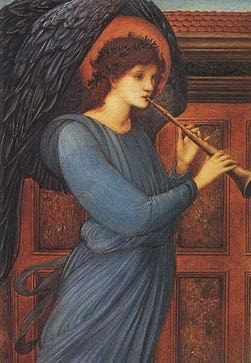
Send Your angels to quell the violence
in our hearts and on our streets.
Amen
For those of you in Los Angeles, please take care of yourselves and each other. My love is with you. So is the cosmic companionship that even now is guiding us all to our highest best use. This is our time and we will rise.
For those of you in Los Angeles, please be prayerful. Ask for guidance. Be very attentive to the voice within. Pray for the mantle of the Holy Spirit to be placed around your shoulders.
There are angels to your left, and angels to your right. There are angels in front of you and angels behind you. Go forth in confidence. Go forth in peace.
Let’s all of us send our love to Los Angeles – to the immigrants, to the protesters, and yes to the ICE agents, to the National Guard, to the police and to the President. Only love can cast out fear.
Praying for divine protection for everyone. God bless us all.
Amen
Consciousness, spirituality, biography, sexuality, androgyny, futurism, space, the arts, science, astrology, democracy, humor, books, movies and more


 We do not merely calculate movement as a robot might; we perceive it. We perceive motion, just as we perceive color or depth, as a unique qualitative experience that is vital to our visual awareness and consciousness. Something beyond our understanding occurs in the genesis of qualia, the transformation of an objective cerebral computation to a subjective experience. Philosophers argue endlessly over how these transformations occur and whether we will ever be capable of understanding them.