
truTV • Jan 15, 2009 Subscribe to truTV for more! http://bit.ly/1db6UsP This Vice Principal has his hands full trying to set some school dance boundaries.
Monthly Archives: October 2024
Libra Solar Eclipse, October 2, 2024

Wendy Cicchetti
Libra Solar Eclipse
The Libra annular solar eclipse is the second eclipse of the season, and is arguably more significant than the partial eclipse, but is still not entirely complete. What marks it as distinctive is the “ring of fire” effect, which makes it very pretty around the edges. Music fans may think of a Johnny Cash song and a possible theme therein of the power of love to transform us. There are different versions of the “truth” about who actually wrote the song and what inspired it [see https://en.wikipedia.org/wiki/ Ring_of_Fire_(song], depending on whether you wish to believe Cash’s first or second wife’s story! But that in itself reflects some of the issues of a Libra eclipse.
So does the official, credited co-authorship between Cash and second wife, June Carter, alongside the song being a non-hit when first recorded by her sister, Anita Carter, but more successful when later rearranged by Johnny Cash to include the famous mariachi-style horns for his own recording. This song was clearly a result of collaboration, but with different results on either side of the scale! And with certain people’s truth, and success, “eclipsed” by another’s version.
This is a fair example of what we might expect when contemplating what this Libra ring of fire eclipse might bring. But let’s hope there’s a more amicable way through relationship and business matters, and not too much pain from any flames! Spiritually, fire is often linked with purification, and, at the level of farming efficiency, razed ground is cleared to help with regeneration. So this might be a time when we try to clear away some of the bad (or old) stuff and start afresh.
Mercury is conjunct the eclipsed Sun in Libra, adding to the sense of diplomacy needed to manage certain situations peaceably. But some people may find themselves so at odds with a situation that this place of equilibrium feels out of reach, no matter how they try to square the circle. If so, a possible way forward is to examine what is gained by holding steadfast to a line that seems to stir up trouble, whether inwardly or outwardly. Possibly, we are fueling an inner fire because it provides a useful energy. So the eclipse might well reveal a hidden motive, or help with understanding the complexities of a situation that seems paradoxical or nonsensical.
A square from Mars in Cancer to Sun, Moon, and Mercury, suggests that a hatchet has not been entirely buried, or that the reason this is the case might become more evident. With the Cancerian focus, it could be that blood-ties and inherited issues complicate matters. There is the decided feel of lighting a fuse if we’re not careful!
On the plus side — because there always is one, according to Libran logic — passionate energy can fuel decisive action that puts an end to an argument, too. It may do so in a fairly dramatic way, and perhaps not without loss — yet, just as with the razed field, what has gone was mostly already spent. The focus for the future is on cleansing and regeneration, so that new seeds can be planted.
This article is from the Mountain Astrologer by Diana McMahon Collis
Word-Built World: to exact
Dictionary
Definitions from Oxford Languages · Learn more
ex·act
verb
verb: exact; 3rd person present: exacts; past tense: exacted; past participle: exacted; gerund or present participle: exacting
- demand and obtain (something, especially a payment) from someone.”tributes exacted from the Slavic peoples”Similar:demandrequireinsist oncommandcall forimposerequestask forexpectlook forextractcompelforcewringwrestsqueezeobtainconstrain
- inflict (revenge) on someone.”he exacts a cruel revenge against the winning candidate”Similar:inflictimposedeliveradministerissueapply
Origin

late Middle English (as a verb): from Latin exact- ‘completed, ascertained, enforced’, from the verb exigere, from ex- ‘thoroughly’ + agere ‘perform’. The adjective dates from the mid 16th century and reflects the Latin exactus ‘precise’.
Come and See | WAR FILM | FULL MOVIE
Mosfilm • Premiered May 6, 2022 • 1943, the Great Patriotic War, territory of Belarus. The 16-year-old boy Flera, having dug out a carbine among scraps of barbed wire, rusty machine-gun belts and shot-through helmets, goes into the forest to join the ranks of the partisans. This film, like no other, shows the tragedy of a child on a battlefield. At the beginning of the picture Flera is just a teenager. But In the end, having gone through horror and fear, child becomes an adult, frighteningly adult – his face is distorted by senile wrinkles, and there is no room for love in his soul… IMDb rating: 8,4 Year of production: 1985 Director: Klimov Elem Writers: Alexander Adamovich, Elem Klimov Composer: Yanchenko Oleg Operator: Rodionov Alexey Production designer: Petrov Victor Cast: Laucevičius Lubomiras, Berda Alexander, Kravchenko Alexey, Mironova Olga, Bagdonas Vladas, Lumiste Juri, Lorenz Victor, Rabetsky Kazimir, Tilicheev Evgeny, Vasiliev Victor, Domrachev Vasily
The Real Threat He Poses
Dan Rather/Substack
 Dan Rather. (photo: Stewart Volland/Vulture)
01 october 24
And why we must keep talking about it
We need to be talking more, not less, about the threat Donald Trump poses to our democracy. The former president and his understudy, JD Vance, have been trying to convince voters, with no evidence and a head-spinning level of hypocrisy, that violence against the former president was caused by rhetoric from Democrats.
Trump has upended the political script, saying, “[The Democrats’] rhetoric is causing me to be shot at, when I am the one who is going to save the country.” Followed closely by JD Vance’s incendiary quip: “The big difference between conservatives and liberals is that no one has tried to kill Kamala Harris in the last couple of months, and two people now have tried to kill Donald Trump in the last couple of months. I’d say that’s pretty strong evidence. The left needs to tone down the rhetoric. It needs to cut this crap out.”
And if you believe that, I’ve got a bridge to sell you.
Among the media and the campaigns, the “threat to democracy” line has apparently become old hat. When he was running for reelection, President Joe Biden often used it in an effort to differentiate himself. Unfortunately, this idea apparently doesn’t poll all that well. While it is true and terrifying, it is also a bit abstract — and for some, hard to believe. Lowering the price of milk is concrete and plausible.
So the Harris campaign hasn’t been talking about democracy much, instead concentrating on tangible policies to help the middle class. While this makes sense politically — and I hope it works — I’m here to say we cannot lose sight of the fact that a second Trump presidency would threaten our way of government and our way of life.
Trump’s term as president was just a precursor to what we can expect the second time around, but it bears repeating to remind us what he is capable of. In case anyone has forgotten, here is a partial list of how he has jeopardized democracy:
- Attempted to overturn a free and fair election, a number of times in a number of ways.
- Tried to block the peaceful transfer of power by inciting a mob to attack the United States Capitol.
- Undermined the independence of the Justice Department, while claiming our legal system was rigged.
- Botched the federal government’s response to the pandemic, resulting in a massive loss of life, because he doesn’t believe in inconvenient truths.
- Cozied up to dictators and autocrats, even asking one to investigate a baseless claim against his political rival.
- Selected Supreme Court justices who curtailed reproductive rights, to the point where women are being denied care and dying.
- Lied. All the time. The leader of the free world must be credible.
- Is sowing seeds of doubt that the 2024 election will be legitimate.
There is every indication that a second Trump trip to the White House would be even more harmful than the first.
This time around he is angrier and thirstier for vengeful retribution. He has said he will weaponize the Justice Department against his enemies. Full stop.
His loyal cronies have had more time to plan. We know they are vetting and training a legion of sycophants to displace career bureaucrats across the executive branch. The guardrails we had last time, whistleblowers and “adults in the room,” will be gone.
After nine years of Trump at the top of the Republican Party, his cult-like reach has created an army of MAGA-elected officials at the state and local levels who are more than happy to do his bidding, even if it’s illegal.
He is more gullible than ever — wanting, needing to believe his own hype. Believing his own bluster has had dangerous consequences. See: January 6, 2021. He spends his time searching social media for confirmation of his over-inflated self-importance. He surrounds himself with yes-men and women falling all over themselves to prove their fealty. No one will tell him the truth, for fear of retribution. It is a modern spin on the children’s fable “The Emperor’s New Clothes” — only this horror story would be titled, “The Politician’s Stupefying Greatness.”
The coup de grace is that Trump has carte blanche to do whatever he wants. That terrifying reality is brought to you by none other than the Supreme Court with its ruling in Trump v. United States. In a letter to the Senate Judiciary Committee following that decision, representatives from 75 legal organizations said it “poses a significant threat to our democracy by effectively providing the president with sweeping legal immunity for criminal acts.”
We tend to memorialize significant dates in our nation’s history. In my lifetime, there was Pearl Harbor, December 7, 1941. More recently, September 11, 2001, and January 6, 2021, have been etched into our psyche. But I would argue November 5, 2024, could be as or even more significant. It will test the strength of our country’s democratic infrastructure. That infrastructure and the American voter can save democracy by sending Kamala Harris to the Oval Office.
Swami Vivekananda on letting your soul teach you

Rachel Maddow lays out why you should care about JD Vance’s real agenda
MSNBC • Sep 30, 2024 • Rachel Maddow shows JD Vance explaining his lack of faith that democracy can deliver on his conservative ideals, and shows the influences behind Vance’s preference that the United States government be gutted and instead run by a dictator.
Rachel Maddow lays out why you should care about JD Vance’s real agenda
By admin | October 1, 2024 | Uncategorized
MSNBC • Sep 30, 2024 • Rachel Maddow shows JD Vance explaining his lack of faith that democracy can deliver on his conservative ideals, and shows the influences behind Vance’s preference that the United States government be gutted and instead run by a dictator.
Story: Problem with Dandelions

Trump’s Hitlerian Month
Timothy Snyder/Substack
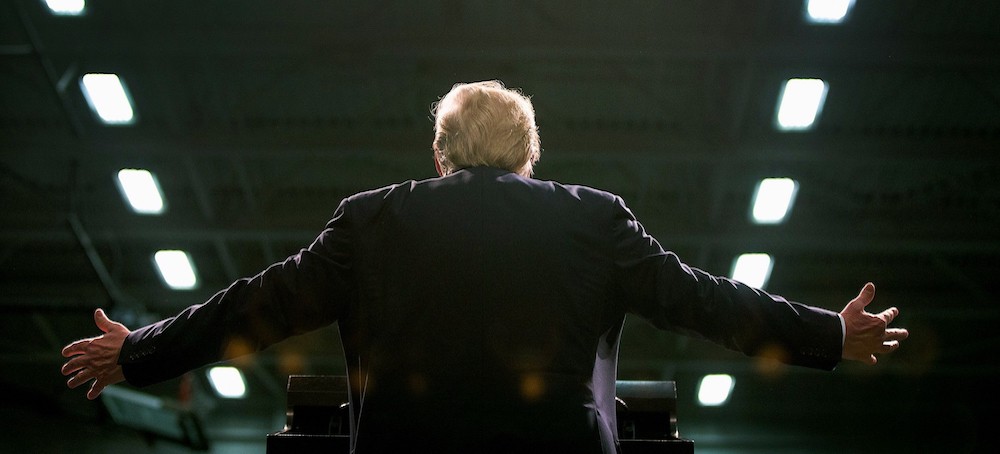 Donald Trump. (photo: Intercept)
30 september 24
ALSO SEE: Timothy Snyder: Thinking About (Substack)
A September to Remember
Trump just had quite a Hitlerian month.
But before broaching the subject of Trump and Hitler I have to say a with a word about the American taboo on “comparisons.”
Anyone who refers to Trump’s Hitlerian moments will be condemned for “comparison.” Somehow that “comparison” rather than Trump’s deeds becomes the problem. The outrage one feels about the crimes of the 1930s and 1940s is transferred from the person who resembles the criminal to the person who points out the resemblance.
This cynical position opposing “comparisons” exploits the emotional logic of exceptionalism. Americans are innocent and good (we would like to believe). We are not (we take for granted) like the Germans between the world wars. We would never (we imagine) tolerate the stereotypes German Nazis invoked. We have learned the lessons of the Holocaust.
Since we are so innocent and good, since we know everything, it just cannot be true — so runs the emotional logic — that a leading American politician does Hitlerian things. And since we are so pure and wise, we never have to specify what it was that we have learned from the past. Indeed, our our goodness is so profound that we must express it by attacking the people who recall history.
And so, in the name of our capacity to remember great evil, we make it impossible to actually remember great evil. A taboo on “comparison” becomes a shield for the perpetrator. Those who invoke the past are the true villains, the real source of the problem, or, as Trump says about journalists, the “enemy of the people.” Indeed, the more Trump resembles Hitler, the safer the man is from criticism on this point.
I hope that the irony of all of this is clear: the idea that “comparison” is a sin rests on the notion of the inherent and unimpeachable virtue of the American Volk, who by definition do nothing wrong, and whose chosen Leader therefore must be beyond criticism. In this strange way, outrage about “comparison” reinforces fascist ideas about purity and politics. We should hate the dissenters. We should ignore whatever casts doubt on our sense of national virtue. We should never reflect.
Democracy, of course, depends on the ability to reflect, and that reflection is impossible without a sense of the past. The past is our only mirror, which is why fascists want to shatter it. In fascist Russia, for example, it is a criminal offense to say the wrong things about the Second World War. The reason why we keep alive the memory of Nazi crimes is not because it could never happen here, but because something similar can always happen anywhere. That memory has to include the details of history, or else we will not recognize the dangers.
“Never again” is something that you work for, not something that you inherit.
Before we think about this past month, we also have to consider the past four years. This entire election unfolds amidst a big lie. It was Hitler’s advice to tell a lie so big that your followers would never believe that you would deceive them on such a scale. Trump followed that advice in November 2020. His claim that we actually won the election in a landslide is a fantasy that opens the way to other fantasies. It is a conspiratorial claim that opens the way to conspiratorial thinking generally. It prepares his followers for the idea that other Americans are enemies and that violence might be needed to install the correct leader.
This year we have seen that explicit Nazi ideas are tolerated in the Trump milieu. The vice-presidential candidate shares a platform with Holocaust deniers, and defends Holocaust denial as free speech. This is a fallacy people should see through: yes, the First Amendment allows Nazis to speak, but it does not ennoble Nazi speech. The fact that people say fascist things in a country with freedom of speech is how we know that they are fascists — and that, if they themselves comes to power, they will end freedom of speech and all other freedoms.
Which brings us to North Carolina and to the gubernatorial candidate Trump once called the country’s hottest politician. No one is denying that Mark Robinson has the right under the First Amendment to call himself a Nazi or to praise Mein Kampf. The question is what we do about this. Trump will not intervene here because he believes that Robinson is more likely to win than a substitute candidate would be. Consider that for a moment: for Trump, the reason not to distance himself a self-avowed Nazi is that he hopes that the self-avowed Nazi will win an election, take office, and hold power.
This is not surprising. Trump and Vance are running a fascist campaign. Its main theme in September was inspired by a lady in Springfield, Ohio, who lost her cat and then found it again. For J.D. Vance, who knew what happened, this became the basis for the lie that Haitian immigrants were eating domestic animals. For Donald Trump, that became a reason to promise that Haitians in Springfield would be deported. He had found people who were both Blacks and immigrants, who could serve as the “them” in his politics of us-and-them.
It is fascist to start a political campaign from the choice of an enemy (this is the definition of politics by the most talented Nazi thinker, Carl Schmitt). It is fascist to replace reason with emotion, to tell big lies (“create stories,” as Vance says) that appeal to a sense of vulnerability and exploit a feeling of difference. The fantasy of barbarians in our cities violating basic social norms serves to gird the Trump-Vance story that legal, constitutional government is helpless and that only an angry mob backed by a new regime could get things done.
It is worth knowing, in this connection, that the first major action of Hitler’s SS was the forced deportation of migrants. About 17,000 people were deported, which generated the social instability that the Nazi government the used as justification for further oppression. Trump and Vance plan to deport about a thousand times as many people.
Now, the Hitlerian things that Trump says would be Hitlerian with or without this Hitlerian context of the last four years, the last year, or the last month. And this context would be Hitlerian with or without Trump’s recent Hitlerian utterances.
It is helpful, however, to see all of this together, as a whole, because it makes it harder to excuse each individual piece of the story. In September, in his most important remarks about international and domestic politics, Trump invoked blatantly antisemitic stereotypes.
In international politics, the key moment concerns Ukraine and its head of state. Since February 2022, the Ukrainian president, Volodymyr Zelens’kyi, has been rightly understood and admired as a symbol of physical and political courage. When Russia began its full-scale invasion that month, the American consensus was the Ukraine would crack within days and that Zelens’kyi would (and should) flee. Instead, he stayed in Kyiv despite the approach of Russian assassins and the Russian army, rallied his people, and oversaw the successful defense of his country. He has since visited the front every few weeks.
This is how Trump characterized Zelens’kyi in September, echoing comments that he has made before: “Every time he came to our country, he’d walk away with $100 billion. He’s probably the greatest salesman on Earth.” Trump seems threatened by Zelens’kyi. As Trump has made clear numerous times, his first and only impulse is to give Putin what Putin wants. The idea of taking risks to defend freedom from the Russian dictator is well beyond the pinprick-sized black hole that is Trump’s moral universe.
And of course the claim itself is false. The number is too big. And the money does not go to Zelens’kyi himself, obviously. That Zelens’kyi does personally profit is a favorite idea of Vance, who repeats Russian propaganda to this effect. The money does not even, for the most part, go to the Ukrainian government. Most of the military aid does to American companies who build new weapons for American stockpiles. We then send old weapons to Ukraine, to which we assign a dollar value.
The essential thing, though, is the antisemitic trope Trump chose to express himself. It goes like this. Jews are cowards. Jews never fight wars. Jews stay away from the front. Jews only cause wars that make other people suffer. And then Jews make vast amounts of money from those wars. Volodymyr Zelens’kyi, the Ukrainian president, is Jewish. And thus “the greatest salesman on earth” for Trump. And the corrupt owner of “yachts” for Vance. A war profiteer, as in the antisemitic stereotype, not a courageous commander, as in reality.
Indeed, most of what Trump says about Zelens’kyi, Ukraine, and and the war itself makes sense only within the antisemitic stereotype. Trump never speaks about the Russian invasion itself. He never recalls Russian war crimes. He never mentions that Ukrainians are defending themselves or their basic ideas of what is right. He certainly never admits that Zelens’kyi is the democratically-elected president of a country under vicious attack and who has comported himself with courage. The war, for Trump, is just a scam — a Jewish scam.
And that, of course, is why he thinks he can end it right away: he thinks he can just shoulder the Jew aside and deal with his fascist “friend” Putin, who for him is the “genius” in this situation, and who must be allowed to win. Despite the evidence, Trump says that Russia always wins wars, dismissing both history (regular Russian losses such as the Crimean War, the Russo-Japanese War, the First World War, the Polish-Bolshevik War, the Afghan War) and the actual events of the ongoing Russian invasion, in which Ukraine has taken back half the territory it lost and driven the Russian fleet from the Black Sea. Russia is counting on Trump. They need him in power to win their war, and they know it.
It need hardly be said that if Trump throws American power on the Russian side, the “deal” that follows will not end the war. It will only mean that Russia is able to kill more Ukrainians faster. Trump will then claim that the deal itself was beautiful and perfect — and try to change the subject from the slaughter he brought about through his antisemitic hubris and admiration of Russian fascism.
In domestic politics, the key moment concerns the elections themselves. In September, Trump told Americans that, were he to lose the elections, “Jewish people would have a lot to do with the loss.” Jews who did not vote for him would be, in his words, “voting for the enemy.” This was so obviously troubling that the American press, in fairness, did draw attention to it.
It is worth considering, though, just how deeply this statement reaches into fascist practice. In five essential ways, which I will place in italics below, this is Hitlerian antisemitism.
1. Jews must be singled out as a group. There are countless other demographically small groups in the country who could be assigned responsibility when Trump loses the election. If the election is close, one would be able to carve out hundreds of sections of the population who made the difference. And yet somehow Trump blames Jews. They cannot be allowed, like everyone else, to go to the voting booth and make decisions on the basis of what they think, as citizens. Instead they must be treated as a group — because as a group they can be threatened.
2. Jews must pass a loyalty test. Americans have the right to vote how they like. That is the essence of the American system. But not Jews. Those who vote for Democrats are the victim of, in Trump’s words, “a hold, or curse.” Jews have to prove their loyalty by voting for the candidate who claims to be the more patriotic one — Trump. This is something that he has said over and over again. If Jews vote otherwise, he said in September, they are voting for the “enemy.” This loyalty test has been a plague for Jews for centuries.
3. Jews have unusual powers. It seems normal to single out the Jews as a group, and to claim that they must pass a loyalty test, if you believe that their actions are especially significant. Jews will have “a lot to do” with outcome, says Trump. And therefore they can be blamed in an outsized way when he loses, and the government that results can be treated as not truly American.
4. Jewish votes make a left-center coalition illegitimate. This has been a favorite claim of antisemites in democracies. In the first Polish presidential election after the First World War, parliament chose a centrist president. Among the votes that got him across the line were those of Jewish parties. According to right-wing antisemites, that made the process illegitimate. After loud propaganda to this effect, a fanatic assassinated the elected president. Hitler similarly said that left-center governments in Germany were illegitimate because of the supposedly central role of Jews in creating the “system.”
5. Jews stab you in the back. Trump describes himself as the victim of the Jews. In his view, 100% of Jews should vote for him, and the fact that they do not is the result of an inexplicable plot: “I really haven’t been treated very well, but it’s the story of my life.” The idea that the Jews are responsible for betraying the natural leader of the Volk was Hitler’s. He blamed electoral defeats on the Jews. The notion of a Jewish “stab in the back” arose from the First World War, where the German defeat was blamed on Jews who supposedly did not go to the front and who supposedly betrayed Germany on the home front.
And so we see the internal consistency of Trump’s Hitlerian ideas, as expressed this past month. At home, Jews cannot be seen as normal Americans, since they must be presumed disloyal and to have special powers. An election won with Jewish votes is artificial and its outcome is not to be taken seriously. Violence against Americans would be the natural outcome. Abroad, the courage of Jewish president of Ukraine must be ignored and his person denigrated. A war led by a Jewish leader is artificial and Ukrainian victories are not to be taken seriously. Violence against Ukrainians is thus the natural outcome.
In both cases, the violent collapse of a democracy is seen as natural.
I do not expect there to be much talk of any of this in October. We have all been disciplined to avoid the “comparisons,” and the media are restrained by the threat of lawsuits. And there is a simpler fear: Trump might come to power and then use force to punish the journalists.
The Harris-Walz campaign, for its part, has wisely chosen to campaign with slogans involving freedom and the future. This is, no doubt, a better strategy than dwelling on what would happen were Trump to win.
In any event, Trump’s Hitlerian month has provided more clues about the form the darkness will take. It was a September to remember.
In the silence about Trump’s fascism, those who care about freedom and the future will hear one more reason to act.
‘Don’t Kill My Child. Kill Me Instead’
Nicholas Kristof/The New York Times
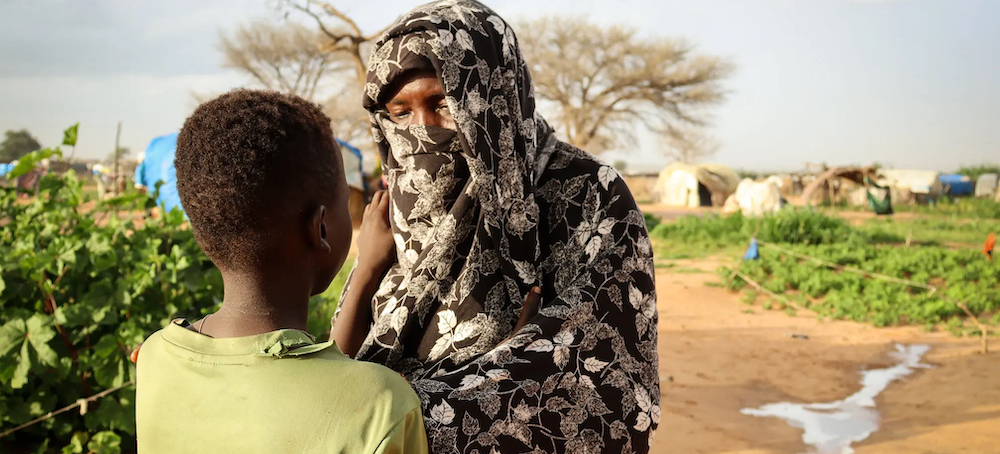 Naima with her son, Nazir, outside their hut. (photo: Nicholas Kristof/NYT)
30 september 24
Side by side with the worst of humanity, you regularly encounter the best. And so it was that while covering murder, rape and starvation in Sudan, I was awed by a heroic refugee, Naima Adam.
I’m on the Chad-Sudan border reporting on atrocities against Black African ethnic groups in Sudan, wrenchingly similar to the Darfur genocide here two decades ago. To report here is to appreciate that “evil” is not just an archaic Hebrew Bible term, but a force still powerful in the 21st century.
And yet: When civilization collapses and we humans are tested, some people reveal themselves as sociopaths, but a remarkable number turn out to be saints like Naima.
Naima, 48, is a member of one of the Black ethnic groups that have been targeted by destructive extremists in Sudan’s Arab leadership. Four times in the last 20 years Arab marauders have burned her home in their efforts at ethnic cleansing of non-Arab groups, and the Janjaweed Arab militia murdered her husband nine years ago.
After two military factions started a civil war in 2023, one of them — a descendant of the Janjaweed called the Rapid Support Forces, armed and supported by the United Arab Emirates — tried once again to drive Black Africans from Darfur. Naima recounted the same pattern I heard from so many people: The militia surrounded her village, lined up men and boys, then shot them one by one.
“We’re going to get rid of this Black trash,” she quoted the Arab gunmen saying.
Then the gunmen went house to house to kill, plunder and rape. Mostly, those they raped were girls and women, she said, but they also raped at least one man.
Two men took one of Naima’s daughters into a room and closed the door; she suspects they raped the girl, but sexual violence is such a taboo that she never asked her daughter what happened. Rape survivors bear the trauma on their own, and while a civil society group has formed a women’s center on the border to help, it is a struggle to find funding.
With the militia killing even young boys, Naima was terrified the gunmen would murder her 10-year-old son, Nazir. So she put Nazir on her back, the way Sudanese moms carry young children, to make him seem smaller.
A gunman saw through the ruse and demanded that she hand Nazir over.
“He’s a boy,” the man shouted. “Kill him!”
“Don’t kill my child,” Naima pleaded. “Kill me instead.”
One man clubbed Naima with the butt of his rifle to try to grab the boy. Another raised his gun and shot Naima twice, through the breast and in the leg; she showed me the scars. Both were flesh wounds, and even as she bled she fought and would not surrender her son.
Some men in the militia think it is bad luck to shoot a woman, and perhaps for that reason the attackers retreated and went on to attack the next house. Naima and her children were able to escape and find refuge in another village.
But the Rapid Support Forces then attacked this new location, she said, and this time they grabbed Naima’s 14-year-old niece to rape. Naima blocked them and told them to rape her instead.
So two of the gunmen men stripped Naima naked and held her down, she said, while one of the attackers pulled down his pants and prepared to rape her. This was hard for her to talk about, but eventually she explained how she stopped the assault: She grabbed the man’s penis and yanked.
“I bent it like this,” she said, demonstrating a furious shaking movement. “I tried to break it.”
The man clubbed her with his gun and was ready to shoot her, but his partner was rattled and told him to leave her alone, she said. They left without raping her or her niece.
Naima may single-handedly have done more to disincentivize rape in Sudan than all the world leaders put together.
Naima’s mother was murdered, and her father and one of her sons are missing and may be dead. She led the surviving members of her family to the safety of a refugee camp across the border in Adré, Chad, where one of her adult sons remains hospitalized after brutal torture in Sudan. He suffered a mental breakdown and can’t talk about what he endured.
Nazir has nightmares but is recovering. He is devoted to his mother and told me gravely that he understands that she was shot for saving his life.
As for Naima, she has recovered from the bullet wounds but is impoverished. I asked if she was sending Nazir to school in the camp. She laughed at the idea that she could afford school fees. “I was embarrassed that I couldn’t make tea for you,” she said. “I have nothing.”
Yet she still supports orphans in the refugee camp. Helping those in danger is a priority for her.
I asked her whether she wanted revenge against the Sudanese Arabs who had caused her so much tragedy. Would she favor attacking Arab villages, killing the men and raping the women?
She looked shocked at the question. “We are human beings,” she told me firmly. “We are Muslims. We have principles. We don’t want this to happen to the Arabs.”
In one sense, Naima is exceptional; in another, she reflects the magnificent response of so many ordinary Sudanese and Chadians to the recent atrocities. Sudan has been largely abandoned by the world, including by President Biden and other leaders. But Sudanese civil society has been as heroic as the country’s military leadership has been deplorable.
Sudanese doctors work without pay, local groups set up soup kitchens and refugee volunteers train child victims of trauma to make handicrafts that they can sell to earn money. I spoke to one of these trainers, Um Salama Umar, who said that the Rapid Support Forces had murdered two of her sons and three of her sisters; now she tries to heal by helping traumatized children rebuild their lives.
Anybody who wants to help might consider grass-roots groups in the Mutual Aid Sudan coalition, MutualAidSudan.org.
So, yes, Sudan reveals the human capacity for evil, but it’s also a reminder of an equally powerful human capacity for strength, resilience and courage. It’s thus possible to return from a land aching from famine, massacres and rape and feel honored to be part of the same gallant species as those Sudanese like Naima who emerge from an ultimate test as moral exemplars for us all.