The Prince of Disks has an unfailing determination to reach his goals, achieve his ambitions and create a world he is comfortable to live in. He has an interesting way of doing this – he takes every task a stage at a time. Whilst keeping the end aim in mind, he diligently attends to the task in hand, completing it satisfactorily and then moving on smoothly to the next logical stage.This method of working has numerous advantages – there’s the satisfaction of completing something – even though you might still be aware that this particular piece of work is just one step in the journey.Another plus is that work unfolds in a productive stream – each process deriving from the last. This often allows you to pick up on any detail you may have overlooked or missed.Also there is a consistent sense of progress – a feeling that you are drawing closer to your goals. Every single achievement is composed of many small acts which add together to create the whole.The Prince of Disks is a fertile and abundant card – it signifies the planting of seeds which will grow into great big trees. The tree would not exist without the seed which was planted in the very first place.So… on a day ruled by the Prince of Disks, you need to take everything a stage at a time. Decide early on what you’re actually hoping to achieve during the day – and make this a reachable goal. Then plot your method of working toward it. Now… off you go!!!Affirmation: “I now locate my goals and work towards them with great energy.”
“You think of yourself as a human searching for a spiritual awakening, when in fact you are a spiritual being attempting to cope with a human awakening. Seeing yourself from the perspective of the spirit will help you remember why you came here and what you came here to do.”
Neale Donald Walsch (b.1943) American Writer
AN OPPORTUNITY FOR DAILY REFLECTION BROUGHT TO YOU BY THE SCHOOL OF PRACTICAL PHILOSOPHY
Marta quits her job over an argument with colleagues at work about who should be given credit for a recent deal. Her impulsive emotions bring her to quit without consideration of its far reaching consequences. Is it even important who gets credit for the deal? Could it be settled more rationally? And has she considered where she might find alternative employment?
Gandolfo maintains a toxic relationship with his partner despite knowing it is high time to break up. The comfort of familiarity prevents him from braving the unknown. Every morning he imagines catastrophic scenarios that might extricate him from this situation—accidents, illnesses, obligations that force her relocation—yet fate does not do for him what he must do for himself. He remains paralyzed, unable to pursue what he knows is right.
Roberta’s fixation with order and being in control isolates her from society. She plans each day—and every activity of each day—so meticulously that her friends despair over her lack of spontaneity. She lives alone, works alone, and spends her evenings alone. This way she can execute her plans to the letter. She celebrates her birthday alone too, looking around and wondering, “How come everyone else has such fun together?”
Marta, Gandolfo, and Roberta’s suffering is self-inflicted. One could say that this is the result of an imbalance, with one aspect of their psychology dominating all the rest. As such, they are not particularly unusual. A close study of people in general reveals internal contradictions to be the norm.
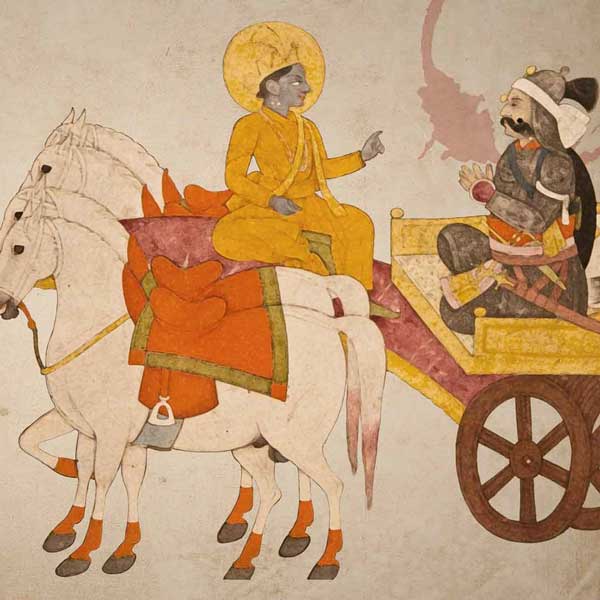
Arjuna with Horse, Carriage, and Driver
ORIGINS OF THE CARRIAGE METAPHOR
One ancient eastern teaching explains these contradictions by using the metaphor of the carriage horse and driver to illustrate the makeup of human beings. This metaphor first appears in the sacred texts that form the foundation of Hinduism—the Vedas—and is elaborated upon in later Hindu texts, such as the Upanishads:
Know the Self as lord of the chariot, The body as the chariot itself, The discriminating intellect as the charioteer, And the mind as reins. The senses, say the wise, are the horses; Selfish desires are the roads they travel. i
When the horse, carriage, and driver work in harmony, they form a synergy that transcends their individual capabilities. The driver’s intellect guides the horses’ raw power, while the carriage uses that power to transport more or heavier goods. This cooperation allows for efficient, purposeful movement towards a chosen destination. However, if these elements fall out of sync, the system not only falters, but the activity of each part is impeded. A poorly maintained carriage will slow down even the best of steeds; an untrained horse will drag even the most sophisticated carriage off course; a negligent driver will be unable to direct any horse and carriage. In human terms, this translates as internal conflict, indecision, or self-destructive behavior. The metaphor illustrates how our potential for excellence—or for dysfunction—depends on the delicate balance among our various faculties.
This same metaphor was adopted and adapted by various psychological traditions, most recently by George Gurdjieff:
[GURDJIEFF] A man as a whole, with all his distinct and separately functioning localizations… is almost exactly comparable to that means for transporting a passenger which consists of a carriage, a horse, and a coachman. ii
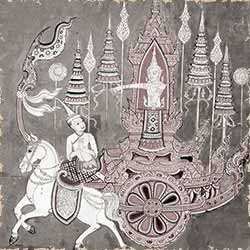
Siddhartha with Horse, Carriage, and Driver
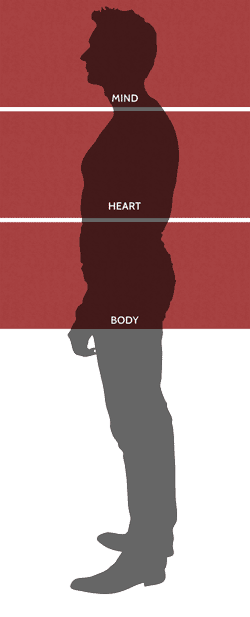
Micro-Cosmos Human as Three-Brained Being
GURDJIEFF’S METAPHOR OF THE CARRIAGE EXPLAINED
Gurdjieff pointed out that humans are only seemingly unified. Having a single physical body, and answering to a single name, promotes the illusion that we are always one and the same. A closer examination quickly refutes this. Each thought, sensation, and emotion is a separate impulse, originating from separate parts, often unaware of, and even contradicting each other. Gurdjieff’s metaphor of the carriage, horse and driver brings this to life. He correlates each of the three components with the three separate ‘brains’ or ‘functions’ that comprise human psychology:
The horses symbolize our emotional function,
The carriage symbolizes our motor function,
The driver symbolizes our thinking function.
By nature, these three separate functions are by no means attuned to each other. They are undeveloped and untrained.
Continuing with Gurdjieff’s metaphor: The carriage is rusty and its wheels are not balanced. The horses are malnourished and unaccustomed to obeying commands; they are accustomed to following their own desires. The driver has never been taught the language of the horses, what to feed them, or how to groom them. Nor does he know whom to ask for instructions about where to go.
Applying this to Marta, Gandolfo and Roberta: Marta’s impulsive decision to quit her job stems from her emotional function. Her galloping horses drag her driver and carriage over a cliff from which recovery will come at great cost. Gandolfo’s inability to change course is rooted in his motor function. His carriage is stuck in a familiar path and is resistant to change. Roberta’s obsessive planning is driven by her thinking function. Her driver micromanages her horses and carriage, attempting to do what they could do much more efficiently for themselves. Each suffers from an imbalance between horse, carriage, and driver that impedes their functioning and causes them to suffer.
James Brown • Mar 16, 2013 Subscribe to James Brown: http://bit.ly/29Vydud James Brown performs “Please Please Please” to a live audience on the TAMI Show. “Please, Please, Please” was written by James Brown and Johnny Terry and released as a single on Federal Records in 1956, it charted #6 R&B. It was the group’s debut recording and first chart hit, and became their signature song. The TAMI Show is a 1964 concert that included performances by numerous popular rock and roll and R&B musicians from the United States and England. TAMI stood for both “Teenage Awards Music International” and “Teen Age Music International”. The concert was held at the Santa Monica Civic Auditorium on October 28 and 29, 1964. Free tickets were distributed to local high school students. The best footage from each of the two concert dates was edited into the film, which was released on December 29, 1964. The TAMI Show is particularly well known for James Brown’s performance featuring his legendary dance moves and explosive energy. Video transcript: Please, please, please, please. (Please, please don’t go). Please, please, please. (Please, please don’t go). Honey, please don’t (Go). Yeah, oh yeah, love, I love you so. (Please, please don’t go). Baby, you did me wrong. (So you got me woman). Well, well you done me wrong. (So you got me woman). So you done, done me wrong. (Go). Well, oh yeah, took my love, now you’re gone. (Please, please don’t go). Please, please, please, please, please. (Please, please don’t go). Please, please, please, please, please. (Please, please don’t go). Honey, please don’t (Go). Well, oh yeah, love, I love you so (Please, please don’t go). I just wanna hear you say I, I, I, I, I. (Please, please don’t go) I, I, I, I (Please, please don’t go). Honey, please don’t. (Go). Oh, oh yeah, love, I love you so. (Please, please don’t go). Baby, take my hand. (Please, please don’t go) I wanna be your lover man. (Please, please don’t go). Oh yeah, slipped out of my head. Honey, please don’t (Go). Well, oh yeah, love, I love you so. (Please, please don’t go). Please don’t go. (Please, please don’t go).Please. Please. Please. Please. Please. Please don’t go. (Please, please don’t go). Honey you don’t know what you do to me. Don’t go. Don’t go. Honey, please don’t go. Ha, I love you so, please, please. (Please, please don’t go). Want more James Brown, go to Shout Factory: https://www.shoutfactory.com/film/fil…
Mars is now in Cancer, and is here to stay. Because of the upcoming retrogradation, Mars will spend much longer in Cancer than usual. That is, until April 18th, 2025, with just a brief detour through Leo.
This is a big deal.
Normally, Mars hangs out in a sign for about 2 months, and 2 months of Mars in Cancer would be pretty standard. But this time, Mars is here for almost 6 months, which means it’s going to dig much deeper into Cancer themes like nurturing, protection, and emotional security.
Cancer Vs. Capricorn
Cancer is traditionally seen as the mother, while Capricorn, its opposite, is seen as the father.
Of course, this is symbolic – Cancer isn’t literally our mother, and Capricorn isn’t literally our father. These signs represent those core energies we associate with care, security, and structure.
Cancer is the energy that nurtures, protects, and cares for us unconditionally. It’s the force that allows us to embrace our inner child, to be cared for without any strings attached. The purest expression of Cancer is a flowing stream, full of life and nourishment.
Cancer embodies the instinct to give, nurture, and safeguard life. Every species, from insects to birds to humans, shares this maternal drive to care for and protect their young.
On the other side of the axis, Capricorn represents our instinct to grow up and become self-sufficient. Our Cancer caretakers can’t shelter us forever, so as we mature, we learn the skills and discipline to stand on our own, eventually becoming nurturers ourselves.
Capricorn is the instinct to leave behind the nest and forge our own path. Capricorn teaches us – often the hard way, thank you Saturn – to take responsibility for the life we want to create.
The purest expression of Capricorn energy is like the goat standing at the top of the mountain. She didn’t get there to dominate or show off – she reached the summit by climbing it, one step at a time.
Her sense of control, security, and accomplishment is simply the natural outcome of that steady, determined capricornization process.
Cancer And Capricorn – The Yin/Yang Of Our Individuation Process
Of course, the journey of individuation – becoming our truest selves – is rarely smooth or simple.
Still, our sense of fulfillment and success in life depends on how well we balance and integrate these opposing forces: Cancer’s nurturing and emotional security with Capricorn’s drive for self-sufficiency and responsibility.
There’s no secret here – if you’ve ever done therapy, you know that no matter what brought you there initially, the conversation eventually circles back to your parents.
The root of most of our challenges often traces back to early dynamics that shaped our outlook on life.
Cancer and Capricorn represent the yin and yang of this balance: receiving the nurturing and resources we need (Cancer), and finding the structure and direction to express ourselves uniquely (Capricorn).
If we simplify it, most of our struggles come down to two key dynamics: either mommy or daddy issues – or both.
But with Mars’ extended stay in Cancer, we’re about to get a deep dive into unresolved nurturing and caregiving dynamics.
Mars in Cancer Opposite Pluto In Capricorn
Mars in Cancer’s slow pace will create ongoing tension as it opposes Pluto in Capricorn.
This tension starts building in October, peaking on November 3rd, 2024, when Mars (at 29° Cancer) directly opposes Pluto (at 29° Capricorn). This opposition at a cardinal anaretic degree promises to be especially intense and transformative.
And that’s not the end of the story. Mars retrograde will oppose Pluto again on January 5th, 2025, and once more on April 27th, 2025.
While these final oppositions shift to the Leo/Aquarius axis, all the aspects Mars forms while in shadow are still tied to the Mars retrograde in Cancer cycle and symbolically linked to the unresolved themes of the Cancer-Capricorn axis.
Mars-Pluto oppositions are intense. Both Mars and Pluto represent power and control dynamics, which can lead to a battle of will, where our boundaries and determination are tested.
Mars vs. Pluto – The Impossible Situation
During a Mars-Pluto opposition, we attract – consciously or unconsciously – the “impossible situation,” a scenario so dramatic, so intense, that it irrevocably changes our outlook on life.
The “impossible situation” will likely be a scenario that repeats a deeply unconscious dynamic from our childhood.
If we were to analyze most of our life choices – like the people we surround ourselves with, our relationship patterns, career paths, or belief systems – they often reflect an unconscious effort to process and transcend early childhood or parental influences that shaped our core identity.
These formative experiences become embedded in our psychological wiring, shaping how we think, feel, and act, and influencing the beliefs we carry and the outcomes we experience.
Until we fully understand and integrate these patterns, we tend to repeat them throughout our lives – again and again.
Pluto in Capricorn’s ‘daddy issues’ have revolved around learning how to step into our own authority by dismantling and radically transforming outdated structures and power dynamics. Pluto in Capricorn has been giving us tough love since 2008, teaching us resilience and self-reliance.
Pluto in Capricorn has also revealed some harsh realities – not all the ‘grownups’ have good intentions. Not all leaders are role models. Not everyone in power acts in our best interests.
Life is a jungle where people compete for limited resources. If you’re not strong, if you’re not strategic, you might not survive. If you snooze, you lose.
Mars In Cancer – Mommy Issues
Mars in Cancer brings a different set of challenges, ones that strike at the core of our emotional security and dig deep into our vulnerabilities.
No matter how loving your upbringing, there were likely moments when those meant to protect and care for you fell short, for various reasons.
As children, we need care, nurture, food, and support. These aren’t luxuries; they are essential for survival. Just as birds are instinctively driven to build nests and feed their young, our caregivers have a biological responsibility to ensure our well-being.
When this process doesn’t go smoothly, we simply don’t have the necessary foundations to become well-rounded adults.
It’s not a lost cause – if we didn’t receive that support early, we can learn to build those foundations later in life. However, it’s crucial to acknowledge the damage. Every time we needed support and didn’t receive it, a wound was formed, which could limit our ability to reach our full potential.
During Mars’ transit through Cancer, take some time to reflect on how you nurture yourself.
Perhaps this prolonged Mars in Cancer transit will take you on a journey to heal your inner child. You may need to mourn it first. Then, take good care of it. Then, re-parent it.
This process of self-nurturing and healing will eventually bring you the inner security and emotional strength that may have been lacking earlier in life.
And at the Mars-Pluto opposition, which will peak in early November, pay attention to anything that makes you angry, to anything that makes your blood boil.
The opposition aspect is our psyche’s way of surfacing unconscious conflicts by projecting them onto others or external situations.
Whatever triggers us, whatever makes us angry, whatever stirs up deep emotions is an unconscious wound making its (clumsy) way into our awareness.
Ultimately, these emotions – whether pain, anger, or resentment – need to find their way out.
Not by throwing a fist or crying like a baby (Cancer), nor by trying too hard to act from a higher self, maintain rigid control, or put other people down (Capricorn).
Somewhere, halfway through the Cancer/Capricorn spectrum, lies our truthful, empowered, emotionally and socially-conscious expression.
“One does not become enlightened by imagining figures of light, but by making the darkness conscious. The latter procedure, however, is disagreeable and therefore not popular.”
― C.G. Jung
Carl Gustav Jung (July 26, 1875 – June 6, 1961) was a Swiss psychiatrist, psychotherapist, psychologist and pioneering evolutionary theorist who founded the school of analytical psychology. Wikipedia
The Astrology Podcast • Sep 27, 2024 An in-depth discussion about the life and work of Geoffrey Cornelius, and his argument that astrology is a form of divination, with astrologers Kirk Little and Chris Brennan. Geoffrey passed away recently on August 27, and so Kirk and I got together to talk about his work and the impact of his thinking on our understanding of astrology. One of the central themes of our discussion is Geoffrey’s groundbreaking thesis that astrology should be understood as a form of divination rather than a science based on causal relationships. Kirk and I explore how this perspective shifts the way we approach astrology, emphasizing that the symbols and signs in a chart serve as omens rather than direct influences. This re-framing opens up a richer understanding of how astrology can provide insights into our lives. We also delve into the importance of symbolic thinking in astrology, particularly how it relates to the interpretation of horoscopes. Kirk shares how Geoffrey’s work encourages us to think about astrology in a more fluid and dynamic way, where the meanings of symbols can evolve and resonate differently for each individual. This approach not only enhances our practice but also deepens our connection to the cosmos and the messages it conveys. Throughout our conversation, it becomes clear that Geoffrey Cornelius was not just an astrologer but a philosopher who continuously sought to understand the deeper truths of astrology. Kirk highlights how Geoffrey’s commitment to exploring the philosophical underpinnings of astrology remains an unfinished journey, inspiring us to keep questioning and expanding our understanding of this ancient practice. His work encourages us to engage with astrology not just as a tool for prediction but as a profound means of self-discovery and reflection. Kirk is the author of a paper on Geoffrey’s book The Moment of Astrology: Kirk Little, “Defining the Moment: Geoffrey Cornelius and the Development of the Divinatory Perspective” (2006) He hosts a website on astrology and divination that contains a number of other resources related to the subject: https://cosmocritic.com This is episode 463 of The Astrology Podcast: https://theastrologypodcast.com/2024/…
“Childhood ends in life’s best-known rite of passage, the coming-of-age moment, what the Romans called adulescentia (literally, a “ripening” or “flaming up” ).
—The Fourth Turning by William Strauss and Neil Howe
Ralph Waldo Emerson, who went by his middle name Waldo (May 25, 1803 – April 27, 1882), was an American essayist, lecturer, philosopher, abolitionist, and poet who led the Transcendentalist movement of the mid-19th century. Wikipedia
adjective: 1. Exhibiting traits associated with male as well as female identities. 2. Having a gender presentation that blends or transcends traditional binary categories.