US President Donald Trump and Russia’s President Vladimir Putin shake hands during a meeting on the sidelines of the G20 Summit in Hamburg, Germany, on July 7, 2017 (AFP).
Russian state television personalities this week were reportedly crestfallen by news of former President Donald Trump’s criminal conviction on 34 felony counts for falsifying business records to cover up hush-money payments to adult film star Stormy Daniels.
The Daily Beast’s Julia Davis reports that television personalities in Russia were despondent to see their preferred candidate dealt a guilty verdict, even as they hoped he could still go on to win the 2024 presidential election.
State Duma member Aleksei Zhuravlyov, for one, said that the jury’s decision to convict Trump was a poor reflection on Americans’ intelligence.
“There are idiots in every country, but this is the only instance where idiots have their own country,” he declared. “This is something new in history.”
TV host Dmitry Kulikov, meanwhile, angrily declared that, “They wronged our Donald Trump!” before interviewing political scientist Malek Dudakov, who had been openly rooting for at least a hung jury to get the former president off the hook.
“The miracle did not happen,” he lamented. “Our Donald Fredovych was found guilty on all 34 counts… now he is a felon.”
The Russian government has sought to help Trump acquire the presidency since his first election campaign back in 2016.
According to special counsel Robert Mueller’s investigation, Russian operatives were responsible for hacking into former Trump rival Hillary Clinton’s campaign’s email system and then leaking the contents of those emails to WikiLeaks in the fall of 2016.
Although Mueller did not establish a criminal conspiracy between Trump and Russia, his investigation did find that members of the campaign knew Russia was trying to help him get elected and welcomed their assistance.
Trump himself once infamously said that he “hoped” Russia would find Clinton’s “missing” emails from her time serving as secretary of state.
A network of local news outlets has been trading in human hands for AI to report stories. Moyo Studio/E+/Getty ImagesCNN —
The articles on a local news site popping up around the country appear to cover what any community outlet would focus on: crime, local politics, weather and happenings. “In-depth reporting about your home area,” the outlet’s slogan proudly declares.
But a closer look at the bylines populating the local site and a national network of others — Sarah Kim, Jake Rodriguez, Mitch M. Rosenthal — reveals a tiny badge with the words “AI.” These are not real bylines. In fact, the names don’t even belong to real humans. The articles were written with the use of artificial intelligence.
The outlet, Hoodline, is not the first or only news site to harness AI. News organizations across the world are grappling with how to take advantage of the rapidly developing technology, while also not being overrun by it.
But experts warn that relying too heavily on AI could wreck the credibility of news organizations and potentially supercharge the spread of misinformation if not kept in close check. Media companies integrating AI in news publishing have also seen it backfire, resulting in public embarrassments. Tech outlet CNET’s AI-generated articles made embarrassing factual errors. The nation’s largest newspaper chain owner, Gannett, pulled back on an AI experiment reporting on high school sports games after public mockery. Sports Illustrated deleted several articles from its website after they were found to have been published under fake author names.
Hoodline, founded in 2014 as a San Francisco-based hyper-local news outlet with a mission “to cover the news deserts that no one else is covering,” once employed a newsroom full of human journalists. The outlet has since expanded into a national network of local websites, covering news and events in major cities across the country and drawing millions of readers each month, the company said.
But last year, Hoodline began filling its site with AI-generated articles. A disclaimer page linked at the bottom of its pages notes to readers, “While AI may assist in the background, the essence of our journalism — from conception to publication — is driven by real human insight and discretion.”
Zachary Chen, chief executive of Hoodline parent company Impress3, which acquired the site in 2020, defended the site’s use of AI and its transparency with readers, telling CNN the outlet provides valuable reporting in news deserts around the country and is generating revenue to hire more human journalists in the future.
Hoodline’s staff includes “dozens of editors, as well as dozens of journalist researchers, full time,” Chen said. The outlet also employs a “growing number of on-the-ground journalists who research and write original stories about their neighborhood beats,” he added, referencing recent articles about restaurants, retail stores and events in the San Francisco area.
A screen grab from the Hoodline website shows a story with a byline labeled “AI.” From Hoodline
Bios for bots
But until recently, the site had further blurred the line between reality and illusion. Screenshots captured last year by the Internet Archive and local outlet Gazetteer showed Hoodline had further embellished its AI author bylines with what appeared to be AI-generated headshots resembling real people and fake biographical information.
“Nina is a long-time writer and a Bay Area Native who writes about good food & delicious drink, tantalizing tech & bustling business,” one biography claimed.
The fake headshots and biographies have since been removed from the site, replaced with a small “AI” badge next to each machine-assisted article’s byline, though they still carry human names. The archived screenshots have also been wiped from much of the internet. Wayback Machine director Mark Graham told CNN that archived pages of Hoodline’s AI writers were removed last month “at the request of the rights holder of the site.”
Chen acknowledged the company requested that the archive’s screenshots of the site be removed from the internet, saying “some websites have taken outdated screenshots from months or even years ago to mischaracterize our present-day practices.”
“An empty gesture toward transparency”
But experts expressed alarm over Hoodline’s practices, warning that it exemplifies the potential pitfalls and perils of using AI in journalism, threatening to diminish public trust in news.
The way the site uses and discloses AI purposely tricks readers by “mimicking” the look and feel of a “standards-based local news organization with real journalists,” said Peter Adams, a senior vice president of the News Literacy Project, which aims to educate the public on identifying credible information.
“It’s a kind of flagrantly opaque way to dupe people into thinking that they’re reading actual reporting by an actual journalist who has a concern for being fair, for being accurate, for being transparent,” Adams told CNN.
The small “AI” badge that now appears next to fake author personas on the site is “an empty gesture toward transparency rather than actually exercising transparency,” Adams added.
Chen would not disclose what AI system Hoodline is employing, only calling it “our own proprietary and custom-built software, combined with the most cutting-edge AI partners to craft publish-ready, fact-based article.” Each article, Chen said, is overseen by editors before it is published.
Gazetteer previously reported that at least two Hoodline employees said on LinkedIn that they were based in the Philippines, far from the US cities that the outlet purports to cover. Chen did not respond to CNN’s question about its staff or where they are located.
The News/Media Alliance, which represents more than 2,200 US publishers, has supported news organizations taking legal action against AI developers who are harvesting news content without permission. Danielle Coffey, the group’s chief executive, told CNN that Hoodline’s content “is likely a violation of copyright law.”
“It’s another example of stealing our content without permission and without compensation to then turn around and compete with the original work,” Coffey said. “Without quality news in the first place, this type of content among other practices will become unsustainable over time, as quality news will simply disappear.”
Chen told CNN he takes copyright law very seriously and that the outlet has “greatly refined processes with heavy guardrails.” The site’s readers, he asserted, “appreciate the unbiased nature of our AI-assisted news,” and claimed Hoodline’s visitor traffic has soared twentyfold since the publication was acquired. (Chen did not specify their traffic numbers.)
That’s not to say there isn’t a place for AI in a newsroom. It can assist journalists in research and data processing and reduce costs in an industry struggling with tighter budgets. Some news organizations, like News Corp., are increasingly inking lucrative partnerships with AI developers like OpenAI to help bolster its large language models’ knowledge base.
But Hoodline’s use of machine-written articles under seemingly human names is not the way to do it, said Felix Simon, a research fellow in AI and digital news at the Reuters Institute for the Study of Journalism at the University of Oxford.
“Employing AI to help local journalists save time so they can focus on doing more in-depth investigations is qualitatively different from churning out a high amount of low-quality stories that do nothing to provide people with timely and relevant information about what is happening in their community, or that provides them with a better understanding of how the things happening around them will end up affecting them,” Simon told CNN.
Research conducted by Simon and Benjamin Toff, a journalism professor at the University of Minnesota, has also found that the public has not embraced the use of AI in news reporting.
“We found that people are somewhat less trusting of news labelled as AI, and there is reason to believe that people won’t be as willing to pay for news generated purely with AI,” he said.
Keeping local news alive
On Hoodline’s network of local news sites, it is difficult to find an article not written by the software. Much of the site’s content appears to be rewritten directly from press releases, social media postings or aggregated from other news organizations. Chen said the outlet aims to “always provide proper attribution” and follow “fair use” practices.
“Local news has been on a terrible downward trend for two decades, and as we expand, Hoodline is able to bring local stories that provide insight into what’s going on at a hyper-local level, even in so-called ‘news deserts,’” Chen said.
The outlet, which is profitable, Chen said, plans to hire more human journalists as the company looks to evolve its current AI personas into “AI news anchors delivering stories in short-form videos.” The plan will make use of the fake bylines published on the site, eventually turning them into AI news readers, he said.
“It would not make sense for an AI news anchor to be named ‘Hoodline San Francisco’ or ‘Researched by Person A & Edited by Persona B.’ This is what we are building toward,” Chen said.
Nuala Bishari, a former Hoodline reporter, wrote in a recent column for the San Francisco Chronicle that seeing her old job replaced by AI is “surreal.”
“Old-fashioned shoe-leather reporting has been replaced by fake people who’ve never set foot in any of the neighborhoods they write about — because they don’t have feet,” Bishari wrote.
But the transformation at Hoodline shows that bigger solutions are needed to keep vital local news reporting alive.
“Without a big shift, journalism as we know it will continue to sputter out,” she wrote. “And it isn’t just tiny outlets like Hoodline that are in danger of going extinct or being zombified by AI.”
At conception, essence and the physical body conjoin. All living creatures are conceived in this way, which means all have some combination of an essence and a physical body. Essences differ considerably between species and will be discussed in the September labor. Physical bodies also differ between species, but their general utility is the same: they make it possible to move, access nourishment, avert danger, and procreate. Of our three bodies, the physical body is the one we share the most in common with the rest of the animal world. For this reason, the May and June labors, dedicated to farming the physical body, are represented by harvesting hay—hay being food for livestock.
May spanned the moving function of the physical body; June will span the instinctive function. While the abilities of the moving function obviously differ between species—one walks, another flies, a third is adapted to swim—the instinctive function of all species is fundamentally the same. It is responsible for the survival and well-being of the organism. It governs all its physiological processes, such as respiration, digestion, circulation, etc. It is also hard-coded to favor conditions or resources that aid its survival and to avoid those that constitute a threat. It formulates its priorities accordingly, even if these priorities conflict with the needs of essence and personality. This is right work from the perspective of the instinctive function, as without such priorities we would not meet the basic requirements for living. We would lack the instinct to avoid danger, lack the drive to earn our daily bread, and lack the sense of responsibility to provide for our offspring. Our species would face extinction.
The instinctive function’s priorities do not encompass inner farming. As long as we are only making brief and intermittent efforts to study the structure of our psychology and to observe its functioning in real time, it only mildly resists our anemic progress. But once we step up our efforts and attempt to introduce some form of inner discipline, some alternative government to our habitual way of manifesting, the instinctive function senses that its priorities are being threatened and increases its resistance. The specifics of how it does this vary and are material for self-observation, but the general rule is that it amplifies our bodily demands. As the brain in charge of monitoring our bodily processes, it can manipulate them to dissuade effort. It can make us feel too tired, too unwell, or too lightheaded, to invest more attention in our present activity than is strictly required for its basic, functional fulfillment. In that respect, it can be said that the instinctive function is under the law of gravity. Like a river that finds the easiest path to the sea, it always pursues the path of least resistance and greatest energy conservation. Our organism’s natural yield is quite enough, refinement is superfluous. Nature is enough, inner farming is superfluous.
We can verify our instinctive function’s competition with inner farming when we attempt to apply the disciplines of this work while performing instinctive activities. The instinctive function perceives this as an intrusion and will adamantly resist. A good area for experimentation is dining. To observe ourselves while dining, it is not enough to merely wish for it to happen; we must employ specific exercises to counteract instinctive resistance. Usually, this involves a slowing down of our natural tempo while dining. We can do this by putting our utensils down on the table between bites, or keeping our elbows from touching the table, or finishing chewing one bite before preparing the next—or all of these together. Once our habitual haste around dining is curbed, we gain the possibility of tasting our food—of bringing attention to the sense of taste—instead of swallowing and gulping like the rest of the animal world.
In applying these dining exercises, it is important to note that we are not doing anything injurious to our physical body—we are not denying it the sustenance it needs for proper functioning. We are only insisting that it partake of what it needs on different terms. The threat here is not existential; it is the usurping of a tyrant seated on the throne of our internal world—a tyrant whose existence we had not even suspected. Verifying this is in itself worthwhile, even if we find we are unable to introduce self-observation while dining, as, at least initially, will be the case. We will have taken a radical step towards revealing and understanding the psychology of our instinctive function. Replacing it with conscious government will come in due course.
June 2024 features one of the best transits of the year: Jupiter in Gemini is trine Pluto in Aquarius.
This is the first time since 1977 that we have a Jupiter-Pluto trine in Air, social and communication-oriented signs.
1977 is when Steve Jobs launched the first Apple II computer, revolutionizing the home computer market.
1977 was also when the National Women’s Conference was held in Houston, Texas. This event brought together thousands of women to discuss equal pay, reproductive rights, and gender discrimination, and had a lasting impact on the feminist movement.
Similar themes related to innovation in communication and knowledge (Jupiter in Gemini), and in empowerment through groups (Pluto in Aquarius) will likely emerge during this Jupiter trine Pluto transit.
In June 2024 we also have the Sun-Venus conjunction, which means that Venus officially transforms from a morning star into an evening star.
We actually can’t see Venus at the moment, because she’s very close to the Sun, but from late July 2024 onwards, she will start appearing on the western horizon, after sunset.
Sun-Venus conjunctions are unique celestial events that repeat in a 5-pointed star pattern. We have a Sun-Venus conjunction in Gemini every 4 years, and these conjunctions occur in the same area of the sky (and of our chart), moving approx. 1-2 degrees with every conjunction.
The previous Sun-Venus conjunctions in Gemini happened in June 2020, June 2016, June 2012, June 2008, June 2004, and so on. So if these times ring a bell for whatever reason, or if you know you have planets around 14° Gemini, this will be an important one!
Another reason why this Sun-Venus conjunction is important is that it happens just before the New Moon in Gemini. We basically have a Sun-Moon-Venus conjunction, which sets the stage for new beginnings in the Gemini area (house) of your chart!
The first half of June is very energized with Gemini energy – we have a record of 5 planets in Gemini when the Moon joins the Gemini stellium on June 5th-6th, 2024.
But then around June 17th, 2204, the dynamic changes dramatically, as Mercury and Venus both leave Gemini at the same time, conjuncting at 0° Cancer. A few days later, the Sun joins in, and we transition from a Gemini stellium to a Cancer stellium, emphasizing themes of home, family, history, and emotional security.
But let’s take a look at the most important transits of the month:
June 2nd, 2024 – Jupiter Trine Pluto
On June 2nd, 2024, Jupiter (at 1° Gemini) is trine Pluto (at 1° Aquarius).
Jupiter and Pluto are outer planets, which means their influence is more subtle, and they tend to impact society on a broader level. If, however, you have personal planets or angles in the first 2 degrees of the Air signs (Gemini, Libra, Aquarius), you’re in luck. Jupiter trine Pluto activating your natal chart is like a green light from the universe to move ahead with projects, score important wins, and attract success.
As a general theme, Jupiter trine Pluto enhances our curiosity and interest in intellectual topics, encouraging us to delve deep into complex subjects and get to the root cause of the matter.
The trine will also bring positive developments in communities (Aquarius) and social dynamics in general. Time to get out of the house and meet people!
June 4th, 2024 – Sun Conjunct Venus In Gemini
On June 4th, 2024, Sun is conjunct Venus at 14° Gemini.
When our purpose in life (Sun) aligns with our values (Venus) we connect with a sacred part of ourselves that knows what’s best for us, that knows what’s the next course of action.
When Venus marries the Sun, something inside us ‘clicks’. Pay attention to any subtle nudges or intuitive insights, as they will give you valuable guidance on how to move forward in alignment with your deepest desires and aspirations.
June 6th, 2024 – New Moon In Gemini
On June 6th, 2024, we have a New Moon at 16° Gemini.
The New Moon is exactly conjunct Venus, and also shares the sign with Mercury and Jupiter. We basically have a 5-planets-in-Gemini New Moon. This New Moon is as Gemini as you can get – so if you have planets or angles in Gemini, this will be an important one for sure.
The New Moon in Gemini is square Saturn (now at 18° Pisces), bringing in some delays and potential challenges. We may be asked to reassess our plans and re-prioritize to overcome these hurdles.
Whatever happens, keep in mind that every New Moon a seed is planted. Every New Moon is a new beginning. Every New Moon is an opportunity. Sometimes opportunities are dressed up as problems… but this doesn’t mean we should dismiss them by default. Perhaps that grumpy accountant who asks you to triple check your expenses is not your enemy. You might thank them later.
At the New Moon in Gemini, ask yourself “What is that grumpy accountant (aka Saturn) trying to warn me about? What is it that I need to pay attention to so that you build a solid foundation for the future?”
June 9th, 2024 – Mars Enters Taurus
On June 9th, 2024, Marsleaves Aries andingresses into Taurus.
Mars in Aries gets lots of praise, and for good reason; Mars and Aries have lots of things in common – the fiery energy, the assertiveness, the pioneering spirit. Mars feels at home in Aries… but not so much in the earthy, slow, and methodical sign of Taurus.
However, just because Mars and Taurus’ qualities don’t naturally ‘click’ this doesn’t mean these energies can’t work together effectively. Way too often we underestimate the enduring power of Mars in Taurus. Muhamad Ali had Mars in Taurus.
With Mars in Taurus, slow and steady wins the race.
June 11th, 2024 – Mars Square Pluto
On June 11th, 2024, Mars (at 1° Taurus) is square Pluto (at 1° Aquarius).
This is a tense aspect that will test our resilience and determination. We may feel as though we are trapped in a “me against the world” scenario, facing power struggles or confrontations with authority figures.
However, this aspect also brings opportunities to break free from some outdated patterns or structures that have been holding us back, challenging us to assert ourselves and stand up for what we believe in.
June 17th, 2024 – Venus Enters Cancer
On June 17th, 2024, Venus enters Cancer, bringing a dramatic shift into our emotional landscape.
If, with Venus in Gemini, we were more intellectually curious and socially active, Venus in Cancer is all about feelings. With Venus in Cancer, we no longer justify our choices with “does it make sense?” as if logic were the sole guiding force.
What’s important is whether it makes sense to us. Whether it resonates. And Cancer knows better than anyone the importance of tuning in and trusting the inner guidance.
June 17th, 2024 – Mercury Conjunct Venus In Cancer
On June 17th, 2024, Mercury is conjunct Venus at 0° Cancer.
This Mercury-Venus conjunction is quite extraordinary. 0° Cancer is one of the 4 cardinal points, the most potent degrees in astrology. When Mercury and Venus align at this degree, a powerful portal of manifestation will open.
It’s not so often that our mind (Mercury) and heart (Venus) are in perfect agreement with each other! This is THE time to bring your creative intention to life. I will write a detailed report about this transit closer to the date.
On June 20th, 2024, Sun enters Cancer. Happy birthday to all Cancer people and happy solstice to everyone on Earth!
We have 2 solstices and 2 equinoxes in a year, which split the year into 4, 3-month quarters. Therefore, the Cancer solstice will set the scene for the next 3 months of the year. The energy is very potent as we transition into a new phase of growth, renewal, and transformation.
June 21st, 2024 – Full Moon In Capricorn
On June 21st, 2024, we have a Full Moon at 1° Capricorn. The Full Moon is opposite Mercury and Venus in Cancer, it’s square Neptune (at 29° Pisces) and applies a wide trine to Mars (now at 9° Taurus).
The Full Moon in Capricorn will encourage us to revisit childhood themes and patterns – and especially the stories we’ve been telling ourselves about who we are, our limitations, and our capabilities – and move forward from a more adult, empowered place.
The Full Moon in Capricorn is an opportunity to release victimhood mentalities and take ownership of our lives and decisions.
June 30th, 2024 – Saturn Goes Retrograde
On June 30th, 2024, Saturn goes retrograde at 19° Pisces. Saturn has now traveled beyond the halfway mark of its journey through Pisces. By now, we have a pretty good idea of what this transit is about.
But to make sure no stone is left unturned, in classic Saturnian style, the planet of structure, responsibility, and limitation goes retrograde.
Saturn will retrograde in Pisces until November 16th, 2024 (when it turns direct at 12° Pisces). So if you have planets between 12 and 19° degrees in mutable signs (Gemini, Virgo, Sagittarius and Pisces) this Saturn retrograde will directly impact that particular area of your chart.
For all of us, Saturn retrograde is a time to reassess our commitments, responsibilities, and long-term goals. It’s a period for introspection, where we are asked to go deeper into specific areas of our life that need more work.
Hard work is rarely pleasant – hence Saturn’s reputation as a ‘grumpy’ – but it’s what actually helps us grow and evolve, making us better human beings.
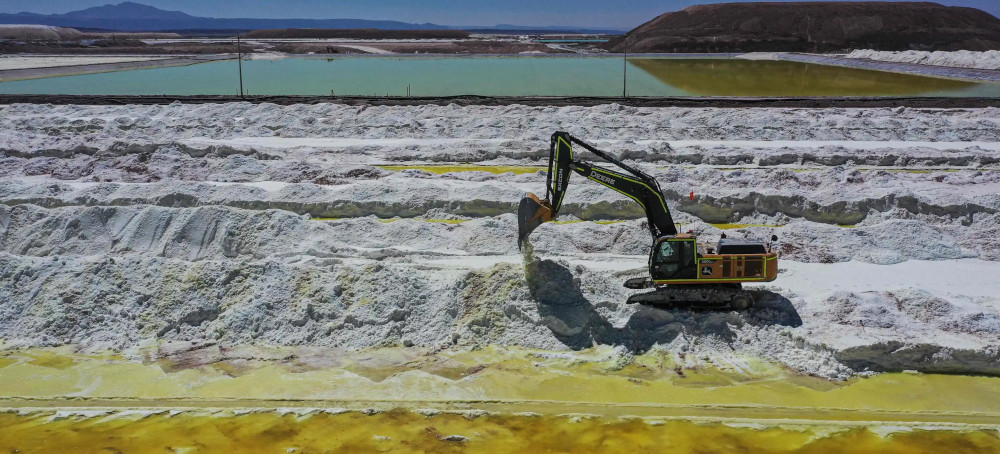
A lithium mine in the Atacama desert, Chile, in 2022. (photo: AFP)
31 may 24 (RSN.org)
Big tech is playing its part in reaching net zero targets, but its vast new datacentres are run at huge cost to the environment
When you picture the tech industry, you probably think of things that don’t exist in physical space, such as the apps and internet browser on your phone. But the infrastructure required to store all this information – the physical datacentres housed in business parks and city outskirts – consume massive amounts of energy. Despite its name, the infrastructure used by the “cloud” accounts for more global greenhouse emissions than commercial flights. In 2018, for instance, the 5bn YouTube hits for the viral song Despacito used the same amount of energy it would take to heat 40,000 US homes annually.
This is a hugely environmentally destructive side to the tech industry. While it has played a big role in reaching net zero, giving us smart meters and efficient solar, it’s critical that we turn the spotlight on its environmental footprint. Large language models such as ChatGPT are some of the most energy-guzzling technologies of all. Research suggests, for instance, that about 700,000 litres of water could have been used to cool the machines that trained ChatGPT-3 at Microsoft’s data facilities. It is hardly news that the tech bubble’s self-glorification has obscured the uglier sides of this industry, from its proclivity for tax avoidance to its invasion of privacy and exploitation of our attention span. The industry’s environmental impact is a key issue, yet the companies that produce such models have stayed remarkably quiet about the amount of energy they consume – probably because they don’t want to spark our concern.
Google’s global datacentre and Meta’s ambitious plans for a new AI Research SuperCluster (RSC) further underscore the industry’s energy-intensive nature, raising concerns that these facilities could significantly increase energy consumption. Additionally, as these companies aim to reduce their reliance on fossil fuels, they may opt to base their datacentres in regions with cheaper electricity, such as the southern US, potentially exacerbating water consumption issues in drier parts of the world. Before making big announcements, tech companies should be transparent about the resource use required for their expansion plans.
Furthermore, while minerals such as lithium and cobalt are most commonly associated with batteries in the motor sector, they are also crucial for the batteries used in datacentres. The extraction process often involves significant water usage and can lead to pollution, undermining water security. The extraction of these minerals are also often linked to human rights violations and poor labour standards. Trying to achieve one climate goal of limiting our dependence on fossil fuels can compromise another goal, of ensuring everyone has a safe and accessible water supply.
Moreover, when significant energy resources are allocated to tech-related endeavours, it can lead to energy shortages for essential needs such as residential power supply. Recent data from the UK shows that the country’s outdated electricity network is holding back affordable housing projects. This will only get worse as households move away from using fossil fuels and rely more on electricity, putting even more pressure on the National Grid. In Bicester, for instance, plans to build 7,000 new homes were paused because the electricity network didn’t have enough capacity.
In an era where we expect businesses to do more than just make profits for their shareholders, governments need to evaluate the organisations they fund and partner with, based on whether their actions will result in concrete successes for people and the planet. In other words, policy needs to be designed not to pick sectors or technologies as “winners”, but to pick the willing by providing support that is conditional on companies moving in the right direction. Making disclosure of environmental practices and impacts a condition for government support could ensure greater transparency and accountability. Similar measures could promote corporate accountability in global mineral supply chains, enforcing greater human rights compliance.
In navigating the intersection of technological advancement and environmental sustainability, policymakers are facing the challenge of cultivating less extractive business models. This is not just about adopting a piecemeal approach; it’s about taking a comprehensive systematic view, empowering governments to build the needed planning and implementation capacity. Such an approach should eschew outdated top-down methods in favour of flexible strategies that integrate knowledge at all levels, from local to global. Only by adopting a holistic perspective can we effectively mitigate the significant environmental impacts of the tech industry.
Ultimately, despite the unprecedented wave of innovation since the 1990s, we have consistently overlooked the repercussions of these advances on the climate crisis. As climate scientists anticipate that global heating will exceed the 1.5C target, it’s time we approach today’s grand challenges systemically, so that the solution to one problem does not exacerbate another.
Kafka claims in a letter to Milena Jesenská, his girlfriend and first translator, that the emotional cohesion of “The Judgment” is evident in “every sentence, every word, every—if I may say so—music.” Kafka could hear that “music” in Jesenská’s Czech translation, although he would have initially preferred to hear the voice of his beloved: “I wanted to hear from you and not the voice from the old grave, the voice I know all too well.”
His high praise of Jesenská’s translation could only have come from a polyglot writer, who spoke Czech in addition to his native German, had a sophisticated understanding of the translator’s task, and whose writing straddles linguistic and cultural boundaries.
Anyone who attempts a new translation of Kafka owes a great debt to the work of Willa and Edwin Muir, who created the remarkably elegant, and, for the better part of the twentieth-century, canonical English-language translations of Kafka. As first translators, the Muirs needed to introduce their unsettling author to English-speaking readers and creatively adapted some of Kafka’s stylistic idiosyncrasies.
We latter-day translators of this now classic modern writer are perhaps a little freer to stretch English in our inevitably less than successful attempts to echo Kafka’s austere music, his singular voice, and his rhythmic accumulation of logically sequenced detail. For, as Milan Kundera reminds us in an essay on French translations of The Castle, “every author of some value transgresses against ‘good style’ and in that transgression lies the originality (and hence the raison d’être) of his art.”
I would add that we translators, and indeed readers, too, need to pay close attention not only to the surface of Kafka’s stories, but also to what he, in a letter to Jesenská, calls their “subterranean passages.”
Although Kafka absorbed the work of an eclectic assortment of classical and modern writers—Johann Wolfgang von Goethe, Heinrich von Kleist, Adalbert Stifter, Charles Dickens, Gustave Flaubert, Fyodor Dostoevsky, and Robert Walser—he developed a unique style, which owes something to the precise, limpid prose that he honed in his official reports at his day job as a lawyer.
In his fiction, he manages to sound at once dry and impersonal while retaining many of the idiosyncrasies that are familiar to readers of his diaries and letters. His is often a diffident voice which keeps questioning itself, retracting even hesitant assertions. His style in these stories ranges from the stately prose in the opening lines of “The Judgment” to the dramatic and almost cinematic as well as occasionally bureaucratic style of “The Transformation” through the painful precision and evasive obfuscation of “In the Penal Colony” to an ape’s humorously pedantic and slightly stilted speech in “A Report for an Academy.”
In translating the stories in Selected Stories, I have resisted the temptation to make the English more vivid, expressive, and colorful than Kafka’s plain and understated German. That plainness was a deliberate choice, a rejection of the “high-flown stuff” (almost none of which has survived) that he wrote as a youth while he still was, as he put it, “mad about grand phrases.”
Kafka’s usually clear and dispassionate tone—Samuel Beckett, who read The Castle in German, called it “almost serene”—heightens the uncanniness of the events depicted in his stories while also enabling us readers to detach ourselves from the protagonist and to perceive layers of irony and, yes, humor hidden in the interstices of his sentences.
A translator’s effort to recreate the disparate effects of these styles is at least partly foredoomed by the distance between languages, even those so closely related as are English and German. Take, for instance, syntax: Kafka, and indeed German literary convention, is famously partial to long sentences, which I have tried to mimic, even though they challenge contemporary English-language preferences.
Kafka’s blurring of the line between the perspective of the generally unobtrusive narrator and that of the main character, through whose point of view many of the stories in this selection are largely told, poses another challenge for the translator. Even within the same sentence Kafka can switch back and forth between those two perspectives, and the narrator’s drily impersonal diction often gives way to the more colloquial language that conveys the protagonist’s thoughts and ruminations.
In stories told in the first-person, there are some abrupt changes of tense, from past to present, which are as startling in German as they are in English. I have also tried to reflect, at least partly, Kafka’s shifting choices when it comes to punctuation: while sparse and mostly reliant on commas in some stories, in others such as “The Transformation” it can be quite heavy, with abundant semicolons.
Another challenge for the translator is how to render little words informally known as “flavoring particles,” which carry a range of possible meanings, such as wohl (perhaps, probably, indeed) and doch (however, but, indeed, after all). Whereas careless writers of German sprinkle such words into their writing with abandon, Kafka deploys them with characteristic precision and so the translator needs to figure out from the context which of the multiple meanings of those little words makes the most sense.
The stories, arranged in the sequence in which they were written, include some of Kafka’s best-known tales and others which are not quite so familiar. The emphasis is on stories written between 1912, the year in which he wrote “The Transformation” (usually translated as “The Metamorphosis”) and “The Judgment,” and 1924, the year of Kafka’s premature death of tuberculosis at the age of forty. My translation generally follows the German critical editions, which have removed the stylistic varnish, as it were, added by Max Brod, Kafka’s close friend, posthumous editor, and first biographer.
The format of this volume has fortunately allowed me to alert readers to otherwise untranslatable features of the original text such as double meanings and verbal leitmotifs, as well as to supply some contextual information. Although the notes reflect my long-standing interest in Kafka’s creative process and in the complex relationship between his life and his art, I have also sought to suggest some of the wide range of interpretations that his stories have elicited.
While working on this project, I kept discovering new things about Kafka that I had missed in four decades reading, teaching, and writing about his work. My hope is that readers of will also make their own discoveries as they find their way through those “subterranean passages.”
Mark Harman is Professor Emeritus of German and English at Elizabethtown College. His award-winning translations include Franz Kafka’s Amerika: The Missing Person and The Castle and Selected Stories, as well as Herman Hesse’s Soul of the Age: Selected Letters and Rainer Maria Rilke’s Letters to a Young Poet.








 A lithium mine in the Atacama desert, Chile, in 2022. (photo: AFP)