Here we are, matter yearning for meaning, each of us a fragile constellation of chemistry and chance hurtling through a cold cosmos that has no accord for our wishes, takes no interest in our dreams. “I can’t but believe that all that majesty and all that beauty, those fated and unfailing appearances and exits, are something more than mathematics and horrible temperatures,” Willa Cather wrote to the love of her life while watching the transcendent spectacle of Jupiter and Venus rising in the summer sky. “If they are not, then we are the only wonderful things — because we can wonder.”
That we can wonder is what saves us. The price evolution had us pay for our exquisite consciousness is an awareness of our mortality — an awareness unbearable without the capacity for wonder at the miracle of existing at all, improbable as we each are against the staggering odds of never having been born, alive on an improbable world unlike any other known. Wonder is the religion nature invented long before we told our first myths of prophets and messiahs, the great benediction of our fate as borrowed stardust on short-term loan from an entropic universe.
In early 1835, with the Beagle docked in Chile for repairs four years into its voyage, the twenty-six-year-old Darwin hired muleteers and set out to cross the Andes on foot and hoof, relishing the exposed face of Earth’s geologic history in the dramatic landscape. By mid-March, he reached the Piuquenes pass connecting Argentina and Chile and began the trying ascent. Breathing became “deep and laborious.” He felt the tightness in his chest. The mules panted and stopped every fifty feet. But when he stumbled upon some fossil shells on the ridge, he “entirely forgot” the altitude sickness in his delight.
And then, approaching the summit against wind “impetuous and extremely cold,” he encountered something belonging to the enchanting canon of the unphotographable.
Standing there amid the austere beauty of the mountain and the elements in their extreme, with petrified pieces of deep time in his pocket, Darwin touched God.
“View of Nature in Ascending Regions” by Levi Walter Yaggy from Geographical Portfolio, 1893. (Available as a print and as stationery cards.)
When near the summit, the wind, as generally happens, was impetuous and extremely cold. On each side of the ridge we had to pass over broad bands of perpetual snow, which were now soon to be covered by a fresh layer. When we reached the crest and looked backwards, a glorious view was presented. The atmosphere resplendently clear; the sky an intense blue; the profound valleys; the wild broken forms: the heaps of ruins, piled up during the lapse of ages; the bright-coloured rocks, contrasted with the quiet mountains of snow, all these together produced a scene no one could have imagined. Neither plant nor bird, excepting a few condors wheeling around the higher pinnacles, distracted my attention from the inanimate mass. I felt glad that I was alone: it was like watching a thunderstorm, or hearing in full orchestra a chorus of the Messiah.
“Love, but be careful what you love,” the Roman African philosopher Saint Augustine wrote in the final years of the fourth century. We are, in some deep sense, what we love — we become it as much as it becomes us, beckoned from our myriad conscious and unconscious longings, despairs, and patterned desires. And yet there is something profoundly paradoxical about such an appeal to reason in the notion that we can exercise prudence in matters of love — to have loved is to have known the straitjacket of irrationality that slips over even the most willful mind when the heart takes over with its delicious carelessness.
How to heed Augustine’s caution, not by subjugating but by better understanding our experience of love, is what Hannah Arendt (October 14, 1906–December 4, 1975) explores in her least known but in many ways most beautiful work, Love and Saint Augustine (public library) — Arendt’s first book-length manuscript and the last to be published in English, posthumously salvaged from her papers by political scientist Joanna Vecchiarelli Scott and philosopher Judith Chelius Stark.
Hannah Arendt (photograph by Fred Stein, 1944); Saint Augustine (painting by Gerard Seghers, circa 1600-1650.)
For half a century after she wrote it as her doctoral thesis in 1929 — a time when this apostle of reason, who would become one of the twentieth century’s keenest and most coolly analytical minds, was composing her fiery love letters to Martin Heidegger — Arendt obsessively revised and annotated the manuscript. Against Augustine’s whetstone, she came to hone her core philosophical ideas — chiefly the troublesome disconnect she saw between philosophy and politics as evidenced by the rise of ideologies like totalitarianism, the origins of which she so memorably and incisively examined. It was from Augustine that she borrowed the phrase amor mundi — “love of the world” — which would become a defining feature of her philosophy. Occupied by questions of why we succumb to and normalize evil, Arendt identified as the root of tyranny the act of making other human beings irrelevant. Again and again, she returned to Augustine for the antidote: love.
But while this ancient notion of neighborly love, which would come to inspire Martin Luther King, Jr., was central to Arendt’s philosophical concern and her interest in Augustine, its political significance is inseparable from the deepest wellspring of love: the personal. For all of the political and philosophical wisdom she draws from it, Augustine’s Confessions is animated by his experience of personal love — that eternal force that governs the Sun and the Moon and the stars of our interior lives, reflected and codified in our cultural and social structures.
Illustration from An ABZ of Love, Kurt Vonnegut’s favorite vintage Danish guide to sexuality
With an eye to Augustine’s conception of love as “a kind of craving” — the Latin appetitus, from which the word appetite is derived — and his assertion that “to love is indeed nothing else than to crave something for its own sake,” Arendt considers this directional desire propelling love:
Every craving is tied to a definite object, and it takes this object to spark the craving itself, thus providing an aim for it. Craving is determined by the definitely given thing it seeks, just as a movement is set by the goal toward which it moves. For, as Augustine writes, love is “a kind of motion, and all motion is toward something.” What determines the motion of desire is always previously given. Our craving aims at a world we know; it does not discover anything new. The thing we know and desire is a “good,” otherwise we would not seek it for its own sake. All the goods we desire in our questing love are independent objects, unrelated to other objects. Each of them represents nothing but its isolated goodness. The distinctive trait of this good that we desire is that we do not have it. Once we have the object our desire ends, unless we are threatened with its loss. In that case the desire to have turns into a fear of losing. As a quest for the particular good rather than for things at random, desire is a combination of “aiming at” and “referring back to.” It refers back to the individual who knows the world’s good and evil and seeks to live happily. It is because we know happiness that we want to be happy, and since nothing is more certain than our wanting to be happy, our notion of happiness guides us in determining the respective goods that then became objects of our desires. Craving, or love, is a human being’s possibility of gaining possession of the good that will make him happy, that is, of gaining possession of what is most his own.
That is why a generous and unpossessive love — a love undiminished by the failure to attain the good for which it craves — can seem like a feat nothing short of superhuman. (“If equal affection cannot be, / Let the more loving one be me,” Arendt’s good friend and great admirer W.H. Auden wrote in his sublime ode to that superhuman triumph of the heart.) But a love predicated on possession, Arendt cautions, inevitably turns into fear — the fear of losing what was gained. Two millennia after Epictetus offered his cure for heartbreak in the acceptance that all things are perishable and therefore even love ought to be held with the loose fingers of nonattachment, Arendt — who notes Augustine’s debt to the Stoics — writes:
So long as we desire temporal things, we are constantly under this threat, and our fear of losing always corresponds to our desire to have. Temporal goods originate and perish independently of man, who is tied to them by his desire. Constantly bound by craving and fear to a future full of uncertainties, we strip each present moment of its calm, its intrinsic import, which we are unable to enjoy. And so, the future destroys the present.
The present is not determined by the future as such… but by certain events which we hope for or fear from the future, and which we accordingly crave and pursue, or shun and avoid. Happiness consists in possession, in having and holding our good, and even more in being sure of not losing it. Sorrow consists in having lost our good and in enduring this loss. However, for Augustine the happiness of having is not contrasted by sorrow but by fear of losing. The trouble with human happiness is that it is constantly beset by fear. It is not the lack of possessing but the safety of possession that is at stake.
Death, of course, is the ultimate loss — of love as well as life — and therefore the ultimate object of our future-oriented dread. And yet this escape from presence via the portal of anxiety — perhaps the commonest malady to which human beings are susceptible — is itself a living death. Arendt writes:
In their fear of death, those living fear life itself, a life that is doomed to die… The mode in which life knows and perceives itself is worry. Thus the object of fear comes to be fear itself. Even if we should assume that there is nothing to fear, that death is no evil, the fact of fear (that all living things shun death) remains.
A love that seeks anything safe and disposable on earth is constantly frustrated, because everything is doomed to die. In this frustration love turns about and its object becomes a negation, so that nothing is to be desired except freedom from fear. Such fearlessness exists only in the complete calm that can no longer be shaken by events expected of the future.
If presence — the removal of expectancy — is a prerequisite for a true experience of love, then time is the elemental infrastructure of love. Nearly half a century later, in becoming the first woman to speak at the prestigious Gifford Lectures in the 85-year history of the series, Arendt would make this notion of time as the locus of our thinking ego a centerpiece of her landmark lecture, The Life of the Mind. Now, quoting from Augustine’s writings, she considers the paradox of love beyond time for creatures as temporal as we are:
Even if things should last, human life does not. We lose it daily. As we live the years pass through us and they wear us out into nothingness. It seems that only the present is real, for “things past and things to come are not”; but how can the present (which I cannot measure) be real since it has no “space”? Life is always either no more or not yet. Like time, life “comes from what is not yet, passes through what is without space, and disappears into what is no longer.” Can life be said to exist at all? Still the fact is that man does measure time. Perhaps man possesses a “space” where time can be conserved long enough to be measured, and would not this “space,” which man carries with himself, transcend both life and time?
Time exists only insofar as it can be measured, and the yardstick by which we measure it is space.
For Augustine, she notes, memory is the space in which time is measured and cached:
Memory, the storehouse of time, is the presence of the “no more” (iam non) as expectation is the presence of the “not yet” (nondum). Therefore, I do not measure what is no more, but something in my memory that remains fixed in it. It is only by calling past and future into the present of remembrance and expectation that time exists at all. Hence the only valid tense is the present, the Now.
One of the major themes I explore in Figuring is this question of the temporality of even our lushest experiences. “The union of two natures for a time is so great,” Margaret Fuller — one of my key figures — wrote. Are we to despair or rejoice over the fact that even the greatest loves exist only “for a time”? The time scales are elastic, contracting and expanding with the depth and magnitude of each love, but they are always finite — like books, like lives, like the universe itself. The triumph of love is in the courage and integrity with which we inhabit the transcendent transience that binds two people for the time it binds them, before letting go with equal courage and integrity. Fuller’s exclamation upon seeing the paintings of Correggio for the first time, overcome with beauty she had not known before, radiates a larger truth about the human heart: “Sweet soul of love! I should weary of you, too; but it was glorious that day.”
The Now is what measures time backwards and forwards, because the Now, strictly speaking, is not time but outside time. In the Now, past and future meet. For a fleeting moment they are simultaneous so that they can be stored up by memory, which remembers things past and holds the expectation of things to come. For a fleeting moment (the temporal Now) it is as though time stands still, and it is this Now that becomes Augustine’s model of eternity.
Augustine himself captures this transcendent temporality:
Who will hold [the heart], and fix it so that it may stand still for a little while and catch for a moment the splendor of eternity which stands still forever, and compare this with temporal moments that never stand still, and see that it is incomparable… but that all this while in the eternal, nothing passes but the whole is present.
Arendt hones in on the heart of the paradox:
What prevents man from “living” in the timeless present is life itself, which never “stands still.” The good for which love craves lies beyond all mere desires. If it were merely a question of desiring, all desires would end in fear. And since whatever confronts life from the outside as the object of its craving is sought for life’s sake (a life we are going to lose), the ultimate object of all desires is life itself. Life is the good we ought to seek, namely true life.
She returns to desire, which simultaneously takes us out of life and plunges us into it:
Desire mediates between subject and object, and it annihilates the distance between them by transforming the subject into a lover and the object into the beloved. For the lover is never isolated from what he loves; he belongs to it… Since man is not self-sufficient and therefore always desires something outside himself, the question of who he is can only be resolved by the object of his desire and not, as the Stoics thought, by the suppression of the impulse of desire itself: “Such is each as is his love” [Augustine wrote]. Strictly speaking, he who does not love and desire at all is a nobody.
[…]
Man as such, his essence, cannot be defined because he always desires to belong to something outside himself and changes accordingly… If he could be said to have an essential nature at all, it would be lack of self-sufficiency. Hence, he is driven to break out of his isolation by means of love… for happiness, which is the reversal of isolation, more is required than mere belonging. Happiness is achieved only when the beloved becomes a permanently inherent element of one’s own being.
It is stunning to trace the line of these ideas across the life of Arendt’s mind. Decades after her doctoral days, she would compose her influential treatise on how tyrants use isolation as a weapon of oppression — totalitarianism, in other words, is not only the denial of love but an assault on the essence of human beings.
“I think a little more should be required of the poet than perhaps is required of the sculptor or the painter. The poet deals in words with which everyone is familiar. We all handle words. And I think the poet, if he wants to speak to anyone, is constrained to do something with those words so that they will (I hate to use the word) mean something, will be something that a reader may touch.”
–GWENDOLYN BROOKS
Gwendolyn Elizabeth Brooks (June 7, 1917 – December 3, 2000) was an American poet, author, and teacher. Her work often dealt with the personal celebrations and struggles of ordinary people in her community. She won the Pulitzer Prize for Poetry on May 1, 1950, for Annie Allen, making her the first African American to receive a Pulitzer Prize. Wikipedia
The Queen of Swords indicates a woman who is blessed (or cursed) with sharp perception, and highly honed intuition. She is acutely analytical, with a razor-sharp ability to get to the heart of a situation, seeing exactly what is, rather than what others would wish her to see.She is a private woman, unwilling to let people too close to her until she is satisfied she thoroughly understands their motivations. But once won as a friend, she is unfailingly loyal, honest and supportive.She’s usually very intelligent, with a dry sense of humour. Her penetrating insight will often reveal aspects of themselves to others that they had previously been unable to grasp – thus she is a capable therapist, teacher or leader.The woman represented by this card will be experienced in the flow of life, understanding a great deal about both the great triumphs, and the deepest failings of the race. Her clarity and measured expression will be of great value at times of confusion and sadness.Sometimes in a reading, this card will turn up to indicate a woman in a particular phase of her life, where she temporarily becomes a Sword as a result of what is happening to her. In that case the card is not quite so positively defined, for it can indicate a woman left alone, and perhaps embittered. She may be a widow, or a woman passing through the aftermath of divorce.In this case we often see the more negative aspects of the Queen – coldness, judgementalism, criticism. At these times there is a certain sourness about her, with cynicism and sharpness making themselves felt.It should be said that these qualities are inherent to the woman who is a Queen of Swords by nature too – if the woman concerned has not evolved sufficiently you will often find that the card represents a person who is hard and cold toward others.
An evolutionary biologist and a science fiction writer walk into a bar… and mull over survival.
By: Peter Watts
I’ve known Dan Brooks for 40 years now. Somehow we’re still talking to each other.
We’ve followed radically different trajectories since first meeting back in the ’80s. Dan built a truly impressive rap sheet of over 400 papers and book chapters, seven books, and too many awards, fellowships, and distinctions to count on your fingers and toes. I, in contrast, left academia in a huff (industry funding came with, shall we say, certain a priori preferences concerning the sort of results we’d be reporting) and became a science fiction writer. It’s a position from which, ironically, I’ve had more influence on actual scientists than I ever did as an academic — admittedly a low bar to clear.
And yet our paths continue to intersect. Dan offered me a post-doc in his lab around the turn of the century (DNA barcoding — I really, really sucked at it). A few years later I helped him relocate to Nebraska, leading to an encounter with the armed capuchins of the U.S. Border Patrol and eventual banishment from that crumbling empire. The protagonist of my novel “Echopraxia” is a parasitologist suspiciously named Daniel Brüks. And I once ended up one creepy handshake away from Viktor Orbán, when Dan finagled a speaking gig for me at Hungary’s iASK Symposium.
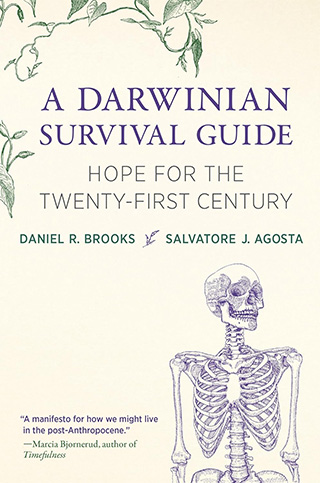
The dance continues. Sometimes we hug like brothers. Sometimes we feel like punching each other’s lights out (also, I suppose, like brothers). But one thing we never do is bore each other — and whenever Dan’s in town, we manage to meet up at a pub somewhere to reconnect. What follows is an edited record of one such meeting, more formal than most, which took place shortly after the publication of “A Darwinian Survival Guide.”
The following conversation was recorded in March 2024. It has been edited for clarity and length.
In that corner: Dan Brooks and Sal Agosta, with a Darwinian survival guide. So, take it away, Dan. Guide us to survival. What’s the strategy?
Daniel Brooks: Well, the primary thing that we have to understand or internalize is that what we’re dealing with is what is called a no-technological-solution problem. In other words, technology is not going to save us, real or imaginary. We have to change our behavior. If we change our behavior, we have sufficient technology to save ourselves. If we don’t change our behavior, we are unlikely to come up with a magical technological fix to compensate for our bad behavior. This is why Sal and I have adopted a position that we should not be talking about sustainability, but about survival, in terms of humanity’s future. Sustainability has come to mean, what kind of technological fixes can we come up with that will allow us to continue to do business as usual without paying a penalty for it? As evolutionary biologists, we understand that all actions carry biological consequences. We know that relying on indefinite growth or uncontrolled growth is unsustainable in the long term, but that’s the behavior we’re seeing now.
“Darwin told us in 1859 that what we had been doing for the last 10,000 or so years was not going to work.”
Stepping back a bit. Darwin told us in 1859 that what we had been doing for the last 10,000 or so years was not going to work. But people didn’t want to hear that message. So along came a sociologist who said, “It’s OK; I can fix Darwinism.” This guy’s name was Herbert Spencer, and he said, “I can fix Darwinism. We’ll just call it natural selection, but instead of survival of what’s-good-enough-to-survive-in-the-future, we’re going to call it survival of the fittest, and it’s whatever is best now.” Herbert Spencer was instrumental in convincing most biologists to change their perspective from “evolution is long-term survival” to “evolution is short-term adaptation.” And that was consistent with the notion of maximizing short term profits economically, maximizing your chances of being reelected, maximizing the collection plate every Sunday in the churches, and people were quite happy with this.
Well, fast-forward and how’s that working out? Not very well. And it turns out that Spencer’s ideas were not, in fact, consistent with Darwin’s ideas. They represented a major change in perspective. What Sal and I suggest is that if we go back to Darwin’s original message, we not only find an explanation for why we’re in this problem, but, interestingly enough, it also gives us some insights into the kinds of behavioral changes we might want to undertake if we want to survive.
To clarify, when we talk about survival in the book, we talk about two different things. One is the survival of our species, Homo sapiens. We actually don’t think that’s in jeopardy. Now, Homo sapiens of some form or another is going to survive no matter what we do, short of blowing up the planet with nuclear weapons. What’s really important is trying to decide what we would need to do if we wanted what we call “technological humanity,” or better said “technologically-dependent humanity,” to survive.
Put it this way: If you take a couple of typical undergraduates from the University of Toronto and you drop them in the middle of Beijing with their cell phones, they’re going to be fine. You take them up to Algonquin Park, a few hours’ drive north of Toronto, and you drop them in the park, and they’re dead within 48 hours. So we have to understand that we’ve produced a lot of human beings on this planet who can’t survive outside of this technologically dependent existence. And so, if there is the kind of nature collapse that the Melbourne Sustainable Studies Institute is talking about, how are those people going to survive? A completely dispassionate view would just say, “Well, you know, most of them won’t. Most of them are going to die.” But what if it turns out that we think that embedded within all of that technologically dependent society there are some good things? What if we think that there are elements of that existence that are worth trying to save, from high technology to high art to modern medicine? In my particular case, without modern medical knowledge, I would have died when I was just 21 years old of a burst appendix. If I had managed to survive that, I would have died in my late 50s from an enlarged prostate. These are things most would prefer not to happen. What can we begin doing now that will increase the chances that those elements of technologically-dependent humanity will survive a general collapse, if that happens as a result of our unwillingness to begin to do anything effective with respect to climate change and human existence?
Peter Watts: So to be clear, you’re not talking about forestalling the collapse —
Daniel Brooks: No.
Peter Watts: — you’re talking about passing through that bottleneck and coming out the other side with some semblance of what we value intact.
Daniel Brooks: Yeah, that’s right. It is conceivable that if all of humanity suddenly decided to change its behavior, right now, we would emerge after 2050 with most everything intact, and we would be “OK.” We don’t think that’s realistic. It is a possibility, but we don’t think that’s a realistic possibility. We think that, in fact, most of humanity is committed to business as usual, and that’s what we’re really talking about: What can we begin doing now to try to shorten the period of time after the collapse, before we “recover”? In other words — and this is in analogy with Asimov’s Foundation trilogy — if we do nothing, there’s going to be a collapse and it’ll take 30,000 years for the galaxy to recover. But if we start doing things now, then it maybe only takes 1,000 years to recover. So using that analogy, what can some human beings start to do now that would shorten the period of time necessary to recover? Could we, in fact, recover within a generation? Could we be without a global internet for 20 years, but within 20 years, could we have a global internet back again?
Peter Watts: Are you basically talking about the sociological equivalent of the Norwegian Seed Bank, for example?
Daniel Brooks: That’s actually a really good analogy to use, because of course, as you probably know, the temperatures around the Norwegian Seed Bank are so high now that the Seed Bank itself is in some jeopardy of survival. The place where it is was chosen because it was thought that it was going to be cold forever, and everything would be fine, and you could store all these seeds now. And now all the area around it is melting, and this whole thing is in jeopardy. This is a really good example of letting engineers and physicists be in charge of the construction process, rather than biologists. Biologists understand that conditions never stay the same; engineers engineer things for, this is the way things are, this is the way things are always going to be. Physicists are always looking for some sort of general law of in perpetuity, and biologists are never under any illusions about this. Biologists understand that things are always going to change.
Peter Watts: Well, that said, that’s kind of a repeated underlying foundation of the book, which is that evolutionary strategies are our best bet for dealing with stressors. And by definition, that implies that the system changes. Life will find a way, but it won’t necessarily include the right whales and the monarch butterflies.
Daniel Brooks: Right, right. Yeah.
Peter Watts: And you take on quite explicitly the neo-protectionists, who basically want to preserve the system as it exists, or as it existed at one point in the idealized past, forever without end, as opposed to allowing the system to exercise its capacity to change in response to stress. You cite anoxic ocean blobs; you cite, quite brilliantly I thought, the devastating effect beavers have on their local habitat.
Daniel Brooks: Yeah.
Peter Watts: And you take on the sacred spirit animal of the World Wildlife Fund, the polar bear. And the bottom line here is that shit happens, things change, trust life to find a way, ‘cause evolution hasn’t steered us wrong yet.
Daniel Brooks: Yeah.
Peter Watts: Now, this is an argument that some might say is invasible by cheaters. I read this and I thought of the Simpsons episode where Montgomery Burns is railing to Lisa, and he says, “Nature started the struggle for survival, and now she wants to call it off because she’s losing? I say, hard cheese!” And less fictitiously, Rush Limbaugh has invoked essentially the same argument when he was advocating against the protection of the spotted owl. You know, life will find a way. This is evolution; this is natural selection. So, I can see cherry-picking oil executives being really happy with this book. How do you guard against that?
Daniel Brooks: Anybody can cherry-pick anything, and they will. Our attitude is just basically saying, look, here’s the fundamental response to any of this stuff. It’s, how’s it working out so far? OK? There’s a common adage by tennis coaches that says during a match, you never change your winning game, and you always change your losing game. That’s what we’re saying.
One of the things that’s really important for us to focus on is to understand why it is that human beings are so susceptible to adopting behaviors that seem like a good idea, and are not. Sal and I say, here are some things that seem to be common to human misbehavior, with respect to their survival. One is that human beings really like drama. Human beings really like magic. And human beings don’t like to hear bad news, especially if it means that they’re personally responsible for the bad news. And that’s a very gross, very superficial thing, but beneath that is a whole bunch of really sophisticated stuff about how human brains work, and the relationship between human beings’ ability to conceptualize the future, but living and experiencing the present.
There seems to be a mismatch within our brain — this is an ongoing sort of sloppy evolutionary phenomenon. So that’s why we spend so much time in the first half of the book talking about human evolution, and that’s why we adopt a nonjudgmental approach to understanding how human beings have gotten themselves into this situation. Because everything that human beings have done for 3 million years has seemed like a good idea at the time, but it’s only been in the last 100 or 150 years that human beings have begun to develop ways of thinking that allow us to try to project future consequences and to think about unanticipated consequences, long-term consequences of what we do now. So this is very new for humanity, and as a consequence, it’s ridiculous to place blame on our ancestors for the situation we’re in now.
“We’re hoping that people will begin seriously thinking that our short-term well-being is best served by thinking about our long-term survival.”
Everything that people did at any point in time seemed like a good idea at the time; it seemed to solve a problem. If it worked for a while, that was fine, and when it no longer worked, they tried to do something else. But now we seem to be at a point where our ability to survive in the short term is compromised, and what we’re saying is that our way to survive better in the short term, ironically, is now based on a better understanding of how to survive in the long run. We’re hoping that people will begin seriously thinking that our short-term well-being is best served by thinking about our long-term survival.
Peter Watts: What you’ve just stated is essentially that short-term goals and long-term goals are not necessarily the same thing, that one trades off against the other. When you put it that way, it seems perfectly obvious — although I have to say, what you’re advocating for presumes a level of foresight and self-control that our species has, shall we say, not traditionally manifested. But yeah, a widely adhered-to view of evolution is a reactive one— the pool is drying up, and evolution looks at that and says, oh my goodness, the pool is drying up! We should probably get those fish to evolve lungs. Whereas what evolution actually does is say, oh look, the pool is drying up! Good thing that fish over in the corner that everybody picked on has a perforated swim bladder; it might be able to, like, breathe air long enough to make it over to the next pool. Too bad about all those other poor bastards who are going to die. And to hone that down to a specific example that you guys cite in the book, you’re saying “high fitness equals low fitness” — that you need variation to cope with future change.
Daniel Brooks: Right.
Peter Watts: So optimal adaptation to a specific environment implies a lack of variation. When you’re optimally adapted to one specific environment, you are screwed the moment the environment changes. And the idea that high fitness equals low fitness is what I call a counterintuitive obvious point: It is something that seems oxymoronic and even stupid when you first hear it, but when you think about it for more than two seconds, it’s like — who was it that responded to “The Origin of Species” by saying, Of course! How silly of me not to have thought of it myself. I’ve forgotten who said that.
Daniel Brooks: A lot of biology professors, who then wrote articles about how they actually had thought of it for themselves, but nobody paid any attention to that!
Peter Watts: And that might be one of the more essential values of this book — that it reminds us of things we should already know, but never thought about rigorously enough to actually realize.
Shifting gears to another key point in the book, democracy, which you describe as the one form of government that allows the possibility of change without violence. But you also admit — and this is a quote: “Our governance systems, long ago coopted as instruments for amplified personal power, have become nearly useless, at all levels from the United Nations to the local city council. Institutions established during 450 generations of unresolvable conflict cannot facilitate change because they are designed to be agents of social control, maintaining what philosopher John Rawls called ‘the goal of the well-ordered society.’ They were not founded with global climate change, the economics of wellbeing, or conflict resolution in mind.” So what you are essentially saying here is that anyone trying to adopt the Darwinian principles that you and Sal are advocating is going to be going up against established societal structures, which makes you, by definition, an enemy of the state.
Daniel Brooks: Yes.
Peter Watts: And we already live in a world where staging sit-down protests in favor of Native land rights or taking pictures of a factory farm is enough to get you legally defined as a terrorist.
Daniel Brooks: That’s right. Yeah.
Peter Watts: So, how are we not looking at a violent revolution here?
Daniel Brooks: That’s a really good point. I mean, that’s a really critical point. And it’s a point that was addressed in a conference a year ago that I attended, spoke in, in Stockholm, called “The Illusion of Control,” and a virtual conference two years before that called “Buying Time,” where a group of us recognized that the worst thing you could do to try to create social change for survival was to attack social institutions. That the way to cope with social institutions that were non-functional, or perhaps even antithetical to long-term survival, was to ignore them and go around them.
So let me give you an example: I was speaking with member representatives of a rural revitalization NGO in Nebraska a year ago, and they said, “OK, this rural revitalization stuff and climate migration, this sounds like a really good idea. How are we going to get the federal government to support these efforts?” And I said, “They’re not going to.” I said, “You have to understand that in the American situation, the two greatest obstacles to rural revitalization and climate migration are the Republican Party and the Democratic Party. The Democratic Party is a party of big cities; they don’t want to lose population. The Republican Party is the population of the rural areas; they don’t want people from the cities moving into their areas. Both parties are going to be against this. This is why Joe Biden’s, you know, ‘the climate president,’ but he’s not doing nearly enough. Not even close. Because these people are all locked into the status quo.” And so I told these people, I said, “You don’t ask for permission, and you don’t go to the federal government. You go to the local towns in these rural areas and you say, ‘What do you need? What do you want?’ You then advertise for the kinds of people you want to come in. You want to have electricity self-sufficiency in your town. You need somebody who knows how to build and maintain a solar farm. Advertise for people like that in the big cities. Get them to come and live in your town. Don’t ask the government; do the right thing. Never ask for permission; just do the right thing. They’re not going to pay any attention to you.” And these people said, “Yes, but then if we’re successful, the politicians will come in and claim credit!” And I said, “So what? Who cares! Let them come in, do a photo op, and then they go back to Washington D.C. and they’ll forget you.”
Peter Watts: Maybe. But in cases where it’s been tried, the power utilities step in and squash such efforts as though they were bugs. Set up solar panels and the utility will charge you for “infrastructure maintenance” because by opting out of the grid, you’re not paying “your fair share.” Drive an electric vehicle and you might be subject to an additional “road tax” because, by not paying for gasoline, you’re not paying for road work. The system actively works to make these initiatives fail. And this power goes beyond just stifling progress. They have control of armed forces; they have a monopoly on state violence. We are not allowed to beat up the cops; the cops are allowed to beat us up.
Daniel Brooks: I suppose I have more faith in human nature than is warranted by the evidence. Sal and I do not think such local initiatives will be easy or that they will mostly succeed — at least not until things are so bad that they are the only workable option. What we are saying is that these local initiatives are the Darwinian response to trouble (move away from trouble, generalize in fitness space, and find something that works), and if we recognize trouble early enough, we can opt to begin surviving now. At the same time, during climate perturbations, lots of organisms do not make it, so we need as many individual efforts as possible to increase the chances that someone will survive.
“Local initiatives are the Darwinian response to trouble, and if we recognize trouble early enough, we can opt to begin surviving now.”
There is evidence that some people are doing this, sometimes with the blessing of local and state authorities and without arousing the interest of national authorities. What people need to do is have a commitment to survival, decide what their assets are and their local carrying capacity, and then go about doing the right thing as quietly as possible. As for your point about state violence: What happens if the cops in a small town are the people you go to church with?
Peter Watts: That’s an interesting question.
Daniel Brooks: That’s the point. I mean, what we’re trying to find out, one of the experiments that rural revitalization and, and climate migration is going to resolve for us, is, what is the largest human population that can safeguard itself against being taken over by sociopaths? Let me explain what I mean. Generally speaking, the larger the population, the smaller the number of people who actually control the social control institutions. So you have five different language groups in the city, but somehow it turns out that the people in charge of the religion, or the banks, or the governance only represent one of those language groups. They end up controlling everything. This is a breeding ground for sociopaths to take control. And sure enough, by about 9,000 years ago, when this is all in place, we begin to see religious and governance and economic institutions all support the notion of going to war to take from your neighbors what you want for yourself. And we’ve been at war with ourselves ever since then, and this was not an evolutionary imperative; this was a societal behavioral decision. It’s understandable, in retrospect, as a result of too many people, too high a population density. So you live in circumstances where people cannot identify the sociopaths before they’ve taken control. And that’s the subtext in the idea that one of the ways that we should deal with the fact that more than 50 percent of human beings now live in large cities in climate-insecure places, is for those people to redistribute themselves away from climate-insecure areas, into population centers of lower density, and cooperating networks of low-density populations, rather than big, condensed cities.
Peter Watts: Let’s follow this move back to the rural environment a bit, because it’s fundamental. I mean, you brought it up, and it is fundamental to the modular post-apocalyptic society you’re talking about.
Daniel Brooks: Sure. Not post-apocalyptic: post-collapse.
Peter Watts: Post-collapse. Fair enough.So, another quote from the book: “Neo-protectionists compliment the ever-larger city’s perspective by suggesting that the biosphere would be best served if humans were maximally separated from the wild lands.”
Daniel Brooks: Right.
Peter Watts: “This makes no sense to most humans, and that is why no post-apocalyptic or dystopian novel or film depicts large cities as places of refuge and safety during a crisis.” Just putting up my hand, I can vouch for that, having written my share of apocalyptic sci-fi.
Daniel Brooks: Nobody’s running to the cities.
Peter Watts: “Any attempt to separate humans from the rest of the biosphere would be detrimental to efforts to preserve either.” And I believe at some other point you reference neo-protectionist arguments that we should put aside half of the natural life —
Daniel Brooks: Yeah. That’s E.O. Wilson’s half —
Peter Watts: And putting aside, for the moment, my sympathies for that sentiment — in defense of the neo-protectionists, all of human history says that whenever we interact with nature, we pretty much fuck it up.
Daniel Brooks: No. It doesn’t say that. First of all, when you talk of most of human history, you’re talking about the last thousand years, 2,000 years, 3,000 years. What has been the actual historical record of humans for the last 3 million years?
Peter Watts: I take your point. And it’s a legitimate point when you talk about a global human population, that you mention, in the millions. But we’re at a population of 8 billion now. So accepting, wholesale, without argument, your argument that cities are basically wasteful, unsustaining, pestholes of disease and so on —
Daniel Brooks: That benefit a few people a lot, and treat the great majority as a disposable workforce.
Peter Watts: Yeah. But we still are dealing with a planet in which 94 percent of mammalian biomass on this planet is us and our livestock, so how does that kind of biomass integrate intimately with what remains of our natural environment without just crushing it — or are you anticipating, like, a massive cull of a —
Daniel Brooks: But, see, you’re repeating a bunch of truisms that are not borne out by the actual evidence. We don’t crush — Homo sapiens doesn’t crush the biosphere. Homo sapiens interacts with the biosphere in ways that alter it. See, evolutionary alteration of the environment does not mean collapse. It means change. This is the neo-protectionist language — that any change is going to collapse the biosphere. That’s bullshit. I mean, what human beings are doing to the biosphere right now is nothing compared to what blue-green algae did to the biosphere 4 billion years ago.
“This is the neo-protectionist language — that any change is going to collapse the biosphere. That’s bullshit.”
Peter Watts: Absolutely.
Daniel Brooks: And what happened? Us, OK? The Chicxulub asteroid: If it hadn’t killed the dinosaurs, there would be no us.
Peter Watts: I actually, personally, find comfort in the idea that there have been, what, five major extinction events? And that in every single case, there has been a beautiful, diverse —
Daniel Brooks: Because there was sufficient evolutionary potential to survive.
Peter Watts: Exactly.
Daniel Brooks: Not because a whole bunch of new magical mutations showed up.
Peter Watts: Right. But, it took anywhere from 10 to 30 million years for that to happen —
Daniel Brooks: So?
Peter Watts: — and I would argue that most people — I mean, I’m kind of on your side in this, but I’m also increasingly sympathetic to the human extinction movement. I think most people are hoping for recovery in less geological terms, timescale-wise.
Daniel Brooks: This is a really critical point, because this, then, loops back to the whole Asimov’s Foundation thing. Do we wait 30,000 years for the empire to rebuild, or can we do it in 1,000 years? That’s what we’re talking about. We have great confidence that the biosphere is going to restore itself, within — you know, no matter what we do, unless we make the whole planet a cinder, the biosphere’s going to “restore itself” within, you know, 10 million years. Whatever. That’s fine. And we — you know, some form of humanity — may be part of that, or may not. But the reality is that what we want to do, as human beings, is we want to tip the odds in our favor a little bit. We want to increase the odds that we’re going to be one of those lucky species that survives. And we know enough to be able to do that. We know now enough about evolution to be able to alter our behavior in a way that’s going to increase the odds that we’ll survive. So the question is, are we going to do that? So this whole business of whether or not, you know, what’s going to happen in 3 million years — you’re right: That’s not important. But what happens tomorrow is not important either. What’s important is what happens in the first generation after 2050. That’s what’s important. That first generation after 2050 is going to determine whether or not technological humanity reemerges from an eclipse, or whether Homo sapiens becomes just another marginal primate species.
Peter Watts is a Hugo Award-winning science-fiction author and a former marine biologist. His most recent novel is “The Freeze-Frame Revolution” (Tachyon).
Daniel R. Brooks is Professor Emeritus, University of Toronto, Senior Research Fellow, H. W. Manter Laboratory of Parasitology, University of Nebraska State Museum, and Fellow of the Stellenbosch Institute for Advanced Study (STIAS). He is the co-author of “The Stockholm Paradigm” (University of Chicago Press), “The Major Metaphors of Evolution” (Springer), and, most recently, “A Darwinian Survival Guide.”
POSTED ON MAY 13
The MIT Press is a mission-driven, not-for-profit scholarly publisher. Your support helps make it possible for us to create open publishing models and produce books of superior design quality.
This article is about the Theosophical term. For the Tibetan term Sprul pa (སྤྲུལ་པ་), see Nirmāṇakāya. For the film, see Tulpa (film).
Tulpa is a concept originally from Tibetan Buddhism and found in later traditions of mysticism and the paranormal of a materialized being or thought-form, typically in human form, that is created through spiritual practice and intense concentration.[1][2][3] Modern practitioners, who call themselves “tulpamancers”, use the term to refer to a type of willed imaginary friend which practitioners consider to be sentient and relatively independent. Modern practitioners predominantly consider tulpas to be a psychological rather than a paranormal concept.[4][5][6][7] The idea became an important belief in Theosophy.
Origins
The concept of tulpas has origins in the Buddhist nirmāṇakāya, translated in Tibetan as sprul-pa (སྤྲུལ་པ་): the earthly bodies that a buddha manifests in order to teach those who have not attained nirvana. The western understanding of tulpas was developed by twentieth-century European mystical explorers, who interpreted the idea independently of buddhahood.[8]
20th-century Theosophists adapted the Vajrayana concept of the emanation body into the concepts of ‘tulpa’ and ‘thoughtform’.[9] The Theosophist Annie Besant, in the 1905 book Thought-Forms, divides them into three classes: forms in the shape of the person who creates them, forms that resemble objects or people and may become ensouled by nature spirits or by the dead, and forms that represent inherent qualities from the astral or mental planes, such as emotions.[10] The term ‘thoughtform’ is also used in Evans-Wentz‘s 1927 translation of the Tibetan Book of the Dead.[11] The concept is also used in the Western practice of magic.[12][page needed] The Slender Man has been described by some people as a tulpa-effect, and attributed to multiple people’s thought processes.[13]
Occultist William Walker Atkinson in his book The Human Aura described thoughtforms as simple ethereal objects emanating from the auras surrounding people, generating from their thoughts and feelings.[14] He further elaborated in Clairvoyance and Occult Powers how experienced practitioners of the occult can produce thoughtforms from their auras that serve as astral projections which may or may not look like the person who is projecting them, or as illusions that can only be seen by those with “awakened astral senses”.[15]
Alexandra David-Néel
Spiritualist Alexandra David-Néel stated that she had observed Buddhist tulpa creation practices in 20th-century Tibet.[8][1] She described tulpas as “magic formations generated by a powerful concentration of thought.”[16]: 331 David-Néel believed that a tulpa could develop a mind of its own: “Once the tulpa is endowed with enough vitality to be capable of playing the part of a real being, it tends to free itself from its maker’s control. According to David-Néel, this happens nearly mechanically, just as the child, when her body is completed and able to live apart, leaves its mother’s womb.”[16]: 283 She said she had created such a tulpa in the image of a jolly Friar Tuck-like monk, which she claimed had later developed independent thought and had to be destroyed.[17][3] David-Néel raised the possibility that her experience was illusory: “I may have created my own hallucination”, though she said others could see the thoughtforms that she created.[16]: 176
Tulpamancers
Influenced by depictions in television and cinema from the 1990s and 2000s, the term tulpa started to be used to refer to a type of willed imaginary friend.[9] Practitioners consider tulpas to be sentient and relatively autonomous.[4] Online communities dedicated to tulpas spawned on the 4chan and Reddit websites. These communities refer to tulpa practitioners as “tulpamancers”. The communities gained popularity when adult fans of My Little Pony started discussing tulpas of characters from the My Little Pony television series.[4] The fans attempted to use meditation and lucid dreaming techniques to create imaginary friends.[5][18] Surveys by Veissière explored this community’s demographic, social, and psychological profiles. These practitioners believe a tulpa is a “real or somewhat-real person”.[5] The number of active participants in these online communities is in the low hundreds, and few meetings in person have taken place. They belong to “primarily urban, middle-class, Euro-American adolescent and young adult demographics”[5] and they “cite loneliness and social anxiety as an incentive to pick up the practice”.[5] 93.7% of respondents expressed that their involvement with the creation of tulpas has “made their condition better”,[5] and led to new unusual sensory experiences. Some practitioners have sexual and romantic interactions with their tulpas, though the practice is controversial and trending toward taboo.[citation needed] One survey found that 8.5% support a metaphysical explanation of tulpas, 76.5% support a neurological or psychological explanation, and 14% “other” explanations.[5]
Practitioners believe tulpas are able to communicate with their host in ways they sense do not originate from their own thoughts. Some practitioners report experiencing hallucinations of their tulpas. Practitioners that have hallucinations report being able to see, hear and touch their tulpas.[5]
Veissière’s survey of 141 respondents found that the rates of neurodivergence including autism, ADD, and ADHD was significantly higher among the surveyed tulpamancers than in the general population. He goes on to speculate that people may be more likely to want to make a tulpa because these groups have a higher level of loneliness. Tulpamancers were typically white, articulate, and imaginative and lived in urban areas.[19] A 2022 study found individuals that did not have psychosis who experienced more than one unusual sensory phenomenon, (in this instance ASMR and Tulpamancy) were found to have greater hallucination-proneness than people that only experienced one of the two sensory phenomenon.[20]
Somer et al. (2021) described the Internet tulpamancer subculture as being used to “overcome loneliness and mental suffering”, and noted the close association with reality shifting (RS), a way of deliberately inducing a form of self-hypnosis in order to escape from current reality into a pre-planned desired reality or “wonderland” of chosen fantasy characters.[19]
We’re almost halfway through 2024 and we at The Book Review have already written about hundreds of books. Some of those titles are good. Some are very good. And then there are the following.
We suspect that some (though certainly not all) will be top of mind when we publish our end-of-year, best-of lists. For more thoughts on what to read next, head to our book recommendation page.
In this reworking of the “Adventures of Huckleberry Finn,” Jim, the enslaved man who accompanies Huck down the Mississippi River, is the narrator, and he recounts the classic tale in a language that is his own, with surprising details that reveal a far more resourceful, cunning and powerful character than we knew.
Alderton’s novel, about a 35-year-old struggling to make sense of a breakup, delivers the most delightful aspects of romantic comedy — snappy dialogue, realistic relationship dynamics, funny meet-cutes and misunderstandings — and leaves behind clichéd gender roles and the traditional marriage plot.
A young Iranian American aspiring poet and recovering addict grieves his parents’ deaths while fantasizing about his own in Akbar’s remarkable first novel, which, haunted by death, also teems with life — in the inventive beauty of its sentences, the vividness of its characters and the surprising twists of its plot.
For Tana French fans, every one of the thriller writer’s twisty, ingenious books is an event. This one, a sequel to “The Searcher,” once again sees the retired Chicago cop Cal Hooper, a perennial outsider in the Irish west-country hamlet of Ardnakelty, caught up in the crimes — seen and unseen — that eat at the seemingly picturesque village.
This follow-up to Orange’s debut, “There There,” is part prequel and part sequel; it trails the young survivor of a 19th-century massacre of Native Americans, chronicling not just his harsh fate but those of his descendants. In its second half, the novel enters 21st-century Oakland, following the family in the aftermath of a shooting.
Set at a women’s boxing tournament in Reno, Nev., this novel centers on eight contestants, and the fights — physical and emotional — they bring to the ring. As our critic wrote: This story’s impact “lasts a long time, like a sharp fist to your shoulder.”
In 1970s Philadelphia, an alien girl sent to Earth before she’s born communicates with her fellow life-forms via fax as she helps gather intel about whether our planet is habitable. This funny-sad novel follows the girl and her single mother as they find the means to persevere.
In his candid, plain-spoken and gripping new memoir, Rushdie recalls the attempted assassination he survived in 2022 during a presentation about keeping the world’s writers safe from harm. His attacker had piranhic energy. He also had a knife. Rushdie lost an eye, but he has slowly recovered thanks to the attentive care of doctors and the wife he celebrates here.
This urgent and propulsive account of Latin American politics and immigration makes a persuasive case for a direct line from U.S. foreign policy in Central America to the current migrant crisis.
By the time he made his third Pacific voyage, the British explorer James Cook had maybe begun to lose it a little. The scientific aims of his first two trips had shifted into something darker. According to our reviewer, the historian Hampton Sides “isn’t just interested in retelling an adventure tale. He also wants to present it from a 21st-century point of view. ‘The Wide Wide Sea’ fits neatly into a growing genre that includes David Grann’s ‘The Wager’ and Candice Millard’s ‘River of the Gods,’ in which famous expeditions, once told as swashbuckling stories of adventure, are recast within the tragic history of colonialism.”
This absorbing biography of the Black psychiatrist, writer and revolutionary Frantz Fanon highlights a side of him that’s often eclipsed by his image as a zealous partisan — that of the caring doctor, who ran a secret clinic for Algerian rebels.
In her fifth memoir, Fuller describes the sudden death of her 21-year-old son. Devastating as this elegant and honest account may be — it’s certainly not for the faint of heart — it also leaves the reader with a sense of having known a lovely and lively young man.
In this reworking of the “Adventures of Huckleberry Finn,” Jim, the enslaved man who accompanies Huck down the Mississippi River, is the narrator, and he recounts the classic tale in a language that is his own, with surprising details that reveal a far more resourceful, cunning and powerful character than we knew.
“The proletarian revolutionary must understand, or must be convinced, that, even if he does not see himself as directly implicated, the emancipation of the homosexual concerns him just as much as, for example, the emancipation of women and of people of colour. As for the homosexual, he must understand that his liberation can be total and irreversible only if it is achieved within the context of social revolution, in other words, only if the human race succeeds not just in liberalizing attitudes, but far more than this, in transforming everyday life.” [95]
Guérin commented once that “the driving force of my life has been love”. [97] Perhaps this provides the unifying principle underlying all of Guérin’s work. As he wrote in 1959 in the foreword to an essay about the censorship of homosexual writers:
The problem in reality is not homosexuality. It is, above and beyond that, the problem of sexual liberation, or rather, more generally even than that, it is the problem of freedom. Eroticism is one of the instruments of freedom. There is within it, in the words of Simone de Beauvoir, a principle which is hostile to society, or, more precisely, hostile to a society in which man oppresses man [sic], hostile to the authoritarian society. In Carmen, the song goes: Love is a gypsy child./It has never, ever obeyed laws. [98]
There are nevertheless clearly some aspects of Guérin’s sexual attitudes or practices which are not unproblematic, notably his tendency to objectify his sexual partners and to idealize working-class youth. As Sedgwick very eloquently put it:
Guérin’s desires have always been framed less in terms of a body than of an embodiment: the lovers pass as successor-incarnations of an active, questing proletariat, a mass of privacies summating through their plenitude and their sameness into a collective public subject. It is a myth of working-class virility which yokes Guérin’s syndicalism with his sexual nature, in an idealisation which echoes the less erotic (but equally ethereal) mythology of the proletariat-as-agent heralded by a Sorel or a Lukacs. [99]
Guérin also tended (particularly through his masochism, his fetishism and his adherence to somewhat stereotypical, reductionist representations of physical beauty) to reproduce exploitative relations similar to those which have been much targeted by feminism.
To some extent, Guérin was aware of these contradictions — the contradictions, in Sedgwick’s words, “between the egalitarian and emancipatory values which the Left canvasses for the reform of society, and the metaphysics of abasement, domination or objectivation which seem to characterise sexual relations of a certain intensity” [100] — and in Eux et lui, notably, he submitted himself to a public and painfully honest autocritique.
Sedgwick argues, quite rightly, that Guérin’s linking of his homosexual proclivities with the proletariat seen as social vanguard “does not establish the radicalism of Guérin’s sexual choice within the terms of sexual politics itself.” [101] And he goes on to claim that our modern awareness of sexual politics has tended historically to derive not from the class-struggle-oriented Marxists and anarchists, but “from liberal feminists, or from Utopians like Fourier and Owen who have rejected the class-struggle in industry, or from a women’s movement which from the nineteenth century to the present has been seldom entirely happy with the definition of radical priorities offered by even the most revolutionary of males.” [102] Quite apart from the fact that this claim is at least in part questionable, Sedgwick also seems to have been ignorant of Guérin’s writings on sexuality other than the autobiographical texts. For, although Guérin adhered to the orthodox Marxist argument, as expounded by Engels, according to which the patriarchal family, private property and the state were both coterminous and historically determined, it is precisely in the Utopian Fourier, in the individualist anarchists Armand and Stirner, in Reichian psychoanalysis and in the liberal sexologist Kinsey that Guérin found the ideas he needed to produce a critique of labour movement homophobia and to tie this up with a socialist critique of bourgeois patriarchy. Sedgwick concluded his analysis of the contradictions in Guérin by arguing that:
In his more personal, experiential writing, Guérin is unwittingly correcting the entire theoretical orientation of his public socialism: his oscillation between a masculine public sphere of production and a quasi-feminine world of the heart is the penalty of the double life forced on him by society’s ban. [103]
This is doubtless true of an earlier period in Guérin’s life. But surely what characterizes Guérin’s activism and his non-autobiographical writings from the 1950s onwards, and particularly after his coming out in 1965, is his move away from Marxism-Leninism and towards anarchism, away from the point of production and towards a breaking down of the artificial barrier between the “public” and the “private”, towards a growing commitment to sexual and especially homosexual liberation, and an attempt both on a theoretical and on a practical, organizational level to bring these two aspects of total social revolution together.
The issue of homosexuality acquired ever greater importance in Guérin’s life, and, in an interview he gave at the age of 75, he made the following remarks about a collection of essays, which he evidently thought might be his last, entitled Son testament:
I may well not live many more years, and as a precaution I have been keen to let it be known that I would like my last publication, my last thoughts, to focus on my love of boys. Having already written books on a great number of different subjects, having a great deal of experience of political activism and having very strong political views, I could have produced a synthesis of my thoughts about revolution, antimilitarism, anticolonialism, etc. If I was insistent that my last book should be called His Testament, it is because I think that homosexuality has played such a primordial rôle in my life, that it has haunted me day and night from the age of 15, that that is the message I wish to leave behind. The fact that I am married, a father, a grandfather, bisexual, homosexual, […] it seems to me that this is what I must leave behind as the final expression of my life as a writer and as a man. [104]
Finally, to conclude, I can do no better that to quote an assessment of Guérin’s contribution in the form of a letter to him from Pierre Hahn, a leading left-winger in the gay lib movement and a founder member of the FHAR:
More than to any other, homosexuals are grateful to you — and I more than anyone — for everything you have done for them, and that at a time when to speak out in such a way brought with it great disrepute. […] But your most valuable contribution is a life’s work which is at once political (in the traditional sense of the word) and sexological: it is La Peste brune plus Kinsey; it is Fourier and the texts against colonialism; it is, above all, you yourself. [105]
Daniel Guérin (May 19, 1904 – April 14, 1988) was a French libertarian-communist author, best known for his work Anarchism: From Theory to Practice, as well as his collection No Gods No Masters: An Anthology of Anarchism in which he … Wikipedia
The years of pandemic and lockdown are still working powerfully on us from the inside. But we have trouble acknowledging this, much less metabolizing it. This conversation with Christine Runyan, which took place in the dark middle of those years, helps make sense of our present of still-unfolding epidemic distress — as individuals, as communities, as a species. She has cultivated a reverence for the human nervous system. She tells truths about our bodies that western medicine itself is only fitfully learning to see. This quiet conversation is not just revelatory, but healing and calming. It holds startling prescience about some of what we’re navigating now. And it offers self-compassion and simple strategies for finding ease within ourselves — and with each other — as we live forward from here.


When near the summit, the wind, as generally happens, was impetuous and extremely cold. On each side of the ridge we had to pass over broad bands of perpetual snow, which were now soon to be covered by a fresh layer. When we reached the crest and looked backwards, a glorious view was presented. The atmosphere resplendently clear; the sky an intense blue; the profound valleys; the wild broken forms: the heaps of ruins, piled up during the lapse of ages; the bright-coloured rocks, contrasted with the quiet mountains of snow, all these together produced a scene no one could have imagined. Neither plant nor bird, excepting a few condors wheeling around the higher pinnacles, distracted my attention from the inanimate mass. I felt glad that I was alone: it was like watching a thunderstorm, or hearing in full orchestra a chorus of the Messiah.