
Corina Lidia Muresan on Facebook.com

WED, 7/26/2023 – BY CARL GIBSON (Occupy.com)

Two years before he died, legendary physicist Dr. Stephen Hawking ominously warned that the development of artificial intelligence, or AI, would be “either the best, or the worst thing, ever to happen to humanity.” Today, the rapid proliferation of artificial intelligence, or AI, is already wreaking havoc on workers in multiple industries. In May 2023 alone, AI took an estimated 4,000 jobs away from workers.
CEOs using AI to cut labor costs is only likely to intensify: The CEO of IBM said he would be using AI to replace nearly 8,000 jobs at the company over the next five years. Summit Shah, the CEO of an Indian e-commerce tech startup, recently made headlines for laying off 90% of his support staff and replacing them with an AI chatbot similar to ChatGPT. And according to a 2020 report by the World Economic Forum, AI could be utilized to fill 85 million jobs around the globe by 2025.
In the ongoing WGA and SAG-AFTRA strike that’s brought Hollywood to a standstill, one of the points of contention is studios wanting to use AI to capture an actor’s likeness and then use that likeness in perpetuity while only paying an actor for their initial appearance. And while Disney CEO Bob Iger could make up to $25 million in yearly compensation under his current contract, actress Jana Schmieding, who acts in the Disney+ series Reservation Dogs, makes just $0.03 every three months in streaming residuals for that show.
But despite all of the conversation around AI, what has yet to be seriously discussed is using AI to perform the job where it would be the most useful and cost-effective: As a CEO.
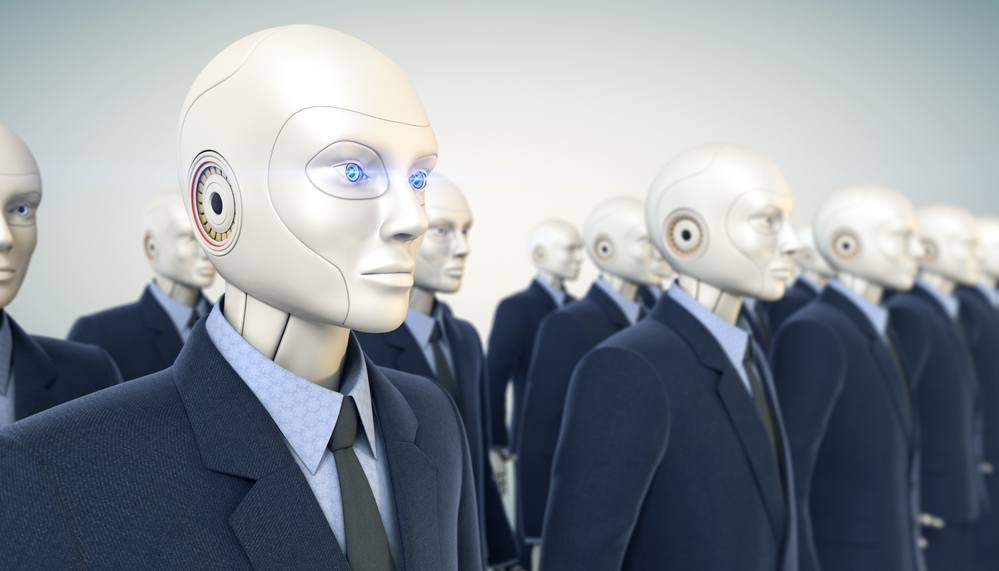
AI is exacerbating the war against the working class
The logic behind corporations replacing human workers with AI is that it will reduce payroll costs and make the company more efficient, allowing it to make other investments that will improve its balance sheet and its share price over time. AI may be new, but its use in this way is merely an acceleration of a decades-long trend of corporate executives paying workers as little as possible while rewarding themselves with increasingly excessive compensation packages.
At every company, the CEO role is easily the most costly. According to a 2023 study by Equilar and the Associated Press, CEO pay packages at publicly traded companies still average between $10 million and $20 million annually across 11 different industries when accounting for both salary and stock. The top 10 highest paid CEOs collectively were paid nearly $900 million in total compensation in 2022 alone.
When comparing CEO compensation with average worker compensation, top executives made roughly 400 times more than the average worker, according to a 2022 study by the Economic Policy Institute (EPI). Since 1978, CEO pay has risen by almost 1,500%. The EPI also found that while worker productivity and wages were growing at roughly the same pace between 1948 and 1978, wage growth abruptly flatlined in the 1980s and onward even as productivity continued to steadily increase. By 2021, worker productivity had grown by more than 64% since 1978, while wages had grown by only 17%. This means nearly 50% of workers’ labor value was effectively stolen by their employers over the course of several decades.
Interestingly, that period of time was also when the percentage of American workers who belonged to labor unions began to decline while the incomes of the richest 10% of Americans started climbing rapidly. After President Ronald Reagan busted the federal air traffic controllers union in 1981, union membership declined steadily each year with other companies likely viewing Reagan’s anti-worker policies as a green light to do the same.
A separate chart from EPI showed that in 1978, the percentage of workers who were unionized was around 25%, while 32% of income went to the top 10%. By 2014, only 11% of workers were unionized, and the top 10% held more than 47% of income. Conversely, in 1956, when union membership was the highest at 33% of workers, the top 10% held just 32% of income. This data strongly suggests the drive for “efficiency” and “cost-cutting” could be better described as the owner class pillaging the wealth of the working class, or, more simply, class war.

AI would be less costly and more efficient than a human CEO
When analyzing all of this data in a larger context, it could be argued that, at least in the US, a CEOs’ primary role is not just strengthening the company’s balance sheet, but fattening their own net worth. After all, when considering more than 52% of CEO compensation is in the form of stock options, CEOs are incentivized to do whatever it takes to increase the value of company shares, so the shares they’re paid with are worth even more. This is not only greedy and self-serving, but highly inefficient.
In June of this year, US News & World Report ranked the 50 best countries in the world for business. The publication ranked countries based on criteria like the favorability of a tax system, the level of bureaucracy, manufacturing costs, corruption, and government transparency. Switzerland ranked #1, and Panama, Finland, Luxembourg, and Norway rounded out the top five, respectively. To compare, the US didn’t even crack the top 50.
The best countries for business all share a few common traits: They typically have universal healthcare and public health insurance options, free education through the college level, generous paid leave policies, maternity and paternity leave, and child care among other well-funded safety net programs, freeing up companies from having to provide those benefits themselves. Additionally, CEOs are paid well, but far more modestly than American CEOs. Workers in these countries are also paid far more on average than in the US. According to Glassdoor data, the average Swiss CEO makes roughly $236K in US dollars (USD), while average Swiss workers make between $7,800 and $9,089 USD per month.
It could be easily argued that creating an AI to perform executive level functions like data analysis, risk assessment, and resource allocation would be preferable given AI’s strengths in those areas, especially when considering a machine doesn’t need compensation in the tens of millions of dollars to do so. While it would be somewhat concerning as a worker to know you’re reporting to a machine, that machine would still report to human beings on the company’s board and would be supplanted by other human C-suite executives who could come up with organizational vision and be the human faces of the company,
Just as Summit Shah had a programmer create the AI chatbot he used to replace support staff, an AI CEO could be programmed to include the well-being and happiness of the company’s workers in its performance metrics, rather than being chiefly driven by share prices. And if a company was no longer bound to pay a CEO tens of millions of dollars in compensation and bonuses over the course of a multi-year contract, it could have millions more to use for talent recruitment and retention, capital expenditures, and other things that would strengthen a company over the long term.
Like it or not, AI is here to stay. If it can be utilized where it will create the most efficiency and do the least harm, it could, as Stephen Hawking noted, be not the worst thing, but the best thing for humanity.
Carl Gibson is a freelance journalist and columnist whose work has been published in CNN, the Guardian, the Washington Post, the Houston Chronicle, the Louisville Courier-Journal, Barron’s, Business Insider, the Independent, and NPR, among others. Follow him on Bluesky @crgibs.bsky.social.
Jul 26, 2023, 2:00 AM PDT (Insider.com)
For the second time this year, I have taken a European high-speed train to Paris in lieu of a flight from a neighboring country.
To my surprise, my February journey from Amsterdam sparked an online debate over rail travel thanks to a viral Twitter post teasing the difference in how Americans and Europeans see trains.
Personally, growing up in north Florida meant high-speed rail travel was pretty foreign to me, so I was thrilled about the experience despite its apparent mundaneness in Europe.
And, after giving it a second go in June — this time on French-operated TGV InOui from Frankfurt — my thoughts haven’t changed as the experience truly put US rail companies like Amtrak to shame.
Granted, Amtrak isn’t horrible and has provided me with a comfortable ride from New York to Boston many times, but it is often late and the cars and stations are much dirtier usually.
Plus, there are only a few high-speed routes available in the US and it’s unlikely the car-dependent nation will see a robust rail network like in Europe anytime soon. Building anything close to Japan’s 300-mile-per-hour bullet trains in a reasonable amount of time is probably impossible.
Nevertheless, it doesn’t hurt to dream. And, some companies are hoping to move the needle, like South Florida’s Brightline high-speed train.
As I patiently wait for rail innovations at home, I can at least still enjoy them abroad. Here’s what my $100 one-way journey from Frankfurt to Paris on the 186-mile-per-hour TGV train was like in first class.
The station was packed, though there were plenty of places to eat or sit before boarding the train. Also available were €6 lockers for those that need to store luggage.
And, there is a clean restroom in the middle of the chaos, but it’ll cost €1 — so it’s best to have some coins on hand.
The 45 minutes was more than enough time as the tracks were within a few minutes walk from the station entrance — no bag check, no security, and no boarding gates.
I was automatically assigned the seat but was able to indicate a single window seat as my preference during booking. This is also when people can choose upper or lower deck seating.
There were also quad and duo-seating around me, with tables in between the sets of four — perfect for families or meetings.
My laptop easily fit on the tray table and I felt like I had plenty of space to store my backpack and charging cables.
The seat pitch and recline were incredible compared to airlines and I can imagine the former would be helpful for taller travelers.
The WiFi on Thalys wasn’t as spotty, though I find that, in general, airplane internet is typically faster than on trains.
I was a little worried about theft, but since I could see my suitcase at all times I felt it was safe. I kept my backpack under the seat in front of me though.
While views from 35,000 feet are nice, I love seeing the rural parts of Europe that I don’t get to experience very often.
It was fun to walk up the stairs to the little bar area. I also noticed some one-off chairs in the hallways that could be used to make a private phone call.
I liked the little dining area and can imagine it’d be a quiet spot to stretch your legs or get some alone time.
Other options included chocolate cake, quiche, yogurt, a ham sandwich, chicken casserole, gnocchetti pasta, a giant pretzel, and a beef burger, among others.
The quinoa salad had lima beans, chic peas, and a vinaigrette dressing, while the sandwich had poppy seed bread and vegetables.
Next time, I’d skip the meal and eat before or after the ride or bring my own food. Though, I could probably get by on the buffet car’s simple snacks, like the pretzel.
It reminded me of any typical train bathroom, though the bidet’s on the bullet trains in Japan will always be the best.
The wings around the headrest helped me cocoon myself into the seat and easily sleep, though the fact I was pretty fatigued from a red-eye flight also helped me rest.
One of the biggest advantages of train travel is the convenience of being dropped off in city centers rather than on the outskirts of town, which is where many international airports sit — including those in Paris.
Both Charles de Gaulle and Orly airports are at least 45 minutes from my hotel, versus 10 minutes from Paris Est station.
The journey included the time it took to get on the train, plus the train ride itself and the metro to my hotel.
That takes into account arriving at the airport two hours before departure, the time waiting for baggage claim, as well as the commute to the hotel from Charles de Gaulle.
Plus, the weather can have a bigger impact on planes compared to trains, so there is less chance of a delay or cancellation.
In fact, Google actually displays the Deutsche Bahn train — Germany’s national rail operator — as an option when searching for flights between Frankfurt and Paris.
For future planning, I’d likely opt for the train again over a plane given the price and convenience.
I upgraded to first class for only a few dollars more than coach, but the main differences are really just comfort and guaranteed proximity to the buffet car.
The only warning is that the coach section does have more seats, so it could be louder and more crowded than the first class cars.
| PATRICK MAZZA JUL 28, 2023 – The Raven (theraven@substack.com) |

Today’s U.S.-dominated global order was consolidated under the presidency of Franklin Roosevelt during the Great Depression and World War II.
8 minute read
The theme that has informed The Raven through the first two years of this journal’s existence, “Beyond Empire,” drew as one of its prime inspirations the work of historian William Appleman Williams. As dean of the revisionist school of U.S. history that emerged in the late 1950s, Williams illuminated how the U.S. grew and acted much as any empire. When the U.S. had a choice between building community or expanding to avoid the tough choices that path would involve, the U.S. consistently chose imperial expansion, first across the continent, and then around the world. In his later career, Williams pointed to the way beyond empire in creating community, which inspires the new theme of The Raven, “Building the Future in Place.”
The Raven is a reader-supported publication. To receive new posts and support my work, consider becoming a free or paid subscriber.
This is the third in a four-part series reviewing the short book in which Williams summarized his life’s work, Empire as a Way of Life. The first part looked at the roots of empire in the early history of the U.S. The second part overviewed growth of the U.S. from continental to global empire in the 19thcentury. This third part reviews how the U.S. global order grew to dominate in the 20th. The fourth part will examine how this connects to our current global crisis, in particular the climate crisis just beginning to emerge into awareness when Williams wrote Empire as a Way of Life, and how Williams’ thinking can inform our work to build a future based on community beginning in the places we live.
The way the U.S. global empire developed to be the most powerful empire in history is encapsulated in the first three presidents of the 20th century, William Appleman Williams wrote in his final work, published in 1980, Empire as a Way of Life: An Essay on the Causes and Character of America’s Present Predicament Along with a Few Thoughts About an Alternative.
Theodore Roosevelt, president from 1900-09, was arguably the first to hold that office with a vision for the U.S. as a world power. Famous for his saying, “Speak softly and carry a big stick,” TR was the embodiment of the U.S. as a global policeman, benevolent in its own view. In relations with Latin America, Roosevelt said nations “must have a just regard for their obligations towards outsiders . . . chronic wrongdoing, or an impotence which results in a general loosening of the ties of civilized society, may . . . force the United States . . . to the exercise of an international police power.”
But, notes Williams, TR made clear that role also involved “rich and ostensibly civilized powers.” He would negotiate a settlement in the 1904-5 Russo-Japanese War, intervene in a European dispute over Morocco, and send a built-up U.S. fleet on a tour around the world. “ . . . the President made it clear he considered it necessary to maintain order within the rich neighborhoods as well as in the poor slums. . . the watchman . . . projecting its community values . . . as the single standard for the world.”
His successor, William Howard Taft, in office from 1909-13, expressed the role of the U.S. in terms of the global marketplace with his Dollar Diplomacy. Writes Williams, “The long years of acquiring and developing the domestic, continental empire were over.” He quotes Taft. The U.S. had “accumulated a surplus of capital beyond the requirements of internal development . . . our surplus energy is beginning to look beyond our own borders, throughout the world, to find opportunity for the profitable use of our surplus capital . . . “ The role of government was “to preserve to the American people that free opportunity in foreign markets which will soon become indispensable to our prosperity . . . “
Woodrow Wilson, president from 1913-21, brought those two strains together with “a grand vision of global benevolence presided over by the United States,” Williams writes. To that purpose he led the nation into World War I in the righteous conviction that the deployment of American police power was necessary to usher in a millennium of democratic progress based upon the acceptance and observance of the principles and practices of the American marketplace economy.”
He quotes Wilson. The U.S. had to enter that conflict because violation of those principles “made the life of our own people impossible unless they were corrected and the world secured once and all against their recurrence.” Williams writes, “His emphasis was on the world being defined in the image of America (italics Williams’).” This is the “world made safe for democracy” for which Wilson strove.
Wilson provided “an impressive synthesis” of “the new imperial outlook . . . he had to control the disgruntled poor (symbolized by the ongoing revolutions in China, Mexico, and Russia) while simultaneously policing the greed of the rich who competed with the United States for the wealth of the world. That awesome undertaking was the inevitable result of defining American freedom and welfare and security in global terms.”
That system needed to preserve the “Open Door” for capital investment throughout the world. This was first expressed in Secretary of State John Hay’s Open Door Notes of 1899-1900 insisting to other powers that there should be no bars on trade and investment in the spheres of influence they maintained in China. Williams viewed these notes as seminal expressions of what was to be U.S. policy throughout the world. (This is detailed in more depth in the second part of this series.)
Thus those revolutions constituted a fundamental challenge to the Open Door order. Williams writes that it could not “survive countries taking themselves out of the system,” whether the motivation was socialist as in Russia or nationalist as in China and Mexico. “The most militant imperialists emphasized the necessity for prompt and strong action to prevent such withdrawals from the global system.”
The Great Depression that began in 1929 challenged that system in unprecedented ways. “ . . . faith in growth was . . . dashed to the ground. The failure stunned most Americans. They had been born to the truth that their culture was predicated upon growth, and now there was no growth. Truly a traumatic experience.”
That would have a deep impact on U.S. foreign policy from the 1930s through the postwar period. The New Deal led by President Franklin Roosevelt instituted major social policies and built new infrastructure, but it did not bring the economy full recovery. “Most Americans realized, privately if not publicly, that the economy was revived only through World War II. As a consequence, they were viscerally uneasy about a slide back into the depression after the conflict ended.”
The depression forced limits on marketplace freedoms most Americans had believed were the basis of their own individual liberty, thus reinforcing those uncertainties. “Americans had little psychological affinity . . . for a philosophy that viewed such restraints as part of a community of reciprocal benefits and obligations (italics Williams’).” All that would make them tolerable was economic growth. “And in the American economy that growth was predicated upon imperial expansion.”
Thus efforts by other countries to address the depression through their own controls were regarded as “threatening to leave the United States a beleaguered island of freedom.” That included efforts by France and Britain to maintain preference in their own colonial empires, as well as efforts to create autarkic systems in Europe by Nazi Germany and in East Asia by fascist Japan. “American leaders increasingly emphasized their earlier fears that a world divided into such trading blocs would create what Walter Lippman called ‘a truly revolutionary condition’ that would force the United States to make structural and institutional changes at home.”
Writes Williams, “Franklin Roosevelt understood the ultimate truth about empire as a way of life. End the empire and all hell might break loose: the Furies would appear.”
Thus the course for World War II was set. “ . . . between the January 1940 termination of the commercial treaty with Japan and the September 1940 exchange of destroyers for bases with Great Britain, he committed the government to a war for America’s imperial way of life.” Of course the regimes in Germany and Japan were despicable, but the underlying imperial agenda of the war is indicated by the fact that, apart from the most notable war criminals, the ruling political, economic and military leadership of those nations was maintained in the postwar era. In return, they would merge their nations fully into the Open Door order. U.S. financial leverage forced a war-bankrupted Britain to open up its empire. A Cold War would start shortly after the war with the only major nations that remained “out of the system,” the Soviet Union and China.
In the years leading up World War II, the fundamentals of the domestic order that would prevail through the postwar years were put in place. The origins of the modern military-industrial complex can be traced to spending in the 1930s intended both to prepare for war and revive the economy. Williams notes that 20% of 1932-40 tax receipts went to military spending. Roosevelt also “reinforced the inherent power of giant corporations,” which took the lion’s share of military contracts. “ . . . the New Deal created an institutional link between the huge companies and the military.”
Overall, despite FDR’s rhetoric about “’malefactors of great wealth, his administration was concerned to save and if possible revive a capitalist economy based on large corporations.” So he fostered a tight alignment between the state and the corporations. The state would provide subsidies, create markets, and assure access to resources. “Thus the collapse of the system of marketplace capitalism consolidated the power of those who were committed to sustaining the system.” Everyone else, Congress, state and local governments, and citizens, “were being steadily reduced to responding to, or simply implementing, proposals and actions taken by the executive department and the corporations.”
The global order we know today originated in the 1930s and 1940s. FDR aimed to realize the U.S. “global dream of an open world marketplace dominated by American power.” But, writes Williams, “It was a grand illusion predicated upon a failure to comprehend the full meaning of the Great Depression, and grounded in the charming belief that the United States could reap the rewards of empire without paying the costs of empire and without admitting that it was an empire.”
Those bills are coming due today, in renewed great power competition that threatens global nuclear annihilation, and a climate crisis grounded on the assumption of unlimited economic growth. Williams’ questions remains as cogent as ever. “Are we unable, intellectually, to do any better to sermonize on the theme that endless growth is crucial to our social-psychological health; and are we unable, morally to share the world . . . on an equitable basis? If you answer ‘yes’ to those questions, then hunker down for what James Baldwin called The Fire Next Time . . . We will suffocate, sizzle and fry.”
“Empire as a way of life will lead to nuclear death,” Williams concluded in 1980.
His answer: “Get on with important matters. Turn away from empire and begin to create a community.”
In the 43 years since Williams completed his final work, we have not heeded his call, and the nuclear danger he envisioned then has returned with unprecedented potency, while the climate crisis then on the dim horizon indeed threatens to sizzle and fry us. It is time to turn to abandon empire as a way of life and turn to the hard work of creating community, beginning where we live.
Next: How empire is a thief stealing from the future, and Williams’ vision for moving from empire to regional communities.

If my Twitter feed is anything to go by, AI is now changing everything roughly once every 24 hours. This has gotten me interested in the question of how societies cope with rapid technological change.
This week I finished reading a classic of the genre, Alvin Toffler’s Future Shock, a breathless account of the future published in 1970.
Toffler defines future shock as a malaise in which we get so psychologically and systemically overwhelmed by change that we experience a kind of societal motion sickness, or collective nausea.
Rather than adapting to change, or riding technological change to human ends, we lose any sense of control.
The sheer pace, diversity, and vibrancy of change triggers something akin to a fit, and we float along in the rapids, wide-eyed and paralysed, in a direction we may not like and might not even understand.
This concept feels uncomfortably timely. And indeed the whole book is worth a read, if only for the fun of its dodgier forecasts (why did anyone ever think we’d end up living in vast cities under the sea?)
What I find most interesting about Future Shock, though, are Toffler’s proposed remedies, which come in a final section of the book called Strategies for Survival.
So — on the off-chance that I’m not the only one feeling nauseous at the unstoppable frenzy of AI — what medicine does Toffler prescribe?

The first set of remedies Toffler proposes for future shock are essentially about management practices. He thinks we need to change the way we run organisations to make them more capable of continual adaptation in fast-changing and complex environments.
What I love about reading this material is that it feels like you’re watching, live, as agile methods are born.
Here, for example, is Toffler’s account (written in 1970, remember) of why old-school corporations struggle with rapid, unpredictable change:
The increasingly unstable environment demands more and more non-programmed decisions down below; the need for instant feedback blurs the distinction between line and staff; and hierarchy totters. Planners are too remote, too ignorant of local conditions, too slow in responding to change. As suspicion spreads that top down controls are unworkable, planees begin clamouring for the right to participate in the decision-making. (406)
You could draw a straight line from that paragraph to the principles of the digital product team: push decisions as close to the work as possible, consider the autonomous product team to be the unit of delivery, and integrate learning and doing into rapid cycles of iteration.
Back in 1970, of course, none of this had crystallised, still less had it been written down into the codified set of practices, ceremonies, and tools that are available to organisations today.
If anything, though, what I find so striking isn’t how far we’ve come, but how slow we’ve been to adopt these new practices, especially in our institutions of government.
It’s now 50 years on from Toffler’s diagnoses — and even longer since Peter Drucker’s earlier diagnoses along similar lines —yet when you push for these practices in Whitehall it still feels like you’re asking for something new.
So step one for dealing with future shock is to go much further and deeper in what we tend, these days, to call digital transformation, i.e. to adopt contemporary/internet-era management practices by default.
New management practices, though, are only part of how we cope with rapid change. And for me Toffler’s most interesting material comes when he talks more broadly about “the death of technocracy”.(404)
Here we get into a deeper critique not just of how we run organisations but of how we govern in ways that make us bad at coping with change — especially changes in complex systems like societies and economies.
At the heart of this is the question of how we come together as a society to think about the future.
Toffler’s core concerns here could not feel more timely. He’s interested in how we get better at anticipating where we’re heading as a society, and how we could get better at keeping alternative futures alive.
On one level this all sounds quite abstract but Toffler has a practical project of institution-building in mind. He wants us to build “a post-technocratic social intelligence system”, which is an ugly phrase that hides a powerful and timely idea.
Toffler is thinking of a suite of institutions that would equip us to approach the future with more intent. A system of governance that would enable us to anticipate the future, as best we can, and reflect on whether we like where we’re headed, and course-correct if we don’t.
What would this system look like in practice?
Part of Toffler’s argument is that it would need to be broader than the narrow technocratic apparatus that we normally use in public policy to think about the future. In particular, it would go beyond what Toffler dismissively calls “econo-thinking”, drawing in diverse disciplines to reflect on where we’re headed as a society not just economically but culturally, environmentally, and psychologically.
At the core of Toffler’s vision of social futurism, then, is the question of how we save enough space — and the right kind of space — to anticipate the future and imagine different futures together.
Here’s how Toffler put it in 1970:
Today as never before we need a multiplicity of visions, dreams and prophecies — images of potential tomorrows. … Today we suffer from a lack of utopian ideas around which to organise competing images of possible futures. (421)
Hence the need for a ”collaborative utopianism” and Toffler’s provocative suggestion that we “construct utopia factories”. (421)
This again all starts to sound pretty head-in-the-clouds but in a sense it’s quite a practical project of democratic reform. Toffler refers to jury service as a model, suggesting a system in which we call people up periodically to engage in deliberations about the kind of future we’re building and the kind of future we want. The goal being to fill a gap:
Nowhere in politics is there an institution through which an ordinary person can express their ideas about what the distant future ought to look, feel, or taste like. (437)
One thing I was struck by, reading these passages, is how contemporary they feel, despite being written half a century ago.
We’re seeing a revived interest in the role of imagination, just as technological change seems to accelerate. See, for example, Cassie Robinson’s work on imagination infrastructures or Geoff Mulgan’s recent book on the role of social and political imagination.
I’m also struck that we’re seeing fresh energy in debates about democratic reform, and specifically the question of what democracy could look like — and needs to look like — in a digital society.
This is again in keeping with Toffler’s argument. Because it’s clear that Toffler sees his “post-technocratic social intelligence system” as part of a long and unfinished project of democratic reform.
Toffler takes what you could call a functional view of democracy, arguing that democracy emerged in large part because an industrial society required more sophisticated feedback mechanisms:
Democratic political forms arose in the West not because a few geniuses willed them into being or because man showed an ‘unquenchable first for freedom’. They arose because the historical pressure towards social differentiation and towards faster-paced systems demanded sensitive social feedback. (429)
So as AI ramps up the pace of change, it would be surprising if we didn’t need new forms of democracy in these terms — or what Toffler calls new information systems.
Maybe we should think about this as developing novel forms of human intelligence — manifested in novel institutions — that are capable of matching the pace and complexity of artificial intelligence.
And again it’s interesting that we see lively debates in precisely these areas. There’s momentum behind plural technologies, which use digital technologies to enable deliberation and cooperation across diverse groups. And there’s a whole field of collective intelligence, pioneered at Nesta, which offers a suite of well-tested deliberative and participatory tools.
My hunch is that these debates will gain momentum, so that in time we’ll think differently about what democracy means in a high technology society.
It seems likely that AI will force us to dust off those radical questions about how we relate to the future. And maybe in climate change we see glimmers of the kind of “anticipatory democracy” that Toffler had in mind. We are at least attempting, albeit imperfectly, to anticipate where we’re heading and to change our path before we get there.
Finally, I suspect a lot of this will go back to those agile management practices, as we press on with the work of diffusing user-centred practices across the state, so that public services are run in a way that is participatory and iterative by default.
I suspect that in time we’ll come to realise that these approaches aren’t in tension with democracy, as people sometimes suggest, but are a key part of what democracy will mean in the rapid currents of the 21st century.
For more on contemporary practices, see my recent blogs: How to solve wicked problems and Move fast and fix things. And as always, for the big picture take on how we govern a digital age, there’s my book, End State.


Author of End State: http://smarturl.it/EndState How do we govern the future?
Translation is a 5-step process of “straight thinking in the abstract.” The first step is an ontological statement of being beginning with the syllogism: “Truth is that which is so. That which is not truth is not so. Therefore Truth is all there is.” The second step is the sense testimony (what the senses tell us about anything). The third step is the argument between the absolute abstract nature of truth from the first step and the relative specific truth of experience from the second step. The fourth step is filtering out the conclusions you have arrived at in the third step. The fifth step is your overall conclusion.
The claims in a Translation may seem outrageous, but they are always (or should always) be based on self-evident syllogistic reasoning. Here is one Translation from this week.
1) Truth is that which is so. That which is not truth is not so. Therefore Truth is all that is. Truth being all is therefore total, therefore whole, therefore complete, therefore full, therefore fulfilled, therefore rewarded, therefore rewarding. i think therefore I am. Since I am and since Truth is all that is, therefore I am Truth. Since I, being, am Truth, therefore I, being, am whole, complete, full, fulfilled, rewarded, rewarding. Since I am Consciousness and I am Truth, therefore Truth is Consciousness.
2) Parents can castrate their children emotionally OR children can allow themselves to be emotionally castrated by their parents.
Word-tracking:
parents: creators, to birth, to start something that wasn’t there before
child: creation, baby, infant, not speaking, barbarian, birth, berth, to carry
castrate: eunuch, to cut off, to weaken, to make more docile, to take away power, strength, to cut off, to disinherit
power: ability to be
3) Truth being all that is is therefore without limit, infinite. Can anything new be brought into infinite being? No. Therefore, in Truth, there are no parents. Since there are no parents/creators in Truth, there can be no creations/children in Truth. Therefore there is no creation, only unveiling of what is already there. Truth being whole, cannot be cut off from Itself, be made more docile, or disinherited. Therefore truth is the manifestation of Infinite power, the ability to be OR Truth can’t be disinherited from its infinite power, ability to be.
4) Truth is without limit, infinite.
There are no parents.
There is no creation, only unveiling of what is already there.
Truth is the manifestation of Infinite power, the ability to be.
Truth can’t be disinherited from its infinite power, ability to be.
5) Truth is the unveiling of the permanent.
For information about Translation or other Prosperos classes go to: https://www.theprosperos.org/teaching

When Trauma and Recovery was first published in 1992, it was hailed as a groundbreaking work. In the intervening years, Herman’s volume has changed the way we think about and treat traumatic events and trauma victims.
In a new afterword, Herman chronicles the incredible response the book has elicited and explains how the issues surrounding the topic have shifted within the clinical community and the culture at large. Trauma and Recovery brings a new level of understanding to a set of problems usually considered individually. Herman draws on her own cutting-edge research in domestic violence as well as on the vast literature of combat veterans and victims of political terror, to show the parallels between private terrors such as rape and public traumas such as terrorism. The book puts individual experience in a broader political frame, arguing that psychological trauma can be understood only in a social context.
Meticulously documented and frequently using the victims’ own words as well as those from classic literary works and prison diaries, Trauma and Recovery is a powerful work that will continue to profoundly impact our thinking.
(Goodreads.com)

When I was 15 this other boy called me gay and not a real man because I didn’t want to sit down next to him and jack off to porn.
Not even slightly exaggerating here.
“Real men never say no to sex”
I saw a video of a woman saying “Real men don’t eat peanut butter and jelly” and I was flabbergasted.
“Sleep on their stomachs”
A guy at work described something his daughter did as “cute” and then some douche told him that men aren’t supposed to call things cute.
A little kid told me that when I said his little drawing was cute. “Boys aren’t allowed to say cute or pretty”
Once saw a woman on twitter say something like “if a man is too eager when the free bread gets to the table that’s sus” and I was just blown away by that one
Fellas, is it gay to be hungry?
Wear sunscreen.
Oh yeah, I know when I see healthy, youthful skin on a guy I immediately think “this is not a real man!”
Real men don’t put cream in their coffee. I responded with, “real men don’t give a shit what other men think of their beverage choices.”
Not sure if it counts, but a young woman wouldn’t sell me a Luna Bar because it’s made for women. I said “No. It’s marketed to women. But I like this flavor.” She said “I can’t sell it to you. It has estrogen in it.” We had a frustrating back and forth before I finally convinced her that I was willing to take the risk and she sold it to me.
She thought that a bar had HORMONES?
My friends once introduced me to this guy who was talking REALLY LOUDLY.
I thought maybe he didn’t realize how loud he was being so I said “you’re a little loud.”
Dude said “real men talk loud. Chicks like that.”
I did not like that.
“Read the Instructions”
I’ve heard real men don’t drink tea.
Wannabe tough guy: “Real men don’t cook… Only women and gay men cook.”
Me: “What about male Chef’s like Gordon Ramsay?”
Response A) They’re closeted gay men.
Or
Response B) A Chef is a paid position so it doesn’t count.
Use umbrellas.
This one is hilarious and true.
I once went across the street from my apartment to pick up a pizza in the rain, using an umbrella to keep dry and a group of guys about my age were running from awning to awning getting absolutely soaked. As I walked past, one of them was like “Nice umbrella,” in a very condescending tone.
At least one of his friends goes, “Dude, we are literally soaking and you’re making fun of his umbrella.” It was pretty funny.
“wash their ass because it makes them gay”
(Reddit.com)
The Lord of Cruelty is never a happy card to emerge in a reading – it always indicates hardness and unkindness, a total lack of consideration or compassion. There’s something almost mechanical in the way that this kind of cruelty manifests – almost as though inflicting pain is force of habit. There is no ethical responsibility for the victim of the attack, nor even any useful result from its application.
The card can come up to indicate some other person’s cruelty toward you – in which case look for ‘people’ cards to give you a clue as to the instigator. It can come up to mark your cruelty to another person – in which case expect to find corrective cards nearby. Or it may indicate your unkindness and lack of empathy with your own inner needs and feelings.
Whatever the apparent motive may be for this type of cruelty, it is the stuff of darkness. Here we see venom dealt for venom’s sake; we see the power of ill-wishing in action. And anyone who engages in such behaviour is not only fouling our world for the rest of us, but is also invoking such a level of redemptive force against themselves that they will have a hard job managing when the tidal wave hits them.
A moral and spiritual human being may not engage in this type of behaviour. And if we end up the target of spite and malice, we may not seek vengeance. Such a flow of dirty energy will be strengthened by any engagement with it. Rather, if we are unfortunate enough to find ourselves on the receiving end, whether from some-one else, or our own subconscious self-doubt, we need to use any method at our disposal to lift us away from the whole thing.

(via angelpaths.com and Alan Blackman)