
(Courtesy of Gwyllm Llwydd)

2023/02/22 (nordot.app)
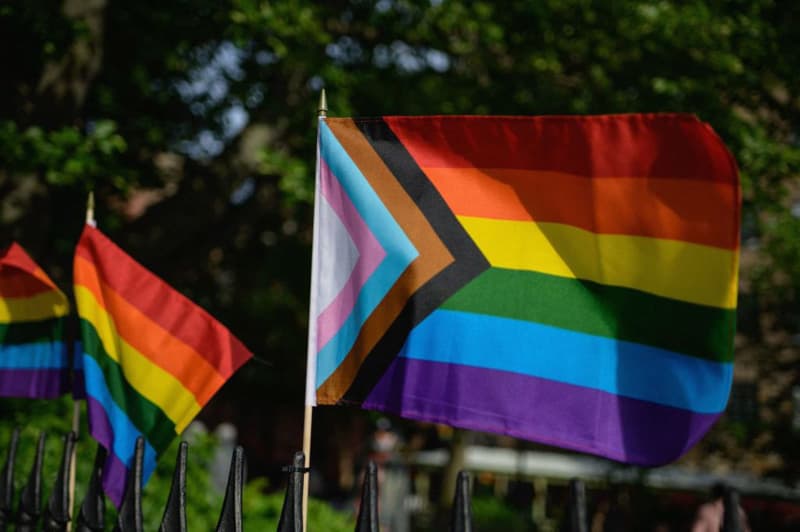
A total of 7.2% of adults in the United States identified as LGBTQ in 2022 a Gallup poll released Wednesday shows.
While that’s just a small increase from 2021 numbers — 7.1% — the 2022 Gallup data reflects an overall upward trend. In 2012, when the analytics giant began measuring LGBTQ identification, only about 3.5% of adults self-identified as lesbian, gay, bisexual, transgender, queer or something other than heterosexual and cisgender (meaning they identify with the sex they were assigned at birth).
Researchers credit the younger generations — especially those born between 1997 and 2004, or Generation Z — for the continuous increase.
Nearly 20% of Gen Z adults identified as LGBTQ. That rate is considerably lower (11.2%) among millennials (adults born between 1981 and 1996). Only 3.3% of Generation X adults, those born between 1965 and 1980 identified as LGBTQ.
Data for the survey came from phone interviews with more than 10,000 adults. Gallup researchers asked respondents if they identified as lesbian, gay, bisexual, transgender, or another identity. Some of the volunteered responses included pansexual, asexual or queer. Respondents could also choose multiple identities.
As is “typically the case,” the largest share of LGBTQ adults identified as bisexual. About 1 in 5 LGBT adults identify as gay, about 1 in 7 say they are lesbian, and slightly fewer than 1 in 10 identify as transgender.
The proportion of bisexual adults is also higher among younger generations.
About 66% of LGBTQ Gen Z adults and 62% of LGBTQ millennials identified as bisexual in 2022. Among older generations, less than half of LGBT adults say they are bisexual.
Even though LGBTQ identification remained somewhat stable in 2022 when compared with the previous year, it has become “much more common in the U.S. in the past decade,” researchers wrote, adding that the upward trend is expected to continue.
“With many more younger than older adults seeing themselves as something other than heterosexual, the LGBT share of the entire U.S. adult population can be expected to grow in future years,” researchers wrote.
“However, this growth depends on younger people who enter adulthood in future years continuing to be much more likely to identify as LGBT than their parents, grandparents and great-grandparents,” they added.
———
© New York Daily News
The Sun is numbered nineteen and usually shows a representation of the Sun with rays streaming from it. The Thoth deck version you see here is exceptional in that it is the rose of the Rose-Cross design which forms the Sun itself. The rays of light give the impression of spiralling out into the Universe. Within these rays are the signs of the Zodiac. There are usually a male and female – the same individuals we saw with the Lovers. They are the holy innocent children of God, bathed in the Sun’s rays.
The Sun conveys a sense of fertility and bounty. It is concerned with the turn of the years, cycles of birth, life, death and rebirth. This is a very warm and happy card. After the Moon opened up new doors, the Sun comes up to light the way forward. We have new hope and belief.
This is a card of healing, especially on an emotional level. It promises hope and happiness, along with a new sense of safeness, protection and recovery. We are at the place where miracles happen.
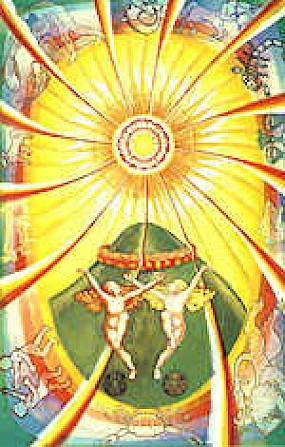
(via angelpaths.com and Alan Blackman)
NBC News • Feb 16, 2023 • #NBCNews #ArtificialIntelligence #ChatbotIn a New York Times article, technology reporter Kevin Roose reveals an interaction between him and Microsoft’s new search engine feature powered by A.I. NBC’s Tom Llamas speaks with Roose on how his conversation with the chatbot known as Sydney took a wild turn.
The Astrology Podcast • Feb 23, 2023 • Monthly Astrology ForecastsIn episode 391 we look ahead at the astrological forecast for March of 2023, with astrologers Chris Brennan, Austin Coppock, and Leisa Schaim. March is one of the most notable months of 2023 because it contains a number of planetary ingresses, such as Saturn moving into Pisces, Pluto moving into Aquarius, and Mars finally departing Gemini for Cancer. At the beginning of the episode we talk about some recent stories in the news and how the astrology played out over the past month, and then in the second half we do a full analysis of the astrology of March.
FEBRUARY 21, 2023 AT 7:00 AM BY ROB BREZSNY (newcity.com)
Staring At Point Blank/Photo: Marshal Quast
ARIES (March 21-April 19): Philosopher John O’Donohue wrote a prayer not so much to God as to Life. It’s perfect for your needs right now. He said, “May my mind come alive today to the invisible geography that invites me to new frontiers, to break the dead shell of yesterdays, to risk being disturbed and changed.” I think you will generate an interesting onrush of healing, Aries, if you break the dead shell of yesterdays and risk being disturbed and changed. The new frontier is calling to you. To respond with alacrity, you must shed some baggage.
TAURUS (April 20-May 20): Rightwing religious influencers are rambling amuck in the United States. In recent months, their repressive pressures have forced over 1,600 books to be banned in 138 school districts in thirty-eight states. The forbidden books include some about heroes Nelson Mandela, Cesar Chavez and Rosa Parks. With this appalling trend as a motivational force, I encourage you Tauruses to take inventory of any tendencies you might have to censor the information you expose yourself to. According to my reading of the astrological omens, now is an excellent time to pry open your mind to consider ideas and facts you have shut out. Be eager to get educated and inspired by stimuli outside your usual scope.
GEMINI (May 21-June 20): I think we can all agree that it’s really fun to fall in love. Those times when we feel a thrilling infatuation welling up within us are among the most pleasurable of all human experiences. Wouldn’t it be great if we could do it over and over again as the years go by? Just keep getting bowled over by fresh immersions in swooning adoration? Maybe we could drum up two or three bouts of mad love explosions every year. But alas, giving in to such a temptation might make it hard to build intimacy and trust with a committed, long-term partner. Here’s a possible alternative: Instead of getting smitten with an endless series of new paramours, we could get swept away by novel teachings, revelatory meditations, lovable animals, sublime art or music, amazing landscapes or sanctuaries and exhilarating adventures. I hope you will be doing that in the coming weeks, Gemini.
CANCER (June 21-July 22): The scientific method is an excellent approach for understanding reality. It’s not the only one, and should not be used to the exclusion of other ways of knowing. But even if you’re allergic to physics or never step into a chemistry lab, you are wise to use the scientific method in your daily life. The coming weeks will be an especially good time to enjoy its benefits. What would that mean, practically speaking? Set aside your subjective opinions and habitual responses. Instead, simply gather evidence. Treasure actual facts. Try to be as objective as you can in evaluating everything that happens. Be highly attuned to your feelings, but also be aware that they may not provide all facets of the truth.
LEO (July 23-Aug. 22): Is there anything in your psychological makeup that would help you do some detective work? How are your skills as a researcher? Are you willing to be cagey and strategic as you investigate what’s going on behind the scenes? If so, I invite you to carry out any or all of these four tasks in the coming weeks: 1. Try to become aware of shrouded half-truths. 2. Be alert for shadowy stuff lurking in bright, shiny environments. 3. Uncover secret agendas and unacknowledged evidence. 4. Explore stories and situations that no one else seems curious about.
VIRGO (Aug. 23-Sept. 22): The country of Nepal, which has strong Virgo qualities, is divided into seven provinces. One is simply called “Province No.1,” while the others are Sudurpashchim, Karnali, Gandaki, Lumbini, Bagmati and Janakpur. I advise Nepal to give Province No. 1 a decent name very soon. I also recommend that you Virgos extend a similar outreach to some of the unnamed beauty in your sphere. Have fun with it. Give names to your phone, your computer, your bed, your hairdryer,and your lamps, as well as your favorite trees, houseplants and clouds. You may find that the gift of naming helps make the world a more welcoming place with which you have a more intimate relationship. And that would be an artful response to current cosmic rhythms.
LIBRA (Sept. 23-Oct. 22): Are you aimless, impassive and stuck, floundering as you try to preserve and maintain? Or are you fiercely and joyfully in quest of vigorous and dynamic success? What you do in the coming weeks will determine which of these two forks in your destiny will be your path for the rest of 2023. I’ll be rooting for the second option. Here is a tip to help you be strong and bold. Learn the distinctions between your own soulful definition of success and the superficial, irrelevant, meaningless definitions of success that our culture celebrates. Then swear an oath to love, honor and serve your soulful definition.
SCORPIO (Oct. 23-Nov. 21): The next four weeks will be a time of germination, metaphorically analogous to the beginning of a pregnancy. The attitudes and feelings that predominate during this time will put a strong imprint on the seeds that will mature into full ripeness by late 2023. What do you want to give birth to in forty weeks or so, Scorpio? Choose wisely! And make sure that in this early, impressionable part of the process, you provide your growing creations with positive, nurturing influences.
SAGITTARIUS (Nov. 22-Dec. 21): I recommend you set up Designated Arguing Summits (DAT). These will be short periods when you and your allies get disputes out in the open. Disagreements must be confined to these intervals. You are not allowed to squabble at any other time. Why do I make this recommendation? I believe that many positive accomplishments are possible for you in the coming weeks, and it would be counterproductive to expend more than the minimal necessary amount on sparring. Your glorious assignment: Be emotionally available and eager to embrace the budding opportunities.
CAPRICORN (Dec. 22-Jan. 19): Actor Judi Dench won an Oscar for her role as Queen Elizabeth in the film “Shakespeare in Love”—even though she was onscreen for just eight minutes. Beatrice Straight got an Oscar for her role in the movie “Network,” though she appeared for less than six minutes. I expect a similar phenomenon in your world, Capricorn. A seemingly small pivot will lead to a vivid turning point. A modest seed will sprout into a prismatic bloom. A cameo performance will generate long-term ripples. Be alert for the signs.
AQUARIUS (Jan. 20-Feb. 18): Most of us are constantly skirmishing with time, doing our best to coax it or compel it to give us more slack. But lately, you Aquarians have slipped into a more intense conflict. And from what I’ve been able to determine, time is kicking your ass. What can you do to relieve the pressure? Maybe you could edit your priority list—eliminate two mildly interesting pursuits to make more room for a fascinating one. You might also consider reading a book to help you with time management and organizational strategies, like these: 1. “Getting Things Done” by David Allen. 2. “The 7 Habits of Highly Effective People” by Stephen R. Covey. 3. “15 Secrets Successful People Know About Time Management” by Kevin Kruse.
PISCES (Feb. 19-March 20): “What is originality?” asked philosopher Friedrich Nietzsche. Here’s how he answered: “to see something that has no name as yet, and hence cannot be mentioned though it stares us all in the face.” Got that, Pisces? I hope so, because your fun assignments in the coming days include the following: 1. to make a shimmering dream coalesce into a concrete reality; 2. to cause a figment of the imagination to materialize into a useful accessory; 3. to coax an unborn truth to sprout into a galvanizing insight.
Homework: What’s something you would love to do but were told never to do by someone you loved? Newsletter.FreeWillAstrology.com
Neuroscientist Anil Seth draws on his 20-year career to reveal that the mystery of consciousness need not be beyond science.
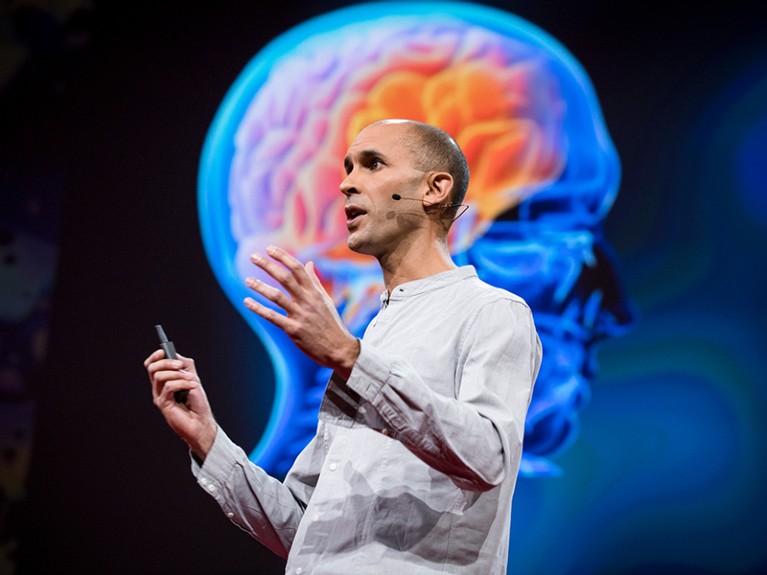
Anil Seth recalls standing in front of a bathroom mirror aged eight or nine, and suddenly understanding that he would die one day. That realization made him wonder about where he came from, and why he was who he was. Those childhood thoughts about consciousness developed in his teenage years, resulting in debates with friends about free will and the mind. Seth now investigates such questions as a neuroscientist, and is the author of the 2021 book Being You: A New Science of Consciousness (Faber & Faber). His 2017 TED Talk, ‘Your brain hallucinates your conscious reality’, has had more than 13 million views. Here he talks to Nature about his career and book, and about the other public-engagement activities he undertakes as professor of cognitive and computational neuroscience at the University of Sussex near Brighton, UK.
Consciousness is linked to subjective experience, which isn’t the same as being intelligent or having language or writing poetry. I want people to understand that the science of consciousness is alive and well. It doesn’t mean we will find the answer to it, but we can make a lot of progress in understanding it.
I make three arguments in the book. The first is that consciousness can be addressed by science. I divide it from one big scary mystery into a few smaller, more-tractable ones. For example, how can we explain the difference between various levels of consciousness — such as between general anaesthesia and wakeful awareness or falling into a dream sleep, a psychedelic state and so on.
The second argument is based on how we perceive the world around us — the idea that we live in a controlled hallucination and that our experiences of the world don’t give us direct, unfettered access to whatever’s out there. The neuroscience theory here is that the brain is continually generating predictions about our surroundings.
The third argument is that the self is another kind of controlled hallucination, whether it’s the experience of free will, of having a body of emotion, of mood — all different kinds of perception.
At the end of the book, I explore some of these implications for consciousness in non-human animals, and question whether artificial intelligence will become not only intelligent, but also sentient.Why women aren’t from Venus, and men aren’t from Mars
I like to talk about what I do and, perhaps unlike with some other areas of science, people are naturally curious about consciousness and more willing to listen. I have also always liked writing. When I was an undergraduate, I realized that writing is fulfilling. Through your academic career, you write more and more, be it papers, research grants or editing. I did some public-engagement work, initially giving talks, then writing short pieces for outlets such as New Scientist and The Guardian, which was extremely satisfying.
In 2016, I presented a Friday Discourse at the UK Royal Institution — the most prestigious thing I had done. (These talks were set up in their current format in 1826 as informal conversations about science with the public.) I chatted to people who were working in public engagement, including geneticist and BBC broadcaster Adam Rutherford, and I just felt then that it was the appropriate moment to write the book.
I started doing physics at university, mainly because it is seen as the most fundamental of the sciences and the best way to plug any gaps in understanding. But I felt I was moving too far away from the mind, so I switched to psychology and, later, during my master’s degree and PhD, to computer science and artificial intelligence.
After my PhD, a postdoctoral opportunity in brain-based robotics arose at the Neurosciences Institute in San Diego, California. I got the job, not because of my interest in consciousness, but because I could help to build biologically inspired robots.How a grisly historical accident set one neuroscientist on the road to writing a book
At that time, in the early 2000s, the institute was one of the few places where it was acceptable to study consciousness. There was a sense that the field was still predominantly philosophical and that it might be a poor career choice, because people didn’t really know what consciousness was or how it worked. However, things changed when senior academics began to talk about consciousness and to set up dedicated research institutions. I ended up staying at the institute for more than six years, working on diverse projects (it ceased its research operations in 2018). Also, living in San Diego is not bad, learning to surf and all.
It was an inspiring time, with the feeling that I had found an intellectual community. I started attending meetings of the Association for the Scientific Study of Consciousness — an international non-profit organization co-founded by the German philosopher Thomas Metzinger in 1994. The community includes some of the smartest and most interesting people I have met, from disciplines across philosophy, psychology, neuroscience, medicine and computer science. I thought, ‘this is the work that I want to do’.
I think we are all interested in ourselves, how we work and who we are, so I am grateful that I have been able to make a career out of my interest in these fundamental questions.
With difficulty. One struggle is that universities want academics to do public engagement, but do not give much credit in terms of time or teaching remission. Sometimes, the attitude is that if it is fun, then you should do it in your spare time. Good public engagement takes time, and is very important for inspiring new generations of scientists and increasing the impact of your work.Collection: Science communication
Luckily, I had an Engagement Fellowship from the UK research funder Wellcome that provided me with a break from teaching duties. However, I was still writing the book mainly in the evenings and at weekends. The rest was done ad hoc by setting myself deadlines. If you write 1,000 words every couple of days, you will soon have a book.
A key challenge was balancing what I wanted to say with what people will want to read, which is where having a good editor really helps. I was worried that, having put lots of effort into the book, it would sink like a stone and go unnoticed. However, the reception was extraordinary and exceeded my expectations.
One current project is Dreamachine, which brought together scientists, philosophers, architects, musicians and digital designers to develop a collective, immersive art experience. It is based on the neuroscience concept that fast, flickering lights on closed eyes give rise to visual hallucinations. Last year, the installation formed part of the UNBOXED festival, a UK-wide event featuring ten creative projects that straddled the arts, sciences, technology and mathematics. During the festival, more than 30,000 people experienced Dreamachine, which is amazing. Hopefully it is reigniting people’s curiosity in the brain.
Another focus is the Perception Census, a big online citizen-science survey overseen by the University of Sussex and the University of Glasgow, UK. We’re asking members of the public to take part in a series of online, interactive tasks from the comfort of their own homes, so we can try to learn more about perceptual diversity.Collection: Spotlight on neuroscience
Over the past decade or so, there has been much emphasis on neurodiversity, the idea that there are many different ways of experiencing the world, and that this cognitive and perceptual variation enriches society. However, the neurodiversity label has come to be associated with specific conditions, such as autism or attention deficit hyperactivity disorder, ironically reinforcing the idea that if you don’t identify with a neurodivergent condition, then you experience the world as it is, in a neurotypical way.
But perceptual diversity exists among all of us. Two people might experience different colours when they look up at the sky, but they won’t know it because they will use the same descriptive words. It’s also because the differences they see are not enough to influence behaviour, and, crucially, because perceptual experience seems to be a window on to objective reality, rather than a brain-based construction. I’m now very interested in mapping out this hidden perceptual diversity. I want to know about the middle, not the extremes. Our Perception Census project is doing exactly this. If we can recognize that everyone literally sees the world in a different way, then it might become easier to accommodate the fact that others might see, and therefore believe, different things.
doi: https://doi.org/10.1038/d41586-023-00541-z
This interview has been edited for length and clarity.
(Contributed by Michael Kelly, H.W.)


