The Universe in Verse

An annual charitable celebration of the wonder of reality through stories of science winged with poetry, born in 2017 as part celebration of life and part protest against the assault on science, nature, and reality — that is, on life — in the era of “alternative facts” and vanishing environmental protections. Highlights from the previous seasons can be seen here.

SEASON 5: APRIL 16, 2022 (SANTA CRUZ, CA)

To be human is to live suspended between the scale of gluons and the scale of galaxies, yearning to fathom our place in the universe. That we exist at all — on this uncommon rocky world, just the right distance from its common star, adrift in a galaxy amid hundreds of billions of galaxies, each sparkling with hundreds of billions of stars, each orbited by numberless possible worlds — is already miracle enough. A bright gift of chance amid the cold dark sublime of pure spacetime. A triumphal something against the staggering cosmic odds of nothingness.

Stationed here on this one and only home planet, we have opposed our thumbs to build microscopes and telescopes, pressing our curiosity against the eyepiece, bending our complex consciousness around what we see, longing to peer a little more deeply into the mystery of life with the mystery of us.

For the fifth annual Universe in Verse, I joined forces with my astronomer friend and threetime alumna Natalie Batalha (who led NASA’s Kepler and its triumphant discovery of more than 4,000 potential cradles for life beyond Earth, and now heads an inspired astrobiology initiative as her work on the search for life continues at UC Santa Cruz) to explore this longing through a kaleidoscope of vantage points.

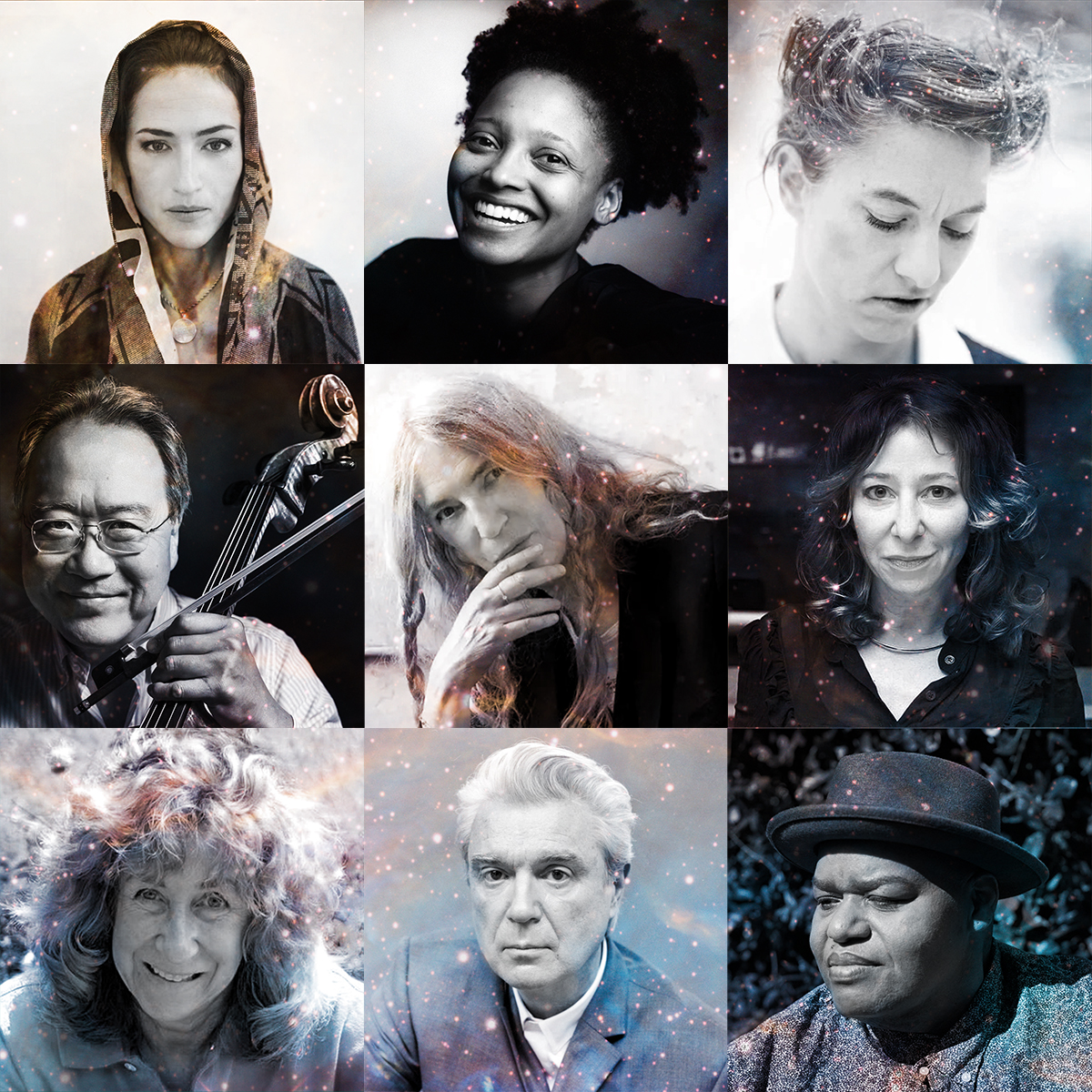
In a majestic outdoor amphitheater built into a former quarry in the redwoods, we gathered to celebrate the marvel and mystery of life, from the creaturely to the cosmic, with stories from the history of science and our search for truth, illustrated with poems spanning centuries of human thought and feeling — poems about entropy and evolution, about trees and mushrooms, about consciousness and dark matter, about the birth of flowers and the death of stars — composed by a constellation of extraordinary humans, from Emily Dickinson to Gwendolyn Brooks, and performed by a constellation of extraordinary humans: writers Rebecca Solnit and Roxane Gay, musicians Zoë Keating and Joan As Police Woman, artist and Design Matters creator Debbie Millman, artist and DrawTogether creator Wendy MacNaughton, poet Diane Ackerman, cosmologist and jazz saxophonist Stephon Alexander, cognitive scientist, writer, and Dog Cognition Lab director Alexandra Horowitz, physicist and writer Alan Lightman, and On Being creator Krista Tippett (my largehearted collaborator in the Universe in Verse animated interlude season below, who long ago kindled my friendship with Natalie).

All proceeds from the show were split halfway between a new scholarship at UCSC, honoring the life and legacy of astronomer and search-for-life pioneer Frank Drake, and The Nature Conservancy, whose tireless work stewards and protects the broadest community of life across our own irreplaceable world.

As an end-of-year offering, I am making the full recording of the show available between December 24 and January 1 as a free holiday broadcast, to be enjoyed in viewing parties or parallel solitudes, in fragments or in a single-sitting feast. (Don’t miss the especially magical musical-poetic finale, beginning at around 2:33:30.)

While you watch, something to consider: As a society, we have ceased thinking about how cultural matter appears before us — we take it for granted that we will be informed, entertained, perhaps even enchanted, with nothing required of us in kind. We call this cultural matter by the slur under which Silicon Valley has commodified it: “content” — something to fill the empty the screen, of the hollow life, insentient to the human endeavor behind it, the myriad invisible labors and sacrifices, collaborations and lonelinesses that make anything of beauty and substance come to life.

Please know: The Universe in Verse has been a colossal endeavor, to which a constellation of gifted and generous humans have donated their time and talent — resources diverted from primary lives and livelihoods — to offer this collaborative gift of perspective and tenderness. (This recording itself was a gasp of an expense.) If you find yourself come a little more alive while you watch it, if it deposits you back into your life a little broader of mind and fuller of heart, please honor the immense labor behind the love by making a donation to offset the cost and cheer the spirit.

ANIMATED INTERLUDE SEASON (2021-2022)

The Universe in Verse was born in 2017 as part celebration of the wonder of life and the splendor of reality, and part protest against the assault on science and nature — that is, on life and reality — in the era of “alternative facts” and vanishing environmental protections. An act of resistance and an act of persistence. Fierce insistence on the felicitous expression of nature in human nature, with our capacity for music and mathematics, for art and hope.

Spring after spring, it remained a live gathering and a labor of love. Then, in the gatherless disorientation of the pandemic, I joined forces with my friends at On Being to reimagine the spirit of The Universe in Verse in a different incarnation — a season of perspective-broadening, mind-deepening, heart-leavening stories about science and our search for truth, enlivened by animated poems with original music: emblems of our longing for meaning.

Carrying the animations are stories about relativity and the evolution of flowers, about entropy and space telescopes, about dark matter and the octopus consciousness, illustrated with poems new and old, by Emily Dickinson and Richard Feynman, by W.H. Auden and Tracy K. Smith, by Marilyn Nelson and Edna St. Vincent Millay, brought to life by a human constellation strewn across spacetime and difference: twenty-nine largehearted artists, musicians, writers, scientists, and other weavers of wonder, who have poured their time and talent into this improbable labor of love. The total distance between them exceeds the circumference of the globe. Half a century stretches between the youngest and the eldest.
Continue reading The Universe in Verse

Potlatch

From Wikipedia, the free encyclopedia

The Kwakwaka’wakw continue the practice of potlatch. Illustrated here is Wawadit’la in Thunderbird ParkVictoria, B.C., a big house built by Chief Mungo Martin in 1953. Wealthy, prominent hosts would have a longhouse specifically for potlatching and for housing guests.

Part of a series on
Economicapplied, and development
anthropology
showBasic concepts
showProvisioning systems
showCase studies
showRelated articles
showMajor theorists
Social and cultural anthropology
vte

potlatch is a gift-giving feast practiced by Indigenous peoples of the Pacific Northwest Coast of Canada and the United States,[1] among whom it is traditionally the primary governmental institution, legislative body, and economic system.[2] This includes the HeiltsukHaidaNuxalkTlingitMakahTsimshian,[3] Nuu-chah-nulth,[4] Kwakwaka’wakw,[2] and Coast Salish cultures.[5] Potlatches are also a common feature of the peoples of the Interior and of the Subarctic adjoining the Northwest Coast, although mostly without the elaborate ritual and gift-giving economy of the coastal peoples (see Athabaskan potlatch).

A potlatch involves giving away or destroying wealth or valuable items in order to demonstrate a leader’s wealth and power. Potlatches are also focused on the reaffirmation of family, clan, and international connections, and the human connection with the supernatural world. Potlatch also serves as a strict resource management regime, where coastal peoples discuss, negotiate, and affirm rights to and uses of specific territories and resources.[6][7][8] Potlatches often involve music, dancing, singing, storytelling, making speeches, and often joking and games. The honouring of the supernatural and the recitation of oral histories are a central part of many potlatches.

From 1885 to 1951, the Government of Canada criminalized potlatches. However, the practice persisted underground despite the risk of government reprisals including mandatory jail sentences of at least two months; the practice has also been studied by many anthropologists. Since the practice was decriminalized in 1951, the potlatch has re-emerged in some communities. In many it is still the bedrock of Indigenous governance, as in the Haida Nation, which has rooted its democracy in potlatch law.[9][10]

The word comes from the Chinook Jargon, meaning “to give away” or “a gift”; originally from the Nuu-chah-nulth word paɬaˑč, to make a ceremonial gift in a potlatch.[1]

Overview

Speaker Figure, 19th century, Brooklyn Museum, the figure represents a speaker at a potlatch. An orator standing behind the figure would have spoken through its mouth, announcing the names of arriving guests.N.B. This overview concerns the Kwakwaka’wakw potlatch. Potlatch traditions and formalities and kinship systems in other cultures of the region differ, often substantially.

A potlatch was held on the occasion of births, deaths, adoptions, weddings, and other major events. Typically the potlatch was practiced more in the winter seasons as historically the warmer months were for procuring wealth for the family, clan, or village, then coming home and sharing that with neighbors and friends. The event was hosted by a numaym, or ‘House‘, in Kwakwaka’wakw culture. A numaym was a complex cognatic kin group usually headed by aristocrats, but including commoners and occasional slaves. It had about one hundred members and several would be grouped together into a nation. The House drew its identity from its ancestral founder, usually a mythical animal who descended to earth and removed his animal mask, thus becoming human. The mask became a family heirloom passed from father to son along with the name of the ancestor himself. This made him the leader of the numaym, considered the living incarnation of the founder.[11]: 192 

Only rich people could host a potlatch. Tribal slaves were not allowed to attend a potlatch as a host or a guest. In some instances, it was possible to have multiple hosts at one potlatch ceremony (although when this occurred the hosts generally tended to be from the same family). If a member of a nation had suffered an injury or indignity, hosting a potlatch could help to heal their tarnished reputation (or “cover his shame”, as anthropologist H. G. Barnett worded it).[12] The potlatch was the occasion on which titles associated with masks and other objects were “fastened on” to a new office holder. Two kinds of titles were transferred on these occasions. Firstly, each numaym had a number of named positions of ranked “seats” (which gave them a seat at potlatches) transferred within itself. These ranked titles granted rights to hunting, fishing and berrying territories.[11]: 198  Secondly, there were a number of titles that would be passed between numayma, usually to in-laws, which included feast names that gave one a role in the Winter Ceremonial.[11]: 194  Aristocrats felt safe giving these titles to their out-marrying daughter’s children because this daughter and her children would later be rejoined with her natal numaym and the titles returned with them.[11]: 201  Any one individual might have several “seats” which allowed them to sit, in rank order, according to their title, as the host displayed and distributed wealth and made speeches. Besides the transfer of titles at a potlatch, the event was given “weight” by the distribution of other less important objects such as Chilkat blankets, animal skins (later Hudson Bay blankets) and ornamental “coppers”. It is the distribution of large numbers of Hudson Bay blankets, and the destruction of valued coppers that first drew government attention (and censure) to the potlatch.[11]: 205  On occasion, preserved food was also given as a gift during a potlatch ceremony. Gifts known as sta-bigs consisted of preserved food that was wrapped in a mat or contained in a storage basket.[13]

Dorothy Johansen describes the dynamic: “In the potlatch, the host in effect challenged a guest chieftain to exceed him in his ‘power’ to give away or to destroy goods. If the guest did not return 100 percent on the gifts received and destroy even more wealth in a bigger and better bonfire, he and his people lost face and so his ‘power’ was diminished.”[14] Hierarchical relations within and between clans, villages, and nations, were observed and reinforced through the distribution or sometimes destruction of wealth, dance performances, and other ceremonies. The status of any given family is raised not by who has the most resources, but by who distributes the most resources. The hosts demonstrate their wealth and prominence through giving away goods.

Potlatch ceremonies were also used as coming-of-age rituals. When children were born, they would be given their first name at the time of their birth (which was usually associated with the location of their birthplace). About a year later, the child’s family would hold a potlatch and give gifts to the guests in attendance on behalf of the child. During this potlatch, the family would give the child their second name. Once the child reached about 12 years of age, they were expected to hold a potlatch of their own by giving out small gifts that they had collected to their family and people, at which point they would be able to receive their third name.[15]

For some cultures, such as Kwakwaka’wakw, elaborate and theatrical dances are performed reflecting the hosts’ genealogy and cultural wealth. Many of these dances are also sacred ceremonies of secret societies like the hamatsa, or display of family origin from supernatural creatures such as the dzunukwa.

Edward Curtis photo of a Kwakwaka’wakw potlatch with dancers and singers

Chief O’wax̱a̱laga̱lis of the Kwagu’ł describes the potlatch in his famous speech to anthropologist Franz Boas,

We will dance when our laws command us to dance, we will feast when our hearts desire to feast. Do we ask the white man, ‘Do as the Indian does’? No, we do not. Why, then, will you ask us, ‘Do as the white man does’? It is a strict law that bids us to dance. It is a strict law that bids us to distribute our property among our friends and neighbors. It is a good law. Let the white man observe his law; we shall observe ours. And now, if you are come to forbid us to dance, begone; if not, you will be welcome to us.[16]

Among the various First Nations groups which inhabited the region along the coast, a variety of differences existed in regards to practises relating to the potlatch ceremony. Each nation, community, and sometimes clan maintained its own way of practicing the potlatch with diverse presentation and meaning. The Tlingit and Kwakiutl nations of the Pacific Northwest, for example, held potlatch ceremonies for different occasions. The Tlingit potlatches occurred for succession (the granting of tribal titles or land) and funerals. The Kwakiutl potlatches, on the other hand, occurred for marriages and incorporating new people into the nation (i.e., the birth of a new member of the nation.)[17] The potlatch, as an overarching term, is quite general, since some cultures have many words in their language for various specific types of gatherings. It is important to keep this variation in mind as most of our detailed knowledge of the potlatch was acquired from the Kwakwaka’wakw around Fort Rupert on Vancouver Island in the period 1849 to 1925, a period of great social transition in which many aspects of the potlatch became exacerbated in reaction to efforts by the Canadian government to culturally assimilate First Nations communities into the dominant white culture.[11]: 188–208 

History

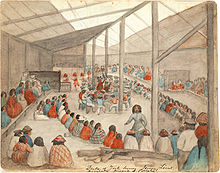
Watercolor by James G. Swan depicting the Klallam people of chief Chetzemoka at Port Townsend, with one of Chetzemoka’s wives distributing potlatch

Prior to European colonization, gifts included storable food (oolichan, or candlefish, oil or dried food), canoesslaves, and ornamental “coppers” among aristocrats, but not resource-generating assets such as hunting, fishing and berrying territories. Coppers were sheets of beaten copper, shield-like in appearance; they were about two feet long, wider on top, cruciform frame and schematic face on the top half. None of the copper used was ever of Indigenous metal. A copper was considered the equivalent of a slave. They were only ever owned by individual aristocrats, and never by numaym, hence could circulate between groups. Coppers began to be produced in large numbers after the colonization of Vancouver Island in 1849 when war and slavery were ended.[11]: 206 

Example of an ornamental copper used at a potlatch

The arrival of Europeans resulted in the introduction of numerous diseases against which Indigenous peoples had no immunity, resulting in a massive population decline. Competition for the fixed number of potlatch titles grew as commoners began to seek titles from which they had previously been excluded by making their own remote or dubious claims validated by a potlatch. Aristocrats increased the size of their gifts in order to retain their titles and maintain social hierarchy.[18] This resulted in massive inflation in gifting made possible by the introduction of mass-produced trade goods in the late 18th and earlier 19th centuries. Archaeological evidence for the potlatching ceremony is suggested from the ~1,000 year-old Pickupsticks site in interior Alaska.[19]

More at: https://en.wikipedia.org/wiki/Potlatch

Book: “Long Walk to Freedom”

Long Walk to Freedom

Long Walk to Freedom

(Long Walk to Freedom #1-2)

by Nelson Mandela

Nelson Mandela is one of the great moral and political leaders of our time: an international hero whose lifelong dedication to the fight against racial oppression in South Africa won him the Nobel Peace Prize and the presidency of his country.

Since his triumphant release in 1990 from more than a quarter-century of imprisonment, Mandela has been at the center of the most compelling and inspiring political drama in the world. As president of the African National Congress and head of South Africa’s anti-apartheid movement, he was instrumental in moving the nation toward multiracial government and majority rule. He is revered everywhere as a vital force in the fight for human rights and racial equality.

The foster son of a Thembu chief, Mandela was raised in the traditional, tribal culture of his ancestors, but at an early age learned the modern, inescapable reality of what came to be called apartheid, one of the most powerful and effective systems of oppression ever conceived. In classically elegant and engrossing prose, he tells of his early years as an impoverished student and law clerk in a Jewish firm in Johannesburg, of his slow political awakening, and of his pivotal role in the rebirth of a stagnant ANC and the formation of its Youth League in the 1950s.

He describes the struggle to reconcile his political activity with his devotion to his family, the anguished breakup of his first marriage, and the painful separations from his children. He brings vividly to life the escalating political warfare in the fifties between the ANC and the government, culminating in his dramatic escapades as an underground leader and the notorious Rivonia Trial of 1964, at which he was sentenced to life imprisonment. Herecounts the surprisingly eventful twenty-seven years in prison and the complex, delicate negotiations that led both to his freedom and to the beginning of the end of apartheid. Finally he provides the ultimate inside account. 

(Goodreads.com)

Mahalia Jackson – O Holy Night 

wambui37 Dec 4, 2012 Mahalia Jackson – O Holy Night (unmatched and unforgettable) wenn jemals jemand zur Ehre Gottes gesungen hat, dann war es sicherlich “Mahalia Jackson” !! If anyone ever sung for the glory of God, then It was determined “Mahalia Jackson! !! Die unvergessliche Mahalia Jackson, die Königin des Gospel! The unforgettable Mahalia Jackson, the Queen of Gospel!

James Tunney – The Totalitarian Loop

Evan McDermod • Dec 17, 2022 The Fifth Dimension Ep. 225 – James Tunney rejoins the podcast to discuss the emergence of an inescapable totalitarian loop. James is an author and painter who left a successful career in law to focus on spiritual and artistic development. He is a leading voice critiquing the implications of transhumanism and collective abandonment of our spiritual consciousness. Full discussion topics include: -Loops as the building block of consciousness -Technocracy as a closed-circuit loop system -The outsourcing of socialization to artificial intelligence -Modern day imperialism and the colonization of human consciousness -Living in the Human Zoo -The rise of a global Fourth Reich system -Reclaiming the natural process of spiritual evolution Connect with James: https://www.jamestunney.com/

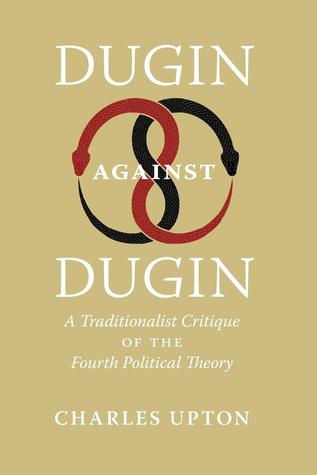
Book: “Dugin Against Dugin: A Traditionalist Critique of the Fourth Political Theory”

Dugin Against Dugin: A Traditionalist Critique of the Fourth Political Theory

Dugin Against Dugin: A Traditionalist Critique of the Fourth Political Theory

by Charles Upton, John Andrew Morrow (Foreword)

Dugin against Dugin is the most detailed critique yet published of the theories of Russian political leader and philosopher Aleksandr Dugin. His critics call him “mysterious, dangerous”–but he is no mystery to those who have preserved an instinct for the Unity of Truth, and can therefore see how his ideas both relate to one another and contradict each other.

Charles Upton is an exponent of traditional metaphysics, a veteran of the U.S. peace movement, a Muslim, a Sufi, and as a native-born American. No critic of Aleksandr Dugin is more in sympathy with his essential worldview; none is more outraged by what he’s done with it. That’s why the author has confronted him on every level, in nearly every field that Dugin has chosen to address.

Dugin has made a valiant attempt to ground his politics in metaphysics. Unfortunately, his metaphysics are inverted, his view of Orthodox Christianity heretical, his image of Islam twisted, and his flirtation with Satanism all too obvious. No contemporary political theorist has faced the doom of Man more bravely; no social critic has seen the evils of extreme Postmodern Liberalism more clearly–yet he can provide no real alternatives. He has deviated from what traditional metaphysicians Ren� Gu�non and Julius Evola called the Primordial Tradition, and turned instead to deception and self-contradiction.

Dugin against Dugin shines a light on the transformation of religion and the peace movement in the U.S. over the past half-century, the 180-degree inversion of the American Left, the dangers and potentials of the Alt Right, and what true American patriotism might look like in the 21stcentury. It presents traditional metaphysics as a liberation from political ideology, expands on Gu�non’s “science of Apocalypse,” and recounts the history of the Covenants Initiative–an international peace movement co-founded by the author in 2013.