Amedeo Clemente Modigliani (July 12, 1884 – January 24, 1920) was an Italian painter and sculptor who worked mainly in France. He is known for portraits and nudes in a modern style characterized by a surreal elongation of faces, necks, and figures that were not received well during his lifetime, but later became much sought-after. Wikipedia
The core of William Blake’s vision, his greatness as one of the British Romantics, is most fully expressed in his Illuminated Books, masterworks of art and text intertwined and mutually enriching. Made possible by recent advances in printing and reproduction technology, the publication of new editions of Jerusalem and Songs of Innocence and of Experience in 1991 was a major publishing event. Now these two volumes are followed by The Early Illuminated Books and Milton, A Poem. The books in both volumes are reproduced from the best available copies of Blake’s originals and in faithfulness and accuracy match the acclaimed standards set by Jerusalem and Songs. These two volumes are uniform in format and binding with the first two volumes.
The Early Illuminated Books comprises All Religions Are One and There Is No Natural Religion; Thel; Marriage of Heaven and Hell; and Visions of the Daughters of Albion. Milton, A Poem, second only to Jerusalem in extent and ambition, is accompanied by Laocon, The Ghost of Abel, and On Homer’s Poetry.
New Thinking Allow • Dec 10, 2022 This video is a special release from the original Thinking Allowed series that ran on public television from 1986 until 2002. It was recorded in about 1990. There is a growing body of solid research in the field of psychic healing. Jerry Solfvin, a parapsychologist who is adjunct associate professor at the Center for Indic Studies at University of Massachusetts Dartmouth and also formerly associated with John F. Kennedy University, describes various experiments showing positive healing results — even when there was no healer present. Solfvin hypothesizes that positive expectations may play a very important role in psychic and spiritual healing. Now you can watch all of the programs from the original Thinking Allowed Video Collection, hosted by Jeffrey Mishlove. Subscribe to the new Streaming Channel (https://thinkingallowed.vhx.tv/) and watch more than 350 programs now, with more, previously unreleased titles added weekly. New!! Free month of the classic Thinking Allowed streaming channel for New Thinking Allowed subscribers only. Use code THINKFREELY.
Several Circles | Art Histor • Dec 9, 2022 As is often the case with free-spirited visionaries, the weird and wonderful William Blake (British, 1757–1827) was largely disregarded during his lifetime. Now we celebrate his blazing genius, which kindled a fantastical mythos of divine beings, profound works of poetry, and some of the most brilliantly bizarre images in British art. We’re delighted to present this video in collaboration with @TheEsotericaChannel where Dr. Justin Sledge explores the arcane realms of history, philosophy, and religion. Click the link below for Dr. Sledge’s investigation into the mystical forces that guided Blake.
Exclusive: Men and women coming in with shotgun wounds to different parts of bodies, doctors say
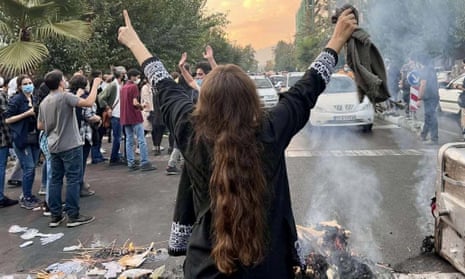
A protest in Tehran days after the death of Mahsa Amini. One medic said he treated a woman ‘deliberately’ shot in the genitals and thighs. Photograph: Social media/Rex/Shutterstock
Iranian security forces are targeting women at anti-regime protests with shotgun fire to their faces, breasts and genitals, according to interviews with medics across the country.
Doctors and nurses – treating demonstrators in secret to avoid arrest – said they first observed the practice after noticing that women often arrived with different wounds to men, who more commonly had shotgun pellets in their legs, buttocks and backs.
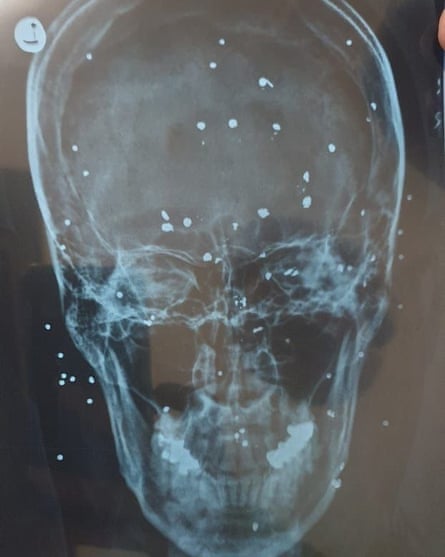
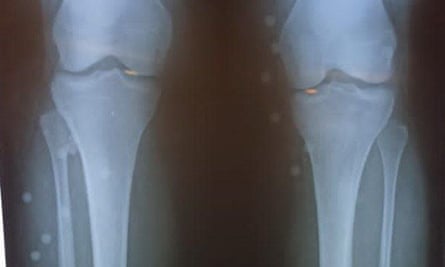
While an internet blackout has hidden much of the bloody crackdown on protesters, photos provided by medics to the Guardian showed devastating wounds all over their bodies from so-called birdshot pellets, which security forces have fired on people at close range. Some of the photos showed people with dozens of tiny “shot” balls lodged deep in their flesh.
The Guardian has spoken to 10 medical professionals who warned about the seriousness of the injuries that could leave hundreds of young Iranians with permanent damage. Shots to the eyes of women, men and children were particularly common, they said.
One physician from the central Isfahan province said he believed the authorities were targeting men and women in different ways “because they wanted to destroy the beauty of these women”.
“I treated a woman in her early 20s, who was shot in her genitals by two pellets. Ten other pellets were lodged in her inner thigh. These 10 pellets were easily removed, but those two pellets were a challenge, because they were wedged in between her urethra and vaginal opening,” the physician said. “There was a serious risk of vaginal infection, so I asked her to go to a trusted gynaecologist. She said she was protesting when a group of about 10 security agents circled around and shot her in her genitals and thighs.”
Traumatised by his experience, the physician – who like all medical professionals cited in this article spoke on condition of anonymity for fear of reprisals – said he had a hard time dealing with the stress and pain he witnessed.
“She could have been my own daughter.”
An X-ray image provided by an Iranian doctor of a skull showing pellets from a shotgun round.
Some of the other medical professionals accused security forces, including the feared pro-regime Basijmilitia, of ignoring riot control practices, such as firing weapons at feet and legs to avoid damaging vital organs.
One doctor from Karaj, a city near Tehran, said security forces “shoot at the faces and private body parts of women because they have an inferiority complex. And they want to get rid of their sexual complexes by hurting these young people.”
The ministry of foreign affairs was approached to comment on the allegations made by the medics but has yet to respond.
Nationwide protests
Activists say such horrific gender-based violence is no surprise given the misogynistic rule of Iran’s ayatollahs, who took power in the 1979 revolution and have maintained control with brute force, often against women.
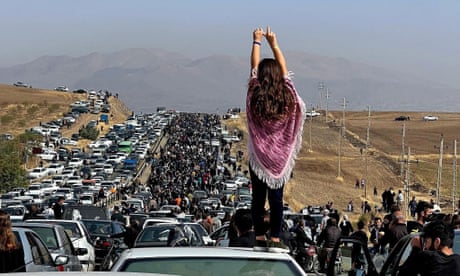
It was the death in September of a 22-year-old woman, Mahsa Amini that ignited the boldest challenge to the hardline theocratic rule of the country’s clerics.
Amini was arrested for improperly wearing her headscarf and then apparently beaten into a coma by Iran’s morality police. In the days after her death, girls and women nationwide defied the legally imposed dress code and ripped off their hijabs.https://interactive.guim.co.uk/uploader/embed/2022/12/iran-zip/giv-6562YWnLgp3AJtnh/
Tehran has repeatedly blamed foreign enemies for the unrest and accused “terrorists” of killing dozens of security force members. That conflicts with statements from the UN office of the high commissioner for human rights, which said more than 300 people had been killed so far in the crackdown, including more than 40 children.
And while the UN human rights council has adopted the resolution to create a fact-finding mission to investigate alleged human rights violations, investigators are unlikely to be admitted to the country.
A unnamed man in his thirties who was shot at by Iranian plain-clothed police from a car, according to medics who treated him. Around 30 pellets were removed from his body.
Part of Tehran’s campaign of intimidation has included threats to doctors who treat the wounded.
Facing such dangerous conditions, a doctor from Mazandaran said she was removing pellets, which are sometimes metal and sometimes plastic, with the lights off to avoid detection. “The women are so ashamed to go to the hospital that many are treated at home and that’s very dangerous,” the doctor said.
On 26 October, hundreds of medics protested outside the medical council of Iran, and were shot with pellet guns by the security forces. A surgeon from Tehran treated his colleagues who were shot in their backs and legs while running away.
The surgeon said he treated serious injuries of at least five protesters who were shot at close range by pellet guns. “One of the injured people I treated wasn’t even protesting. He was a bystander … and thought he wouldn’t be shot at. They’re shooting blindly at everyone who’s not one of them.”
Brian Castner, a senior crisis adviser on arms and military operations at Amnesty International, said the injuries shown in the photographs provided to the Guardian were broadly consistent “with the use of birdshot, which is designed for hunting and has no place in any legitimate or lawful use of force by police”.
He said it would be hard to gauge from the photos alone what parts of the body were targeted, or from what range, because of the spraying nature of birdshot pellets from shotguns. At least one photo showed what appeared to be a large single “slug” projectile, Castner said, which is used for hunting big game, such as deer. “The person who was hit is very lucky they were not hit in the chest or head and killed. There has been some evidence I have seen before of slug use, but this is a clear example.”
Shot in the eyes
The Tehran surgeon said that one case referred to him was a 25-year-old bystander who was shot in the face on 16 September, when the protests had just begun. “Pellets have hit his eyes, head and face … He is almost blinded in both eyes and he can only detect light and brightness with them. He is not in a good condition.”
It is one of the hundreds of reports that have emerged of protesters losing their eyesight after being shot by pellets at close range. The Guardian has seen photos of people with pellets lodged in their eyeballs.
One case that grew to national prominence was an attack on a student from the port city of Bandar Abbas, who was shot in her right eye. Ghazal Ranjkesh shared on her Instagram profile that she was shot while on the way back from work.
“The last image that my right eye saw was the smile of the person shooting at me,” she wrote in a post that has now been deleted after it was widely shared on protest groups and social media, creating a backlash.
More than 400 ophthalmologists from Iran have signed a letter alerting Mahmoud Jabbarvand, the secretary general of the Iranian Society of Ophthalmology, to what appears to be the deliberate blinding of protesters.
One of the ophthalmologists who signed the letter said they had treated four patients who lost some or all of their eyesight, including one 20-year-old man whose X-ray showed 18 pellets in his head and face.
An X-ray image provided by an Iranian doctor of legs showing pellets from a shotgun round.
“I felt horrible, I felt so angry and I had tears in my eyes looking at their pain. The eye is the most sensitive part of the human body and it is very painful to think about these injured people who are all young and have to live with this disability and low vision for the rest of their lives,” he said.
“I heard many similar cases from my colleagues and the cases of eye damage in the recent protests are much more. It’s more than 1,000 cases,” he said, adding that they had yet to receive a response to the letter.
The Guardian shared photos of eye and facial injuries sustained at the protests with Iain Hutchison, an oral and facial surgeon in the UK who founded the surgical research charity Saving Faces.
Hutchison said the images showed “people who have been shot at point-blank range using shotgun pellets shot directly into both eyes leaving serious permanent visual damage or blindness”.
The nature of the injury, he said, suggested “that they would have been held down or held still and not had the ability to move their head away”.
Knowing that demonstrators will need medical treatment for such severe injuries, authorities have increased surveillance at hospitals. A doctor from a hospital in Shiraz said that new security guard had been stationed outside the emergency ophthalmology department late last month.
“He controlled whoever was entering and exiting the emergency ophthalmology department, and he asked to see our identity cards and tags each time. It was the first time I saw this happening in the hospital. It looked like this addition to the guards happened after an increasing number of protesters with eye injuries were admitted,” said the doctor.
In other parts of the country, particularly in the Kurdistan region where the government has blockaded whole cities, volunteers are having to smuggle in bandages and medicine on foot.
Soran Mansournia, a Kurdish human rights activist who is part of a committee of doctors and has been coordinating with civilians to deliver medicines and treat wounded protesters secretly, said: “The number of wounded is very high. Every day we hear about the death of an injured person who did not go to hospital out of fear of arrest.”
If I have a visual experience that I describe as a red tomato a meter away, then I am inclined to believe that there is, in fact, a red tomato a meter away, even if I close my eyes. I believe that my perceptions are, in the normal case, veridical—that they accurately depict aspects of the real world. But is my belief supported by our best science? In particular: Does evolution by natural selection favor veridical perceptions? Many scientists and philosophers claim that it does. But this claim, though plausible, has not been properly tested. In this talk I present a new theorem: Veridical perceptions are never more fit than non-veridical perceptions which are simply tuned to the relevant fitness functions. This entails that perception is not a window on reality; it is more like a desktop interface on your laptop. I discuss this interface theory of perception and its implications for one of the most puzzling unsolved problems in science: the relationship between brain activity and conscious experiences.
Prof. Donald Hoffman, PhD received his PhD from MIT, and joined the faculty of the University of California, Irvine in 1983, where he is a Professor Emeritus of Cognitive Sciences. He is an author of over 100 scientific papers and three books, including Visual Intelligence, and The Case Against Reality. He received a Distinguished Scientific Award from the American Psychological Association for early career research, the Rustum Roy Award of the Chopra Foundation, and the Troland Research Award of the US National Academy of Sciences. His writing has appeared in Edge, New Scientist, LA Review of Books, and Scientific American and his work has been featured in Wired, Quanta, The Atlantic, and Through the Wormhole with Morgan Freeman. You can watch his TED Talk titled “Do we see reality as it is?” and you can follow him on Twitter@donalddhoffman.
Lorna’s story is amazing and it touched my heart” Roma Downey Actress/ Producer and Star of Touched By An Angel
Angels in My Hair is the autobiography of Lorna Byrne, a modern day Irish mystic with the powers of the saints of old.
Lorna physically sees and talks with angels every day and has done so ever since she was a baby. As a young child, she assumed everyone could see the angels who always accompanied her, but adults thought she suffered from a mental disability because she did not seem to be focusing on the world around her. Today, sick and troubled people from all around the world are drawn to her for comfort and healing, and theologians of different faiths seek her guidance.
Angels in My Hair is a moving and deeply inspirational chronicle of Lorna’s remarkable life story. Invoking a wonderful sense of place, she describes growing up poor in Ireland, and marrying the man of her dreams—only to have the marriage cut short by tragedy.
An international bestseller, translated into 23 languages, Angels in My Hair has garnered overwhelming responses from readers from all walks of life giving them hope and helping them to realize that no matter how alone they might feel they always have a Guardian angel by their side. Now includes a chapter on how to connect to your angel and an afterword on angels and America
Bio: LORNA BYRNE has been seeing and talking to angels since she was a baby. Now, having raised her family, she talks openly for the first time about what she has seen and learned. She lives quietly in rural Ireland.
The current system of private railroad ownership discourages carbon-reducing solutions such as increased passenger rail. A new system is needed.
Railroad management vs. climate solutions
Railroads have a tremendous opportunity to offer transportation that reduces climate pollution to near zero, bringing freight back from trucks and restoring passenger service that cuts car and airplane travel. The problem is the railroads themselves, who manages them and for what ends. It is in how the railroads are structured, and only a profound shift can release them to fully realize their climate-saving potential.
The issue is a bottom-line orientation that sees railroads as primarily a money machine to generate dividends for shareholders. It is a product of a long process. Facing new competition from publicly subsidized highways and aviation, railroad industry business models collapsed in the 1970s. The response was deregulation of the railroads, followed by super-concentration that has winnowed the greater part of the U.S. rail industry down to four major carriers focused on loads that provide highest profit. Those are shipping containers and bulk traffic in commodities such as coal, oil and grains.
Mixed freight is less profitable and harder to manage. So railroads have discouraged it through raising prices and downgrading service. That has pushed mixed freight to trucks, which typically consume 3 to 5 times the energy to move the same amount of material, meanwhile tearing up highways. Trucks are the major source of road damage, but the repair bills are subsidized by all drivers and the general public.
The creation of Amtrak in the 1970s took passenger service off the railroads’ backs, and that is how they regarded it. Lifting a burden that ate into their bottom lines. Yet aside from a few lines owned by Amtrak, most of the service runs on railroad main lines. Hours-long delays behind freight trains indicate the priority railroads give to passenger service. And they resist expanding service because it interferes with their bread-and-butter traffic.
Clearly, to restore freight and passenger service, and realize the capacity of railroads to reduce and eliminate transportation climate pollution, a different structure is required.
Open access toll roads versus nationalization
Many see the answer in nationalization of the railroads, putting them in a public service utility mode rather than a for-profit mode. Embodying a broader set of social and environmental goals beyond the financial bottom line, publicly owned railroads would elevate the climate priority and enhance the role of railroads in the transportation system. Other arguments against continuing the current private ownership system are deteriorating service levels, underinvestment in rail infrastructure and inhumane labor practices.
For all these reasons, Railroad Workers United in October endorsed nationalization. RWU is an umbrella organization meant to unite rail industry craft unions around common agendas. There is no singular industry union. In the resolution, RWU said it “supports the public ownership of the rail infrastructure of the U.S., Canada, and Mexico, to be operated henceforth in the public interest, placed at the service of the people of all three nations.”
It is a clean solution that makes great sense. As RWU noted in its resolution, “rail infrastructure the world over is held publicly, as are the roads, bridges, canals, harbors, airports, and other transportation infrastructure.” That is because it is generally understood that railroads are a vital public utility. Operating them to serve private interests gets in the way of realizing their full benefits to society, as is clearly the case here.
Personally I favor this solution, as I wrote about in this recent post. But there are practical difficulties that force me to consider another pathway offered by veteran railroader Thomas White, which he describes as open access toll roads for trains. White proposes a regulatory route in which rail line operators are financially separated from rail service operators. In this system, lines are opened up for service providers which pay tolls for using them. In essence, it would break the monopoly major railroads have on tracks, and open the door for a multiplicity of new freight and passenger operations.
“An open access, toll road for trains arrangement allows the railroad corporations to provide or discourage service as they currently do,” White writes. “Other companies provide the service that is now missing. Those companies could be existing short line operators, existing commuter rail operating companies, or new companies established to serve some segment of the rail transportation market.”
So the decision whether or not to operate mixed freight and passenger service is taken out of the hands of current railroad management that recalcitrantly resists them. Instead the tracks are under the control of rail infrastructure companies with an incentive to maximize track use, much of which is currently underutilized.
The European Union provides a precedent for this system. Most European railroads were made public early last century, but this was also a system in which infrastructure and service operators were joined. The EU Commission opened up the system in 1991, creating public infrastructure corporations that set common tolls for all service companies. In Germany, which White says has gone furthest in implementation, 350 service providers now operate.
The issue of time and climate urgency
White’s most powerful argument for his pathway is the need for rapid reductions in climate pollution. The Paris Climate Accord goal to limit global heating to 1.5°C requires a 45% cut in carbon dioxide pollution from 2010 levels by 2030, and that only provides around a 50-50 chance of meeting the target. Unfortunately, that seems increasingly out of reach,according to a new U.N. report. To achieve the more modest limit of 2°C, a cut of 25% from 2010 levels by 2030 is needed. All this while carbon dioxide levels reached record levels in 2021.
White counterposes this urgent situation against the practical reality that nationalization would require a long, drawn out process and be stuck in litigation for many years.
While the railroads could be nationalized via eminent domain, which allows the government to take property for public purposes, “The Constitution does not allow government taking of private property without compensation,” White notes. “Eminent domain only means the owner must sell. The owner must still be compensated. Determining ‘fair’ value for the entire U.S. rail network will be in court for generations of lawyers, during which nothing will change. Then Congress will need to come up with the (wild guess based on recent transactions) trillion bucks to pay for it.”
As an indication of the difficulties, White points to the years of court battles California has had to acquire right-of-way for its high speed rail network, as landowners contested valuations under eminent domain proceedings.
White outlines other challenges. “The railroad industry occupies land acquired by purchase, grant, franchise agreement, right of way agreement, lease, easement, and other instruments. Many of the instruments may need modification to accommodate a change of rights. Some may prohibit transfer of ownership, further complicating the process.”
The open access toll roads model could be accomplished much more rapidly through an act of congress forcing the division of infrastructure and service operators. And it would not drain public coffers to compensate railroad owners.
The companies would likely fight it. They would not readily give up the money machine that has made railroads the most profitable industry in the U.S. by opening the door to new competition. But the nationalization path would also require congressional action, which they would also fiercely resist. While open-access legislation would probably be challenged in court, that would be a relatively straightforward matter compared to years of litigation over fair value.
Either pathway would be an uphill battle. The contrast, in White’s view, is that open access would be settled much more quickly, opening the way for rail to provide low carbon transportation options in a timeframe meaningful for reaching climate targets.
A mixed system
White has over 55 years of experience in railroad operations. He has been a towerman, train order operator, yard clerk, crew caller, train dispatcher, and assistant chief dispatcher. Today he works as a railroad operations consultant in the US, Canada, Mexico, and South Africa. He has authored four books in the field, and contributed to three others.
His last position as a railroad employee was at Burlington Northern, where he worked on service design, scheduling, new passenger projects, technology development, and capacity planning. As part of that, he led development of the Amtrak Cascades Long-Range Plan. The plan lines out a series of track improvements that, if fully realized, would provide passenger transportation from Vancouver, BC to Portland at the relatively high speed of 110 mph. The Seattle-Portland leg would be around a 2-1/2 hour trip. It could be realized in a decade.
The 2009 stimulus, passed after the 2008 financial meltdown, provided $800 million to start funding those improvements. But the attention of political leaders has instead been diverted to creation of a bullet train reaching up to 220 mph on a new track. White is critical of this for the same reason as nationalization, the time and money needed to accomplish it, at least 20 years for an estimated $24-$42 billion, versus urgent climate deadlines
In White’s envisioned system, as in the upgrades on the Cascades line, the public would make investments in railroad infrastructure on the basis of its social, economic and environmental benefits. Such a system could potentially overcome the problem of underinvestment in rail infrastructure seen today. The infrastructure company would apply for funds to accommodate new business, and would own the improvements. It could be through a lease in perpetuity that guarantees if the line is eventually nationalized, the public will not pay for improvements it has made.
That could facilitate electrification of the lines. Electrified rail run on renewable energy holds the promise for rail to supply transportation services with near zero carbon pollution. This is the prospect lined out in a book I co-authored with Bill Moyer, Solutionary Rail – A people-powered campaign to electrify America’s railroads and open corridors to a clean energy future. In a regulated system, electrification could be mandated due to its public benefits, and funded by the public to realize those benefits. Because electric locomotives are more economical to operate than diesel versions, rail service operators would have an incentive to invest in them once overhead electrical wires were available.
Remaining questions
Public-private partnerships have come in for skepticism, charged with inordinately benefitting private interests at the expense of the public. In this system, there would have to be careful assessment of infrastructure investment benefits to make sure the public is getting a good deal. Druthers, I would prefer the model of outright public ownership of rail infrastructure. But if such partnerships are needed to realize the carbon-reductions rail might provide in a reasonable time, the argument for them is powerful.
Similarly, if private companies brought on new freight and passenger services under open access faster than a system in which the government operated both tracks and service, the climate case would also be persuasive. That does not count out the possibility of a hybrid resembling today’s highways in which private services run on a nationalized track network.
The other big question is whether open access would solve the problem of poor labor practices. As documented in my last post, these include the lack of paid sick leave and set work schedules, as well as the inclination of railroads to try to shunt responsibility for workplace injuries onto workers. So far, unions have been unsuccessful in gaining concessions from railroads on these issues, and the settlement imposed by congress and the president does nothing to resolve them.
Workers have to suck up and deal with these conditions because the industry is an oligopoly with only a few major employers. If there were more rail service companies, workers would have more options, and companies would have to compete for workers. Better working conditions would be a selling point. At the same time, these companies could also be non-union, so workers would not have representation. It is clear why RWU favors nationalization, though as the recent rail strike ban indicates, as an employer the federal government might be not much of an improvement over private rail companies.
At this point, I have to conclude that if we could achieve a nationalized rail infrastructure system in a timeframe meaningful for needed carbon reductions, we should go for it. The railroad companies as they are currently structured will not get the job done. But if regulatory reform that breaks infrastructure and service providers into financially separate units will accomplish the task faster, the climate argument tips the scales in favor of this pathway. I will continue to explore this in future posts.
Wendy Cicchetti | Twixt Earth and Sky • Dec 10, 2022Misty and Wendy talk about predictions for 2023. All planets go direct in January and several planets change signs making for a new interesting mix of energies. Sign up for WENDY’S CELESTIAL UPDATE newsletter: where you will receive updates for what is happening astrologically and in the world and get details about Wendy’s Holiday Reading Specials: https://twixtearthandsky.com/EAS_Sign…
Consciousness, sexuality, androgyny, futurism, space, the arts, science, astrology, democracy, humor, books, movies and more