
DW News Dec 12, 2022 A teenager in Britain has been cleared of cancer after a revolutionary new treatment for leukaemia. The treatment is called base editing, and involves genetically engineering a patient’s DNA. Doctors have hailed its success as a breakthrough and say could be used to treat a wide range of other diseases.
Monthly Archives: December 2022
Talking to angels “or whatever you want to call them”
New Thinking Allowed with Jeffrey Mishlove • Dec 11, 2022 Lorna Byrne is a spiritual teacher, international bestselling author, and philanthropist. Her books have been published in more than 50 countries. Lorna has been seeing angels since she was a baby. She sees angels, physically, with as much clarity as the rest of us see people. She is author of seven books, including A Message of Hope from the Angels, Stairways to Heaven, and Angels in My Hair: The True Story of a Modern-Day Irish Mystic. She is the founder of the Lorna Byrne Children’s Foundation. Her website is lornabyrne.com. Before she could speak, Lorna has been able to communicate with angels and spirits. Even though she is severely dyslexic, she has written bestselling books. All that she has learned was taught to her by angels. Among her countless precognitive experiences, include knowing, at the age of 10, who she would marry. Millions of angels are on earth. Although, she describes many angels as unemployed. She shares how we can employ them to receive their messages and help. She has had several near-death experiences (NDEs), including visiting heaven. She says we have NDEs to know that we don’t die. Lorna gives a special message from the angels to New Thinking Allowed. New Thinking Allowed CoHost, Emmy Vadnais, OTR/L, is an intuitive healer and health coach based in St. Paul, Minnesota. She is the author of Intuitive Development: How to Trust Your Inner Knowing for Guidance With Relationships, Health, and Spirituality. Her website is https://emmyvadnais.com/ (Recorded on October 28, 2022)
Book: “I Am Not I”
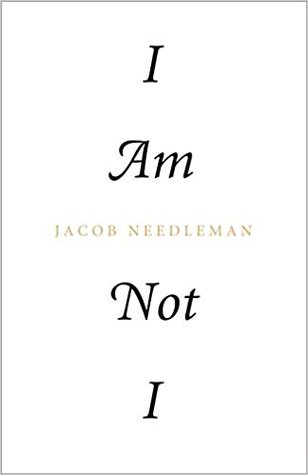
I Am Not I
Seeking to reconcile the split between our inner child and our adult self, eminent philosopher and religious scholar Jacob Needleman evokes the ancient spiritual tradition of a deep dialogue between a guiding wisdom figure and a seeker. The elder offers an initiation to a younger self, an initiation the author feels is missing from our culture. Rendered as a stage play, the conversation between the 80-year-old author and his younger selves unfolds, and an ambiguity emerges as to whether this is strictly the author’s internal dialogue or whether the younger self may be nurturing a rebirth of the author.
On one level, I Am Not I brings younger readers (teenagers and young adults) face to face with powerful spiritual and philosophical ideas. But as the book progresses, the dialogue delves into questions and insights that carry astonishing new hope and vision for every man and woman, challenging our culture’s accepted—and often toxic—ideas about humanity’s place in a living universe.
(Goodreads.com)
Bio: Jacob Needleman
From Wikipedia, the free encyclopedia
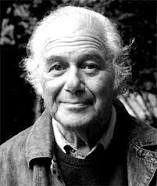
| Jacob Needleman | |
|---|---|
| Needleman in 2018 | |
| Born | October 6, 1934 (age 88) Philadelphia, Pennsylvania |
| Died | Oakland, California |
| Nationality | American |
| Alma mater | Harvard University Yale University University of Freiburg, Germany |
| Occupation | Professor of Philosophy |
| Known for | Philosophy, Gurdjieff Work |
| Spouse | Gail Needleman |
| Website | jacobneedleman.com |

Jacob Needleman (born October 6, 1934 – died November 28 2022) was an American philosopher, author, and religious scholar.
Needleman was Jewish[1][2] and was educated at Harvard University, Yale University, and the University of Freiburg, Germany.[3] He was a Professor Emeritus of Philosophy and Religion at San Francisco State University[4][5] and is said to have “popularized the term ‘new religious movements’.”[6] He was former Visiting Professor at Duxx Graduate School of Business Leadership in Monterrey, Mexico, and former Director of the Center for the study of New Religions at The Graduate Theological Union in Berkeley, California. He has also served as Research Associate at the Rockefeller Institute for Medical Research, as a Research Fellow at Union Theological Seminary, as Adjunct Professor of Medical Ethics at the University of California Medical School and as guest Professor of Religious Studies at the Sorbonne, Paris (1992). [7] Needleman was honored by the New York Open Center in New York City in 2006.[8][9] Needleman also narrates classical religious texts in audiobook format, including the Taoist Tao Te Ching and the Hindu Bhagavad Gita. He was deeply involved in the Gurdjieff Work, and the Gurdjieff Foundation of San Francisco.[10]
Commentary
On Being a Philosopher
In Talks at Google[11] in 2007, Needleman said, “A philosopher deals with the great unanswerable questions, which I think have answers, but not usually in the state of being that we’re asking them. In other words, these great questions that wake us up in the middle of the night about: Why are we here? What’s the meaning of it all? Questions that some people make fun of. These questions are some of the kinds of questions that sometimes the mind can ask, but the mind alone cannot answer. And since we are a culture that has gravitated toward, the center of gravity of most of our personalities, is the intellect, these questions seem to be intrinsically unanswerable and the response to these questions has to be not just in words or in interesting insights, but in the movement down from the mind to make contact with the heart and the body, which, when they work together, are like another intelligence. So that is what I think the true Philosopher tries to open to – that part which can respond to these [questions] and actually live what we are speaking about.”
On Democracy
In a 2012 On Being interview[12] with Krista Tipett, Needleman said, “A democratic citizen is not a citizen who can do anything he wants; it’s a citizen who has an obligation at the same time. And just to give you an example, if I may, the freedom of speech, what is the duty associated with it? Well, if you ponder that a little bit, you’ll come to the conclusion very clearly that the right of free speech implies the duty of allowing others to speak. If I have the right to speak, I have the duty to let you speak.
Now, that’s not so simple. It doesn’t mean just to stop my talking and wait till you’re finished and then come in and get you. It means I have an obligation inwardly — and that’s what we’re speaking about, is the inner dimension. Inwardly, I have to work at listening to you. That means I don’t have to agree with you, but I have to let your thought into my mind in order to have a real democratic exchange between us. And that is a very interesting work of the human being, don’t you think?”
On Money
In a 1990 A World of Ideas Interview[13] with Bill Moyers, Needleman said, “There’s always been greed, there’s always been avarice. There’s always been a problem with people wanting more than they need. That’s caused more problems for the human race than almost anything else. But cultures have always wanted other things, too. They’ve wanted honor. They’ve wanted power. Love. Respect. Beauty. It’s hard to say now, though, that our culture wants anything else as much as it wants. money.”
On the Gurdjieff Teaching
Needleman spoke often of Gurdjieff and his teaching.
In a 1991 Interview with Gnosis Magazine Needleman said,[14] “What Gurdjieff offers is a world view—the idea of an organic universe, a conscious universe, a universe with a purpose. The Gurdjieff teaching said life is a fundamental property of reality, and there is a movement toward consciousness and away from consciousness. There is a ladder of energies going up and down, and everything is included in that in some grand purpose. I found this very reasonable. Later scientific discoveries have more or less confirmed that there’s more livingness in the universe than was thought thirty or forty years ago.”
Decades later, in an 2016 Interview with Commonweal, Needleman said,[15] “What does humanity serve? The human being is meant to serve, is here on earth, according to Gurdjieff’s teaching, to serve other human beings, to serve the earth, and to serve a certain function in the universe. That means, practically speaking we are built to serve, we are built to be able to love.”
Writing
Jerry Needleman authored articles, interviewed and wrote 24 books in a writing career that began in 1970.
Bibliography
- The New Religions (1970)
- A Sense of the Cosmos: The Encounter of Modern Science and Ancient Truth (1975)
- Sacred Tradition & Present Need (edited by Jacob Needleman and Dennis Lewis) (1975)
- On the Way to Self Knowledge (edited by Jacob Needleman and Dennis Lewis) (1976)
- Speaking of My Life: The Art of Living in the Cultural Revolution (1979)
- Lost Christianity: A Journey of Rediscovery to the Centre of Christian Experience (1980)
- The Heart of Philosophy (1982)
- The Way of the Physician (1985)
- Sword of Gnosis: Metaphysics, Cosmology, Tradition (1988)
- Sorcerers: A Novel (1988)
- Real Philosophy: An Anthology of the Universal Search for Meaning (introduction and commentary by Jacob Needleman and David Appelbaum) (1990)
- Money and the Meaning of Life (1991)[16]
- Modern Esoteric Spirituality (edited by Jacob Needleman and Antoine Faivre) (1992)
- Eros (1995)
- A Little Book On Love (1996)
- Time and the Soul: Where has all the Meaningful Time Gone – And Can We Get it Back? (1998)
- The American Soul: Rediscovering the Wisdom of the Founders (2003)
- The Wisdom of Love: Toward a Shared Inner Search (previously published as A Little Book on Love) (2005)[17]
- Why Can’t We Be Good? (2008)
- What is God? (2009)[18]
- Introduction to the Gurdjieff Work (2009)
- An Unknown World: Notes on the Meaning of the Earth (2012)
- Necessary Wisdom: Jacob Needleman talks about God, time, money, love, and the need for philosophy, in conversations with D. Patrick Miller. (2013)[19]
- I am Not I (2016)
What We Lost When We Lost Jacob Needleman
Dec 3, 2022 (mitch-horowitz-nyc.medium.com)
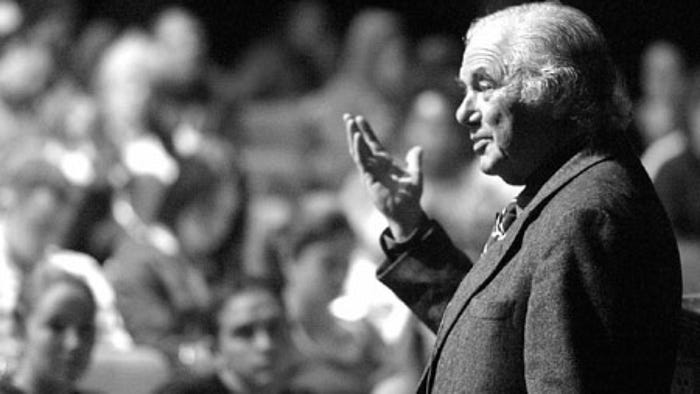
Remembering a philosopher of esotericism
Philosopher and author Jacob Needleman died at age 88 on November 28, 2022. With his passing, our culture lost not only a distinguished and widely published scholar of religions, but one of the few writers of our age who proved capable of communicating the nature of inner experience.
In more than twenty books, spanning from 1970 to 2016, Jerry, as he was known to friends, defined the interior life of the mind, emotions, and body — the fears, frivolities, and moments of resplendent awareness — and the individual’s fitful ability to see, to relate to life in fleeting ways that affirmed the human striving, and warranted belief in, the presence of a greater dimension of existence.
Indeed, Jerry’s fullest gift as a writer was the capacity to compellingly describe inner contradictions and strivings — a quality possessed by Ralph Waldo Emerson, Krishnamurti, and very few other modernist spiritual figures. Topics that would implode on other writers were perfectly molded in his hands.
I had the opportunity to witness Jerry’s abilities closely from when I first began publishing him at Penguin Random House with the appearance of one of the books of which he was justly proudest, The American Soul in 2002 to An Unknown World in 2012. His virtuosity was palpable — and, I warrant, explainable.
Jerry possessed, of course, great personal sensitivity as well as decades of immersion in the penetratingly truthful ideas of 20th century spiritual philosopher G.I. Gurdjieff (1877–1949). Any individual with those coordinates could venture valuable observations. But his work stood, too, on another set of shoulders: the writer’s preternatural work ethic.
By the time I met Jerry, born in 1934 and with numerous books published as well as an education from Harvard, Yale, and the University of Freiburg, and a professorship in philosophy at San Francisco State, he was already something of a grand eminence on the public spiritual scene. I knew several accomplished spiritual writers who, by that stage of their careers, had more or less checked out — allowing themselves to defer to eager, younger, and sometimes sycophantic colleagues, who recorded lectures and conversations which were spun into half-books.
The company’s president admired Jerry’s work. I once told her, “This man is over seventy and he writes every day.” In one of the few publishing meetings I attended where something useful got said, an executive announced: “We want writers who are dedicated to and serious about their craft.” He could have been describing Jerry. That was the writer’s secret, if there was any: constant effort and practice. In a different context, Gurdjieff said: “You must understand that ordinary efforts do not count. Only super-efforts count.” Jerry abided.
Indeed, I came to feel that Jerry’s finest books appeared in the latter part of his career. My personal favorite is Why Can’t We Be Good? from 2008. In it, he probed one of the core fissures of human nature: our incapacity to act on our ideals. This inability, as Jerry understood, stems from the individual’s actual unfamiliarity with his or her nature; a hole we fill with fuzzy, rote, and false self-estimation. Man is asleep, as Jerry understood from the work of Gurdjieff. Not in some metaphorical way but actually — and on a scale that one almost never sees.
Although Jerry received a fair degree of media attention— including interviews by Bill Moyers in his “A World of Ideas” TV special and just credit for popularizing the term “New Religious Movements” — the author was, at times, pained by his relative lack of recognition in mainstream letters. Prominent reviews were rare. (As of this writing, days after his passing, not a single obituary has yet appeared.) The reason for this, I aver, was Jerry’s unwillingness to compromise his precise — and sparkling — language and ideas. He would not employ cheapened or off-the-shelf phraseology; he would not devise lists; he would not give books cute, cloying, or affected titles; he would not pursue trends; he would not wink at or wiseacre over the depth of problems facing the individual; and, above all, he would not disguise or condition belief and ideals. It wouldn’t have occurred to him. In Money and the Meaning of Life in 1991 he wrote:
A Freudian psychoanalyst once summed up to me his vision of the human condition by saying that man is not as bad as he thinks he is, nor can he become as good as he dreams of becoming. The assumption of this book is precisely the opposite of the psychoanalytic view: man is in far worse condition than he believes, but he can become far greater than he imagines.
Jerry’s points about the universally degraded nature of our existence were not easily communicated to readers accustomed to accepted modes of inquiry or pedantry. Indeed, he remarked to me that during his early years as a student of religion, not once did a professor suggest that the ideas under scrutiny might be actually true. Upon publication of Why Can’t We Be Good?, one reviewer extolled the book’s “eloquent and entertaining thoughts” (never was the latter descriptor more misapplied) and concluded that the author “discovers that our inability to be good is simple: humans are creatures of choice, and our freedom allows us to make bad choices as well as good ones.” The writeup marked one of the few instances when I violated my professional rule of never complaining to a publication about a review. The unnamed critic had literally (I use the word carefully) misunderstood Jerry’s book to the extent of its opposite. His point wasn’t that individuals possess choice and select poorly. Nor was his point that we lack choice. Rather, our false condition requires immense self-work and observation before we can assume the mantle of choice.
Jerry was accustomed to people — students, seekers, reviewers, talkers — trying to reprocess truth through more familiar (and less painful) language. When sampling the ideas of Gurdjieff, onlookers were apt to say, “Oh it’s like…,” filling in a recognizable metaphor. Jerry’s response: “It’s not like anything.” Once at a New York City workshop, the philosopher conducted an exercise in sacred movements. “It’s fun,” an attendee remarked. Jerry replied, “If you knew your life depended on it, you wouldn’t find it fun.”
I do not mean to leave the impression that there was a sternness to Jerry. He wore an impish grin, laughed easily (including at himself), and genuinely enjoyed people’s company. I recall attending a conference for his book The American Soul at a spiritual center in Virginia Beach, VA, and seeing him smile at strangers at the beachfront hotel. “Do you have a nice room?” he asked a busy vacation mom as she entered the elevator. The formerly beleaguered woman smiled, “Oh, yes, very nice.”
“You see,” he told me, “if you just recognize people they light up.”
There was also another Jerry who could be fussy and finicky to the point of annoyance. He could pit people against one another. At times, there was tension between us. I will share a slightly embarrassing memory — to myself — in the service of telling the truth, which he would have wanted and expected. I once grew enthralled listening to Jerry’s beautiful baritone narration of the Bhagavad Gita on a book-on-tape before we started calling them audiobooks. Each time he invoked Krishna telling his wavering warrior-disciple, “Fight, Arjuna,” I felt a charge go through me. I fantasized about one day whispering the same words to Jerry on his deathbed. But we both went separate ways; I never got the chance.
And yet: the meticulous wisdom and hard-won insights of his books entered my bones, as they did those of many seekers. Whenever I’m tempted to render a trite statement or quick-and-neat judgment, something stops me (or ought to). That is Jerry’s influence. It stays with me whenever I try.
“Fight, Arjuna.”
Book: “Magnificent Rebels: The First Romantics and the Invention of the Self”

Magnificent Rebels: The First Romantics and the Invention of the Self
by Andrea Wulf
From the best-selling author of The Invention of Nature comes an exhilarating story about a remarkable group of young rebels–poets, novelists, philosophers–who, through their epic quarrels, passionate love stories, heartbreaking grief, and radical ideas launched Romanticism onto the world stage, inspiring some of the greatest thinkers of the time.
When did we begin to be as self-centered as we are today? At what point did we expect to have the right to determine our own lives? When did we first ask the question, How can I be free? It all began in a quiet university town in Germany in the 1790s, when a group of playwrights, poets, and writers put the self at center stage in their thinking, their writing, and their lives. This brilliant circle included the famous poets Goethe, Schiller, and Novalis; the visionary philosophers Fichte, Schelling, and Hegel; the contentious Schlegel brothers; and, in a wonderful cameo, Alexander von Humboldt. And at the heart of this group was the formidable Caroline Schlegel, who sparked their dazzling conversations about the self, nature, identity, and freedom. The French revolutionaries may have changed the political landscape of Europe, but the young Romantics incited a revolution of the mind that transformed our world forever. We are still empowered by their daring leap into the self, and by their radical notions of the creative potential of the individual, the highest aspirations of art and science, the unity of nature, and the true meaning of freedom. We also still walk the same tightrope between meaningful self-fulfillment and destructive narcissism, between the rights of the individual and our responsibilities toward our community and future generations. At the heart of this inspiring book is the extremely modern tension between the dangers of selfishness and the thrilling possibilities of free will.
(Goodreads.com)
Dyslexia is a feature, not a flaw, at student exhibition
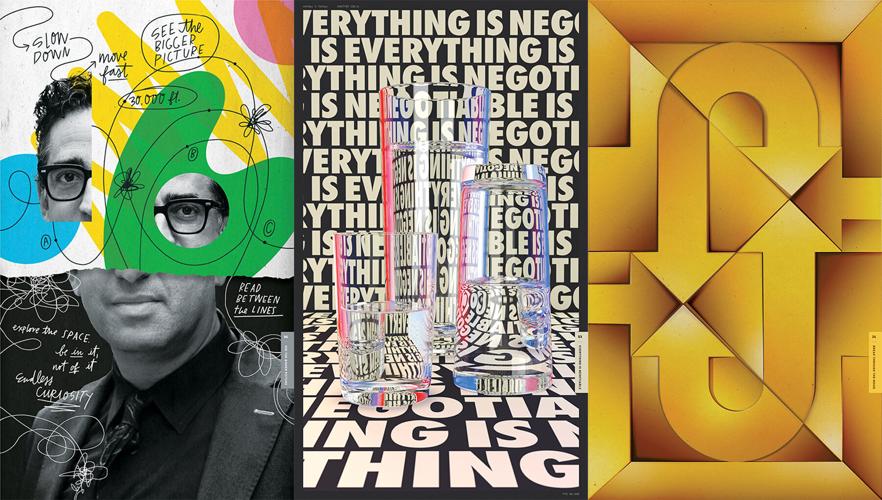
Gil Gershoni’s “See the Bigger Picture,” “Everything is Negotiable” and “Break Through the Noise,” images on display at Dyslexic Dictionary exhibition at Arion Press Gallery through Dec. 22.

Nolan Ward is among the students who made a contribution to the Dyslexic Dictionary.
- Dyslexic Dictionary
Dozens of dyslexic students from across the Bay Area have created artwork to be shown at an exhibition in San Francisco’s Arion Press Gallery beginning Dec. 14.
Gil Gershoni, executive producer of Dyslexic Dictionary that includes the student show, says his goal is “to change the prism through which we, as a society, but especially our youth, view dyslexia.
”Yes, dyslexia makes a few things — like reading and writing — more challenging,” says Gershoni, who has dyslexia. “But it also supercharges our abilities in many other ways. The goal is to reframe dyslexia as an asset, a hyper-ability, rather than a disability.”
Students chose a word that represents what dyslexia means to them and paired it with evocative renderings that capture their experience as dyslexics.
Students in the Bay Area with dyslexia have been and continue to be invited to submit their artwork as a postcard after downloading the template from DyslexicDictionary.com. The project will continue through 2023, and after the Arion exhibition closes, the postcards can be seen online.
Among exhibiting students, Robin Zellweger, age 13, said, “The inspiring art I saw made me think that one of the benefits of having dyslexia is creativity. I hope the whole world notices that dyslexia is an advantage.”
”The exhibit made me feel like dyslexia is appreciated,” said Alizee Picault-Haulin, age 12. “There was one piece of art that was a dress made out of wood. That showed me one way that people with dyslexia think differently.”
{span}According to the International Dyslexia Association, people with dyslexia experience difficulty reading but also struggle with spelling, writing, pronouncing words and other language skills. It affects people of all backgrounds and intellectual levels. Dyslexics can be capable or even gifted in areas such as art, computer science, design, drama, electronics, math, mechanics, music, physics, sales, and sports. Some well-known figures with dyslexia include Albert Einstein, Muhammed Ali, Stephen Hawking, Robin Williams, Cher and many others. {/span}
Gershoni, who developed the Dyslexic Dictionary, is owner of Gershoni Creative, a San Francisco design agency whose clients include Apple and Spotify; Gershoni is also the founder of Dyslexic Design Thinking.
The students’ exhibition at Arion overlaps through Dec. 22 with the Dyslexic Dictionary show by Gershoni and eight dyslexic artists “invited to explore and redefine how their minds experience language.”
They include California Gov. Gavin Newsom, Nigerian artist Adeniyi Akingbade, Dutch graphic designer Christian Boer, San Francisco artist Adam Eli Feibelman, English writer and illustrator Sally Gardner, Marin artist and designer Martin Grasser, Philadelphia sculptor and neuroscience lecturer Rebecca Kamen, and London sculptural womenswear designer Kelsey Ann Kasom.
San Francisco production artist Michael Strickland comments on the exhibition: “I’ve been working professionally with graphic artists for decades, and most of the great ones are dyslexic. They comprehend the world more through visual symbols than letters.”
About 20% of the population has dyslexia of various forms, though many people go throughout their entire lives without a formal diagnosis. Dyslexia paints the world in different colors and tones for those who are affected by it.
The First Romantics and the Invention of the Self: How a Circle of Friends and Lovers United Nature and Human Nature
By Maria Popova (themarginalian.org)

Just after the revolutionary work he recounted in Awakenings, Oliver Sacks wrote in a note to the music therapist at Beth Abraham Hospital: “Every disease is a music problem; every cure is a musical solution.” He was quoting Novalis — the young German poet and philosopher who, while working in a salt mine and studying mathematics, geology, physics, and biology, was composing tortured and transcendent poems inspired by the death of his teenage beloved.
Novalis is one of the characters who animate Andrea Wulf’s Magnificent Rebels: The First Romantics and the Invention of the Self (public library) — the story of a circle friends and lovers in late-eighteenth-century Germany who refined their ideas in ricochet — ideas that shaped our present understanding of art and nature, mind and reality, the world and ourselves as function and functionary of it.
After the formidable Germaine de Staël popularized their ideas outside Germany, the tendrils of their influence went on to touch Coleridge and Emerson, Whitman and Joyce, sinking into the very soul of the modern world and its self-regard.
Illustration by Margaret C. Cook for a rare 1913 edition of Walt Whitman’s Leaves of Grass. (Available as a print.)
Having previously written about Alexander von Humboldt and the “invention” of nature — in the sense of the birth of its modern conception — Wulf now chronicles the “invention” of the modern self, the Ich, in the intellectual kiln of the same time and place, revealing the two to be inseparably related, reminding us that we can’t understand nature if we don’t understand ourselves or care for one without caring for the other.
She calls them the Jena set, after the town in Duchy of Saxe-Weimar where they constellated their portable universe of radicalism, and writes:
They were rebellious and felt invincible. Their lives became the playground of this new philosophy. And the story of their tiptoeing between the power of free will and the danger of becoming self-absorbed is significant on a universal level. The Ich, for better or worse, has remained centre stage ever since. The French revolutionaries changed the political landscape of Europe, but the Jena Set incited a revolution of the mind. The liberation of the Ich from the straitjacket of a divinely organised universe is the foundation of our thinking today. It gave us the most exciting of all powers: free will.
Against the grain of their time, they exercised their free will in open marriages and long-term monogamies without marriage. With names that sounded alike and intellectual passions that fired alike, they became a kind of hive mind fixated on celebrating the self and set out to “symphilosophize” — a term they invented for the intellectual symbiosis and symphonic creative collaboration at the heart of their life. Wulf writes:
Among them, of course, were Goethe and Schiller, whose intergenerational friendship was the intellectual and creative anchor of both of their lives. Humboldt flits in and out of the scene, with his experiments in galvanism and his passionate devotion to the web of life. But there are also central characters now nearly forgotten — the influential brothers August Wilhelm Schlegel and Friedrich Schlegel, who believed that they were “all part of the same family of magnificent outlaws” and stood against Rousseau in their conviction that both boys and girls deserved a rigorous education; the young Friedrich Schelling, who at age eleven had informed his teachers that they had nothing else to teach him and had become the youngest professor appointed at the University of Jena at twenty-three, who “radiated infinity,” and who believed that “mind is invisible nature, while nature is visible mind” and told his students:

Goethe’s color wheel from his theory of color and emotion. (Available as a print.)
There was Novalis, who “regarded the ordinary with wonder” and “slept little and worked hard” — at his poetry and in the salt mines — and believed that we and the world are an integrated system, each indispensable to the other, so that our task is to “catch sight of ourselves as an element in the system.” Wulf writes:
It was Novalis who offered the closest thing they had to a founding credo of Romanticism:
But by far the most colorful character is Caroline Schlegel, who was to the German Romantics what Margaret Fuller was to the American Transcendentalists. Vivacious, opinionated, educated far beyond the gendered limits of her time, Caroline spent time in prison for her revolutionary leanings, had a baby by a young Napoleonic soldier after a fiery one-night stand, and was animated by what she called “a firm, almost instinctive need for independence.” She besotted both Schlegel brothers, married one in what was at base an amicable friendship, and took the young Schelling as a lover, becoming the great love and muse of his life. The slight squint of her blue eyes cast the spell binding everyone into the “magic circle” of the group. “We have to build a poetic world out of ourselves,” Novalis told her as he declared her the beating heart of that world.
Art by Cindy Derby from A Velocity of Being: Letters to a Young Reader. (Available as a print, benefitting the New York public library system.)
They all believed in the power of language. “You have not just to carry out revolutions,” Friedrich Schlegel wrote, “you have to speak them too.” No one spoke them more revolutionarily than the young Schelling, whose lectures enchanted a generation of thinkers with a whole new way of seeing the world — his students called it his “poetry of the universe.” Wulf writes:
The Enlightenment had truly enlightened. But this new rational approach had also created a certain distancing from nature and excluded the roles of feeling and beauty. Nature had become something that was investigated from a so-called objective perspective. Light, for example, was no longer appreciated for its kaleidoscopic play of iridescent colours, Novalis said, but for its refraction and “mathematical obedience”: hence its elevation to the term “Enlightenment” itself. This was why Schelling’s students fell for their young professor. He reunited what the scientific revolution had separated: nature and humankind. No matter how much scientists observed, calculated and experimented, there was something emotional, something visceral and perhaps inexplicable about humanity’s connection to nature. However we feel it, nature can soothe, heal or simply fill us with joy. Schelling gave us the philosophical explanation.
And by doing so, his philosophy of oneness became the heartbeat of Romanticism.

Art by Charlie Mackesy from The Boy, the Mole, the Fox and the Horse
In consonance with William Blake’s lifelong devotion to turning art into a lens on the universe, the Jena set understood that because we are part of nature, the products of our creative imagination are how nature examines itself, comprehends itself, and coheres. Wulf considers how Schelling’s System of Transcendental Idealism “became the philosophical underpinning of Romanticism”:
These were ideas the entire Jena set shared. Friedrich Schlegel proclaimed that “all art should become science and all science art.” Novalis insisted that “science in its perfected form must be poetic” and that “laboratories will be temples.” Caroline Schlegel prophesied that “when the world goes up in flames like a scrap of paper, works of art will be the last living sparks.”
Works of art only ever spring from the particular vantage point of a particular authentic self — an Ich — and this is the enduring legacy of the first Romantics.
But all great ideas, if followed not critically but cultishly, run the risk of metastasizing into dogmas. Today, we are living with one such metastasis of Romanticism in our staggering epidemic of selfing — rather than connecting us to each other and the living world as kindred elements in a system, the inflamed Ich has folded us unto ourselves: living proteins of ego. It is by returning to the original philosophy, before its mutation, that we stand a chance of reclaiming the self as a crucible of creativity and a portal of connection to nature.
Art by Paloma Valdiva for Pablo Neruda’s Book of Questions
Wulf reclaims the legacy of the Romantics:
The Jena Set believed that we have to be conscious of our selves — to be “selfish” in the sense of being aware of and in control of our own being and free will.
[…]
The “Art of being Selfish,” in the context of Schelling’s Naturphilosophie, also means understanding one’s place in this great interconnected living organism that is nature. “Since we find nature in the self,” one of Schelling’s students concluded, “we must also find the self in nature.” Being selfish in that sense means comprehending and recognising the concept of unity with the universe. Not harming the planet therefore means not harming yourself.

Illustration by Mimmo Paladino for a rare edition of James Joyce’s Ulysses
With an eye to Novalis’s insistence that “without perfect self-understanding we will never learn truly to understand others,” she adds:
Complement Magnificent Rebels with poet, painter, and philosopher Etel Adnan — a modern-day Romantic, writing in her nineties — on the self and the universe, then revisit the Schelling-influenced Emerson on how to trust yourself and Whitman’s Humboldt-inspired poem “Kosmos.”
Shirley Jackson on writing
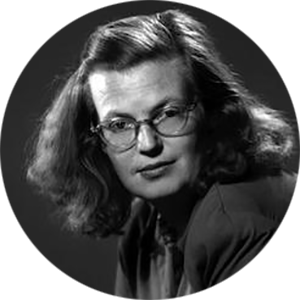
“I cannot find any patience for those people who believe that you start writing when you sit down at your desk and pick up your pen and finish writing when you put down your pen again; a writer is always writing, seeing everything through a thin mist of words, fitting swift little descriptions to everything he sees, always noticing.”
–SHIRLEY JACKSON
Shirley Hardie Jackson (December 14, 1916 – August 8, 1965) was an American writer known primarily for her works of horror and mystery. Over the duration of her writing career, which spanned over two decades, she composed six novels, two memoirs, and more than 200 short stories. Wikipedia
Tarot Card for December 12: The Aeon
The Aeon
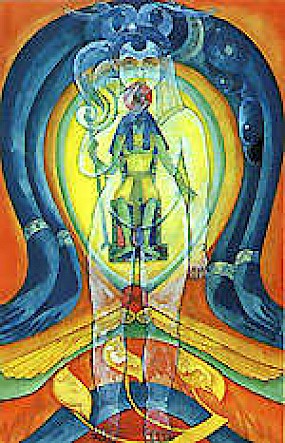
The Aeon (or Judgement, Last Judgement, Atonement, Resurrection) is numbered twenty and often shows figures arising from graves in answer to the clarion call of an angel. The Thoth deck veers away from the Christian overtones and instead we see the goddess Nuit, a primal sky goddess from the beginning of creation. Her body is arched above our heads and curves to imply the ankh cross, a symbol of immortality and life. A child-like male figure stands within the ankh’s loop with his finger to his lips in the traditional mystical gesture of silence. A seated regal figure is behind him. Both figures are said to represent Horus, first as child and then as ruler.
Horus was the son of Osiris and Isis. When his father was murdered by his brother Set, Horus was protected and raised by Isis. Horus’ ascension to manhood triggered a series of battles with Set, culminating in his assumption to the throne of Egypt. Set was sent away defeated and thus Horus is seen as a god of redemption.
The Aeon forces us to acknowledge that our actions set up a chain of cause-and-effect for which we are solely responsible. Here we pass through the fire of purification, shedding dead and dying wood as we go. We judge ourselves frankly, forgive, and leave the past behind. And then we are free to step into the light.
This is a card of healing, especially on an emotional level. It promises hope and happiness, along with a new sense of safeness, protection and recovery. We are at the place where miracles happen.
(via angelpaths.com and Alan Blackman)