TOPICS — The illusion of time, temporal perspectives, pride, hierarchy, wholeness.
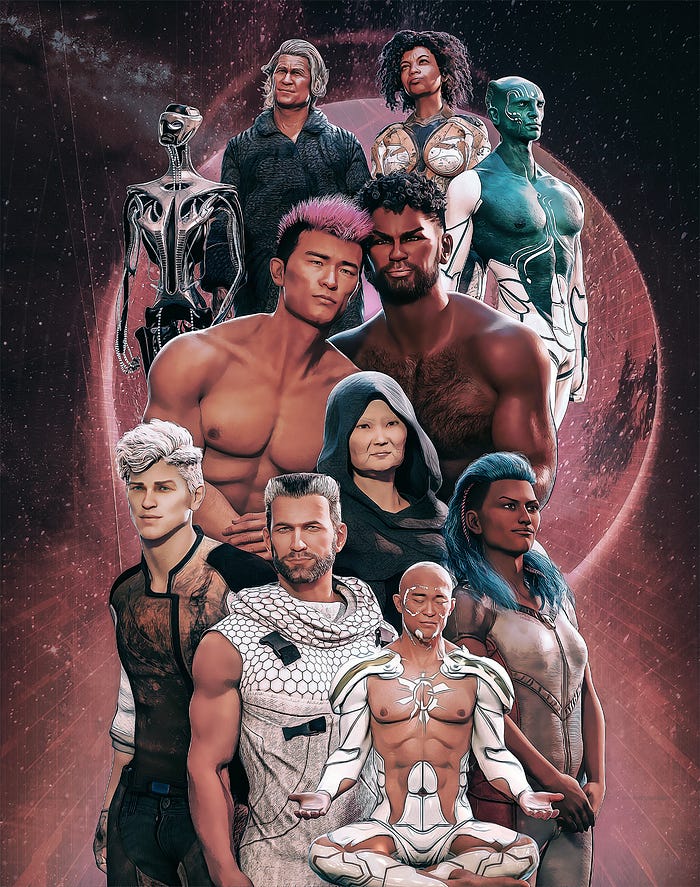
image by author
We have each lived many lives, lived in many times, inhabited many types of body, and explored many realms of consciousness. We have played every role in a grand space-time opera.
Mortality is an illusion that we choose to experience as being real. We are eternal consciousness. This is the basis of most spiritual belief.
Time is an illusion that we experience as being real. We are timeless beings. This is not included in most spiritual beliefs, and yet, they are really saying the same thing, that…
What we are eternally are — consciousness — is not contained by either time or space.
The way a seed grows into a tree is like the tree-trunk of eternal consciousness branching out to explore ideas, creating foci of exploration called twigs, that produce the intense perception of leaves (which represent embodied individuals).
Because everything in reality is holographic, each leaf contains the coding for the entire tree and the pattern repeats in the individual (at another level of harmonic).
You are a tree trunk who branches out to explore ideas that excite you, creating groupings of exploratory time-space events called twigs, that produce the intense perception of leaves (which represent potent events in your history).
Just as you can look at the events of your life as, “These events are all a part of what I am. I am what connects them all”, so too does eternal consciousness look at every human and say, “These people are all a part of what I am. I am that which connects them all.”
You are the tree trunk that connects all the events of your life.
Why is it we can easily see ourselves as being the container of all the events of our lives (events which may be diverse and disparate), and yet we resist applying that to ourselves and seeing what we are as a part of something wider? This is because we become possessive of our individuality through qualities such as pride.
Pride can be a positive quality. I hope you feel proud of the events of your life. I hope you feel proud of your children. I hope you feel proud of everything you create. I hope you feel proud of each meal you cook. Pride is not the enemy.
Where pride creates a shadow — that blinds / obfuscates — is when it tips into possessiveness. This is a product of hierarchical thinking where a person ignores their negative qualities, amplifies their positive qualities, and believes these positive qualities result from them being a superior person.
We like to think of selves as being unique, not as something of which there are many.
Although it is far more subtle, it is this same possessiveness that causes us to resist seeing ourselves as a part of something larger. We like to think of ourselves as THE tree trunk, not a tree leaf. But, as has been discussed in previous articles, BOTH are true. You are both leaves and the tree trunk because…
We are the entire tree.
You are both a big fish in a small pond and a small fish in a big pond.
You are both eternal and within a ‘real’ illusion of mortality.
You are both an individual and a state of collective consciousness.
You span all states of consciousness you can imagine exist.
But this is too much to comprehend. It is not the mortal experience if you know you are immortal. The perception of linear time is destroyed by the perception of timelessness.
All that I write of is the state of awakening. Awakening from this dream. But you must always remember it is a dream we wanted to have. This has been a ‘good’ dream — a dream we are pleased with, a dream that delivered, a dream that was all we wanted it to be.
We are the tree trunk that created leaves. Leaves that dream of being a tree trunk.
We are the ocean that created fish. Fish that dream of knowing the entire ocean.
God created humans, and humans explore being creators. Creation is.
The breaking down of hierarchy is to see that each leaf contains the tree trunk and the tree trunk contains the potential for all the leaves. They are the same thing viewed from a different temporal perspective.
The bulb is a flower, just from different temporal perspectives.
You are young and old, depending on how you view yourself.
What this all boils down to is very simple…
YOU ARE NOT ONE THING (unless you define that one thing to be everything and every moment in existence).
Whatever qualities you champion, you are also possess the opposite of each of those qualities. You are all qualities. You embody all opposites. You stand in no specific spot. You are no specific age. You have no specific name. You are consciousness. You are life. You are creation.
You are all names.
You possess nothing unless you accept you possess everything.
You experience yourself as a state of consciousness that walks a singular path, but you are the consciousness that walks every path.
You see nothing, unless you accept you see everything.
You live nowhere, unless you accept you live everywhere.
You will experience mortality until you accept you are immortal.
See my medium profile to read this series of articles in the order they were written.
Translation is a 5-step process of “straight thinking in the abstract.” The first step is an ontological statement of being beginning with the syllogism: “Truth is that which is so. That which is not truth is not so. Therefore Truth is all there is.” The second step is the sense testimony (what the senses tell us about anything). The third step is the argument between the absolute abstract nature of truth from the first step and the relative specific truth of experience from the second step. The fourth step is filtering out the conclusions you have arrived at in the third step. The fifth step is your overall conclusion.
The Ukraine Emergency Translation Group meets every Friday at 11 a.m. Pacific time via Zoom. We call it the Ukraine Emergency Translation Group but we welcome Translations about anything. Here are sense testimonies (2nd steps) we translated and their corresponding conclusions: (5th steps) this week.
2) Family dynamics can injure and imprison people. 5) The system that is Truth is whole, complete, absolute, perfect dynamic thinking conscious beingness.
2) Some people are more interested in their self-image then in their self-reality. 5) The One Consciousness of Truth is the only property, riches, things.
Some comments from group members about this group:
“I like the group interaction and different perspectives. Also, at least for me, it gives me a sense of accountability and keeps the practice fresh in my mind. ” –Sarah Flynn
“This group has freed me up to have more fun with my Translations.” –Mike Zonta
In a year, we have a New Moon in each sign of the zodiac. The New Moon in Virgo is our once-in-a-year opportunity to embrace the Virgo energy and focus on the Virgo area of our chart.
It’s late August, so we are now moving out of the Leo season into the Virgo season. If Leo is a holiday season, Virgo is the “go back to work” season.
Ask a Leo to do something they don’t feel like doing. That’s a direct threat to their identity, and the answer is of course, no. Leo waits for the right moment to arrive. Virgo just gets on with things.
Leo wants to feel good before doing something. Virgo feels good after it gets the job done.
Doing what feels right is of course a great thing – that’s why Leo rules over joy and pleasure. But if everything we do is sourced in joy and pleasure, we’ll eventually get stuck (Leo is a fixed sign). That’s why we need a mutable sign (Virgo) to move that Leo energy out of its comfort zone.
We all have something to learn from Virgo. Virgo doesn’t wait for the right moment. Virgo doesn’t wait for things to feel right. Virgo just does what needs to be done.
Virgo is associated with duty, service and responsibility, and these words have a bit of a negative connotation, or at least feel unpleasant. However, ‘duty’ can be a great thing: nothing compares to that feeling of accomplishing something of value.
New Moon In Virgo – The Aspects
The New Moon is at 4° Virgo and it issquare Mars in Gemini.
This is a very tense square: the New Moon is at 4°04’ Virgo, and Mars at 4°01’ Gemini.
Mars squares usually blow a fuse or two. Since Virgo and Gemini are both Mercury-ruled, the source of irritation may be a conversation or some other type of information exchange. At the New Moon, we may hear some news that get our blood boiling.
Virgo doesn’t argue for the sake of arguing. Virgo wants to put things into good use. But like with all (complex) things in life, there’s always a bottleneck somewhere, something that undermines our efforts and good intentions.
The goal of the New Moon in Virgo square Mars is to identify and fix that bottleneck.
What is it that is irritating you, slowing you down, or stopping you from making progress?
Thankfully, the ruler of the New Moon, Mercury, is part of a nice grand trine with Mars and Pluto. Whatever Mars triggers, it will eventually be put into good Virgo use.
Sometimes we need to have those uncomfortable discussions to clear things out and move forward.
The New Moon in Virgo is also a good time to move from thinking to actually doing. If something is bothering you, do something about it. If you have a big plan, put it into practice. Whatever you do, take action. There’s no way to escape this intense Mars energy, so rather than having things happen to you, you want to be intentional about your actions.
New Moon In Virgo – The Bigger Picture
The New Moon in Virgo is not only an opportunity to take action (Mars) to improve something (Virgo) in your life.
The New Moon in Virgo is an invitation to ask yourself some greater questions.
How can you incorporate more of the common-sense, productive, service-oriented Virgo energy into your life?
Almost every aspect of our life would benefit from Virgo’s service-oriented nature.
If you feel demotivated at work for example, consider how your job helps others. Research studies have shown again and again that service to others is at the very heart of creating meaning and purpose in one’s life.
When we use our time and resources well, we add meaning to our life. When we create value to others, we always get something back, because nothing gets unnoticed in the grand scheme of things. It may not happen tomorrow, but it will eventually happen.
Another thing to consider is how your everyday actions and activities add (or don’t add) value.
Take a look at your everyday activities, at work or in your private life. Does that online research help you achieve your goals, or is it just another rabbit-hole distraction? On the other hand, some seemingly ‘waste of time’ activities like going for a 1 hour walk do bring a lot of value – from well being, mental clarity, to long term health benefits.
Whenever you do something, remember to put your discerning Virgo hat on.
Let’s say you want to attend a group call. Before you hit the “accept” button, ask yourself “Do I benefit from this live interaction?”.
If the call has breakout rooms and you get to participate, bounce back ideas, build relationships, or make group decisions, then that’s a good reason to attend. But if you’re just vaguely interested in the topic, you’re much better off skimming through the meeting notes.
When I recently looked at my tasks with a Virgo eye, I realized that there are very specific activities – that take only 5% of my time – that create the greatest value for my customers. Surprise (not surprise): doing that 5% is uncomfortable, because things that move the needle usually require intense focus and problem solving.
However, just like in the grasshopper and the ant story – it always pays off to be productive, to be of service, and to create value. Virgo energy may be less sexy than Leo, Libra, or Scorpio – yet embodying it makes all the difference and helps us live a life of meaning and purpose.
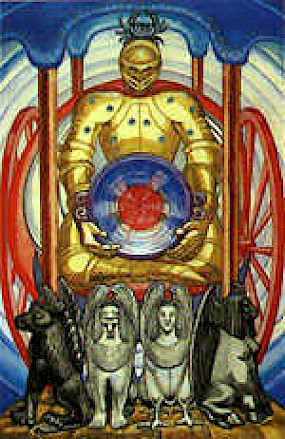
The Chariot is numbered seven and usually depicts a warrior driving a chariot triumphantly home. The chariot is drawn by powerful and wild creatures. These creatures are our Will – a wayward beast to control at the best of times!
The Chariot represents the principle that the human Will functions only when the whole being is behind it. This card is about the struggles we have with ourselves and with life. It promises that with diligence, honesty and perseverence we can overcome the most insurmountable of obstacles.
This is a hopeful and encouraging card, reminding us that we can climb to the heights if we want to. Here we are taught how to master the opposing forces within us, in order to bring them and thus ourselves into harmony. We are cosmic warriors, unfurling, learning and growing – divine and vital parts of the Universe.
K: That is fairly simple, is it not? Have you not noticed that when you are very happy and feeling full of life, you have no belief in God?
Then you just live. You see, it is only the people who are frightened, who have not understood this complex thing called life—with all its agonies, miseries, aches, despairs,frustrations—it is only they who believe, who escape into something which they call God.
And there are innumerable images of God in this country; you see them by the thousands. People believe in God because they are afraid of life. But it is only when you love life that you find out what God is. But most of us avoid life, just as all the saints, the so-called religious people, do. They—the saints—want to suppress life, they want to shape it, discipline it, control it, beat everything out of it, and the result is that they are dry, withered human beings who everlastingly talk about God; but they are nowhere near God.
To find out what God is, is quite a different matter. It requires amazing intelligence—not sitting around reading the Gita, or doing good works, or following some guru. To find out if there is God, the real thing, you need a mind and a heart that are completely mature, open, rich, and unspoiled by fear.
A timeless Spring
22 November 1963
Jiddu Krishnamurti (May 12, 1895 – February 17, 1986) was a philosopher, speaker and writer. In his early life, he was groomed to be the new World Teacher, an advanced spiritual position in the theosophical tradition, but later rejected this mantle and withdrew from the organization behind it. Wikipedia
New Thinking Allowed with Jeffrey Mishlove Aug 25, 2022 Richard Smoley is editor of Quest: The Journal of the Theosophical Society in America. He is also former editor of Gnosis Magazine. His books include Hidden Wisdom: The Guide to the Western Inner Traditions, Inner Christianity: The Guide to the Esoteric Tradition, Forbidden Faith: The Secret History of Gnosticism, The Essential Nostradamus, Conscious Love: Insights from Mystical Christianity, The Dice Game of Shiva: How Consciousness Creates the Universe, The Supernatural: Writings on an Unknown History, The Deal: A Guide to Radical and Complete Forgiveness, and How God Became God: What Scholars Are Really Saying About God and the Bible. In this interview from 2016, he notes that many of the great spiritual teachers of the twentieth century (Blavatsky, Steiner, Gurdjieff, Jung) had teachers who remain unknown. He suggests that this reflects the desire of all these individuals to avoid the limelight of public scrutiny. While describing most channeled material as “banal”, he praises Jane Roberts’ Seth material as well as A Course in Miracles. He reviews the history of Satanism and, paradoxically, associates it with the objectivist philosophy of Ayn Rand. He also comments on the writings of Aleister Crowley as well as tantra. New Thinking Allowed host, Jeffrey Mishlove, PhD, is author of The Roots of Consciousness, Psi Development Systems, and The PK Man. Between 1986 and 2002 he hosted and co-produced the original Thinking Allowed public television series. He is the recipient of the only doctoral diploma in “parapsychology” ever awarded by an accredited university (University of California, Berkeley, 1980). He is a past vice-president of the Association for Humanistic Psychology; and is the recipient of the Pathfinder Award from that Association for his contributions to the field of human consciousness. He is also past-president of the non-profit Intuition Network, an organization dedicated to creating a world in which all people are encouraged to cultivate and apply their inner, intuitive abilities. He is the Grand Prize winner of the 2021 Bigelow Institute for Consciousness Studies essay competition on the best evidence for human postmortem survival of consciousness. (Recorded on August 7, 2016)
When we study astrology for a while, we tend to take for granted core astrological concepts like houses.
We already know what the 12 houses stand for, right?
However, taking a new look at how houses have come about in the first place, can help us unveil new meanings.
The key characteristic of houses is their spatial dimension. The 12 houses are derived from the space around us.
We can understand the 12 houses of our natal chart at a deeper level if we start from what defines them in the first place.
The angles!
The 12 houses and the Angle Theory
Let’s take the Ascendant as the anchor point.
The Ascendant is where the horizon was rising when you were born. The Ascendant and the 1st house is who you are, it is your Ego, the incarnation of spirit on Earth.
When we take the Ascendant as the anchor point, this is when things get interesting.
If the Ascendant is our Ego, the 12th house is on top of the 1st house, so it represents what’s above the Ego, what we cannot see, our blind spot, but also what we can grow and develop into.
When we think of the 12th house as an elevated 1st house, it makes total sense that the 12th house is a spiritual, selfless place.
We apply to same logic to derive the meaning of the 2nd house.
The 2nd house is just under the 1st house, what we “stand on”, what we own, so it represents that part of ourselves that feeds the Ego, that part of ourselves that works in our favor.
That’s why the 2nd house is the house of money, possessions, talents, food, and energy levels. It is what we own, what is ours.
The 2nd house is our piggy bank – of talents, energy, and assets. The 2nd house describes qualities we already own and are ready to harness.
The question today is whether we can twist free of them and again become a self-governing nation. Or if we’re doomed to continue to devolve into a full-blown oligarchy
“At bottom, the Court’s opinion is thus a rejection of the common sense of the American people, who have recognized a need to prevent corporations from undermining self-government since the founding, and who have fought against the distinctive corrupting potential of corporate electioneering since the days of Theodore Roosevelt.
“It is a strange time to repudiate that common sense. While American democracy is imperfect, few outside the majority of this court would have thought its flaws included a dearth of corporate money in politics.”
—Justice John Paul Stevens’s dissent in Citizens United
In 2010 the United States Supreme Court wrapped up their systematic dismantling of representative democracy in America. Their job on behalf of the morbidly rich donors who put them onto the Court is now almost complete.
The symptoms are all around us:
*Climate change is whacking the world in a way never before seen by humans, and every political party in every developed country in the world acknowledges it except one: the American GOP. Why? Because only in America has a supreme court fully legalized political bribery and Republicans are taking big bucks from the fossil fuel industry and petrobillionaires.
*Fully a third of voters polled by ABC/Ipsos this month said they have no confidence that either party can honestly deal with substantive problems like gun violence, taxes, gas prices, and inflation (among others). While the “why” question wasn’t asked, it’s easy to infer the answer: politicians in both parties are on the take, or held back from meaningful action by a few colleagues (like Sinema/Manchin) who are openly on the take.
*Monopolistic consolidation of the American economy is so complete that American consumers are being openly played as the world’s suckers. We pay more — often twice to ten times more — than the citizens of any other developed country for everything from pharmaceuticals to broadband to cell service. There was a time in America when Congress did something about monopolies: that time is now gone, as lawmakers are regularly bribed by the very corporations they would have to pass laws to regulate.
*In the 1970s the American middle class made up the majority of Americans and average CEOs took home only about 30 times what their workers did because any money they made beyond that was hit with a top 74% tax bracket. CEOs back then didn’t have multiple mansions, private jets, and megayachts. Many lived in the communities where their businesses were located.
*Today fewer than 45 percent of us are in the Middle Class, one worker can no longer raise a family, and the morbidly rich pay as little a 3% in income taxes while many — like Trump — pay nothing at all for decades. This persists because those very CEOs now pay off enough politicians to prevent taxes from being raised to a historically reasonable level.
*Gun violence now kills more American children than any other cause and America is awash in weapons-of-war openly marketed to sexually insecure young white men. We’re the only developed country in the world struggling with regular mass shootings, school shootings, and a high frequency of police violence and homicide against civilians.
No other developed country in the world has these problems because no other developed country in the world allows their gun industry and some of their police unions to bribe their politicians.
In a shocking analysis on Substack, former Labor Secretary Robert Reich documents how Congress — in the 200 years before five Republicans on the Supreme Court legalized political bribery — used to regulate corporate behavior. If Congress wanted more products from muskets to computer chips made in America, or less pollution from our cars, they’d pass a law increasing tariffs on foreign guns and chips, and penalties on manufacturers whose products pollute.
Now, instead of regulating business, Reich notes, Congress subsidizes business. We gave the chip makers $50+ billion to move production here with few strings attached; we passed out hundreds of billions to subsidize green power.
Why the change from regulation to subsidy? Because instead of doing what’s best for America, Congress now does what’s best for their “donors.”
Thanks to five Republicans on the Supreme Court.
America, in short, is now paralyzed by the big money corruption of our political process. And that, in turn, is nearly 100 percent the fault of corrupt Republicans on the US Supreme Court who, themselves, were given their jobs by corrupt big-money players who wanted the Court to make America more billionaire-friendly.
It’s not like we weren’t warned.
Back in 1910, former President Teddy Roosevelt gave a speech in Osawatomie, Kansas telling Americans that if we didn’t take on the morbidly rich, they’d bring democracy to its knees.
“The Constitution guarantees protections to property, and we must make that promise good,” Roosevelt told the crowd. “But it does not give the right of suffrage [voting] to any corporation.”
Corporations, in other words, are not people, Roosevelt said. It was common sense back then, although, as Mitt Romney famously pointed out, the Supreme Court has turned that on its head in the past decades.
As long as corporations were able to interfere in elections and throw massive amounts of money at candidates, Roosevelt told his crowd, America would remain locked in a crisis of plutocracy.
The only answer, he said, is to “prohibit the use of corporate funds directly or indirectly for political purposes,” and hold CEOs and corporate officers “personally responsible when any corporation breaks the law.”
The federal government was neither taxing giant corporations, massive inheritances, nor any other aspect of the lives of the morbidly rich, and that failure, Roosevelt said:
“[H]as tended to create a small class of enormously wealthy and economically powerful men, whose chief object is to hold and increase their power.”
The crowd roared with approval, and word traveled across the country. Within a decade the Constitution was amended so we had both a federal income tax on the morbidly rich, a corporate income tax, and an inheritance tax.
America felt the result immediately.
During those first two decades of the 20th century, Democrats and progressive Republicans put up barriers to corporations and that generation’s equivalent of billionaires from buying and owning politicians.
The immediate result was the birth of the largest and fastest growing middle-class in the history of the world.
Americans not only knew that Teddy Roosevelt was right; they saw the evidence of growing oligarchy all around them and rejected it. Both parties had become populist when it came to protecting democracy from political bribery.
For the 200 years prior to Nixon putting Lewis Powell on the Supreme Court and its later Citizens United decision, every American voter and politician knew how money in politics could corrupt government.
As the author of the Declaration of Independence wrote in his only book, Notes on Virginia:
“With money, we will get men, said Caesar, and with men we will get money. … They should look forward to a time, and that not a distant one, when a corruption in this, as in the country from which we derive our origin, will have seized the heads of government, and be spread by them through the body of the people; when they will purchase the voices of the people, and make them pay the price.
“Human nature is the same on every side of the Atlantic, and will be alike influenced by the same causes. The time to guard against corruption and tyranny is before they shall have gotten hold of us. It is better to keep the wolf out of the fold, than to trust to drawing his teeth and claws after he shall have entered.”
The teeth and claws of the morbidly rich are now deeply sunk into the American body politic.
The question today is whether we can twist free of them and again become a self-governing nation. Or if we’re doomed to continue to devolve into a full-blown oligarchy like Russia and Hungary did, where all decisions are now made by oligarchs and a strongman leader empowered by them, and elections are just done for show and around local issues.
We went through this cycle of seizing democracy back from corrupt great wealth about 100 years ago. It was difficult last time and it will be difficult this time.
But we’re already in the midst of it: the Supreme Court has done what they have done, and it has caused an enormous social, economic, cultural, and political crisis — and even violence.
America has had an on-again, off-again relationship with political corruption that goes all the way back to the early years of this republic. Perhaps the highest level of corruption, outside of today, happened in the late 1800s at the tail-end of the last Gilded Age.
One of the iconic stories from that era was that of William Clark, who died in 1925 with a net worth in excess, in today’s money, of $4 billion. He was one of the richest men of his day, perhaps second only to John D. Rockefeller.
And in 1899, Clark’s story helped propel an era of political cleanup that reached its zenith with the presidency of progressive Republicans (a species that no longer exists) Theodore Roosevelt and William Howard Taft.
Clark’s scandal even led straight to the passage of the 17th Amendment, which let the people of the various states decide who would be their U.S. senators, instead of the state legislatures deciding, which was the case from 1789 until 1913, when that amendment was ratified.
By 1899, Clark owned pretty much every legislator of any consequence in Montana, as well as all but one newspaper in the state. Controlling both the news and the politicians, he figured the legislature would easily elect him to be the next U.S. senator from Montana.
Congress later learned that he not only owned the legislators but, several historians have suggested, stood outside the statehouse with a pocket full of $1,000 bills (literally: those bills weren’t taken out of circulation until 1969 by Richard Nixon), each in a plain white envelope, to hand out to every member who’d voted for him to become one of Montana’s two US senators.
When word reached Washington DC about the envelopes and the cash, the US Senate began an investigation into Clark, who famously told friends and aides, “I never bought a man who wasn’t for sale.”
It was one of the most widely discussed political scandals in American history. Mark Twain wrote of Clark:
“He is as rotten a human being as can be found anywhere under the flag; he is a shame to the American nation, and no one has helped to send him to the Senate who did not know that his proper place was the penitentiary, with a chain and ball on his legs.”
Montana State Senator Fred Whiteside, who owned the only non-Clark-owned newspaper in the state, the Kalispell Bee, led the big exposé of Clark’s bribery. Enough of Montana’s legislators, however, took Clark’s money and ignored Whiteside’s reporting to shut down the statewide investigation.
The US Senate then launched an investigation in 1899 and, sure enough, found out about Clark’s envelopes and numerous other bribes and emoluments he’d offered to state legislators. Stunned by the national level of public outrage, they refused to seat him.
To get around that, the following year Montana’s governor — also in Clark’s pocket — appointed Clark to the US Senate seat he had previously purchased; he then served a full eight-year term.
Clark’s story went national all over again and became a rallying cry for clean-government advocates like progressive Republican President Theodore Roosevelt.
It led to the passage of the 1907 Tillman Act, providing for a year in prison for any corporate director, officer, or agent who gave any money or thing of value to any candidate for federal office on behalf of any corporation.
Clark’s story also informed the 1910 Corrupt Practices Act, also known as The Publicity Act because it required all political committees supporting candidates in more than two states to publicly reveal their finances and donations.
In 1912, progressive Republican President Taft, after doubling the number of corporations being broken up by the 1890 Sherman Anti-Trust Act over what President Theodore Roosevelt had done, championed the 17th Amendment (direct election of senators, something some Republicans today want to repeal).
Their singular goal was to prevent Clark’s kind of corruption — rich guys buying legislators — from ever happening again.
Meanwhile, in Montana, while the Clark-corrupted state legislature was fighting reforms the people were demanding, a state-wide wave of outraged citizens put a measure on the state ballot of 1912.
Their ballot measure parroted the federal Tillman Act at the Montana state level, outlawing corporations from giving any money of any sort to Montana politicians. That same year, Texas and other states passed similar legislation (the corrupt former Speaker of the US House, Tom DeLay, R-Texas, was prosecuted under his state’s version of that law before the Supreme Court struck it down).
Montana’s anti-corruption law, along with many of those of numerous other states, persisted until 2010, when former Justice Anthony Kennedy, writing for the five-vote Republican majority on the U.S. Supreme Court, declared in the Citizens United decision that political corruption didn’t exist in the United States.
Kennedy, in what has to be one of the most absurd things ever penned by a Supreme Court justice, wrote that he’d examined “more than 100,000 pages” of legal opinions and could not find:
“…any direct examples of votes being exchanged for … expenditures. This confirms Buckley’s reasoning that independent expenditures do not lead to, or create the appearance of, quid pro quo corruption. In fact, there is only scant evidence that independent expenditures even ingratiate. Ingratiation and access, in any event, are not corruption.”
The US Supreme Court, following on the 1976 Buckley case that grew straight out of the Powell Memo and was written in part by Justice Lewis Powell, turned the definitions of corruption upside down.
That same year they decided Citizens United, the Court overturned the Montana anti-corruption law in the 2010 American Tradition Partnership, Inc. v. Bullock ruling, essentially saying that money doesn’t corrupt politicians.
This is particularly true, the five Republicans on the US Supreme Court ruled, if that money comes from corporations that can “inform” us about current issues, (literally the logic they used in Citizens United) or the morbidly rich who, presumably, must be people of the highest possible integrity (and they pay great speaking fees to Supreme Court justices).
Now we’ve reached something close to peak corruption. The 2018 midterm election saw $5.7 billion spent to elect candidates, and in a solid majority of cases the candidate who spent the most money won. The 2020 election cost $14.4 billion.
Billionaires who were largely non-political two decades ago are now making billion-dollar “investments” in politicians and political movements, as we saw with the $1.6 billion contribution a single Republican donor made to Leonard Leo’s group that I wrote about yesterday.
Billions invested in bribing politicians sounds like a lot of money (and to most of us it is!), but consider how just a few simple tax law changes made during the Reagan administration have transferred fully $50 trillion from the American Middle Class to the top 1 percent.
Even at these nosebleed-levels of bribery, buying politicians is still the best investment a corporation or morbidly rich family can make.
Invest millions, make billions. Invest billions, make trillions. It’s as close to a guaranteed return-on-investment you can get, assuming you have the kind of big money necessary to play the game.
This naked corruption of our political process should be the biggest story in America today, but our corporate media has been among the biggest beneficiaries of legalized government bribery.
The 1996 Telecommunications Act — largely written by the industry itself — let a few rightwing billionaire families take over thousands of radio stations, hundreds of television stations, a good chunk of the nation’s internet activity, and start multiple rightwing media empires.
Rightwing and anti-union billionaires now own some of our largest national newspapers, and fully half of all local newspapers nationwide are owned by a handful of billionaire-run hedge funds.
How does this end?
Viktor Orbán, when he first came to power in Hungary, helped oligarchs close to him take over the majority of that nation’s media; now he easily wins re-election, both because of rigged voting rules and gerrymandering, but — most importantly — because there’s no longer any meaningful progressive media in Hungary.
Industry after industry in Hungary was taken over by Orbán’s rightwing and often openly Nazi cronies, just like in Putin’s Russia, so that even making anti-Orbán comments at work, in public, or on social media can cause Hungarians to lose their jobs no matter how unrelated the remark may seem to media or politics.
We’re seeing similar, ominous signals coming out of American media: CNN is the most recent concerning case.
While some members of the Democratic Party have been sold out for quite a while (which is why Obamacare was a subsidy to insurance companies, rather than regulation of the insurance market or an expansion of Medicare: thanks, Joe Lieberman), that party is now pretty much our nation’s last hope.
You won’t find a single Republican willing to acknowledge this problem — even the never-Trumpers are in denial and just want to get back to the regular corrupt gravy train — but Democratic politicians are now regularly winning elections around the issue of the corruption of their Republican opposition.
There are many problems in today’s America, from gun violence to poverty and homelessness to a crisis of the middle class.
All, however, are problems of political corruption at their core. And in almost every case, a solution to these problems is being blocked by politicians being paid off in a fashion legalized by Republicans on the Supreme Court.
And it all began with a handful of Republicans on the US Supreme claiming, In a complete contradiction of the beliefs of our Founders and American history, that corporations are persons and money is constitutionally-protected free speech.
There are several approaches we could take to fix this, which I’ve discussed in the past and will again in the future.
But, like President Teddy Roosevelt did back in the day, first we have to establish a nationwide consensus that this is the crisis, the cancer at the core of our democracy, that must be dealt with immediately.