N ew Thinking Allowed with Jeffrey Mishlove Nov 8, 2020 Whitley Strieber is author of more than 40 books, including many novels. Among his non-fiction works are Communion: A True Story, Confirmation: The Hard Evidence of Aliens Among Us, Solving The Communion Enigma: What Is To Come?, The Secret School: Preparation for Contact, The Key: A True Encounter, and A New World. He is coauthor, with his late wife Anne Strieber, of The Communion Letters. He is coauthor, with Professor Jeffrey Kripal, of The Super Natural: A New Vision of the Unexplained. His website is http://www.strieber.com/. Herein is a surprisingly deep philosophical and spiritual discussion concerning the apprehension and understanding of levels of reality within consciousness and their interaction with the physical world. The discussion then focuses on Whitley’s latest, soon to be published book about Jesus Christ. The conversation also includes a discussion of love and marriage. New Thinking Allowed host, Jeffrey Mishlove, PhD, is author of The Roots of Consciousness, Psi Development Systems, and The PK Man. Between 1986 and 2002 he hosted and co-produced the original Thinking Allowed public television series. He is the recipient of the only doctoral diploma in “parapsychology” ever awarded by an accredited university (University of California, Berkeley, 1980). (Recorded on October 28, 2020)
Monthly Archives: August 2022
Prosperos party (1972)
The Continuity of Consciousness with Stephan A. Schwartz
New Thinking Allowed with Jeffrey Mishlove Aug 4, 2022 Stephan A. Schwartz is a Distinguished Consulting Faculty of Saybrook University. He is the columnist for the journal Explore, and editor of the daily web publication Schwartzreport.net in both of which he covers trends that are affecting the future. His other academic and research appointments include: Senior Fellow for Brain, Mind and Healing of the Samueli Institute; founder and Research Director of the Mobius laboratory. Government appointments include Special Assistant for Research and Analysis to the Chief of Naval Operations. Schwartz was the principal researcher studying the use of Remote Viewing in archaeology. Using Remote Viewing he discovered Cleopatra’s Palace, Marc Antony’s Timonium, ruins of the Lighthouse of Pharos, and sunken ships along the California coast, and in the Bahamas. He is the author of more than 130 technical reports and papers. He has written The Secret Vaults of Time, The Alexandria Project, Mind Rover, Opening to the Infinite, and The 8 Laws of Change. To be notified concerning the release of Stephan’s next book on remote viewing the future, go to: https://mailchi.mp/stephanaschwartz/2… Here he discusses research on reincarnation, focusing on the interesting correlation between the birthmarks of children and the death wounds of the past-life personalities that they recall. He also discusses near-death experiences, remote-viewing, and a variety of other disciplines that suggest that consciousness is fundamental and prior to space and time. He quotes Max Planck, a founder of quantum mechanics, who arrived at a similar conclusion — and he speculates on the implications of this insight. New Thinking Allowed host, Jeffrey Mishlove, PhD, is author of The Roots of Consciousness, Psi Development Systems, and The PK Man. Between 1986 and 2002 he hosted and co-produced the original Thinking Allowed public television series. He is the recipient of the only doctoral diploma in “parapsychology” ever awarded by an accredited university (University of California, Berkeley, 1980). He is also the Grand Prize winner of the 2021 Bigelow Institute essay competition regarding the best evidence for survival of human consciousness after permanent bodily death. (Originally Recorded on February 6, 2017)
A Glossary of Regenerative Culture

As new ways of thinking and doing grow, a new language always grows with them. Here are many of the words, phrases and terms you’re likely to find in discussions about a regenerative future.

Active Hope: legendary deep ecologist Joanna Macy’s approach to the volatile, uncertain, complex and ambigious future we face. Not just being blithely hopeful, but digging in with deep commitment to fostering action for the future. Joanna’s Work That Reconnects is a perfect example of how to find active hope; recognise your grief for what we are losing, find your focus — what you can do and go forth in community to take action.
Agroecology — is the science of sustainable farming as well as a political movement that aims to improve the way food is grown and processed globally. Fundamentally, agroecology is about shifting the control of the land, seeds, markets and labour out of the hands of big business and back into the hands of small-scale farmers.
Agroforestry — the Soil Association describes this as the combination of forestry and agriculture. There are two main types: silvo-pastoral agroforestry: grazing of animals under trees, where the animals enrich the soil while the trees provide shelter and fodder for the animals; and silvo-arable agroforestry: where crops are grown beneath trees, often in rows which are large enough for a tractor to tend to the crops without damaging the trees. This is farming in 3D, the trees and the crops occupy different levels above ground, and also below ground where the tree roots will reach down deeper than the crops.
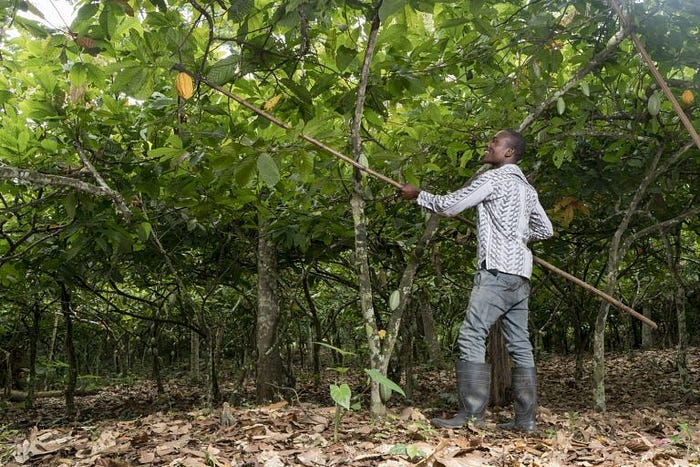
Agroforestry is helping to revitalise degraded cocoa plantations in West Africa for example.
Anthropocene: the name given by scientists to the era — estimated to have begun near the late 1950s — when the impact of one single species — humans — determined the fate of all other life on Earth.
Biomes are global-scale zones, generally defined by the type of plant life that they support in response to average rainfall and temperature patterns. For example, tundra, coral reefs or savannas.
Biomimicry: is an approach to innovation that seeks sustainable solutions to human challenges by emulating nature’s time-tested patterns and strategies. Founded by the awesome Janine Benyus, the Biomimicry Institute seeks to promote and develop design and social innovation according to the principles of nature.


A famous piece of biomimicry design were the ultimately-banned Speedo sharksin swimsuits.
Seven fabrics inspired by nature: from the lotus leaf to butterflies and sharks
Biomimicry brings nature and technology together to create exciting new fabrics that are smarter and more sustainable
Bioregion: a debated term. I’ll go for the World Resources Institute definition:
“A bio-region is a land and water territory whose limits are defined not by political boundaries, but by the geographical limits of human communities and ecological systems. Such an area must be large enough to maintain the integrity of the region’s biological communities, habitats, and ecosystems; to support important ecological processes, such as nutrient and waste cycling, migration, and stream flow; to meet the habitat requirements of keystone and indicator species; and to include the human communities involved in the management, use, and understanding of biological resources. It must be small enough for local residents to consider it home.
A bioregion would typically embrace thousands to hundreds of thousands of hectares. It may be no bigger than a small watershed or as large as a small state or province. In special cases, a bioregion might span the borders of two or more countries.

A bioregion is also defined by its people. It must have a unique cultural identity and be a place in which local residents have the primary right to determine their own development. This primary right does not, however, imply an absolute right. Rather, it means that the livelihoods, claims, and interests of local communities should be both the starting point and the criteria for regional development and conservation. Within that framework many other state, investor, and other economic interests must be accommodated.
Bioregionalism is the act of working out how to create a regenerative future in any specific, defined bioregion. Cascadia in Western America is a great example of a bioregional approach to the future (see above map).

In the UK, Bioregional is a not-for-profit consultancy led by Sue Riddlestone which supports towns and cities to develop their own One Planet Living approach to bioregional stability. We also have The Bioregional Learning Centre in Devon which looking at a bioregional strategy for the South Hams.
In the USA, the Capital Institute is bringing together a number of different bioregional initiatives and projects under the Regenerative Communities Network and Hubs.
Blended Finance: according to the OECD, blended finance is the strategic use of development finance for the mobilisation of additional finance towards sustainable development in developing countries. It is a mechanism designed to help deliver the UN Sustainable Development Goals.
Blind Spots: Nora Bateson has something beautiful to say on blinds spots. Blind spots show up as the reflex always to bestow uncritical faith in authorities (including one’s own superiors) and handed-down rules; the other, the quick dismissal of seemingly irreverent assertions. It’s a comfort blanket in times of uncertainty and volatility that we all need to be aware of when working towards a regenerative future.

Buckminster Fuller Institute: again not a piece of terminology, more of a legend. The institute covers just about everything that sits under the umbrella of Design Science Revolution.
Circular Economy: is synonymous with Ellen Macarthur for me. No-one has done more to promote the concept and value of shifting from sustainability to a circular approach to tackling our extractive, wasteful economy. Her Ted Talk still gives me the shivers.
Climate Emergency: thanks to Extinction Rebellion and Greta Thunberg, it seems there is at last some momentum from grassroots to government to recognise that we need radical action yesterday. The resurgence of non-violent activism of the 60s and 70s which served Martin Luther King, marks a new renaissance for resistance to business-as-usual. Long may it glue up the works.

Complexity: I like author Michelle Holliday’s story in The Age of Thrivability and I hope she won’t mind me paraphrasing it here. The wiring on an aircraft is complicated; it would take you a long time to figure out where everything had to go if you didn’t know. But you could study and learn. Put a crew and passengers on a flight, combine it with prevailing weather and you can’t possible predict or work out what might happen on that flight. Even if you studied all the people for years. The system’s behaviour is unknowable because it is complex.
Co-creative collaboration: is what nature does, and its how we should approach the future. Contrary to the most popular interpretation of Darwinism, although competition exists in nature, it’s not quite the dog-eat-dog world of high human finance that we might have been led to think. A great example is the collaboration between sea anemones and clownfish which is also a symbiotic relationship.
Intricate relationship allows the other to flourish : Sea Anemones – AskNature
Of the over 1,000 anemone species that live in the ocean, only 10 species coexists with the 26 species of tropical…
Commons (avoiding the tragedy of): I love Elinor Ostrom’s Governing the Commons — it’s been transformative to my thinking. Elinor Ostrom’s work deals with common pool resource (CPR) management, for which she won a Nobel Prize in economics in 2009. Ostrom outlines a few theories that we typically use to explain why common resource allocation will fail without intervention:
- Prisoner’s dilemma: A game where two individuals do not cooperate, even though they rationally ought to
- Tragedy of the commons: Individuals in the commons act according to their personal interest, thus depleting the resource
- Free-rider problem: Individuals enjoy a benefit without contributing back, because there is no cost associated with doing so
The underlying assumption is that without external intervention, individuals will act selfishly, without regard for collective interests.
Convergence: when the divergent parts of an ecosystem or biological entity or system come together in relationship to form a convergent whole with new characteristics and capabilities.

Daniel Christian Wahl: author of Designing Regenerative Cultures sneaks in at D because although he’s a name not a narrative word, he’s the author of one of the most seminal books on regenerative culture and he can’t be left out! He’s written multiple articles on this platform that are worth exploring.
Divergence: in every living system there are individual parts — for example the cells, organs and systems within our bodies or the different departments and people in an organisation. The more diverse the parts are able to be, the more likely it is that the whole will be adaptable, agile and resilient the system will be.
Doughnut Economics: economist Kate Raworth’s model for a just space for humanity, combining the Stockholm Resilience Centre’s Planetary Boundaries and the UN Sustainable Development Goals. A brilliant framework for creative conversations around innovation for a regenerative future. We need bridges like this that help us to have the dificult discussions we need to have to take us forward.


Duality: could be described in many ways. But here I’ll use binary thinking, the presentation of discussion as black/white, right/wrong.
Ecoliteracy: I’ll leave this one to Daniel Christian Wahl. He says: “Ecoliteracy is the ability to understand the organization of natural systems and the processes that maintain the healthy functioning of living systems and sustain life on Earth. An ecologically literate person is able to apply this understanding to the design and organization of our human communities and the creation of a regenerative culture.” Read more here.
Continue reading A Glossary of Regenerative CultureRegenerative Cultures, Regenerative Economies, and Bioregional Regeneration

Edit of original by Virginie Glaenzer and Daniel Christian Wahl
Some people are starting to talk about regenerative cultures as possible pathways towards a thriving future of people unfolding their unique potential within the context of the communities and regions they help to regenerate — cultures that are healthy, resilient and adaptable.
A regenerative economy goes beyond sustainability and requires local collaboration and solidarity among individuals as co-creative participants.
What Is a Regenerative Culture?
Regenerative cultures are unique expressions of the potential inherent in the people and places of a given bioregion. They add value and health to the nested wholeness from local, to regional, to global in the understanding that human thriving critically depends on healthy ecosystems and a life-supporting biosphere.
In strengthening regenerative economic activities, we need to learn to balance: efficiency and resilience; collaboration and competition; diversity and coherence; and small, medium, and large organizations and needs.
In other words, regenerative economics is an economic system that works to regenerate capital assets, which are assets that provide goods and/or services that are required for or contribute to our well being. We need to recognize the earth as the original capital asset without trying to reduce the intrinsic value of life to only utilitarian value to humanity, nor trying to make living capital convertible to financial capital as that would enable the most dangerous form of enclosure of the remaining ecological commons!
Regenerative leadership is a process [of personal development that aligns] one’s own way of being and actions with the wider pattern of life’s evolutionary journey within the communities, ecosystems, biosphere and Universe [we participate in].
As Janine Benyus has said so succinctly: “Life creates conditions conducive to life.” Regenerative Cultures aim to emulate this insight in how we relate to the human family and all life.
What Are the Challenges?
Our challenge is to free ourselves from the mindset of scarcity and competition and step into co-creating a future of shared collaborative abundance for all of humanity and the community of life.
One crucial aspect of this transition is to understand the limitations of the narrative of separation that has informed our understanding of who we are for too long and reconnect with our fundamental interbeing with the very fabric of life that our common future depends upon.
Regenerative Leadership
Transforming the human presence and impact in Earth
Regenerative leadership can no longer be about positioning your company as a market leader, celebrated for having some positive impact on society. It starts by leading our own lives regeneratively in service to our communities and to the wider community of life.
Can regenerative economics & mainstream business mix?
Or, is it even possible to create regenerative businesses in a degenerative economic system?
What Are the Principles?
Capital Institute, a non-partisan think-tank launched in 2010 by former JPMorgan Managing Director [until 2001], John Fullerton, is searching for a new narrative. The people working with the institute draw insights from modern science and are grounded in timeless wisdom traditions. Fullerton suggested 8 guiding principles:

1. In Right Relationship
2. Views Wealth Holistically
3. Innovative, Adaptive, Responsive
4. Empowered Participation
5. Honors Community and Place
6. Edge Effect Abundance
7. Robust Circulatory Flow
8. Seeks Balance
One of the core principles of a regenerative culture is to co-create shared meaning by supporting indidvdiual and collective capacity for shifting from competitive to collaborative systems. Regenerative cultures are about “co-evolving mutuality” (Regenesis Group) between people and within the community of life.
How Does One Get Started?
Take a look at the World Future Council’s and Herbert Girardet’s work on the transition from “petropolis” to “ecopolis” through the creation of regenerative cities nested within their bioregion.
Ecologically informed urban and regional planning
Everything that is white in the winter should be green in the summer. Everything that gets rained on, everything under…
Regeneration International maps regenerative agriculture projects around the world and aims to support the transition towards regenerative land management practices and a regenerative food system.
There are events happening around the world such as Regeneration 2030 or The Regenerative Business Summit, where many of the global experts on regeneration will come together to explore how we can deliver well-being and shared prosperity on a healthy planet. You are invited to be part of it, in person or online.
What Questions are being Raised?
We have to admit that capitalism is broken and structurally degenerative, and understand that redesigning the human presence and impact on Earth will go hand in and with re-localization and re-regionalization supported by global collaboration and solidarity.
By daring to ask deeper questions we begin to see the world differently. As we engage in conversation about such questions, we collectively begin to contribute to the emergence of a new culture.
- How do we create an economy with its operations based on cooperative relationships?
- How would a regenerative economy nurture the entrepreneurial spirit and enable empowered participation?
- How can we ensure that the economy promotes robust circular flows?
Questions more than answers can guide us as we choose a wiser path into an uncertain future. That is why Daniel Wahl’s book ‘Designing Regenerative Cultures’ has more than 250 questions in it. Consider them a place to start!
—
If you like the post, please clap AND remember that you can clap up to 50 times if you like it a lot ;-)!
Daniel Christian Wahl — Catalyzing transformative innovation in the face of converging crises, advising on regenerative whole systems design, regenerative leadership, and education for regenerative development and bioregional regeneration.
Author of the internationally acclaimed book Designing Regenerative Cultures
Free Will Astrology: Week of August 4, 2022
AUGUST 2, 2022 AT 7:00 AM BY ROB BREZSNY (newcity.com)

Photo: Nixx Studio
ARIES (March 21-April 19): Aries poet Ada Limón advises us to notice and love “the music of the world.” She says that praising and giving attention to the good things “are as important and necessary as witnessing and naming and holding the grief and sorrow that comes with being alive.” This is always a crucial principle to keep in mind, but it will be extra essential for you in the coming weeks. Your ability to attract the influences and resources you need most will thrive if you focus on and celebrate the music of the world. PS: I encourage you to sing more than usual, too.
TAURUS (April 20-May 20): Here’s my hope for you in the coming months: You will cultivate a specialty for connecting people and situations that need to be affiliated but aren’t yet. You will regard your flair for blending as a gift you offer generously. Can you picture yourself doing that? I think it will be fun and will also benefit you in unexpected ways. So here’s my proposed plan: Conspire to heal fragmentation and schisms. Unite heavenly and earthly things. Keep the far side and the near side in touch with each other. Never let the past forget about the future, and vice versa. One more thing, Taurus: Be gleefully imaginative as you mix and conjoin and combine.
GEMINI (May 21-June 20): In a play by Gemini philosopher Jean-Paul Sartre, a character says, “Hell is other people.” What did he mean by that? One interpretation is that our fellow humans always judge us, and their judgments rarely align with who we really are and who we imagine ourselves to be. Here’s my solution for that problem: Choose allies and companions whose views of you match your own. Is that so hard? I suspect it will be easier than usual for you in the coming months, Gemini. Take advantage of life’s natural tendency to connect you with cohorts who appreciate you. Be picky as you avoid the hell of other people.
CANCER (June 21-July 22): The people most likely to succeed as entrepreneurs are those with a high degree of analytical intelligence. Right? Well, it’s more complicated than that. Reasoning ability and problem-solving skills are key skills, but not as important as emotional intelligence: the power to understand and manage feelings. I mention this, Cancerian, because the coming months will be a favorable time to advance your ambitions by enhancing and expressing your emotional intelligence. Here’s some reading to foster your powers:
1. tinyurl.com/EmotionSmarts
2. tinyurl.com/SmartFeeler
3. tinyurl.com/WiseFeeler
4. tinyurl.com/BrightFeeler
LEO (July 23-Aug. 22): In the coming weeks, Leo, I urge you to always be confident that YOU ARE THE PARTY! Everywhere you go, bring the spirits of fun and revelry. Be educationally entertaining and entertainingly educational. Amuse yourself by making life more interesting for everyone. At the same time, be kind and humble, never arrogant or insensitive. A vital part of your assignment is to nourish and inspire others with your radiance and charm. That formula will ensure you get everything you need. I foresee bounty flowing your way! PS: Regularly reward your admirers and followers with your magnanimous Cheshire-cat grin.
VIRGO (Aug. 23-Sept. 22): In my Astrological Book of Life, here’s what I have inscribed about Virgos: You may not always find the perfect solution, but you are skilled at finding the best solution available. This will be an especially valuable knack in the coming weeks, both for yourself and others. I trust you will scan for practical but compassionate answers, even if they are partial. And I hope you will address at least some of everyone’s needs, even if no one is completely satisfied. You can be the master of creative compromise that we all need. Thanks in advance for your excellent service!
LIBRA (Sept. 23-Oct. 22): Everyone knows that “balance” is a keyword for you Librans. However, there are many interpretations of what balance entails. Here’s how I define it for you during the coming weeks: 1. an openness to consider several different ways to capitalize on an opportunity, but to ultimately choose just one way; 2. the ability to see and understand all sides of every story, while also knowing that for pragmatism’s sake you must endorse a single version of the story; 3. the capacity to be both constructively critical and supportively sympathetic; 4. the facility to be welcoming and inviting while still maintaining healthy boundaries.
SCORPIO (Oct. 23-Nov. 21): “Life is enchanting for me because I have so much control over what I think,” my Scorpio friend Daria told me. “If I decide to flatter myself with comments about how attractive I am, I can do just that. If I would like to imagine a good fairy visiting me while I sleep and giving me a dream of having an orgasm with my lover while we fly over the Serengeti Plains, I can.” I asked her about the times when worries gush forth unbidden from her subconscious mind and disturb her joy. She said, “I simply picture myself shoving those worries in a hole in the ground and blowing them up with an exploding rose.” I bring Daria’s mind-management expertise to your attention, Scorpio, because the coming weeks will be an excellent time for you to raise your mastery over what you think.
SAGITTARIUS (Nov. 22-Dec. 21): People might impatiently advise you to relax and settle down. Others might tell you to stop dreaming such big visions and formulating such adventurous plans. Still others might give you the side-eye because they imagine you are having too much fun and brainstorming too wildly and laughing too loudly. If you receive messages like those, give the complainers a copy of this horoscope. It will tell them that YOU WILL NOT COMPLY WITH ANY INHIBITING DIRECTIVES. Your astrologer, me, authorizes you to be as vast and venturesome and enterprising and spontaneous as you dare. In doing so, I am speaking on behalf of the cosmic rhythms. Your plucky audacity has been heavenly ordained.
CAPRICORN (Dec. 22-Jan. 19): In accordance with astrological omens, I hereby authorize you to worry, worry, and worry some more. Stew and simmer and ferment as you weigh all the options and mull the correct actions. But when the time is right, end your fretting with crisp decisiveness. Shake off any residual doubt that still clings to you. And then undertake robust action to transform the situation that provoked your righteous brooding. In my astrological opinion, what I have just described is your best plan for success in the coming days.
AQUARIUS (Jan. 20-Feb. 18): “I was looking for a love unlike my parents’ love or my sister’s love or the love on a foreign kitchen floor,” writes Rebecca Dinerstein Knight in her novel “The Sunlit Night.” “I wanted to forgive my mother and father for their misery and find myself a light man who lived buoyantly and to be both his light and his dark.” I offer you her thoughts, Aquarius, in the hope of inspiring you to expand and deepen your ideas about the love you want. The coming weeks will be a favorable time to revise and reinvigorate your definitions of intimacy and togetherness. You will have extra power to see new truths about how best to create maximum synergy and symbiosis.
PISCES (Feb. 19-March 20): “Even raw and messy emotions can be understood as a form of light, crackling and bursting with energy,” writes Jungian psychoanalyst Clarissa Pinkola Estés. For example, “We can use the light of rage in a positive way, in order to see into places we cannot usually see.” Likewise, confusion might be a healthy sign that a long-held misunderstanding is dissolving. Disappointment may herald the demise of an unrealistic expectation. So let’s unleash a big cheer for raw and messy emotions, Pisces! I suspect they will soon be your gateway to clarity and renewal.
Homework: Ask for something you’ve never had the clarity or chutzpah to ask for until now. Newsletter.FreeWillAstrology.com
How to complete an impossible challenge
There’s no need to hide under the bed covers – with the GOD principle you’ll be able to achieve your goals, big or small
by Kevin Dutton & John Collins
Distant dreams. Photos supplied by the authors, except where noted otherwise
Kevin Duttontwo spent decades as a research scientist at the universities of Oxford and Cambridge before recently taking up the post of Australia’s first Professor of the Public Understanding of Psychology at the University of Adelaide. He is a bestselling author, elite performance consultant, and co-hosts the podcast Psycho Schizo Espresso with Iron Maiden frontman, Bruce Dickinson. He can be found on Twitter @TheRealDrKev
John Collinsis a British rower, double Olympic finalist, World Championship medallist and two-time World Cup Winner. He is captain of Leander, the most successful sports club in the world (when measured in Olympic medals). He found rowing through taking up the Duke of Edinburgh award as a kid. He lives in Reading, UK.
Edited by Christian Jarrett
2 August 2022 (psyche.c0)
Need to know
Whether it’s moving house, planning a wedding or putting together a killer pitch to land a major client, how many times have you found yourself faced with a task that seems so overwhelming that your brain freezes in blind panic? It’s surprisingly common. The reason is simple. When you’re presented with a big, complicated ask, your brain gets caught in the dazzling cognitive headlights of competing demands and deadlines. Instead of focusing on what you need to do, the temptation is to find comfort or distraction. You reach for a bar of chocolate or a leisurely trawl through Instagram – as if that will put things right.
Just like our prehistoric ancestors would’ve competed for limited physical resources, so the threat of psychological scarcity – not enough time, not enough energy, too many things to do – triggers a similar fight-or-flight response in our contemporary brains, which often results in the modern-day equivalent of freezing … procrastination. We buy something else we don’t need off eBay. Scroll through our Twitter feed. Or catch up with friends on Facebook. Again.
So, if Insta, TikTok and Netflix don’t cut it, what should you do when you’re faced with a task of seemingly impossible magnitude? The answer is, turn to GOD!
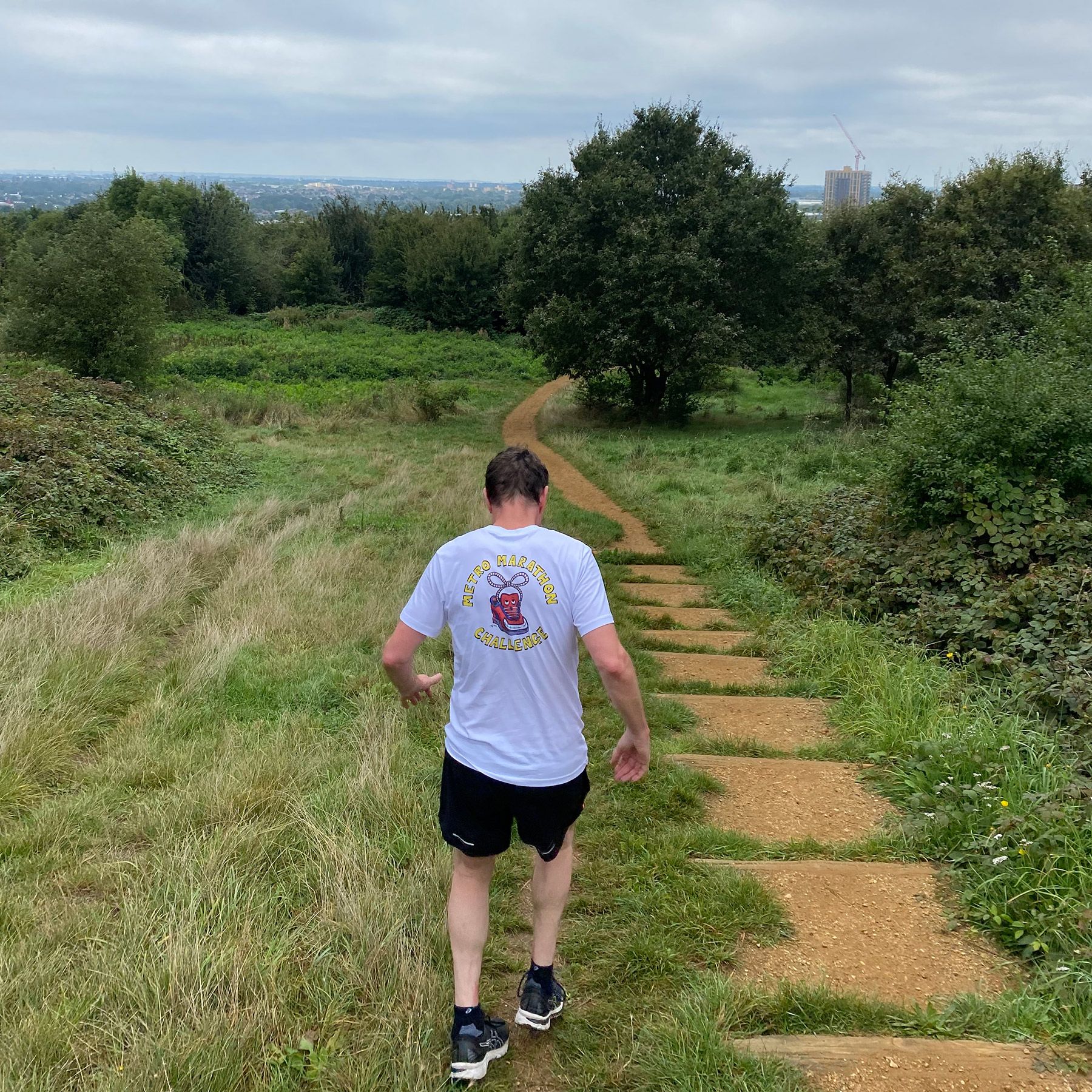
Back in September 2021, we embarked upon a challenge that everyone, including ourselves, thought was totally bonkers. The Metro Marathon Challenge involved navigating all 317 London Underground stations on foot in two weeks, sleeping rough on the streets of the capital for the duration, then running the London Marathon. You know you’re up against it when the world’s greatest living explorer, Ranulph Fiennes, offers words of encouragement! ‘The Metro Marathon Challenge requires that old-school Special Forces combination of guts, preparation and endurance,’ Fiennes observed. ‘I wish Kev and John the very best of luck. By God, they’re going to need it.’ The former Special Forces soldier turned bestselling author, Andy McNab, was similarly circumspect. ‘The Metro Marathon Challenge is eccentric, original … but genuinely bloody hard,’ he commented. ‘Fifty-fifty in my book whether Kev and John manage to pull it off.’ We did. And when we crossed the finish line just under four hours later, we became the first people in history to navigate the entire metro system of a major city on foot in one go. Mission accomplished.

But it wasn’t easy. The success of the venture depended in no small part on our strict adherence to an omnipotent code of psychological conduct that we call the ‘GOD Principle’. ‘GOD’ stands for guts, organisation and determination, and with GOD on your side, we believe you can achieve pretty much anything you set your mind to in life, no matter how big or how small it might be.
In this Guide, we’ll examine each component of this all-conquering cognitive triad to see precisely how they all contributed to the success of the Metro Marathon Challenge… and how you too can deploy them in the face of any major challenge in your own life.NEED TO KNOWWHAT TO DOKEY POINTSLEARN MORELINKS & BOOKS
What to do
Find your ‘why’
The German philosopher Friedrich Nietzsche wrote in his classic work Die Götzen-Dämmerung (1889), or Twilight of the Idols: ‘He who has a “why” to live for can bear almost any “how”.’ We believe in the power of our psychological approach, which we’ll come to next, but if the ‘why’ isn’t there – if your task lacks vision or your mission an underlying purpose, then even GOD will be hard pushed to help you.
The Metro Marathon Challenge was a serious undertaking devised by Kev for a correspondingly poignant reason. A long time ago, a random conversation with a homeless man under a bridge one night had had a profound influence on Kev’s life. When news reached Kev that this man had died on the streets during the pandemic, it affected Kev greatly and he wanted to do something, not just as a mark of respect, but also as a token of appreciation for the time he’d spent with him that particular night. If we could raise a bit of cash in the process and, in some small way, shine a spotlight on the problem of homelessness, then so much the better.
The power of purpose can be seen all the time in sport. In 1990, a few weeks before the boxer Buster Douglas orchestrated one of sport’s biggest ever upsets by handing the formidable Mike Tyson his first professional defeat, Douglas’s mother had died. The fight wasn’t all plain sailing. In the eighth round, Tyson floored Douglas with an explosive uppercut – and usually, when Tyson did that to an opponent, they stayed put.
Not this time.
As he lay there on the canvas, in a world of pain and confusion, Douglas suddenly remembered the promise he had made to his mother at her funeral just 23 days before the fight.
‘Mum,’ he’d said. ‘One day I’ll be the heavyweight champion of the world!’
The rest is history. Douglas staggered to his feet, weathered the storm, and two rounds later knocked out Tyson with a devastating punch of his own to claim the title.

Who knows what Tyson’s ‘why’ was that night? But, whatever it was, chances are that Douglas’s was bigger – and that it was this that afforded him his remarkable, Rocky-style, against-all-the-odds victory.
Of course, if your ‘why’ is bigger than your opponent’s, then all well and good. But if it’s bigger than you, even better.
Guts – attack the challenge
The first component of the GOD Principle was once summed up by the celebrated Second World War US general George Smith Patton Jr in four words: ‘When in doubt, attack.’ More recently, the late, great Australian cricketer and spin-ball wizard Shane Warne reprised Patton in six words: ‘If in doubt, attack every time.’
In the final weeks of our preparation for the Metro Marathon Challenge, one of us (Kev) favoured delaying the start for a couple of months. He was concerned he hadn’t done enough training. John disagreed. He pointed out that few athletes sit or stand on the start line of an Olympic final feeling 100 per cent ready for what lies ahead. There’s always an element of doubt; a feeling that one hasn’t quite done enough to see the job through. At such crunch times, John observed, you simply have to back yourself. You have to take your first stroke, take your first step, play your first shot.
In short, you need to have the guts to attack the challenge.
There are two scientific-backed reasons for ‘attacking’ an apparently impossible task. The first centres on unconscious processing: getting started early on a task fires up your brain to continue working on it even when you’ve downed mental tools for the day, and this in turn can start to make the challenge feel more familiar and less daunting.
These processes were explored in the early 1900s when the Gestalt psychologist Kurt Lewin described an observation he’d made at a restaurant to one of his graduate students, Bluma Zeigarnik. Lewin had noticed that a waiter seemed to have a better memory for orders that were still to be paid for than he did for orders where the bill had already been settled.
Intrigued, Zeigarnik looked into it… and discovered that the waiter wasn’t alone in his enhanced ability to remember unpaid food orders. In fact, the eponymous ‘Zeigarnik effect’ occurs when tasks or activities that have been interrupted – or are still underway – are more easily recalled than those that have been completed. This effect means that the earlier you start any challenge, the more your brain can work on it when you’re not – and, moreover, the less scary it gets as familiarisation grows.
This latter observation is known as the ‘mere exposure effect’ or the ‘familiarity principle’, a phenomenon first demonstrated in the 1960s by someone not far from Zeigarnik in the biographical dictionary, the social psychologist Robert Zajonc. In short, when we have already encountered something, it makes it easier for us to think about it in the future, and this facility usually generates more liking. It’s why we tend to like a song more the second and third times we hear it – and why, to return to our original point, the very act of starting a task inadvertently makes it easier to complete.
A year from now you’ll be glad you started today, someone once said. Hopefully that sounds familiar.
The second scientific reason why ‘now’ is better than ‘later’ has to do with stress management and self-preservation. Research shows that the longer you put off an unpleasant task or event, the more negative the experience eventually becomes overall. In one study, in which participants were given the choice of receiving a strong electric shock immediately or a milder shock later, they opted, 70 per cent of the time, to ‘get it over with’ now.
Madness? Not at all. People made the calculation that a Level 4 shock received later plus all the anticipatory anxiety amounted, on balance, to a greater negative experience overall than an earlier (thus anxiety-free) Level 6 shock on its own.
So, why don’t we act like those participants when we’re faced with unpleasantly difficult task in ‘real life’, and choose to ‘bring it on’ rather than procrastinate?
We believe it’s because, in the research, a ‘decision’ was all that was needed. Once people had made it, nothing more was required of them. In contrast, when we put off stuff at work, we do so as much through inertia than anything else. Once you’ve made the decision to act… you then have to act.
Get going in two steps – initiation and execution
How can you make it easier for yourself to face your fears head-on now and nip anxiety in the bud? The answer is surprisingly simple:
- First, be specific about your intention to start whatever it is that needs doing.
- Second, you need to stick to it.
Never set fuzzy goals – and commit to the goals you do set. The fuzzier they are, the more likely you are to come up with excuses not to do them. So, swap the vague ‘I’ll start the report/pitch tomorrow’ to the specific ‘At 9:30 sharp tomorrow morning, as soon as I sit down at my desk with a coffee, I’m going to begin crafting an exciting intro, explaining the business opportunity, highlighting the underlying business model, and explaining why we can beat the market.’ The clearer the image you have in your mind of what you need to do, the greater your chances of doing it.

Then, when you do settle down at your desk the following morning at 9:30 – and immediately regret the commitment you made the previous day – don’t rely on how you feel at the time but on what you planned earlier. It’s at times like this, when you’re hovering in the doorway of the pain-plane, humming and hawing about the wisdom of jumping out, that you must take comfort in the parachute of science. The landing will be softer than you think.
Organisation – break the challenge into chunks
When I (Kev) was around seven, my dad’s car broke down on the motorway. We pulled over on the hard shoulder and started walking to the nearest emergency phone, located in those days at mile-long intervals along the roadside. It was a cold, damp and murky night, and a dense fog encircled us.
Dad took a torch out of the glove compartment and handed it to me. There were no lights on the motorway, and it was impossible to see where we were going, except for those occasional moments of thunderous enlightenment when a huge truck rumbled past, headlights blazing.
I shone the torch directly in front of me into the swirling gloom. The light boomeranged straight back and blinded me. I couldn’t see a thing.
‘Dad,’ I called out, ‘this is hopeless. I can see better in the dark than I can with this.’
I’ll never forget what happened next. Dad turned around, took the torch out of my hand, and shone it onto the ground just a few inches in front of my feet.
‘You don’t need to see a mile up the road,’ he said. ‘All you need to do is put one foot in front of the other. So long as you can see enough to do that, you’ll be OK.’
I could. And I was. And although, in fairness, a car breakdown in the middle of the night on the northern approach to Doncaster doesn’t have much going for it, for me it was a life-changing experience – I learned that breaking a challenge into manageable chunks is a trick worth mastering. This is the ‘organisation’ component of the GOD Principle.
OK, we admit, this is not an insight of earth-shattering originality. The venerable Chinese philosopher Lao Tzu, to take just one ancient thinker, beat us to the punch by some 26 centuries when he observed that a journey of 1,000 miles begins with a single step. A little more recently, there’s the psychological research on chunking – a tried-and-tested cognitive strategy aimed at conserving focus and preserving willpower by dividing up larger tasks into smaller, rewarding, bite-size phases.
Crucially, chunking doesn’t just make challenges seem easier, it also aids motivation. Back in 2012, the psychologist John Salamone at the University of Connecticut led a study that helps explain why. He placed rats in a cage with two piles of food. The path to one of the piles was easy. Whereas the other, to a pile twice as large, was obstructed by a small barrier. Before letting the rats loose in the cages, Salamone adjusted dopamine levels in their brains.
His discovery challenged preconceptions about the fiendish neurobiology of our reward circuitry. The rats with lower levels of dopamine (often misleadingly referred to as the ‘pleasure molecule’) invariably chose the easier, unobstructed path to the single portion of food. But those with higher levels of the neurotransmitter braved the difficult route, opting to first jump over a small interposing fence to feast on a double helping.
Salamone concluded that dopamine arguably has less to do with pleasure – as had previously been thought – and more to do with drive, incentive and interest: with the cost-benefit analysis of engaging in particular activities. Dopamine wasn’t the ‘pleasure’ molecule. It was the ‘motivation’ molecule.
So where can you come by this elixir of industry? The answer lies in the anticipation of progress and achievement. Whenever you expect to get something right – whenever you make a prediction that turns out to be correct, or you see the chance to accomplish a challenge – the brain celebrates by pouring a shot of dopamine, fuelling your motivation, and then chugging it back when things work out, giving you the sweet high of achievement. Any excuse will do. From figuring out a joke, to drawing up that knockout marketing plan to, yes, you guessed it, finally completing the Metro Marathon Challenge is cause for celebration in the brain’s social calendar.
A dopamine ‘hit’ is basically your prefrontal cortex in party mode. It’s the brain treating itself to a drink for acing it. That’s why video games are so addictive – and why, if you want to get the best out of yourself, you need to think about turning your life into one.
The games are structured and organised into various phases and stages that dole out frequent feel-good feedback based on incremental progress. They chunk big, faraway, superordinate goals – finishing the game – into smaller, proximal, more immediate goals: reaching the next level. They keep your cognitive flashlights trained firmly on the ground in front of you.
Rome wasn’t built in a day. But it was built a day at a time.
Continue reading How to complete an impossible challengeUkraine: Life Under Russia’s Attack | FRONTLINE
FRONTLINE PBS | Official Aug 2, 2022 A dramatic and intimate look inside the Russian assault on Kharkiv, told by the people living through it. This journalism is made possible by viewers like you. Support your local PBS station here: http://www.pbs.org/donate. When Russia began its attack on Kharkiv, Ukraine’s second-largest city, in February of 2022, many people expected the city to fall in days. But the Ukrainians refused to surrender. Now, a new FRONTLINE documentary tells the story of the battle for Kharkiv through the experiences of those who stayed in the city, despite the ever-present threat of the war. Filmed during the first three months of the war, the documentary chronicles the experiences of people living through Russia’s attack: the displaced families trying to survive underground; the civilians caught in the fight; and the first responders risking their lives to help others. “Ukraine: Life Under Russia’s Attack” is a Basement Films production for GBH/FRONTLINE in association with Channel 4. Filmed, produced and directed by Mani Benchelah and Patrick Tombola; produced in Ukraine by Volodymyr Pavlov; directed in London by Teresa Smith. The editor is Agniezska Liggett. The production manager is Leah Downs. The executive producers are Ben de Pear, Edward Watts and Cate Blanchett. The executive producer and editor-in-chief for FRONTLINE is Raney Aronson-Rath.
(Contributed by Michael Kelly, H.W.)
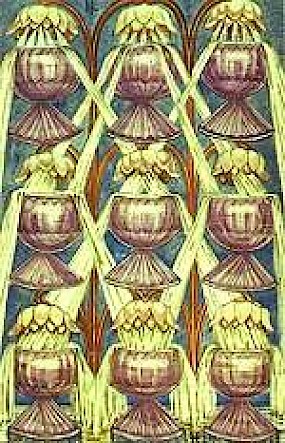
Tarot Card for August 4: The Nine of Cups
The Nine of Cups
This is a lovely card, known as Lord of Happiness. It talks about a sense of inner fulfilment and bliss, which radiates outward to touch everybody with whom you come into contact.
At a spiritual level, we’re talking about inner harmony, contentment and tranquillity – an appreciation of the High Powers, feeling at one with the Universe. This feeling leads to feeling that we are blessed by life.
On an everyday level, the card will often come up to mark periods of high achievement, and the resulting sense of pleasure and satisfaction. It will also come up to acknowledge joy and happiness in an emotional relationship.
When this card appears in your reading, it’s important to make the time to simply enjoy your own feelings, to revel in your sense of calmness and joy.
(via angelpaths.com and Alan Blackman)