Is everything connected? Can we sense what’s happening to loved ones thousands of miles away? Why are we sometimes certain of a caller’s identity the instant the phone rings? Do intuitive hunches contain information about future events? Is it possible to perceive without the use of the ordinary senses?
Many people believe that such “psychic phenomena” are rare talents or divine gifts. Others don’t believe they exist at all. But the latest scientific research shows that these phenomena are both real and widespread, and are an unavoidable consequence of the interconnected, entangled physical reality we live in.
Albert Einstein called entanglement “spooky action at a distance” — the way two objects remain connected through time and space, without communicating in any conventional way, long after their initial interaction has taken place. Could a similar entanglement of minds explain our apparent psychic abilities? Dean Radin, senior scientist at the Institute of Noetic Sciences, believes it might.
In this illuminating book, Radin shows how we know that psychic phenomena such as telepathy, clairvoyance, and psychokinesis are real, based on scientific evidence from thousands of controlled lab tests. Radin surveys the origins of this research and explores, among many topics, the collective premonitions of 9/11. He reveals the physical reality behind our uncanny telepathic experiences and intuitive hunches, and he debunks the skeptical myths surrounding them. Entangled Minds sets the stage for a rational, scientific understanding of psychic experience.
Profiled in the NY Times Magazine, Dean Radin is perhaps the most respected parapsychologist in the country. An articulate, engaging communicator, he wields impeccable credentials, a healthy skepticism & a meticulous scientific method to put psi phenomona like telepathy, clairvoyance, precognition & psychokinesis to hard scientific tests. His manifesto makes a persuasive case for the truth of psychic phenomena & places us on the cusp of what may well be the next great paradigm shift. Uniting the latest in high-tech experiments, including irrefutable data from his own groundbreaking research, with teachings of mystics & theories of quantum physics, he explores myriad phenomena from ESP to ghosts to psychokinesis. He reveals the remarkable extent to which psi is already tacitly acknowledged & exploited by Fortune 500 corporations & government, then analyzes how the inevitable mass acceptance of the mind-matter link will affect social, economic, academic, health & spiritual issues. At once visionary & pragmatic, The Conscious Universe recalls Godel, Escher, Bach & The Holographic Universe, yet transcends mere experiments to offer a bold vision.
Everyone knows that sub-atomic particles have some very strange qualities. Light sometimes behaves like a particle, sometimes like a wave. Objects separated by vast distances interact faster than the speed of light – what Einstein called ‘spooky action at a distance’. Most strangely, the behaviour of objects somehow seems be determined in retrospect, depending on what the observer is looking for. In this ground-breaking work the authors show how these quantum properties are being observed in larger and larger objects. They set out carefully and cautiously exactly what quantum theory might mean for us. Quantum physics presents an unanswerable challenge to our common sense understanding of the universe, and the final explanation might not come from physics at all, but from the equally strange world of cognitive neuro-science – the mysteries of mind and matter might be one and the same.
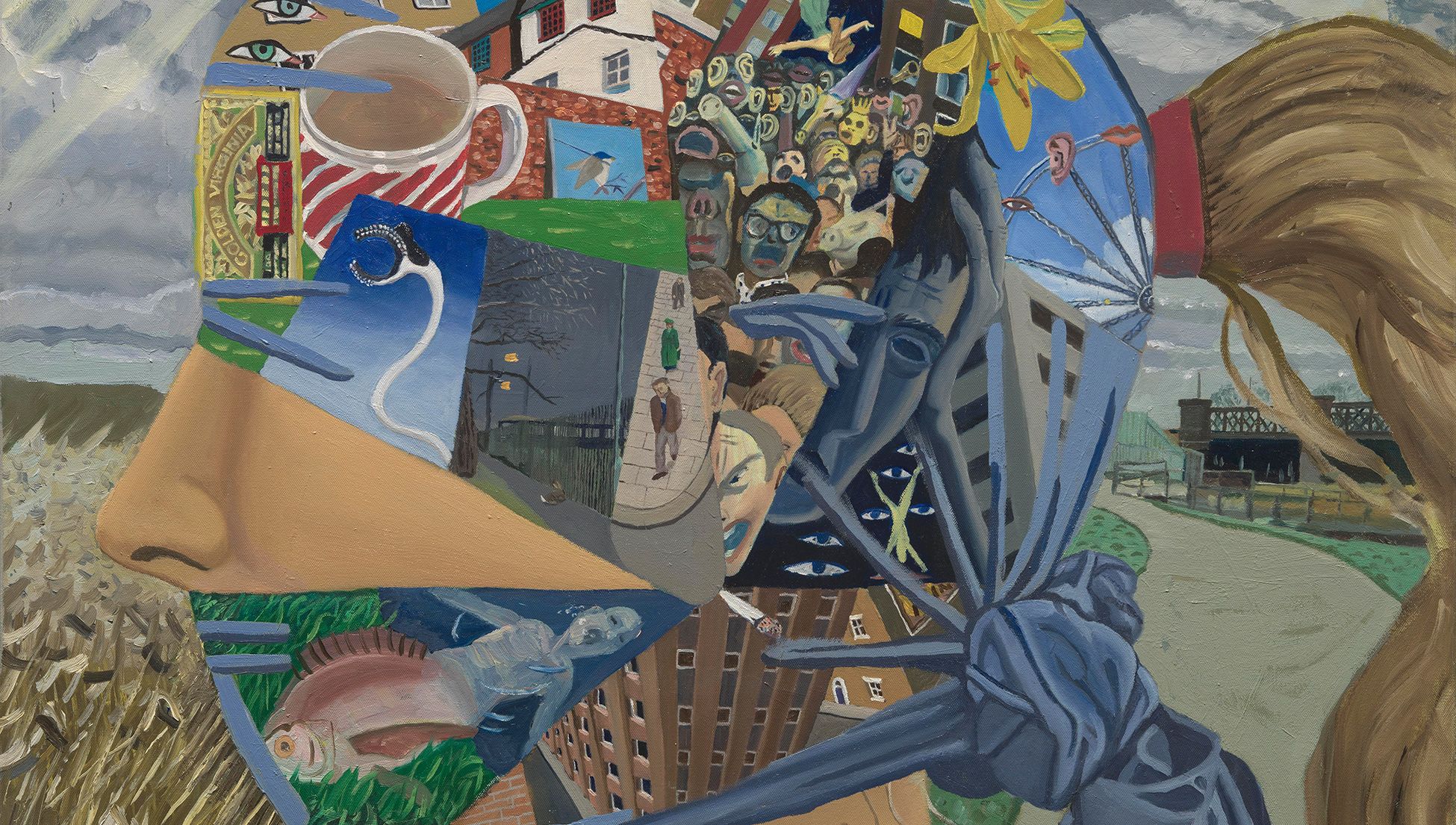
Fish Schizophrene (c1986) by Bryan Charnley, an artist with first-hand experience of the devastating effects of schizophrenia. Image courtesy the Wellcome Collection
Henry R Cowan is a PhD candidate in psychology at Northwestern University in Illinois and a clinical psychology intern at the Ohio State University.
What would you say if I asked you to tell the story of your life? If you are like the thousands of people who have participated in life stories research around the world, you could probably tell a pretty good story about where you came from, how you became the person you are today, and where you are headed in the future. You might talk about your childhood experiences, your education or career, significant challenges or accomplishments, important relationships, or themes that connect your experiences together.
Here are a few things you probably would not say:
‘… what scared me the most was a sense that I had lost myself …’
‘I couldn’t relate to the world around me, as my reality became increasingly fractured and confused.’
‘My illness eradicated my sense of self, and now I am engaged in the lifelong process of obtaining, maintaining and slowly modifying my sense of who I am.’
These are excerpts from the stories of people living with schizophrenia, a psychotic disorder that can include delusions (strongly held beliefs that do not seem to fit reality), hallucinations (seeing, hearing or feeling things that are not there), disorganised thought and speech, loss of motivation, blunted emotional expression and social withdrawal. Schizophrenia is a rare but serious mental illness. Although it affects fewer than one in 100 people, schizophrenia’s worldwide disease burden, in terms of years lived with disability, is roughly equal to that of Alzheimer’s disease and alcohol abuse combined. This is because schizophrenia is a chronic, disabling condition that manifests early in life – it is commonly diagnosed between late adolescence and the early 30s.
Our life stories help us to define and communicate who we are as people
When asked to tell their life stories, people with schizophrenia tend to tell unusual ones. First, the basic chronology of the life story is shifted. Most people experience a ‘reminiscence bump’ in early adulthood, with many personally significant and relatively well-remembered events occurring between ages 15 to 30 (and especially between ages 20 and 24). For instance, we might form memories of graduating college, getting a first job, or starting or ending significant romantic relationships. These events become centrepieces of our life stories, defining who we are for decades to come. However, schizophrenia causes profound disruptions during these same years. People diagnosed with schizophrenia often become unable to care for themselves, lose valued roles and relationships, and undergo treatment. These experiences seem to curtail the reminiscence bump: rates of personally significant memories might steadily increase in the teenage years, then drop sharply following a diagnosis of schizophrenia.
People living with schizophrenia also tend to include unusual kinds of experiences in their life stories, focusing on psychotic episodes, hospitalisations and traumatic events. Their life stories might even include vivid, emotionally intense experiences of psychotic symptoms themselves – for instance, vivid memories of being spied on, conspired against or chosen by God to save the world.
In short, people with schizophrenia tell unusual life stories about unusual kinds of personal experiences. But why do these stories matter? How might they impact mental health and wellbeing? And how might they change through treatment and recovery?
At the most basic level, these stories matter because many people living with schizophrenia want their life stories to be heard. As Robert Bayley, a musician and author who has lived with schizophrenia for the past 40 years, has explained: ‘It is often forgotten that there is a person behind the condition, with a fundamental need to be understood … We must be seen as individuals and not regarded as just a collection of symptoms.’
Psychological research also shows that, generally speaking, our life stories help us to define and communicate who we are as people. For example, imagine a middle-aged man – let’s call him David – who tells you a story about his difficult experience growing up in a poor neighbourhood, how it opened his eyes to the hardship that children face living in poverty, and how it motivated him to pursue a tough but fulfilling career in social work.
People with schizophrenia often describe a sense of getting profoundly lost in their own experience
Do you feel like you got to know David’s personality, at least a little bit, from hearing this very rough outline of his story? If you did, you might be noticing some of the relevant psychological features of personal storytelling. Importantly, these features have less to do with the content of the story and more to do with how the story is told.
David’s story, for instance, was clearly structured with a beginning, middle and end. It moved from painful beginnings toward positive emotion and agency. And David found meaning in his life story by connecting his past experiences to his present-day identity as a social worker. Psychologists who study narrative identity, or the ways in which we tell our life stories, might say that David expresses strong narrative structure, the motivational and affective theme of redemption (a movement from negative beginnings to a positive ending), and deliberate autobiographical reasoning to make sense of his past experiences.
These dimensions of narrative identity are interwoven with psychological wellbeing. Research has found that narrative identity variables, including redemption, are associated with wellbeing even when accounting for other relevant factors (such as income, personality traits and psychiatric diagnoses). In some cases, changes in narrative identity even precede changes in wellbeing: one study found that increases in narrated agency occurred earlier during psychotherapy, followed by improvements in mental health. Personal stories reflect and might even support people’s mental health by helping to give their lives a sense of meaning, purpose, unity and forward momentum into the future.
In contrast, people who experience poor wellbeing or mental illness tend to tell life stories that focus on unwanted emotions, passive responses to life events and alienation from people around them. In schizophrenia, this trend is amplified and reaches into all aspects of personal storytelling, as my colleagues and I outline in a recent review of the research literature. However, unlike most people who struggle with mental illness, people with schizophrenia often also describe a sense of getting profoundly lost in their own experience. While they are in the midst of this instability, they often have difficulty structuring personal stories in a way that listeners can understand. (This is evident in a sample of one person’s description of his childhood: ‘No, that happened there… where my father took out gold, and we were happy, we used to get up early and it was fantastic… cleaning.’)
People with schizophrenia can also have trouble finding meaning in past events or connecting their past experiences to their present identity. Unlike David’s structured, meaningful life story of becoming a social worker, their life stories tend to be more fragmented and painful.
For instance, Janet Stewart, who works on a mental health team in Montreal supporting others with serious mental illness, has nevertheless struggled to find words for her own story of living with schizophrenia:
There’s too much, it’s too big for me: five years of psychosis, the medication change that caused the episode (a medical error), homelessness, emptiness: no connection, no drive, no motivation, no direction, no feelings, just groping in the dark for so many years, no laughter, no joy, no pleasure. Not even any tears. All these thoughts and feelings crowd together, I want to get them all out, but they leave me paralysed …
It’s not just that the life stories of people living with schizophrenia are marked by unusual experiences. Many of these individuals seem to miss out on the potential for coherently structured personal stories to provide meaning to events in their lives.
Yet life stories are living documents. As the years pass, research has found, it’s typical for much of the content of a life story to change. Some people repeat very little of the content of their life stories across subsequent versions. How might the life story change as individuals recover from psychotic disorders?
Recovery from psychosis can be a deeply redemptive personal story
After experiencing a psychotic episode and being diagnosed with a psychotic disorder, people face unique challenges to their personal identities. The symptoms of psychosis, and the general cognitive impairment that typically accompanies psychosis, can make people feel alienated from themselves. At the same time, the loss of roles and relationships and the internalisation of stigma against people with serious mental illness can make them feel disconnected from others. These processes help to explain how their life stories become so painful and fragmented.
But psychosis can also prompt personal growth. Many people diagnosed with psychotic disorders feel that they have learned important things about themselves through the experience of psychosis. As one person put it: ‘The experience answered a lot of questions I had about my identity in life … and gave me a humility in how I look at reality … I like to think it made me a better human.’
I see similar experiences of personal growth in my clinical work in a specialty care programme for early psychosis. Some of the time, our patients need help managing delusions or hallucinations. But much of our time is spent helping our patients to build relationships, get jobs, complete college degrees, live independently and pursue valued goals. Rather than simply treating psychotic symptoms, we help young people build meaningful lives around their psychotic symptoms.
Through this recovery process, people living with psychotic disorders can change their personal stories. In fact, some psychological treatments – notably metacognitive reflection and insight therapy – are designed to support recovery by helping people build more elaborated and integrated understandings of themselves and their life stories. Even when life stories start out disjointed and difficult to understand, clinicians can help people to see themselves as more agentic, connected to others and socially valued by listening and helping to build structure in personal stories.
When people living with a psychotic disorder feel agency and mastery over their lives, they are often able to recover functionally (eg, by living independently, working and maintaining stable relationships) even if they still experience psychotic symptoms. For many people, this is what recovery from psychosis looks like. And it can be a deeply redemptive personal story.
Bayley, the musician and author who reminded us that ‘there is a person behind the condition’, expresses this redemptive arc in his own life story. Despite struggling for decades with his symptoms and enduring frustration with society and the healthcare system, Bayley is not defined by these painful experiences. Rather, he has found ‘some kind of balance’ through art, music and writing. He has published a semi-autobiographical novel and released an album of his original compositions. A loving wife, friends and family, he says, ‘[keep] me as positive as I can be’. Ultimately, he writes, ‘I have been transformed from a vulnerable 16-year-old … to an individual, now 51, who has created works of literature and music, and studied the visual arts … I’ve managed to create a rich amount of work that I’m incredibly proud of.’
Bayley’s story illustrates how people diagnosed with psychotic disorders can live full and satisfying lives. And while they might face unique challenges in constructing and sharing their personal narratives, their stories are individual, complex and rich in potential for personal growth and redemption. They want to tell these stories; we should all be willing to listen.
One of Thane’s Foundation Classes Live/Monitor Zoom Class
Sat/Sun November 6 and 7
Emotional blocks present us with challenges that can lead to the most profound insights. Releasing the Hidden Splendour teaches how to trade in painful or unpleasant feelings for insight and freedom by practicing the Joseph Technique™.
In a practice of loving and thoughtful self reflection we come to release the past and embrace our true heritage of freedom and grace.
Audio with Thane and live instruction by Rick Thomas H.W., M.
Two full days (9 – 5 Pacific) of class on this weekend. Class fees: $150 New to class / $75 Review Class details with Zoom link will be emailed to you.
The man represented by the Knight of Wands will be a loving and open-hearted person, with a strong sense of morality and a great sense of humour. He will be active, energetic and willing to help. You often find these types of men in the healing professions, or in other areas where they are required to assist, guide and support others.
He’s a man with a deep respect for life and all living things, attuned to Nature and to the creatures of the earth. He has a deep well of compassion which spills over readily to anyone who needs his help, but he also has the restraint to know when too much assistance is a bad thing. Then he will act to enable and empower, rather than to assisting.
He’s a faithful, and dedicated family man, being fully engaged in the domestic situation. His life reflects his high ethical standards, though he is not given to sermonising, nor standing in judgement on others. He could be defined as an idealistic realist – accepting the frailties of the race, whilst doing his best to strengthen it.
His faults spring from his good points – for instance, he dislikes causing pain, and will therefore delay when he needs to act if he thinks it will hurt other people. He will sometimes remain in limiting or painful circumstances because of this. His sense of rightness and duty is intense, and sometimes drives him to make foolish choices and decisions. He will shy away from conflict and unpleasant situations, especially when these arise as a result of his own needs, though he will never walk away from a struggle on behalf of somebody else.
If you are regarding this card as a spiritual change, then see it as an indication that the warrior of right and light is required – you’ll need to stand up for something that matters, and which is unable to defend itself.
All scientific facts are inferences of consciousness.
–Dean Radin
New Thinking Allowed with Jeffrey Mishlove Dean Radin, PhD, is chief scientist at the Institute of Noetic Science in Novato, California. He is author of The Conscious Universe, Entangled Minds, Supernormal, and Real Magic. Here he describes a series of personal synchronicities that both troubled him and led him toward a greater appreciation of esoteric forms of magick. He describes the many parallels between the traditions of psychical research and parapsychology and those of magick and the western esoteric tradition. The magical worldview, or philosophical idealism, also offers the possibility of better explaining the empirical findings of parapsychology. He also sees parallels between magickal rituals and parapsychological experiments. New Thinking Allowed host, Jeffrey Mishlove, PhD, is author of The Roots of Consciousness, Psi Development Systems, and The PK Man. Between 1986 and 2002 he hosted and co-produced the original Thinking Allowed public television series. He is the recipient of the only doctoral diploma in “parapsychology” ever awarded by an accredited university (University of California, Berkeley, 1980). He is past-vice-president of the Association for Humanistic Psychology, and is the recipient of the Pathfinder Award from that association for his contributions to the study of consciousness. (Recorded on November 21, 2018) For a complete, updated list with links to all of our videos, see https://newthinkingallowed.com/Listin…. For opportunities to engage with and support the New Thinking Allowed video channel — please visit the New Thinking Allowed Foundation at http://www.newthinkingallowed.org. To join the NTA Psi Experience Community on Facebook, see https://www.facebook.com/groups/19530… To download and listen to audio versions of the New Thinking Allowed videos, please visit our new podcast at https://itunes.apple.com/us/podcast/n…
For as long as you can remember, you’ve had a dream. You’ve longed to see your product idea come to fruition so you never have to work for anyone else again.
Stephen Key has been living this dream for 30 years. The developer of such lucrative products as Michael Jordan s WallBall(r), the Spinformation(r) rotating label, and HotPicks(r) guitar picks, he knows better than anyone how to make a great living as an entrepreneur. Key develops ideas for new products, licenses them out, collects royalty checks, and doesn’t look back. You can do it, too. All you need is “One Simple Idea.”
In this book, Key reveals the secrets that helped him and thousands of his students including bestselling author Tim Ferriss turn their creativity into a passive income generator by renting an idea to a company, which takes care of R&D, production, marketing, sales, accounting, distribution, and everything else you don t want to do.
You ll be amazed at how simple the process of licensing an idea for profit actually is. Key explains how to: Keep your ideas safe without spending time and money on a patent Be your own boss without formally opening a business See your product go to market without footing a dime in expenses Make potentially big money without quitting your day job
The age-old business assumption that ideas must come from within organizations has been shattered. From global corporations to small businesses, companies have become so confident in outside entrepreneurs that licensing is now a $500 billion industry. Businesses need freelancers like Key and you to provide creative, marketable ideas for new offerings.
With “One Simple Idea,” there s no prototyping, no patents, and, best of all, no risk. You can make the system work for you rather than the other way around.”
Lucia Osborne-Crowleyis a writer and journalist. Her news reporting and literary work has appeared in Granta, The Sunday Times and The Guardian, among others. She currently works as a staff reporter for Law360. She is the author of I Choose Elena (2019) and My Body Keeps Your Secrets (2021). She lives in London.
The first time I saw my therapist, she was standing in front of a room full of people, talking about William Golding’s novel Lord of the Flies (1954). It was part of a series of book events on the theme of psychoanalysis and literature, and my therapist was dissecting the emotional and psychodynamic contours of the book, in particular the ending.
The novel concerns a group of English schoolboys whose plane is downed while they are being evacuated from a war that is raging at home: after being stranded on an island for weeks and brought to the brink of murderous despair, they are rescued by a British naval officer on the novel’s final page. But… my therapist was saying, the man represents rescue in only the least meaningful sense of the word. He would save the boys, yes. They would survive. But sometimes that is not enough. When the boys begin to cry, breaking down in front of the adults as they process what happened to them on the island, the naval officer turns away while they compose themselves. He will save them, but he cannot bear to witness their suffering. What does that kind of survival mean?
As soon as my therapist explained why the ending of the book was not a meaningful rescue, I thought: I know what that’s like – the worst effects of my own traumatic history were brought about by my mortal fear of allowing anyone to witness them. I know what it’s like to survive without being seen. To survive, but live forever in hiding. In that moment, I knew that she would not turn away. I emailed her every week following until an appointment slot opened up in her diary.
My therapist practises psychodynamic psychotherapy. That means she specialises in so-called talk therapy, in which the patient guides the conversation. It derives from the Freudian model of psychoanalysis, but it has an extra element, too. Psychodynamic therapists believe that relationships hold the key to many people’s psychological suffering, and so the way the patient relates to others is key to healing. That work begins with the relationship between patient and therapist.
Psychodynamic therapy differs from other talk therapies in using the patient-therapist relationship to explore the patient’s unconscious thoughts and fears, and in allowing the therapist to interject, feeding back how they feel about what the patient is and isn’t saying. A psychodynamic therapist enables the patient to renegotiate their relationships using the therapeutic dynamic as a safe testing ground. This is why, I believe, psychodynamic therapy is often so useful for people who suffer from post-traumatic stress disorder (PTSD). It can help the patient recognise hidden memories associated with the original trauma by showing them how those memories play out inside the patient-therapist relationship.
Abuse survivors are left with a sense that there is something toxic about them that caused another person to treat them badly
Trauma is not cognitive. It is not a set of thoughts, but a set of instincts. The US psychiatrist Robert Jay Lifton writes in Death in Life: Survivors of Hiroshima (1968) that PTSD occurs when a traumatic event leaves a ‘death imprint’ or an ‘indelible imprint’ on the brain. When traumatic memories get stuck in this way, they cannot be rearranged into logical narratives. Instead, they remain trapped in the brain as flashes of an unbearable experience that leak out at the mind’s weakest moments. The part of the brain responsible for separating the past from the present – the hippocampus – becomes dysfunctional and the brain re-enters fight, flight or freeze mode every time it is reminded of the experience, even though there is no longer any danger present.
I suffered from PTSD for 10 years without knowing it, after I was violently raped by a stranger in an abandoned bathroom stall, following years of being sexually abused by a mentor as a young elite gymnast. I never spoke about my rape or my abuse. I thought that, in not telling anyone, I could pretend it hadn’t happened. But it doesn’t work like that. At 17, I started having panic attacks; I stopped sleeping, fell prey to severe bouts of depression. Looking back now, I understand that this was connected to my rape. But at the time, I was committed to ignoring it. I was referred to a cognitive behavioural therapist – a type of talk therapy that tries to identify the person’s unhelpful thought patterns and re-arrange them. I tried CBT for years, but it never helped me, because my conscious thoughts weren’t the problem. What was troubling me was much deeper, more unconscious, than that. What was troubling me was hidden from everyone – even me.
Abuse survivors are left, often without realising it, with a sense that there is something toxic or bad about them, something rotten that caused another person to treat them badly. This was never something I thought. It was something I felt; something pre-rational that I knew in my bones to be true. Because these assumptions are unconscious, they play out in every relationship we form without us knowing it. And because of the intense connection between trauma and shame, we find it very hard to identify the feelings that are symptoms of PTSD because they are, so often, unspeakable.
Until I met my therapist, I had never been able to articulate the worst things I believed about myself. I didn’t think anyone would be able to tolerate how much I hated myself. So instead of articulating these feelings, I spent years and years dissociating from relationships, avoiding intimacy and sabotaging closeness, imagining I’d be abandoned as soon as the other person found out how rotten I truly was. But while dissociation protects us from feeling the overwhelming emotions connected to the traumatic memory – panic, fear, pain – if it is never processed, it numbs all the other emotions, too: connection, love, joy, safety. It is the naval officer in Lord of the Flies, offering rescue but not compassion. Offering survival, but not living.
I was still curating myself for her in order to hide the things I’m ashamed of
Feeling ashamed and dissociated often leads PTSD sufferers to develop intense people-pleasing behaviour. The fear of being exposed as inherently bad addicts us to finding ways to win the approval of others, as if that approval might neutralise the toxic thing inside of us. I have always been this way, people-pleasing my way into what I thought were meaningful relationships. But when you believe you’ve tricked people into liking you by doing things for them, you rob yourself of the ability to feel close to anyone. Every relationship becomes conditional.
Without realising it, I have spent most of my life believing that I have to hide parts of myself in order to be loved. That I have to pretend to be more than I am – more successful, more wanted, more beautiful – because of a deep-seated belief that I am unworthy. Until I met my therapist.
One afternoon in June last year, my therapist brought up the fact that I find an excuse to cancel our session every other week. ‘Something always comes up that you are willing to put our session off for,’ she said.
I stayed silent for a moment, unsure what to say.
‘I think there is a part of you that is still so afraid to be seen clearly by anyone,’ she said.
‘Sustained contact is terrifying to you because it is the most intense form of exposure. The idea that I might catch you on a bad day really frightens you, because it means I will see that sometimes you are grumpy or underslept or resentful.
‘Or,’ she said after a pause, ‘worst of all – when you are unhelpful. When you are angry.
‘You are willing to be seen by me, but only when you feel able to curate yourself first. When you can say smart things and dutifully recount your week and encourage me when I make an observation that is accurate: only when you can be helpful, pliant, pleasant.
‘This way, you are always in control. On the other days, you find an excuse to hide from me. You can’t bear it.’
She was absolutely right. I’ve worked so hard at expelling my shame, but its grip is still suffocating. This woman, the person who knows more about me than anyone ever has, was still being presented with a false version of me. I was still curating myself for her in order to hide the things I’m ashamed of.
The idea that someone cares about me enough to see me clearly, and to feel genuine anger on my behalf, has been life-changing
At first, I panicked when my therapist said this. I felt exposed, which in my mind is linked to danger. But being seen and being bad are not the same thing. My therapist was not criticising me for cancelling our sessions – she was accepting this avoidance as part of my suffering and she was trying to help me. In that room – and only in that room – I believed that I did not have to be perfect to be worthy of love.
Another of my dissociative symptoms is a desperate need to repress feelings of anger. If anger is weaponised against you, you fear it. My rapist was somehow so, so angry with me, even though we had never met before that night, and so he bequeathed me a fear of my own anger; as if, in feeling anger, I might become him, and he me, and I might carry him inside me forever. When anger is adjoined to abuse, it’s frightening. But healthy anger is productive. Anger says: This isn’t working for me. Anger says: I need more than this. Expressing anger requires being willing to be seen, which is why you can express it only when you feel confident that a relationship can contain its emotion and move forward. Since I’d always assumed that my relationships were fragile and weak, and that any moment the other person saw me clearly, they’d leave, I couldn’t risk expressing anger. So I dissociated.
More and more frequently, I was describing situations to my therapist and casting them in the light I’d perfected so well: always framing myself as relatively helpless, anxious, grateful for any scrap of love offered me, and guilty for asking too much. And slowly, she started saying: ‘I don’t actually think you feel grateful, or anxious to please this person. I think you feel angry.’
She was right. At the heart of what I was voicing, somewhere I couldn’t reach, was a story about someone letting me down. Somewhere, buried beneath all my shame, was anger.
‘How did you know?’ I said.
She said: ‘I know because I feel angry. And I think that feeling is coming from you.’
In this moment – which we’ve now repeated many times – is the true beauty of psychodynamic therapy. What my therapist was describing is transference – when the therapist is so intimately attuned to the patient that they can sense an emotion that the patient is unable to consciously express.
I can’t tell you how much that one phrase has changed me: I know because I feel angry. For the first time in my life, my anger could be expressed, because I felt safe enough to feel it in her presence. The idea that someone cares about me enough to see me clearly, and to feel genuine anger on my behalf, has been life-changing. The shift wasn’t about the ways my therapist encouraged me to think. It was about the way she made me feel. She made me feel real. Made me feel safe. Made me feel alive.
Consciousness, spirituality, biography, sexuality, androgyny, futurism, space, the arts, science, astrology, democracy, humor, books, movies and more