
Susy O’Hare IN UTERO is a cinematic rumination on what will emerge as the most provocative subject of the 21st Century – life in the womb and its lasting impact on human development, human behaviour, and the state of the world. Epigenetics, Alice In Wonderland, The Matrix, scientists, psychologists and doctors converge to prove that we are not what we think we are. IN UTERO brings together for the first time convincing data that explains why some of us face challenges from the start while others thrive. Prepare to be surprised, intrigued, but no longer baffled by what the future holds for yourself, your loved ones, and the human race! This film will change everything – IN UTERO…where it all began. I’m organising a screening of this on the 23rd Nov 2017 in Perth. Please go here for more details.
Monthly Archives: June 2021
“The fear of death is the same as the fear of love”
Choose Again A question and answer session with Diederik Wolsak, founder of the Choose Again Society – Recorded live on December 11th, 2013. Visit us on the web at www.choose-again.com
Radical acceptance
The painful feelings you avoid grow twisted in the dark. By facing your sorrows and struggles you can take back your life

Photo by Paolo Pellegrin/Magnum
Joshua Coleman is a psychologist in private practice and senior fellow with the Council on Contemporary Families. His books include The Marriage Makeover (2004), The Lazy Husband (2005), When Parents Hurt (2007) and Rules of Estrangement (2021). He lives in the San Francisco Bay Area.Listen here
Brought to you by Curio, an Aeon partner
14 June 2021 (aeon.co)
Edited by Pam Weintraub
Aeon for Friends
Terrible things can happen. You get diagnosed with an incurable disease. Your accident changes your ability to do the activities that made life fun and meaningful. Your spouse decides that they want someone else. Even if you’re lucky enough to avoid huge life-changing events, you’re going to be faced with disappointments, hurts or humiliations that require you to make sense of the many ways that existence can be painful.
The inevitability of suffering is written into every aspect of our shared past. It has preoccupied philosophers such as Aristotle, Socrates, the Stoics, the Epicureans and the Cynics. Religious leaders have instructed the faithful in the meaning of suffering since humans first conceived of spirits or gods. The belief that our interpretation of events determines our experience of pain was seen in the writings of the 7th-century Buddhist Dharmakīrti and the 11th-century Islamic polymath Ibn al-Haytham. The universality of suffering is made palpable through works of art such as Michelangelo’s unfinished sculpture the Rondanini Pietà (1552-64), or J S Bach’s Chaconne in D Minor (c1710s-20s), to name only a few.
Despite all of that accumulated wisdom and perspective, I am still at a loss for what to say to some of my friends or clients in pain. There isn’t a new body for the woman diagnosed with Stage 4 ovarian cancer. No new spine for my friend who had a severe spinal cord injury from a skiing accident. There are also no straightforward solutions for the parents whose adult children no longer want them in their lives – an area in which I’ve been specialising for the past 15 of my 40 years as a psychologist. It’s not uncommon for such people to ask: ‘Will I die alone in a hospital bed with no children or grandchildren to comfort me? Who will bury me? Will my children even miss me once I’m gone?’
Nobody trained me for these questions, and I’m sure I responded clumsily and ineffectually in the first few years when I began to be flooded with referrals after writing my first book on estrangement, When Parents Hurt (2007). But after working with so many estranged parents over the past 15 years and doing my own research through the University of Wisconsin Survey Center, summarised in my new book Rules of Estrangement (2021), I slowly discovered something important: the more we try to evade or avoid painful realities, the more entangled we become in the tentacles of their embrace.
I found guidance in the research of the psychologist Marsha Linehan, the founder of dialectical behaviour therapy. ‘The path out of hell is through misery,’ Linehan wrote. ‘By refusing to accept the misery that is part of climbing out of hell, you fall back into hell.’ The path out of hell is through misery. What’s that supposed to mean? It means that you have to start by ‘radically accepting’ where you are right now. Radical acceptance means that you don’t fight what you’re feeling in this moment. You feel sad? Feel sad. Don’t judge it, don’t push it away, don’t diminish it, and don’t try to control its passage. Turn toward the feeling rather than turning away from it.
I learnt this lesson the hard way. Part of my interest in estrangement started with my own daughter cutting off contact with me for several years in her early 20s. I had been divorced from her mother for some time, but eventually remarried and had more children, an act that caused her to feel displaced in ways that I hadn’t fully understood until she was an adult. During those terrible years of my estrangement, I found myself daily rehearsing every parental mistake I’d ever made. Tender memories that had seemed impervious to revision became infested with doubt and self-criticism. The times when I knew that I’d been far from my best parenting self were thrust into a torturous spin cycle of ‘If only I hadn’t said that, done that, written that.’ At some point, instead of continuing down this path I thought: ‘Your daughter might never talk to you again. Ever. Last time you saw her? That might be the last time you’ll ever see her. You’re going to have to accept that.’ It wasn’t a harsh or critical voice – more like wise counsel from some censored part of me. And the allowance of that gloomy reality was oddly, paradoxically, reassuring. It helped me to stop fighting something that wasn’t changing. It freed me to be more open to facing the ways that I’d let her down, an act that led to our eventual and blessed reconciliation.
Radical acceptance emphasises the importance of facing our present condition in all of its awful implications. Statements such as ‘This isn’t fair,’ ‘I don’t deserve this,’ ‘This isn’t how it’s supposed to be,’ however true, only heighten our suffering. To use a mundane example, consider being stuck in traffic, a situation where you have little control. It’s tempting to berate yourself for not leaving earlier, for living in a congested city, or to hate the person who’s causing the traffic because he didn’t check his petrol gauge before leaving home. In these moments, we can either get worked up into a frenzy over the injustice of it all – or take a deep breath and accept that it is what it is, and that it’s beyond our control.
Yet, it isn’t only feeling victimised by life in small or large ways that creates suffering: sometimes it’s our attempt to replace painful thoughts with happy ones. The title of a paper by the psychologists Matthew Killingsworth and Daniel Gilbert, ‘A Wandering Mind Is an Unhappy Mind’ (2010), sums up this reality. Killingsworth and Gilbert found that people were less happy when they attempted to avoid thinking about the present by thinking about the past or the future. In other words, fighting what they were feeling, even with happy thoughts, was more aversive than accepting their present condition. In a related saying, questionably attributed to Laozi: ‘Depression is living in the past, anxiety is living in the future, and joy is found living in the present.’
Of course, living in the present doesn’t necessarily mean more joy – or any joy, for that matter. If anything, focusing on the immediate present might well intensify your feelings of sadness, fear or anger. However, we can gain increasing control and awareness over how long and how intensely we experience painful realities by facing them in the present. We can reinterpret the meaning of painful events, take actions to decrease the pain and reduce the distance it travels through other aspects of our lives. Facing our thoughts and feelings head-on might also free us to appreciate positive aspects of our lives, unrelated to the preoccupying event: those whom we love and those who love us.
An example of going toward painful feelings is illustrated in the work of the psychologist and neuroscientist Lisa Feldman Barrett, who advises people to get into the ‘granularity’ of their emotions. If there’s something that’s making you sad, try to go even deeper in your exploration and description. Ask yourself whether it’s just sadness, or is it actually despair, grief, misery, agony, rejection, insecurity, sorrow or defeat? Is it just anger? Or is it resentment, rage, irritation, jealousy, annoyance or bitterness?
Why should you get more specific? Barrett, who wrote the book How Emotions Are Made (2017), found that higher emotional granularity was associated with lowered needs for medication, fewer hospitalisation days for illnesses, and greater flexibility in regulating emotions. Barrett doesn’t recommend that we dwell on the feeling, but rather that we try to explore its shape and boundaries to increase its definition.
Barrett notes that culture greatly determines what we attend to and how our emotions are made. She disagrees with researchers such as the psychologist Paul Ekman who believes that each emotion has its own neurological signature that can be similarly identified across cultures. Instead, she observes that some cultures don’t have a unified concept for the experiences that Westerners lump together as ‘an emotion’. She lists as examples the Ifaluk of Micronesia, the Balinese, the Fulani of West Africa, the Ilongot of the Philippines, the Kaluli of Papua New Guinea, the Minangkabau of Indonesia, the Pintupi of Western Australia and the Samoans as cultures that characterise emotions not as something that occurs within the individual, but as interpersonal events that require two or more people.
The power of radical acceptance can also be found in exposure therapy, a form of cognitive behavioural therapy (CBT). In exposure therapy, participants are guided to gradually turn up the heat on events or outcomes that they most fear, dread or seek to avoid. This form of therapy can be done either by imagining the experience – for example, when a solider with post-traumatic stress disorder (PTSD) is guided to relive a traumatic event from the war – or when someone who fears public speaking joins Toastmasters and is required, over time, to get up on stage and talk to an audience.
Exposure therapy, like radical acceptance, operates from the premise that what stays in the dark grows in the dark; that serenity is better achieved by looking more deeply into the face of what we fear than by heading in the other direction. For example, the first time you watch a horror movie, you’re going to be horrified – that is, if it’s doing its job. But how scared will you be by the fifth, let alone the 10th viewing of the same movie? At some point, your mind concludes that, since nothing terrible has happened, you should go check your email or get something to eat. The parallel to the horror movie is that the more we expose ourselves to (and radically accept) that which we fear, the more we lessen its hold on us. The more we avoid facing our fears, the less we’re able to loosen their hold.
Facing death might allow us to feel more accepting and grateful for being alive
Another technique used in exposure therapy is ‘flooding’, which employs the ‘downward arrow’ technique. Here, you take the event that most troubles you and you keep going down, down, down until you’ve reached your absolute worst-case scenario. For example, Jennifer discovered that her husband was cheating on her. When she confronted him, he admitted to it, said he was in love with the other woman and wanted to file for divorce. Jennifer was understandably devastated and in enormous pain. However, she had a bigger problem, and that was the way her mind terrorised her by telling her that it was her fault, that she’d never fall in love again and, perhaps most important, that the pain she was experiencing was intolerable. Using the model of the horror movie, I had Jennifer write out a paragraph of her most compelling predictions about the future and beliefs about her lack of worth in all their scary detail. I directed her to write it out each day and read it over and over for 5 to 15 minutes until her anxiety and emotions began to come down for that day. I discouraged her from distracting herself because I knew that her mind couldn’t get appropriately bored with the horror movie unless she was intensely watching it. Over time, her anxiety began to ease and her ideas began to challenge the automaticity of her pathogenic beliefs. Like most psychological interventions, it took daily practice and diligence. However, with time and effort, she was able to shorten both the duration and intensity of her suffering by going toward it rather than away from it.
The techniques of flooding and exposure might sound similar to what you’re already doing – endlessly repeating and replaying negative events without any positive consequence. However, the goal isn’t just to obsess about your worries or difficult emotions; it’s to consciously set aside a limited time every day – typically with the instruction of a therapist trained in CBT – to gradually tolerate more and more of your worst-case beliefs until the emotions stop being so compelling.
Mindfulness meditation is a common way to practise radical acceptance since the goal is to observe whatever thoughts and feelings arise and then return to the breath, mantra or whatever else anchors the practitioner to the present. The difference between meditation and the techniques of exposure is that the latter intentionally encourages bringing to mind worst-case scenarios, whereas meditators are commonly instructed to simply observe and accept whatever appears – positive or negative – and then watch it pass.
Yet, the distinction between exposure and meditation might be thin. A meditation called maranasati (death awareness) encourages individuals to frequently think about their own mortality. As the Buddha is reported to have said: ‘Of all mindfulness meditations, that on death is supreme.’ Facing death might allow us to feel more accepting and grateful for being alive. It might remind us that – despite life’s pain and complications – it’s better than the alternative. And if you want to practise facing your inevitable passing, there’s an app for that called We Croak (seriously).
Psychedelics might also provide an opportunity for radical acceptance. While they’ve been shown to be beneficial in the treatment of psychological maladies such as depression, anxiety, PTSD and end-of-life issues, their mechanism isn’t completely understood. I believe that part of the efficacy of psychedelics lies in the way that they remove from us the ability to regulate or control what comes in and out of our minds while we’re under the influence of these powerful agents. The oft-reported experience of rebirth during the psychedelic encounter might result, in part, from having to radically face and accept your fears – their terrifying or beautiful truths – and seeing that you’re not destroyed. The integrity of the ship holds despite being tossed back and forth in tumultuous seas.
The paediatrician and psychoanalyst Donald Winnicott argued that infants and toddlers internalise the attitude and disposition of the parent by playing independently in the mother’s presence (almost all psychology research was about mothers up until roughly two decades ago, when we discovered fathers). In the play scenario, the ‘holding environment’ of parental interest and availability allows infants to explore their environment with more confidence and feelings of security. Later theorists of attachment, such as Mary Ainsworth, found that infants who felt securely attached were more adventurous in their explorations than those who were less securely attached.
Winnicott described therapy as a form of play where clients explore the full range of their thoughts or feelings with the support of their therapist. For example, much of what I do as a psychologist is listen. I advise where I can, make suggestions where appropriate, but I also offer a willingness to not only hear the pain of my clients, but to do so without interrupting, advising or challenging them to consider alternative explanations. Instead of reassuring them that it’s not so bad, that things will get better, that it’s bound to change, I’m more likely to accept that their pain is understandable, that their situation might not improve – it might, in fact, get worse – and that their current painful reality might be the new normal. It took me years to see the therapeutic value in just shutting up and allowing my clients to get into their details, without trying to make it all better. In the process of just listening and caring, I’m extending my radical acceptance of their painful situation.
Of course, most people do want advice and direction from their therapist, and I’m happy to oblige them. But first they have to know that I can tolerate hearing how intensely compelling are their painful thoughts or feelings, how wretched were their actions, and how much to blame they feel for their life’s outcomes. Once that’s in place, I’m better able to help them move toward self-compassion, especially in cases where they’re burdened by ongoing feelings of self-criticism. Radically accepting our flaws – the ways that our actions hurt those we love, the ways that we’re not whom we hoped to be – isn’t only our best chance at redemption in the eyes of those we hurt; it’s our best chance of changing our relationship to our own profound feelings of guilt, sorrow or regret.
Radical acceptance might still be too weak to silence the shrill voices that threaten your wellbeing
But why is feeling anxious so common? It’s because our brains didn’t evolve to keep us happy; they evolved to keep us alive. To that extent, our minds inflate potential dangers because those who failed to assess real threats didn’t live long enough to transmit their genes. For example, if my Jewish ancestors had said: ‘Dictator, schmictator. You worry too much!’ and stayed in eastern Europe, they wouldn’t have survived long enough to pass on their anxious genes to me and my offspring. Put another way, the cast of annoying, catastrophising, over-generalising, self-criticising mental characters that create so much suffering have adaptive value; they just shouldn’t be put in charge of the show. Radical acceptance is a way of saying: ‘You have my attention. Thank you for your concern that things are as terrible as you’re describing and might be that bad in the future, too. I have taken seriously what you have to say, but now I’m going to see what else emerges in my consciousness.’ While plenty of painful feelings pass without our intervention, those that create the most acute suffering require more from us. If we neither investigate and label nor accept the nettlesome thoughts or feelings, the part of us that believes we’re truly in danger might get louder and more insistent.
On the other hand, if I’ve learnt anything as a psychologist, it’s that what works for one person will be useless for another. Practising radical acceptance, or any of the other methods that I’ve described here, might still be too weak a remedy to silence the shrill and compelling voices that threaten your wellbeing. If that’s the case, you might be better helped with actions and activities that move you away from your ruminations, such as intense exercise, loud music, supportive friends, spending time in nature, giving to others and cultivating self-compassion.
Culture can also determine how hard we need to work to escape the confines of our painful beliefs. There’s increasing evidence that cultures with high rates of social inequality such as those found in the United States, China or India have much higher rates of depression and anxiety than those with low social inequality such as Germany, Japan and the Scandinavian countries. Recent research by the psychologist Iris Mauss and colleagues found that the more actively we pursue happiness as an individual quest, as is commonly prescribed in the US, the more unhappy, lonely and depressed we’re likely to become. By contrast, in those countries where happiness is defined as a form of social engagement rather than an individual pursuit, greater happiness is the result.
That’s because our fates are inextricably tied to others. Americans, despite our staggering wealth, are poor in relations. We’re more isolated, more tribal, more lonely. While practising radical acceptance is an important way to face truths we’d rather avoid, friends and supportive family can make the act of acceptance less scary, less lonely and, ultimately, less painful. It’s ‘very, very dangerous’, writes Virginia Woolf in Mrs Dalloway (1925), ‘to live even one day’.
But far more dangerous when we forge our paths alone.
To read more about emotion regulation, visit Psyche, a digital magazine from Aeon that illuminates the human condition through psychology, philosophical understanding and the arts.
Only by taking leave of our senses can we plunge into reverie

Photo by Christopher Anderson/Magnum
Rachel Gennis a neuroscientist, artist and writer who works between the Manchester Writing School and the School of Digital Arts, both at Manchester Metropolitan University. She has written two novels – The Cure (2011) and What You Could Have Won (2020) – and is now working on Hurtling, a hybrid collection of essays about the neuroscience, art and experience of artistic reverie, as well as Blessed which explores fighting and addiction to regret. She lives in Sheffield.
Edited by Marina Benjamin
13 JANUARY 2021 (psyche.co)
1. As well as to dream and to wander, an ancient root of the word ‘reverie’ is the Middle French desver – to lose meaning. By letting meaning loose, allowing it to graze, we can put play in the tether that commonsense usually keeps tight. In Move Closer (2000), the philosopher John Armstrong sees creative reverie as a state of letting something happen: when we find ourselves absorbed in a process or practice, we surrender to a flow of associations by quietening the self. In this state, we’re able to apprehend something novel that leaves us surprised. But what is the stuff of reverie? If we wish to cultivate it, we must ask what we lose by describing it in purely computational terms.
2. In The Soul of the White Ant (1925), Eugène Marais, the Afrikaner poet and naturalist, prostrates himself in devotion to the termite, scrutinising the potent ‘invisible influence [that] streams from the organism of the queen’ to her soldier and worker ants – this influence ‘is a power beyond our senses; it can penetrate all material barriers, even such as thin steel or iron plates.’ Marais’s empirical scrutiny never denies the sacred. As a result, his thinking is sublime. His is a book I wish I’d written. Perhaps reverie is related to revere.
3. As a species of strenuous relaxation, reverie allows our private selves to mesh with forces in the outside world. While the emergent ‘insight’ suggests answers found inside ourselves, ‘spread mind’ theory – a kind of modern-day pantheism elaborated by the Italian philosopher Riccardo Manzotti, which supposes consciousness to inhere within physical entities – points to origins of creativity in the dynamic interplay between our mind and the world. As Manzotti puts it: ‘[M]ind is the point of the universe where knowledge and being are the same.’ Or, as the Canadian poet Karen Solie has it: ‘Objects of my attention made more of me.’ In reverie, we are propped open while the world has a sniff around.
4. One route to creativity is quickly solving problems inside a given conceptual space (symbolic). Another involves peering beyond the problem space’s current limitations to new meanings (semantic), and expanding meaning into something potentially contrary to everything achieved so far. So while flow states are pleasurable, reverie and the insights it apprehends might not be.
Reverie, like dreams, provides a bridge between unconscious and conscious thinking, and doesn’t require an object
5. If we are to understand reverie, we need to differentiate it from flow. The psychologist Mihaly Csikszentmihalyi describes the flow state as the subjective experience of engaging in just-manageable challenges by tackling a series of clear proximal goals. But first comes a preparation period whereby we immerse ourselves into a group of problematic themes that stir up our interest and curiosity. Does the difference between talent and genius, certainty and uncertainty, embodiment and ecstasy reside in differences between flow and reverie? That reverie is simply intense flow is questionable, since reverie can be a sudden illumination and feel perilous. Indeed, the Norwegian psychoanalyst Eystein Våpenstad, quoting Steven Cooper, refers to ‘rougherie’.
6. Because reverie is indistinct, flow is better studied, and getting in among the material seems key to its initial stages. On hearing that ‘marble changes colour under different people’s hands’, the sculptor Barbara Hepworth realised that it was ‘not dominance which one had to attain over material, but an understanding, almost a kind of persuasion, and above all greater co-ordination between head and hand.’ Absorbed in playing or making, we process feedback on our progress, and adjust our actions accordingly. This holds whether playing Fortnite (ludic) or making pinch pots (aesthetic). Brain-imaging studies have begun to map the interconnected brain areas that contribute to flow states. But the well of suppressed experience and imagery, drawn upon in reverie in combination with the flickering fragility of the state itself, is not so amenable to study.
7. A conscious experience requires an intentional object. Whereas reverie, like dreams, provides a bridge or a dialogue between unconscious and conscious thinking, and doesn’t require an object, or trigger. Reverie states can be akin to the psychologist William James’s concept of the fringe – what Manzotti and his fellow philosopher Andrea Lavazza call ‘the intermediate zone between the mind and what is not yet mental’, while flow is a containment inside eager attentiveness. To transition from an embodied certainty to attending to ‘nothing’ takes guts. But this is a live nothing, not a vacuum. I scribble: Flow is to knowledge as Reverie is to wisdom? The g-force tests before we get into orbit?
8. After ‘immersion’, Csikszentmihalyi outlines an ‘incubation’ phase of the flow process in which ideas are tossed around beneath the threshold of consciousness – calling ‘to each other on their own without our leading them down a straight and narrow path’ and, here, unexpected combinations can come into being. An ‘incubation’ period doesn’t create novel insight, rather it’s a phase in which the cognitive system constructs the tools with which to see something. James’s fringe, in offering a working model of the shift from an unconscious to a conscious domain, would presumably allow for such a construction.
A lack of effort helps the reverie to form: not effortlessness, rather an active suppression of effort
9. The visual anthropologist Amanda Ravetz points out that reverie states are not produced on command, through an act of will; or, rather, they are a product of intention, but where no urgency is involved. The psychoanalyst Marion Milner, in On Not Being Able to Paint (1950), links reverie to ‘a certain kind of absent-mindedness which is not easy to achieve unless one is given a certain type of protection and permission from the environment’. Only then might we open up our receptors and move from what the artist Jenny Eden calls an inner to an outer space, where the self disappears along with self-conscious rumination. Evaluative feedback, if negative – such as anticipated regret – might degrade our relationship with reverie. By ruminating on what might go wrong, we scupper the momentum needed to reach the escape velocity that reverie can demand.
10. Diary entry: There is no writing but in the face of doubt, it is restraint that provokes a lift-off into orbit – held at speed, I’m objectively vulnerable but subjectively safe. The Italian psychoanalyst Roberto Speziale-Bagliacca points to metaphors used by patients that imply that a lack of effort helps the reverie to form: not effortlessness, rather an active suppression of effort. But how far can one bear the impotence required, refusing the possibility of discovery while seeking novelty? These are questions that inhere in the poet Rachael Boast’s lines in ‘The Script of Sleep’ (2016):
The right words formed in my mind
backlit by the hum of their origin
yet even as they brightened into line
I fell asleep inside them
too tired to begin. If accident
has design, then here it is …
11. I Tweet: Laying still is hard when you are trying to discover something, a crass reinterpretation of John Keats’s more succinct thesis that if we can suppress our obsessive seeking after incessant facts and endure long periods of strenuous not-knowing – his ‘negative capability’ – then we can replicate what the psychoanalyst Wilfred Bion saw as his profession’s ideal receptive state of mind. Reverie of both types, then, although imaginative, is work not holiday. Only when the poet Alice Oswald lost her translation notebook and was forced to work without notes did she find that ‘not just the poem but the brightness beneath it was visible’.
12. Attention is involved then, but it doesn’t like the limelight. In a sense, Montaigne’s definition in 1580 of reverie as psychic activity not subject to attention presaged the discovery of the brain’s default mode network (DMN), which functional imaging reveals is activated during resting states. The DMN oversees tasks involving internally focused, self-referential cognition (or rumination) and also mind-wandering. It’s an important component of the neural basis of the ego and, when modulated (say, by LSD), it temporarily creates a more unified and interconnected brain where the self no longer feels ‘separate’ and ego is dissolved. In a 2002 paper for the journal Common Knowledge, the poet Anne Carson remarks how, in a similar bid to put her ‘self’ to one side, the heretic Marguerite Porete (burned at the stake in 1310) tested her ability ‘to clear her own heart and her own will off the path that leads to God’. At the moment of its annihilation, Carson says: ‘God practises upon the soul an amazing act of ravishing.’
In reverie we are rendered vulnerable, sub-contracted into having the best brought out in us
13. Despite the unpredictability and low probability of naturally occurring mystical-type experiences in writing, I am always attracted to the idea of surrendering my responsibility for what goes on the page. Like the painter Celia Paul, who writes in her memoir Self-Portrait (2019): ‘You need to give yourself completely, while at the same time seeing things from a distance.’
14. Functioning as what Porete calls ‘le Loingprés’ or ‘the FarNear’, God opens ‘an aperture, like a spark, which quickly closes, in which one cannot long remain … ’ It might be that increased brain interconnectivity provides what might be called a ‘window of opportunity’ before the brain goes back to a more fixed state again. Such transition (a word that also describes the late phase of childbirth where, to the mother, death feels imminent) might show reverie as an intense interplay between the abstract and the perceptual, wherein annihilation and ecstasy are equally possible. Every important creative act, says Paul, ‘has this duality: of giving everything and then of letting go, so that the created work can have a life of its own.’ Oswald seems to capture precisely this straddling in her poem ‘Swan’ (2016):
A rotted swan
is hurrying away from the plane-crash mess of her wings
one here
one there
getting panicky up out of her clothes and mid-splash
looking down again at what a horrible plastic
mould of herself split-second
climbing out of her own cockpit …
15. The phase of interplay between perceptual and abstract inputs contributes to the creative semantic space such that the mind is a web. ‘The unity into which the Thought – as I shall for a time proceed to call … the present mental state – binds the individual past facts with each other and with itself, does not exist until the Thought is there,’ wrote James in 1890. Reverie affords this unity, and the thought is caught; art is found not made. The laws of physics do not change to make aeroplanes fly.
16. The rawness of exiting reverie helps us understand its nature. Someone has spoiled our game. Being yanked from reverie causes a definite rupture, provoking petulance, and requiring mending if one is to reinstate it. In reverie we are rendered vulnerable, sub-contracted into having the best brought out in us. In our new porous (pious?) state, our essence is drawn forth by forces beyond the centrifuge – and maybe even by the dynamic power of the FarNear – so that we can unify and connect with something more; receiving and transmitting at once.
17. Sightless, and willing to be guided without question, we are permitted to seek. Marais saw termites at ceaseless work as ‘mere automata, governed by the psychological power of the queen. For the same reason, they lost their sight, and other senses which are the accompaniment of an individual psyche.’ Does taking leave of our senses render us more or less receptive than these ‘guided’ termite automata? Only by testing the boundaries of flow and reverie might we discover whether reverie deepens our connectedness by removing our individual targets or by making us blind to them, or both.
The dimming of the light
With its revolutionary heat and rational cool, French thought once dazzled the world. Where did it all go wrong?
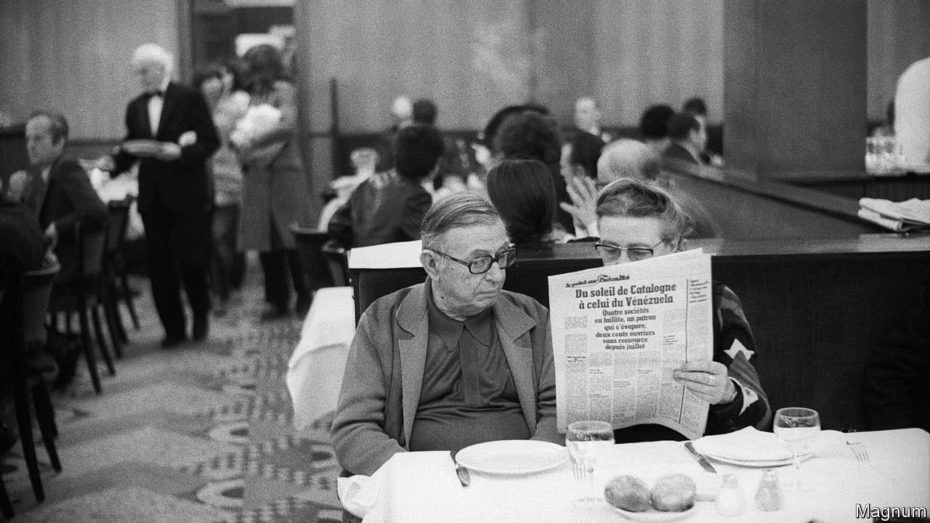
Jean-Paul Sartre and Simone de Beauvoir having lunch at the “La Coupole” Brasserie, December 1973. Photo by Guy Le Querrec/Magnum
Sudhir Hazareesingh is professor in politics and a tutorial fellow in politics at Balliol College at the University of Oxford. He won the Prix d’histoire for The Legend of Napoleon (2006), and his latest book is How the French Think (2015).
22 September 2015 (aeon.co)
Edited by Brigid Hains
Aeon for Friends
There are many things we have come to regard as quintessentially French: Coco Chanel’s little black dress, the love of fine wines and gastronomy, the paintings of Auguste Renoir, the smell of burnt rubber in the Paris Métro. Equally distinctive is the French mode and style of thinking, which the Irish political philosopher Edmund Burke described in 1790 as ‘the conquering empire of light and reason’. He meant this as a criticism of the French Revolution, but this expression would undoubtedly have been worn as a badge of honour by most French thinkers from the Enlightenment onwards.
Indeed, the notion that rationality is the defining quality of humankind was first celebrated by the 17th-century thinker René Descartes, the father of modern French philosophy. His skeptical method of reasoning led him to conclude that the only certainty was the existence of his own mind: hence his ‘cogito ergo sum’ (‘I think, therefore I am’). This French rationalism was also expressed in a fondness for abstract notions and a preference for deductive reasoning, which starts with a general claim or thesis and eventually works its way towards a specific conclusion – thus the consistent French penchant for grand theories. As the essayist Emile Montégut put it in 1858: ‘There is no people among whom abstract ideas have played such a great role, and whose history is rife with such formidable philosophical tendencies.’
The French way of thinking is a matter of substance, but also style. This is most notably reflected in the emphasis on rhetorical elegance and analytical lucidity, often claimed to stem from the very properties of the French language: ‘What is not clear,’ affirmed the writer Antoine de Rivarol in 1784, somewhat ambitiously, ‘is not French.’ Typically French, too, is a questioning and adversarial tendency, also arising from Descartes’ skeptical method. The historian Jules Michelet summed up this French trait in the following way: ‘We gossip, we quarrel, we expend our energy in words; we use strong language, and fly into great rages over the smallest of subjects.’ A British Army manual issued before the Normandy landings in 1944 sounded this warning about the cultural habits of the natives: ‘By and large, Frenchmen enjoy intellectual argument more than we do. You will often think that two Frenchmen are having a violent quarrel when they are simply arguing about some abstract point.’
Yet even this disputatiousness comes in a very tidy form: the habit of dividing issues into two. It is not fortuitous that the division of political space between Left and Right is a French invention, nor that the distinction between presence and absence lies at the heart of Jacques Derrida’s philosophy of deconstruction. French public debate has been framed around enduring oppositions such as good and evil, opening and closure, unity and diversity, civilisation and barbarity, progress and decadence, and secularism and religion.
Underlying this passion for ideas is a belief in the singularity of France’s mission. This is a feature of all exceptionalist nations, but it is rendered here in a particular trope: that France has a duty to think not just for herself, but for the whole world. In the lofty words of the author Jean d’Ormesson, writing in the magazine Le Point in 2011: ‘There is at the heart of Frenchness something which transcends it. France is not only a matter of contradiction and diversity. She also constantly looks over her shoulder, towards others, and towards the world which surrounds her. More than any nation, France is haunted by a yearning towards universality.’
This specification of a distinct French way of thinking is not rooted in a claim about Gallic ‘national character’. These ideas are not a genetic inheritance, but rather the product of specific social and political factors. The Enlightenment, for example, was a cultural phenomenon which spread rationalist ideas across Europe and the Americas. But in France, from the mid-18th century, this intellectual movement produced a particular type of philosophical radicalism, which was articulated by a remarkable group of thinkers, the philosophes. Thanks to the influence of the likes of Voltaire, Diderot and Rousseau, the French version of rationalism took on a particularly anti-clerical, egalitarian and transformative quality. These subversive precepts also circulated through another French cultural innovation, the salon: this private cultural gathering flourished in high society, contributing to the dissemination of philosophical and artistic ideas among French elites, and the empowerment of women.
This intellectual effervescence challenged the established order of the ancien régime during the second half of the 18th century. It also gave a particularly radical edge to the French Revolution, compared, notably, with its American counterpart. Thus, 1789 was not only a landmark in French thought, but the culmination of the Enlightenment’s philosophical radicalism: it gave rise to a new republican political culture, and enduringly associated the very idea of Frenchness with novelty and resistance to oppression. It also crystallised an entirely original way of thinking about the public sphere, centred around general principles such as the ‘Declaration of the Rights of Man’, the civic conception of the nation (resting on shared values as opposed to blood ties), the ideals of liberty, equality and fraternity, and the notions of the general interest and popular sovereignty.
One might object that, despite this common and lasting revolutionary heritage, the French have remained too diverse and individualistic to be characterised in terms of a general mind-set. Yet there are two decisive reasons why it is possible – and indeed necessary – to speak of a collective French way of thinking. Firstly, since the Enlightenment, France has granted a privileged role to thinkers, recognising them as moral and spiritual guides to society – a phenomenon reflected in the very notion of the ‘intellectual’, which is a late-19th-century (French) invention. Public intellectuals exist elsewhere, of course, but in France they enjoy an unparalleled degree of visibility and social legitimacy.
Secondly, to an extent that is also unique in modern Western culture, France’s major cultural bodies – from the State to the great institutions of secondary and higher education, the major academies, the principal publishing houses, and the leading press organs – are all concentrated in Paris. This cultural centralisation extends to the school curriculum (all high-school students have to study philosophy up to the baccalauréat), and this explains how and why French ways of thought have exhibited such a striking degree of stylistic consistency.
The French way of thinking has been remarkably fertile. One of the striking measures of this success is the extent to which French ideas have shaped the values and ideals of other nations and peoples. Versailles in the age of the Sun King was the unrivalled political and aesthetic exemplar for European courts, in the same way as the French Revolution, by virtue of its equation of monarchy with tyranny, and its celebration of civic equality, became an inspiration for progressives all over the world during the 19th century and beyond. The Russian Bolsheviks were notably obsessed by the analogies between their revolution and its French predecessor.
At the same time, thanks to its colonial empire (the second largest in the world after Britain’s), France basked in its great-power status and projected its ‘civilising mission’ across its Asian and African dominions. The Statue of Liberty, which has become such an emblem of Americanness, was designed by the French sculptor Frédéric Bartholdi in 1879; to this day Poland’s national anthem celebrates Napoleon Bonaparte; and Brazil’s flag bears the motto of Auguste Comte’s positivist philosophy: order and progress.
Modern French literature, from Flaubert, Balzac and Hugo to Camus, has become an integral part of the Western cultural heritage. In the second half of the 20th century, Jean-Paul Sartre became a global symbol of the intellectual who dared speak truth to power in all its forms, while Simone de Beauvoir’s The Second Sex (1949) revolutionised our understanding of the feminine condition. A few decades later, ‘French theory’ reshaped the contours of US academia, and Michel Foucault, Jacques Derrida and Pierre Bourdieu remain to this day among the most cited thinkers in the social sciences.
One of the main reasons for this global appeal was the dynamism of French thinking. The sheer inventiveness of Gallic thinkers reflects the key role devolved to imagination, alongside reason, in modern French thought; and a corresponding contempt for empirical knowledge: Rousseau begins his Discourse on the Origin of Inequality (1754) by ‘laying aside all facts’. Hence the tendency for French thinkers to push their ideas to their extreme conclusions, and the primacy given to intellectual creation and cultural innovation. Key concepts such as ideology and engagement are French inventions, and the idea of rupture is central to French intellectual discourse. Derrida was thus one of the most recent of a long tradition of French thinkers when he asserted in 2001: ‘There is no ethical responsibility, no decision which is worthy of its name which is not, in its essence, revolutionary, which is not in rupture with the system of dominant norms, or even with the very idea of normativity itself.’
This inventiveness also appears in the establishment of such powerful overarching frameworks as republicanism, positivism, socialism, existentialism and structuralism, and in the Gallic fondness for combining apparently contradictory concepts. ‘Never were we more free than under the German occupation,’ said Sartre at the end of the Second World War, and this French love of paradox has also given us mystical rationalists, conservative revolutionaries, secular missionaries, republican monarchs, and (most wondrous of all) the concept of the glorious defeat.
French thought proved compelling, too, because of its remarkable boldness. This quality was expressed in the richness of the French utopian tradition, which began with Rousseau, reached its apogee in the 19th century in the irenic works of socialists and Saint-Simonians, and later culminated in the communist tradition. This boldness was also reflected in the extraordinary intellectual ambition to provide ‘total’ explanations of human phenomena – a common trait of Denis Diderot and Jean le Rond d’Alembert’s 18th-century Encyclopédie, Comte’s 19th-century positivism, and the 20th-century Annales historians’ methodology, whose self-proclaimed objective was to produce a ‘total history’.
French rationalism is charged with creating a nation of individualists, with a fetish for skepticism and challenging authority
This French style of thinking has had its critics, both from within France and outside. The liberal thinker Alexis de Tocqueville noted in 1856 the ‘extraordinary and terrible’ influence of literary figures in France, lamenting their disposition to ‘indulge unreservedly in ethereal and general theories’ in order to ‘rebuild society on some wholly new plan’. Making the same point in philosophical terms in 1901, the essayist Hippolyte Taine criticised Descartes and Rousseau, France’s tutelary thinkers, for shying away from experience, and creating a formal mode of reasoning that relied only on the deductive method and on essentialist abstractions such as ‘human nature’.
Likewise, Foucault criticised the French philosophical obsession with Reason for its sweeping character, and for effectively clearing the way for new, and more perverse, forms of social and political oppression. Indeed, Foucault believed that the imperatives of control and domination lay at the heart of the Enlightenment’s conception of rationalism: it was thus less concerned with liberating the mind than with imposing a bourgeois order of ‘pure morality and ethical uniformity’. It was a similar intuition that led Frantz Fanon to urge his comrades struggling for freedom from colonial rule during the post-Second World War-era to reject the false universalism of ‘the European model’, which was nothing but ‘the negation of humanity’.
In less apocalyptic terms, French philosophical rationalism has also been charged with creating a nation of individualists, with a crippling fetish for skepticism, and for challenging authority in all its forms. This trait has been deemed to have negative consequences of both a practical and theoretical nature. In the latter case, it has fostered a tradition of theoretical extremism (most vividly reflected in the vibrant radical movements in France both on the right and the left). It has hindered the emergence of a gradualist epistemological tradition of acquiring knowledge through a process of accumulation. And in practical matters, this French individualism has encouraged a cult of singularity and a resistance to state power: President Charles de Gaulle (himself one of France’s great individualists) gave voice to this concern when he once wondered whether it was possible to govern a country that produced 246 varieties of cheese.
Since the late 20th century, the rich tradition of French thought has come under increasing strain. The symptoms of this crisis are numerous, beginning with a widespread belief in the decline of French artistic and intellectual creativity. In 2007, Time magazine’s cover article even announced ‘The Death of French Culture’, cruelly concluding: ‘All of these mighty oaks being felled in France’s cultural forest make barely a sound in the wider world.’ Even philosophical ideas about resisting tyranny and promoting revolutionary change, which were the hallmark of French thought since the Enlightenment, lost their universal resonance. It is instructive that neither the fall of Soviet-style communism in eastern Europe or the Arab spring took any direct intellectual inspiration from French thinking. The European project, the brainchild of French thinkers such as Jean Monnet, has likewise stalled, as European peoples have grown increasingly skeptical of an institution that appears too distant and technocratic, and insufficiently mindful of the continent’s democratic and patriotic heritages.
Mirroring this retrenchment is a pervasive mood of pessimism that has spread across the French nation. In opinion polls since the early 21st century, the French have appeared consistently gloomy about their future prospects as a nation. French thinking has become increasingly inward-looking – a crisis that manifests itself in the rise of the xenophobic Front National, which has become one of the most dynamic political forces in contemporary France, and in the sense of despondency among the nation’s intellectual elites. It is no accident that two of the bestselling pamphlets of the recent past have been Alain Finkielkraut’s L’Identité malheureuse (2013) and Eric Zemmour’s Le suicide français (2014), and that Michel Houellebecq’s latest dystopian novel about the election of an Islamist candidate to the French presidency bears the resigned title of Soumission (‘submission’) (2015).
A telling example of this crisis of French thought is the discussion of the integration of post-colonial minorities from the Maghreb – one of the burning issues in contemporary French politics. The roots of this question lie in the universality of the French model of citizenship, and the deeply held assumption of the beneficial quality of French civilisation for humankind. Because of their belief in the emancipatory quality of their culture, French progressives consistently advocated a policy of assimilation in the colonies, and largely ignored the racism and social inequalities produced by their own empire. This uncritical belief in the supremacy of the French mission civilisatrice was illustrated during the Algerian war of national liberation in the 1950s and early ’60s by the socialist Guy Mollet, who rejected all manifestations of Algerian nationalism as ‘reactionary’ and ‘obscurantist’.
This colonialist legacy still casts a long shadow over the ways in which France treats and perceives its ethnic minority citizens, especially those from the Maghreb. Because of their rejection of ‘communitarian’ group identities in the British or American mould, the French have no generic way of even designating these minority groups (the only available word is the slang term beur), except to refer to their country of origin. Even worse, these minorities are regularly demonised in the French conservative press and by the extreme right. This vilification has been made easier by the typically abstract and binary ways that French thinkers have framed the debate about minority integration. Thus the principle of laïcité (secularism) has been deployed not to protect the religious freedom of the Maghrebi minorities, but to question their Frenchness.
The Gallic malaise highlights the erosion of the classical strengths of French thinking (universalism, dynamism and inventiveness)
The Muslim veil (hijab) has been banned in French schools, and those who have opposed this measure have been spuriously accused of ‘communitarianism’ and ‘Islamism’ – terms all the more terrifying in that they are never precisely defined. Since the January 2015 attack on Charlie Hebdo, there have been widespread calls for French citizens of Maghrebi origin to ‘prove’ their attachment to the nation. Presenting the issue of civic integration in such schematic terms has proved socially divisive, not least because it has detracted from the real problems confronting these populations: unemployment, racial discrimination, and educational underachievement.
The French fondness for abstraction appears in its most paradoxical (and perverse) form in the absence of precise statistical information about their Maghrebi minorities, as it is illegal to collect data about ethnicity and religion in France (an article on the front page of Le Monde this August stated that France has ‘between 2 and 5 million Muslims’). And so, in the absence of specific social facts and trends, the debate about minority integration has become mired in crude ideological oversimplifications: the equation of secularism with Frenchness (even though the 1905 law separating church and state has never been implemented in some parts of France, such as Alsace-Moselle); the suggestion that the white secular French are the bearers of ‘reason’, while those who practise the Islamic faith are ‘reactionary’ (the very same argument deployed earlier against any natives who dared to question French colonial rule); and the essentialist assumption of an immutable, and yet paradoxically-fragile, French ‘national identity’.
The present Gallic intellectual crisis is in part an anguished collective reaction against France’s shrinking place in a world increasingly dominated by Anglo-American culture. Indeed, this penetration has now advanced deep into the French heartlands: Disneyland Paris is one of the most visited theme parks in Europe; translations of US and UK novels routinely feature on French bestseller lists; and to the dismay of many of the nation’s intellectual elites, the French government recently voted a law allowing French universities to teach certain courses in English. The global retreat of French cultural institutions is also apparent in the low ranking of the nation’s elite universities in the Shanghai league table, and the generally recognised impotence of official organisations such as Francophonia, the association of French-speaking countries, which does little except hold lavish annual summits of its heads of state.
In intellectual terms, the Gallic malaise also highlights the erosion of the classical strengths of French thinking (universalism, dynamism and inventiveness), and the preponderance of its less salubrious features: an over-reliance on abstraction, and a fetish for semantics (one of the most perverse legacies of the post-structuralist flourish of the late-20th century, typified by the works of Foucault, Derrida, Gilles Deleuze and Jean Baudrillard); a tendency to look inwards in space, and backwards in time, and to retreat within the comfortable boundaries of disciplinary specialisations. As the leading historian Pierre Nora said in an interview with Le Figaro this May, French thought is increasingly suffering from ‘national provincialisation’.
The humanism of the republican tradition is still alive, and pushing back against the pessimism of the declinists
All of these negative elements are fused in the current mainstream discussion of French identity, which stems from the refusal of the nation’s elites to adapt their rhetoric to the reality of a multicultural and postcolonial French society. This resolute and often dogmatic attachment to a unitary sense of the French collective self is also one of the powerful legacies of Descartes’ conception of philosophical reason. This ideal (echoed in the classic concept of the ‘one and indivisible republic’) remains widespread among French intellectual elites today. As the editor of the daily newspaper Libération Laurent Joffrin put it in an article this April: ‘Only an abstract conception of Man can confer unity upon France.’
Yet there are silver linings to this bleak vision. The humanism and intellectual creativity of the republican tradition is still alive, and indeed is increasingly pushing back against the pessimism of the declinists. Such voices can be heard in the progressive press, notably in the powerful pamphlet by the journalist Edwy Plenel Pour les musulmans (2015), an eloquent demonstration that multiculturalism is in fact an integral (albeit unrecognised) part of France’s cultural heritage; in the sociological theories of Bruno Latour, whose research effectively combines grand theory with epistemological pluralism; and in Thomas Piketty’s acclaimed study of the inherently inegalitarian nature of modern capitalism, which was hailed by the Nobel Prize-winning US economist Paul Krugman as ‘a book that will change both the way we think about society and the way we do economics’.
Indeed, there are wider grounds for optimism. The French are still exceptionally devoted to their culture, to an extent that is unique in the Western world. France remains the land of major cultural festivals (more than 3,000 are held every year, mostly during the summer); the Journées du Patrimoine draw more than 12 million annual visitors to the country’s historical sites; the Ministry of Culture provides subsidies to a wide range of cultural activities, from artistic endeavours and research institutes to regional bookshops. Most importantly, the French still idolise their major writers, and remain a nation of avid readers, across all age groups and occupations. The Rentrée Littéraire is a cherished literary ritual every September, and for the 2015 season no fewer than 589 new novels are expected.
Among the runaway early successes is Laurent Binet’s La septième fonction du langage, an entertaining murder-mystery yarn framed around the death of the philosopher Roland Barthes in 1980. Its subtle lampooning of the vanities of late-20th-century Parisian high culture should be read as a satire of the structuralists’ interpretative delirium, but also as a belief in the possibility of a return to the universalising rationalism of the French intellectual tradition. Regeneration, after all, is one of the most potent ideals of modern French culture.
Sudhir Hazareesingh’s book How the French Think: An Affectionate Portrait of an Intellectual People is published in the US on 22 September 2015.
Whom We Love and Who We Are: José Ortega y Gasset on Love, Attention, and the Invisible Architecture of Our Being
By Maria Popova (brainpickings.org)

“Attention is the rarest and purest form of generosity,” the great French philosopher Simone Weil wrote shortly before her untimely death. An epoch after her, Mary Oliver eulogized the love of her life with the observation that “attention without feeling… is only a report.” Looking back on centuries of love poems by people of genius who dared to love beyond the cultural narrows of their time, the poet J.D. McClatchy observed that “love is the quality of attention we pay to things.”
Because our attention shapes our entire experience of the world — this, after all, is the foundation of all Eastern traditions of mindfulness, which train the attention in order to anneal our quality of presence — the objects of our attention end up, in a subtle but profound way, shaping who we are.
Because there is hardly a condition of consciousness that focuses the attention more sharply and totally upon its object than love, what and whom we love is the ultimate revelation of what and who we are.
That is what the great Spanish philosopher José Ortega y Gasset (May 9, 1883–October 18, 1955) explores in a series of essays originally written for the Madrid newspaper El Sol and posthumously published in English as On Love: Aspects of a Single Theme (public library) — a singular culmination of Ortega’s philosophic investigation of Western culture’s blind spots, biases, and touching self-delusions about love, that is, about who and what we are.
Illustration from the vintage Danish handbook An ABZ of Love
Defining love as “that sense of spiritual perception with which one seems to touch someone else’s soul, to feel its contours, the harshness or gentleness of its character,” Ortega notes that love reveals “the most intimate and mysterious preferences which form our individual character.” He writes:
There are situations, moments in life, in which, unawares, the human being confesses great portions of his ultimate personality, of his true nature. One of these situations is love. In their choice* of lovers [human beings] reveal their essential nature. The type of human being which we prefer reveals the contours of our heart. Love is an impulse which springs from the most profound depths of our beings, and upon reaching the visible surface of life carries with it an alluvium of shells and seaweed from the inner abyss. A skilled naturalist, by filing these materials, can reconstruct the oceanic depths from which they have been uprooted.
Defining attention as “the function charged with giving the mind its structure and cohesion,” Ortega places it at the center of the experience of love:
[…]
Our spiritual and mental life is merely that which takes place in the zone of maximum illumination. The rest — the zone of conscious inattention and, beyond that, the subconscious — is only potential life, a preparation, an arsenal or reserve. The attentive consciousness can be regarded as the very space of our personalities. We can just as well say that that thing dislodges a certain space in our personalities.

Art by Dorothy Lathrop, 1922. (Available as a print.)
Half a century after William James — one of Ortega’s greatest influences and philosophical progenitors — laid the groundwork of modern psychology with his statement “My experience is what I agree to attend to,” Ortega adds:
[…]
“Falling in love,” initially, is no more than this: attention abnormally fastened upon another person. If the latter knows how to utilize his privileged situation and ingeniously nourishes that attention, the rest follows with irremissible mechanism.

Art by Margaret C. Cook from a rare 1913 edition of Walt Whitman’s Leaves of Grass. Available as a print.
Paradoxically, the cultural narrative handed down to us by the Romantics postulates that love broadens and consecrates our awareness of life: Suddenly, everything is illuminated; suddenly, everything sings. Anyone who has ridden the intoxicating elation of early love has felt this, and yet Ortega intimates that this is an illusion of consciousness, masking the actual phenomenon at work, which is rather the opposite — everything is tinted with aspects of the beloved, blurring and tuning out the details that give the world its actuality. Ortega writes:
At the same time, that exclusiveness of attention endows the favored object with portentous qualities… By overwhelming an object with attention and concentrating on it, the consciousness endows it with an incomparable force of reality. It exists for us at every moment; it is ever present, there alongside us, more real than anything else. The remainder of the world must be sought out, by laboriously deflecting our attention from the beloved… The world does not exist for the lover. His beloved has dislodged and replaced it… Without a paralysis of consciousness and a reduction of our habitual world, we could never fall in love.

Art from the 19th-century French physics textbook Les phénomènes de la physique. (Available as a print.)
Long before cognitive scientists came to study what “an intentional, unapologetic discriminator” attention is as it frames our experience of reality by deliberate exclusion, Ortega writes:
Nothing illustrates this contracting of the lens more clearly than the discomposing experience of emerging from the somnambulant state of in-loveness — an experience familiar to anyone who has ever surfaced from an infatuation or has deepened an infatuation into a clam and steady love. Ortega writes:

One of Antoine de Saint-Exupéry’s original watercolors for The Little Prince.
But despite its potential pitfalls, love remains at once the most interior and the most influential experience of our personhood. In a sentiment evocative of that exquisite line from The Little Prince — “What is essential is invisible to the eye.” — Ortega considers how love, so invisible yet so essential a feature of our humanity, polishes the lens of our entire worldview:
[…]
Probably, there is only one other theme more inward than love: that which may be called “metaphysical sentiment,” or the essential, ultimate, and basic impression which we have of the universe. This acts as a foundation and support for our other activities, whatever they may be. No one lives without it, although its degree of clarity varies from person to person. It encompasses our primary, decisive attitude toward all of reality, the pleasure which the world and life hold for us. Our other feelings, thoughts, and desires are activated by this primary attitude and are sustained and colored by it. Of necessity, the complexion of our love affairs is one of the most telling symptoms of this primogenital sensation. By observing our neighbor in love we are able to deduce his vision or goal in life. And this is the most interesting thing to ascertain: not anecdotes about his existence, but the card upon which he stakes his life.

Art by Jean-Pierre Weill from The Well of Being
And yet our culture has a peculiar willful blindness to how love shapes life and the particular expression of aliveness that is our creative work — a peculiar denial of the elemental fact that because we love with everything we are, our loves imprint everything we make. (I wrote Figuring in large part as an antidote to this dangerous delusion, exploring how the loves at the center of great lives shaped the way in which those persons of genius in turn shaped our understanding of the world with their scientific and artistic work.) Ortega shares in this distaste for the cultural diminishment of love as a driving force of creative work. Observing that many persons extraordinary creative power have tended to take their loves “more seriously than their work” — the very work for which they are celebrated as geniuses, and a choice for which they have suffered derision by their contemporaries and by posterity — he admonishes against this common cultural judgment:

Crochet mural by street artist NaomiRAG, Greenpoint, Brooklyn. Photograph by Maria Popova. (Available as a print.)
A century and a half after astronomer Maria Mitchell — a key figure in Figuring — observed that “whatever our degree of friends may be, we come more under their influence than we are aware,” Ortega laments:
But while love reveals who we are, it also shapes who we are, sculpting our character and tinting our personality. The century of psychology developed since Ortega’s epoch has illuminated just how much “who we are and who we become depends, in part, on whom we love.” Ortega intuits this transformative power of love and, in consonance with Kurt Vonnegut’s theory that you can be in love up to three times in life, he writes:

Art by Dorothy Lathrop, 1922. (Available as a print.)
Complement these fragments from Ortega’s intensely insightful On Love with Adrienne Rich on how relationships refine our truths, James Baldwin on love and the illusion of choice, and Esther Perel on our greatest misconception about love, then revisit what remains my favorite meditation on the subject from centuries of literature and philosophy: Hannah Arendt on love and how to live with the fundamental fear of loss.
In Other Words: Releasing the Hidden Splendour
Kundalini Yoga Training with Sat Dharam Kaur “Who Do You THINK You Are?” public talk in Vancouver Jan 29, 2016, with Dr. Gabor Maté, Diederik Wolsak and Sat Dharam Kaur ND. This talk was a fundraising event for Beyond Addiction: The Yogic Path to Recovery, in Vancouver. See http://beyondaddiction.ca For more lectures with Dr. Gabor Maté, see http://drgabormate.com For workshops with Diederik Wolsak, see http://choose-again.com
A.H. Almaas on your roadblocks

“Your conflicts, all the difficult things, the problematic situations in your life are not chance or haphazard. They are actually yours. They are specifically yours, designed specifically for you by a part of you that loves you more than anything else. The part of you that loves you more than anything else has created roadblocks to lead you to yourself. You are not going in the right direction unless there is something pricking you in the side, telling you, “Look here! This way!” That part of you loves you so much that it doesn’t want you to lose the chance. It will go to extreme measures to wake you up, it will make you suffer greatly if you don’t listen. What else can it do? That is its purpose.”
–A. H. Almaas (born 1944) is the pen name of A. Hameed Ali, a Kuwaiti American author and spiritual teacher who writes about and teaches an approach to spiritual development informed by modern psychology and therapy which he calls the Diamond Approach. “Almaas” is the Arabic word for “diamond”. Almaas is originally from Kuwait. Wikipedia
Beethoven Flashmob in Nuremberg, Germany.

They lost their loved ones to Covid. Then they heard from them again
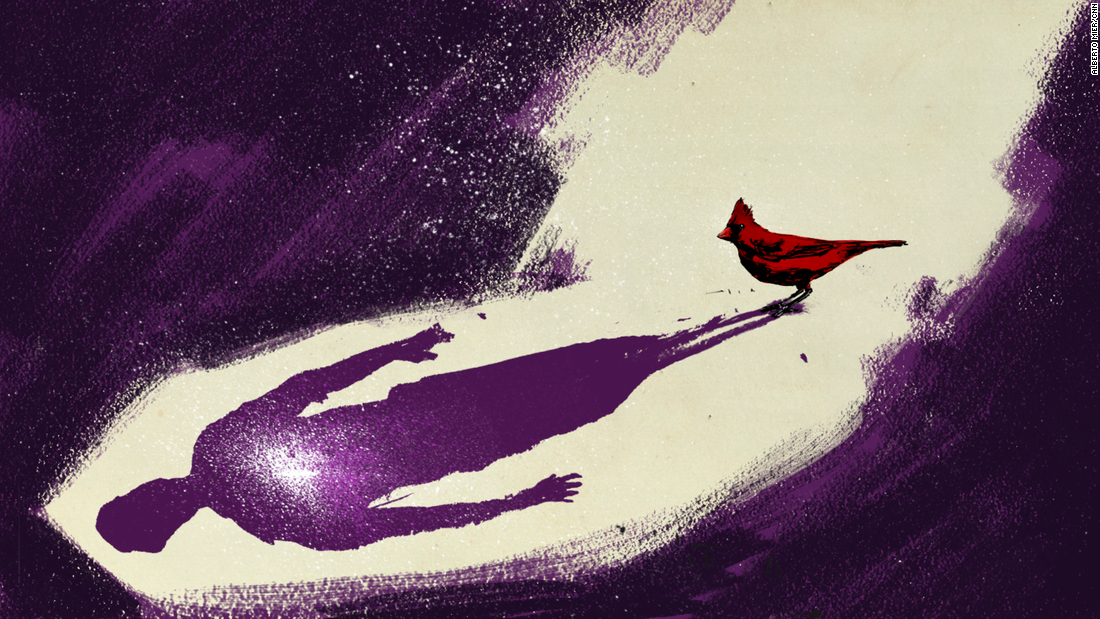
By John Blake, CNN
Updated 4:07 AM ET, Sun June 20, 2021 (cnn.com)
(CNN)They never ran out of things to talk about. It was obvious from the start.He was a brawny former Maine lobsterman with a booming baritone. She was a redhead with freckles from Wisconsin who worked in corporate recruiting. They talked about everything from sci-fi movies and her love for the rock group Bon Jovi to whether the Lord of the Rings film trilogy did justice to J.R.R. Tolkien’s books. He asked for permission to kiss her on their first date. She said yes.When Ian and Michelle Horne got married, he wore a purple tie on their wedding day because it was her favorite color. As the years rolled by, they got matching tattoos and gave each other nicknames from the movie, “The Princess Bride.” He called her Princess Buttercup and she called him “Farm Boy Wesley.” They made plans to visit Ireland this year to celebrate her Irish roots.Then came the pandemic. Last fall, after a long battle, Michelle Horne died from complications caused by Covid-19. Ian Horne’s “superpower,” as he called her, was gone. They had been married almost 10 years.But not long after his wife’s death, the morning radio deejay in Wichita, Kansas, wondered if Michelle was still speaking to him. He was driving to his job in the predawn darkness when he spotted something odd. About two dozen streetlights flanking the highway had turned purple. They looked like a lavender string of pearls glowing in the night sky.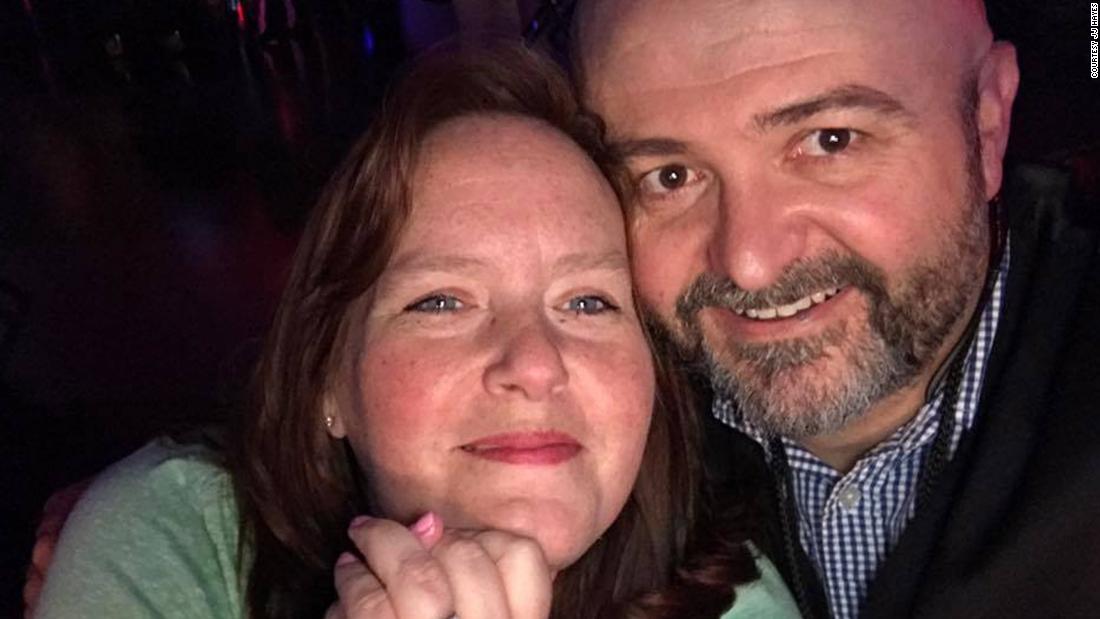 Michelle and Ian Horne. The couple were married almost 10 years.Horne took it as a sign.Enter your email to subscribe to the Results Are In Newsletter with Dr. Sanjay Gupta.“close dialog”
Reported encounters with departed loved ones are not uncommon
The coronavirus pandemic has now killed more than 600,000 Americans. Many of us never had a chance to hug or say farewell to loved ones who died alone and isolated in hospital wards due to fears of spreading the virus.But there is another group of pandemic survivors who say they have been granted a second chance to say goodbye. They are people like Horne who believe they’ve been contacted by a loved one who died from coronavirus.These experiences can be subtle: relatives appearing in hyper-real dreams, a sudden whiff of fragrance worn by a departed loved one, or unusual behavior by animals. Other encounters are more dramatic: feeling a touch on your shoulder at night, hearing a sudden warning from a loved one, or seeing the full-bodied form of a recently departed relative appear at the foot of your bed.These stories may sound implausible, but they are in fact part of a historical pattern. There is something in us — or in our lost loved ones — that won’t accept not being able to say goodbye.And whenever there is a massive tragedy such as a pandemic, a war or a natural disaster, there is a corresponding surge in reports of people seeing the dead or trying to contact them.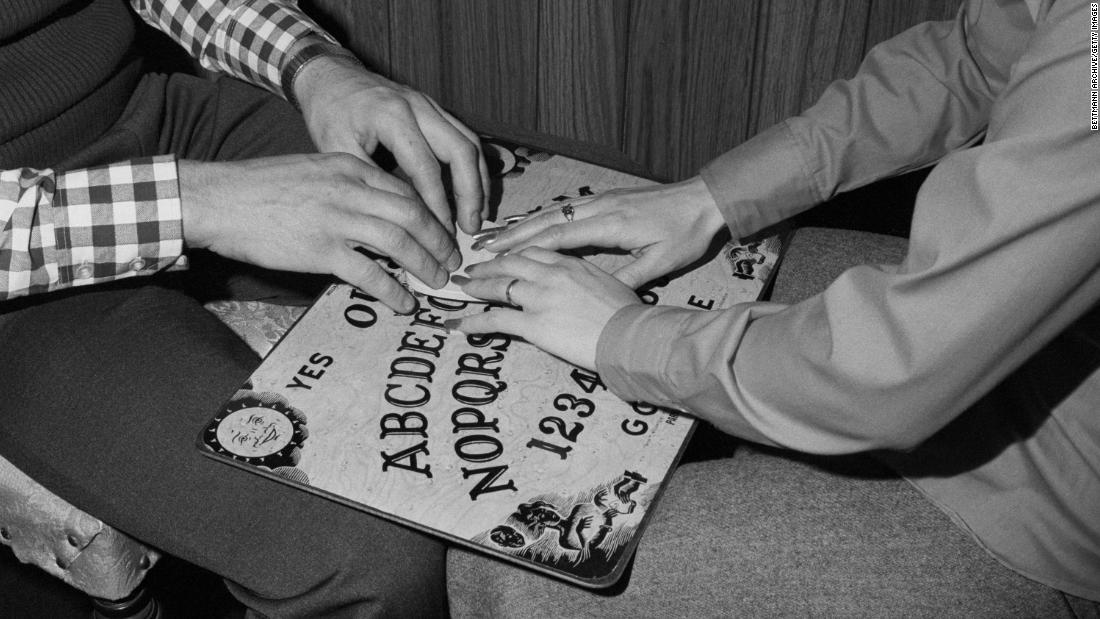 After mass tragedies such as wars many Americans have turned to Ouija boards in an attempt to contact departed loved ones.The 1918 influenza epidemic sparked a “spiritualism craze” as Americans turned to seances and Ouija boards to contact departed loved ones. After the 9/11 terrorist attacks came a wave of people reporting sightings of and even conversations with those who had been snatched from their lives.When a tsunami struck Japan in 2011, killing at least 20,000 people, so many inhabitants of Ishinomaki reported seeing their loved ones appear that a book and a documentary were made about this city of wandering ghosts.”These kind of reports are normal in my world,” says Scott Janssen, an author who has worked in the hospice field for years and studies these experiences. “It would make sense that in a pandemic or other event that leads to mass deaths that there will be a numerical increase in reports and experiences, given the shared grief and trauma.”
These experiences are so common in the psychological field that there is a name for them: ADCs, or “after death communications.” Research suggests at least 60 million Americans have these experiences, and that they occur across cultures, religious beliefs, ethnicities and income levels. Many of these encounters occur in the twilight state between sleeping and waking, but others have been reported by people who were alert.Bill Guggenheim, co-author of “Hello from Heaven,” a book that explores ADCs, believes there is a spiritual purpose behind the visits.”They want you to know they’re still alive, and that you’ll be reunited with them when it’s your turn to leave your lifetime on Earth,” he writes. “They want to assure you they’ll be there to meet you and greet you — and perhaps even to assist you — as you make your own transition.”
A dining room encounter with a beloved aunt
ADCs may serve another function in the world created by Covid — to reassure people who couldn’t be at the side of their loved ones when they died.Consider the story of Jamie Jackson, an office manager who lives near Gettysburg, Pennsylvania, and her beloved “Aunt Pat.” Jackson’s aunt died of a heart attack last summer after complications from Covid. Jackson said her aunt was like a mother to her — someone she spent summers with and accompanied to the hospital for routine medical visits.But when her aunt was afflicted with Covid, Jackson couldn’t visit the hospital to reassure her.”That was the hardest thing,” Jackson says. “You can’t say goodbye and you can’t be there as an advocate for your loved one, which is difficult because you have somebody who’s in the hospital, who’s scared and not used to being alone.” Gloves worn by pallbearers are draped on the casket of retired officer Charles Jackson Jr., who died from Covid-19 in April 2020 in Los Angeles. Covid restrictions prevented many people from saying goodbye to dying loved ones in person.Seven months later, though, Jackson says she heard from her aunt again.It was December, and Jackson was putting up Christmas decorations in the house while Bing Crosby sang holiday carols. Christmas was one of her aunt’s favorite holidays, and she loved decorating. Jackson’s bin was filled with the same decorations that once belonged to her aunt.Jackson says she left the bin in her hallway to get something and when she returned, she saw a translucent figure peering into it. It was the figure of a petite woman, with the same haircut, color of hair and white blouse and blue slacks that her aunt used to wear.Jackson froze. Her hearted started pounding. She fled to her dining room and started crying. When she returned, the figure was gone. She says it was her aunt.”It was overwhelming,” Jackson says. “It’s hard to put into words. I felt touched by that. It’s obvious that she’s around and she’s visiting me.”
A cold hand on a shoulder and a whiff of perfume
Some post-Covid paranormal encounters are even more dramatic. One woman says she was literally touched by a loved one who died from complications from Covid.Marie Pina teaches English as a second language in Manitoba, Canada. She says her 79-year-old mother, Inez, was about to be released from the hospital last November when there was a Covid outbreak in her ward. She tested positive and was put in isolation. She returned home the next month, but had lost her strength.About four months after her diagnosis, her mother died.On the morning of her mother’s death, Pina says she was reaching for her slippers in her bedroom when she felt a cold hand on her shoulder. She turned and saw her mother sitting beside her, staring straight ahead with no expression. She looked 20 years younger.”Her touch was cold, like she had just come from outside,” Pina says.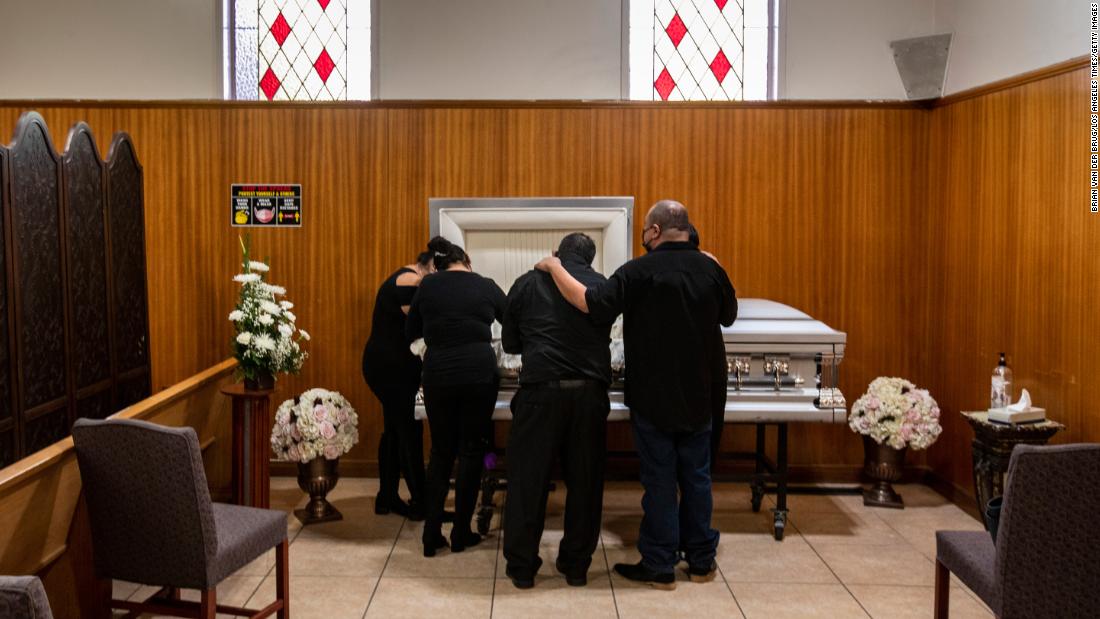 Family members gather to mourn a lost relative at the Continental Funeral Home on December 20, 2020 in East Los Angeles.One day not long after that morning, Pina reported another classic characteristic of an ADC. She was making spinach soup, one of her mom’s favorites, when she suddenly smelled the fragrance associated with her mother — a combination of White Diamond perfume and her mom’s Chi hairspray.”The scent was overpowering,” Pina says. “My husband and I stood in the kitchen awestruck as I stirred the soup. We both could smell it. It lasted for approximately five minutes before evaporating.”Talk to people who have these experiences, and many will acknowledge that maybe their minds created the episode. Others insist the visitations were too real to deny.Jackson, who lost her aunt, says it’s almost irrelevant if they’re real or not. Their impact is real, she says. They made her feel better.”If I needed to see it and it made me feel better and that’s all it was, I’m okay with that,” she says. “I tell people if they don’t want to believe me, that’s fine. I don’t need to explain to other people.”
Some paranormal visitations aren’t so welcome
Other ADCs are more chilling. Some paranormal experiences happen to people who are not reassured by them.”Some people are creeped out by these things and are certainly not looking for them,” says Janssen, the hospice worker. “For some it clashes with worldviews or religious beliefs. Some people have visits like this years after the fact when they are not grieving, or have visits from people with whom they have struggled and from whom they might not actually wish to have a visit.”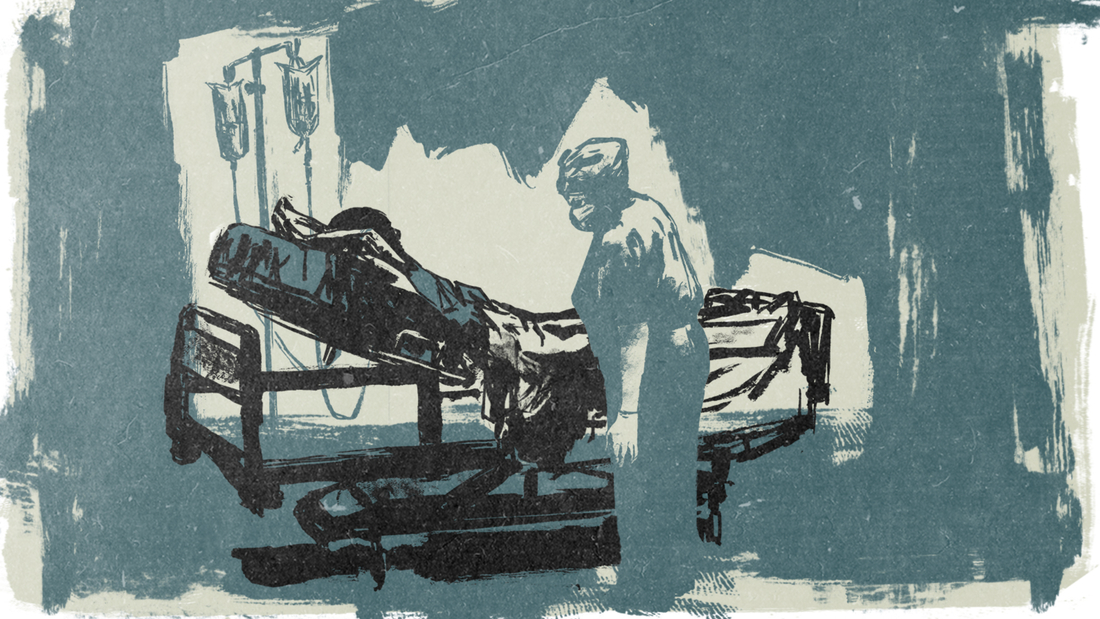 Many victims of coronavirus died alone in hospitals, depriving family members of closure.Haunting ADCs also are common during wartime. War memoirs are filled with stories of combat veterans reporting creepy, after-death visitations from fallen comrades or even enemy soldiers they’ve killed. In the classic memoir, “What It Is like to Go to War,” Karl Marlantes, a Vietnam veteran, wrote about how the ghost of a North Vietnamese soldier he killed stalked him years after he returned home.In one striking passage, Marlantes relates how he exorcised his enemy’s ghost. He arranged a private mass with a priest at 2 in the morning at an old church where he says he saw the spirits of the enemies he killed and the comrades who died under his command file into the pews. Even his late grandparents appeared, smiling as if they approved.Counselors working with veterans often hear such stories, Janssen says.”I’ve been doing this a long time and I consider it a near universal [phenomenon] that after a particularly heavy engagement, a lot of people in your unit are lost, it is inevitable that some of those troops are going to receive visits from their buddies,” he says.
An unusual bird sighting and a cry in the night
Horne, the radio DJ, reports having other after-death encounters with his late wife.Not long after she died, he was sitting on the deck in his backyard when a cardinal landed on a branch in front of him. Cardinals, according to folklore, often appear when loved ones are near. Horne was struck by the bird because he says cardinals don’t normally show up in Kansas in autumn.Horne says he’s had moments when he’s clearly heard Michelle call to him in the night: “Ian, wake up!””It’s as if she’s in the room with me,” he says. “It’s enough to snap me awake, and I’m a deep, hard sleeper. Call it an auditory hallucination or what you want, but I definitely hear it.”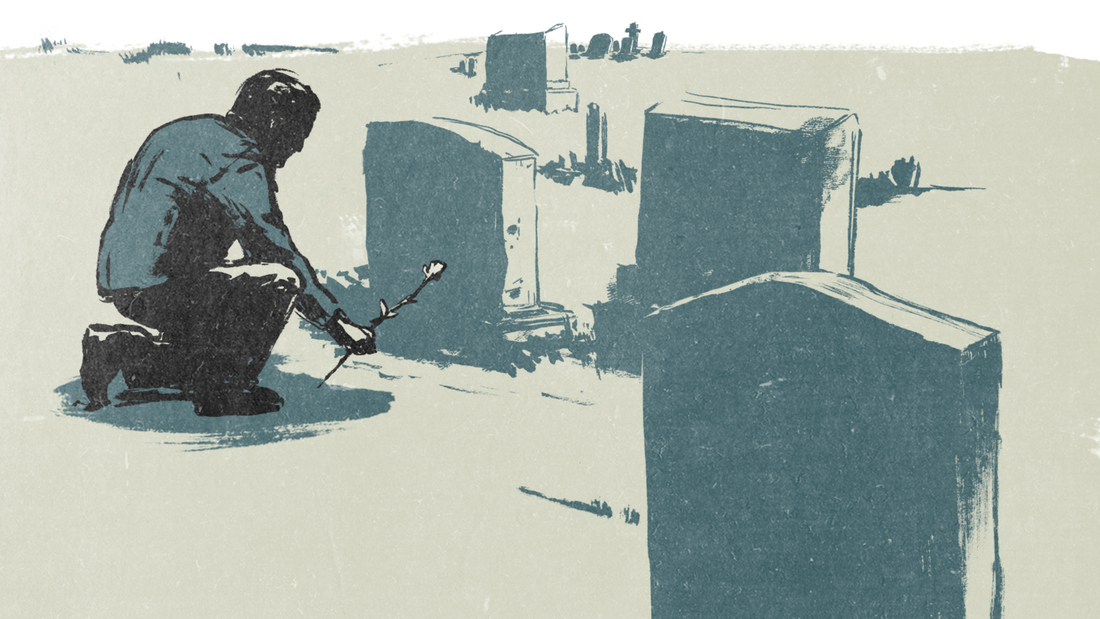 Perceived messages from deceased loved ones can be comforting but also unsettling.Both signs are comforting to him in part because Horne remembers how Michelle fought so hard to live. He says her immune system was weakened after she received a kidney transplant several years ago. When the pandemic hit, they both dreaded what would happen if she got the virus.After their worst fears proved true, Horne says it seemed at first as if Michelle would survive. She endured a lengthy hospital stay, which included being put on a ventilator, but was released last October. She worked hard to get better, but there were times when Michelle’s natural optimism wavered.Horne says she once told him, “I’m such a burden to you. You don’t deserve this. You should just leave.”He kept encouraging her in physical therapy.”I was in it for the long haul, for better or for worse,” he says.Michelle’s body, though, didn’t have the strength for the long haul. She died from a heart attack last October, her body weakened by Covid, Horne says. She was 50.Horne’s radio audience has rallied around him. He’s shared his story on the air and it’s been featured in local newspapers. He finds it cathartic to talk about Michelle.”I feel that a person dies twice — once when they have their physical death and the second time, when we stop saying their name,” he says. “Any opportunity I have to talk about Michelle, I will take it.”
 Purple streetlights in Wichita, Kansas, which Ian Horne thinks are a signal from his late wife.Yet in an odd way, Michelle may be still talking to Horne, even after he first saw those purple streetlights.When they were married, Horne developed a ritual with Michelle. She worried about his safety driving to work in the dark each morning. After he arrived, he would reassure Michelle by texting: “I’m here. I love you.”The purple lights in Wichita are still shining. Horne keeps seeing them on his morning commute. It’s as if Michelle is responding with a similar message.He’s not sure how long the purple lights will remain. He called the city of Wichita and they attributed the faulty lights to a defective batch. They told him they were going to replace the lights. He’s in no rush for that to happen.”I’m kind of honestly hoping that they don’t,” Horne says. “I will always believe that Michelle turned them purple. Whether she actually did or not, that’s up to a reader or viewer to decide. They can explain it away … I believe it was a way for Michelle to be with me on my ride to work.
(Suggested by Sarah Flynn)