Amor Vincit Omnia

Gemäldegalerie, Staatliche Museen zu BerlinGoogle Arts & Culture

Amor Vincit Omnia

Painting by Caravaggio

Description

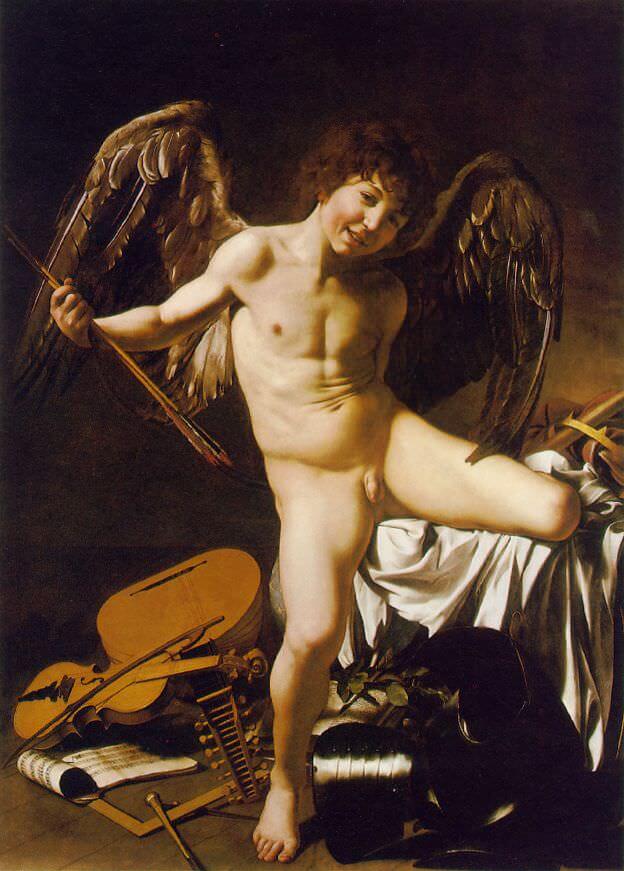
Amor Vincit Omnia is a painting by the Italian Baroque artist Caravaggio. Amor Vincit Omnia shows Amor, the Roman Cupid, wearing dark eagle wings, half-sitting on or perhaps climbing down from what appears to be a table. Wikipedia

Love’s contradictions: Catullus on the agony of infatuation

Love’s contradictions: Catullus on the agony of infatuation | Psyche

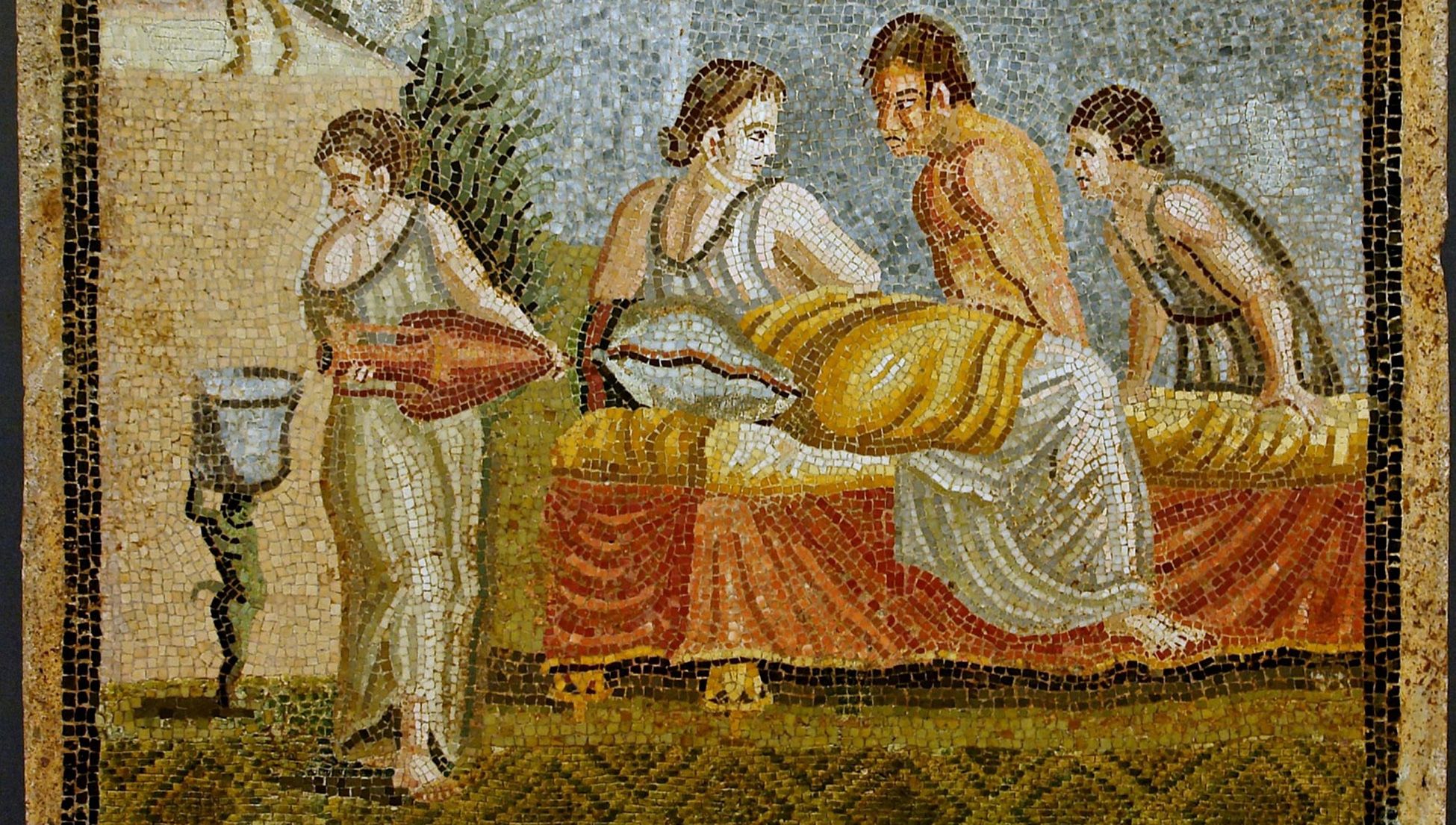
A Roman love scene, 1st century CE. From the Kunsthistorisches Museum, Vienna. Photo courtesy Wikipedia

Armand D’Angouris a professor of Classics and a fellow of Jesus College at the University of Oxford. His books include The Greeks and the New: Novelty in Ancient Greek Imagination and Experience (2011) and Music, Text, and Culture in Ancient Greece (2018), co-edited with Tom Phillips. His latest book is Socrates in Love: The Making of a Philosopher (2019).

Edited by Nigel Warburton

6 JANUARY 2021 (psyche.co)

I hate and love. If you ask me to explain
The contradiction,
I can’t, but I can feel it, and the pain
Is crucifixion.

Odi et amo: quare id faciam fortasse requiris.
Nescio, sed fieri sentio et excrucior.

This simple but heartfelt couplet (translation above by James Michie in 1969) is the best-known Latin love epigram – a short poem in elegiac metre – that survives from Ancient Rome. Composed by the poet Catullus around 55 BCE, number 85 of his book of 116 poems, it pithily encapsulates the searing conflict of emotions that he claims to be experiencing in the course of his affair with a younger married woman, who is addressed in other poems as his ‘girl’ (puella) and by the pseudonym ‘Lesbia’. But for such a short poem – just 14 words in Latin – it has raised a whole host of questions, and hundreds of pages have been written about it. What is the point of the poem? How should it be translated from the Latin? How does it relate to the poet’s life and feelings? Its psychology comes across as complex and strikingly modern, as does much of Catullus’s poetry; to some, the questions it raises might seem more suited to a post-Freud­ian examination of mental conflict than to the concerns of an ancient poet. We might recognise that the opposite emotions of love and hate can be simultaneously entertained; but how, after all, does that work?

In its original Latin, Poem 85 is a so-called elegiac couplet, in which a longer line (hexameter) is followed by a shorter one (pentameter). The words of the poem have been placed with care. The couplet is composed in a criss-cross pattern, beginning and ending with two verbs of intense emotional connotation: odi, ‘I hate’; and excrucior, ‘I’m racked’. The first line concludes with the quest­ioning requiris, ‘you ask’; the second opens with the answer nescio, ‘I don’t know’. The middle of the first line has faciam, ‘I do’; the middle of the second has its passive counter­part fieri, ‘is being done’ (related to fiat – literally, ‘let it be done’).

The couplet thus mimics by its shape the image of the poet being pulled apart in opposite directions, an image made explicit by the verb excrucior. That word (the root of our ‘excruciating’) will have evoked for Romans the noun crux (plural cruces). Although in the 1st millennium CE crux came to be heard almost exclusively to mean ‘cross’ with reference to the crucifixion of Christ, in Catull­us’s time it was more commonly used to signify the ‘rack’. This was the standard instrument of torture in the Roman world, to which unfort­unate victims were bound by their hands and legs so that their bodies might literally be pulled apart.

While Catullus remains utterly infatuated with Lesbia, she has proved to be
distress­ingly fickle to him

No less cruel and visible as a method of execut­ion in the Roman world was crucifixion. Catullus was in his teens when in 71 BCE the slave-revolt led by Spartacus was quelled, and he would probably have witnessed at first hand the gruesome sight of 6,000 captured slaves being nailed or strung up to die on wooden crosses along the Appian Way leading from Rome to Capua. What­ever the precise image intended by Catullus as a parallel to his own feeling of torment, what is evident is that the combination of hate and love, pulling him in different directions, is making him feel as if he is being ‘racked to death’: the ex of excruc­ior connotes a process leading towards expiry and extinction, as well as exten­sion – both in time and across space. Moreover, Catullus claims, there’s nothing he can do about it: he’s simply the object of this torturous and self-contradictory feeling. His response to someone who might wish to enquire (requi­ris) about what he’s ‘doing’ (faciam) is that he’s not ‘doing’ anything, but that he senses (sentio) it ‘being done’ (fieri) to him: the passive form of the verb corres­ponds to his own passiv­ity in the process he’s describing.

However, just before Catullus presents himself as the helpless victim of opposing emot­ions, the answer he gives to the imagined question is unequivocal: ‘I don’t know’. The implication of nescio (the negative of scio, ‘know’, whence comes our word ‘science’) has been overlooked by generations of translators from the Latin, who have rendered the word quare as ‘why’ or ‘the reason why’ rather than ‘how’ – even though it’s clear that Catullus does know, as do his read­ers, why or for what reason he’s prey to emotional conflict. For instance, one of the poem’s earliest English trans­lators, the poet Richard Lovelace (1617-57), renders it as:

I hate and love; would’st thou the reason know?
I know not, but I burn, and feel it so.

Similarly, the translator in the popular Loeb series, which prints classical texts with facing versions in straightforward English, in 1976 had it as:

I hate and love. Why I do so, perhaps you ask?
I know not, but I feel it, and I am in torment.

Such translations using ‘why’ followed by ‘I don’t know’ ask us to supp­ose that Catullus is claiming an inability to understand the reason for his painful emotional turmoil. Yet the poet has already made it abundantly clear, in several other poems describing his affair with Lesbia, that he knows the reason only too well: while he remains utterly infatuated with her, she has proved distress­ingly fickle to him, willing to be unfaithful not only to her husband but to her adult­erous liaison with the poet too. In Poem 72 (my translation), Catullus analyses the effect on him of Lesbia’s infidelity:

You used to say you had eyes for Catullus alone,
Lesbia, and would rather hold me in your arms than Jove.
My feelings for you then were not just vulgar lust,
but the kind of love a father feels for his children and their kin.
Now that I know your ways, my desire for you burns ever fiercer,
even though you’re far shabbier in my eyes, and flightier.
How can this be, you say: it’s because such hurtful treatment
is bound to make one desire one’s lover more, but like them less.

How is it possible, in terms of logic or emotion, to feel both hate and love towards the same person at the same time?

In the final couplet here, Catullus explains to the reader, in terms very similar to those he uses in Poem 85, the paradox of his feelings. The enquirer doesn’t need to ask the cause of the poet’s pain, here described as iniuria (‘hurtful treatment’) because it’s easy to understand: Catullus is wounded by Lesbia’s sexual intimacy with other lovers and hotly resents her behaviour; but his desire for her, perhaps intensified by the prospect of losing her to a love-rival, is even stronger.

The reader might still ask how such divergent feelings as love and dislike can coexist in a lover and be directed towards the same object – indeed, the final line above describes some­thing that feels like such an emotional contradiction, the combin­ation of desire with disliking. That divergence is, in Poem 85, yet more starkly expressed with ‘I hate and love’ (rendered more emphatically in translations that repeat the ‘I’: ‘I hate and I love’). But, again, Catullus would expect the reader to ask not ‘why’, but ‘how’; that is, how is it possible, whether in terms of logic or emotion, for someone to feel both hate and love towards the same person at the same time? Since Catullus knows, as do his readers, why he’s prey to these contradictory feelings, only in answer to the question ‘how’ can it be reasonable for him to follow up, as he does, with ‘I don’t know’. Having declared his ignorance of how the perplexing phenomenon of simultaneous opposing emotions can arise, he then abandons analysis and simply testifies to his own torment.

The correctness of the translation of quare as ‘how’ is confirmed by lexical data. In Catullus’s time and before (as found, for example, in passages written by Catullus’s older contemp­orary, the orator Cicero) quare is used to mean ‘how’ or ‘in what way’. It comes to mean ‘why’ in the course of the language’s hist­­ory; but given the compelling contextual and linguistic arguments for the understanding of what Catullus is asking in Poem 85, what explanation can there be for the persist­ent mistranslation of quare as ‘why’ rather than as ‘how’ in English? (Trans­lations into other languages such as Italian, German and French also tend to fluctuate between rendering quare as ‘why’ and ‘how’).

One answer must be that translators have been influenced by a later Latin couplet that’s as famous as Catullus’s, and indeed alludes to it. A satirical squib (number 32) composed by the poet Martial in the late 1st century CE, more than 100 years after Catullus’s death, uses the same couplet form:

I don’t like you, Sabidius, and I’m unable to say why:
All I can say is this: I don’t like you.

Non amo te, Sabidi, nec possum dicere quare:
Hoc tantum possum dicere: non amo te.

Nothing is known of the context of the epigram or of the implied feud between the poet and the otherwise unknown Sabidius. But the poem has won a firm, if anecdotal, place in the annals of Latin studies in England. The story (undoub­tedly apocryphal) is told how, as a student at Christ Church College, Oxford, the writer Thomas Brown (1662-1704) committed a misde­meanour and was sent for punishment to the college dean, a Dr Fell. The dean required Brown to trans­late some Latin verse on the spot, and opened a book of epigrams at random to present him with Martial’s couplet. After a moment’s thought, Brown recited, allegedly to the dean’s delight, his witty and memorable version of the poem:

I do not like thee, Doctor Fell,
The reason why I cannot tell;
But this I know, and know full well,
I do not like thee, Doctor Fell.

In the case of Martial’s epigram, ‘the reason why’ is a perfectly good translation of quare. But that later connotation of quare has too often been foisted on to Catullus’s much earlier epigram with insufficient thought. To do so obscures the poet’s own specific expression of philo­sophical and psychological perplexity. It also saddles him with an improbable admission of ignorance about his painful situation vis-à-vis Lesbia, of which various other poems of his show him too well aware. In short, in Poem 85 Catullus is not asking ‘why’, but ‘how’. Accordingly, my translation here proposes how the reader might correctly understand and enjoy this famous couplet:

I hate and love: perhaps you ask how both of these I do.
I don’t know, but I feel it, and I’m being torn in two.

Marxism and Buddhism

Life is suffering, whether you sit under a Bodhi Tree or stand with the workers. But do the two schools agree on the remedy?

Buddhist monks receive alms in Luang Prabang, Laos. Photo by Chris Stowers/Panos

Adrian Kreutz

is a graduate student in philosophy at the University of St Andrews in Scotland, and a foreign cooperative researcher at Kyoto University in Japan. Listen here

Brought to you by Curio, an Aeon partner

Edited by Sam Dresser

17 July 2019 (aeon.co)

Marxism and Buddhism might not seem to have much in common. The former is a materialist socioeconomic theory conceived by a 19th-century bearded guy from Trier in Germany, while the latter is a religion originating from orations delivered under a fig tree by a gaunt, peaceful, intimidating character in what is India today. Historically and geographically, they are as far apart as it gets, but the core of their philosophical analysis of the human condition is astoundingly close. It is so close, in fact, that Buddhist metaphysics can complement Marxist socioeconomic philosophy. As the anthropologist Claude Lévi-Strauss wrote in 1955: ‘Marxism and Buddhism are doing the same thing, but at different levels.’

At least since Tenzin Gyatso, His Holiness the 14th Dalai Lama of Tibet, commented on his Marxist inclination in 1993, it is evident that Buddhism and Marxism have something in common:

Of all the modern economic theories, the economic system of Marxism is founded on moral principles, while capitalism is concerned only with gain and profitability … The failure of the regime in the former Soviet Union was, for me, not the failure of Marxism but the failure of totalitarianism. For this reason, I still think of myself as half-Marxist, half-Buddhist.

And Marx himself knew something of Buddhism. In a letter to a friend, written in 1866, he described his own meditation practice:

I have become myself a sort of walking stick, running up and down the whole day, and keeping my mind in that state of nothingness which Buddhism considers the climax of human bliss.

So do Marxism and Buddhism really complement each other? How?

Central to both philosophies is a schema of ‘diagnosis and treatment’. They share a diagnosis: life is essentially suffering. For Marx, the chief catalyst of suffering is capitalism. Capitalism creates more suffering for the working class, whereas the bourgeoisie and the capitalists are comparatively well-off – but that doesn’t mean that capitalism does not create suffering on the side of the winners too, as I shall soon point out. For the Buddha, the transient and fleeting nature of life makes suffering inescapable. In modern Japanese, the gentle sadness associated with nature’s state of flux is called mono no aware. The Indo-Tibetan Buddhist term for the effects of the impermanence of nature is duḥkha, which might be translated as suffering, but sometimes painfrustrationsorrowmisery or dissatisfaction is more applicable. Duḥkha is the first of the Four Noble Truths that the original Buddha propounded right after his experience of enlightenment under the Bodhi Tree.

It is not difficult to see what is behind the concept of duḥkha: life is full of suffering – mental and physical – and in many cases there is little we can do about it. We get older and lose our physical and mental esprit, we lose the people we love, and the possessions we dearly hold on to will one day no longer be ours. All this is inevitable since the world is a world of impermanence and transience – anitya is the Buddhist term. We are plagued by anxiety caused by the fear of becoming ill, losing our job, losing a loved one, losing money, losing fame. The reality of suffering is an incontestable, ubiquitous truth.

This gets us to the second of the Noble Truths, which is trṣṇa, often translated as thirst, but perhaps better thought of as attachment. We are attached to our job, our family, our possessions and our selves. This is not necessarily a bad thing as it strengthens human relations and self-care, but it also causes suffering when paired with the impermanence of everything that we are attached to. So the cause of our suffering is not the nature of reality itself, but our attitude towards it. We cling to the erroneous idea that good things will go on forever and bad things will either never happen or, if they do, we will soon return to the good place.

According to Marx’s Das Kapital (1867), there is more to duḥkha than the impermanent nature of reality. There is this socioeconomic system that fosters a mechanism of competition between individuals in the quest for accumulated wealth to which the people that produce it have only limited access or no access at all. Through this process, the majority of people are abused, controlled and mistreated, alienated from their human essence – not to mention the exploitation of nature and its resources. Marx saw that capitalism generates an extra amount of unnecessary duḥkha: it keeps people in poverty (relative to the value of their labour), it keeps people unemployed (to nurture competition and to tie the workers to the capitalist), it plays with the health of people (by forcing them to work under harmful circumstances, having to fear pecuniary injury when medical care is necessary) and, above all, it alienates people from the essence of their human existence (by the division of labour and long working hours). Social inequality and horrendous living conditions lead to crime, violence and hatred – this is no surprise. Crime, poverty, alienation and exploitation cause suffering, but not exclusively on the side of the exploited workers. Capitalists live in constant fear of losing their status and their money, so they have to work hard to protect it – what you own, in the end, owns you.

App-based mindfulness practice has become the newest balm for the stressed-out capitalist

For Buddhists, the source of suffering lies in a conflict between how we take reality to be and how reality really is. To get rid of suffering, then, is to apprehend reality as it really is – this is being in the mode of enlightenment. According to Marx, there is an extra source of suffering in the mode of production. So, for him, the point is to change this awful mode of production to something better. But as with enlightenment, it is hard to see the problem in the first place, and the capitalist system does everything to hide its malevolence behind the welcoming curtains of consumer culture.

From a Buddhist perspective, the capitalist motor is fuelled by humankind’s deepest vice: its trṣṇa. Marx understood that the whole economic system is based on consumption, and marketing agencies know how to push trṣṇa to the realms of utter perversion, thereby warranting a continuum of consumption and labour. The worker is the hamster, consumer culture is the hamster wheel. People are tricked into believing that Furbies, iPads and all those other pointless goods and services are necessary for a happy and fulfilled existence. A sense of ‘meaning’ has been replaced with instant, short-term, on-demand happiness.

Buddhists know about the elusiveness of happiness. Given the inevitable transience of life, the Buddhist goal is not to be happy 24/7, but to live a meaningful life. Life for the worker becomes meaningful, Marx says, in that it helps the worker to, more or less directly, reduce the suffering in someone else, since capitalism drives the worker to specialisation, and not everybody will become a nurse, doctor, social worker, teacher etc.

Capitalism evolved around the human desire for a meaningful existence, but it offers only short-term happiness. Why, then, are we still thirsty for pointless consumer goods? Because we are made to believe that the possession of those goods defines us. The psychologist Philip Cushman in 1990 accurately described the ping-pong game between conspicuous consumption and the source of suffering, which is the trṣṇa for a true self: ‘Capitalism treats humans as empty vessels, never complete, never one, without a stable identity, needing to be filled with commodities.’ Consumer culture is supposed to fill a lacuna – a sense of self, of identity, of essence – gouged into the human psyche by the alienating working conditions found under capitalism. This ping-pong game is a psychological perpetuum mobile that oscillates between taking away an experience of self-identity (by division of labour, poverty and unemployment), and substitutes it with consumption. This liminal state contributes to the continuous generation of capital.

The consumerist mentality is not the remedy. Unfortunately, Buddhism in the form of watered-down app-based mindfulness practice and yoga in Lululemon Athletica spandex has become the newest balm for the stressed-out capitalist. The most famous Marxist academic of our time, Slavoj Žižek, once said that ‘the “Western Buddhist” meditative stance is arguably the most efficient way for us to fully participate in capitalist dynamics while retaining the appearance of mental sanity’.

We are, of course, more than empty vessels. But what are we? Marx’s concept of the self is a matter of considerable debate among Marx scholars. The social psychologist Erich Fromm in 1961 wrote that ‘Marx did not believe, as do many contemporary sociologists and psychologists, that there is no such thing as the nature of man; that man at birth is like a blank sheet of paper, on which the culture writes its text.’ Yet, there must be a self, otherwise we could not be alienated from it, but is it an empty vessel that asks for refuelling?

In 1845, Marx wrote of his fellow Young Hegelian, Ludwig Feuerbach, that he ‘resolves the essence of religion into the essence of human nature. But the essence of man is no abstraction inherent in each single individual. In reality, it is the ensemble of the social relations.’ There is no central property of the self, only relations. According to Marx’s historical materialism, the social relations that determine the self are, as we know, determined by the ‘mode of production’. Consequently, when the ‘mode of production’ changes, so does human nature.

Meanwhile, according to Buddhist philosophy, there is no self as entity, but only as a loose set of relations. In the circles of later Buddhism, one technical term has been of major significance: svabhava. It is frequently translated as self-being, but for our purposes can be thought of as substance. What is a substance? This is hard to define, and philosophy has said a great deal about it. Let us just think of a substance as a uniform, self-sufficient, necessary, unchangeable, fundamental thing-in-itself. Prominent examples of a substance are God, the world-soul, mind and matter.

For the Buddhists, there is nothing with svabhava, nothing with substance. So, the self has no svabhava either. We can unfurl the idea svabhava-less-ness, or sunyata (emptiness), with a metaphor. But first, consider an immediate rejoinder: it is easy to think of the Buddhist picture described above as hopelessly nihilistic. But denying that there is a substance to the self, in a deep metaphysical sense, does not imply that there is no such thing that functions as a self. In fact, Buddhists did not want to eliminate the self once and for all, and neither did Marx. Without anything that functions as the self, there would be nothing that suffers under capitalism or from being thrown into the transient world. Hence, Marx’s complicated sociopolitical analysis would be pointless, and Buddhism somehow unmotivated. There has to be something that functions as the locus of suffering. For that, let us turn to the Buddhist notion of sunyata (emptiness).

If something is empty of substance, then it is relations that define the thing. In other words, everything is what it is in virtue of bearing certain relations to other things and, as those things are related to other things, ultimately in virtue of bearing relations to everything else. Everything stands in a unique set of relations to other things, which thereby individuates it without its having to assume a unique and individual substance. You stand in countless relations to your parents, spouse, but also to your car and bank account. The impression that there are such things as houses, selves, spouses, bank accounts, hammers and so on, all independent of a network of relations, is actually a conceptual illusion. This, in short, is the Buddhist notion of emptiness. The notion of emptiness includes the notion of self. The self, too, is empty in that it is exclusively defined by its relations, not some underlying substance. This is the idea of no-self.

There is nothing – so to speak – to stick consumer goods to, like sticky notes on a refrigerator

This relationalism is beautifully invoked in the metaphor of Indra’s net. Here is how the religion scholar Francis H Cook described it in 1977:

Far away in the heavenly abode of the great god Indra, there is a wonderful net which has been hung by some cunning artificer in such a manner that it stretches out infinitely in all directions. In accordance with the extravagant tastes of deities, the artificer has hung a single glittering jewel in each ‘eye’ of the net, and since the net itself is infinite in dimension, the jewels are infinite in number. There hang the jewels, glittering like stars in the first magnitude, a wonderful sight to behold. If we now arbitrarily select one of these jewels for inspection and look closely at it, we will discover that in its polished surface there are reflected all the other jewels in the net, infinite in number. Not only that, but each of the jewels reflected in this one jewel is also reflecting all the other jewels, so that there is an infinite reflecting process occurring.

This idea of interdependence emphasises the communitarian aspect of human life – and should serve as the metaphysical fundament of Marxist philosophy. The Marxist idea of the self is defined by its biological, psychological and economic relations to others, indeed all others inside the animate and inanimate world. Just like the net metaphor suggests, this creates a universal interdependence, or ‘interbeing’ as the Buddhist monk Thich Nhat Hanh called it in the 1960s. For Buddhists, this picture of the self and reality is available through meditation.

The idea that the self is defined in terms of others reveals the illusiveness behind the metaphor of the empty vessel. People are not empty vessels because we are not vessels at all – there is no such thing as a vessel. This really is the point of the idea of no-self: there are relations, but no vessels. Once one realises the true nature of emptiness, there is nothing – so to speak – to stick consumer goods to, like sticky notes on a refrigerator; the ping-pong game between consumption and alienation should stop with this insight. Why? Because there is, from a Buddhist metaphysical perspective, no refrigerator.

The realisation of interbeing and emptiness (two sides of one coin) generates compassion, according to the Buddhists. If it is true that I am in interbeing with the people around me, I would rather abstain from harming them. Otherwise, I would end up harming myself though the mediate effects of my actions. Capitalism obfuscates this interdependence by fostering a reckless, and mythical, individuality, but in Marxist thought interdependence is omnipresent. So, the Buddhist metaphysics of emptiness and its concept of the empty self can, and should, serve as a foundation for the Marxist picture. The goal is a ‘nirvana of society’, as the Dalai Lama says.

A society based on the Buddhist ideal of compassion is one where Marxism could finally be implemented. In fact, there have already been several attempts to politicise Buddhism. What Thich Nhat Hanh calls Engaged Buddhism is one example; Uchiyama Gudō (1874-1911), a Soto Zen priest who advocated socialist movements during the Meiji era, is another. Perhaps the most outspoken Buddhist-Marxist was Girō Seno’o (1890-1961), a Japanese Nichiren Buddhist who in the 1930s advocated Revitalised Buddhism, which combined Marxist economics with Pure Land Buddhism. Seno’o is even said to have argued that ‘the capitalist system generates suffering and, thus, violates the spirit of Buddhism’.

Let’s call the Marxist socioeconomic system that is grounded in Buddhist metaphysics Compassionate Marxism. The focus of Compassionate Marxism has to be on ahimsā – nonviolence. Only then can Marxism be immune to totalitarian and authoritarian abuse, and hence no longer prone to repeat its history. Whether Marx himself taught that revolution is necessarily violent, or if there is a possibility of a peaceful transformation, is a vexed question. During the 1844-49 period, Marx held that violent revolution is indeed necessary, given the stringent structure of the bourgeois system. But if it is the economic circumstances that necessitate a turn towards something communist, and not totalitarian, then nonviolent revolution might be possible given the right political interventions.

Humanity is not evil because the economic system is; the economic system is evil because humanity is

The feasibility of the Marxist project is grounded in the benevolent communal nature of the human being. Some might argue that the idea that once humanity realises its interconnectedness it would turn away from cruelty and towards compassion is wishful thinking – a justified objection. The 18th-century German philosopher Immanuel Kant understood cruelty and hatred to be each individual’s fault and deeply ingrained in the nature of human existence. This thought is widespread today, and studies in clinical psychology support it. But for Marx, it is the socioeconomic conditions that are to blame for cruelty, hatred and crime. The human, he would hold, is inherently benevolent and compassionate. Who has got it right?

I think we should all be realistically inclined enough to understand that it is likely Marx fell prey to the Swimmer’s Body Illusion: the swimmer has a perfect body not because she is a swimmer; she is a swimmer because she has the perfect body for swimming. Accordingly, humanity is not evil because the economic system is; the economic system is evil because humanity is. In the end, we are the atoms of economics, the agents of trade. Economics is dependent on us, not vice versa. History indicates that communal projects – such as the North American Phalanx, a secular utopian socialist commune in New Jersey in the 1840s – are susceptible to hatred, mistrust, bribery and fraud. In the 1960s and ’70s, the Milgram experiment and the Stanford prison experiment both suggested that we live under the tyranny of capitalism because we are either inherently tyrannical beings or because we simply obey. The capitalist system just suits our nature. All signs indicate that we don’t have the capacities for universal benevolent compassion, uncontaminated by a proclivity to evil, hatred and competition. We cannot all live like monks, even if this would ensure that one’s basic material needs would be looked after by the community.

But can’t we be both tyrannical and interconnected? Buddhist practice could help us overcome the evil aspects of our nature and promote the compassionate side within us. The socioeconomic system of Compassionate Marxism could be the breeding ground for compassion, and compassion the motor of a socioeconomic system with low duḥkha. Working on the inner Tyrannosaurus would benefit those suffering from Capitalism, which, according to Marx and Buddha, is everyone. The problem with Left-activists is that they see the evil as being exclusively caused by the socioeconomic system (this was Marx’s problem too), without understanding how these factors operate within us. ‘Social change requires inner change – becoming less selfish,’ says the Dalai Lama. The question is not who we are – we are malevolent creatures, as far as I can tell. The question is who we want to be.

Thinkers and theoriesPolitical philosophyComparative philosophy

Metaphysical Idealism

Bernardo Kastrup has been leading the modern renaissance of metaphysical idealism, the notion that reality is essentially mental. He has a Ph.D. in philosophy (ontology, philosophy of mind) and another Ph.D. in computer engineering (reconfigurable computing, artificial intelligence).

Tom Campbell and Bruce Lipton: Two Scientists “See the Same World”

Tom Campbell Tom Campbell, physicist (formerly with NASA), and Bruce Lipton, biologist (author of The Biology of Belief), discuss what they have discovered about reality from their unique perspectives. This is an uplifting and insightful interview by Chuck and Karen Robison of What If It Really Works. Produced by Keith Warner and Donna Aveni of MBT Events. This video has been edited from the original format to comply more fully with Tom’s YouTube channel requirements. Tom Campbell here — If you find something of significant value in our videos, please consider supporting their production through our Patreon account — or through a one-time donation……the links are in the description below…thank you! ** LINKS https://www.Patreon.com/mybigtoe​ Tom’s Patreon ** https://bit.ly/39lwhen​ One time donation link thru PayPal (no PayPal account required) https://my-big-TOE.com​ Tom’s website https://mbtevents.com​ Tom’s events, online events, programs, and binaural beats. https://mbtevents.com/future-events-1https://www.facebook.com/LoveCaringHe…​ Donna’s MBT Outpouring * https://twitter.com/TomCampbell_MBT​ Twitter https://www.instagram.com/tomcampbellmbt​ Instagram https://CUSAC.org​ 501 c 3 Center for the Unification of Science and Consciousness Supporting the completion of Quantum Physics Experiments http://www.brucelipton.com​ Bruce Lipton’s website ** Tom Campbell here…I and MBT Events hope you liked this video — we now have well over a thousand hours of free video on this user-friendly ad-free YouTube channel. Though these videos are free to our viewers, they represent many thousands of hours in production and editing, and many thousands of dollars invested in video and audio equipment along with the required computers, and software to store and process the raw video into finished products. So far, all of this content has been funded directly out of our own pockets. Be assured, we will always continue to do what we can — it is our life, our purpose — a labor of love that we will continue to pursue as best we can. However, those pockets are not as deep as they used to be, thus, we are now seeking to augment our resources with support from our viewers. If you find something of significant value in our videos, please consider supporting their production through our newly created Patreon account — or through a one-time donation……the links are in the description above…thank you!

Stewart Brand portrayed as tech futurist and publisher in ‘We Are as Gods’

Jessica Zack April 15, 2021 Updated: April 17, 2021 (SFChronicle.com)

Stewart Brand, writer and founder of Whole Earth Catalog, portrait inside the Mirene, a converted 1912 tugboat where he and his wife Ryan Phelan call home in Sausalito.Photo: Stephen Lam, The Chronicle

For a devoted futurist like Stewart Brand, who is famous for his projections about technology and the environment, looking at his own past doesn’t necessarily come naturally.

Given his fame as creator of the iconic 1960s DIY handbook Whole Earth Catalog (described by Steve Jobs as “Google in paperback form”), and later as an influential technologist at the forefront of the personal computing revolution, numerous filmmakers have asked the Marin cyberculture legend to make a movie about his life. But Brand never wanted to waste precious time or energy on nostalgia. He said no to the idea of a biopic — until filmmakers Jason Sussberg and David Alvarado approached Brand in 2017.

Now their fascinating docu-portrait “We Are as Gods” is screening at this year’s San Francisco International Film Festival, available to stream through Sunday, April 18.

“We pitched Stewart the idea that instead of just looking backward, we’d create a portrait of the futurist as already living in a future” others can’t yet quite see, said Sussberg in a video interview from his San Francisco home.

“We Are as Gods” directors David Alvarado (left) and Jason Sussberg.Photo: Brendan Hall / Structure Films

Sussberg and Alvarado, based in Brooklyn, N.Y., had already made a short film in 2014 for Time magazine about “de-extinction,” Brand’s late-in-life passion project promoting the use of biotech to bring back extinct species — like the passenger pigeon, the American chestnut tree, even the woolly mammoth.

They planned to make Brand’s zeal for genetic engineering central to their proposed feature-length documentary. To their surprise, over an extended conversation with Brand at Skywalker Ranch following a screening of their last film, “Bill Nye: Science Guy,” Brand said yes.

In “We Are as Gods,” the two filmmakers travel with Brand, now 82, to Siberia, where he’s attempting, with geneticist George Church, to “re-wild” the ecosystem, and to west Texas, where his Long Now Foundation is building a 10,000-year clock inside a mountain to foster long-term thinking.

Stewart Brand tours a seed bank in Siberia in a scene from “We Are as Gods.”Photo: Brendan Hall / Structure Films

“Looking forward and looking back are pretty connected, actually,” Brand said during a recent afternoon on Sausalito’s waterfront.

He and his wife, Ryan Phelan, welcomed The Chronicle onto the Mirene, a 64-foot 1912 tugboat they’ve called home at Waldo Point Harbor, Sausalito, for almost 40 years. There Brand explained that when he launched his 1980s think tank, Global Business Network, he started to consider himself a “professional futurist.”

Stewart Brand, Whole Earth Catalog founder, walks on a ramp from the Mirene.Photo: Stephen Lam, The Chronicle

“I got really interested in what the French call the longue durée, the long view of things,” he said. “You can only feel even remotely comfortable thinking about the future if you have a lot of knowledge of the deep past.”

It’s a very Brand-ian answer, both surprising and philosophical, to the question of what it felt like to watch his life’s high and low points unfurl onscreen in the new film. (Brand is candid in “We Are as Gods” about battling depression in the ’70s.)

Ryan Phelan, wife of Stewart Brand, speaks in an interview aboard the Mirene in Sausalito.Photo: Stephen Lam, The Chronicle

There’s a lot of life to pack into the 94-minute film that gives audiences a whirlwind tour through his irreverent mind and numerous incarnations.

Brand was a self-described “free-range kid” from Illinois who studied biology at Stanford with notorious doomsayer Paul Ehrlich. He pioneered LSD use with Ken Kesey and co-produced the 1966 Trips Festival. In 1968 Brand launched the Whole Earth Catalog with an iconic cover photo of Earth from space, and a slogan: “We are as gods and might as well get good at it.”

Brand pivoted to technology after seeing promise and the cool factor in early Stanford gamers’ excitement. (“Ready or not, computers are coming to the people,” he wrote in Rolling Stone in 1972.) He put on the first Hackers Conference, and founded the proto-Facebook online community the Well during the dial-up modem days of the mid-’80s.

Stewart Brand communes with people at the Whole Earth Truck Store in Palo Alto.Photo: Courtsey of Stewart Brand

“I think Stewart is naturally pulled toward things on the fringe of what could be a possible future, and then he rushes toward it, obsesses about it and feeds off the excitement for about five years, and then gets bored and moves on to the next thing,” Alvarado said. “That pattern was so interesting to us, and a through line in the film.”

Brand has never shied away from controversy, especially when it comes to his belief in using technology to save our planet. The film includes footage of him taking heat from Peter Coyote and others for following his techno-optimism to dangerous lengths. It’s a criticism he and Phelan counter persuasively and with heart.

“I’ve been a conservationist since the 1950s, and I saw the environmental movement go down some primrose paths that blinded them to some important capabilities,” says Brand, referring to the knee-jerk environmental backlash against any kind of technological intervention in nature.

“But only by trying new stuff can you maybe find a better solution. Think of the alternative – trying nothing?”

Brand is all too aware where complacency leads on a planet that’s growing hotter, more flammable and less habitable by the year.

Stewart Brand on the Furthur bus with the Merry PrankstersPhoto: Ted Streshinsky

While still a true futurist, Brand admits to feeling more reflective in his 80s. He’s been working closely with his biographer, John Markoff, and spent hundreds of hours with Alvarado and Sussberg.

The filmmakers were so overwhelmed with material they said they easily could have made “an entire film about each part of Stewart’s life,” and revealed they’re planning on launching a podcast “so we can go into even more detail.”

In one of the most captivating sections in “We Are as Gods,” 28-year-old Brand became so fixated on the need for humankind to see a photo of the whole Earth from space that he hitchhiked across the country selling buttons for a quarter each that said, “Why haven’t we seen a photograph of the whole Earth yet?”

He was confident that if NASA released the image, people would appreciate the Earth’s fragility and do more to protect it.

“The image of the mushroom cloud from 1945 on dominated everybody’s thinking about the world,” Brand says. “It’s a really simple image, and as a symbol it was a powerful framing device.

“What’s interesting is there is so far not one iconic image of climate change. If I could devise one, I would gladly do it.”

“We Are as Gods” is available to stream for $12 as part of the San Francisco International Film Festival through Sunday, April 18. sffilm.org

©Copyright 2021 Hearst Communications, Inc.

How the American Civil War Gave Walt Whitman a Call to Action

Mark Edmundson on the Great American Poet as Defender of Democracy

VIA HARVARD UNIVERSITY PRESS

By Mark Edmundson

April 16, 2021 (lithub.com)

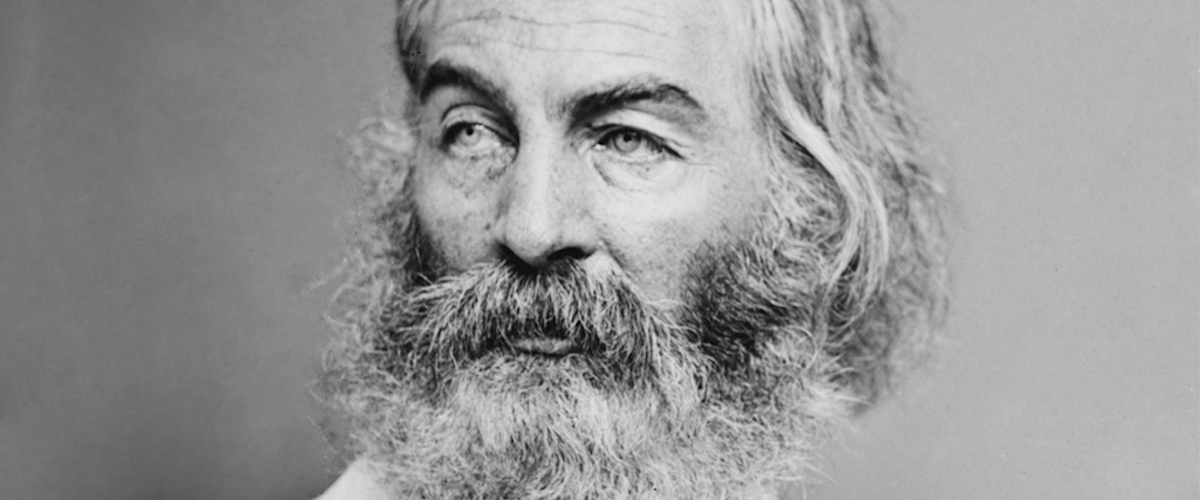
Walt Whitman did all he could to advance the fortunes of his own book, Leaves of GrassHe reviewed it himself, not once but three times.

“An American Bard at last,” he crowed. Whitman, the New Yorker, was commercially minded. Quickly, he got to work on a new edition. He wrote more poems and published them a year later in the edition of 1856This volume is short and squat, a quarto, not an expansive folio like the 1855. It looks to be loaded with compact muscle.

Whitman did something memorable to the 1856 volume, which he published himself, something that Emerson probably never fully forgave him for. He took a line from the moving letter that Emerson sent him to celebrate the first edition of Leaves and embossed it in gold on the spine of the book.

“I greet you at the beginning of a great career, R. W. Emerson,” the binding says. Whitman neglected to ask Emerson’s permission, and, we’re told, the Sage of Concord was quite angry with the American Bard. Emerson did regain his equanimity—in which he put considerable stock—though this was not the last time that he would grow unhappy with the pupil who turned out to be more than a pupil. In the new book, Whitman included a long letter to Emerson, in which he addressed him as “master.” Perhaps that helped calm the sage down.

The 1856 volume didn’t do what Whitman hoped—none of his volumes really did. He wanted his books to pass into the hands of “the people.” He wanted the people he celebrated to read and enjoy the celebration. That didn’t happen in 1855 or 1856 or in 1860, when the third volume of Leaves came out.

At the end of his life, at the close of a birthday celebration in Camden, New Jersey, that moved Whitman to tears, he still mourned the fact that his work had never really reached what he thought of as his true audience. Maybe this is so because Whitman presents insurmountable conceptual and metaphorical difficulties. Perhaps it’s also that his vision, though cogent and reasonably consistent, remains far out ahead of us. All through his life, Whitman kept trying.

Whitman published other notable poems in the 1855 edition, especially the ones that would be titled “There Was a Child Went Forth,” “The Sleepers,” and “Boston Ballad.” After 1855 came the strange and moving elegy “When Lilacs Last in the Dooryard Bloom’d,” as well as “Crossing Brooklyn Ferry,” “Out of the Cradle Endlessly Rocking,” and “As I Ebb’d with the Ocean of Life.” Whitman also composed some wonderful short poems, such as “I Saw in Louisiana A Live-Oak Growing,” “When I Heard the Learn’d Astronomer,” and “A Noiseless Patient Spider.”

Virtually all of Whitman’s poems have at least one or two memorable lines. Yet much of his work after 1855, and almost all of it after 1865, has something of a programmatic air. It’s as though Whitman is writing commentary on Song of MyselfHe had experienced an astonishing vision. But what exactly did the vision mean? What were its implications? And maybe most important, how might he and his country live it out?

Not long after the 1856 edition came out, Whitman moved back to Brooklyn with his mother and extended family, to live in a basement apartment. The family had to rent out the top floor to keep itself even marginally solvent. Whitman wrote poems and some journalistic pieces for a few dollars here and there. He still composed constantly. Walt turned almost every consequential experience into words. But gradually his studied and happy indolence turned into aimlessness: loafing became lassitude. His interest in writing poems dwindled.

Almost every day, Whitman traveled from Brooklyn, usually by ferry, to Manhattan. There he spent his time at a below-ground Broadway establishment called Pfaff’s. The restaurant was the meeting place for a group of American artists, actors, journalists, actresses, and writers, who thought of themselves as Bohemians. The man who brought the Bohemian life over from Paris was a Nantucket born and raised writer and editor named Henry Clapp. Clapp had been to Paris, where he’d lived for a couple of years on the Left Bank, acquiring a French mistress and learning to live the sensuous, lazy life of French cafes and theater. Clapp was the main figure at the long table under Broadway, where the Bohemians gathered.

Pfaff, the proprietor, was German, rotund, gregarious, and hospitable. He seems to have loved filling his restaurant with the fast and slightly scandalous figures who came to sit with Clapp, shoot the breeze, indulge in duels of wit, and plan great futures for themselves. Among the wits, Clapp was preeminent. Of his rival editor Horace Greeley (my ancestor, I was told as a boy), Clapp said, he’s a “self-made man who worships his creator.”

Perhaps it’s also that his vision, though cogent and reasonably consistent, remains far out ahead of us.

Women as well as men sat at the long table: among them Ada Clare, the “Queen of Bohemia,” and Adah Menken, the most notorious actress of the day, who rode onto the stage wearing a nude body stocking in a play based on Byron’s BeppoWhitman sat at the long table too—though there was little of the wit about him. He was prone to quiet conversation with the Bohemians sitting closest, but more than that, he was inclined to listen. Whitman was as devoted a listener as he was an observer. Everyone who knew him at Pfaff’s seems to have liked him.

The primary Bohemian, Clapp was an early champion of Whitman’s work, and never ceased in his admiration for the poet or his willingness to help publicize him. Whitman drank at Pfaff’s, but not very much. It seems a beer would last him through the night. He occasionally had a glass of champagne. His abstemious ways and relative silence didn’t stop him from becoming a figure there. He was known as the author of a scandalous volume—the erotic side of Whitman’s poetry had been excoriated in a dozen ways by at least a dozen reviewers. He also dressed the part of the avant-garde artist: slouch hat, open shirt, pants tucked into high boots. His beard had gone richly aflower. He looked like someone to reckon with, which in his way he was.

But Whitman didn’t spend all his time at Pfaff’s sitting at the long table and listening to the wits vie with each other for Clapp’s approval. There was another table closer to the center of the tavern that Whitman also favored. This one was populated by young men, whose company Whitman apparently relished as much as he did that of the wits. Was it what we would call a gay culture that Whitman was involved in? It’s not certain.

For some time, Whitman had been drawn to the company of males, usually young and working class. He listed their names in his journals, walked with them, talked with them, hugged and kissed them, and occasionally slept with them. Was there sex involved? None of Whitman’s behavior was unusual for midcentury America, where intense same-sex friendships arose between men and women alike.

Many women approached Whitman with romance in mind. He fended them off, usually with some charm. But he pursued intimate relations with men quite frequently. Were they ever consummated? Of Whitman’s prominent critics, Richard Poirier seems most certain that Whitman led a thriving sexual life during his Broadway days. David Reynolds, the author of a comprehensive volume on Whitman and his cultural milieu, is far less certain. On the matter of Whitman and homosexual sex, he’s an agnostic, as am I.

Many of the men Whitman befriended during his days at Pfaff’s were stage drivers. They drove horse-drawn wagons ferrying passengers and freight up and down Broadway. Broadway could be chaotic: few traffic regulations, little enforcement of those that existed, busy people hustling in all directions. Accidents were common, fights between the drivers frequent. Many of the drivers got hurt, some of them badly. Whitman, who often rode up on the box with them as they banged their ways up and down Broadway, was a loyal friend. When they were injured, he visited them in the hospital. He sat by their bedsides, talked with them, joked, offered them tobacco and other small gifts. He also did one of the things he did best: he listened.

Whitman could sit by the hour at a driver’s bed, learning about who he was, where he came from, what his dreams were, and where his problems lay. The drivers liked and respected Whitman, and in the hospital, his connections with them strengthened. There was sometimes a forced, nearly hysterical quality about the revelry at Pfaff’s during the late 1850s. America was moving closer to war. Many of the regulars pretended to ignore the coming cataclysm, but not Whitman. He worried for his nation. He had appointed himself its personal bard, and he believed that the welfare of any nation, but especially a democracy, was much in the hands of its poets.

Whitman was furiously committed to the idea of Union. The United States must stay one and whole. If it did not, the democratic ideal might go down as a failure. Whitman did all he could in his poems and journalism to fight for national unity. In this, he was much like Lincoln: Whitman detested slavery, but the prospect of disunion was his principal anxiety. Lincoln said that if he could save the Union without freeing a single slave, he would do so. Whitman the citizen and journalist would have concurred: though as we’ve seen, Whitman the visionary nurtured other aspirations about race in democratic America.

America was moving toward crisis, and the denizens of Pfaff’s, Whitman included, were dealing with it in their various ways. Whitman wrote and brooded, brooded and wrote, and braced himself for the moment when his beloved Union would undergo major challenge. Walt saw Lincoln for the first time on Tuesday, February 19, 1861, when the president went to New York, on the way to Washington, DC, for his inauguration. Whitman was one of a crowd of 30,000 gathered on Broadway to get a look at the president-elect. Walt saw Lincoln leave his carriage, mount the steps of the Astor Hotel, turn, take a slow, melancholy look around, then disappear behind closed doors. Lincoln did not speak a word to the crowds that had gathered to see him. (Or so Whitman says—others claim he made brief remarks.) Whitman was on the top of a stagecoach when he saw Lincoln, the man who would fascinate and move him for the next four years and beyond.

Looking back, Whitman recalled how “two or three shabby hack barouches [four-wheeled horse-drawn carriages] made their way with some difficulty through the crowd, and drew up at the Astor House entrance. A tall figure step’d out of the centre of these barouches, paus’d leisurely on the sidewalk, look’d up at the granite walls and looming architecture of the grand old hotel—then after a relieving stretch of arms and legs, turn’d round for over a minute to slowly and good-humoredly scan the appearance of the vast and silent crowds.”

A handful of states had already left the Union by the day that Whitman saw Lincoln arrive in New York, and before long, Southern troops fired on Fort Sumter. War was on. The next two years were among the worst of Walt’s life. He was too old to fight: he was now in his forties, and all the beefsteak, champagne, and butter he’d consumed at Pfaff’s had made him portly. Whitman had been terrified by the idea of Civil War—he hated the thought of the states being at deadly odds with each other. (The states being in tension with one another was fine with Walt: he wanted as much diversity and even opposition as possible, without fracture.)

Whitman was furiously committed to the idea of Union.

Once war came, Whitman became a fierce proponent of Northern victory. Lincoln called for mass enlistment, and Whitman wrote a poem—not one of his best—seconding the call. Whitman continued to write poetry and some journalism from the start of the war through to 1862, but these were among his worst days.

He simply did not know what to do with himself. What should the bard of America do when his nation was split and its citizens were off trying to kill one another? Whitman rambled and wrote a little, wrote some and rambled. But he was living with no sense of purpose. The casualty reports rolled in, and what had seemed like it would be a short war went on and on. The new recruits who marched out of New York City to fight the Rebs left with ropes tied around the barrels of their rifles, each planning to drag a Confederate recruit back home with him. Matters didn’t go as planned. The soldiers who enlisted on the Union side generally couldn’t imagine the war would last four months—it would continue for four years. Whitman, lost in a purgatory of his own, had no sense what to do.

Then one day, everything changed. George Whitman, Walt’s younger brother, had enlisted at Lincoln’s first call for volunteers. He was one of the men who’d gone off with a rope around his rifle. George was an anomaly in the Whitman family: sane, affectionate, decent, unimaginative, and practical. Walt loved him deeply, as he loved all his family, and was perpetually anxious about George’s fate. After every major battle George fought in, and there were plenty of them, the Whitman family searched through the casualty reports for his name. George emerged from one engagement after another unharmed.

Then came the Battle of Fredericksburg, which left 13,000 Union soldiers dead or wounded in a single day. The Whitmans knew that George was deployed near the battle site and began searching the newspapers for word of him. The New York Tribune carried news of a First Lieutenant George Whitmore of the 51st New York, George’s regiment, who’d been wounded. How badly, the paper didn’t say. Surely this could be a transcription or a printing error, the Whitmans thought: this could be their George. Almost immediately, Walt was off to find his brother and make sure he was all right.

Whitman was a resourceful traveler, and in only a few days, he made it to the front lines, found George’s regiment, and then, in short order, George. George was fine. A piece of shrapnel had sliced into his cheek, but he was well and in his usual high spirits. (How George emerged from the Whitman family as healthy, hearty, and relatively commonplace as he was is no small mystery.)

Whitman was fascinated by life in the camp, and quickly made friends with the soldiers. (Whitman, true to the persona of Song, was about as gregarious and friendly as it was possible for an inwardly attuned individual to be.) He ate with the soldiers, sharing their rations; he learned about the battles they’d fought and about their backgrounds and their aspirations for life after the war. He liked them a great deal—no surprise, Whitman cherished the company of everyday young American men—and apparently the soldiers took quickly to Walt. George was already well regarded in the regiment: he was reliable, brave, and good-humored.

He did for the soldiers much of what he’d done for the Broadway stage drivers when they were hurt.

Walt’s spirits, depressed for months, began to rise. On the first day at camp, Walt saw something that shocked and fascinated him. An engagement was recently over, and there outside the surgical tent, he saw a hill of amputated arms and legs. The surgeons were still at work, and Walt, not terribly squeamish, no stander above men and women in their distress, went into the field hospital and even into the surgeons’ tent and watched and wondered. He gave what help he could— Whitman wasn’t a trained nurse, but he assisted with basic tasks, like moving the wounded soldiers from place to place.

When he could, he sat with the wounded men and talked with them and joked and—compassionate (and authentically modest) bard that he was—he listened. He did for the soldiers much of what he’d done for the Broadway stage drivers when they were hurt. Not far away the formidable nurse Clara Barton was working headlong to help the fallen. Whitman watched Barton in amazement, and understood he could never do what she with her nurse’s training could. But slowly an idea seemed to gather in him.

He was feeling alive for the first time in months. It wasn’t enough to write poems about the war; it wasn’t enough to write journalistic pieces, though Whitman wrote some effective dispatches from the camps. He wanted to do more, and now he saw what, given his talents and his heart’s inclination, he might contribute.

__________________________________

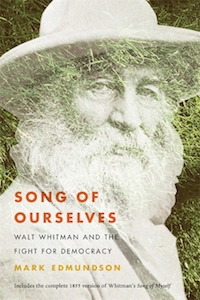
Song of Ourselves

Excerpted from Song of Ourselves: Walt Whitman and the Fight for Democracy. Used with the permission of the publisher, Harvard University Press. Copyright © 2021 by the President and Fellows of Harvard College. All rights reserved.

Mark Edmundson
Mark Edmundson

Mark Edmundson is University Professor at the University of Virginia. He teaches courses in Romantic and Modern Poetry, Shakespeare, and Nineteenth Century Philosophy. He has published eight books, including TeacherLiterature against Philosophy, Plato to DerridaThe Death of Sigmund Freud and The Fine Wisdom and Perfect Teachings of the Kings of Rock and Roll. His essays have appeared in many publications including The New York TimesThe New RepublicThe NationRaritanThe Yale ReviewNew Literary HistoryAmerican Literary History and The London Review of Books. He has held fellowships from the Guggenheim Foundation, the National Endowment for the Humanities, and the Commonwealth Center for Literary and Cultural Change. He has been awarded the Daniels Family Distinguished Teaching Professorship at the University of Virginia, for excellence in undergraduate teaching.

The first blockchain-based democracy awakens

Dear Humans,

A truly decentralized experiment, with members coming from all four corners of the Earth ? to assert their right to having a political voice, a Universal Basic Income, and true digital sovereignty.

Here’s a quick intro video:

We know that’s a lot to unpack, so we’ll walk you through the basics below:

Proof of Humanity

Joining Proof of Humanity is the first step to participate in the DAO, and we highly encourage you to register!

In order to join, you need to make a video of yourself with your Ethereum wallet (here’s a short tutorial on how to get one), certifying that you are a unique human being and that you are not yet a part of the Proof of Humanity registry. You will also need to make a deposit which will be returned to your wallet once you are approved.

After submitting your profile, someone who is already in the list needs to vouch for you. If you know anyone from our team, please reach out to us either by replying to this e-mail or directly on our social media, and we will gladly vouch you in. If you don’t, our amazing community has organized this crowdvouching group on Telegram to help. 

Here’s more detailed information about the registration process.


$UBI?

An inalienable right to liquidity, to be bestowed upon every Human on Earth. This is already redefining everything we knew about decentralized, digital economies, and we have a thriving market on Uniswap with over 1 million USD in our liquidity pools!


Proof of Humanity DAO

Ok, so we have a registry of unique Humans, and Universal Basic Income on the blockchain. Now what? 

That is for us to build together. The “Proof of Humanity DAO” (the official name will be decided by the community) is a decentralized democracy, governed by everyone who is a member of the registry. It’s an opportunity to create new, deeply deliberative and participatory governance systems, as well as to fund public goods using innovative methodologies! We also need to continuously adapt our token issuance rates and registration requirements over time. And last but not least, there are 4,000,000.00 $UBI in our common pool, to support projects that will benefit humanity. Anyone may submit a proposal on how to allocate these funds. Here’s a Twitter thread with more info.

This is an unprecedented political experiment, which drastically expands the locus of possibility for democracy. We want you, who has been with us all along, to be a part of it. 

It has been a long and fascinating journey, but we are only getting started. Thank you for being there for us over the years.

Be well, and stay in touch.

The Democracy Earth team

Democracy Earth Foundation is a 501(c)(3) nonprofit in San Francisco, California. Democracy.EarthOn twitter.
Donate: opencollective.com/democracyearth

$UBI contract:

BTC Support:

The misinformation virus

Lies and distortions don’t just afflict the ignorant. The more you know, the more vulnerable you can be to infection

Elitsa Dermendzhiyska

is a science writer and social entrepreneur working at the intersection of technology, research and mental health. She is the editor of the mental health anthology What Doesn’t Kill You: 15 Stories of Survival (2020). She lives in London.Listen here

Brought to you by Curio, an Aeon partner

Edited by Marina Benjamin

16 April 2021 (aeon.co)

There’s a new virus in town and it’s not fooling around. You can catch it through face-to-face contact or digitally – that is, via a human or bot. Few of us possess immunity, some are even willing hosts; and, despite all we’ve learned about it, this virus is proving more cunning and harder to eradicate than anyone could have expected.

Misinformation isn’t new, of course. Fake news was around even before the invention of the printing press, although the first large-scale journalistic sham occurred in 1835, when the New York Sun published six articles announcing the discovery of life on the Moon (specifically, unicorns, bat men and bipedal beavers). Consider, too, early modern witch hunts, or those colonial myths that depicted slaves as a different species; the back-and-forth volleys of anti-Jewish and anti-German propaganda during the world wars, McCarthyism’s Red Scare, even communism’s utopian narratives. History teems with deceit.

What’s different today is the speed, scope and scale of misinformation, enabled by technology. Online media has given voice to previously marginalised groups, including peddlers of untruth, and has supercharged the tools of deception at their disposal. The transmission of falsehoods now spans a viral cycle in which AI, professional trolls and our own content-sharing activities help to proliferate and amplify misleading claims. These new developments have come on the heels of rising inequality, falling civic engagement and fraying social cohesion – trends that render us more susceptible to demagoguery. Just as alarming, a growing body of research over the past decade is casting doubt on our ability – even our willingness – to resist misinformation in the face of corrective evidence.

The classic experiments to correct misinformation date to the late 1980s. Subjects were given news briefs from the scene of a fictional warehouse fire, one of which mentions a closet with volatile materials – cans of oil paint and gas cylinders – others report ‘thick, oily smoke’, ‘sheets of flames’ and ‘toxic fumes’ that put the firefighters’ lives at risk. A further brief cites the police investigator on the case stating that the closet was, in fact, empty, before the report ends with the fire finally put out.

Having read the briefs, subjects had to answer a series of questions meant to probe their grasp of the correction made by the police investigator. It seems a simple test yet, across a multitude of studies, people repeatedly fail it. In one experiment, as many as 90 per cent of the subjects linked the fire’s toxic nature or intensity to the cans of oil paint and gas cylinders, despite none being found in the closet. More surprisingly, when asked directly, most of these participants readily acknowledged the empty closet. Researchers have reported similar results many times, including using blatantly direct retractions (‘there were no cans of paint or gas cylinders’). Yet no matter how clear the correction, typically more than half of subjects’ references to the original misinformation persist. What’s remarkable is that people appear to cling to the falsehood while knowing it to be false. This suggests that, even if successfully debunked, myths can still creep into our judgments and colour our decisions – an outcome referred to in the literature as ‘the continued influence effect’.

Why does this happen? According to Jason Reifler, professor of political science at the University of Exeter, we tend to take incoming information at face value, ‘because the existence of human society is predicated on the ability of people to interact and [on] expectations of good faith.’ Moreover, myths can take on subtle, crafty forms that feign legitimacy, making them hard to expose without careful analysis or fact checks. This means that those of us too dazed by the job of living to exert an extra mental effort can easily succumb to deception. And once a falsehood has slipped in and become encoded in memory – even weakly – it can prove remarkably sticky and resistant to correction.

One of the most common explanations for the continued influence effect puts it down to a gap in our mental model, or the story we tell ourselves about what happened. If the myth fits the ‘logic’ of events, its retraction leaves a hole, and the cogs of the story no longer click into place. We need the cans of oil paint and the gas cylinders: what would otherwise explain the billows of smoke and the force of the blaze? Remove the volatile materials from the closet, and the causal chain of events in our head unravels. If we aren’t to lose coherence, it makes sense to hold on to both the actual fact and the fitting falsehood – but keep them separate, compartmentalised, so that they don’t clash. This might be why, as studies show, we could be well aware of the truth, yet still allow the myth to creep in elsewhere and corrupt tangential judgments.

Older people might be particularly vulnerable to misinformation that’s repeated when retracted

Another reason why misinformation resists correction is repetition. Once something gets repeated often enough – sensational claims on social media; urban legends passed from one bored timewaster to another – it can trick us into taking it as true merely because of its familiarity. The illusory truth effect, as it’s known, suggests that the easier to process and more familiar something is, the more likely we are to believe it. Which is exactly what repeating a misleading claim does – getting it to go down smooth by strengthening the neural pathways linked to it.

This can pose a challenge for corrections that work by repeating the original misinformation. Consider, this retraction to a myth prone to ensnare hopeful new mothers: ‘Listening to Mozart will not boost your child’s IQ.’ The tiny ‘not’ mid-sentence is all that sets the myth and its correction apart – and it’s easy to imagine that as time passes and memory fades, that ‘not’ will wash away, leaving Mozart’s symphonies and smarter babies linked together in memory, and making the myth more familiar. Could this cause the correction to fail or even backfire?

In 2017, Stephan Lewandowsky, a cognitive scientist at the University of Bristol, and two colleagues from the University of Western Australia set out to investigate this possibility. They measured their test subjects’ beliefs in 20 myths and 20 facts, then corrected the myths in a way that repeated them twice more. Right away, as well as 30 minutes later, the correction significantly reduced subjects’ beliefs in – and references to – the false statements. However, after only a week, belief ratings crept back up to almost double their corrected levels.

Because memory declines with age, older people might be particularly vulnerable to misinformation that’s repeated when retracted. Indeed, in a similar study with older adults, Lewandowsky’s team found that, after three weeks, subjects aged over 65 ended up re-remembering most of the successfully corrected myths as facts. Again, though, no backfire effects occurred – that is, where the correction actually increases belief in the myth – and, despite some contrary earlier evidence, researchers now believe such effects to be rare, if they exist at all. And although repeated mentions of a myth can strengthen it, one repetition during correction seems safe and even desirable as it makes the myth more pliant by activating it in memory.

In recent years, as misinformation has wormed its way into large swathes of society, scientists have been looking for the most effective methods to counter it. Recently, Lewandowsky spearheaded The Debunking Handbook 2020, an online collection of best practice by 22 of the most active researchers in the field. The contributors nominated more than 50 relevant findings and more than 30 practical recommendations, rating them on their importance and the strength of the available evidence. To successfully debunk a myth, the authors conclude, it helps to provide an alternative causal explanation to fill the mental gap that retracting the myth could leave. Counterarguments work too, as they point out the inconsistencies contained in the myth, allowing people to resolve the clash between the true and the false statement. Another strategy is to evoke suspicion about the source of the misinformation. For example, you might be more critical of government officials who reject human-caused global warming if you suspect vested business interests behind the denialist claims.

The most vaccine-hesitant subjects ended up even less willing to vaccinate than they were before the study

Some researchers, however, question the practical significance of debunking strategies devised in a lab. As Reifler put it to me: ‘Are the “positive” effects of interventions we are seeing real effects, in terms of creating long-lasting changes in the accuracy of people’s beliefs? Or is this just a momentary “I’m accepting it because I was told it – and you could’ve told me the exact opposite thing and I’d have believed that?”’ In a world where both media and online platforms have turned into hotbeds of misinformation, Reifler’s question sounds especially urgent. John Cook, a climate change communication researcher at George Mason University in Virginia, told me: ‘I could develop the perfect message that debunks the myth completely. And, even if I could get that message to the right person, what happens if they just go home and turn on Fox News and get five hours of misinformation thrown at them? That particular message will be wiped out.’

It can get worse. Suppose the perfect message does find a person in need of disabusing, and even succeeds in fixing their false beliefs: will that person’s attitudes and behaviour change accordingly? If you tell people that 97 per cent of climate scientists agree about the reality of global warming, studies show that you’ll likely increase their perception of expert consensus on the subject. But whether this greater awareness translates into action – say, support for carbon-reduction policies – remains unclear. The evidence is mixed, and the question has sparked ‘substantial debate and disagreement’ among researchers, says James Druckman, professor of political science at Northwestern University in Illinois. Yet even in studies that do find a knock-on effect on intentions, that effect is small. In other words, you can deliver the facts to people, you can even get them to accept those facts – and it still might not change a thing.

One worrying demonstration of this possibility comes from the realm of vaccines. In a 2016 study, Reifler worked with the political scientist Brendan Nyhan at Dartmouth College in New Hampshire, testing two approaches to debunk the myth that flu vaccines actually cause the flu – a myth partly responsible for low vaccination rates and thousands of preventable deaths from seasonal influenza in the US. One subject group saw official corrective materials from the US Centers for Disease Control and Prevention, while another group received information about the risks of not vaccinating. This latter group showed no change in myth beliefs, whereas in the correction group the myth beliefs substantially declined, even among the most sceptical subjects. It seemed that the correction had worked – and brilliantly. But what ultimately interested Reifler was less the participants’ beliefs and more their intentions to vaccinate – and, across the sample, these didn’t budge at all. The most vaccine-hesitant subjects ended up even less willing to vaccinate than they were before the study.

When I talked to Reifler, he couldn’t name any research that showed that communicating the safety of vaccines (or highlighting the dangers of refusing them) had a positive effect on people’s intentions to vaccinate. At this point in our interview, I faltered. It just seemed too absurd that in a matter of life and death, information potentially key to survival could still be ignored. I asked Reifler if he found this disappointing. He said he was used to it. ‘My entire career is filled with work that is depressing. My usual joke is that if it’s bad for the world, it’s probably good for my research.’

To fully grasp the pernicious nature of the misinformation virus, we need to reconsider the innocence of the host. It’s easy to see ourselves as victims of deception by malicious actors. It’s also tempting to think of being misinformed as something that happens to other people – some unnamed masses, easily swayed by demagoguery and scandal. ‘The problem is that people are sheep,’ one friend said to me. I’ve heard this sentiment echoed time and again by others, the implication always being that they and I were not like those other, misinformed people. No: we were educated, had been taught to think, immune to dupery. But, as it turns out, misinformation doesn’t prey only on the ignorant: sometimes, those who seem least vulnerable to the virus can prove its keenest hosts, and even handmaidens.

Startling evidence for this possibility comes from Dan M Kahan, professor of law and psychology at Yale University who has been studying how ordinary people evaluate complex societal risks. One strand of his research is trying to shed light on the sometimes dramatic disparity between public opinion and scientific evidence. Together with a small group of researchers, in 2010 Kahan set out to demystify this disparity in relation to global warming. At the time, despite widespread consensus among climate scientists, only 57 per cent of Americans believed that there was solid evidence for global warming, and just 35 per cent saw climate change as a serious problem. ‘Never have human societies known so much about mitigating the dangers they face but agreed so little about what they collectively know,’ Kahan wrote.

One standard explanation, which Kahan calls the ‘science comprehension thesis’, holds that people have insufficient grasp of science, and are unlikely to engage in the deliberate, rational thinking needed to digest these often complex issues. It’s a plausible explanation, yet Kahan suspected that it doesn’t tell the whole story.

Asking for people’s take on climate change is also to ask them who they are and what they value

In the 2010 study, published in Nature in 2012, Kahan and his collaborators measured subjects’ science literacy and numeracy, and plotted those against the participants’ perceived risk of global warming. If the science comprehension thesis was right, then the more knowledgeable the subjects, the more they’d converge towards the scientific consensus. Surprisingly, however, the data revealed that those who scored high on hierarchy and individualism – the hallmark values of a conservative outlook – exhibited the opposite pattern: as their science literacy and numeracy increased, their concern for climate change actually declined. What explains this seeming paradox?

Kahan argues that rather than being a simple matter of intelligence or critical thinking, the question of global warming triggers deeply held personal beliefs. In a way, asking for people’s take on climate change is also to ask them who they are and what they value. For conservatives to accept the risk of global warming means to also accept the need for drastic cuts to carbon emissions – an idea utterly at odds with the hierarchical, individualistic values at the core of their identity, which, by rejecting climate change, they seek to protect. Kahan found similar polarisation over social issues that impinge on identity, such as gun control, nuclear energy and fracking, but not over more identity-neutral subjects such as GMO foods and artificial sweeteners. In cases where identity-protective motivations play a key role, people tend to seek and process information in biased ways that conform to their prior beliefs. They might pay attention only to sources they agree with and ignore divergent views. Or they might believe congruent claims without a moment’s thought, but spare no effort finding holes in incongruent statements: the brightest climate-change deniers were simply better than their peers at counter-arguing evidence they didn’t like.

This hints at a vexing conclusion: that the most knowledgeable among us can be more, not less, susceptible to misinformation if it feeds into cherished beliefs and identities. And though most available research points to a conservative bias, liberals are by no means immune.

In a 2003 study, Geoffrey Cohen, then a professor of psychology at Yale, now at Stanford University, asked subjects to evaluate a government-funded job-training programme to help the poor. All subjects were liberal, so naturally the vast majority (76 per cent) favoured the policy. However, if subjects were told that Democrats didn’t support the programme, the results completely reversed: this time, 71 per cent opposed it. Cohen replicated this outcome in a series of influential studies, with both liberal and conservative participants. He showed that subjects would support policies that strongly contradict their own political beliefs if they think that others like them supported those policies. Despite the social influence, obvious to an outsider, participants remained blind to it, and attributed their preferences to objective criteria and personal ideology. This would come as no surprise to social psychologists, who have long attested to the power of the group over the individual, yet most of us would doubtless flinch at the whiff of conformity and the suggestion that our thoughts and actions might not be entirely our own.

For Kahan, though, conformity to group beliefs makes sense. Since each individual has only negligible impact on collective decisions, it’s sensible to focus on optimising one’s social ties instead. Belonging to a community is, after all, a vital source of self-worth, not to mention health, even survival. Socially rejected or isolated people face heightened risks of many diseases as well as early death. Seen from this perspective, then, the impulse to fit our beliefs and behaviours to those of our social groups, even when they clash with our own, is, Kahan argues, ‘exceedingly rational’. Ironically, however, rational individual choices can have irrational collective consequences. As tribal attachments prevail, emotions trump evidence, and the ensuing disagreement chokes off action on important social issues.

Recently, public disagreement has spilled over to the idea of truth itself. The term ‘post-truth’ became the Oxford Dictionaries Word of the Year in 2016, and came to characterise that year’s US presidential election and the Brexit referendum. In a 2017 paper, Lewandowsky argued that we’ve gone ‘beyond misinformation’: ‘The post-truth problem is not a blemish on the mirror,’ he wrote. ‘The problem is that the mirror is a window into an alternative reality.’ In this other reality, marked by the global rise of populism, lies have morphed into an expression of identity, a form of group membership. In the US, the UK, Germany, Austria, Italy, Poland, Brazil and India, populists have captured a growing disenchantment with the status quo by pitting ‘the people’ against ‘the elites’, and attacking so-called elitist values – education, evidence, expertise.

In the populist story, lying takes on the trappings of anti-establishmentarianism, undermining truth as a social norm. This is the misinformation virus at its most diabolical: a point where health (in this case, of the body politic) ceases to matter – as was so graphically demonstrated during the storming of the US Capitol this January – and the host consents to being infected. (The one good thing to come out of that ‘insurrection’ is that tough action was swiftly taken against the peddlers of misinformation with Twitter banning the then president Donald Trump and suspending thousands of QAnon-related accounts.)

It’s probably easier to change what we think others think than what we ourselves do

It’s easy to despair over all the cognitive quirks, personal biases and herd instincts that can strip our defences against the ever-evolving misinformation machinery. I certainly did. Then, I found Elizabeth Levy Paluck. She is a psychologist at Princeton University who studies prejudice reduction – a field in which a century of research appears to have produced many theories but few practical results. In 2006, she led an ambitious project to reduce ethnic hostilities in the Democratic Republic of Congo. She blended a number of prominent theories to create a ‘cocktail of treatments’: a radio drama, in which characters from different communities modelled cooperation and mutual trust; a talk show whose host read audience letters replete with messages of tolerance, and who encouraged listeners to put themselves in the shoes of outgroup members. Nothing worked. After a year of broadcasting, prejudice remained as entrenched as ever.

For Paluck, this was ‘an empirical and theoretical puzzle’, prompting her to wonder if beliefs might be the wrong variable to target. So she turned to social norms, reasoning that it’s probably easier to change what we think others think than what we ourselves do. In 2012, Paluck tested a new approach to reducing student conflict in 56 middle schools in New Jersey. Contrary to popular belief, some evidence suggests that, far from being the product of a few aggressive kids, harassment is a school-wide social norm, perpetuated through action and inaction, by bullies, victims and onlookers. Bullying persists because it’s considered typical and even desirable, while speaking up is seen as wrong. So how do you shift a culture of conflict? Through social influence, Paluck hypothesised: you seed supporters of a new norm and let them transmit it among their peers. In some schools, Paluck had a group of students publicly endorse and model anti-bullying behaviours, and the schools saw a significant decline in reported conflicts – 30 per cent on average, and as much as 60 per cent when groups had higher shares of well-connected model students.

I’ve wondered recently if, like school violence, misinformation is becoming part of the culture, if it persists because some of us actively partake in it, and some merely stand by and allow it to continue. If that’s the case, then perhaps we ought to worry less about fixing people’s false beliefs and focus more on shifting those social norms that make it OK to create, spread, share and tolerate misinformation. Paluck shows one way to do this in practice – highly visible individual action reaching critical mass; another way could entail tighter regulation of social media platforms. And our own actions matter, too. As the Scottish biologist D’Arcy Wentworth Thompson said in 1917, ‘everything is what it is because it got that way’. We are, each and every one of us, precariously perched between our complicity in the world as it is and our capacity to make it what it can be.

Information and communicationValues and beliefsCognition and intelligence