CAN DEMOCRACY BE AN AGENT OF BOTH POWER AND GOODNESS?

To Promote True Civic Virtue, Our System of Government Needs an Ethical Compass and to Actively Engage Citizens
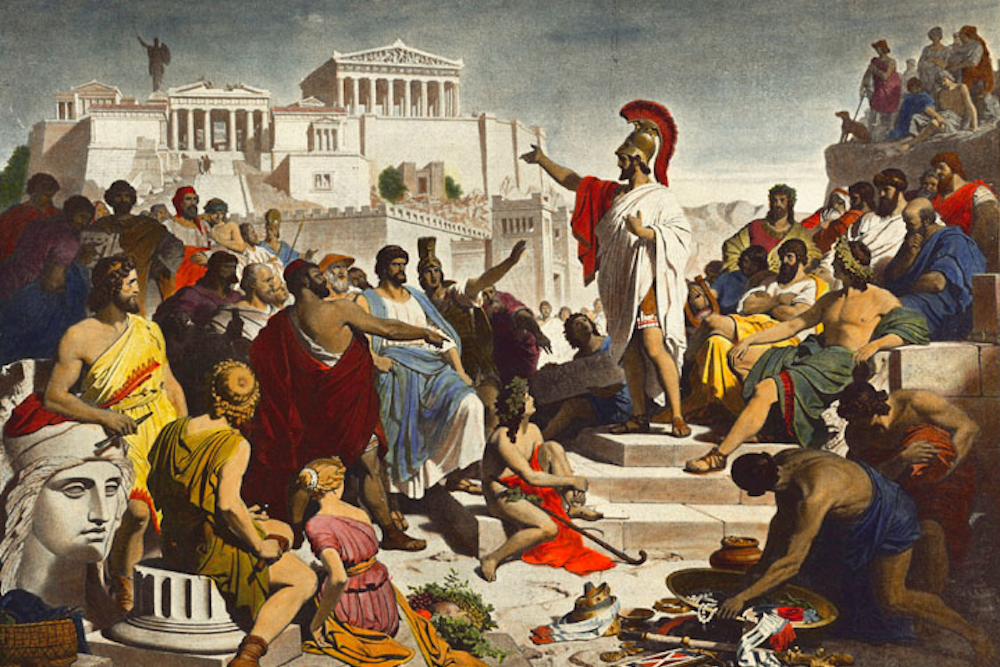
Painting by Philipp von Fotz depicting Pericles delivering his funeral oration in front of the Athenian Assembly. Courtesy of Wikimedia Commons.

by JOHN R. WALLACH | SEPTEMBER 26, 2018 (zocalopublicsquare.org)

Of all the political words that trip off our tongues yet bedevil understanding, one of the most important is “democracy.”

Strictly translated, it signifies authoritative power (kratos) by the citizenry or people (demos)—particularly the lower and middle classes—in the public affairs of a political order. Of course, this does not describe our reality.

We Americans live in a republic, whose laws are made by public officials in whom citizens invest power and authority, legitimating their power over the citizens who are governed. Citizens vote for their representatives, but there is often little relation between what citizens vote for and what their representatives do. Thus, President Lyndon B. Johnson campaigned on a peace platform in 1964; George W. Bush voted to keep America out of foreign entanglements in 2000; Donald Trump campaigned as (inter alia) a champion of the working man who would restore America’s infrastructure. The First Amendment grants citizens freedom of speech and religion, but those rights are extended only as far as is accepted by agents of the three branches of government. White supremacists can demonstrate in Charlottesville and the University of Virginia, but protesters at the Republican National Convention are put in pens far from the convention hall.

When today’s public officials refer to the American state as a democracy, they often do so to make themselves look good, not to be truthful. For few actually advocate programs that politically empower the people, and they often disregard the preferences of citizens. Polls show that a majority of citizens favor stricter regulations of guns and polluters; higher taxes on the wealthy; a relatively tolerant immigration policy; liberal views on “social issues”; and health care for all. Yet the Congress does not adhere to these public opinions—and I don’t think it’s because they’re smarter or more virtuous.

But the trouble with democracy transcends contradictions between words and deeds or citizens and their representatives. A fog blurs the meaning of democracy, especially when it is invoked to describe our political order. But that fog reveals a real question—is democracy a beneficial political order or merely a linguistic honey?

In my scholarship, I have found that confusion about democracy stems from the misunderstood and opaque relationship between democracy and ideas of goodness, especially goodness as it relates to common and public affairs. This misunderstanding is particularly disturbing in the midst of democracy’s invocation today: Few citizens understand democracy’s ability, practically or ethically, to improve our social lives, and few politicians genuinely want to.

Practical roots of this misunderstanding recur to the American founding. The drafters of the American Constitution did not intend to create a democracy—thus, the Electoral College and the Senate (although having two houses of Congress can have democratic benefits). To the contrary, they secured a republic that would regulate American democracy and protect slavery not only because of racism but also because they didn’t trust ordinary citizens with political power.

As the nation extended suffrage and abolished slavery and segregation, the political question became how democratic should the republic become. Americans may wonder whether greater democracy is even desirable, since few in the echelons of society that dominate public communications and our capitalist economy are prone to entrust more power to the many who are often seen as uncouth—incapable of political judgment and likely to threaten their positions.

While anti-democratic thought often stems from prejudices of one kind or another, it actually is true that democracy does not inherently provide an automatic guide for just political action. Democracy is not automatically just, because the demos is not automatically right. This is not a uniquely democratic foible; human beings are fallible. And it is not that we must fear “tyranny of the majority,” because a genuine political majority of a populace rarely exercises power. It was not a majority of the American citizenry that favored or fought for slavery; it was not a majority of the French citizenry that authorized the Reign of Terror; it was not a majority of the German citizenry that elected Hitler.

Besides this historical truth, political action in democracies and all other political orders occurs amid conditions of uncertainty. When citizens engage political dilemmas, they have reason to wonder exactly what the two conceptual pillars of democracy—freedom and equality— mean. What is political freedom for, if not anything should be allowed to “go”? How are we to put political equality into practice, if we do not seek sameness? This critique puts a moral and intellectual burden on the understanding and practice of democratic citizenship and governance: How can one be sure that becoming more democratic means that society and its citizenry will become better?

These questions of how and whether democracy produces goodness are serious and longstanding. Demokratia connoted the power of “the many” over “the few,” and noteworthy political theorists have argued that “the many” are more trustworthy political judges than “the few.” But neither is automatically good. Since its inception, democratic activity has needed ethical compasses to enable citizens who make decisions to do so beneficially, for the public as a whole. But there is no single intellectual or practical source for these compasses. Citizens may believe in God or think reasonably, but there is no God or Reason or website or algorithm that identifies the needs of democracy.

And that’s the point. We are not born with these virtues and practical skills. And yet everyone can learn the basic skills of political navigation, given the requisite general education and political experience.

This is why democracy can’t be only an ideal; it must be a practice of ongoing political activity wherever possible and practical to acquire this education and experience. When citizens’ political participation exclusively involves voting in official elections, it is reduced to being an adjunct to the agendas of the few individuals who both seek public office and have the wherewithal to be serious candidates. What I call the “political activity” of citizenship does not entail “activism” for all citizens, but it does require constant attention to the well-being of democracy. Every instance of democratic (not Democratic) opposition to republican (not Republican) rule needs to justify not only greater kratos for the demos but also political movement in a beneficial direction that reaches out persuasively to opponents. Every time women or subordinate races are mistreated as such, everyone should speak out on their behalf.

Citizens also need to explain to themselves and others why a political decision in a democratic society is good for the people. This calls for a kind of reconciliation between democracy and goodness that is hard to achieve. We must ask: How can democracy not only be an agent of power but also of goodness? And how can ethics, power, and knowledge operate practically in a way that benefit, rather than subvert, democracy? Without a democratic ethics, democracies will be run by factious majorities only interested in their own power. And with a democratic ethics that lose touch with actual citizens, a political elite may enact a morality that harms minorities or even the majority of those citizens.When today’s public officials refer to the American state as a democracy, they often do so to make themselves look good, not to be truthful. For few actually advocate programs that politically empower the people, and they often disregard the preferences of citizens.

Over the course of history in “the West” there have been various watchwords of goodness in democratic contexts that can be instructive. I have found five such watchwords that express ethical standards that complement democracy, although their benefits are no more automatic than democracy itself.

The first is “virtue,” used as a standard of political excellence. Today, it is hard to understand virtue in general, but we can identify unusual efforts to excel in honoring and promoting the well-being of the public realm—profiles in political courage. Among individuals, Abraham Lincoln, Jane Addams, Margaret Sanger, Franklin Delano Roosevelt, Fannie Lou Hamer, and Martin Luther King Jr., strike me as good candidates. But note that each of these examples stand on the shoulders of hundreds of thousands of ordinary citizens that energized them.

A second notion that must complement contemporary democratic ethics is “representation.” This term became politically salient in the 17th and 18th centuries as secular states sought legitimation by reaching out to non-aristocratic and even (at times) non-property-holding men. We cannot do without representation today, as it is needed to link large numbers of citizens to modern political power. It can be done well by promoting dialogue between leaders and those they lead. But it also can be a tool for consolidating rule by a political elite over the majority of citizens.

Third, there is a sense of “civil rightness,” a neologism I have coined to refer to equal opportunity plus merit. “Civil rightness” is the achievement of goodness in civil society. It became the economic hallmark for equality amid the competition that marks job-seeking in modern societies. It can be used to open doors, when equality is extended to relatively powerless people and practices in civil society, or to close doors, when notions of merit are practically used to block access by the meritorious but unconventional. That said, it cannot be ignored in contemporary societies if they would be both democratic and good.

A fourth guidepost for complementing democracy and goodness today is “legitimacy.” Previously used to define rightful heirs in powerful families, including royalty, it has become more widely used in public discourse since the beginning of the 20th century, when and where no one ethical standard for a non-theocratic collectivity and government was accepted by citizens.

The final watchword for reconciling democracy and goodness today is “human rights.” In official international discourse, it is a kind of goodness that automatically complements the democratic character of modern states. It has risen in importance since the end of the Cold War, and human rights organizations do good work when they shine light on the horrible, politically caused suffering of human beings. But even attachment to human rights can become undemocratic when focus on their abuse distracts attention from a society’s common political needs.

The goodness of democracy also requires cooperation—so that winners and losers in political contests keep playing with and against each other in the same “game” of promoting the public interest (as each sees it) in society. Democratic citizens, therefore, need to reach beyond themselves when acting politically, lest power become the only name of the game. Only if citizens learn productive arts of cooperation amid the slings and arrows of fortune can democracy become good. That is not easy amid the obstacles generated by society’s dominant powers. But it is a task that everyone can accomplish. Undertaking it suits us to cast futures that are both democratic and beneficial for our mortal selves and endangered planet.

JOHN R. WALLACH is professor of political science at Hunter College and the Graduate Center at the City University of New York and was a founder and the first Director of the Hunter Human Rights Program. He is author of Democracy and Goodness: A Historicist Political Theory.
Identity Politics and Civic Imagination

By Dmitri N. Shalin | April 5, 2021 (tikkun.org)

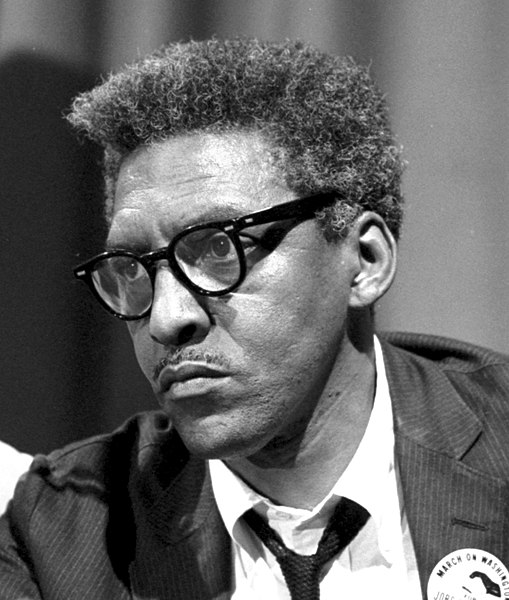
Leffler, Warren K., photographer; cropped by Beyond My Ken (talk) 09:59, 25 November 2010 (UTC), Public domain, via Wikimedia Commons

Bayard Rustin

On October 22 of 1883, Frederick Douglass attended a civil rights meeting in Washington D.C. where he observed a disturbing pattern of hatred that disempowered Americans showed toward their Black countrymen: “Perhaps no class of our fellow citizens has carried this prejudice against color to a point more extreme and dangerous than have our Catholic Irish fellow citizens, and yet no people on the face of the earth have been more relentlessly persecuted and oppressed on account of race and religion than the Irish people.”

Douglass singled out Irish immigrants, but the phenomenon he noticed was not unique to this group.  What he condemned was the all-too-common failure of civic imagination – the reluctance to acknowledge a shared humanity and reach out to the oppressed still struggling to gain full citizenship in a society plagued with prejudice and injustice.

This pattern has persisted over time and is now evident in the anti-gay stance taken by the Frederick Douglass Foundation.  According to Clarence Henderson, head of the North Carolina chapter of this conservative African American organization, “there’s no comparison” between the LGBTQ fight for gay rights and the African Americans’ struggle for civil liberties.  “How many gays or lesbians were lynched?” asks Henderson.  “There is a difference between what a human being is and what a human being does.”

This is from a man who in 1960 defied the authorities by refusing to vacate the Whites-only lunch counter in Greensboro.  Over half a century later, he became a leader in the organization that filed the amicus brief with the Supreme Court in support of the White bakery owner’s right to snub a Black couple looking to buy a wedding cake.We need your support to bring the kind of analyses and information Tikkun provides.
Click Here to make a tax-deductible contribution.

The ambivalence toward gays among African Americans has deep roots.  When Martin Luther King Jr. was tipped off about Bayard Rustin’s openly gay lifestyle, he distanced himself from the fellow civil rights leader and kept him at bay for several years.  As did Roy Wilkins who prevailed on his colleagues at NAACP to render Rustin invisible in the 1963 March on Washington.

In his autobiography, W. E. B. Du Bois gave a moving testimony about his own struggle with the issue: “A young man [Augustus Granville Dill], long my disciple and student, then my co-helper and successor to part of my work, was suddenly arrested for molesting men in public places.  I had before that time no conception of homosexuality.  I had never understood the tragedy of Oscar Wilde.  I dismissed my co-worker forthwith, and spent heavy days regretting my act.”

We should be careful to distinguish the deficit of civic imagination from the surfeit of bigotry driven by a hatred toward people on account of their membership in a supposedly inferior class.  Yet freedom fighters are known to harbor strong prejudices, juxtapose their political identities to those of lesser tribes, and insist on the superiority of their constitutional claims.

Susan B. Anthony, a women’s right pioneer and a committed abolitionist, turned against her longtime ally Frederick Douglas when he backed the 15th Amendment enfranchising Black men before White women.  Speaking at the 1869 American Equal Rights Association’s meeting, Ms. Anthony declared: “The old anti-slavery school say women must stand back and wait until the negroes shall be recognized.  But we say, if you will not give the whole loaf of suffrage to the entire people give it to the most intelligent first.  If intelligence, justice, and morality are to have precedence in the Government, let the question of woman be brought up first and that of the negro last.”

A few decades later, Alice Pole expressed a similar sentiment when she bristled at the prospect of Black and White suffragists marching side by side in the 1913 Women Suffrage Parade: “As far as I can see, we must have a white procession, or a Negro procession, or no procession at all.”

Charlotte Perkins Gilman’s bias was blunter still.  An ardent feminist and the acclaimed author of Women and Economics, she inveighed against immigrants inundating American cities.  Her attitude toward Jews was unabashedly racist, as she alleged in her autobiography that “one third of the inhabitants of New York now are Jews” and predicted “the rapidly descending extinction of our nation, superseded by other nations who will soon completely outnumber us.”

As these examples attest, being marginalized is no guarantee that one will be sensitive to the needs of minorities further down the totem pole, or that exclusionary practices would not infect the victorious liberation movement.  The tension brewing within the LGBTQ community is the latest manifestation of this pattern.

Midway through the 1990s, transgender activists began to join forces with the organizations advocating for the rights of gay, lesbians, and bisexual people on the assumption that their shared interests and the political clout of the LGB community would help advance the trans agenda.  Now the alliance shows strain, as the transgender and transexual activists discover that their priorities aren’t always aligned with the coalition partners.

Several activists writing for the inaugural issue of Transgender Quarterly sounded alarm about the fact that “more and more gender-normative, economically and racially privileged, coupled, and metropolitan gays and lesbians are crossing into the mainstream” (Heather Love).  Ana Cristina Marques recently published a paper where she spotted the “radical trans-exclusionary feminist attacks on transgender people” which, her research showed, could make transgender people feel unwelcome in the spaces patronized by gays and lesbians.

The issues dividing the advocates for these group are complex, the most salient ones being the traditional gender binary and the embodiment challenges stemming from sex-reassignment, neither of which riles gay and lesbians the way they can disrupt the lives of transgender folk.  But these issues are serious enough for students of gender and trans rights advocates like Susan Stryker and Zein Muribo to contend that “LGBT privileges the expression of sexual identity over gender identity,” that “listing ‘T’ with ‘LGB’ – and at the end, no less – locates transgender as an orientation,” and that “although the inclusion of transgender alongside lesbian, gay, and bisexual opened up new political alliances across these groups, it also closed off possibilities for coalitions with different political groups – such as activists fighting for immigrant rights who face concerns over documentation that are similar to those of transgender people.”

I will not go into the nascent friction between the transgender and queer advocates over who better represents the marginalized people, the friction that threatens to further weaken the LGBTQ coalition.  The point is that we need to rethink what we mean by “identity” and “alliance” if we want to fend off the more destructive implications of identity politics.

Identity is not a fixed quality, a visible attribute manifesting itself in predictable fashion across space and time.  It is an ongoing accomplishment, a project we undertake to realign our actions, feelings, and words in response to competing possibilities for enselfment.  Contrary to popular belief, self-identity has more to do with what one does than with what one is.  It is always tested by our rival commitments which are bound to clash on occasion and muddle our allegiances.

The competing demands on our civic imagination remind us that alliances we form are not sacrosanct, that cliques, groups, and classes we belong to are not entities safeguarded by border patrols but emergent social fields whose gravitational pull is bound to breed ambivalence – a mark of emotional intelligence pervading moral life.

Nor should the exercise of civic imagination be limited to human targets.  What about animal rights, living creatures subject to vivisection for the benefit of humankind?  Maybe it’s time to phase out Premarin, the estrogen-based drug (used by transgender people among others) which is extracted from the urine of mares forcibly impregnated and kept for months in cramped stalls.  And is it too fanciful to extend civic imagination to the planet earth whose depth we plunder and whose habitats we methodically destroy?

So, before we cast a jaundiced eye at the civil rights fighters of yore who were not as woke as we are, we should check our own privileges and reach out to those who fair worse than we are.

Bayard Rustin lived as an openly gay man long before society acknowledged his right to do so.  The year he died, in1987, he stated: “Twenty-five, 30 years ago, the barometer of human rights in the United States were black people.  That is no longer true.  The barometer for judging the character of people in regard to human rights is now those who consider themselves gay, homosexual, lesbian.”

Not everybody is blessed with the clear-sightedness and audacity of Bayard Rustin.  It took years for Barack Obama to evolve on the issue of marriage equality before he summoned his valor and got onboard.  There is room for all of us to evolve.  And keep evolving, as we practice civic imagination and reach across political divides.

We need your support to bring the kind of analyses and information Tikkun provides.
Click Here to make a tax-deductible contribution.

ABOUT DMITRI N. SHALIN

Dmitri N. Shalin is professor of sociology and director of the UNLV Center for Democratic Culture. Dr. Shalin is coordinator of Justice & Democracy Forum series, editor of the Social Health of Nevada Report, co-director of the International Biography Initiative and Erving Goffman Archives, and organizer of international forums on Russian politics and culture. His research interests and publications are in the areas of pragmatism, emotional intelligence, autobiographical discourse, democratic culture, and Russian society.

Mercury conjunct Chiron – the Gift inside the Wound

April 6, 2021 (astrobutterfly.com)

On April 9th, 2021 Mercury is conjunct Chiron at 9° Aries.

Mercury conjunct Chiron is an opportunity to take a close look at our wounds, and discover their hidden treasure. When we have a Chiron transit, the gift is ALWAYS found in unlikely places: deep inside the wound.

Chiron is known as the “Wounded Healer”.

Wounded Healer is a metaphor initially used by Carl Jung to describe therapists that want to become therapists PRECISELY because of a personal wound they are continuously trying – but are unable – to heal.

This unhealed wound draws them to people who share the same wound.

However, Carl Jung (and later, other psychologists and scientists) also discovered that unless we heal our wound, we cannot truly help others. We will, at best, sympathize with the wounded.

We will, at best, hold space and give others the opportunity to explore their wound from different angles.

However, a wounded healer also risks projecting their personal wounding process onto others, and ultimately, giving bad healing advice.

Unless we heal ourselves first, we just don’t know what works and what doesn’t.

You want business advice from people who have successful businesses, not from people who are eager to help (but lack experience). You want legal help from lawyers who have a track record of winning cases (and not just a passion for helping their clients).

You want nutrition advice from people in good health. And you want healing from someone who has healed themselves first.

Coming back to Chiron. Chiron is not ‘just’ a Wounded being trying to figure things out.

If we go back to the Greek myth, we learn that Chiron was a wise centaur that HAS figured things out, becoming the greatest teacher and healer of his time.

Unlike other Centaurus, who were untamed and troublemakers, Chiron was wise and level-headed.

Chiron has reconciled his animal nature with his divine nature, taking the best of these two worlds, and becoming a holistic teacher and healer.

Chiron And Wholistic Healing

How did that happen? What made Chiron different?

Chiron was born half-man, half-horse. Disgusted by his appearance, his mother abandons him at birth. This was Chiron’s primal wound – the wound of rejection.

Thankfully, Apollo (the Greek counterpart of the Sun) adopts Chiron and teaches him ‘Solar’ skills, such as prophecy and poetry.

This, combined with Chiron’s half-horse a.k.a animal and instinctual nature, gave Chiron a unique advantage, and helped him become a revered and respected teacher.

He understood both the workings of nature and the workings of the divine, and became a Whole-istic healer.

IMPORTANT: If Chiron was not abandoned at birth, he couldn’t have been adopted by Apollo, and he wouldn’t have had the chance to bridge the gap from nature to spirit. This initial abandonment, this initial wound, was precisely what made Chiron so special.

Our Chiron wound is the “initial condition” – what we need to not only accept, but also integrate, and use as a catalyst for growth.

Chironic healing is not just the process of finding relief from pain – it is the process of reconciling what is otherwise incompatible or unacceptable within ourselves.

When we bridge these two otherwise conflicting worlds, we ‘heal’, and discover our unique gift.

The Chiron wound is that quality you have that is initially seen as “unacceptable” because it is odd, non-ordinary or goes against the social norms. How can a horse also be a man? How can a man also be a horse? How can a black person have light skin? How can a boy behave like a girl?

But it is precisely this reconciliation of these opposing natures that not only ‘heals’ our wound, but also becomes our unique advantage, our ‘value proposition’, our greatest gift.

Mercury Conjunct Chiron – Becoming Aware Of What Hurts

Let’s come back to Mercury conjunct Chiron.

Any Chiron transit will stir the Chironic process we described.

With Mercury, it’s words, thoughts, and memories that will trigger our old wounds and hurts.

When Mercury is conjunct Chiron, we often recall some hurtful things someone has said to us. Parents or siblings that bullied us, teachers that undermined our self-confidence, colleagues or peers that made us feel odd or inadequate.

Mercury helps us “see” and understand what is otherwise difficult to grasp. When Mercury is conjunct Chiron, we can finally acknowledge our primal Chiron wound of inadequacy.

Chiron Healing Approaches

Let’s say you stuttered as a child, and your colleagues bullied you.

What do we do when these hurtful memories resurface? Most of the time, we take one of the following two approaches:

1) the most ineffective approach: the memory is so hurtful, that you reject it, and choose not to process it. You numb it down, either by thinking of something else, or by consuming substances. Even yoga and meditation, otherwise excellent practices, can do more harm than good when used to numb down our wounds.

2) less ineffective, but with no true growth potential: you process the emotion, but try to convince yourself that there is nothing wrong: “My voice is beautiful”. Or “It doesn’t matter if I stutter, I also have many other qualities, nobody’s perfect”. Or “Bullying says everything about the bully, not about me. I am so over it”.

However, there is another way to deal with the wound: you not only acknowledge these past hurts, but also seek the treasure behind them.

If it still bothers you, chances are there is something in there that requires your attention.

If it’s still there, it means it has already influenced your life in a profound way.

In your attempts to overcome the ‘handicap’, you have found alternative ways of dealing with it, and developed some skills you would not have otherwise developed.

Perhaps your awareness of your stuttering made you pay extra attention to what you say, and as a result, your communication is now more clear and articulate.

Research has shown that people who stutter are more aware of the mistakes they make (not only in speech), and are ALSO more eager to correct their mistakes. This makes them perfectionists, which is a great skill especially in professions that require error-free operations, e.g. medicine or engineering.

Sometimes the link between the wound and the gift is quite obvious: the child who stutters eventually becomes a singer or a communication expert.

Other times the link is less obvious: the child who stutters later becomes a great aviation engineer, thanks to their discipline and attention to detail.

Mercury Conjunct Chiron – The Gift Inside The Wound

The gift inside the wound may not be very obvious at first, but a Mercury-Chiron transit is one of the best opportunities to become aware of the relationship between the wound and the gift.

When we have a Chiron transit, healing the wound doesn’t only mean finding relief from pain – it means digging into the wound until we find the deeper meaning behind it.

If there is something about yourself that is still bothering you, chances are there is a gift there to be unveiled. A potential that is yet to materialize. That wound is the KEY to something much greater. That wound will continue to bug you until you recognize the gift behind it.

Mercury rules over our communication – not only our communication with other people, but also with ourselves.

That voice inside your head (which we call thoughts), is nothing else but Mercury having a conversation with you. It is Mercury trying to tell you something, trying to get your attention on something that needs to be understood at a deeper level.

Mercury brings clarity. With Mercury conjunct Chiron, it is easier to articulate and acknowledge the wound, and most importantly, to become aware of the gift inside the wound.

–Astro Butterfly

The State of Our Democracy, featuring Timothy Snyder

Bowdoin College In the aftermath of the January 6 attack on the Capitol, the College is presenting a series of discussions with leading experts on the current state and future prospects for American democracy. Timothy Snyder is the Richard C. Levin Professor of History at Yale University and a permanent fellow at the Institute for Human Sciences in Vienna. He specializes in the history of fascism in twentieth-century Europe. He is the author of On Tyranny, described by The Washington Post as “a slim book that fits alongside your pocket Constitution and feels only slightly less vital,” and published an essay in The New York Times titled “The American Abyss” about the sources and meanings of the January 6 insurrection. Moderated by Page Herrlinger, associate professor of history.

One Republican’s Lonely Fight Against a Flood of Disinformation

After losing an ugly congressional race last year, Denver Riggleman is leading a charge against the conspiracy-mongering coursing through his party. He doesn’t have many allies.

Denver Riggleman, a Republican former congressman from Virginia, recounted trying last summer to warn his colleagues that the QAnon conspiracy theory was dangerous.
Denver Riggleman, a Republican former congressman from Virginia, recounted trying last summer to warn his colleagues that the QAnon conspiracy theory was dangerous.Credit…Matt Eich for The New York Times
Jeremy W. Peters

By Jeremy W. Peters

April 3, 2021 (NYTimes.com)

AFTON, Va. — Denver Riggleman stood virtually alone.

It was Oct. 2, on the floor of the House of Representatives, and he rose as one of only two Republicans in the chamber to speak in favor of a resolution denouncing QAnon. Mr. Riggleman, a freshman congressman from Virginia, had his own personal experiences with fringe ideas, both as a target of them and as a curious observer of the power they hold over true believers. He saw a dangerous movement becoming more intertwined with his party, and worried that it was only growing thanks to words of encouragement from President Donald J. Trump.

“Will we stand up and condemn a dangerous, dehumanizing and convoluted conspiracy theory that the F.B.I. has assessed with high confidence is very likely to motivate some domestic extremists?” asked Mr. Riggleman, a former Air Force intelligence officer. “We should not be playing with fire.”

Six months later, conspiracy theories like QAnon remain a threat that most Republicans would rather ignore than confront, and Mr. Riggleman is out of office. But he is ever more determined to try to expose disinformation from the far right that is swaying legions in the Republican base to believe in a false reality.

Mr. Riggleman is a living example of the political price of falling out of lock step with the hard right. He lost a G.O.P. primary race last June after he officiated at the wedding of a gay couple. And once he started calling out QAnon, whose followers believe that a satanic network of child molesters runs the Democratic Party, he received death threats and was attacked as a traitor, including by members of his own family.

The undoing of Mr. Riggleman — and now his unlikely crusade — is revealing about a dimension of conservative politics today. The fight against radicalism within the G.O.P. is a deeply lonely one, waged mostly by Republicans like him who are no longer in office, and by the small handful of elected officials who have decided that they are willing to speak up even if it means that they, too, could be headed for an early retirement.

“I’ve been telling people: ‘You don’t understand. This is getting worse, not better,’” Mr. Riggleman said, sitting on a stool at his family bar one recent afternoon. “People are angry. And they’re angry at the truth tellers.”

Mr. Riggleman, 51, is now back home in the foothills of the Blue Ridge Mountains, where he and his wife run the bar and a distillery. And for his next move in a career that has included jobs at the National Security Agency and founding a military contracting business, he is working with a group of other experts to shine a light on what he calls the “social disease” of disinformation.

His experience with the issues and emotions at work is both professional and personal. He was so intrigued by false belief systems that he self-published a book about the myth of Bigfoot and the people who are unshakably devoted to it.

Mr. Riggleman is working with a group of other experts to shine a light on what he calls the “social disease” of disinformation.
Mr. Riggleman is working with a group of other experts to shine a light on what he calls the “social disease” of disinformation.Credit…Matt Eich for The New York Times

Mr. Riggleman, who first ran and won in 2018 after the Republican incumbent in his district retired, joined the arch-conservative Freedom Caucus and was endorsed by Mr. Trump.

Now he says it “gives me shivers” to be called a Republican. He hopes to show that there is still a way to beat back the lies and false beliefs that have spread from the fringe to the mainstream. It is a heavy lift, and one that depends on overcoming two strong impulses: politicians’ fear of losing elections and people’s reluctance to accept that they were taken in by a lie.

Mr. Riggleman summarized his conversations with the 70 percent of House Republicans he said were privately appalled at the former president’s conduct but wouldn’t dare speak out.

“‘We couldn’t do that in our district. We would lose,’” he said. “That’s it. It’s that simple.”

Stocky, fast-talking and inexhaustibly curious, the former congressman is now working for a group of prominent experts and academics at the Network Contagion Research Institute, which studies the spread of disinformation in American politics and how to thwart it. The group has undertaken several extensive investigations into how extremists have used propaganda and faked information to sow division over some of the most contentious issues of the day, like the coronavirus pandemic and police violence.

Their reports have also given lawmakers a better understanding of the QAnon belief system and other radical ideologies that helped fuel the riot at the Capitol on Jan. 6.

Mr. Riggleman said he had written one report about the involvement of far-right militants and white supremacist groups in the attack specifically at the request of a Republican member who needed help convincing colleagues that far-left groups were not the culprits.

Getting lawmakers to see radical movements like QAnon as a threat has been difficult. Joel Finkelstein, the director of the Network Contagion Research Institute, said that in June, when the group tried to sound the alarm on QAnon to members of Congress, Mr. Riggleman was the only one who responded with a sense of urgency and agreed to help.

“We were screaming it from the rooftops,” Mr. Finkelstein said. “We said: ‘This is going to be a problem. They’re growing increasingly militant in their conspiracies.’” When the institute’s members spoke to Mr. Riggleman, he said, “We showed him our data and he said, ‘Holy moly.’”

Far from a theoretical or overblown concern, disinformation and its role in perpetuating false beliefs about Mr. Trump’s election loss and its aftermath are problems that some Republicans believe could cripple their party if left ignored.

In a sign of how widespread these conspiracy theories are, a recent poll from Suffolk University and USA Today found that 58 percent of Trump voters wrongly believed the storming of the Capitol was mostly inspired by far-left radicals associated with antifa and involved only a few Trump supporters.

“There was a troika of us who said, ‘This is going to a bad place,’” said Paul Mitchell, who represented Michigan in the House for two terms before retiring early this year in frustration. He said he had watched as members dismissed Mr. Riggleman, despite his experience in intelligence. “There weren’t many people who gave a damn what your expertise was,” Mr. Mitchell said. “It was inconsequential compared to the talking points.”ImageBob Good defeated Mr. Riggleman in a state Republican Party convention in June.Credit…Amy Friedenberger/The Roanoke Times, via Associated Press

Mr. Riggleman’s loss last summer in a closely held party convention allowed him to be more outspoken. The winner, Representative Bob Good, is a former associate athletic director at Liberty University who took issue with Mr. Riggleman’s officiation at the gay wedding and called him “out of step” with the party’s base.

And as Mr. Riggleman kept it up and spoke out more aggressively against Mr. Trump after the election, his fight got lonelier.

“I had a colleague of mine pat me on the shoulder and say: ‘Denver, you’re just too paranoid. You’re killing yourself for the rest of your life politically by going after the big man like this,’” Mr. Riggleman recalled.

When he returned to Virginia for good in January, he said he sometimes felt just as isolated. Family members, former constituents and patrons at the distillery insisted that the election had been stolen from Mr. Trump. And they couldn’t be talked out of it, no matter how hard he tried.

He recalled a recent conversation with one couple he is friends with that he said was especially exasperating.

“I go over stats,” he said. “I go over figures. I go over the 50 states, how that actually works. How machines that aren’t connected are very hard to hack. How you’d have to pay off hundreds of thousands of people to do this.”

“Did not convince them,” he added.

Other friends of his, some of whom are also members of the growing group of former Republican lawmakers now publicly criticizing Mr. Trump, said that many conservative politicians saw no incentive in trying to dispel disinformation even when they know it’s false.

“What some of these guys have told me privately is it’s still kind of self-preservation,” said Joe Walsh, a former congressman from Illinois who ran a short-lived primary campaign against Mr. Trump last year. “‘I want to hang onto the gig. And this is a fever, it will break.’”

That is mistaken, Mr. Walsh said, because he sees no breaking the spell Mr. Trump has over Republican voters anytime soon. “It’s done, and it was done a few years ago,” he said.

Mr. Riggleman, who is contemplating a run for governor in Virginia and is writing a book about his experience with the dark side of Republican politics, sees a way forward in his experience with Bigfoot. The sasquatch was how many people first learned about him as a politician, after an opponent accused him of harboring a fascination with “Bigfoot erotica,” in 2018.

“I do not dabble in monster porn,” he retorts in his book, “Bigfoot … It’s Complicated,” which he based in part on a trip he took in 2004 on a Bigfoot expedition.ImageMr. Riggleman paid $2,000 to go on a Bigfoot expedition with his wife in 2004.Credit…Matt Eich for The New York Times

The book is full of passages that, if pulled out and scrubbed of references to the mythical creature, could be describing politics in 2021.

Mr. Riggleman quotes one true believer explaining why he is absolutely convinced Bigfoot is real, even though he has never seen it. In an answer that could have come straight from the lips of someone defending the myth that Mr. Trump actually won the 2020 election, the man says matter-of-factly: “Evidence is overwhelming. Check out the internet. All kinds of sightings and facts.”

At another point, Mr. Riggleman describes a conversation he had with someone who asked if he really thought that all the people claiming to have seen Bigfoot over the years were liars. “I don’t think that,” Mr. Riggleman responds. “I do believe that people see what they want to see.”

He did find one way to crack the Bigfoot false belief system: telling true believers that they were being ripped off to the tune of hundreds or thousands of dollars to go on expeditions where they would never actually see the creature.

“They got very angry,” he said. But eventually, some started to come around.

(Contributed by Michael Kelly, H.W.)

David Attenborough’s warning: are humans responsible for pandemics? | Extinction: The Facts – BBC

BBC Subscribe and ? to OFFICIAL BBC YouTube ? https://bit.ly/2IXqEIn​ Stream original BBC programmes FIRST on BBC iPlayer ? https://bbc.in/2J18jYJ​ With a million species at risk of extinction, Sir David Attenborough explores how this crisis of biodiversity has consequences for us all, threatening food and water security, undermining our ability to control our climate and even putting us at greater risk of pandemic diseases. Extinction is now happening up to 100 times faster than the natural evolutionary rate, but the issue is about more than the loss of individual species. Everything in the natural world is connected in networks that support the whole of life on earth, including us, and we are losing many of the benefits that nature provides to us. The loss of insects is threatening the pollination of crops, while the loss of biodiversity in the soil also threatens plants growth. Plants underpin many of the things that we need, and yet one in four is now threatened with extinction. Last year, a UN report identified the key drivers of biodiversity loss, including overfishing, climate change and pollution. But the single biggest driver of biodiversity loss is the destruction of natural habitats. Seventy-five per cent of Earth’s land surface (where not covered by ice) has been changed by humans, much of it for agriculture, and as consumers we may unwittingly be contributing towards the loss of species through what we buy in the supermarket. Our destructive relationship with the natural world isn’t just putting the ecosystems that we rely on at risk. Human activities like the trade in animals and the destruction of habitats drive the emergence of diseases. Disease ecologists believe that if we continue on this pathway, this year’s pandemic will not be a one-off event. Extinction: The Facts | BBC #BBC#BBCExtinctionTheFacts#BBCiPlayer​ All our TV channels and S4C are available to watch live through BBC iPlayer, although some programmes may not be available to stream online due to rights. If you would like to read more on what types of programmes are available to watch live, check the ‘Are all programmes that are broadcast available on BBC iPlayer?’ FAQ ? https://bbc.in/2m8ks6v​.

Orson Welles’s adaptation of Plato’s timeless allegory of the cave

Warning: this film features rapidly flashing images that can be distressing to photosensitive viewers.

10 August 2020 (aeon.co)

It is the task of the enlightened not only to ascend to learning and to see the good but to be willing to descend again to those prisoners and to share their troubles and their honours, whether they are worth having or not. And this they must do, even with the prospect of death.
– Plato’s Republic, Book 7

Plato’s allegory of the cave thought-experiment ponders the experience of prisoners shackled in a cave from birth, only able to see the shadows of objects projected onto a wall. The text then traces the journey of a prisoner who is set free from the cave, given the opportunity to experience reality in the glow of the Sun and, upon returning to the cave, is met with laughter by the other prisoners, who think him a fool for struggling to readjust to his old existence. A simple story yielding complex commentaries on the nature of reality and wisdom, Plato’s timeless allegory is built into the foundations of modern philosophy and, more than two millennia later, still stirs debate. Carried by a rich narration from Orson Welles, this rarely seen 1973 animated adaptation of Plato’s words populates the tale with haunting human figures, bringing retro-surreal life to the parable.

Via Open Culture

Director: Sam Weiss

Narrator: Orson Welles

Animator: Dick Oden