
Monthly Archives: April 2021
Book: “The Dead”

The Dead
by James Joyce
Often cited as the best work of short fiction ever written, Joyce’s story details a New Year’s Eve gathering in Dublin that is so evocative and beautiful that it prompts the protagonist’s wife to make a shocking revelation to her husband—closing the story with an emotionally powerful epiphany that is considered one of the best in modern literature.
(Goodreads.com)
Mickey Donovan on where great kids come from

“Great kids come from great fucks.”
— Mickey Donovan, Ray Donovan, Season 6
Mickey Donovan is the deuteragonist of Ray Donovan. He is a gangster and ex-convict, who served 20 years in prison for a murder which he did not commit, and is the father of Ray, Bunchie, Terry, Bridget and Daryll.
Warriors’ James Wiseman Consumed with chasing greatness, leans on Kobe Bryant’s teachings, meditation and music
Story by Connor Letourneau | April 3, 2021 (SFChronicle.com)
At least once a day, Warriors center James Wiseman sits in his room as he stares at a notebook with words and images that represent his goals: All-Star. Defensive Player of the Year. NBA champion. MVP. Hall of Famer.
For about 10 minutes, Wiseman imagines his fully realized self, a process of visualization he started a couple of months ago. He’d read that Kobe Bryant and Michael Jordan considered it a driving force behind their greatness. Wiseman, who was struggling with the speed and physicality of NBA games, wanted to be an all-time great. He was 19. He had a plan.
EDITOR’S NOTE
This is the second installment of “Wiseman’s Way,” a series chronicling James Wiseman’s rookie season with the Warriors.
Read Part 1: Family sacrifices helped Warriors’ James Wiseman live his dream. ‘Now it’s my turn to help’
“If you look at something every day, you can actually manifest it,” Wiseman said. “You just look at it every day, and that gives you motivation to keep moving toward that certain objective.”
Wiseman, who turned 20 on Wednesday, often gets frustrated by how far he is from some of his goals. His obsession with film study hasn’t kept him from botching box-outs or defensive rotations 35 games into his rookie season. For all his immense physical tools, Wiseman has yet to prove he can be a key part of a winning NBA team.
The narratives have been critical, with fans and analysts bemoaning the Warriors’ decision to draft him over LaMelo Ball, a national sensation and Rookie of the Year front-runner for Charlotte before he suffered a potentially season-ending wrist injury two weeks ago. But they also tend to overlook Wiseman’s unenviable acclimation to the NBA. The preseason lost to a positive coronavirus test. The 11 games sidelined by a sprained left wrist. The additional three games spent in the NBA’s health and safety protocols.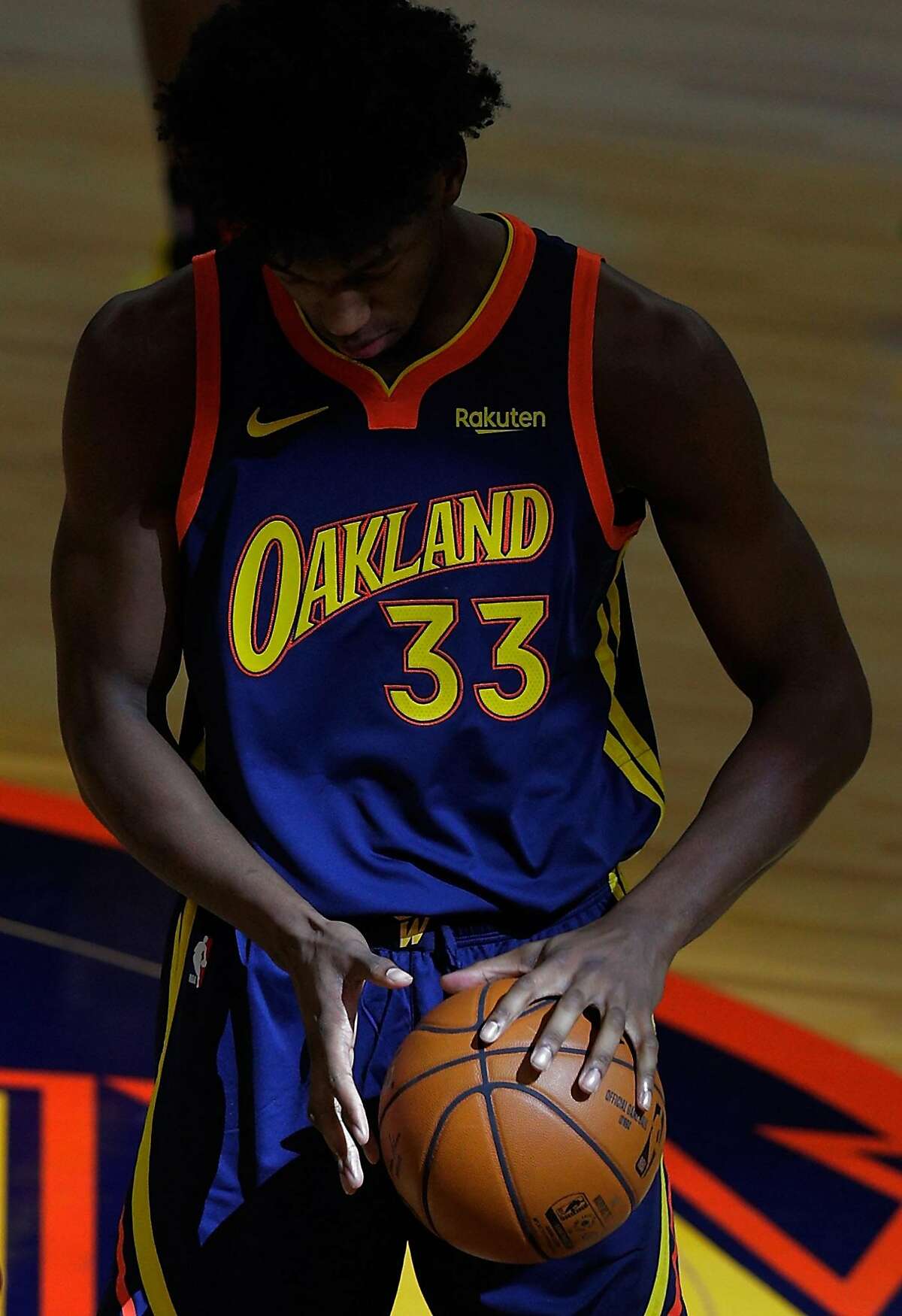
James Wiseman warms up before the Warriors’ game against the the Philadelphia 76ers at Chase Center in San Francisco, on March 23. | Carlos Avila Gonzalez / The Chronicle
Wiseman has tried to stay off social media, but he’s well aware that many believe he won’t make good on his predraft hype. A recent ESPN report suggested that his role had become a “source of organizational tension.” While some think trial-by-fire situations would only help Wiseman’s development, others are adamant that he should be eased into a heavy workload.
Such scrutiny can’t compare, however, to the pressure he puts on himself. A self-described perfectionist, Wiseman has become so consumed with chasing greatness that his closest confidants worry he is losing perspective. His mother, Donzaleigh Artis, and sister, Jaquarius Greer, remind him daily that he is in a league of grown men. Struggles were inevitable.
What comforts Steve Kerr is that Wiseman has all the hallmarks of a perennial All-Star: the talent, the work ethic, the drive. At some point, hopefully sooner rather than later, the Warriors head coach believes Wiseman will get the breakthrough he is seeking.
“He’s going to be amazing,” Kerr said. “We all just have to be patient.”

James Wiseman (33) attempts to block the Lakers’ Montrezl Harrell at Chase Center on March 15. | Carlos Avila Gonzalez / The Chronicle
Last month, after watching Wiseman foul out in a blowout loss to the Lakers, Artis awoke at 9 a.m. to meet him in the parking lot before his coronavirus test. Sitting in the passenger seat of Wiseman’s black Ford F-150, Artis blared a hip-hop song as she sang along. Wiseman chuckled.
Artis, a retired school bus driver and gas station attendant who now lives five floors below her son at a luxury apartment complex in San Francisco’s Mission Bay, considers it her job to keep Wiseman positive. But in a season rife with setbacks, his good times have seldom lasted long.
The following night, Artis could hear the melancholy in his voice as he explained over the phone that he wouldn’t be traveling with the team for his homecoming games in Memphis. Wiseman had entered the league’s health and safety protocols because a team staffer with whom he shared a table had tested positive for the coronavirus.

“He’s going to be amazing. We all just have to be patient.”
STEVE KERR
After quarantining in his Houston hotel room for two nights, Wiseman would fly back to San Francisco, where he’d continue to self-isolate for five days. This devastated Wiseman, whose mom had spent weeks arranging Warriors-Grizzlies tickets for more than 40 friends and relatives. Her hotel and flights already booked, Artis flew to Memphis anyway, spending much of her two-day trip commiserating with Greer about how much they wished Wiseman were there.
“This season is beginning to be just so disappointing,” Artis said. “Every time he takes two steps forward, they push him back nine steps.”
Wiseman knew when he left the University of Memphis after only 69 minutes of playing time that he’d face a steep learning curve in the NBA. What he couldn’t have predicted, however, was that a global pandemic would present numerous more challenges.
The draft was pushed back five months, which forced the NBA to cancel summer leagues and condense training camps. After he missed the Warriors’ three preseason exhibitions because of a positive coronavirus test, Wiseman arrived early to practices and stayed late studying film, only to suffer a wrist injury in late January that sidelined him nearly a month.
By the time Wiseman entered the league’s health and safety protocols two weeks ago, he had made an agreement with his mom and sister that they’d all take a break from social media. Tweets and Instagram posts about Wiseman, decidedly complimentary at the start of the season, had turned negative. A rash of poor performances prompted calls for the Warriors to trade their “bust.”

“He’s always been so hard on himself. But when I talk to him, I just remind him, ‘You’re right on track. Don’t let anyone make you believe otherwise.’ ”
THOMAS COLEMAN
From time to time, Kerr invited Wiseman to his hotel room, where he reminded him that all the lessons learned this season would fuel long-term gains. Warriors teammates Stephen Curry and Draymond Green also tried to comfort Wiseman with stories about how they were benched as rookies.
Among rookies, Wiseman ranks tied for first in blocks (1 per game), second in rebounding (5.8 per game), fourth in shooting percentage (51.2) and fifth in scoring (11.5 points per game). But he is just 12th in minutes (21.8 per game), which is on pace to be the lowest for a No. 2 overall pick since Hasheem Thabeet in 2009-10. The reason isn’t complicated: The Warriors have played better without him. According to NBA.com, they have outscored opponents by 2.6 points per 100 possessions with Wiseman on the bench — a far cry from the 9.6 points per 100 possessions they’ve been outscored by when he’s on the floor.
Stephen Curry tries to fire up James Wiseman in fourth quarter of the Warriors’ 119-104 loss to the New York Knicks at Chase Center on Jan. 21. | Scott Strazzante / The Chronicle
Out of 250 qualifying players on FiveThirtyEight’s player-ranking system, Wiseman is 249th. Perhaps most concerning, though, is his inability to complement the face of the franchise. Wiseman has yet to figure out where and how to find Curry — a tricky proposition for any newcomer acclimating to his frenetic playing style. The Warriors average 103.2 points per 100 possessions when Curry shares the floor with Wiseman, but that number spikes to 117.3 points per 100 possessions when Curry is on the floor with any other center.
By announcing last week that Wiseman would start the rest of the season, Kerr showed that he’s prioritizing the center’s development over making the playoffs. Still, Wiseman said he feels like a failure sometimes.
Two months ago, when Ball’s highlight-worthy passes and gaudy stats were becoming a national story line, Wiseman found himself checking his fellow rookie’s box scores after games. Coaches and family members told him that centers take longer to acclimate to the NBA than guards, that his time was coming. It did little to lessen the sting: The player drafted one spot after him was outplaying him.
“Not going to lie, I was thinking about all of that at first,” Wiseman said. “But after a while, I got to the point where I was like, ‘You know what? I’m just going to worry about myself. God knows I already have enough to occupy my mind, anyway.’ ”
Warriors rookie James Wiseman stands by the window in his apartment in San Francisco on March 28. Photographer’s note: To adhere to the NBA’s coronavirus precautions, this photo was made from a remote camera held by Wiseman’s assistant inside the apartment while the photographer, looking at a computer outside, triggered the frame. | Carlos Avila Gonzalez / The Chronicle
Each morning, before he brushes his teeth or changes his clothes, Wiseman opens the Calm app on his iPhone and lets his mind go blank as he listens to guided meditations.
For nearly two years, introspection has been a part of his daily routine. The summer before Wiseman’s freshman year at Memphis, he watched a YouTube video of his idol, Bryant, talking about the power of meditation. Wiseman started using the app and zoning out to low-frequency beats online, anything to help him stop overthinking.
Wiseman considers that just one of many ways the late Bryant has helped him. Though Wiseman never met Bryant, beyond a quick handshake at a Nike camp during Wiseman’s junior year of high school, he has tried to follow Bryant’s blueprint for greatness.
In addition to watching almost every Bryant interview he could find on YouTube, Wiseman has read Bryant’s “Wizenard Series” of children’s books. Whenever Wiseman needs inspiration, he revisits Bryant’s autobiography, “The Mamba Mentality: How I Play.”
One chapter, on Bryant’s struggles adjusting to life in the NBA as a 17-year-old straight out of high school, particularly resonated with Wiseman. Bryant averaged just 7.6 points per game on 41.7% shooting as a rookie, and he didn’t have to deal with the physicality of the league’s best centers. Another one of Wiseman’s idols, power forward Kevin Garnett, scored fewer points as a 19-year-old rookie than Wiseman is currently averaging — despite significantly more playing time.
“He’s always been so hard on himself,” said Thomas Coleman, Wiseman’s childhood coach. “But when I talk to him, I just remind him, ‘You’re right on track. Don’t let anyone make you believe otherwise.’”
While training for the draft in Miami, Wiseman started making hip-hop beats on his computer. In recent months, when the stress of basketball began to wear on him, he recorded a few raps over his instrumentals. The writing process served as a sort of therapy for Wiseman, whose lyrics deal with everything from fame to his Christian faith.
Warriors rookie James Wiseman reads from the “Wizenard Series Season One” book in his apartment in San Francisco on March 28. Photographer’s note: To adhere to the NBA’s coronavirus precautions, this photo was made from a remote camera held by Wiseman’s assistant inside the apartment while the photographer, looking at a computer outside, triggered the frame. | Carlos Avila Gonzalez / The Chronicle
Warriors rookie James Wiseman plays some beats he created on his laptop in his apartment in San Francisco on March 28, 2021. Photographer’s note: To adhere to the NBA’s coronavirus precautions, this photo was made from a remote camera held by Wiseman’s assistant inside the apartment while the photographer, looking at a computer outside, triggered the frame. | Carlos Avila Gonzalez / The Chronicle
With many churches closed because of the pandemic, he has taken to reading the Bible every night before bed. His favorite book is Philippians; those passages on overcoming personal challenges have helped him this season. Some nights, when scripture isn’t enough to ease his racing mind, Wiseman shoots Artis a text: “You up? Can I come down?”
At the start of the All-Star break last month, Wiseman was eager to relax with his mom. One night, while playing the tile game Rummikub with Artis, Wiseman realized he’d forgotten to take a league-mandated coronavirus test.
The oversight received national attention and raised questions about his professionalism. After Wiseman was forced to sit out a practice and three quarters of a game against the Clippers, he started arriving to the testing center more than an hour before his appointment, just to make sure he had no problems.

“I want to be one of the greatest to ever play. If you just visualize what you want to do, it comes to pass nine out of 10 times. Actually, scratch that — all of the time.”
JAMES WISEMAN
This ability to learn from his mistakes is part of why those who know him best aren’t worried about his rookie struggles. As a sophomore at the Ensworth School in Nashville, Wiseman, already 6-foot-10, looked overwhelmed against his 6-3 defender from Brentwood Academy, finishing with as many turnovers (seven) as points (seven) in a blowout state semifinals loss.
The memory of that performance motivated Wiseman for the next two years. To improve his ball-handling, he dribbled a tennis ball while walking the halls between classes. Instead of chatting with friends at lunch, Wiseman retreated to the computer lab, where he studied highlights from the previous day’s NBA games. After practices, he lifted weights for over an hour.
Chronicle photographer Carlos Gonzalez had to find a creative way to photograph Warriors rookie center James Wiseman while respecting the NBA COVID-19 safety protocols. Media: Carlos Avila Gonzales / The Chronicle
By his senior season at East High in Memphis, Wiseman was bullying undersized defenders on his way to Gatorade National Player of the Year honors. Even though high school is nothing compared to the NBA, he is sure that, as long as he keeps imagining what he could become, he’ll dominate this level soon enough.
“I want to be one of the greatest to ever play,” Wiseman said. “If you just visualize what you want to do, it comes to pass nine out of 10 times.
“Actually, scratch that — all of the time.”
Connor Letourneau covers the Warriors for The San Francisco Chronicle. Email: cletourneau@sfchronicle.com Twitter: @Con_Chron
 ©2021 Hearst
The highest peak in North America. Who knew?
 |
 The individuals were stuck on Denali, the highest peak in North America Photograph: Becky Bohrer/AP The individuals were stuck on Denali, the highest peak in North America Photograph: Becky Bohrer/AP |
Denali is the highest mountain peak in North America, with a summit elevation of 20,310 feet above sea level. With a topographic prominence of 20,194 feet and a topographic isolation of 4,621.1 miles, Denali is the third most prominent and third most isolated peak on Earth, after Mount Everest and Aconcagua. Wikipedia
Moment Of Silence Honoring Regular Season Games Lost To Covid-19

Monday 8:00PM (theonion.com)
INDIANAPOLIS—Asking those in attendance to lower their heads in memory of the shared sacrifice the entire nation made over the last year, the NCAA men’s title game opened Monday evening with a moment of silence to honor the regular season games lost to Covid-19. “A lot of people worked really hard to make sure this could happen, but we didn’t want the season to end without paying our respects and acknowledging just how many games we lost along the way,” said NCAA President Mark Emmert, who claimed it was still hard to fathom the millions of dollars in advertising revenue that Covid had taken over the past year. “We are all hurting. You pray that you never see something like this, and then when all those early season tournaments were cancelled, we can only hope we never suffer through something as tragic as this again. There are so many TV contracts that almost didn’t make it. We just thought it would mean something to show CBS and all our affiliates that we are thinking about them in this difficult time.” At press time Emmert had made an announcement that all the profits from the 2021 NCAA tournament would be donated to essential brands affected by the pandemic.
The Plague of Historical Amnesia in the Age of Fascist Politics
By Henry A. Giroux | April 6, 2021 (tikkun.org)
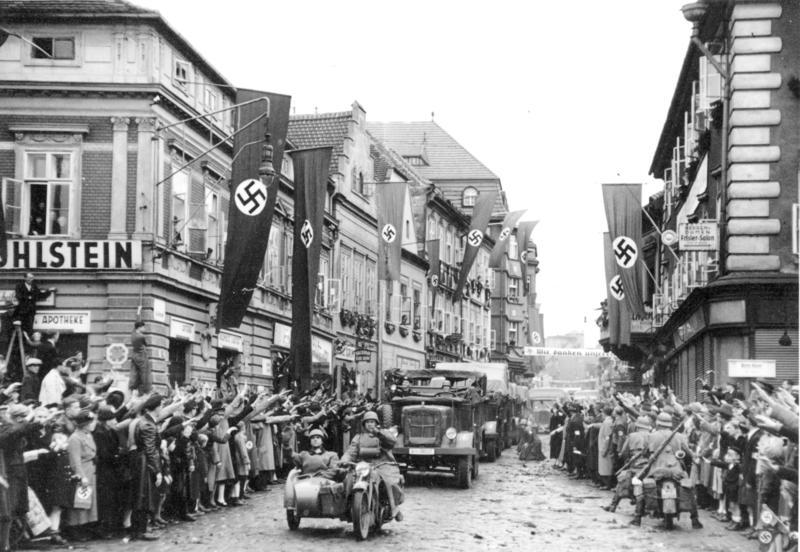
Bundesarchiv, Bild 146-1970-005-28 / CC-BY-SA 3.0, CC BY-SA 3.0 DE , via Wikimedia Commons

Einmarsch in das Sudetenland. Motorisierte deutsche Truppen in Saaz. German mechanized troops enter Saaz. The streets are decorated with swastika flags and banners. 9.10.1938 14.30 Uhr. Saaz. Sudetenland
[Editor’s Note: As we approach the Holocaust Memorial Day Yom Hashoah Thursday, April 8, the issue of whether it could happen here is no longer a wild paranoid fantasy. The most extreme haters have de facto taken over the Republican party and are involved in a systematic campaign to suppress voting rights so that they can win over both houses of Congress in 2022 and then win back the presidency in 2024. The Democrats have no serious strategy to stop this, stuck as they are in a false perception that most Americans care more about their money than anything else and that they will remain loyal to the Dems as long as Biden succeeds in providing them with enough material benefits. They, and many progressives, ignore what the Institute for Labor and Mental Health uncovered in its detailed empirical research–the hunger for meaning, love, respect, and genuine caring. I have explored the political, physiological, and spiritual relevance of that research in my latest book Revolutionary Love. I invite you to share this article by Tikkun ally Henry Giroux, read it to people on zoom or in-person this coming Wednesday night or Thursday as you create your own memorial, or join us as we discuss these issues and grieve together all the lost souls (including the one out of every 3 Jews who lived in 1940 and were murdered by 1945). Learn from Henry Giroux, below, on the plague of historical amnesia.
— Rabbi Michael Lerner rabbilerner.tikkun@gmail.com]
The Plague of Historical Amnesia in the Age of Fascist Politics
As the boundaries of the unthinkable become normalized, historical consciousness is replaced by manufactured forms of historical amnesia and ignorance. As white supremacy becomes entrenched at the highest levels of power and in the public imagination, the past becomes a burden that must be shed.[1] Disparaging, suppressing or forgetting the horrors of history has become a valued and legitimating form of political and symbolic capital, especially among the Republican Party and conservative media. Not only have history’s civic lessons been forgotten, but historical memory is also being rewritten, especially in the ideology of Trumpism, through an affirmation of the legacy of slavery, the racist history of the Confederacy, American exceptionalism, and the mainstreaming of an updated form of fascist politics.[2]
Theodor Adorno’s insights on historical memory are more relevant than ever. He once argued that as much as repressive governments would like to break free from the past, especially the legacy of fascism, “it is still very much alive.” Moreover, there is a price to be paid with “the destruction of memory.” In this case, “the murdered are …cheated out of the single remaining thing that our powerlessness can offer them: remembrance.”[3] Adorno’s warning rings particularly true at a time when two-thirds of young American youth are so impoverished in their historical knowledge that they are unaware that six million Jews were murdered in the Holocaust.[4] On top of this shocking level of ignorance is the fact that “more than one in 10 believe Jews caused the Holocaust.”[5] Historical amnesia takes a particularly dangerous turn in this case, and prompts the question of how young people and adults can you even recognize fascism if they have no recollection or knowledge of its historical legacy.
The genocide inflicted on Native Americans, slavery, the horrors of Jim Crow, the incarceration of Japanese Americans, the rise of the carceral state, the My Lai massacre, torture chambers, black sites, among other historical events now disappear into a disavowal of past events made even more unethical with the emergence of a right-wing political language and culture. The Republican Party’s attack on critical race theory in the schools which they label as “ideological or faddish” both denies the history of racism as well as the way in which it is enforced through policy, laws, and institutions. For many republicans, racial hatred takes on the ludicrous claim of protecting students from learning about the diverse ways in which racism persist in American society. For instance, Republican Governor Ron DeSantis of Florida stated that “There is no room in our classrooms for things like critical race theory. Teaching kids to hate their country and to hate each other is not worth one red cent of taxpayer money.”[6] In this updated version of racial cleansing, the call for racial justice is equated to a form of racial hatred leaving intact the refusal to acknowledge, condemn, and confront in the public imagination the history and persistence of racism in American society.
Bolstered by a former president and a slew of Vichy-type politicians, right-wing ideologues, intellectuals, and media pundits deny and erase events from a fascist past that shed light on emerging right-wing, neo-Nazi, and extremist policies, ideas, and symbols. As Coco Das points out given that 73 million people voted to re-elect Trump, it is clear that Americans “have a Nazi problem.”[7] This was also evident in the words and actions of former president Trump who defended Confederate monuments and their noxious past, the waving of Confederate flags and the display of Nazi images during the attempted coup on the Capital on January 6th, and ongoing attempts by the Republican Party legislators to engage in expansive efforts at enabling a minority government. America’s Nazi problem is also visible in the growing acts of domestic terrorism aimed at Asians, undocumented immigrants, and people of color.
Historical amnesia also finds expression in the right-wing press and among media pundits such as Fox News commentators Tucker Carlson and Sean Hannity, whose addiction to lying exceeds the boundaries of reason and creates an echo chamber of misinformation that normalizes the unspeakable, if not the unthinkable. Rational responses now give way to emotional reactions fueled by lies whose power is expanded through their endless repetition. How else to explain the baseless claim made by them, along with a number of Republican lawmakers, right-wing pundits, and Trump’s supporters who baselessly lay the blame for the storming of the US Capitol on “Antifa.” These lies were circulated despite of the fact that “subsequent arrests and investigations have found no evidence that people who identify with Antifa, a loose collective of antifascist activists, were involved in the insurrection.”[8]
In this case, I think it is fair to re-examine Theodor W. Adorno’s claim that “Propaganda actually constitutes the substance of politics” and that the right-wing embrace of and production of an endless stream of lies and denigration of the truth are not merely delusional but are endemic to a fascist cult that does not answer to reason, but only to power while legitimizing a past in which white nationalism and racial cleansing become the organizing principles of social order and governance.[9]
In the era of post-truth, right-wing disimagination machines are not only hostile to those who assert facts and evidence, but also supportive of a mix of lethal ignorance and the scourge of civic illiteracy. The latter requires no effort to assess the truth and erases everything necessary for the life of a robust democracy. The pedagogical workstations of depoliticization have reached new and dangerous levels amid emerging right-wing populisms.[10] It is not surprising that we live at a time when politics is largely disconnected from echoes of the past and justified on the grounds that direct comparisons are not viable, as if only direct comparisons can offer insights into the lessons to be learned from the past. We have entered an age in which thoughtful reasoning, informed judgments, and critical thought are under attack. This is a historical moment that resembles a dictatorship of ignorance, which Joshua Sperling rightly argues entails:
The blunting of the senses; the hollowing out of language; the erasure of connection with the past, the dead, place, the land, the soil; possibly, too, the erasure even of certain emotions, whether pity, compassion, consoling, mourning or hoping.[11]
It is clear is that we live in a historical period in which the conditions that produced white supremacist politics are intensifying once again. How else to explain former President Trump’s use of the term “America First,” his labeling immigrants as vermin, his call to “Make America Great Again” — signaling his white nationalist ideology–his labeling of the press as “enemies of the people,” and his numerous incitements to violence while addressing his followers. Moreover, Trump’s bid for patriotic education and his attack on the New York Times’s 1619 Project served as both an overt expression of his racism and his alignment with right-wing white supremacists and neo-Nazi mobs. Historical amnesia has become racialized. In the rewriting of history in the age of Trump, the larger legacy of “colonial violence and the violence of slavery inflicted on Africans” are resurrected as a badge of honor.[12]
America’s long history of fascist ideologies and the racist actions of a slave state, the racial cleansing espoused by the Ku Klux Klan, and an historical era that constitutes what Alberto Toscano calls “the long shadow of racial fascism” in America are no longer forgotten or repressed but celebrated in the Age of Trump.[13] What is to be made of a former President who awarded the prestigious Medal of Freedom to a blubbering white supremacist, ultra-nationalist, conspiracy theorist, and virulent racist who labeled feminists as “Feminazis.” In this case, one of the nation’s highest honors went to a man who took pride in relentlessly disparaging Muslims, referred to undocumented immigrants as “an invading force” and an “invasive species,” demonized people of color, and recycled Nazi tropes about racial purity while celebrating the mob that attacked the Capitol as “Revolutionary War era rebels and patriots.”[14] Under the banner of Trumpism, those individuals who reproduce the rhetoric of political and social death have become, celebrated symbols of a fascist politics that feeds off the destruction of the collective public and civic imagination.
William Faulkner once stated “The past is never dead. It’s not even past.” In its updated version, we live not only with the ghosts of genocide and slavery, but also with the ghosts of fascism—we live in the shadow of the genocidal history of indigenous inhabitants, the Ku Klux Klan, Jim Crow, and systemic police violence against people of color.[15] And while we live with the ghosts of our past, we have failed to fully confront its implications for the present and future. To do so would mean recognizing that updated forms of fascist politics in the current moment are not a rupture from the past, but an evolution.[16] White supremacy now rules the Republican Party and one of its tools of oppression is the militarization and weaponization of history. Fascism begins with language and the suppression of dissent, while both suppressing and rewriting history in the service of power and violence.
In the age of neoliberal tyranny, historical amnesia is the foundation for manufactured ignorance, the subversion of consciousness, the depoliticization of the public, and the death of democracy. It is part of a disimagination machine that is perpetuated in schools, higher education, and the corporate controlled media. It divorces justice from politics and aligns the public imagination with a culture of hatred and bigotry. Historical amnesia destroys the grammar of ethical responsibility and the critical habits of citizenship. The ghost of fascism is with us once again as society forgets its civic lessons, destroys civic culture, and produces a populace that is increasingly infantilized politically through the ideological dynamics of neoliberal capitalism. The suppression of history opens the door to fascism. This is truly a lesson that must be learned if the horrors of the past are not to be repeated again. Fortunately, the history of racism is being exposed once again in the protests that are taking place all over the globe. What needs to be remembered is that such struggles must make education central to politics, and historical memory a living force for change. Historical memory must become a crucial element in the struggle for collective resistance, while transforming ideas into instruments of power.
Footnotes:
[1] John Gray, “Forgetfulness: the dangers of a modern culture that wages war on its own past,” New Statesman, [October 16, 2017]. Online: https://www.newstatesman.com/culture/books/2017/10/forgetfulness-dangers-modern-culture-wages-war-its-own-past
[2] Paul Street, “The Anatomy of Fascism Denial: 26 Flavors of Anti-Antifascism, Part 1,” Counter Punch. (Feb 7, 2021).Online https://www.counterpunch.org/2021/02/07/the-anatomy-of-fascism-denial/; Sarah Churchwell, “American Fascism: It Has Happened Again,” The New York Review of Books, [May 26, 2020].Online https://www.nybooks.com/daily/2020/06/22/american-fascism-it-has-happened-here/; Masha Gessen, Surviving Autocracy, (New York: Riverhead Books, 2020); Jason Stanley, How Fascism Works: The Politics of Us and Them, [Random House, 2018); Henry A. Giroux, American Nightmare: Facing the Challenge of Fascism (San Francisco: City Lights 2018); Carl Boggs, Fascism Old and New: American Politics at the Crossroads (New York: Routledge, 2018); Timothy Snyder, On Tyranny: Twenty Lessons from the Twentieth Century (New York: Crown, 2017)
[3] Adorno, Theodor W., “The Meaning of Working Through the Past,” Guilt and Defense, trans. Henry W. Pickford, (Cambridge: Harvard University Press, 2010), p. 215.
[4] Harriet Sherwood, “Nearly two-thirds of US young adults unaware 6m Jews killed in the Holocaust,” The Guardian (September 16, 2020). Online: https://www.theguardian.com/world/2020/sep/16/holocaust-us-adults-study
[5] Ibid., Harriet Sherwood. Online: https://www.theguardian.com/world/2020/sep/16/holocaust-us-adults-study
[6] Michael Moline, and Danielle J. Brown “Gov. DeSantis has found a new culture-war enemy: ‘critical race theory,” Florida Phoenix (March 17, 2021). Online: https://www.floridaphoenix.com/2021/03/17/gov-desantis-has-found-a-new-culture-war-enemy-critical-race-theory/
[7] Coco Das, “What are you going to do about the Nazi Problem?” refusefascism.org. (November 24, 2020). Online: https://revcom.us/a/675/refuse-fascism-what-are-you-going-to-do-about-the-nazi-problem-en.html
[8] Michael M. Grynbaum, Davey Alba and Reid J. Epstein, “How Pro-Trump Forces Pushed a Lie About Antifa at the Capitol Riot,” New York Times (March 1, 2021). Online: https://www.nytimes.com/2021/03/01/us/politics/antifa-conspiracy-capitol-riot.html
[9] Theodor W. Adorno, Aspects of the New Right-Wing Extremism (London: Polity, 2020), p. 13.
[10] I take this issue up in detail in Henry A. Giroux, Racism, Politics and Pandemic Politics: Education in a Time of Crisis (London: Bloomsbury, 2021).
[11] Joshua Sperling cited in Lisa Appignanesi, “Berger’s Way of Being,” The New York Review of Books (May 9, 2019). Online: https://www.nybooks.com/articles/2019/05/09/john-berger-ways-of-being/
[12] Angela Y. Davis, ed. Frank Barat. Freedom Is a Constant Struggle: Ferguson, Palestine and the Foundations of a Movement, (Haymarket Books, 2016: Chicago, IL), pp. 81-82.
[13] Alberto Toscano, “The Long Shadow of Racial Fascism,” Boston Review. (October 27, 2020). Online http://bostonreview.net/race-politics/alberto-toscano-long-shadow-racial-fascism;
[14] Anthony DiMaggio “Limbaugh’s Legacy: Normalizing Hate for Profit.” Counter Punch. (February 19, 2021). Retrieved https://www.counterpunch.org/2021/02/19/limbaughs-legacy-normalizing-hate-for-profit/
[15] See, for instance, Ibram X. Kendi and Keisha N. Blain, eds. Four Hundred Souls (New York: One World, 2021) and Eddie S. Glaude, Jr. Democracy in Black: How Race Still Enslaves the American Soul (New York: Crown, 2016).
[16] On the American origins of fascism, also see Michael Joseph Roberto, The Coming of the American Behemoth: The Origins of Fascism in the United States, 1920-1940 (New York: Monthly Review Press, 2018). Henry A. Giroux, American Nightmare: Facing the Challenge of Fascism(San Francisco: City Lights Books, 2018).
We need your support to bring the kind of analyses and information Tikkun provides.
Click Here to make a tax-deductible contribution.
ABOUT HENRY A. GIROUX
Henry A. Giroux is a Contributing Editor for Tikkun magazine and currently holds the McMaster University Chair for Scholarship in the Public Interest in the English and Cultural Studies Department and is the Paulo Freire Distinguished Scholar in Critical Pedagogy. His most recent books are America’s Education Deficit and the War on Youth (Monthly Review Press, 2013), Neoliberalism’s War on Higher Education (Haymarket Press, 2014), The Public in Peril: Trump and the Menace of American Authoritarianism (Routledge, 2018), and the American Nightmare: Facing the Challenge of Fascism (City Lights, 2018), On Critical Pedagogy, 2nd edition (Bloomsbury), and Race, Politics, and Pandemic Pedagogy: Education in a Time of Crisis (Bloomsbury 2021): His website is www.henryagiroux.com.
U.S. politics isn’t broken. It’s fixed
Katherine M. Gehl|TEDxMileHigh (ted.com)
The “broken” US political system is actually working exactly as designed, says business leader and activist Katherine Gehl. Examining the system through a nonpartisan lens, she makes the case for voting innovations, already implemented in parts of the country, that give citizens more choice and incentivize politicians to work towards progress and solutions instead of just reelection.
This talk was presented to a local audience at TEDxMileHigh, an independent event. TED’s editors chose to feature it for you.
ABOUT THE SPEAKER
Katherine M. Gehl · Business leader, political innovator
Katherine Gehl is a business leader turned political innovator.
WHY I USE THE CLOCKWISE HOUSE SYSTEM
A gem of a missing piece about House Rulership Carl Payne Tobey, The Prosperos and Marcy Nelson. Does anyone recall Wayne Cowdrey or Dianne Clarke? Enjoy.
–Hanz
By Diane Clarke (dianeclarke.com)

One of the most profound turning points in my life took place the day I was introduced to Carl Payne Tobey’s “clockwise house system”. At a holiday party in early December 1971, I serendipitously struck up a conversation with a fellow astrology aficionado, Wayne Cowdrey. He was studying at Prosperos, a metaphysical institute in Los Angeles founded by Thane, one of Tobey’s long-time friends & supporters. Wayne enthusiastically shared Tobey’s ideas with me and proceeded to draw up the Leo 1st house design on a cocktail napkin.Instantly, bells & whistles started going off in my head! All the issues I’d had with the traditional house/sign/planet associations had suddenly cleared up upon seeing the image of the reversed wheel. Seeing Leo associated with the first house (instead of Aries) made so much sense, and having Cancer associated with the second house (instead of Taurus) made even more sense to me. And the rest just fell in line.
At last, the pieces all came together! It was as though some great ancient truth had just been revealed to me, one that was so compelling that I knew that there was no turning back. I was so excited! Little did I know at the time that Pluto had just crossed my ascendant and Uranus was in exact trine to my natal Uranus. It was certainly a significant initiation – one that was to send me off on the major journey of my life!
My interest in astrology had awakened in the spring of ’67, just a month prior to my graduation from UCSB, when on a blind date with a fellow Virgoan. His uncanny insights into my sign, as well as those of mutual friends, immediately piqued my mercurial interest. From there on, I embarked upon my astrological quest – reading any book I could get my hands on, taking any class available, attending conferences, networking & studying with other astrologers, interpreting charts for my friends and doing mini-readings at psychic fairs.
But as much as I was enthralled with astrology, the discrepancies between what I had been taught or read in books—and what I was learning from firsthand feedback—confused & baffled me. The so-called astrological alphabet, based on the commonly-used flat chart (which begins with Aries and goes counter-clockwise), left me cold. The correlations of the signs with houses made no sense at all based on my observations. I’d learned to set up horoscopes using the placidus system, but along the way, I was introduced to the equal house system. After comparing the various house systems amidst the 200 charts of friends & family I’d collected at the time, I became convinced that the equal houses were the most accurate from my perspective. This was a great improvement, but there were still too many lingering questions. Something was missing from the equation. And as a result, my astrology studies remained only a part-time hobby.
I started taking classes at Prosperos, where I met Marcy Nelson, a serious student of Tobey’s correspondence course.
And then—in that magical meeting that fateful day—my passion for astrology was reawakened! It was time to delve deeper. I started taking classes at Prosperos, where I met Marcy Nelson, a serious student of Tobey’s correspondence course. She shared the course materials with me, and for the next several years, we met regularly to go over charts and test out his theories. By November 1972, it became clear that my obsession with astrology was first & foremost in my life and—with Pluto now back on my ascendant and conjunct my Jupiter—walked away from my job as a social worker and took a flying leap into the great unknown! I had never had an official reading and didn’t know what an astrologer actually did, but I was determined to figure it out and be the best astrologer I could be!
I was fortunate to finally meet Tobey in person in January 1975, after having two years of astrological practice under my belt. Marcy and I drove to Tucson together to spend a day with him, pick his brain and share our research with him. It was definitely a pilgrimage! A true hospitable Taurus, he welcomed us to his book & manuscript-strewn abode and generously shared hours of his time with us. He felt like a long-lost grandfather (no surprise, considering that his Moon in Capricorn was conjunct my South Node). Earthy & straightforward, he talked and smoked non-stop, shared lots of tidbits and opinions and was actually interested in our findings. It was such a thrill to be in his presence.
When I asked him if there was some aspect of his research that required further development, he encouraged us to dig deeper into the subject of future & past dynamics. He obviously enjoyed the company of younger individuals and was particularly intrigued by those of us in the “Neptune in Libra” generation. Although we only spent a day together, I came away with a deeper appreciation of his contribution to astrology – and an even stronger commitment to share the truths that he had uncovered. And after nearly 50 years of astrological counseling, teaching, researching and writing about Tobey’s concepts (www.dianeclarke.com), I continue to be excited and inspired by his research. I attribute my success as an astrologer to the fact that my work is based on Tobey’s amazing “clockwise house system”!
At the time, I didn’t realize what a challenging path I’d put myself on. Already out-of-step with the mainstream due to my passion for astrology, the fact that I used both equal house and Tobey’s system also set me apart from the other astrologers. We just didn’t speak the same language – and very few were comfortable looking at things from a different perspective. However, my compulsion to follow what was truth for me won out over my desire for peer acceptance. I started teaching astrology so that I could have others to talk with!
I am grateful to have connected with Naomi Bennett – a fellow traveler on this mission to spread the word and keep the work of Carl Payne Tobey alive & well! Her publications of his correspondence course and his collected works, along with her own books explaining his concepts, have been a major gift to the astrological community—and will hopefully inspire new generations to step off the beaten path and put his ingenious theories to the test. Hopefully, in the near future, I will be publishing my own book on chart interpretation based on the clockwise house system.
©2019 Diane Elizabeth Clarke
(Submitted by Hanz Bolen, H.W., M.)
Compromise of 1877
From Wikipedia, the free encyclopedia

A political cartoon by Joseph Keppler (Puck, 1877) depicts Roscoe Conkling as Mephistopheles, watching as Rutherford B. Hayes strolls off with the prize of the “Solid South” personified as a woman. The caption quotes Goethe’s Faust: “Unto that Power he doth belong Which only doeth Right while ever willing Wrong.”
The Compromise of 1877 was an unwritten deal, informally arranged among U.S. Congressmen, that settled the intensely disputed 1876 presidential election. It resulted in the United States federal government pulling the last troops out of the South, and ending the Reconstruction Era. Through the Compromise, Republican Rutherford B. Hayes was awarded the White House over Democrat Samuel J. Tilden on the understanding that Hayes would remove the federal troops whose support was essential for the survival of Republican state governments in South Carolina, Florida and Louisiana.
Under the compromise, Democrats who controlled the House of Representatives allowed the decision of the Electoral Commission to take effect.
The outgoing president, Republican Ulysses S. Grant, removed the soldiers from Florida, and as president, Hayes removed the remaining troops from South Carolina and Louisiana. As soon as the troops left, many white Republicans also left, and the “Redeemer” Democrats, who already dominated other state governments in the South, took control. The exact terms of the agreement are somewhat contested as the documentation is insufficient.[1]
Black Republicans felt betrayed as they lost power, being subject to domestic terrorism to suppress their voting, and by 1905, virtually all black men were effectively disenfranchised by state legislatures in every Southern state.[2]
Terms of compromise
The compromise essentially stated that Southern Democrats would acknowledge Hayes as president, but only on the understanding that Republicans would meet certain demands. The following elements are generally said to be the points of the compromise:[3]
- The removal of all remaining U.S. military forces from the former Confederate states.[4] At the time, U.S. troops remained only in Louisiana, South Carolina, and Florida, but the Compromise completed their withdrawal from the region.
- The appointment of at least one Southern Democrat to Hayes’ cabinet. (David M. Key of Tennessee was appointed as Postmaster General.)
- The construction of another transcontinental railroad using the Texas and Pacific in the South (this had been part of the “Scott Plan”, proposed by Thomas A. Scott of the Pennsylvania Railroad; he had initiated negotiations resulting in the final compromise).
- Legislation to help industrialize the South and restore its economy following the Civil War and Reconstruction.
- The right to deal with black people without northern interference.
In exchange, Democrats would accept Republican Hayes as president by not employing the filibuster during the joint session of Congress needed to confirm the election.[5][6]
Results
After the Compromise, a few Democrats complained loudly that Tilden had been cheated. There was talk of forming armed units that would march on Washington, but President Grant was ready for that. He tightened military security, and nobody marched on Washington.[7]
Hayes was peacefully inaugurated. Points 1 and 2 of the compromise took effect. Hayes had already announced his support for the restoration of “home rule”, which would involve federal troop removal, before the election. It was not unusual, nor unexpected, for a president, especially one so narrowly elected, to select a cabinet member favored by the other party. Points 3 and 4 were never enacted; it is possible there was no firm agreement about them.
Whether by informal deal or simply reassurances already in line with Hayes’s announced plans, talks with Southern Democrats satisfied the worries of many. This prevented a congressional filibuster that had threatened to extend resolution of the election dispute beyond Inauguration Day 1877.[6]
Interpretations
Historian C. Vann Woodward wrote in 1951 that emerging business and industry interests of the New South found common ground with Republican businessmen, particularly with the railroads. They met secretly at Wormley’s Hotel in Washington to forge a compromise with aid to internal improvements: bridges, canals and railroads wanted by the South. However, Peskin notes that no serious federal effort was made after Hayes took office to fund a railroad or provide other federal aid for improvements.[8] An opposing interest group representing the Southern Pacific actually thwarted Scott’s proposed Texas and Pacific scheme, and ultimately ran its own line to New Orleans.
Some historians, such as Allan Peskin, argue that the assurances offered to some Southern Democrats to prevent a filibuster were not a compromise but a foregone conclusion, as Tilden did not command sufficient support.[8] Peskin admits that Woodward’s interpretation had become almost universally accepted in the nearly quarter century since he had published it. As not all terms of the agreement were met, Peskin believes there was really no deal between the North and South in 1877. He also suggests that Northern Democrats were more significant in quashing the filibuster than those from the South. For instance, Samuel J. Randall (D-Pennsylvania) was Speaker of the House and prevented the filibuster. He was more interested in ensuring that the Radical state government in Louisiana was abandoned than in any southern railroad.[8]
Vincent DeSantis argues that the Republican Party abandoned Southern blacks to the rule of the racist Democratic Party in order to gain the support of Democrats for Hayes’ presidency.[9]
In any case, Reconstruction ended. The dominance of the Democratic Party in the South was cemented with the ascent of the “Redeemer” governments that displaced the Republican governments. After 1877, support for white supremacy generally caused whites to vote for Democrats and the region became known as the “Solid South“.[10] Until the end of the 19th century, black Republicans continued to elect numerous candidates to local office, although Democrats controlled most state representative and statewide seats, except for a brief period of fusion governments supported by Republicans and Populists. The majority of white voters supported national Democratic candidates well into the 20th century before shifting to the Republican Party. This later shift to the Republican party followed the Civil Rights Act of 1964, which was introduced by Democratic President Lyndon B. Johnson and supported by most Republicans and northern Democrats.
In The Mexicanization of American Politics: The United States’ Transnational Path from Civil War to Stabilization (2012), Gregory P. Downs rejects the idea that this was an era of easy reconciliation and political stability. Instead he shows many Americans feared “Mexicanization” of politics, whereby force would be used to settle a presidential election, as force had been used to settle certain state elections in the South. Downs explores how Mexicanization was roundly rejected and stability was achieved.
Whatever deals may or may not have taken place on the side, in formal legal terms, the election of 1876 was not decided by such acts, but by the official vote of Congress to accept the recommendations of the Electoral Commission they themselves had set up as a way out of the election impasse. The expectation in setting up the committee had been that its decisions would be accepted by Congress. It was only when certain Democrats disagreed with the commission’s decisions in favor of Hayes that this arrangement was jeopardized. This Democratic group threatened a filibuster (opposed by Republicans and Congressional Democratic leadership as well) that would prevent the agreed-upon vote from taking place. Discussions of the points in the alleged compromise were related to persuading key Democrats against accepting a filibuster. The very threat of a filibuster—a measure used by a minority to prevent a vote—indicates that there were already sufficient votes for accepting the commission’s recommendations.[11]