Román Baca returned from war a changed man. Struggling with depression and anxiety after a combat tour to Fallujah, Iraq, from 2005 to 2006, Baca took his adversity by storm and created the New York based dance company Exit12.
Eventually, Baca and Exit12 expanded beyond performances by professional dancers to offer workshops to veterans and their loved ones. Devoted to the belief that art heals, the workshops allow a safe place for veterans to communicate often ineffable memories of war, and to process trauma through the language of dance. The choreography of battle is repurposed by Baca and his fellow dancers, who reclaim their military training by liberating it from the strictures of combat. Now, this same training to kill inspires artistic expression, giving the veterans an opportunity to transform their experiences and reconnect with their humanity.
Interweaving the company’s choreography with personal stories of war, the Iranian-American director Mohammad Gorjestani’s film gracefully bridges the two seemingly disparate worlds that Exit12 inhabits. In doing so, the film highlights the surprising synergy between the movements of battle and those of dance, underscoring how both disciplines affect the body and mind.
Working to upend expectations, Exit12: Moved By War offers a surprising portrait of a U.S. Marine. Preconceptions of who or what a war veteran might be are destabilised; there is no ‘one size fits all’ frame for the many faces of war. Baca’s dance workshops are a reminder that our lives can take many courses. A life once dedicated to service can find purpose and a home in dance, proving that the path to self-fulfilment can be embodied many forms.
Travelling across eight different locations, from urban San Jose in California to a desolate stretch of Death Valley, Lost in Light explores the ubiquitous but often overlooked phenomenon of light pollution. As artificial light brightens the night sky, we increasingly lose our view of the stars, planets and constellations, as well as the sense that we’re part of a larger galaxy. Showing eight different ‘levels’ of light pollution throughout California and Oregon, Sriram Murali uses timelapse to dramatic effect, asking what else we lose when we can’t see the stars.
A close-up of Ingenuity taken on April 5 by Mastcam-Z, a pair of zoomable cameras aboard the Perseverance rover. Credit: NASA/JPL-Caltech/ASU.
NASA has delayed the first flight of its Ingenuity Mars helicopter, announcing that it expects to set a new date next week.
The helicopter, which arrived on the red planet tucked inside the Perseverance rover in February, was initially set to fly on Sunday, securing its position as the first rotorcraft to lift off on another world. Late on Friday night, however, a high-speed test of Ingenuity’s rotors ended early: As the helicopter’s command sequence tried to transition the flight computer from “preflight” to “flight” mode, engineers were alerted to a potential problem. The team has decided to update Ingenuity’s flight control software before attempting a maiden flight.
During this first flight, the Ingenuity Mars helicopter will lift off, hover 10 feet above the Martian surface, take pictures, and touch back down—all in a period of about 40 seconds. Meanwhile, some 200 feet away, the Perseverance rover will snap pictures and videos of its companion’s brief voyage.
This first flight will be a modest beginning of a much more ambitious task: In the next 30 days, the Ingenuity team at NASA’s Jet Propulsion Laboratory will attempt a total of five flights, each longer and more technical than the last.
“Each world only gets one first flight,” Ingenuity Project Manager MiMi Aung said during a press conference on Friday. It’s a “historic moment that has analogues in 1903,” NASA’s Associate Administrator for Science Thomas Zurbuchen added, referring to the year the Wright brothers became the first in the world to fly a motor-operated airplane—after two failed liftoffs.
“History tells us that Orville and Wilbur took this setback like true engineers,” confirming that their fundamental understanding of flight was correct and going back and making subtle changes, Aung said during Friday’s press conference. Aung believes she and her team have become similarly well-versed in the unique challenges of flying a hovercraft on another planet and are aware that despite years of preparation, something could go wrong when it’s time for the first attempt. “I want to be conservative,” Aung said on Friday, adding the Ingenuity team had yet to celebrate the Mars helicopter’s achievements.
Perhaps the greatest challenge the team will face is the Martian atmosphere. Made up of mostly carbon dioxide, Mars’ atmosphere is a mere 1% as thick as our own planet’s, which is primarily nitrogen. Its thinness makes it the equivalent of flying at three times the height of Mount Everest, Ingenuity chamber test engineer Amelia Quon said on Friday.
Rotorcrafts, including helicopters, fly by generating lift. As their blades spin, they push the air and this lifts the craft up, Aung explains. In a thin atmosphere, she says, there are fewer molecules to push, “so you need to spin much faster to get lift,” she says. While the blades of most Earthly helicopters operate at around 450 to 500 revolutions per minute, Ingenuity’s will move at 2,400 rpm.
Ingenuity’s rotors “are not something off the shelf; they’re really fine-tuned to maximize lift in a really thin atmosphere,” Aung said. Weighing in at about 35 grams, the rotors have a foam core for lightweightedness and are covered in carbon fiber, laid out in a grid, for optimal stiffness and strength.
Like its blades, the body of the Mars helicopter is also lightweight, at less than four pounds. “We couldn’t make this happen” with technology that existed 10 or 15 years ago, Aung said.
Mars’ strong winds also pose a challenge. If gusts become too strong before Ingenuity is scheduled to fly, there’s no way of automatically postponing or canceling the flight through Perseverance, Ingenuity Operations Lead Tim Canham explained during Friday’s press conference. This is because the Perseverance rover’s weather-determining system has no connection to Ingenuity. And Ingenuity has no way to right itself; if it fails to land right-side-up during any of its flights, its mission on Mars would end.
But there’s good news: Martian weather is easy to predict. “Weather on Mars tends to stay the same over a period of sols,” Canham explains. (At 24 hours, 39 minutes, and 35 seconds, a Martian sol is slightly longer than a day on Earth.) The Ingenuity team initially chose 12:30 p.m. Martian time Sunday, the equivalent of 11:00 p.m. EDT, for a potential first liftoff because the team calculated that’s when Ingenuity would have the most charged battery and Mars would have the calmest skies.
The team started testing in 2014 whether Ingenuity could successfully fly on another planet. We “made Mars on Earth,” Quon said, referring to NASA’s Jet Propulsion Laboratory’s 25-foot space simulator thermal vacuum chamber, which Voyager 1 and 2 were tested in before making their way into space and out of our solar system.
First, the team used a flight model to illustrate that lift is possible—picture a couple of hops and a crash landing—in a Martian-like environment. Then, in 2018, the team had the model spin up three feet in the air and turn. In 2019, NASA scientists took data from previous tests and applied them to testing the actual Ingenuity Mars helicopter.
If all goes well, during its first sol after taking to the sky, Ingenuity will transmit its black-and-white photos and flight summary data to Perseverance, which will transmit the data to scientists on Earth. In the following days, scientists expect to receive color imagery and more complex data from the flight.
NASA’s Perseverance Mars rover took a selfie with the Ingenuity helicopter, seen here about 13 feet (3.9 meters) from the rover in this image taken April 6, 2021, the 46th Martian day, or sol, of the mission. Image credit: NASA/JPL-Caltech/MSSS
Canham is also eager to hear the sound of Ingenuity’s liftoff: Perseverance is equipped with a microphone specifically designed to survive on Mars—and capture the snaps, crackles and pops of its sizzling stones. It’s possible for the microphone to capture Ingenuity’s liftoff, but given its somewhat significant distance (more than 200 feet) from the helicopter, there are no guarantees. It’s “very touch and go on whether we’ll get anything,” Canham said on Friday. “But who knows.”
What’s more certain is that Perseverance will capture its own photos of Ingenuity’s first flight.
Before, during, and after Ingenuity’s 40-second airtime, Perseverance will snap six to seven photos a second using its onboard Mastcam-Z cameras, one with zoomed-in perspective and the other a zoomed-out perspective. (You can view images as they come in on NASA’s website here.)
The Ingenuity team expects its second flight to happen four days after its initial flight. And if that one goes well—the goal being to have the helicopter fly up to 15 feet—the team will move to an every-three-day flight cadence.
“We want to have fun” with the fourth and fifth flights, Aung said, suggesting that the team may venture at least 150 feet out and back from the helicopter’s takeoff site, possibly into never-before-seen territory. “This is all about the future. This is all about being a pathfinder,” she said, explaining that Ingenuity can inform how future space helicopters, which will be bigger and heavier, should function.
Like NASA’s first Mars rover—the modest 23-pound microwave-sized Sojourner, which touched down on the red planet in 1997—Ingenuity is a “tech demonstration,” explained Zurbuchen, NASA’s Associate Administrator for Science. Similar to Sojourner’s brief mission on Mars, Zurbuchen believes, decades from now, we’ll look back on Ingenuity’s month of flight with awe and fondness.
“Ingenuity’s month will be an aggressive demonstration of what it can possibly do,” he said. And, teammate Elsa Jensen added, “Big Sister”—Perseverance—“will be watching.”
We are all connected by the spectacular birth, death and rebirth of stars, says astrophysicist Enrico Ramirez-Ruiz. Journey through the cosmic history of the universe as Ramirez-Ruiz explains how supernovas forged the elements of life to create everything from the air you breathe to the very atoms that make you.
This talk was presented at a TED Institute event given in partnership with The Kavli Foundation, the Simons Foundation and the National Academy of Sciences. TED editors featured it among our selections on the home page. Read more about the TED Institute.
Shaily Shashikant Patel receives funding from Virginia Tech. Virginia Tech is a state institution, and therefore research awards are technically “government-funded.”
Americans are fascinated by magic. TV shows like “WandaVision” and “The Witcher,” books like the Harry Potter series, plus comics, movies and games about people with powers that can’t be explained by God, science or technology, have all been wildly popular for years. Modern pop culture is a testament to how enchanted people are by the thought of gaining special control over an uncertain world.
As an expert in ancient magic and early Christianity, I study how magic helped early adherents develop a Christian identity. One part of this identity was morality: the inner sense of right and wrong that guides life decisions. Of course, the darker side of this development is the slide into supremacy: seeing one’s own tradition as morally superior and rightfully dominant.
My work tries to return magic to its proper place as a part of the Christian tradition. I show how false distinctions between magic and Christianity were created to elevate ancient Christianity and how they continue to advance Christian supremacy today.
The origins of magic
In Western culture, magic is often defined in opposition to religion and science. This is problematic because all three concepts are rooted in colonialism. For centuries, many European scholars based their definitions of religion on Christianity, while at the same time describing the practices and beliefs of non-Christians as “primitive,” “superstitious” or “magical.”
This sense of superiority helped Europe’s Christian monarchies justify conquering and exploiting Indigenous peoples around the world in a bid to “civilize” them, often through extreme brutality. Imperialist legacies still color how some people think about non-Christians as “others,” and how they label others’ rituals and religions as “magic.”
But this modern understanding of magic doesn’t map neatly onto the world of the first Christians. “Magic” has always had many meanings. From what scholars can gather, the word itself was imported from the Persian word “maguš,” which may have described a class of priests with royal connections. Sometimes, these “magi” were depicted as performing divination, ritual activities or educating young boys who would take the throne.
Greek texts retained this earlier meaning and also added new ones. The famous ancient Greek historian Herodotus writes that the Persian magi interpreted dreams, read the skies and performed sacrifices. Herodotus uses the Greek word “magos.” Sophocles, a Greek playwright, uses the same term in his tragedy “Oedipus the King,” when Oedipus berates the seer Tiresias for scheming to overthrow him.
Although these two Greek texts both date from roughly the early 400s B.C., “magician” has different connotations in each.
The seven Harry Potter fantasies are the world’s best-selling book series, with more than 500 million novels sold since the first story was published in 1997. Mike Clarke/AFP via Getty Images
While defending himself at trial for performing “evil deeds of magic,” the second-century philosopher Apuleius claimed he both was and was not a “magician.” He insisted he was like a high priest or a natural philosopher rather than someone who uses unsavory means to get what they want. What’s interesting here is that Apuleius uses one idea of high philosophical magic to combat another idea of crude, self-interested magic.
Christianity and magic
The first Christians inherited these varied ideas of magic alongside their Roman neighbors. In their world, people who did “magical” deeds like exorcisms and healings were common. Such people sometimes explained religious or philosophical texts and ideas, as well.
This presented a problem for early Christian authors: If wondrous deeds were fairly commonplace, how could a group looking to attract followers compete with “magicians”? After all, Christian leaders like Jesus, Peter and Paul did extraordinary deeds, too. So Christian writers made distinctions in order to elevate their heroes.
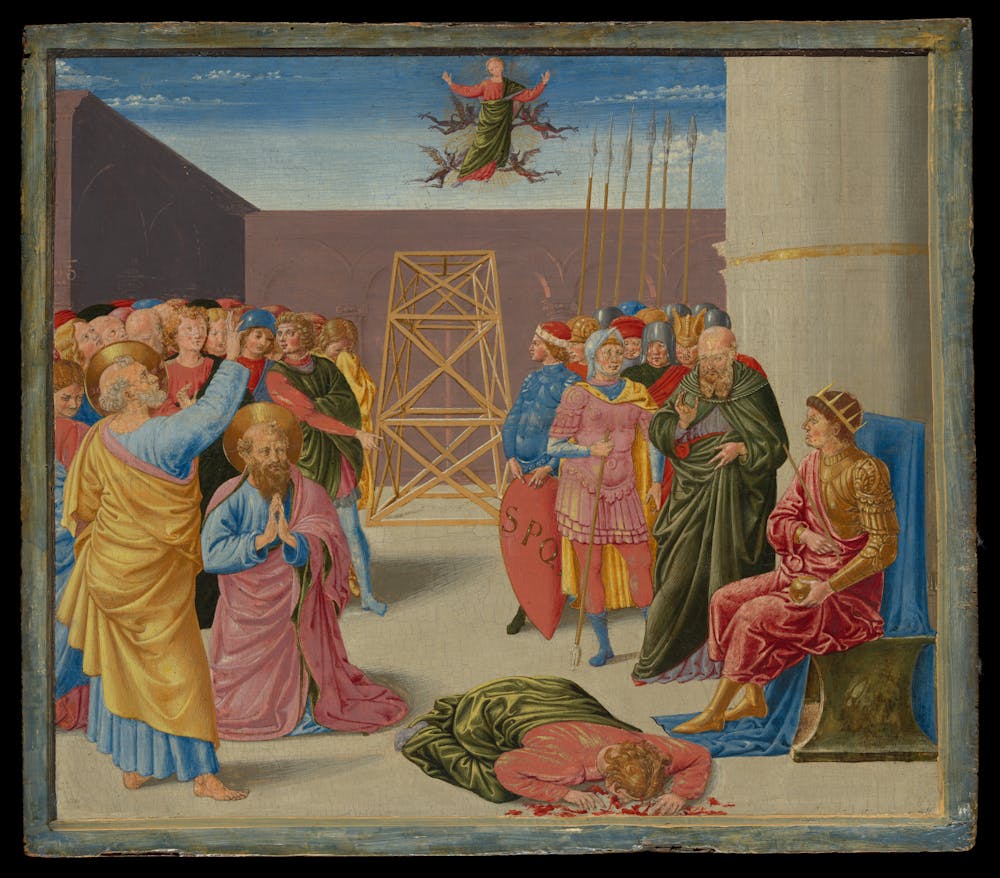
Take the biblical story of Simon the magician. In Acts 8, Simon’s magical deeds entice the Samaritans and convince them to follow him until the evangelist Philip performs even more amazing miracles, converting all the Samaritans and Simon, too. But Simon relapses when he tries to buy the power of the Holy Spirit, prompting the Apostle Peter to rebuke him. This story is where we get the sin of simony: the purchase of religious office.
As I’ve discussed elsewhere, texts like this do not depict real events. They are teaching tools aimed at showing new adherents the differences between good Christian miracle workers and evil magicians. The earliest converts needed such stories because wonder workers looked a lot alike.
Celsus argued that the miracles of Jesus were no different from the magic performed by marketplace sorcerers. Origen agreed the two shared superficial similarities, but claimed they were fundamentally different because magicians cavorted with demons while Jesus’ wonders led to moral reformation. Like the story of Simon the magician, Origen’s disagreement with Celsus was a means of teaching his audience how to tell the difference between morally suspect magicians who sought personal gain and miracle workers who acted for the benefit of others.
In early Christian stories, the magician Simon uses magic immorally to try and gain power and influence. The Metropolitan Museum of Art
Ancient authors invented the idea that the miracles of Christians possessed inherent moral superiority over non-Christian magic because ancient audiences were as enticed by magic as modern ones. But in elevating Christianity above magic, these writers created false distinctions that linger even today.
[Over 100,000 readers rely on The Conversation’s newsletter to understand the world.Sign up today.]
The Conversation is a nonprofit organization, and we depend on readers like you to help us do our important work of sharing ideas and knowledge from academia with the public. Your support keeps us going strong. Your donation will help us reach more people with more research-based journalism. Thank you.
One tap mobile +16699006833,,579891643# US (San Jose) +13462487799,,579891643# US (Houston) Dial by your location +1 669 900 6833 US (San Jose) +1 346 248 7799 US (Houston) +1 301 715 8592 US +1 312 626 6799 US (Chicago) +1 929 205 6099 US (New York) +1 253 215 8782 USMeeting ID: 332 275 676
ARIES (March 21-April 19): “Today I feel the whole world is a door,” wrote poet Dennis Silk. In a similar spirit, 13th-century Zen master Wumen Huikai observed, “The whole world is a door of liberation, but people are unwilling to enter it.” Now I’m here to tell you, Aries, that there will be times in the coming weeks when the whole world will feel like a door to you. And if you open it, you’ll be led to potential opportunities for interesting changes that offer you liberation. This is a rare blessing. Please be sufficiently loose and alert and brave to take advantage.
TAURUS (April 20-May 20): Taurus philosopher Ludwig Wittgenstein was called a genius by Nobel Prize-winning author Bertrand Russell. His “Philosophical Investigations” was once voted the 20th century’s most important philosophy book. Yet one of Wittgenstein’s famous quotes was “How hard it is to see what is right in front of my eyes!” Luckily for all of us, I suspect that won’t be problem for you in the coming weeks, Taurus. In fact, I’m guessing you will see a whole range of things that were previously hidden, even though some of them had been right in front of your eyes. Congrats! Everyone whose life you touch will benefit because of this breakthrough.
GEMINI (May 21-June 20): Why don’t rivers flow straight? Well, sometimes they do, but only for a relatively short stretch. According to the U.S. Geological Survey, no river moves in a linear trajectory for a distance of more than 10 times its width. There are numerous reasons why this is so, including the friction caused by banks and the fact that river water streams faster at the center. The place where a river changes direction is called a “meander.” I’d like to borrow this phenomenon to serve as a metaphor for your life in the coming weeks. I suspect your regular flow is due for a course change — a meander. Any intuitive ideas about which way to go? In which direction will the scenery be best?
CANCER (June 21-July 22): Cancerian poet Denis Johnson eventually became a celebrated writer who won numerous prizes, including the prestigious National Book Award. But life was rough when he was in his twenties. Because of his addictions to drugs and alcohol, he neglected his writing. Later, in one of his mature poems, he expressed appreciation to people who supported him earlier on. “You saw me when I was invisible,” he wrote, “you spoke to me when I was deaf, you thanked me when I was a secret.” Are there helpers like that in your own story? Now would be a perfect time to honor them and repay the favors.
LEO (July 23-Aug. 22): What do you believe in, exactly, Leo? The coming weeks will be a fine time to take an inventory of your beliefs—and then divest yourself of any that no longer serve you, no longer excite you, and no longer fit your changing understanding of how life works. For extra credit, I invite you to dream up some fun new beliefs that lighten your heart and stimulate your playfulness. For example, you could borrow poet Charles Wright’s approach: “I believe what the thunder and lightning have to say.” Or you could try my idea: “I believe in wonders and marvels that inspire me to fulfill my most interesting dreams.”
VIRGO (Aug. 23-Sept. 22): Virgo poet Charles Wright testifies, “I write poems to untie myself, to do penance and disappear through the upper right-hand corner of things, to say grace.” What about you, Virgo? What do you do in order to untie yourself and do penance and invoke grace? The coming weeks will be an excellent time for you to use all the tricks at your disposal to accomplish such useful transformations. And if you currently have a low supply of the necessary tricks, make it your healthy obsession to get more.
LIBRA (Sept. 23-Oct. 22): Kublai Khan, ruler of the Mongol Empire and China in the second half of the 13th century, kept a retinue of 5,000 astrologers on retainer. Some were stationed on the roof of his palace, tasked with using sorcery to banish approaching storm clouds. If you asked me to perform a similar assignment, I would not do so. We need storms! They bring refreshing rain, and keep the earth in electrical balance. Lightning from storms creates ozone, a vital part of our atmosphere, and it converts nitrogen in the air into nitrogen in the ground, making the soil more fertile. Metaphorical storms often generate a host of necessary and welcome transformations, as well — as I suspect they will for you during the coming weeks.
SCORPIO (Oct. 23-Nov. 21): “Unexpressed emotions will never die,” declared trailblazing psychologist Sigmund Freud. “They are buried alive and they will come forth, later, in uglier ways.” I agree, which is why I advise you not to bury your emotions — especially now, when they urgently need to be aired. OK? Please don’t allow a scenario in which they will emerge later in ugly ways. Instead, find the courage to express them soon — in the most loving ways possible, hopefully, and with respect for people who may not be entirely receptive to them. Communicate with compassionate clarity.
SAGITTARIUS (Nov. 22-Dec. 21): Sagittarian author Cristin O’Keefe Aptowicz wrote a poem entitled “Not Doing Something Wrong Isn’t the Same as Doing Something Right.” I propose that we make that thought one of your guiding themes during the next two weeks. If you choose to accept the assignment, you will make a list of three possible actions that fit the description “not doing something wrong,” and three actions that consist of “doing something right.” Then you will avoid doing the three wrong things named in the first list and give your generous energy to carrying out the three right things in the second list.
CAPRICORN (Dec. 22-Jan. 19): In the past few weeks, I hope you’ve been treating yourself like a royal child. I hope you’ve been showering yourself with extra special nurturing and therapeutic treatments. I hope you’ve been telling yourself out loud how soulful and intelligent and resilient you are, and I hope you’ve delighted yourself by engaging with a series of educational inspirations. If for some inexplicable reason you have not been attending to these important matters with luxurious intensity, please make up for lost time in the coming days. Your success during the rest of 2021 depends on your devout devotion to self-care right now.
AQUARIUS (Jan. 20-Feb. 18): Sometimes when a disheartening kind of darkness encroaches, we’re right to be afraid. In fact, it’s often wise to be afraid, because doing so may motivate us to ward off or transmute the darkness. But on other occasions, the disheartening darkness that seems to be encroaching isn’t real, or else is actually less threatening than we imagine. Novelist John Steinbeck described the latter when he wrote, “I know beyond all doubt that the dark things crowding in on me either did not exist or were not dangerous to me, and still I was afraid.” My suspicion is that this is the nature of the darkness you’re currently worried about. Can you therefore find a way to banish or at least diminish your fear?
PISCES (Feb. 19-March 20): “Some people, if they didn’t make it hard for themselves, might fall asleep,” wrote novelist Saul Bellow. In other words, some of us act as if it’s entertaining, even exciting, to attract difficulties and cause problems for ourselves. If that describes you even a tiny bit, Pisces, I urge you to tone down that bad habit in the coming weeks — maybe even see if you can at least partially eliminate it. The cosmic rhythms will be on your side whenever you take measures to drown out the little voices in your head that try to undermine and sabotage you. At least for now, say “NO!” to making it hard for yourself. Say “YES!” to making it graceful for yourself.
Homework: Tell me about your most interesting problem— the one that teaches you the most. FreeWillAstrology.com
The managing director of Thiel Capital finally posted a paper describing his ‘theory of everything’ and promoted it on Joe Rogan’s podcast, raising the ire of critics.EO
The quest to come up with a successful “theory of everything” is one of the guiding lights of modern theoretical physics, reconciling general relativity and quantum mechanics. The inventor of such a theory would no doubt be hailed among the all-time intellectual giants of science, and Eric Weinstein really wants everyone to think it’s him.
Weinstein is primarily an investor, but also a self-styled public intellectual. He graduated with a PhD in mathematics from Harvard, and is currently a managing director of Thiel Capital, which invests in technology and life sciences. He also belongs to and coined the name for the “Intellectual Dark Web,” largely a crew of reactionaries with public profiles that includes Jordan Peterson and Ben Shapiro. He is also the inventor of what he calls “Geometric Unity,” a theory of everything that he’s been flogging since 2013.
At that time, Weinstein―by then long out of academia and working as a consultant for a New York City hedge fund―made waves after promoting his theory by giving a lecture at the University of Oxford and scoring a write-up in The Guardian, instead of writing a scientific paper. The Guardian article was titled: “Move Over Einstein, Meet Weinstein.” Typically, researchers produce a paper containing equations that is then pored over by the wider community of scientists; this element of peer review and discussing ideas and evidence in the open is generally accepted to be a critical part of the scientific process. Weinstein’s audacious approach earned as much criticism as the theory itself, and his latest move has ignited furor all over again.
Earlier this month, Weinstein finally posted a paper describing Geometric Unity online and went on Joe Rogan’s immensely popular podcast to discuss it. There’s even a website called pullthatupjamie.com full of videos and resources on Geometric Unity that was created to make it easy for Rogan’s tech guy, Jamie Vernon, to pull up videos on the podcast.
The appearance on Rogan’s podcast, which has been previously used as an uncritical platform, has generated both new interest in Geometric Unity and intense criticism from scientists who remain unconvinced.
On a previous episode of Rogan’s podcast, in 2020, Weinstein said that his theory is an attempt to go “beyond Einstein” and push theoretical physics forward that could unlock amazing possibilities or terrible power.
”I was somewhat holding this back because I’m afraid of what it unlocks,” Weinstein said, “and now that I know we’re willing to elect Donald Trump, not store masks, play footsie with China, be Putin’s bitch, all of this stuff… to Hell with this.”
When Rogan asked what the main fear is, Weinstein recalled that “the last time we gained some serious insight into how nuclei worked,” nuclear weapons were invented. But, if the theory is correct, it might also give us the needed insight to make humanity into a multi-planet species, Weinstein said.
“One of the great dangers is, great power…. I cant tell what the power would be if the theory is correct, it might give us the ability to escape,” he said.
Rogan, for what it’s worth, didn’t seem overly impressed with Weinstein’s theory in 2021. In an attempt to explain his complicated theory, Weinstein handed Rogan a water wiggle (one of those cheap toys that looks like a small balloon filled with water), and explained how it symbolizes the mathematical concept of a U(1)-bundle. Rogan looks down at the toy in his hand while Weinstein speaks and gets progressively, visibly confused and angry.
“I don’t know what the fuck you just said,” Rogan finally says. “How about that?”
So, what is Geometric Unity? At the moment, modern physics has two frameworks that do not nicely unify: general relativity and quantum mechanics, which describe reality at two vastly different scales. Whereas other physicists might try to square this circle by attempting a quantum version of general relativity, Weinstein’s proposal was to begin with general relativity and its geometric descriptions of reality to try and discover equations describing the universe in its mathematical reality instead of our observable one.
At its core sits the idea of a 14-dimensional “observerse” which our four dimensions (the three spatial dimensions, and time) lie within. A Guardian article at the time described the interplay between these two dimensional spaces as “something like the relationship between the people in the stands and those on the pitch at a football stadium” in that we are observers who can see and are affected by the observerse, but cannot possibly notice or detect every detail. Weinstein’s theory proposes that there is a set of equations in these 14 dimensions that encompass Einstein’s equations, as well as several other famous equation sets, that altogether account for all fundamental forces and particle types.
Timothy Nguyen, a machine learning researcher at Google AI whose phD thesis intersects with Weinstein’s work, co-authored a paper based on Weinstein’s Geometric Unity lecture evaluating the idea in February. The paper identified gaps in Weinstein’s theory “both mathematical and physical in origin” that “jeopardize Geometric Unity as a well-defined theory, much less one that is a candidate for a theory of everything.”
In a blog post accompanying the paper, Nguyen wrote that the theory does not actually bring in quantum theory, relies on a poorly-defined “Ship in a bottle” (Shiab) operator of Weinstein’s own invention, and contains anomalies as well as a dubious assumption about supersymmetry in 14 dimensions. After Weinstein published his paper, Nguyen wrote on Twitter that it “addresses none of the technical gaps presented in our response,” although he did describe it as a “testament to perseverance.”
“If you’re interested in technical gaps, the gap most glaring arises from the ‘Shiab’ operator. It is one of several uniquely idiosyncratic operators of Geometric Unity (it does not exist anywhere else in mathematics), unlike supersymmetry which is already a well-established and well-defined notion,” Nguyen told Motherboard in an email. “Weinstein fails to define the Shiab operator properly and so his theory does not even make mathematical sense, a more egregious problem than having desirable physical properties.”
Nguyen said that Weinstein’s initial PR splash was confusing at best, and that the resulting paper didn’t clarify the most important points.
“Much of Weinstein’s Geometric Unity involves using obscure notation for objects that nobody else has defined and which he disingenuously expected others to understand from watching an over 2 hour long YouTube video,” Nguyen added. “Now that he has released a paper, we find that even Weinstein does not know how to construct the Shiab operator (he makes many qualifications that he no longer has the details).”
Richard Easther, a cosmologist and professor at the University of Auckland, pointed out some eyebrow-raising aspects of the idea in a 2013 blog. For one, a Guardian op-ed by Marcus du Sautoy―Weinstein’s chief academic promoters―seemed to hint at a dynamic constant in the universe, while most physicists support the idea of a constant that is, well, constant. What Weinstein eventually published didn’t impress him, he told Motherboard.
“The theory itself has had no visible impact, and what Weinstein actually delivered looked massively undercooked after the buildup it got from du Sautoy,” Easther said in an email. “A throwaway comment at the time suggested that it might predict a time-varying cosmological constant, but I haven’t seen any meaningful developments about this.”
Weinstein did not respond to Motherboard’s request for comment.
All of this matters because despite the criticisms, Weinstein only finally released a paper this year after years promoting the theory in public forums while questioning the legitimacy of peer review, lamenting the need to provide evidence, and otherwise dismissing critics or skeptics hesitant to accept his theory with open arms. In a May 2020 interview, he said skeptics that wanted him to publish a paper on his idea for verification were simply “irritated” and “pissed off” at “themselves.”
On Rogan’s podcast in 2020, Weinstein painted the academic field of physics as being generally untrustworthy and stifling, which is why he didn’t share his theory.
“I don’t trust these people,” Weinstein said, referring to physicists at universities. “It’s an entire system that believes in peer review, it believes in forced citations, you have to be at a university, you have to get an endorsement to use a preprint server. It’s too few resources, too many sharp elbows.”
Nguyen said he was spurred to evaluate Weinstein’s idea after this attitude set off alarm bells. At first, “It was refreshing to see a former part of my life being discussed outside the cloistered walls of academia and in the wider context of the world,” Nguyen said. But after multiple conversations with Weinstein and watching how he interacted with his fans, Nguyen says he realized none of it was “consistent with my image of how a good-faith scientist engages with his audience.”
Many scientists do in fact unveil their work before peer review on popular sites such as arXiv. However, they do it in paper form (“preprints”) and with the goal of submitting their ideas to the wider community for approval or rejection. Authors do have to have an endorsement from someone in academia to post on arXiv, specifically, but in theory that shouldn’t have been an insurmountable obstacle for Weinstein; du Sautoy has posted several papers to arXiv. Besides that, papers can be posted anywhere, even a dedicated website as Weinstein has now done.
“Even if the physics isn’t interesting, this story does say interesting things about the science. Einstein wrote up his ideas [and] submitted them for peer review just like everyone else―but many self-described ‘outsiders’ portray the scientific community as a closed shop,” Easther told Motherboard. “There is undoubtedly ‘sociology’ at work in the community at times, but anyone making a serious attempt to sell a new idea knows they are asking for busy people to give them a slice of their time and attention―and one of the ways you do that is by making your work as accessible as possible to the people you want to understand it.”
Releasing a paper did not silence the critics. Nor did it vindicate Weinstein’s PR-focused approach to sharing his theory. And all of this may well end up being rather pointless, because the paper ends with disclaimer that Weinstein “is not a physicist and is no longer an active academician, but is an Entertainer and host of The Portal podcast.” The paper, the disclaimer ends, is merely a “work of entertainment.”
Now that Weinstein has finally published a paper describing his theory, it’s entirely possible that further analysis and investigation may show it to be more interesting than its critics have so far found. As Weinstein said on Rogan’s podcast in 2020, “I’ll find out [if] I’m wrong.”
But for now, it seems the only relevant question is: Are we entertained?
National Gallery of Australia Documentary directed by Alison Chernick The last monumental abstract painting by American artist Jackson Pollock, ‘Blue poles’ 1952 became part of Australia’s emerging national art collection in 1973 amid much controversy. Painted four years before the artist’s death in 1956, the purchase price of US$2 million (then equivalent to A$1.3 million) set a new record for Pollock and was, at the time, the most expensive American painting ever sold. This new documentary looks beyond the sensationalism of the global headlines of the day, exploring how the purchase of this masterpiece heralded a new era of art in Australia, positioning the national collection on an international field and contributing immeasurably to Australia’s cultural heritage. The documentary highlights the enduring legacy that the late Ben Heller, art dealer and close friend of Pollock, leaves to the people of Australia through his role in the acquisition of ‘Blue poles’ by the National Gallery of Australia. “If you think of what Jackson did, he has made this museum. In this case, a nation’s life…” This defining moment also owed much to the late James Mollison, the inaugural director of the National Gallery of Australia, whose brave and insightful acquisition helped change the cultural trajectory of a nation. “It is certainly, perhaps, the most important American picture – perhaps in all time.”
(Submitted by Michael Kelly, H.W.)
Consciousness, sexuality, androgyny, futurism, space, the arts, science, astrology, democracy, humor, books, movies and more



 We believe in the free flow of information