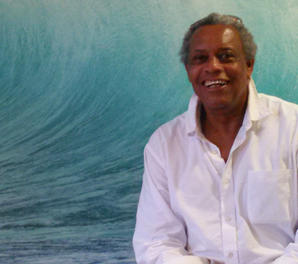
In the few days since the passing of my sister, I have realized once again, the Old Hawaiian Wisdom works best …to just bless her name ‘out loud’ whenever she crosses my mind. It really helps diffuse the sadness and ease-in the earthly-third-world acceptance (that must, on this departed, separate physical plane, BE).
Some people leave quietly from your life, then there are the “powerful forces” that leave a void …rather like lightning on the far horizon, and that silence-void …just before the clap of thunder. And so the latter is, with the Barbara Hill we knew as “Big Sista”. Not just her incredible work as an intensive care, critical-ward nurse, but her natural dynamics as a powerful personality (you astrology buffs would attribute it to Leo with an Aquarian “Queen’s” Life Path).
Today’s chuckle of a memory out of that far horizon, was her little story in the early 90’s of meeting a man at a Beverly Hills cocktail party. All she imparted about him was his goofy, boy-ish, kind of clingy attitude (Barbara “drew people in need of strength and healing to her like a magnet). All she said further about him was, “he was obviously in his seventies or eighties, and had led a very hard life”. “Very interesting to talk to, though.” And, “oh yes, he said his name was Dr. Timothy Leary”.
Conor Sprouls, a customer service representative at a MetLife call center, where an artificial intelligence program monitors employees, in Warwick, Rhode Island, May 24, 2019. In all of the worry about the potential of AI to replace rank-and-file workers, we may have overlooked the possibility it will replace the bosses, too, columnist Kevin Roose says. (Tony Luong / The New York Times)
When Conor Sprouls, a customer service representative in the call center of insurance giant MetLife talks to a customer over the phone, he keeps one eye on the bottom-right corner of his screen. There, in a little blue box, artificial intelligence tells him how he’s doing.Talking too fast? The program flashes an icon of a speedometer, indicating that he should slow down.
Sound sleepy? The software displays an “energy cue,” with a picture of a coffee cup.
Not empathetic enough? A heart icon pops up.
For decades, people have fearfully imagined armies of hyper-efficient robots invading offices and factories, gobbling up jobs once done by humans. But in all of the worry about the potential of artificial intelligence to replace rank-and-file workers, we may have overlooked the possibility it will replace the bosses, too.
Sprouls and the other call center workers at his office in Warwick, Rhode Island, still have plenty of human supervisors. But the software on their screens — made by Cogito, an AI company in Boston — has become a kind of adjunct manager, always watching them. At the end of every call, Sprouls’ Cogito notifications are tallied and added to a statistics dashboard that his supervisor can view. If he hides the Cogito window by minimizing it, the program notifies his supervisor.
An application of Cogito, an artificial intelligence program that monitors employees, at the MetLife call center in Warwick, Rhode Island. (Tony Luong / The New York Times)
Cogito is one of several AI programs used in call centers and other workplaces. The goal, according to Joshua Feast, Cogito’s chief executive, is to make workers more effective by giving them real-time feedback.
“There is variability in human performance,” Feast said. “We can infer from the way people are speaking with each other whether things are going well or not.”
The goal of automation has always been efficiency, but in this new kind of workplace, AI sees humanity itself as the thing to be optimized. Amazon uses complex algorithms to track worker productivity in its fulfillment centers, and can automatically generate the paperwork to fire workers who don’t meet their targets, as The Verge uncovered this year. (Amazon has disputed that it fires workers without human input, saying that managers can intervene in the process.) IBM has used Watson, its AI platform, during employee reviews to predict future performance and claims it has a 96% accuracy rate.
Then there are the startups. Cogito, which works with large insurance companies like MetLife and Humana as well as financial and retail firms, says it has 20,000 users. Percolata, a Silicon Valley company that counts Uniqlo and 7-Eleven among its clients, uses in-store sensors to calculate a “true productivity” score for each worker, and rank workers from most to least productive.
Management by algorithm is not a new concept. In the early 20th century, Frederick Winslow Taylor revolutionized the manufacturing world with his “scientific management” theory, which tried to wring inefficiency out of factories by timing and measuring each aspect of a job. More recently, Uber, Lyft and other on-demand platforms have made billions of dollars by outsourcing conventional tasks of human resources — scheduling, payroll, performance reviews — to computers.
But using AI to manage workers in conventional, 9-to-5 jobs has been more controversial. Critics have accused companies of using algorithms for managerial tasks, saying that automated systems can dehumanize and unfairly punish employees. And while it’s clear why executives would want AI that can track everything their workers do, it’s less clear why workers would.
“It is surreal to think that any company could fire their own workers without any human involvement,” Marc Perrone, the president of United Food and Commercial Workers International Union, which represents food and retail workers, said in a statement about Amazon in April.
In the gig economy, management by algorithm has also been a source of tension between workers and the platforms that connect them with customers. This year, drivers for Postmates, DoorDash and other on-demand delivery companies protested a method of calculating their pay, using an algorithm, that put customer tips toward guaranteed minimum wages — a practice that was nearly invisible to drivers, because of the way the platform obscures the details of worker pay.
There were no protests at MetLife’s call center. Instead, the employees I spoke with seemed to view their Cogito software as a mild annoyance at worst. Several said they liked getting pop-up notifications during their calls, although some said they had struggled to figure out how to get the “empathy” notification to stop appearing. (Cogito says the AI analyzes subtle differences in tone between the worker and the caller and encourages the worker to try to mirror the customer’s mood.)
MetLife, which uses the software with 1,500 of its call center employees, says using the app has increased its customer satisfaction by 13%.
“It actually changes people’s behavior without them knowing about it,” said Christopher Smith, MetLife’s head of global operations. “It becomes a more human interaction.”
The MetLife call center in Warwick, Rhode Island, which uses the artificial intelligence program Cogito to monitor employees.
Still, there is a creepy sci-fi vibe to a situation in which AI surveils human workers and tells them how to relate to other humans. And it is reminiscent of the “workplace gamification” trend that swept through corporate America a decade ago, when companies used psychological tricks borrowed from video games, like badges and leader boards, to try to spur workers to perform better.
Phil Libin, the chief executive of All Turtles, an AI startup studio in San Francisco, recoiled in horror when I told him about my call center visit.
“That is a dystopian hellscape,” Libin said. “Why would anyone want to build this world where you’re being judged by an opaque, black-box computer?”
Defenders of workplace AI might argue that these systems are not meant to be overbearing. Instead, they’re meant to make workers better by reminding them to thank the customer, to empathize with the frustrated claimant on Line 1 or to avoid slacking off on the job.
The best argument for workplace AI may be situations in which human bias skews decision-making, such as hiring. Pymetrics, a New York startup, has made inroads in the corporate hiring world by replacing the traditional résumé screening process with an AI program that uses a series of games to test for relevant skills. The algorithms are then analyzed to make sure they are not creating biased hiring outcomes, or favoring one group over another.
“We can tweak data and algorithms until we can remove the bias. We can’t do that with a human being,” said Frida Polli, Pymetrics’ chief executive.
Using AI to correct for human biases is a good thing. But as more AI enters the workplace, executives will have to resist the temptation to use it to tighten their grip on their workers and subject them to constant surveillance and analysis. If that happens, it won’t be the robots staging an uprising.
Jesse Eisenberg Comedy Movie
MovieAccessTrailers
Published on May 22, 2019
THE ART OF SELF DEFENSE Trailer #2 NEW (2019) Jesse Eisenberg Comedy Movie HD
sfchronicle.com — For most of his adult life, Carlos Plazola kept his stress and anger at bay with exercise. Running didn’t solve all his problems, but it kept him going. When his knees gave out in his late 40s, he turned to yoga for his mental health needs. Then he added meditation. And when that wasn’t enough, he tried psychedelics. In October, he got a dose of magic mushrooms (psilocybin) from a friend of a friend, who also set him up with a bedroom in a house where he could take the drug.
There are a handful of adjectives that frequently feature in Broadway marketing materials. “Transgressive” is not one of them.
This fall, a group of producers is planning to change that. They are making the risky move of bringing to the Golden Theater one of the most buzzed-about Off Broadway shows of last season — “Slave Play,” a daring, provocative, unsettling, polarizing, and yes, transgressive look at race relations through the prism of the sexual hangups of three interracial couples.
The play was written by Jeremy O. Harris, 30, who began working on it in 2016, during his first semester at the Yale School of Drama; he graduated from the program this spring, and the play will be his Broadway debut.
“I’m very excited, mainly because when I was growing up, all the plays I revered were by writers who had worked on Broadway,” Mr. Harris said in an interview.
“Slave Play” is intentionally outrageous, set in a group therapy workshop testing an imaginary technique called “antebellum sexual performance therapy,” in which the couples use explicit sexual role play, set on a plantation but punctured by pop songs, to work through their issues.
“The play is about entanglement, and about the wound inside of America that has gone unhealed for too long,” Mr. Harris said.
The production will be directed by Robert O’Hara and produced by Greg Nobile, Jana Shea and Troy Carter, along with Level Forward, which is Abigail Disney’s company, and Nine Stories, which is a venture from Jake Gyllenhaal and Riva Marker.
Mr. Nobile and Ms. Shea are partners in Seaview Productions, which is also producing “Sea Wall/A Life,” a pair of monologues performed by Mr. Gyllenhaal and Tom Sturridge, on Broadway this summer. Mr. Carter, producing on Broadway for the first time, helped guide the careers of Lady Gaga and John Legend. A former Spotify executive, he this year started a new music company, Q&A.
“Slave Play” is scheduled to begin previews Sept. 10 and to open Oct. 6. The producers said that they would make 10,000 tickets to the show available for $39 in an effort to broaden access.
The run is scheduled for 17 weeks; casting has not yet been announced.
“Slave Play” had a production last winter at New York Theater Workshop, also directed by Mr. O’Hara; it attracted rave reviews, but also prompted controversy and criticism that could intensify as the play gets more attention. Mr. Harris said that much of the controversy over the Off Broadway run was prompted by a photograph of the production, rather than the play itself, but that he was ready for a variety of reactions.
“People have a lot of unchecked emotions around these histories, and they should feel explosive, because it’s explosively relevant to who we are,” he said. “I just hope the controversy is a controversy of ideas and not a controversy of hyperbole.”
Writing in The New York Times, Jesse Green called the drama“willfully provocative, gaudily transgressive and altogether staggering,” while Wesley Morris said “‘Slave Play’ is the single most daring thing I’ve seen in a theater in a long time.” Many critics agreed, but not all; in The Guardian, Hubert Adjei-Kontoh wrote that “the play may simply give white people yet another platform to gaze on black bodies exposed to physical and sexual violence while simultaneously patting themselves on the back for ‘surviving’ the experience.”
Mr. Harris said he did not plan to make substantial changes before the play is presented at the Golden. He said he was heartened by the success last season on Broadway of plays like “What the Constitution Means to Me,” which is about the treatment of women in American legal history.
“People are ready to see something that feels different and is more challenging,” he said. “We’re at this moment, after the last season, where maybe the freaks can come hang out in the commercial landscape.”
He also argued that the play’s provocations are not that unusual in American culture. “The ideas inside of ‘Slave Play’ are not so radical,” he said. “And the things that happen on the stage happen every week in ‘Game of Thrones.’ ”
More about Jeremy O. Harris and ‘Slave Play’
A Playwright Who Won’t Let Anyone Off the Hook
How These Black Playwrights Are Challenging American Theater
Review: Race and Sex in Plantation America in ‘Slave Play’
Michael Paulson is the theater reporter. He previously covered religion, and was part of the Boston Globe team whose coverage of clergy sexual abuse in the Catholic Church won the Pulitzer Prize for Public Service. @MichaelPaulson
The traditional rules about how to be a “real man” in America are breaking down. Economic upheaval has shifted wage earning from men to their wives or partners. The rise of men as primary caregivers of their children is challenging our most fundamental assumptions about gender. The gay rights and trans rights movements are creating expansive new definitions of masculinity. Millennials are leading a much broader acceptance of diversity.
This generation is witness to a collision between traditional masculinity and a new wave, one that values intimacy, caregiving, and nurturing. But many of us have spent our lives under immense pressure to stifle emotional expression of any kind. And we’re learning there’s a cost: Men are suffering higher rates of life-threatening disease, depression, and death. Simply put, the suppression of emotional expression in men is damaging their health and well-being.
If you’ve grown up in the United States, then you’re familiar with the Man Box, the longstanding rules of how to walk, talk, and sound like a man in America:
1. Real men don’t express a wide range of emotions. They limit themselves to expressing anger or excitement.
2. Real men are breadwinners, not caregivers.
3. Real men are “alphas” and natural leaders.
4. Real men are authoritative and make all final decisions.
5. Real men are physically tough and sexually dominant.
These rules take hold early in our lives. Boys 4 and 5 years old are told to shake it off, man up, don’t be a crybaby, and, worst of all, don’t be a girl. This is because the Man Box devalues any form of emotional expression traditionally deemed to be feminine. A devastating result of this anti-feminine bias is that women, gays, and trans people face epidemic levels of bullying, rape, misogyny, homophobia, and violence.
The Man Box robs our sons of a lifetime of opportunities to develop their emotional capacities. Instead, they grow into emotionally isolated men who wall themselves off from the social connectivity central to healing and creating community. The resulting health effects are undeniable.
One in three men aged 45 or older reported himself to be lonely or socially isolated, according to a 2010 survey conducted by AARP. The consequences of that social isolation can be fatal. Between 1999 and 2010, suicide among men aged 35–64 rose by nearly 30 percent, as reported by the Centers for Disease Control and Prevention. Although rates have been rising for both sexes, the study found that middle-aged men are three times likelier than women to end their own lives—27.3 deaths versus 8.1 (per 100,000).
But the risks of social isolation are not just psychological; the absence of robust social relationships has a direct measurable impact on men’s physical health. A 2004 medical study based in Sweden showed that for middle-aged men, having a strong social network and sense of belonging lowered their risk of heart attack and fatal coronary heart disease; inversely, low social support predicted a risk.
The study further confirms that the risk of mortality for poor social relationships is comparable to risk factors like smoking and alcohol consumption, writes Niobe Way, author of Deep Secrets and professor of applied psychology at New York University. “This point underscores the fact that friendships are not simply a feel-good issue—they are a life-or-death issue.”
Add to this epidemic of emotional isolation the physical impact of unresolved trauma in men’s lives, and the combined effects are devastating. In The Body Keeps the Score, psychiatrist and PTSD researcher Bessel van der Kolk explores his decades-long work treating victims of catastrophic trauma. In 1978, he joined the Boston Veterans Administration Clinic as a staff psychiatrist. There, working with veterans of the Vietnam War, van der Kolk began to see the patterns that mark our modern-day understanding of trauma.
How much unresolved trauma do men carry after decades of emotional suppression?
He learned that the human body, when confronted with trauma, can etch horrific memories in the brain, literally reorganizing our perceptions and imagination. The most harmless sounds can trigger flashbacks. One veteran, upon hearing a baby crying, “found himself suddenly flooded with unbearable images of dying children in Vietnam.” He was stuck, in effect, in a terrible loop, revisiting the events over and over again.
One of the many physiological responses to trauma can be seen in a region of the brain called Broca’s Area, which freezes up during flashbacks. This region of the brain is where we construct language to define and interpret our experience of the world. Is it any wonder people find it deeply challenging to put their experiences of trauma into words? Our own physiology is telling us it’s better to remain silent, making trauma all the harder to share or process.
And what exactly qualifies as trauma? Is it only present after catastrophic events or can it also take hold in the smaller brutalities of daily life, on playgrounds or in locker rooms? How much unresolved trauma do men carry after decades of emotional suppression?
I can recall, as a 7-year-old, seeing my home disappear out the back window of a car as a bitter divorce and my mother’s new marriage drew me away. I recall my brother taking out his shock and rage on me for 15 years afterward. I still flash back to the suffocating bullying and violence that ran rampant throughout my years of school and Scouts. And yet, when is any man encouraged to share such stories? For generations, talking about such things was antithetical to our culture’s insistence on male toughness. Thankfully, this is changing. As an editor for the Good Men Project, a website devoted to modern masculinity, I see thousands of men’s stories being told. But we need to hear more. Millions more.
Trauma and the Man Box are mutually reinforcing. If, as men, we do not share our feelings, we will accrue decades of painful hidden stories, some of which will play over and over, triggering depression, fear, and unresolved anger toward ourselves and those we love.
Van der Kolk writes, “Everything about us—our brains, minds, and our bodies—is geared toward collaboration in social systems. This is our most powerful survival strategy, the key to our success as a species, and it is precisely this that breaks down in most forms of mental suffering.”
If we are to empower our sons and improve men’s lives—and their health—we must tear down the walls of the Man Box, encouraging boys and men to express their full emotional range. The path forward begins in our homes. In small, ongoing daily conversations, we can encourage our sons to explore their internal emotional landscapes, sharing those profound discoveries of life. The result will be countless authentic human moments, strung out across decades, each one growing the rich tapestry of human connection and capacity.
The cost of failing to do so is incalculable. Without the robust social networks that emotional expression creates, men will continue to suffer social isolation and shorter, sicker lives.
Van der Kolk defines humans as powerfully resilient and resourceful creatures, able to move beyond the challenging events of our lives and heal. But to do so, men must collaborate, connect, and share our stories, no matter how difficult they may be to tell.
Our best bet for frolicking among the stars will come from building O’Neill space colonies.
Landing on and terraforming distant worlds such as Mars is fraught with greater technical and biological difficulties.
Advances in radiation shielding, space construction and propulsion are needed for any sort of space colonization effort.
Humanity has been openly flirting with cosmic destiny for centuries. From the early reaches of our science fiction literature to the astounding feats of manned space exploration. We’re getting anxious still wading on the earthen shores. The vast expanse of space is calling.
It’s time we finally left the planetary womb and started strutting our stuff permanently amongst the stars.
But, in order to do that, we are going to need some serious new inventions for space colonization. The likes of which will allow us to reach our most ascendent of aspirations — the conquering of the stars.
Whether it’s getting to the moon first, crafting new terraformed sands of Mars, or spinning through self-sustaining colonies — the end result will be the same.
We’re leaving the sandbox and these are some of the tools we’ll use to do it.
O’Neill space colonies
In the 1970s, Princeton physicist Gerard K. O’Neill, was tasked with designing a free floating space colony with existing technology, materials and construction techniques. Suffice to say, we’re no closer to having space colonies now then we were then. O’Neill wrote a number of fascinating books on the topic and claimed that the concept was feasible at the time. He was interested in building alternative human habitats that were both beyond Earth and beyond a planetary body. Out of this was conceived the idea of a giant rotating spaceship, which could support a biosphere and house up to 10 million people.
After its founder’s namesake, this space colonization concept has come to be known as the O’Neill Cylinder. The basis of the structure would be crafted out of steel and aluminum and formed into a hollow cylinder.
This kind of space settlement is arguably the most important of inventions we’d need to give us a permanent place in space.
O’Neill’s plans for the colonies originally appeared in the journal Physics Today. He went on to expand on the idea in a number of books, most notably in The High Frontier: Human Colonies in Space.
A closed ecosystem inside would create the biosphere. Sunlight and solar power would be utilized by giant glass windows in space. All together the goal would be to create a climate controlled living space. There would be no limit to what kind of climate or ecosystem it is that you wanted to create.
Rather than living on top of a sphere as we do now, future cylinder colonists would settle from the inside. Artificial gravity would be created by the cylinder’s walls rotating. These colonies would be situated at Lagrange points in order to stay in a consistent and stable gravitational environment. It would take weeks to fly to these colonies from Earth.
It’s mind-boggling to think of the number of inventions we’d need to create to get a project of this magnitude started. But humanity has never shied away from inventing insane and impossible things.
An entire space mining industry would be needed to transport rocky material from the moon and asteroids to serve as the bedrock to these colonies. Space construction crews would assemble the colonies in space, backed by the thoughtful minds of engineers, master ecologists and so on.
Our American Gilded Age would look pathetically poor in comparison to such an expedition.
This type of space colonization technology was recently referenced by none other than Jeff Bezos, the CEO of Amazon. A student of science fiction and fact, Bezos’s goal is to help build the future of our space industry to one day make something like this possible.
Now, if Musk would have read up a little on his literature, he’d have realized he’s an unwitting planetary chauvinist — a term coined by legendary fiction writer Isaac Asimov.
During an interview, Asimov was questioned about whether or not he’d ever written about space colonies. His response:
“. . . We’ve all been planet chauvinists. We’ve all believed people should live on the surface of a planet, of a world. I’ve had colonies on the moon — so have a hundred other science fiction writers. The closest I came to a manufactured world in free space was to suggest that we go out to the asteroid belt and hollow out the asteroids, and make ships out of them [in the novelette The Martian Way]. It never occurred to me to bring the material from the asteroids in towards the earth, where conditions are pleasanter, and build the worlds there.”
Yet, there is still some validity in wanting to both colonize planets such as Mars and create free floating space colonies. So why not aim for both?
Inventions for traveling through space
Getting ourselves to Mars requires an entire new class of things that don’t exist yet. NASA has tasked themselves with leading the charge on an incredible amount of new technologies that will assist them in both the voyage and landing on Mars. These inventions would also of course spill over to other space colonization efforts.
NASA is working on creating satellite propellant transfer, which means that a robot would be able to refuel a spacecraft while in space, thus eliminating the need for a vehicle to return to the ground and fill up. This would allow for greater range in deep space and be a great boon for transporting space materials without expending more energy than needed.
Another problem that astronauts and future colonists will face is radiation. While scientists are working on better modes of propulsion such as advanced solar sails and lightweight heavy-lift rocket systems, they still face the ever present problem of radiation.
NASA needs to create something that can shield their spaceships if, for example, astronauts are looking to take a six-month trip to Mars. They’ll need to be able to balance creating a radiation shield that’s not too massive, but still protects the ship’s inhabitants.
We’re barely scratching the surface when it comes to just traveling to Mars. Until we can figure this out, actually landing and terraforming the planet is a pipe dream.
There is an innumerable amount of problems that our space inventions will need to solve. The crafting of O’Neill colonies would bring on an absolute deluge of scientific discovery and creation.
Even the maddening planetary chauvinistic rush to Mars will be beneficial to our space colonist aspirations as well.
All in all, our most important inventions need to solve our most basic and eternal problems, but this time in space. Shelter, safety, sustenance and a place to grow and one day thrive.
Between the demands of working and bringing home a paycheck, family obligations, paying the bills, social media, and a little time for friends . . . it feels like no time is left for you.
As part of Self-Care month, I wanted you to focus on making time for yourself. Self-Care is another way of saying let’s be Healthy. Which is really different from saying let me be selfish.
Another idea to consider about Health, is that health is not always maintained from medicines. Medicine suggests you can be relieved of dis-ease, or chemically restore a balance in pursuit of the healthy Body. A healthy lifestyle, I suggest, may take you further than just medicine alone. Consider adding activities and things that contribute to peace of mind, peace in the heart, peace in the soul. And, oh yes, liberal amounts of laughter and love to be applied daily for self-care.
To have a healthy lifestyle takes a change in habits, a conscious focus to make time for yourself each day, even if it is only fifteen minutes a day. It is important but, unfortunately, I have seen from clients in my life coaching business time and again it’s something they will let slide or neglect in their busy stressed-out life and wonder why they feel the way they do.
When your thoughts are negative or unsupportive of your happiness and success you feel out of balance or dis-eased. You will find that to change your thinking means to stop beating yourself up: instead, redirect your thinking to thoughts that will support your success and happiness. Laugh, if you can, when you think about the time you have spent obsessing over matters that are not happening or have run their course and are completed.
Suggestion: Arrange whatever small block of time you can to just stop – and draw back from the fast-paced routine of the day to just be truly with yourself and, if possible, define how you feel, or what you’ve learned or experienced. In those moments with yourself take stock to see how you live, and most importantly what gives you enjoyment. The importance of this exercise is that you are not just letting your life slip away from you.
Self-Care moments exist to counteract living life on autopilot. Use tools like journaling to become more mindful in your day-to-day life. It can take just minutes a day to inspire valuable Habit changes. Two wonderful sources I use and that can get you started in that direction are: First, the book “The 7 Habits of Highly Effective People” by Stephen R. Covey, which is a book written on Covey’s belief that the way we see the world is entirely based on our own perceptions. And the second is by a company called Vertellis, who has put out an actual journaling formatted book called Vertellis Chapters Journal. I highly recommend both for anyone looking to draw out of themselves and refresh their perspective on how they view the world and are living their lives in it. This is also preparation for those who choose to move their life forward. (Unsurprisingly, this forward movement comes with a feeling of living in gratitude and to have no regrets.)
Over the next 7 to 10 years, the world will look a whole lot different. “AI” Technology will see to that! Computer monitors and other screen-time activities will obliterate “quality”-self-time and instill the mantra “staying busy is more important than self-reflection.” Unfortunately, this can create less understanding of oneself and the ability one has for crucial thinking and coping with change in a healthy manner. So, my mission is to facilitate meaningful habit changes with Life Coaching and encouraging self-dialog through Journaling and small group activities. I liken Journaling to going through a maze or Labyrinth of your mind, giving you an outlet for self-reflection and development.
Encouraging these offline moments increases space for self-reflection and can spark sincere conversations with yourself and people you care about to inspire a wholeness within you, through reflection, and self-awareness for a happier, satisfying and more meaningful life.
A satisfying life is what I call a successful life. It goes against conventional thinking, but the word successful, in its normal sense of the word usually is the measure of “other people’s criteria” or standards, not by what the individual creates as criteria for themselves. Flip that around with the use of the word Satisfaction: Now, you see, that is measured, and criteria of your own mind, heart, and efforts are in play.
Routine Daily habits of journaling will allow you to identify your greatest hopes, fears, and dreams, to process that information before you go into a situation that truly matters to you; to learn and name what could hold you back from exploring your innate creativity; to find the nature of what holds you in its grip such as “you’re scared of being disliked”, or “people don’t hear your voice”, or “ fear of letting other people down” –etc., etc. The practice of pinpointing your emotional state is what psychologists call emotional granularity. It is suggested that people who exhibit greater emotional granularity regulate their feelings better and have a greater sense of satisfaction regarding appropriate responses in stressful situations.
Making time for yourself, with daily Journaling, is Self Care that helps you speak to and act with greater control of your interactions, rather than pushing emotions down and numbing yourself to life or being tossed around like salad when stressful situations hit.
To sum up, having a healthy lifestyle takes a change in habits, creating a routine that makes time for yourself – operating in mind, heart, and soul, to consciously focus each day. This type of Self Care gives you the opportunity to see yourself as Conscious mind, the ability to think, “to create and govern thought” and as the vehicle to create your reality.









 In the 1970s, Princeton physicist Gerard K. O’Neill, was tasked with designing a free floating space colony with existing technology, materials and construction techniques. Suffice to say, we’re no closer to having space colonies now then we were then. O’Neill wrote a number of fascinating books on the topic and claimed that the concept was feasible at the time. He was interested in building alternative human habitats that were both beyond Earth and beyond a planetary body. Out of this was conceived the idea of a giant rotating spaceship, which could support a biosphere and house up to 10 million people.
 Getting ourselves to Mars requires an entire new class of things that don’t exist yet. NASA has tasked themselves with leading the charge on an