Trying to understand the arguments of a person whose worldview is opposed to yours is often an exceedingly difficult task. In our ever more diverse and interconnected world, however, we must try. Here, we’ll examine the radical views of a brilliant mind, to help show you how it can be done.
Who was Oscar Wilde?
Oscar Wilde was one of the greatest authors of the late 19th century. A poet of the highest order, he wrote several works which are still widely read today, including The Picture of Dorian Gray and The Importance of Being Earnest. His wit and humor are legendary, as is the story of his fall, decline, and death.
Being a poet, Wilde was remarkably in tune with the social problems of his age. His proposed cure to the various ailments of Victorian England was a radical socialism which had only been tried for short periods before. His arguments are abstract, and he makes only passing mention of financial details. However, they are still worth considering—if only to help us understand how a revolutionary mind works.
Why was Oscar Wilde a socialist?
In his essay The Soul of Man Under Socialism, Wilde begins his argument for collectivism from a strange starting point. He does not desire the perfectly equal society nor one that subjugates the individual will to the common good. He is attracted to left-wing views because of his belief that “Socialism itself will be of value simply because it will lead to Individualism.”
But, how? Isn’t socialism the opposite of individualism?
Wilde believed that capitalism as it existed at the time, with the poor working for a pittance and the rich overly concerned with business affairs, prevented almost everyone from developing their personalities, reaching the peaks of individual achievement, and truly living life to the fullest.
He argued that giving control of the means of production to the community would free the poor from the horrors of poverty and the rich from the fear of going broke. This would then allow people to explore their personalities and live life fully. As Wilde phrases it, under his ideal system, “One will live. To live is the rarest thing in the world. Most people exist, that is all.”
What about all the totalitarianism? Why didn’t he predict that?
Of course, he understands that authoritarian socialism would fail to promote this individualism. He found the idea of “economic tyranny” by the state to be a dangerous concept which would be worse than the Dickensian world he lived in. He demanded that any collectivization must be done voluntarily and without coercion of any kind.
Writing this when he did, long before the totalitarian socialist regimes of the 20th century, his ideas were prophetic. Given how strongly he argues against centralizing economic power in the state, today he would perhaps best be labeled as an anarchist.
Did these ideas have anything to do with his art?
Oscar Wilde was first and foremost a writer and poet. His essay reflects this. When he muses on the few human beings who have been able to fully actualize themselves as individuals up to that time he lists artists such as Lord Byron, Percy Shelly, and Victor Hugo. His ideal world is designed to create artists.
In Wilde’s mind, freeing the individual from either slaving for poverty wages or having to tend to vast estates to avoid the fate of the poor will allow for everyone to focus on creative pursuits. This, in turn, will foster the development of the individual. His utopia is, as historian George Woodcock phrased it, “the society most favorable to the artist.”
Wilde sees no conflict between the ideal world for the artist and for the fostering of individualism since he also says that “art is the most intense mode of Individualism that the world has known.”
What did he think about reforming capitalism?
Wilde was writing during the tail end of the Victorian era, when the poor were tossed into workhouses and the starving had little recourse other than the sympathy of others. While he would find modern capitalism to be more humane than the classical variety he endured, his more radical desires, such as liberating the rich from the duties of business management, would remain unsatisfied in even the most fundamentally reformed capitalist system.
Furthermore, he seems to consider reform to be a disservice to those who need help the most. As he sees it, to give aid to the poor merely prolongs their suffering. By making the situation of the worst off slightly more comfortable, the charitable tend to the symptoms of poverty, but not the disease.
Oscar Wilde was a writer of unusual wit and ability. His praise of the individual and disgust at the injustices of England at the height of its power drove him towards an anarchist vision long before the trials of the 20th century would dim the dreams of many a left-wing idealist.
His arguments, while dated, show us the inner workings of a revolutionary mind similar to those we often encounter but rarely understand. His points, while often utopian, are still vital for us to consider as we look towards the future. As he put it:
“A map of the world that does not include Utopia is not worth even glancing at, for it leaves out the one country at which Humanity is always landing. And when Humanity lands there, it looks out, and, seeing a better country, sets sail. Progress is the realization of Utopias.”
CERN shared this visualization of one of the events in the new Higgs dataset.
Credit: ATLAS Collaboration/CERN
The Higgs boson appeared again at the world’s largest atom smasher — this time, alongside a top quark and an antitop quark, the heaviest known fundamental particles. And this new discovery could help scientists better understand why fundamental particles have the mass they do.
When scientists at the Large Hadron Collider (LHC) first confirmed the Higgs’ existence back in 2013, it was a big deal. As Live Science reported at the time, the discovery filled in the last missing piece of the Standard Model of physics, which explains the behavior of tiny subatomic particles. It also confirmed physicists’ basic assumptions about how the universe works. But simply finding the Higgs didn’t answer every question scientists have about how the Higgs behaves. This new observation starts to fill in the gaps.
As the European Organization for Nuclear Research (CERN), the scientific organization that operates the LHC, explained in a statement, one of the most significant mysteries in particle physics is the major mass differences between fermions, the particles that make up matter. An electron, for example, is a bit less than one three-millionth the mass of a top quark. Researchers believe that the Higgs boson, with its role (as Live Science previously explained) in giving rise to mass in the universe, could be the key to that mystery. [Top 5 Implications of Finding the Higgs Boson]
Two experiments — the Compact Muon Solenoid (CMS) and A Toroidal LHC Apparatus (ATLAS) — observed a decay that revealed that the Higgs “couples” extremely strongly with the superheavy top quark, suggesting a close affinity between the particles. That result lines up with what physicists had predicted.
The new measurements “give a strong indication that the Higgs boson has a key role in the large value of the top quark’s mass. While this is certainly a key feature of the Standard Model, this is the first time it has been verified experimentally with overwhelming significance,” Karl Jakobs, a spokesperson for the LHC’s ATLAS collaboration, said in the statement.
The new results were published today (June 4) in the journal Physical Review Letters. They don’t represent a single observation but rather the faint signals of many observations, collected until the researchers had enough data to be certain of what they were witnessing.
The Higgs-top quark decay, called the “ttH signal,” was published in the paper with a statistical significance measured at 5.2 sigma, meaning it had a far better than 1-in-3.5-million chance of being just a fluke in the data. A follow-up paper posted at the same time on the preprint server arXiv reports an even better significance of 6.3 sigma, which substantially exceeds 1-in-500-million odds of being just a fluke.
Mars enters your sign this week at a very delicate moment, but because it’s the planet of war and not sensitivity, it just stands there and talks while you’re on the can.
Cancer
Sometimes little things mean a lot, as is demonstrated by the microscopic cluster of rapidly growing cancer cells in your pancreas.
Leo
You’ve honestly been trying hard to be a better person, but by Friday you’ll discover you have a favorite professional wrestler.
Virgo
You’ve always wondered if you’d ever be in a situation where the wisdom contained in the lyrics of Hank Williams Jr. songs didn’t apply, and for you, the answer is “not yet.”
Libra
You’ve long wished you could go back to high school knowing what you know now, but you always thought there would be magical time-travel involved when it happened.
Scorpio
You’re always the first to help a friend in need, but only when it means sneaking bulky, plastic-wrapped packages out of hotels in the middle of the night.
Sagittarius
It’s been more than 25 years since you were raised by wolves, so stop using that as an excuse for eating pizza with a fork like some kind of jerk.
Capricorn
While it’s true military budgets are being slashed across the board, don’t get any ideas. They could still slaughter you if they had to.
Aquarius
You’ll learn a painful lesson about accepting dares while drunk, but at least the residents of Niagara Falls will have something to talk about for a while.
Pisces
You always thought ladybugs were such cute, innocent insects, but it turns out that in sufficient numbers, any creature can gnaw one’s leg down to the bone.
Aries
As long as people don’t look too long and the lights aren’t too bright, no one will be able to see where they tried to fix your face from what will happen to it this coming Thursday.
Taurus
There aren’t many people who get as angry at a poorly made Manhattan cocktail as you do, making it very easy for investigators to figure out what happened.
Joan of Arc was a tough cross-dressing teenage warrior who led the medieval French army to victory when she was 17. She is a queer icon, girl-power hero and patron saint of France. Her feast day is May 30.
Smart and courageous, Joan of Arc (c. 1412-1431) had visions of saints and angels who told her to cut her hair, put on men’s clothes and go to war. At age 18 she helped crown a king and at 19 she was killed by the church that later made her a saint. She died for her God-given right to wear men’s clothing, the crime for which she was executed on May 30, 1431.
Contemporary LGBTQ people recognize a kindred spirit and role model in her stubborn defiance of gender rules. Queer writers tend to downplay Joan’s Christian faith, while the church covers up the importance of her cross-dressing. In truth, Joan believed strongly in God AND in cross-dressing. She insisted that God wanted her to wear men’s clothes, making her what today can be called “queer” or “transgender.” She fits the medieval archetype known as the “holy transvestite.” Cross-dressing was illegal, but what really upset the church authorities, then as now, was the audacity of someone being both proudly queer AND devoutly Christian. Her belief that God was the source of her gender-bending queerness makes her especially inspiring for LGBTQ Christians and our allies.
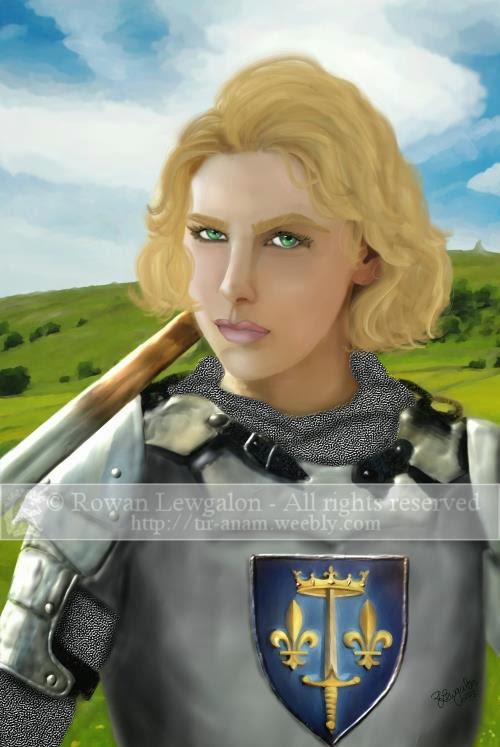
This post features contemporary portraits of Joan by Katy-Miles Wallace (top), Tony O’Connell, Rowan Lewgalon, Robert Lentz and Tobias Haller, plus many historical images.
Joan’s extraordinary life continues to fascinate all kinds of people. Many are eager to claim her as a symbol, from LGBTQ people and feminists to the Catholic Church and French nationalists. There is speculation that she was an intersex person with androgen insensitivity syndrome. Joan is the subject of more than 10,000 books, plays, paintings and films, including recent works by transgender author Leslie Feinberg and lesbian playwright Carolyn Gage.
The extensive records of her trials by the Inquisition make Joan of Arc the best-documented person of 15th century. There are only hints that she may have been a lesbian, but the evidence is absolutely clear about her trans expression as a cross-dresser.
Joan of Arc’s life story
Joan of Arc, also known as Jeanne d’Arc, was born to peasants in an obscure village in eastern France around 1412, toward the end of the Hundred Years War. Much of France was occupied by England, so that Charles, the heir to the French throne, did not dare to be crowned. When Joan was 13, she began hearing voices that told her to help France drive out the English.
The visions continued for years, becoming more detailed and frequent. Once or twice a week she had visions of Michael the Archangel and two virgin saints: Catherine of Alexandria and Margaret of Antioch (another transvestite saint who refused to marry a man). They told her that God wanted her to meet Charles and lead an army to Reims for his coronation.
Joan’s family tried to convince her that her visions weren’t real, and her first attempt to visit the royal court was rejected. When she was 17 she put on male clothing and succeeded in meeting Charles. He agreed to outfit her as a knight and allowed her to lead a 5,000-man army against the English.
On Charles’ order, a full suit of armor was created to fit Joan. He had a banner made for her and assigned an entourage to help her: a squire, a page, two heralds, a chaplain and other servants.
Joan’s appearance awed the soldiers and peasants when she traveled with the army. Mounted on a fine warhorse, she rode past cheering crowds in a suit of armor. Her hair was “cropped short and round in the fashion of young men.” She carried an ancient sword in one hand and her banner in the other. Her sword was found, as Joan predicted, buried at the church of St. Catherine at Fierbois. The banner showed Christ sitting on a rainbow against a background of white with gold lilies and the motto “Jhesus-Maria.” Legend says that white butterflies followed Joan wherever she rode with her banner unfurled.
With Joan leading the way, the army won the battle at Orleans and continued to defeat English and pro-English troops until they reached Reims. She proudly stood beside Charles VII at his coronation there on July 17, 1429.
Joan soon resumed leading military campaigns. Even during her lifetime the peasants adored her as a saint, flocking around her to touch her body or clothing. Her cross-dressing didn’t disturb them. In fact, they seemed to honor her for her transgender expression. Perhaps, as some scholars say, the peasants saw Joan as part of a tradition that linked transvestites and priests in pre-modern Europe.
Was Joan of Arc a lesbian?
One of the first modern writers to raise the possibility of Joan’s lesbianism was English author Vita Sackville-West. She implied that Joan was a lesbian in her 1936 biography “Saint Joan of Arc.” The primary source for this idea was the fact, documented in her trials, that Joan shared her bed with other girls and young women. She followed the medieval custom of lodging each night in a local home. Joan always slept with the hostess or the girls of the household instead of with the men.
“Joan of Arc: Her Trial Transcripts” by Emilia Philomena Sanguinetti is a 2016 book that explores whether Joan was a lesbian or transgender person. Extensive evidence that Joan of Arc was a lesbian or transgender person is presented in the epilogue of this groundbreaking book about the cross-dressing medieval saint. She explores how Joan shared her bed with another woman and insisted on wearing male clothing.
Nobody knows for sure whether Joan of Arc was sexually attracted to women or had lesbian encounters, but her abstinence from sex with men is well documented. Her physical virginity was confirmed by official examinations at least twice during her lifetime. Joan herself liked to be called La Pucelle, French for “the Maid,” a nickname that emphasized her virginity. Witnesses at her trial testified that Joan was chaste rather than sexually active.
Capture and trial of Joan of Arc
Joan’s illustrious military career ended in May 1430. She was captured in battle by the Burgundians, the French allies of the English. During her captivity they called her “hommase,” a slur meaning “man-woman” or “masculine woman.”
In a stunning betrayal, Charles VII did nothing to rescue the warrior who helped win him the crown. It was normal to pay ransom for the release of knights and nobles caught in battle, but he abandoned Joan to her fate. Historians speculate that French aristocrats felt threatened by the peasant girl with such uncanny power to move the masses.
The Burgundians transferred Joan to the English, who then gave her to the Inquisition. She spent four torturous months in prison before her church trial began on Jan. 9, 1431 in Rouen, the seat of the English occupation government. She was charged with witchcraft and heresy.
The politically motivated church trial was rigged against her, and yet Joan was able to display her full intelligence as she answered the Inquisitors’ questions. Her subtle, witty answers and detailed memory even forced them to stop holding the trial in public.
Witchcraft was hard to prove, so the church dropped the charge. (Many of today’s Wiccans and pagans still honor Joan as one of their own.) The Inquisitors began to focus exclusively on the “heresy” of Joan’s claim that she was following God’s will when she dressed as a man. The judges told her that cross-dressing was “an abomination before God” according to church law and the Bible. (See Deuteronomy 22:5.)
“Joan of Arc Kisses the Sword of Liberation” by Dante Gabriel Rossetti, 1863 (WikiPaintings)
Convicted of cross-dressing
They accused Joan of “leaving off the dress and clothing of the feminine sex, a thing contrary to divine law and abominable before God, and forbidden by all laws” and instead dressing in “clothing and armor such as is worn by man.”
Joan swore that God wanted her to wear men’s clothing. “For nothing in the world will I swear not to arm myself and put on a man’s dress; I must obey the orders of Our Lord,” she testified. She outraged the judges by continuing to appear in court wearing what they called “difformitate habitus” (“monstrous dress” or “degenerate apparel.”)
Today Joan’s conservative admirers claim that she wore men’s clothes only as way to avoid rape, but she said that it meant much more to her. Joan of Arc saw cross-dressing as a sacred duty.
The judges summarized Joan’s testimony by saying, “You have said that, by God’s command, you have continually worn man’s dress, wearing the short robe, doublet, and hose attached by points; that you have also worn your hair short, cut ‘en rond’ above your ears with nothing left that could show you to be a woman; and that on many occasions you received the Body of our Lord dressed in this fashion, although you have been frequently admonished to leave it off, which you have refused to do, saying that you would rather die than leave it off, save by God’s command.”
Joan refused to back down on the visions she received from God, and she was sentenced to death. She was burned at the stake on May 30, 1431 in Rouen. Twenty five years later she was retried and her conviction was overturned. Joan was declared innocent.
Her armor, that “monstrous dress,” became an object of veneration, sought after like the Holy Grail with various churches claiming to possess her true armor. Joan of Arc was canonized as a saint in 1920.
Joan of Arc in the arts
In the icon at the top of this post, an androgynous Joan of Arc has a bound chest and a rainbow halo. It was created by queer Lutheran artist and seminarian Katy Miles-Wallace in 2017 as part of her “Queer Saints” series. Her icon of Joan is modeled after genderqueer model Rain Dove. The series presents traditional saints with queer qualities and heroes of the LGBTQ community.
The icons are rooted in queer theology and in Miles-Wallace’s eclectic faith journey that began at a Baptist church in Texas and led to study at Pacific Lutheran Theological Seminary in Berkeley, California. She drew many of them on the altar of a seminary chapel. For more info, see the Q Spirit article “New icons of Queer Saints created by artist Katy Miles-Wallace.” The icons are available as prints, jewelry and more at the Queerly Christian Etsy and Zazzle shops.
Saint Joan of Arc from “Triptych for the 49” by Tony O’Connell
Joan of Arc also has a rainbow halo in “Triptych for the 49” by gay artist Tony O’Connell of Liverpool. Joan of Arc and Sebastian appear as “wrathful protector saints” in the artwork, which honors those killed in the 2016 mass shooting at the Pulse gay bar in Orlando, Florida.
Lewgalon is a spiritual artist based in Germany and also a cleric in the Old Catholic Apostolic Church. Her work is online at Etsy. Lentz is a Franciscan friar known for his innovative and LGBTQ-positive icons. He is stationed at Holy Name College in Silver Spring, Maryland.
“Jeanne d’Arc” was sketched by Tobias Haller, an iconographer, author, composer, and vicar of Saint James Episcopal Church in the Bronx. He is the author of “Reasonable and Holy: Engaging Same-Sexuality.” Haller enjoys expanding the diversity of icons available by creating icons of LGBTQ people and other progressive holy figures as well as traditional saints. He and his husband were united in a church wedding more than 30 years ago and a civil ceremony after same-sex marriage became legal in New York.
Joan of Arc also appears with a rainbow halo as a “wrathful protector saint” in O’Connell’s “Triptych for the 49,” a tribute to the people killed by a mass shooter at the Pulse gay nightclub in Orlando, Florida.
Famous writers and composers who have done works about her include Shakespeare, Voltaire, Verdi, Tchaikovsky, Mark Twain, Bertolt Brecht and George Bernard Shaw. A stunning portrait of Joan kissing her sword was painted by Pre-Raphaelite artist Dante Gabriel Rossetti, whose sister Christina Rossetti is also part of the LGBTQ Saints series at the Jesus in Love Blog at Q Spirit.
Joan has a dialogue with the fire that is about to consume her in a haunting song written by award-winning Canandian poet Leonard Cohen and sung on July Collins video .
Joan of Arc Prayer
A widely used prayer to Saint Joan of Arc makes a powerful statement that can inspire those who believe in equality for LGBTQ people, despite rejection by religion and society:
“In the face of your enemies,
in the face of harassment, ridicule, and doubt,
you held firm in your faith.
Even in your abandonment,
alone and without friends,
you held firm in your faith.
Even as you faced your own mortality,
you held firm in your faith.
I pray that I may be as bold
in my beliefs as you, St. Joan.
I ask that you ride alongside me
in my own battles.
Help me be mindful
that what is worthwhile
can be won when I persist.
Help me hold firm in my faith.
Help me believe in my ability
to act well and wisely. Amen.”
___
Top image credit:
“Queer Saints: St. Joan of Arc” by Katy Miles-Wallace. Available as prints and more at the Queerly Christian Etsy and Zazzle shops.
___
This post is part of the LGBTQ Saints series by Kittredge Cherry. Traditional and alternative saints, people in the Bible, LGBTQ martyrs, authors, theologians, religious leaders, artists, deities and other figures of special interest to lesbian, gay, bisexual and transgender and queer (LGBTQ) people and our allies are covered.
The commanding self in Sufi terminology is that mixture of primitive and conditioned responses, common to everyone, which inhibits and distorts human progress and understanding. The book serves to illustrate and amplify Idries Shah’s preceding (over 20) books on the Sufi Way.
About:
Peter Joseph is an American-born social critic and activist who has lectured around the world on the subject of cultural sustainability. Once deemed “The Herald of Occupy Wall Street” for his tacit prediction of inevitable global uprisings against inequality and economic injustice, his extensive media work has been translated into over 130 languages and experienced by 250 million people. Working in concert with numerous NPOs and grassroots organizations, Joseph’s core focus is on socioeconomic structures that undermine progress in the areas of ecological and social justice. He has been featured and profiled in numerous media outlets, including the New York Times, The Huffington Post, Free-Speech TV, and TED, and has given over a thousand hours of interviews via radio shows and podcasts in the past decade.
Also see: www.peterjoseph.info
About TZM:The Zeitgeist Movement is a global sustainability activist group working to bring the world together for th common goal of species sustainability before it is too late. Divisive notions such as nations, governments, races, political parties, religions, creeds or class are non-operational distinctions in the view of The Movement. Rather, we recognize the world as one system and the human species as a singular unit, sharing a common habitat.
Consciousness, sexuality, androgyny, futurism, space, the arts, science, astrology, democracy, humor, books, movies and more


 ” is an underground classic with Joan as “a cross-dressing, teenaged, runaway lesbian” confronting male-dominated institutions. Feinberg has a chapter on Joan as “a brilliant transgender peasant teenager leading an army of laborers into battle” in her history book “
 .” And Joan is included in the 2017 LGBTQ history book for teens, “

 .” The primary source for this idea was the fact, documented in her trials, that Joan shared her bed with other girls and young women. She followed the medieval custom of lodging each night in a local home. Joan always slept with the hostess or the girls of the household instead of with the men.