Stacy is from Washington, Illinois! So you can say she is a transplant from the midwest and she very pleased about it!
In her own words:
“I’m very athletic, I coached Women’s Division One Volleyball… “I’m fun-loving entertaining opinionated and the best friend anyone could ever want!!!
And she is also very excited to Co-Host this week’s Rainbow Radio!
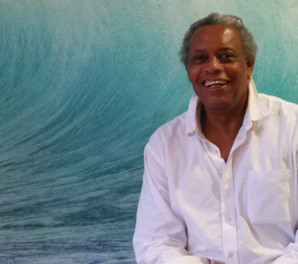
Calvin Harris is a Native of Los Angeles and a former student at Prosperos School on Ontology in Santa Monica. He loves humanity and as being a native of Los Angeles he has had a world of experience in diversity and all the wonderful colors of the rainbow that make up the human spirit
Calvin is one who has surrounded himself with this richly textured community of contradictory and diverse individuals with a passion for life and a flair for success, innovation, and creativity. In his vocation, he performs the roles of mentor, teacher, storyteller, or loving friend.Those that seek him out, are those ready to make a change, find their way through adversity, clamity, and confusion. And those that have the courage to participate and engage in the processes that will bring about their change, their piece, their happiness.
Tune in this Saturday at KX935.com and click listen now to hear the show live. Or check back later if you are busy and play it at your leasure as a podcast! Either way, I think you will find the show and guests features very interesting and fun!
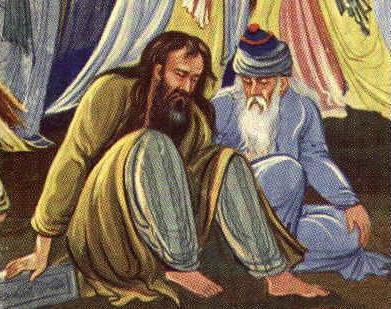
Rumi and Shams together in a detail from “Dervish Whirl” by Shahriar Shahriari (RumiOnFire.com)
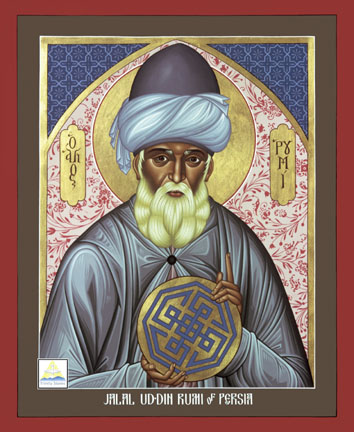
Rumi is a 13th-century Persian poet and Sufi mystic whose love for another man inspired some of the world’s best poems and led to the creation of a new religious order, the whirling dervishes. His birthday is today (Sept. 30).
With sensuous beauty and deep spiritual insight, Rumi writes about the sacred presence in ordinary experiences. His poetry is widely admired around the world and he is one of the most popular poets in America. One of his often-quoted poems begins:
If anyone asks you
how the perfect satisfaction
of all our sexual wanting
will look, lift your face
and say,
Like this.*
The homoeroticism of Rumi is hidden in plain sight. It is well known that his poems were inspired by his love for another man, but the queer implications are seldom discussed. There is no proof that Rumi and his beloved Shams of Tabriz had a sexual relationship, but the intensity of their same-sex love is undeniable.
Rumi was born Sept. 30, 1207 in Afghanistan, which was then part of the Persian Empire. His father, a Muslim scholar and mystic, moved the family to Roman Anatolia (present-day Turkey) to escape Mongol invaders when Rumi was a child. Rumi lived most of his life in this region and used it as the basis of his chosen name, which means “Roman.” His full name is Jalal ad-Din Muhammad Balkhi-Rumi.
His father died when Rumi was 25 and he inherited a position as teacher at a madrassa (Islamic school). He continued studying Shariah (Islamic law), eventually issuing his own fatwas (legal opinions) and giving sermons in the local mosques. Rumi also practiced the basics of Sufi mysticism in a community of dervishes, who are Muslim ascetics similar to mendicant friars in Christianity.
On Nov. 15, 1244 Rumi met the man who would change his life: a wandering dervish named Shams of Tabriz (Shams-e-Tabrizi or Shams al-Din Muhammad). He came from the city of Tabriz in present-day Iranian Azerbaijan. It is said that Shams had traveled throughout the Middle East asking Allah to help him find a friend who could “endure” his companionship. A voice in a vision sent him to the place where Rumi lived.
Meeting of Rumi and Shams
16th-17th century folio
(Wikimedia Commons)
Rumi, a respected scholar in his thirties, was riding a donkey home from work when an elderly stranger in ragged clothes approached. It was Shams. He grasped the reins and started a theological debate. Some say that Rumi was so overwhelmed that he fainted and fell off the donkey.
Rumi and Shams soon became inseparable. They spent months together, lost in a kind of ecstatic mystical communion known as “sobhet” — conversing and gazing at each other until a deeper conversation occurred without words. They forgot about human needs and ignored Rumi’s students, who became jealous. When conflict arose in the community, Shams disappeared as unexpectedly as he had arrived.
Rumi’s loneliness at their separation led him to begin the activities for which he is still remembered. He poured out his soul in poetry and mystical whirling dances of the spirit.
Eventually Rumi found out that Shams had gone to Damascus. He wrote letters begging Shams to return. Legends tell of a dramatic reunion. The two sages fell at each other’s feet. In the past they were like a disciple and teacher, but now they loved each other as equals. One account says, “No one knew who was lover and who the beloved.” Both men were married to women, but they resumed their intense relationship with each other, merged in mystic communion. Jealousies arose again and some men began plotting to get rid of Shams.
One winter night, when he was with Rumi, Shams answered a knock at the back door. He disappeared and was never seen again. Many believe that he was murdered.
Rumi grieved deeply. He searched in vain for his friend and lost himself in whirling dances of mourning. One of his poems hints at the his emotions:
Dance, when you’re broken open.
Dance, if you’ve torn the bandage off.
Dance in the middle of the fighting.
Dance in your blood.
Dance, when you’re perfectly free.
Rumi danced, mourned and wrote poems until the pressure forged a new consciousness. “The wound is the place where the Light enters you,” he once wrote. His soul fused with his beloved. They became One: Rumi, Shams and God. He wrote:
Why should I seek? I am the same as he.
His essence speaks through me.
I have been looking for myself.
After this breakthrough, waves of profound poetry flowed out of Rumi. He attributed more and more of his writings to Shams. His literary classic is a vast collection of poems called “The Works of Shams of Tabriz.” The Turkish government refused to help with translation of the last volume, which was finally published in 2006 as The Forbidden Rumi: The Suppressed Poems of Rumi on Love, Heresy, and Intoxication. It was forbidden both because of its homoerotic content and because it promotes the “blasphemy” that one must go beyond religion in order to experience God.
Rumi went on to live and love again, dedicating poems to other beloved men. His second great love was the goldsmith Saladin Zarkub. After the goldsmith’s death, Rumi’s scribe Husan Chelebi became Rumi’s beloved companion for the rest of his life. Rumi died at age 66 after an illness on Dec. 17, 1273. Soon his followers founded the Mevlevi Order, known as the whirling dervishes because of the dances they do in devotion to God.
Barbara Marx Hubbard invites you to participate in an unprecedented 52 week evolutionary experience for a seminal group of self-selecting individuals. See https://awakeningnewspecies.com for more information.
An Oscar-winning screenwriter has agreed to work on a biopic about the 13th-century poet Jalaluddin al-Rumi.
David Franzoni, who wrote the script for the 2000 blockbuster Gladiator, and Stephen Joel Brown, a producer on the Rumi film, said they wanted to challenge the stereotypical portrayal of Muslim characters in western cinema by charting the life of the great Sufi scholar.
“He’s like a Shakespeare,” Franzoni said. “He’s a character who has enormous talent and worth to his society and his people, and obviously resonates today. Those people are always worth exploring.”
“It’s a very exciting project – and obviously challenging,” Franzoni said. “There are a lot of reasons we’re making a product like this right now. I think it’s a world that needs to be spoken to; Rumi is hugely popular in the United States. I think it gives him a face and a story.”
Rumi’s spiritual and mystical epics, the Masnavi and the Divan, are widely considered among the best poetry ever written and have been translated into numerous languages. The Sufi teacher, who fled in his youth from his birthplace in present-day Afghanistan during the Mongol invasion, travelled through Baghdad, Mecca and Damascus with his family as a refugee before settling in Konya, in modern-day Turkey, where he died in old age.
Portrait of Rumi, the celebrated poet and Muslim scholar. Photograph: Alamy
Rumi’s encounter with the enigmatic mystic Shams of Tabriz, believed to have occurred in 1244, altered the course of his life. After Shams’s mysterious disappearance, an aggrieved Rumi wrote much of the love poetry that he is widely known for in the west – couplets that endure in pocketbook versions of his writings, which have made him the bestselling poet in the US.
Franzoni and Brown said they would like Leonardo DiCaprio to play Rumi, and Robert Downey Jr to star as Shams of Tabriz, though they said it was too early to begin casting. “This is the level of casting that we’re talking about,” said Brown, chief executive of Y Productions, who was also a producer on other hit films such as Se7en, The Fugitive and the Devil’s Advocate. The movie will be co-produced by Y Productions and Es Film.
A key challenge will be trying to build credible and identifiable profiles of Rumi and Shams from a considerable body of mythology. Even the basic facts of their lives are in dispute. Revered Islamic figures in popular discourse tend to be mythologised as saints rather than flawed characters, with their achievements embellished and their flaws papered over.
Shams’s character is also complicated to portray. While those working on the film do not see him as a villain, they do view him as a chaotic influence who distracted Rumi from his teachings and family. The ambiguities could allow writers and producers greater artistic licence, and they hope the intellectual arm-wrestling of the two key figures in the story will make for compelling viewing. “The greatness of Rumi, so much of it came out of that unpredictability and being challenged,” said Franzoni.
A Sufi whirling performance of the Mevlevi order, founded by Rumi. Photograph: AP
Franzoni said the film would probably include a prologue of Rumi’s flight from his birthplace, a situation he said had parallels with modern times. The Mongol invasions bore some semblance to the rampage of extremists in the Middle East today, and the ensuing flight of civilians, he said.
The film will focus on Rumi’s teachings as well as his encounter with Shams, while giving prominence to Kimya, the poet’s outspoken daughter who some scholars believe may have married Shams.
Franzoni and Brown said the main reason they wanted to make the movie was to introduce Rumi’s life story to the millennial generation that so loved Rumi’s poetry. Franzoni said he hoped the audience would be able to identify with the poet. “What’s fascinating is where did this all come from? It’s the 21st century and we’re rolling in it and embracing it. If we position ourselves carefully, [we can say] now we’re going to tell you where something you love came from,” he said.
“I think it’s obvious why people love his poetry. There’s a line about Lawrence of Arabia when they ask him why he likes the desert, and he says ‘because it’s clean’. There’s something profoundly ‘gettable’ about Rumi. You get it. And not only do you get it but it involves you.”
To quote Mike Zonta, H.W., M., “Translation is ‘magical thinking’ based on self-evident axioms and syllogistic reasoning.” And to quote Heather Williams, H.W., M., “Translation is the creative process of re-engineering the outdated software of your mind.” Translation is a 5-step process using words and their meanings and histories to transform the testimony of the senses and uncover the underlying timeless reality of the Universe.
Sense testimony:
Restoration/renewing of connective tissue injury takes longer at an older age.
Conclusions:
Truth is the storehouse of everything, always new/now, justness woven together in goodness.
Truth is One Infinite Consciousness Being, That I Am, continually remembering my true perfect Self ever more fully, as Mind unfolding is revealing the complete intact inviolate wholeness that is always already tirelessly abiding.
Truth the eternal all powerful awareness, is interwoven wholeness New Nowness in streaming consciousness.
Truth Beingness Consciousness is self evidently, instantaneously, storing, guiding, touching, weaving complete ability, love, well being everywhere always.
Truths’ Autismical Aesthetic is innately fusioned first principle having no-need, of restoring, renewing shock’s, being I am, We, Thou isomorphic relationship, which is totally, perfectly, exponentially eloquencial resonance.
[The Sunday Night Translation Group meets at 7pm Pacific time via Skype. There is also a Sunday morning Translation group which meets at 7am Pacific time via GoToMeeting.com. See Upcoming Events on the BB to join, or start a group of your own.]
In love, we fall. We’re struck, we’re crushed, we swoon. We burn with passion. Love makes us crazy and makes us sick. Our hearts ache, and then they break. Talking about love in this way fundamentally shapes how we experience it, says writer Mandy Len Catron. In this talk for anyone who’s ever felt crazy in love, Catron highlights a different metaphor for love that may help us find more joy — and less suffering — in it.
This talk was presented to a local audience at TEDxSFU, an independent event. TED editors featured it among our selections on the home page.
ABOUT
Mandy Len Catron · Writer
Mandy Len Catron explores love stories.
“The Christian religion is a parody on the worship of the sun, in which they put a man called Christ in the place of the sun, and pay him the adoration originally payed to the sun.”
–Thomas Paine (February 9, 1737 – June 8, 1809) was an English-born American political activist, philosopher, political theorist, and revolutionary.Wikipedia
Barbara Marx Hubbard invites you to participate in an unprecedented 52 week evolutionary experience for a seminal group of self-selecting individuals. See https://awakeningnewspecies.com for more information.
“When it comes to moral judgments, we think we are scientists discovering the truth, but actually we are lawyers arguing for positions we arrived at by other means.” The surprising psychology behind morality is at the heart of social psychologist Jonathan Haidt’s research. He explains “liberal” and “conservative” not narrowly or necessarily as political affiliations, but as personality types — ways of moving through the world. His self-described “conservative-hating, religion-hating, secular liberal instincts” have been challenged by his own studies.
Jonathan Haidt: It’s as though these giant electromagnets got turned on in the ’60s, and they’ve been cranking up ever since, and anything that has the vaguest left-right charge gets pulled to one side. Everything gets purified. Psychologically, what we find empirically is that people who identify as conservative tend to like order and predictability, whereas people who identify as liberal, they like variety and diversity. I have one study where we have dots moving around on a screen. Conservatives like the images where the dots are moving around more in lockstep with each other. Liberals like it when it’s all chaotic and random.
Krista Tippett, host: The surprising psychology behind morality — this is at the heart of social psychologist Jonathan Haidt’s research. “When it comes to moral judgments,” he says, “we think we are scientists discovering the truth, but actually we are lawyers arguing for positions we arrived at by other means.” In his acclaimed book, The Righteous Mind, he examined the conundrum behind good people divided by religion and politics. Jonathan Haidt explains “liberal” and “conservative” not narrowly or necessarily as political affiliations, but as personality types, ways of moving through the world. And his own self-described “conservative-hating, religion-hating, secular-liberal instincts” have been challenged by his own studies.
I’m Krista Tippett, and this is On Being.
Jonathan Haidt is professor of Ethical Leadership at New York University’s Stern School of Business. I interviewed him in 2014 at the invitation of a group called Encounter. It is interested in Jonathan Haidt’s research as it navigates an iconically entrenched, bitterly divisive moral conflict of our age, the Israeli-Palestinian relationship. We gathered before an intimate group at the Jewish Community Center of Manhattan.
Ms. Tippett: It’s exciting to be talking about an important subject in an important place in a room surrounded by books. And actually, where I’d like to start is just with you, just a little bit about your background. And I’m curious, specifically, whether you would find traces or roots of not just your interest in morality, but in a sense, your passion for morality, in the religious or spiritual background of your childhood.
Mr. Haidt: Well, my religious and spiritual background is sort of stereotypical for my generation — born in 1963 to parents who were first generation. All four of my grandparents were born in Russia and Poland, came to New York, worked in the garment industry, loved Roosevelt, union organizers. My parents moved, raised me in Scarsdale, New York. I was very assimilated — I have a strong sense of being Jewish as my culture, but not as, really, as a religion. As a kid who always loved science, and when I first read the bible in college, the Old Testament, I was horrified when I read the whole thing. And so I went through the phase that many young scientific types go through. I’m the sort of person who would have been a New Atheist if I hadn’t taken a very different turn in my own research.
Ms. Tippett: So you studied philosophy in college, is that right? And then it seems to me that you made a move, a shift that our culture is actually making, which is that great questions, or this great inquiry about the human condition, which once was reserved for philosophers and theologians, has now moved onto frontiers where we are learning to understand our minds, and in understanding our minds, understanding ourselves in a whole new way.
Mr. Haidt: That’s right. That’s what most excites me, is, I think we’re all interested in our origins. Everybody’s interested in origin stories: Where do we come from? Why are we this way? And when I first read, actually, Richard Dawkins, when I first read The Selfish Gene, and I began to learn about evolution, I felt, “Oh my God, it all makes so much sense. This is why we are the way we are.”
And I remember when I was in London — in Westminster Abbey, I guess it was, wherever Darwin is buried, and in England, they have the graves right there in the church, and people walk over them. And I was like, “No! don’t walk on Darwin’s grave!” So I felt like — I felt as though studying the social sciences and evolution, I feel like we are really beginning to reconstruct our ancestor and origin story, and it’s very, very exciting. And I find it gives me a lot of compassion for us as a species, because a lot of people love to shake their heads and say, “Oh, my God, things are so terrible, and we’re such monsters.” But I have very, very low expectations. My standard is, we’re animals. We’re like chimpanzees that actually figured out how to get along amazingly well and not hurt each other, not hit each other. I mean it’s amazing how peaceful we are, actually.
Ms. Tippett: I mean I just think — just what you just said, I feel like we are — we’re coming to a place where we can have a vocabulary of considering ourselves as a species, which is kind of a new evolutionary phase. And having said that, that you started thinking about these things seriously with Richard Dawkins’s The Selfish Gene, the field you are part of — which is new, which has developed in your lifetime, in our lifetime — is positive psychology, the study of human flourishing, which it takes off into new directions from there.
Mr. Haidt: That’s right. So that would be, I guess — part of the story is, psychology has tended to be a very negative field, in that it’s especially focused on problems.
Ms. Tippett: Pathologies and neurosis.
Mr. Haidt: Pathologies, violence, drug addiction, racism, all those sorts of things. Those are, of course, extremely important to study. We’ve made a lot of progress on them. But in the 1990s, Martin Seligman, a psychologist at Penn, said, when he was president of the American Psychological Association, “Well, what about the positive side of life? Most people are doing pretty well. And when they go to the bookstore, all they have on offer are books by Deepak Chopra. So we should be having psychologists doing research on the positive side of life.” And I started doing research because I study morality and how it’s based on the emotions, so I’d been studying the emotions of disgust and anger and shame, and then I started to think, “Well, what’s the opposite of disgust?” And I started — what do you feel when you see somebody do something beautiful or uplifting? And it felt to me as though there’s such an emotion, but there wasn’t a word for it, at least not in the psychological language — I mean you can say “uplifted” or “touched” or “moved.”
And I came across a wonderful passage in Thomas Jefferson. I’d just arrived at the University of Virginia, and he is the — he’s everywhere. I felt like I worked for the man. It was wonderful. But he describes why it’s so important to read good fiction: because of the effect that beautiful deeds, beautifully explained, can have on you. He said, “Does it not elevate his sentiments, does it not dilate the breast and elevate the sentiment” — a sort of a feeling of opening — “as much as any example in real history can furnish?” And he talked about how it makes us more open, and then new things are possible.






 . It was forbidden both because of its homoerotic content and because it promotes the “blasphemy” that one must go beyond religion in order to experience God.





Jonathan Haidt: It’s as though these giant electromagnets got turned on in the ’60s, and they’ve been cranking up ever since, and anything that has the vaguest left-right charge gets pulled to one side. Everything gets purified. Psychologically, what we find empirically is that people who identify as conservative tend to like order and predictability, whereas people who identify as liberal, they like variety and diversity. I have one study where we have dots moving around on a screen. Conservatives like the images where the dots are moving around more in lockstep with each other. Liberals like it when it’s all chaotic and random.
Krista Tippett, host: The surprising psychology behind morality — this is at the heart of social psychologist Jonathan Haidt’s research. “When it comes to moral judgments,” he says, “we think we are scientists discovering the truth, but actually we are lawyers arguing for positions we arrived at by other means.” In his acclaimed book, The Righteous Mind, he examined the conundrum behind good people divided by religion and politics. Jonathan Haidt explains “liberal” and “conservative” not narrowly or necessarily as political affiliations, but as personality types, ways of moving through the world. And his own self-described “conservative-hating, religion-hating, secular-liberal instincts” have been challenged by his own studies.
I’m Krista Tippett, and this is On Being.
Jonathan Haidt is professor of Ethical Leadership at New York University’s Stern School of Business. I interviewed him in 2014 at the invitation of a group called Encounter. It is interested in Jonathan Haidt’s research as it navigates an iconically entrenched, bitterly divisive moral conflict of our age, the Israeli-Palestinian relationship. We gathered before an intimate group at the Jewish Community Center of Manhattan.
Ms. Tippett: It’s exciting to be talking about an important subject in an important place in a room surrounded by books. And actually, where I’d like to start is just with you, just a little bit about your background. And I’m curious, specifically, whether you would find traces or roots of not just your interest in morality, but in a sense, your passion for morality, in the religious or spiritual background of your childhood.
Mr. Haidt: Well, my religious and spiritual background is sort of stereotypical for my generation — born in 1963 to parents who were first generation. All four of my grandparents were born in Russia and Poland, came to New York, worked in the garment industry, loved Roosevelt, union organizers. My parents moved, raised me in Scarsdale, New York. I was very assimilated — I have a strong sense of being Jewish as my culture, but not as, really, as a religion. As a kid who always loved science, and when I first read the bible in college, the Old Testament, I was horrified when I read the whole thing. And so I went through the phase that many young scientific types go through. I’m the sort of person who would have been a New Atheist if I hadn’t taken a very different turn in my own research.
Ms. Tippett: So you studied philosophy in college, is that right? And then it seems to me that you made a move, a shift that our culture is actually making, which is that great questions, or this great inquiry about the human condition, which once was reserved for philosophers and theologians, has now moved onto frontiers where we are learning to understand our minds, and in understanding our minds, understanding ourselves in a whole new way.
Mr. Haidt: That’s right. That’s what most excites me, is, I think we’re all interested in our origins. Everybody’s interested in origin stories: Where do we come from? Why are we this way? And when I first read, actually, Richard Dawkins, when I first read The Selfish Gene, and I began to learn about evolution, I felt, “Oh my God, it all makes so much sense. This is why we are the way we are.”
And I remember when I was in London — in Westminster Abbey, I guess it was, wherever Darwin is buried, and in England, they have the graves right there in the church, and people walk over them. And I was like, “No! don’t walk on Darwin’s grave!” So I felt like — I felt as though studying the social sciences and evolution, I feel like we are really beginning to reconstruct our ancestor and origin story, and it’s very, very exciting. And I find it gives me a lot of compassion for us as a species, because a lot of people love to shake their heads and say, “Oh, my God, things are so terrible, and we’re such monsters.” But I have very, very low expectations. My standard is, we’re animals. We’re like chimpanzees that actually figured out how to get along amazingly well and not hurt each other, not hit each other. I mean it’s amazing how peaceful we are, actually.
Ms. Tippett: I mean I just think — just what you just said, I feel like we are — we’re coming to a place where we can have a vocabulary of considering ourselves as a species, which is kind of a new evolutionary phase. And having said that, that you started thinking about these things seriously with Richard Dawkins’s The Selfish Gene, the field you are part of — which is new, which has developed in your lifetime, in our lifetime — is positive psychology, the study of human flourishing, which it takes off into new directions from there.
Mr. Haidt: That’s right. So that would be, I guess — part of the story is, psychology has tended to be a very negative field, in that it’s especially focused on problems.
Ms. Tippett: Pathologies and neurosis.
Mr. Haidt: Pathologies, violence, drug addiction, racism, all those sorts of things. Those are, of course, extremely important to study. We’ve made a lot of progress on them. But in the 1990s, Martin Seligman, a psychologist at Penn, said, when he was president of the American Psychological Association, “Well, what about the positive side of life? Most people are doing pretty well. And when they go to the bookstore, all they have on offer are books by Deepak Chopra. So we should be having psychologists doing research on the positive side of life.” And I started doing research because I study morality and how it’s based on the emotions, so I’d been studying the emotions of disgust and anger and shame, and then I started to think, “Well, what’s the opposite of disgust?” And I started — what do you feel when you see somebody do something beautiful or uplifting? And it felt to me as though there’s such an emotion, but there wasn’t a word for it, at least not in the psychological language — I mean you can say “uplifted” or “touched” or “moved.”
And I came across a wonderful passage in Thomas Jefferson. I’d just arrived at the University of Virginia, and he is the — he’s everywhere. I felt like I worked for the man. It was wonderful. But he describes why it’s so important to read good fiction: because of the effect that beautiful deeds, beautifully explained, can have on you. He said, “Does it not elevate his sentiments, does it not dilate the breast and elevate the sentiment” — a sort of a feeling of opening — “as much as any example in real history can furnish?” And he talked about how it makes us more open, and then new things are possible.
Continue reading JONATHAN HAIDT: The Psychology of Self-Righteousness (onbeing.org) →