“Inmates Who Used Peanut Butter, and Guile, to Escape an Alabama Jail Are Caught” by Matt Stevens and Christine Hauser

The Alabama peanut butter caper was not the most sophisticated jailbreak, but it did the trick.

Some inmates in Walker County Jail in Jasper saved peanut butter from their sandwiches and used it like modeling clay to help alter the number above a door that led to the outside. The change made the number resemble the ones above cell doors.

When an inmate demanded that a rookie guard open the door, the guard thought he was letting the inmate back into his cell.

Instead, on Sunday evening, a dozen inmates walked right through the door to make their escape.

“Changing some numbers on the door with peanut butter — that may sound crazy,” the county sheriff, James E. Underwood, said at a news conference on Monday. “But these people are crazy like a fox.”

Twelve inmates escaped, and by Tuesday night, all of them had been recaptured. Sheriff Underwood said it took about eight hours to take the first 11 inmates into custody; the 12th was captured Tuesday around 6:30 p.m. Central time.

Photo

Brady Andrew Kilpatrick, 24, was the last of the 12 inmates captured after an escape from the Walker County Jail in Alabama on Sunday.CreditWalter County Sheriff’s Office, via Associated Press

The inmates who escaped ranged in age from 18 to 30 and were facing charges that included disorderly conduct, domestic violence and attempted murder, according to the Facebook page for the sheriff’s department.

“We’ve got some evil people down here,” Sheriff Underwood said. “They scheme all the time to con us and our employees here at the jail. You have to stay on your toes. This is one time we slipped up. I’m not going to make any excuses. It was a human error that caused this to happen.”

Built in 1998, Walker County Jail holds about 240 inmates and is surrounded by a razor-wire fence. As part of their “well laid out” plan, the sheriff said, the inmates threw their blankets over the wire so they could get over it. Two escapees were cut by razor-wire as they fled; one of those inmates was hospitalized so that he could “have his thumb sewn back on,” the sheriff said.

The inmates, who discarded their orange jumpsuits, had taken advantage of a “young fellow who hasn’t been here very long,” the sheriff added. The guard had been monitoring about 140 inmates in the jail’s “control area” and had “violated policy,” Sheriff Underwood said. He would not specify how the guard would be disciplined, but he said, “We’re going to take care of that matter.”

Sheriff Underwood also said civilians outside the jail could be charged with crimes for assisting the escape.

On Monday, the search for the last missing inmate — Brady Andrew Kilpatrick, 24 — expanded to Shelby County, about 70 miles southeast of Walker County. Deputies were pursuing a woman they had understood to be the escapee’s girlfriend when a fatal crash occurred, the Shelby County coroner, Lina Evans, said in a telephone interview on Tuesday night.

The woman had a male passenger in her vehicle, Ms. Evans said, but he did not turn out to be Mr. Kilpatrick.

When deputies tried to stop the vehicle, the woman began driving “erratically” and fast in an effort to get away, Ms. Evans said. A four-vehicle crash ensued, killing the male passenger, Michael Francis Xavier Lee, a 34-year-old county resident, Ms. Evans said.

The authorities later searched the woman’s home and did not find the inmate, Ms. Evans added.

The Shelby County sheriff’s office did not respond to a phone message seeking comment Tuesday night.

The female driver, whom Ms. Evans did not identify, was injured and was in “very serious condition” at a hospital, she said, adding that she did not know whether the woman had been taken into custody.

“Summer of Love, Winter of Despair” by Dr. Bill Lipsky

Frolicking in the park. Protesting in the street. Dying in a distant land. The “Summer of Love” came during a year filled with sorrow, neglect, and discord. For many, it was the “Long Hot Summer of 1967,” the worst year of civil unrest in United States since 1931. For others, it was a time of protest against both the war in Vietnam—which in five years saw American troop levels rise from 11,300 to 485,600—and the Selective Service System that gathered the men to fight it.

On April 15, 1967, more than 60,000 people gathered in San Francisco to protest America’s involvement in Vietnam, then the largest anti-war demonstration ever held on the West Coast. Six months later, on October 16, some 500 advocates for peace gathered in front of the Selective Service Office in Civic Center to oppose not only the war in Vietnam, but also the draft itself. Many were arrested.

Gay men who did not want to be drafted into the Army—women were exempt—seemed to have an easy way out. All they needed to do, apparently, was answer “yes” to the question on the “Armed Forces Qualification Test,” which was part of the induction process, that asked, “Are you a homosexual?” Classified as “a sociopathic personality disturbance” in the American Psychiatric Association’s Diagnostic and Statistical Manual of Mental Disorders, homosexuality automatically disqualified them from military service.

In reality, it was not that simple. The men had to prove they were “sexual deviants.” Arrest records could work, especially if they had been jailed for “lewd conduct” and not merely “vagrancy” or “disorderly conduct.” Letters from a psychiatrist or psychologist might be accepted, unless he or she had a reputation for writing “testimonials for draft dodgers.” Otherwise, they needed to exhibit an intimate, believable knowledge of gay life where they lived: bars, clubs, bathhouses, popular meeting places.

There were consequences to doing this, especially in the workplace. In 1967, employers could legally ask applicants about why they were deferred or disqualified from military service. It was lawful in all fifty states not to employ—and to fire—anyone simply because he or she was homosexual, so the reason might end a promising job opportunity or career. Gays and lesbians were banned from all jobs in the federal civil service until 1975.

There was some good news in 1967, however, when gays received the right to look at pictures of their choice. Five years earlier, the United States Supreme Court ruled that photographs of nude men were not obscene, but many jurisdictions still prosecuted those who sold them, arguing they were illegal to send through the mail. The Post Office even cancelled stamps with a slogan urging people, “Report Obscene Mail to Your Postmaster.”

The risks did not stop Lloyd Spinar and Conrad Germain. In 1963 they founded Directory Services, Inc. (DSI), to publish material of interest to gay men. Their first magazine was Butch, which debuted in 1965. Within a year, it was selling an astounding 50,000 copies per issue. By 1967, DSI, with 14 full-time employees, was the largest gay-owned, gay-oriented business in the world.

Then the government stepped in. It charged Spinar and Germain with 29 counts of producing, promoting, and mailing obscene material. Anything, it argued, designed to appeal to homosexuals was obscene because “the average person does not tolerate homosexuality and considers homosexual behavior morbid and shameful.”

The Court disagreed. After a 13-day trial, it ruled that while homosexuality may be a perversion, “the materials have no appeal to the prurient interests of the intended recipient deviant group; do not exceed the limits of candor tolerated by the contemporary national community; and are not utterly without redeeming social value.” DSI’s victory was front page news in the September, 1967, issue of The Los Angeles Advocate, the publication’s first.


Hal Call

Germain and Spinar gave a large portion of the credit for their court victory to Hal Call [Prosperos student and friend of Thane]. Long-time president of the San Francisco Mattachine Society, the organization itself had been in a slow decline, but Call stayed involved with homophile issues. In 1967, he founded the Adonis Bookstore, probably the nation’s first gay bookshop. That year, reported The New York Times, the Society for Individual Rights (S.I.R.), then three years old, was the largest homophile organization in the country, with almost 600 members.

More than anything else, S.I.R. wanted to build “a well-defined awareness and cohesiveness among San Francisco’s homosexual community.” It published a monthly magazine; opened the nation’s first gay community center; worked with the Public Health Department to educate gay men about venereal disease; co-sponsored “candidate nights” with the Daughters of Bilitis; and organized parties, dances, bowling leagues, bridge clubs, meditation groups, art classes, and theatrical productions.

One of S.I.R.’s most popular shows was Sirlebrity Capades. The 1967 edition—the third—was produced by Gene Boche, the “Hummingbird of Castro Street,” who from November 2, 1966, to October 28, 1967, was Absolute Empress Bella II of San Francisco. No one in that year’s audience could have believed how much their community would accomplish in the next ten years toward achieving the “Summer of Love’s” vision of personal choice, humanity, social activism, and a world of love.

Bill Lipsky, Ph.D., author of “Gay and Lesbian San Francisco” (2006), is a member of the Rainbow Honor Walk board of directors.

Student news . . .

Prospero mentor Robert McEwen will be interviewed by Advocate for Wellness on Portland Cable Access later this month on the subject of the astrology of the U.S.A. and current transits. Advocate for Wellness is a treatment center in Kennewick, Washington that primarily focuses on substance abuse services. They also offer quality chemical dependency and mental health treatment.
 
The interview will be posted on YouTube.

Postmodernism Part 1


Are truth, knowledge, and objective reality dead?
Postmodernism became the leading intellectual movement in the late twentieth century. It has replaced modernism, the philosophy of the Enlightenment. For modernism’s principles of objective reality, reason, and individualism, it has substituted its own precepts of relative feeling, social construction, and groupism. This substitution has now spread to major cultural institutions such as education, journalism, and the law, where it manifests itself as race and gender politics, advocacy journalism, political correctness, multiculturalism, and the rejection of science and technology.

At the 1998 Summer Seminar of the Institute for Objectivist Studies (now called The Atlas Society), Dr. Hicks offered a systematic analysis and dissection of the Postmodernist movement and outlined the core Objectivist tenets needed to rejuvenate the Enlightenment spirit.

Watch Part 2 here: https://www.youtube.com/watch?v=bChKo…

ABOUT STEPHEN HICKS:
Stephen Hicks is a Canadian-American philosopher who teaches at Rockford University, where he also directs the Center for Ethics and Entrepreneurship. Hicks earned his B.A. and M.A. degrees from the University of Guelph, Canada, and his Ph.D. from Indiana University, Bloomington. His doctoral thesis was a defense of foundationalism.

Hicks is the author of two books and a documentary. “Explaining Postmodernism: Skepticism and Socialism from Rousseau to Foucault.” He argues that postmodernism is best understood as a rhetorical strategy of intellectuals and academics on the far-Left of the political spectrum to the failure of socialism and communism.

His documentary and book “Nietzsche and the Nazis” is an examination of the ideological and philosophical roots of National Socialism, particularly how Friedrich Nietzsche’s ideas were used, and in some cases misused, by Adolf Hitler and the Nazis to justify their beliefs and practices. This was released in 2006 as a video documentary and then in 2010 as a book.

Additionally, Hicks has published articles and essays on a range of subjects, including free speech in academia, the history and development of modern art, Ayn Rand’s Objectivism, business ethics, and the philosophy of education, including a series of YouTube lectures.

Hicks is also the co-editor, with David Kelley, of a critical thinking textbook, “The Art of Reasoning: Readings for Logical Analysis.”

Newsflash: Time May Not Exist (discovermagazine.com)

Not to mention the question of which way it goes …

By Tim Folger|Tuesday, June 12, 2007

No one keeps track of time better than Ferenc Krausz. In his lab at the Max Planck Institute of Quantum Optics in Garching, Germany, he has clocked the shortest time intervals ever observed. Krausz uses ultraviolet laser pulses to track the absurdly brief quantum leaps of electrons within atoms. The events he probes last for about 100 attoseconds, or 100 quintillionths of a second. For a little perspective, 100 attoseconds is to one second as a second is to 300 million years.

But even Krausz works far from the frontier of time. There is a temporal realm called the Planck scale, where even attoseconds drag by like eons. It marks the edge of known physics, a region where distances and intervals are so short that the very concepts of time and space start to break down. Planck time—the smallest unit of time that has any physical meaning—is 10-43 second, less than a trillionth of a trillionth of an attosecond. Beyond that? Tempus incognito. At least for now.

Efforts to understand time below the Planck scale have led to an exceedingly strange juncture in physics. The problem, in brief, is that time may not exist at the most fundamental level of physical reality. If so, then what is time? And why is it so obviously and tyrannically omnipresent in our own experience? “The meaning of time has become terribly problematic in contemporary physics,” says Simon Saunders, a philosopher of physics at the University of Oxford. “The situation is so uncomfortable that by far the best thing to do is declare oneself an agnostic.”

The trouble with time started a century ago, when Einstein’s special and general theories of relativity demolished the idea of time as a universal constant. One consequence is that the past, present, and future are not absolutes. Einstein’s theories also opened a rift in physics because the rules of general relativity (which describe gravity and the large-scale structure of the cosmos) seem incompatible with those of quantum physics (which govern the realm of the tiny). Some four decades ago, the renowned physicist John Wheeler, then at Princeton, and the late Bryce DeWitt, then at the University of North Carolina, developed an extraordinary equation that provides a possible framework for unifying relativity and quantum mechanics. But the Wheeler-­DeWitt equation has always been controversial, in part because it adds yet another, even more baffling twist to our understanding of time.

“One finds that time just disappears from the Wheeler-DeWitt equation,” says Carlo Rovelli, a physicist at the University of the Mediterranean in Marseille, France. “It is an issue that many theorists have puzzled about. It may be that the best way to think about quantum reality is to give up the notion of time—that the fundamental description of the universe must be timeless.”

No one has yet succeeded in using the Wheeler-DeWitt equation to integrate quantum theory with general relativity. Nevertheless, a sizable minority of physicists, Rovelli included, believe that any successful merger of the two great masterpieces of 20th-century physics will inevitably describe a universe in which, ultimately, there is no time.

The possibility that time may not exist is known among physicists as the “problem of time.” It may be the biggest, but it is far from the only temporal conundrum. Vying for second place is this strange fact: The laws of physics don’t explain why time always points to the future. All the laws—whether Newton’s, Einstein’s, or the quirky quantum rules—would work equally well if time ran backward. As far as we can tell, though, time is a one-way process; it never reverses, even though no laws restrict it.

“It’s quite mysterious why we have such an obvious arrow of time,” says Seth Lloyd, a quantum mechanical engineer at MIT. (When I ask him what time it is, he answers, “Beats me. Are we done?”) “The usual explanation of this is that in order to specify what happens to a system, you not only have to specify the physical laws, but you have to specify some initial or final condition.”

The mother of all initial conditions, Lloyd says, was the Big Bang. Physicists believe that the universe started as a very simple, extremely compact ball of energy. Although the laws of physics themselves don’t provide for an arrow of time, the ongoing expansion of the universe does. As the universe expands, it becomes ever more complex and disorderly. The growing disorder—physicists call it an increase in entropy—is driven by the expansion of the universe, which may be the origin of what we think of as the ceaseless forward march of time.

Time, in this view, is not something that exists apart from the universe. There is no clock ticking outside the cosmos. Most of us tend to think of time the way Newton did: “Absolute, true and mathematical time, of itself, and from its own nature, flows equably, without regard to anything external.” But as Einstein proved, time is part of the fabric of the universe. Contrary to what Newton believed, our ordinary clocks don’t measure something that’s independent of the universe. In fact, says Lloyd, clocks don’t really measure time at all.

“I recently went to the National Institute of Standards and Technology in Boulder,” says Lloyd. (NIST is the government lab that houses the atomic clockthat standardizes time for the nation.) “I said something like, ‘Your clocks measure time very accurately.’ They told me, ‘Our clocks do not measure time.’ I thought, Wow, that’s very humble of these guys. But they said, ‘No, time is defined to be what our clocks measure.’ Which is true. They define the time standards for the globe: Time is defined by the number of clicks of their clocks.”

Rovelli, the advocate of a timeless universe, says the NIST timekeepers have it right. Moreover, their point of view is consistent with the Wheeler-DeWitt equation. “We never really see time,” he says. “We see only clocks. If you say this object moves, what you really mean is that this object is here when the hand of your clock is here, and so on. We say we measure time with clocks, but we see only the hands of the clocks, not time itself. And the hands of a clock are a physical variable like any other. So in a sense we cheat because what we really observe are physical variables as a function of other physical variables, but we represent that as if everything is evolving in time.

“What happens with the Wheeler-DeWitt equation is that we have to stop playing this game. Instead of introducing this fictitious variable—time, which itself is not observable—we should just describe how the variables are related to one another. The question is, Is time a fundamental property of reality or just the macroscopic appearance of things? I would say it’s only a macroscopic effect. It’s something that emerges only for big things.”

The problem, in brief, is that time may not exist at the most fundamental level of physical reality.

By “big things,” Rovelli means anything that exists much above the mysterious Planck scale. As of now there is no physical theory that completely describes what the universe is like below the Planck scale. One possibility is that if physicists ever manage to unify quantum theory and general relativity, space and time will be described by some modified version of quantum mechanics. In such a theory, space and time would no longer be smooth and continuous. Rather, they would consist of discrete fragments—quanta, in the argot of physics—just as light is composed of individual bundles of energy called photons. These would be the building blocks of space and time. It’s not easy to imagine space and time being made of something else. Where would the components of space and time exist, if not in space and time?

As Rovelli explains it, in quantum mechanics all particles of matter and energy can also be described as waves. And waves have an unusual property: An infinite number of them can exist in the same location. If time and space are one day shown to consist of quanta, the quanta could all exist piled together in a single dimensionless point. “Space and time in some sense melt in this picture,” says Rovelli. “There is no space anymore. There are just quanta kind of living on top of one another without being immersed in a space.”

Rovelli has been working with one of the world’s leading mathematicians, Alain Connes of the College of France in Paris, on this notion. Together they have developed a framework to show how the thing we experience as time might emerge from a more fundamental, timeless reality. As Rovelli describes it, “Time may be an approximate concept that emerges at large scales—a bit like the concept of ‘surface of the water,’ which makes sense macroscopically but which loses a precise sense at the level of the atoms.”

Realizing that his explanation may only be deepening the mystery of time, Rovelli says that much of the knowledge that we now take for granted was once considered equally perplexing. “I realize that the picture is not intuitive. But this is what fundamental physics is about: finding new ways of thinking about the world and proposing them and seeing if they work. I think that when Galileo said that the Earth was spinning crazily around, it was utterly incomprehensible in the same manner. Space for Copernicus was not the same as space for Newton, and space for Newton was not the same as space for Einstein. We always learn a little bit more.”

Einstein, for one, found solace in his revolutionary sense of time. In March 1955, when his lifelong friend Michele Besso died, he wrote a letter consoling Besso’s family: “Now he has departed from this strange world a little ahead of me. That means nothing. People like us, who believe in physics, know that the distinction between past, present, and future is only a stubbornly persistent illusion.”

Rovelli senses another temporal breakthrough just around the corner. “Einstein’s 1905 paper came out and suddenly changed people’s thinking about space-time. We’re again in the middle of something like that,” he says. When the dust settles, time—whatever it may be—could turn out to be even stranger and more illusory than even Einstein could imagine.

Space (mathematics)

This article is about mathematical structures called spaces. For other uses, see Space (disambiguation).

A hierarchy of mathematical spaces: The inner product induces a norm. The norm induces a metric. The metric induces a topology.

In mathematics, a space is a set (sometimes called a universe) with some added structure.

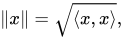
Mathematical spaces often form a hierarchy, i.e., one space may inherit all the characteristics of a parent space. For instance, all inner product spaces are also normed vector spaces, because the inner product induces a norm on the inner product space such that:

{\displaystyle \left\|x\right\|={\sqrt {\langle x,x\rangle }},}

where the norm is indicated by enclosing in double vertical lines, and the inner product is indicated enclosing in by angle brackets.

Modern mathematics treats “space” quite differently compared to classical mathematics.

History

Before the golden age of geometry

In the ancient mathematics, “space” was a geometric abstraction of the three-dimensional space observed in the everyday life. The axiomatic method had been the main research tool since Euclid (about 300 BC). The method of coordinates (analytic geometry) was adopted by René Descartes in 1637. At that time, geometric theorems were treated as an absolute objective truth knowable through intuition and reason, similar to objects of natural science; and axioms were treated as obvious implications of definitions.

Two equivalence relations between geometric figures were used: congruence and similarity. Translations, rotations and reflections transform a figure into congruent figures; homotheties — into similar figures. For example, all circles are mutually similar, but ellipses are not similar to circles. A third equivalence relation, introduced by Gaspard Monge in 1795, occurs in projective geometry: not only ellipses, but also parabolas and hyperbolas, turn into circles under appropriate projective transformations; they all are projectively equivalent figures.

The relation between the two geometries, Euclidean and projective, shows that mathematical objects are not given to us with their structure.  Rather, each mathematical theory describes its objects by some of their properties, precisely those that are put as axioms at the foundations of the theory.

Distances and angles are never mentioned in the axioms of the projective geometry and therefore cannot appear in its theorems. The question “what is the sum of the three angles of a triangle” is meaningful in the Euclidean geometry but meaningless in the projective geometry.

A different situation appeared in the 19th century: in some geometries the sum of the three angles of a triangle is well-defined but different from the classical value (180 degrees). The non-Euclidean hyperbolic geometry, introduced by Nikolai Lobachevsky in 1829 and János Bolyai in 1832 (and Carl Gauss in 1816, unpublished) stated that the sum depends on the triangle and is always less than 180 degrees. Eugenio Beltrami in 1868 and Felix Klein in 1871 obtained Euclidean “models” of the non-Euclidean hyperbolic geometry, and thereby completely justified this theory.

This discovery forced the abandonment of the pretensions to the absolute truth of Euclidean geometry. It showed that axioms are not “obvious”, nor “implications of definitions”. Rather, they are hypotheses. To what extent do they correspond to an experimental reality? This important physical problem no longer has anything to do with mathematics. Even if a “geometry” does not correspond to an experimental reality, its theorems remain no less “mathematical truths”.

A Euclidean model of a non-Euclidean geometry is a clever choice of some objects existing in Euclidean space and some relations between these objects that satisfy all axioms (therefore, all theorems) of the non-Euclidean geometry. These Euclidean objects and relations “play” the non-Euclidean geometry like contemporary actors playing an ancient performance. Relations between the actors only mimic relations between the characters in the play. Likewise, the chosen relations between the chosen objects of the Euclidean model only mimic the non-Euclidean relations. It shows that relations between objects are essential in mathematics, while the nature of the objects is not.

The golden age and afterwards: dramatic change

According to Nicolas Bourbaki, the period between 1795 (Geometrie descriptive of Monge) and 1872 (the “Erlangen programme” of Klein) can be called the golden age of geometry. Analytic geometry made a great progress and succeeded in replacing theorems of classical geometry with computations via invariants of transformation groups.  Since that time new theorems of classical geometry are of more interest to amateurs rather than to professional mathematicians.

However, it does not mean that the heritage of the classical geometry was lost. According to Bourbaki, “passed over in its role as an autonomous and living science, classical geometry is thus transfigured into a universal language of contemporary mathematics”.

According to the famous inaugural lecture given by Bernhard Riemann in 1854, every mathematical object parametrized by {\displaystyle n} real numbers may be treated as a point of the {\displaystyle n}-dimensional space of all such objects.[2]:140 Contemporary mathematicians follow this idea routinely and find it extremely suggestive to use the terminology of classical geometry nearly everywhere.

In order to fully appreciate the generality of this approach one should note that mathematics is “a pure theory of forms, which has as its purpose, not the combination of quantities, or of their images, the numbers, but objects of thought” (Hermann Hankel, 1867).  This is a controversial characterization of the purpose of mathematics, which is not necessarily committed to the existence of “objects of thought.”

Functions are important mathematical objects. Usually they form infinite-dimensional function spaces, as noted already by Riemann and elaborated in the 20th century by functional analysis.

An object parametrized by n complex numbers may be treated as a point of a complex n-dimensional space. However, the same object is also parametrized by 2 n real numbers (if c is a complex number, then c = a + b i, where a and b are real), thus, a point of a real 2n-dimensional space. The complex dimension differs from the real dimension. This is only the tip of the iceberg. The “algebraic” concept of dimension applies to vector spaces. For topological spaces there are several dimension concepts including inductive dimension and Hausdorff dimension, which can be non-integer (especially for fractals). Some kinds of spaces (for instance, measure spaces) admit no concept of dimension at all.

The original space investigated by Euclid is now called three-dimensional Euclidean space. Its axiomatization, started by Euclid 23 centuries ago, was reformed with Hilbert’s axiomsTarski’s axioms and Birkhoff’s axioms. These axiom systems describe the space via primitive notions (such as “point”, “between”, “congruent”) constrained by a number of axioms. Such a definition “from scratch” is now not often used, since it does not reveal the relation of this space to other spaces. The modern approach defines the three-dimensional Euclidean space more algebraically, via vector spaces and quadratic forms, namely, as an affine space whose difference space is a three-dimensional inner product space.

Also a three-dimensional projective space is now defined non-classically, as the space of all one-dimensional subspaces (that is, straight lines through the origin) of a four-dimensional vector space.

A space consists now of selected mathematical objects (for instance, functions on another space, or subspaces of another space, or just elements of a set) treated as points, and selected relationships between these points. It shows that spaces are just mathematical structures of convenience. One may expect that the structures called “spaces” are more geometric than others, but this is not always true. For example, a differentiable manifold (called also smooth manifold) is much more geometric than a measurable space, but no one calls it “differentiable space” (nor “smooth space”).

More at:  https://en.wikipedia.org/wiki/Space_(mathematics)

(Contributed by Richard Branam.)