The Varieties of Religious Experience: A Study in Human Nature
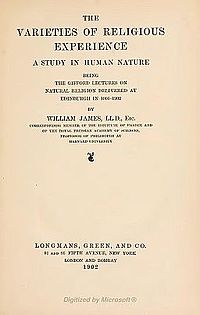 |
| Author |
William James |
| Original title |
The Varieties of Religious Experience: A Study in Human Nature, Being the Gifford Lectures on Natural Religion Delivered at Edinburgh in 1901–1902 |
| Country |
United States |
| Language |
English |
| Subject |
Philosophy of religion |
| Publisher |
Longmans, Green & Co. |
|
Publication date
|
1902 |
| Media type |
Print |
| Pages |
534 |
| LC Class |
BR110.J3 1902a |
| Followed by |
Pragmatism: A New Name for Some Old Ways of Thinking (1907) |
The Varieties of Religious Experience: A Study in Human Nature is a book by Harvard University psychologist and philosopher William James. It comprises his edited Gifford Lectures on natural theology, which were delivered at the University of Edinburgh in Scotland in 1901 and 1902. The lectures concerned the nature of religion and the neglect of science in the academic study of religion.
Soon after its publication, Varieties entered the Western canon of psychology and philosophy and has remained in print for over a century.
James later developed his philosophy of pragmatism. There are many overlapping ideas in Varieties and his 1907 book, Pragmatism.
Reception
The August 1902 New York Times review of the first edition ends with the following:
Everywhere there is a frolic welcome to the eccentricities and extravagances of the religious life. Many will question whether its more sober exhibitions would not have been more fruitful of results, but the interest and fascination of the treatment are beyond dispute, and so, too, is the sympathy to which nothing human is indifferent.
A July 1963 Time magazine review of an expanded edition published that year ends with quotes about the book from Peirce and Santayana:
In making little allowance for the fact that people can also be converted to vicious creeds, he acquired admirers he would have deplored. Mussolini, for instance, hailed James as a preceptor who had showed him that “an action should be judged by its result rather than by its doctrinary basis.” James … had no intention of giving comfort to latter-day totalitarians. He was simply impatient with his fellow academicians and their endless hairsplitting over matters that had no relation to life. A vibrant, generous person, he hoped to show that religious emotions, even those of the deranged, were crucial to human life. The great virtue of The Varieties, noted pragmatist philosopher Charles Peirce, is its “penetration into the hearts of people.” Its great weakness, retorted George Santayana, is its “tendency to disintegrate the idea of truth, to recommend belief without reason and to encourage superstition.”
Religious experiences
James was most interested in direct religious experiences. Theology and the organizational aspects of religion were of secondary interest. He believed that religious experiences were simply human experiences (“Religious happiness is happiness. Religious trance is trance.”).
He believed that religious experiences can have “morbid origins” in brain pathology and can be irrational but nevertheless are largely positive. Unlike the bad ideas that people have under the influence of a high fever, after a religious experience the ideas and insights usually remain and are often valued for the rest of the person’s life.
Under James’ pragmatism, the effectiveness of religious experiences proves their truth, whether they stem from religious practices or from drugs (“Nitrous oxide … stimulate[s] the mystical consciousness in an extraordinary degree.”).
James had relatively little interest in the legitimacy or illegitimacy of religious experiences. Further, despite James’ examples being almost exclusively drawn from Christianity, he did not mean to limit his ideas to any single religion. Religious experiences are something that people sometimes have under certain conditions. In James’ description, these conditions are likely to be psychological or pharmaceutical rather than cultural.
Existential judgment vs. proposition of value
James believed that the origins of a religion shed little light upon its value. There is a distinction between an existential judgment (a judgment on “constitution, origin, and history”) and a proposition of value (a judgment on “importance, meaning, or significance”).
For example, if the founder of the Quaker religion, George Fox, had been a hereditary degenerate, the Quaker religion could yet be “a religion of veracity rooted in spiritual inwardness, and a return to something more like the original gospel truth than men had ever known in England.”
Furthermore, the potentially dubious psychological origins of religious beliefs apply just as well to non-religious beliefs:
Scientific theories are organically conditioned just as much as religious emotions are; and if we only knew the facts intimately enough, we should doubtless see “the liver” determining the dicta of the sturdy atheist as decisively as it does those of the Methodist under conviction anxious about his soul.
Reality of the unseen
James criticized scientists for ignoring unseen aspects of the universe. Science studies some of reality, but not all of it:
Vague impressions of something indefinable have no place in the rationalistic system…. Nevertheless, if we look on man’s whole mental life as it exists …, we have to confess that the part of it of which rationalism can give an account of is relatively superficial. It is the part that has the prestige undoubtedly, for it has the loquacity, it can challenge you for proofs, and chop logic, and put you down with words…. Your whole subconscious life, your impulses, your faiths, your needs, your divinations, have prepared the premises, of which your consciousness now feels the weight of the result; and something in you absolutely knows that that result must be truer than any logic-chopping rationalistic talk, however clever, that may contradict it.
“Healthy mindedness” vs. “the sick soul”
James saw “healthy mindedness” as America’s main contribution to religion. This is the religious experience of optimism and positive thinking which James sees running from the transcendentalists Emerson and Whitman to Mary Baker Eddy’s Christian Science. At the extreme, the “healthy minded” see sickness and evil as an illusion. James considered belief in the “mind cure” to be reasonable when compared to medicine as practiced at the beginning of the twentieth century.
The “sick souls” (“morbid-mindedness”/ the “twice born”) are merely those who hit bottom before their religious experience; those whose redemption gives relief from the pains they suffered beforehand. By contrast, the “healthy minded” deny the need for such preparatory pain or suffering. James believes that “morbid-mindedness ranges over the wider scale of experience” and that (while healthy-mindedness is a surprisingly effective “religious solution”):
“healthy-mindedness is inadequate as a philosophical doctrine, because the evil facts which it refuses positively to account for are a genuine portion of reality; and they may after all be the best key to life’s significance, and possibly the only openers of our eyes to the deepest levels of truth.”
James sees the two types as being a mere matter of temperament. The healthy minded having a “constitutional incapacity for prolonged suffering”; the morbid minded being those prone to “religious melancholia”.
Saintliness
For James, a saintly character is one where “spiritual emotions are the habitual centre of the personal energy”.
James states that saintliness includes:
“1. A feeling of being in a wider life than that of this world’s selfish little interests; and a conviction … of the existence of an Ideal Power. …
2. A sense of the friendly continuity of the ideal power with our own life, and a willing self-surrender to its control.
3. An immense elation and freedom, as the outlines of the confining selfhood melt down.
4. A shifting of the emotional Centre towards loving and harmonious affections, towards “yes, yes” and away from “no,” where the claims of the non-ego are concerned.”
For James the practical consequences of saintliness are Asceticism (pleasure in sacrifice), Strength of Soul (a “blissful equanimity” free from anxieties), Purity (a withdrawal from the material world) and Charity (tenderness to those most would naturally disdain).
Mysticism
James identified two main features to a mystical experience:
Ineffability.—” no adequate report of its contents can be given in words. […] its quality must be directly experienced; it cannot be imparted or transferred to others. […] mystical states are more like states of feeling than like states of intellect. No one can make clear to another who has never had a certain feeling, in what the quality or worth of it consists.”
Noetic quality.—”Although so similar to states of feeling, mystical states seem to those who experience them to be also states of knowledge. They are states of insight into depths of truth unplumbed by the discursive intellect. They are illuminations, revelations, full of significance and importance, all inarticulate though they remain; and as a rule they carry with them a curious sense of authority for after-time.”
He also identified two subsidiary features that are often, but not always, found with mystical experiences:
Transiency.—”Mystical states cannot be sustained for long.”
Passivity.—”the mystic feels as if his own will were in abeyance, and indeed sometimes as if he were grasped and held by a superior power.”