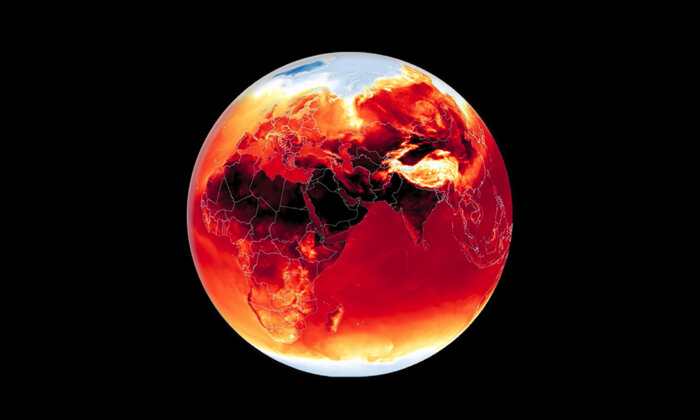
In spite of all our achievements and Gaia’s benign systems of control, we are still threatened by heat. You will assume I mean global warming and, in part, I do. At first I thought global warming caused by carbon dioxide emissions would soon be catastrophic for humans and that Gaia would simply flick us aside as an annoying and destructive species. Later I thought we could manage the heat increases in the near future and should no longer regard warming as an immediate existential threat. Now, however, I believe we should do what we can to cool the planet. I cannot say too strongly that the greatest threat to life on Earth is overheating.
My point is that global warming is certainly real, but the outcomes currently being predicted by scientists, politicians and Greens are not necessarily the ones we should most fear. Global warming is a slow process and its worst effects will be heralded by extremely uncomfortable events. The extreme weather we have experienced recently is only a mild sign of what might be on the way. But I think we have time, time we should spend cooling the planet to make it more robust.
I say this because Earth is, like me, very old. Great age may or may not bring wisdom but it certainly brings frailty. I am 99 as I write this. Hamlet bemoaned “the ills that flesh is heir to,” but he was a young man who died of excessive introspection; had he lived, he would have discovered that the ills of young flesh are as nothing compared to those that elderly flesh endures.
Planets, like humans, grow fragile with age. If all goes well, Gaia and I can expect a productive and pleasant period of decline — but people can have fatal accidents and so can planets. Our personal resilience depends on our state of health. When young, we can often withstand influenza or a car accident, but not when we are close to 100 years old. Similarly, when young, Earth and Gaia could withstand shocks like super-volcanic eruptions or asteroid strikes; when old, any one of these could sterilize the entire planet. A warm Earth would be a more vulnerable Earth.
We know that the Earth withstood near-fatal catastrophes in its long past. There is a great deal of evidence gathered about the impact of an approximately 1-kilometre-diameter rock in the South Pacific about 2 million years ago. The consequences appear to have been devastating, but, interestingly, there is almost no indication of long-term damage to the biosphere. Recent research, however, suggests the risk may be increasing. Scientists studying impact craters on the moon found that there had been a steep rise in the number of asteroid strikes in the last 290 million years. Astonishingly, we are now three times more likely to suffer an impact than the dinosaurs; they were just very unlucky.
Keeping Earth cool is a necessary safety measure for an elderly planet orbiting a middle-aged star.
Gaia, in the past, could take these things in her stride, but can she now? She already struggles to maintain homeostasis — a stable dynamic condition — in the calm between impacts. Now, an asteroid impact or a volcano could destroy much of the organic life the Earth carries. The remnant survivors might be unable to restore Gaia; our planet would quickly become too hot for life.
So, as well as the climatic effects of warming, there are other problems that are more serious than we can imagine — accidents we don’t or can’t prepare for. Keeping Earth cool is a necessary safety measure for an elderly planet orbiting a middle-aged star.
Heat is why we have to keep a close eye on our planet and not think so much about Mars. As NASA’s wonderful rovers continue to gather evidence from Mars, our relative ignorance of our own oceans increases. Not for a moment would I suggest that NASA’s exploration was not worthwhile, but why have we done so little to gather information about our own planet? Our lives may depend on understanding it properly.
We were stunned when the astronauts revealed in 1969 the beauty of our planet seen from space. It took Arthur C. Clarke, the science fiction writer and inventor, to observe how wrong it was to call this planet Earth when, clearly, it is Ocean. Despite being 50 years ago, this discovery that we live on an ocean planet is only just beginning to penetrate the dusty science of geology. It is shameful that we know far more about the surface of Mars and its atmosphere than we know about parts of our oceans.
It is also risky. After the Sun, the sea is the primary driver of our climate. It is vital for our survival that the sea is kept cool. It is easy to understand this just by going on a typical holiday. There we find a hot, sandy beach lapped by clear water. This water is seductive, but it is a dead zone. Whenever the surface temperature of the ocean rises above 15°C, the ocean becomes a desert far more bereft of life than the Sahara. This is because at temperatures above about 15°C the nutrients in the ocean surface are rapidly eaten and the dead bodies and detritus sink to the regions below. There is plenty of food in the lower waters, but it cannot rise to the surface because the cooler lower ocean water is denser than water at the surface. This lack of life in warmer waters explains why so often they are clear and blue.
This is important because, as the photographs from space show so dramatically, Earth is a water planet with nearly three-quarters of its surface covered by oceans. Life on land depends on the supply of certain essential elements such as sulphur, selenium, iodine and others. Just now these are supplied by ocean surface life as gases like dimethyl sulphide and methyl iodide. The loss of this surface life due to the heating of these waters would be catastrophic. Cold water (below 15°C) is denser than water warmer than 15°C. Because of this, nutrients in cold water can no longer reach the surface.
A more serious threat to life would arise if ever the ocean surface temperature rose into the 40°C region, at which point runaway greenhouse heating caused by water vapor would occur. Like CO2, water vapor in the atmosphere absorbs outgoing infrared radiation and so prevents the Earth from cooling by radiating heat away. High levels of water vapor in the atmosphere cause warming and this creates a feedback loop, increasing the water content of the atmosphere by evaporating water from the sea.
In discussions of global warming the role of water vapor is seldom mentioned. When we put carbon dioxide in the air by burning fossil fuel, it stays there until removed by, for example, the leaves of a tree. Burning fossil fuel also puts water vapor in the air, which, unlike carbon dioxide, stays there only if the air is warm enough. On a cold winter day, even your breath condenses as a cloud of mist. The abundance of water vapor in the air simply follows the temperature. When water condenses as mist or as cloud droplets, it can no longer exert its greenhouse effect. In some circumstances, such as cloud layers near the sea surface, their presence has a cooling effect by reflecting sunlight back to space. But cirrus clouds high in the atmosphere have a warming effect. The presence of water vapor in the air makes climate forecasting a complex job and it is easy to see why the forecasters sometimes make mistakes.
We can help natural processes that keep the water vapor content of the air low by avoiding the burning of carbon fuel of any kind. In general, I feel strongly that our need for energy should be treated as a practical problem of engineering and economics, not politics. I feel equally strongly that the best candidate to supply these needs is nuclear fission, or, if it becomes available cheaply and practically, nuclear fusion, the process that sustains the heat of the Sun. There is a further temperature limit we should watch closely. You may have noticed this fatal figure appearing on world weather charts during the freakishly hot summer of 2018. It was 47°C. This is a just about liveable temperature for humans — ask the people of Baghdad — but it is close to our limit. In the Australian summer in January 2019 there were five days in which the average temperature was above 40°C — Port Augusta reached 49.5°C.
In the 1940s, as part of our wartime work, my colleague Owen Lidwell and I measured experimentally the temperature at which the cells of skin were irreparably damaged by heat. This would mean burning the skin of anaesthetized rabbits. I found this request repellent and we decided to burn ourselves instead. This we did using a large, flat flame of burning benzene vapor. As you might expect, it was exceedingly painful. Contact with a 1-centimeter-diameter copper rod kept at 50°C would cause a first-degree burn in one minute. Higher temperatures caused burning more rapidly; at 60°C it took only one second. At temperatures below 50°C there was no burning in five minutes. Human skin cells are typical of mainstream life in their reaction to high temperatures. It is true that some highly specialized forms of life called extremophiles can live at temperatures up to about 120°C, but their capacities and rate of growth are minimal compared with mainstream life.
(Incidentally, as we burnt ourselves, we were watched and looked after by the Institute’s physician, Dr. Hawking. He grew quite intrigued by our capacity to endure pain and invited me to dinner with him and his family at their home in Hampstead. In the course of the evening his wife, also a scientist at the Institute, asked me if I would hold their newly born baby while she performed an intricate preparation for dinner. Having by then two children of my own, I felt quite ready to do so and for a brief period held Stephen Hawking in my arms.)
It is shameful that we know far more about the surface of Mars and its atmosphere than we know about parts of our oceans.
High temperatures make us vulnerable. We are currently in a warm period of the glacial cycle and if we now suffered a catastrophe — an asteroid strike or super-volcano eruption — that led to a failure to pump down carbon dioxide, we could be in mortal danger. The Earth’s average temperature could rise to 47°C and, comparatively quickly, we would enter an irreversible phase leading to a Venus-like state. As the climatologist James Hansen vividly puts it, if we don’t take care, we will find ourselves aboard the Venus Express.
On the way to this sterile state the Earth would probably pass through a period when the atmosphere at the surface was supercritical steam. The supercritical state is curious: it is neither gas nor liquid. It shares with liquids the capacity to dissolve solids, but like a gas it has no boundary. Even rock dissolves in supercritical steam and, from the solution, quartz and even gemstones such as sapphire crystallize as they cool.
If the Earth became hot enough for the ocean to reach the supercritical state, rocks such as basalt would dissolve and release the hydrogen of water as a gas. Long before this, the oxygen of the air would have vanished and in this oxygen-free atmosphere hydrogen would escape to space because the Earth’s gravity is insufficient to hold hydrogen atoms. Indeed, hydrogen would be escaping now but for the presence of oxygen, the atoms of which act like security guards and capture hydrogen atoms when they try to escape the Earth.
So 47°C sets the limit for any kind of life on an ocean planet like the Earth. Once this temperature is passed, even silicon-based intelligence would face an impossible environment. It is even possible that the floor of the ocean would enter the supercritical state and in places where the magma emerged there would be no separation between rocks and supercritical-state steam.
We should be amazed by and grateful for the remarkable achievement of the Gaia system in pumping down carbon dioxide to levels as low as 180 parts per million, the level it reached 18,000 years ago. It is now 400 parts per million and rising, with the burning of fossil fuel responsible for about half of this rise.
Don’t forget that, without life, carbon dioxide would have been much more abundant than now. If you want to know where life put the carbon dioxide, visit a typical chalk cliff, such as the ones at Beachy Head in Sussex. If you look at the chalk through a microscope, you will find it is made of tight-pressed calcium carbonate shells. These are the skeletons of coccolithophores that once lived near the surface of the sea. And in greater quantities are the beds of limestone that are everywhere on the Earth’s surface. If these reservoirs of biogenic carbon dioxide had been returned to the atmosphere as gas in geologically relatively recent times, we would be just like Venus — a hot, dead planet.
Even so, it is very unlikely that, in the imaginable future, the entire surface of the Earth will reach anything like 47°C. The current average temperature is about 15°C. But it is conceivable that, with feedback loops, especially the melting of the polar ice caps and methane released from permafrost, a global temperature of, say, 30°C may be a tipping point that could accelerate heating further. As with much of climate science, we just do not know.
What is clear is that we should not simply assume, as most people do most of the time, that the Earth is a stable and permanent place with temperatures always in a range in which we can safely survive. Some 55 million years ago, for example, an event known as the Palaeocene/Eocene Thermal Maximum took place. This was a period of warming when temperatures rose about 5 degrees above their present level. Animals such as crocodiles lived in what are now the polar oceans, and all the Earth was a tropical place. For a while I thought that if such a rise in temperature could be withstood, then why bother too much about the mere 2 degrees rise of temperature climate scientists say we should avoid at all costs? Not only this, but in places like Singapore people enjoy life where the temperature, year-round, is more than 12 degrees above the average. But I was wrong.
It was thinking about the consequences of asteroid impacts and other accidents that made me see why the Earth needs to stay cool. Yes, a rise in temperature of 5 or even 10 degrees could probably be withstood, but not if the system is disabled, as it would be if there were an asteroid impact of the severity now thought responsible for the Permian extinction. It might also happen through one of the devastating volcanic outbursts that have occurred in the past. So I now think our present efforts to combat mere global warming are vital. We need to keep the Earth as cool as possible to ensure it is less vulnerable to accidents that might disable Gaia’s cooling mechanisms.
James Lovelock (1919–2022) was the originator of the Gaia hypothesis (now Gaia theory) and author of more than 200 scientific papers. His books on the subject include “Gaia: A New Look at Life on Earth,” “The Revenge of Gaia,” and “Novacene,” from which this article is excerpted.
Alan Turing and John von Neumann saw it early: the logic of life and the logic of code may be one and the same.
Image source: Miguel Romero, Adobe Stock
By: Blaise Agüera y Arcas
(thereader.mitpress.mit.edu)
In 1994, a strange, pixelated machine came to life on a computer screen. It read a string of instructions, copied them, and built a clone of itself — just as the Hungarian-American Polymath John von Neumann had predicted half a century earlier. It was a striking demonstration of a profound idea: that life, at its core, might be computational.
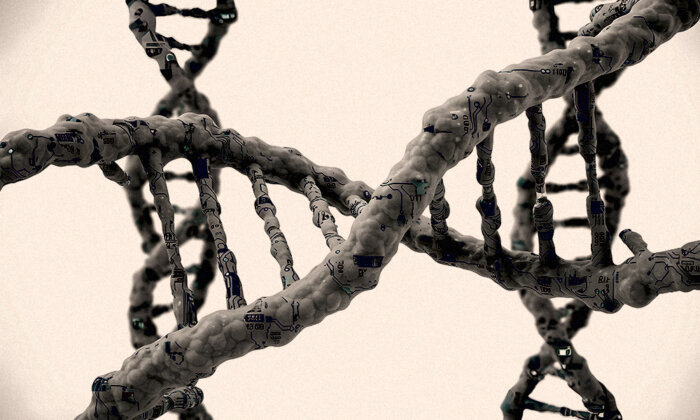
Although this is seldom fully appreciated, von Neumann was one of the first to establish a deep link between life and computation. Reproduction, like computation, he showed, could be carried out by machines following coded instructions. In his model, based on Alan Turing’s Universal Machine, self-replicating systems read and execute instructions much like DNA does: “if the next instruction is the codon CGA, then add an arginine to the protein under construction.” It’s not a metaphor to call DNA a “program” — that is literally the case.
Of course, there are meaningful differences between biological computing and the kind of digital computing done by a personal computer or your smartphone. DNA is subtle and multilayered, including phenomena like epigenetics and gene proximity effects. Cellular DNA is nowhere near the whole story, either. Our bodies contain (and continually swap) countless bacteria and viruses, each running their own code.
It’s not a metaphor to call DNA a “program” — that is literally the case.
Biological computing is “massively parallel,” decentralized, and noisy. Your cells have somewhere in the neighborhood of 300 quintillion ribosomes, all working at the same time. Each of these exquisitely complex floating protein factories is, in effect, a tiny computer — albeit a stochastic one, meaning not entirely predictable. The movements of hinged components, the capture and release of smaller molecules, and the manipulation of chemical bonds are all individually random, reversible, and inexact, driven this way and that by constant thermal buffeting. Only a statistical asymmetry favors one direction over another, with clever origami moves tending to “lock in” certain steps such that a next step becomes likely to happen.
This differs greatly from the operation of “logic gates” in a computer, basic components that process binary inputs into outputs using fixed rules. They are irreversible and engineered to be 99.99 percent reliable and reproducible.
Biological computing is computing, nonetheless. And its use of randomness is a feature, not a bug. In fact, many classic algorithms in computer science also require randomness (albeit for different reasons), which may explain why Turing insisted that the Ferranti Mark I, an early computer he helped to design in 1951, include a random number instruction. Randomness is thus a small but important conceptual extension to the original Turing Machine, though any computer can simulate it by calculating deterministic but random-looking or “pseudorandom” numbers.
Parallelism, too, is increasingly fundamental to computing today. Modern AI, for instance, depends on both massive parallelism and randomness — as in the parallelized “stochastic gradient descent” (SGD) algorithm, used for training most of today’s neural nets, the “temperature” setting used in chatbots to introduce a degree of randomness into their output, and the parallelism of Graphics Processing Units (GPUs), which power most AI in data centers.
Traditional digital computing, which relies on the centralized, sequential execution of instructions, was a product of technological constraints. The first computers needed to carry out long calculations using as few parts as possible. Originally, those parts were flaky, expensive vacuum tubes, which had a tendency to burn out and needed frequent replacement by hand. The natural design, then, was a minimal “Central Processing Unit” (CPU) operating on sequences of bits ferried back and forth from an external memory. This has come to be known as the “von Neumann architecture.”
Turing and von Neumann were both aware that computing could be done by other means, though. Turing, near the end of his life, explored how biological patterns like leopard spots could arise from simple chemical rules, in a field he called morphogenesis. Turing’s model of morphogenesis was a biologically inspired form of massively parallel, distributed computation. So was his earlier concept of an “unorganized machine,” a randomly connected neural net modeled after an infant’s brain.
These were visions of what computing without a central processor could look like — and what it does look like, in living systems.
Von Neumann also began exploring massively parallel approaches to computation as far back as the 1940s. In discussions with Polish mathematician Stanisław Ulam at Los Alamos, he conceived the idea of “cellular automata,” pixel-like grids of simple computational units, all obeying the same rule, and all altering their states simultaneously by communicating only with their immediate neighbors. With characteristic bravura, von Neumann went so far as to design, on paper, the key components of a self-reproducing cellular automaton, including a horizontal “tape” of cells containing instructions and blocks of cellular “circuitry” for reading, copying, and executing them.
Designing a cellular automaton is far harder than ordinary programming, because every cell or “pixel” is simultaneously altering its own state and its environment. Add randomness and subtle feedback effects, as in biology, and it becomes even harder to reason about, “program,” or “debug.”
With characteristic bravura, von Neumann went so far as to design, on paper, the key components of a self-reproducing cellular automaton.
Nonetheless, Turing and von Neumann grasped something fundamental: Computation doesn’t require a central processor, logic gates, binary arithmetic, or sequential programs. There are infinite ways to compute, and, crucially, they are all equivalent. This insight is one of the greatest accomplishments of theoretical computer science.
This “platform independence” or “multiple realizability” means that any computer can emulate any other one. If the computers are of different designs, though, the emulation may be glacially slow. For that reason, von Neumann’s self-reproducing cellular automaton has never been physically built — though that would be fun to see!
That demonstration in 1994 — the first successful emulation of von Neumann’s self-reproducing automation — couldn’t have happened much earlier. A serial computer requires serious processing power to loop through the automaton’s 6,329 cells over the 63 billion time steps required for the automaton to complete its reproductive cycle. Onscreen, it worked as advertised: a pixelated two-dimensional Rube Goldberg machine, squatting astride a 145,315-cell–long instruction tape trailing off to the right, pumping information out of the tape and reaching out with a “writing arm” to slowly print a working clone of itself just above and to the right of the original.
It’s similarly inefficient for a serial computer to emulate a parallel neural network, heir to Turing’s “unorganized machine.” Consequently, running big neural nets like those in Transformer-based chatbots has only recently become practical, thanks to ongoing progress in the miniaturization, speed, and parallelism of digital computers.
In 2020, my colleague Alex Mordvintsev combined modern neural nets, Turing’s morphogenesis, and von Neumann’s cellular automata into the “neural cellular automaton” (NCA), replacing the simple per-pixel rule of a classic cellular automaton with a neural net. This net, capable of sensing and affecting a few values representing local morphogen concentrations, can be trained to “grow” any desired pattern or image, not just zebra stripes or leopard spots.
Real cells don’t literally have neural nets inside them, but they do run highly evolved, nonlinear, and purposive “programs” to decide on the actions they will take in the world, given external stimulus and an internal state. NCAs offer a general way to model the range of possible behaviors of cells whose actions don’t involve movement, but only changes of state (here, represented as color) and the absorption or release of chemicals.
The first NCA Alex showed me was of a lizard emoji, which could regenerate not only its tail, but also its limbs and head! It was a powerful demonstration of how complex multicellular life can “think locally” yet “act globally,” even when each cell (or pixel) is running the same program — just as each of your cells is running the same DNA. Simulations like these show how computation can produce lifelike behavior across scales. Building on von Neumann’s designs and extending into modern neural cellular automata, they offer a glimpse into the computational underpinnings of living systems.
Blaise Agüera y Arcas is a VP/Fellow at Google, where he is the CTO of Technology & Society, and the founder of Paradigms of Intelligence, an organization dedicated to fundamental AI research. He is the author of “What Is Intelligence?,” from which this article is adapted.An open access edition of the book is available here.
Scofield Reference Bible, page 1115. This page includes Scofield’s note on John 1:17.
The Scofield Bible had several innovative features. Most important, it printed what amounted to a commentary on the biblical text alongside the Bible instead of in a separate volume, the first to do so in English since the Geneva Bible (1560).[2] It also contained a cross-referencing system that tied together related verses of Scripture and allowed a reader to follow biblical themes from one chapter and book to another (so called “chain references”). Finally, the 1917 edition also attempted to date events of the Bible. It was in the pages of the Scofield Reference Bible that many Christians first encountered Archbishop James Ussher‘s calculation of the date of Creation as 4004 BC; and through discussion of Scofield’s notes, which advocated the “gap theory,” fundamentalists began a serious internal debate about the nature and chronology of creation.[3]
Legacy
The first edition of the Scofield Bible (1909) was published only a few years before World War I, a war that destroyed a cultural optimism that had viewed the world as entering a new era of peace and prosperity; then the post-World War II era witnessed the creation of a homeland for Jews in Palestine. Thus, Scofield’s premillennialism seemed prophetic. “At the popular level, especially, many people came to regard the dispensationalist scheme as completely vindicated.”[4] Sales of the Reference Bible exceeded two million copies by the end of World War II.[5]
The Scofield Reference Bible promoted dispensationalism, the belief that between creation and the final judgement there would be seven distinct eras of God’s dealing with man and that these eras are a framework for synthesizing the message of the Bible.[6] Largely through the influence of Scofield’s notes, many fundamentalist Christians in the United States adopted a dispensational theology. Scofield’s notes on the Book of Revelation are a major source for the various timetables, judgements, and plagues elaborated on by popular religious writers such as Hal Lindsey, Edgar C. Whisenant, and Tim LaHaye;[7] and in part because of the success of the Scofield Reference Bible, twentieth-century American fundamentalists placed greater stress on eschatological speculation.
The Scofield Bible significantly influenced the Christian Zionist movement. Referring to Scofield’s interpretation of Genesis 12:3 (“I will bless them that bless thee and curse him that curseth thee”), John Hagee, the founder of Christians United for Israel (CUFI), argued that “The man or nation that lifts a voice or hand against Israel invites the wrath of God.”[8]
Later editions
Notes in the 1917 Scofield Bible
The 1917 Scofield Reference Bible notes are now in the public domain, and the 1917 edition is “consistently the best selling edition of the Scofield Bible” in the United Kingdom and Ireland.[9] In 1967, Oxford University Press published a revision of the Scofield Bible with a slightly modernized KJV text, and a muting of some of the tenets of Scofield’s theology.[10] Recent editions of the KJV Scofield Study Bible have moved the textual changes made in 1967 to the margin.[11] The Press continues to issue editions under the title Oxford Scofield Study Bible, and there are translations into French, German, Spanish, and Portuguese. For instance, the French edition published by the Geneva Bible Society is printed with a revised version of the Louis Segond translation that includes additional notes by a Francophone committee.[12]
In the 21st century, Oxford University Press published Scofield notes to accompany six additional English translations.[13]
This article is about the Hellenistic deity. For the Gnostic concept of God, see Aeon (Gnosticism).
Aion depicted as a young man with wings attached to his temples, standing in the circle of the zodiac, with Terra and four putti (representing the seasons) nearby, Roman mosaic, Sentinum, c. 200–300 AD[1]
Aion (from Hellenistic Greek: αἰών, romanized: aión, lit. ‘long period of time’, [ai̯ˈɔːn]) is a Hellenistic deity associated with time, the orb or circle encompassing the universe, and the zodiac. The “time” which Aion represents is perpetual, unbounded, ritual, and cyclic: The future is a returning version of the past, later called aevum (seeVedic SanskritṚtú). Philosophically and mythologically, especially in the context of the mysteries, Aion is understood as the ontological personification of eternity : the time of indestructible permanence [2][3], which is in essence the duration of the fact of Existence, understood as eternal and immutable.[4]
This kind of time contrasts with empirical, linear, progressive, and historical time that Chronos represented, which divides into past, present, and future.[5]: 274
Aion is usually identified as the nude or mostly nude young man within a circle representing the zodiac, symbolic of eternal and cyclical time. Examples include two Roman mosaics from Sentinum (modern–day Sassoferrato) and Hippo Regius in Roman Africa, and the Parabiago plate. But because he represents time as a cycle, he may also be presented as an old man. In the Dionysiaca, Nonnus associates Aion with the Horae and says that he:changes the burden of old age like a snake who sloughs off the coils of the useless old scales, rejuvenescing while washing in the swells of the laws [of time].[6]
The imagery of the twining serpent is connected to the hoop or wheel through the ouroboros, a ring formed by a snake holding the tip of its tail in its mouth. The 4th century CE Latin commentator Servius notes that the image of a snake biting its tail represents the cyclical nature of the year.[8]
Detail from the Parabiago plate depicting Aion; Ajax is shown holding up the zodiac from below, and Tellus (not shown) appears on the plate outside of this image, just past the bottom left of the picture, reclining among her children by Aion.
In his 5th century work on hieroglyphics, Horapollo makes a further distinction between a serpent that hides its tail under the rest of its body, which represents Aion, and the ouroboros that represents the kosmos, which is the serpent devouring its tail.[9]
Identifications
Martianus Capella (5th century CE) identified Aion with Cronus (Latin Saturnus), whose name caused him to be theologically conflated with Chronos (“Time”), in the way that the Greek ruler of the underworld Plouton (Pluto) was conflated with Ploutos (Plutus, “Wealth”). Martianus presents Cronus-Aion as the consort of Rhea (Latin Ops) as identified with Physis.[7]: 137
In his highly speculative reconstruction of Mithraic cosmogony, Franz Cumont positioned Aion as Unlimited Time (sometimes represented as Saeculum, Cronus, or Saturn) as the god who emerged from primordial Chaos, and who in turn generated Heaven and Earth. Modern scholars call this deity the ‘leonto‑cephaline‘ figure – a winged, lion-headed, nude male, whose torso is entwined by a serpent. He typically holds a sceptre, keys, and / or a thunderbolt. Nobody knows for sure who he was or what he represented, but aside from the lion-head, depictions of him have Aion’s icons; in rare instances, his statue appears in mithrea with the human head, and with the lion-head gone, he is indistinguishable from Aion.[10]: 78 The figure of Time “played a considerable, though to us completely obscure, role” in Mithraic ritual and theology.[10]: 128
Aion is identified with Dionysus in Christian and Neoplatonic writers, but there are no references to Dionysus as Aion before the Christian era.[11]Euripides, however, does call Aion a ‘son of Zeus‘.[12]
The Suda identifies Aion with Osiris and Adonis (probably because originally Adonis had been a god who was later downgraded to the status of “mortal” since he was believed to have died). In Ptolemaic Alexandria, at the site of a dream oracle, the Hellenistic syncretic god Serapis was identified as Aion Plutonius.[14][15] The epithet Plutonius marks functional aspects shared with Pluto, consort of Persephone and ruler of the underworld in the Eleusinian tradition. Epiphanius says that at Alexandria Aion’s birth from Kore the Virgin was celebrated 6 January:[13]: 306–307 “On this day and at this hour the Virgin gave birth to Aion.” The date, which coincides with Epiphany, brought new year’s celebrations to a close, completing the cycle of time that Aion embodies.[16]
The Alexandrian Aion may be a form of Osiris-Dionysus, reborn annually;[13]: 309 his image was marked with crosses on his hands, knees, and forehead.[13]: 306–307, 311 Quispel (2008) conjectured that the figure resulted from integrating the OrphicPhanes, who like Aion is associated with a coiling serpent, into Mithraic religion at Alexandria, and that he “assures the eternity of the city.”[17]: 258
In the art of the Roman era, Aion was often conflated with the primordial sky god Uranus / Caelus.[citation needed]
Roman Empire
This syncretic Aion became a symbol and guarantor of the perpetuity of Roman rule, and emperors such as Antoninus Pius issued coins with the legend Aion,[13]: 314 whose (female) Roman counterpart was Aeternitas.[18] Roman coins associate both Aion and Aeternitas with the phoenix as a symbol of rebirth and cyclical renewal.[5]: 307–308
Aion was among the virtues and divine personifications that were part of late Hellenic discourse, in which they figure as “creative agents in grand cosmological schemes”.[19] The significance of Aion lies in his malleability: He is a “fluid conception” through which various ideas about time and divinity converge in the Hellenistic era, in the context of syncretic and monotheistic tendencies.[5]: 307–308 ff
Peaceful protesters, including religious groups, brought flowers to the Immigration and Customs Enforcement (ICE) facility in Portland, Oregon, on September 27, 2025
. The event occurred before a larger protest and followed an announcement by former President Donald Trump that he would send federal troops to Portland.
Event details
When: The peaceful demonstration with flowers took place during the daytime on Saturday, September 27, 2025.
Who: Approximately 100 peaceful protesters, including families and members of various religious congregations, participated in the event.
Where: The demonstration was held outside the ICE facility located at 4310 S Macadam Ave in southwest Portland.
Why: The protest was a response to escalating tensions after Trump announced his intention to send federal troops to Portland.
How: The group marched in a circle in front of the building, distributing flowers as a gesture of peace and defiance.
Context of the protest
The peaceful protest with flowers was followed by a larger and more contentious protest later that evening. Tensions remained high throughout the day, with drones reportedly operated by authorities flying overhead and a helicopter circling the area for several hours.
Flowers as a symbolic gesture
The use of flowers during the protest is not an isolated event. A separate project, “Flowers on the Inside,” also uses flowers symbolically by sending postcards with art from undocumented immigrants to migrants in detention.
Local ICE facility information
Address: 4310 S Macadam Ave, Portland, OR 97239.
Hours: Open Monday to Friday, 9:00 a.m. to 4:00 p.m..
“Cease to be this or that, and to have this and that, then you are all things and have all things, and so, being neither here nor there, you are everywhere…you are everything…what remains is nothing but God.”
“Confront the dark parts of yourself, and work to banish them with illumination and forgiveness. Your willingness to wrestle with your demons will cause your angels to sing.”
AUGUST WILSON
August Wilson (April 27, 1945 – October 2, 2005) was an American playwright. He has been referred to as the “theater’s poet of Black America”. He is best known for a series of 10 plays, collectively called The Pittsburgh Cycle, which chronicle the experiences and heritage of the African-American community in the 20th century. Wikipedia


 In This Issue