Right about now, our organizations are working…in all the wrong ways. They’re solving yesterday’s problems, mostly, still. But those problems have already been solved. Yet today’s and tomorrow’s haven’t. They’re just getting bigger, spinning out of control, and so the future’s unravelling — or what’s left of it.
What do I mean by that? Here are the three problems our creaking old Industrial Age organizations were built to solve, and did solve.
Profit. We know how to build organizations to maximize profits. Profits hit record-shattering levels, and then earth-shattering ones. That doesn’t mean that every organization is profitable, but it does mean that maximizing profits is very much a solved problem. Efficiency, scale, reach, make it all look glamorous, perhaps. We know how to solve this problem — to death.
Scale.We know how to build organizations at massive, and I mean massive scales. Think about how big some of the world’s biggest really are. They employ millions of people, and informally employ even more than that, as contractors and temps and so forth. We have incredibly complex systems of management for all this, from “matrix management,” to the sheer grunt work of modern day “Human Resources,” to the way poor old job-seekers have to send out billions of CVs just to get maybe a handful of interviews. The scale at which we work is colossal. Solved problem.
Reach. We know how to build organizations that can reach…right across the globe. Impress their brands and marketing and messages upon not just millions but even billions of minds. That’s not even particularly complicated anymore — though it can take work. We have, again, incredibly complex systems to manage and manipulate this. Reach means finance, too — now, someone with a pension in Malaysia or Norway can unwittingly be an investor in American insurance company which has to pay for climate-disaster damages in Kansas. Solved problem — we’ve integrated the economy in this way as a thing of unprecedented reach.
But tomorrow’s problems? Which are becoming more and more evident…today? Take a hard look around the globe. What do you see? Here’s what CEOs see, and you can take a look at any number of CEO-agenda style research to back it up. A world of rising geopolitical tension. One of fragmenting societies. Where social contracts are being pushed to the brink, and extremism’s rising. Meanwhile, climate change’s mega-scale impacts are arriving…now…decades ahead of schedule. Economies are predicted to stagnate for the rest of this decade, more or less — and what happens after that isn’t going to be pretty.
Tomorrow’s problems? which are becoming today’s? They’re the Big Ones. They’re new ones. They’re not the old ones of profit, scale, and reach. So what are they? Well, I’d put them like this.
Leaving the world a better place than you found it. Some people might think of that as idealism, yet it’s anything but. Good luck to you if you’re not aboard that boat, because the one we’re on…is sinking. Organizations today have real work to do. We’re still a civilization dependent to about 80% or so on fossil fuels, and that’s understandable, because they’ve powered centuries of growth. But now? We’ve got to make an energy transition — the greatest in human history, which will reshape everything. And that’s about reinventing everything, too, from manufacturing, to governance, to leadership, to priorities.
So this problem’s about investment, not justprofit-maximization. And that’s hard, because it’s unclear. The old problem of maximizing profits? Hire an investment bank, a management consultancy, a brand agency — job done. But now? To do this work? The work of the 21st century? Leaving the world a better place than you found it? Investing in next-generation…everything? Time to get real — and innovate at a high level again, institutionally, managerially, economically, systemically. You have to do this work — you and you alone, because now? It’s the only authentic source of competitive advantage left that there is.
That brings me to problem number two, which is building the future, not just surviving it. As we solved the problems of profit, reach, and scale, we learned how to build organizations that could last…a hundred years or so. They’re some of the world’s most iconic brands today. But now? Are they going to last for another hundred? What about another two hundred? Three?
We don’t know how to build organizations that last on those timescales. And yet this is one of the great challenges of now, because of course those organizations will also be building systems, pathways, infrastructures, ideas that are now meant to last. When we talk about “preventing climate change” or “transcending geopolitical tension” or “redefining governance” that’s what we really mean in a deeper sense. Building stuff that can last…a lot longer…than the last generation of successful organizations did. That isn’t going to fizzle out in another decade or three or even five.
We don’t know how to solve this problem, even remotely, yet. Who do you hire to tell you how to do this? Most of the advisors on the list above, investment banks, consultancies, brand agencies — they’ll talk to you about next quarter. Because of course our focus became ultra myopic. Now as our time horizons extend, and we contend with building organizations and systems that are going to be around after things like climate change or the current wave of geopolitical tension…we’re not just talking about those who can somehow straggle along desperately and somehow survive it, but those who can build, imagine, create, construct, innovate for a world and an age beyond it.
How do you do that? That brings me to problem number three, which is about existence, how you matter, why, to whom, not just what we used to call “vision.” Right about now, our economies and societies are facing existential crises. Why do they exist? What’s their point. Just to create mass stagnation and set people at each others’ throats? Bad answer. Tensions rise. But organizations exist in that matrix, and they face this question, too.
Why do most organizations exist right now? Get beyond the prettified nostrums of vision and mission, and the real answer, too often, comes right back to…profit, scale, and reach. We exist to make even more money! By…being bigger than the next guy! And we do that by bombarding even more people with noise, stuff, from products to “likes,” than our competitors! Bad answers.
Because they have no resonance — none — in the world we live in now. Nobody cares about organizations like this. Not employees. Not customers. Not their managers. Not even, really shareholders, whose horizons, at least at the institutional scale, are shifting outwards and upwards, towards the long-term and the holistic senses of governance and performance. Organizations like this are living under a death sentence of their own cynicism and indifference, they just don’t know it yet. The first chance they get? Everyone — customers, shareholders, employees, managers — flees.
Smarter organizations, right about now, know this — and so they’re groping for a point. A reason. A good answer to the question: why do we exist now? Or at least a better one than the Industrial Age, or even Information Age ones of profit, reach, scale, and profit. Only good answers to that question — ones that make sense in light of today’s Existential Threats to civilization, society, our economies, from climate change to fanaticism to stagnation — count anymore. Really good ones. We’re here to make your life better in this way, positive, concrete, real, tangible, not just some imaginary emotional Mad Men era benefit, not to hurt you, leave you worse off, devalue and dehumanize you, make your increasingly tenuous place in this destabilizing world even more precarious.
Tough question to answer. Yet answering it well is the agenda of the 21st century. All the rest flows from there. So if you’re thinking about the future — begin at the beginning, which is also the ending, the end, the point, the purpose, what matters. Tomorrow’s problems are here today, but tomorrow’s organizations aren’t. Those that get there first? That’s what the real race in this century is about, not solving yesterday’s problems.
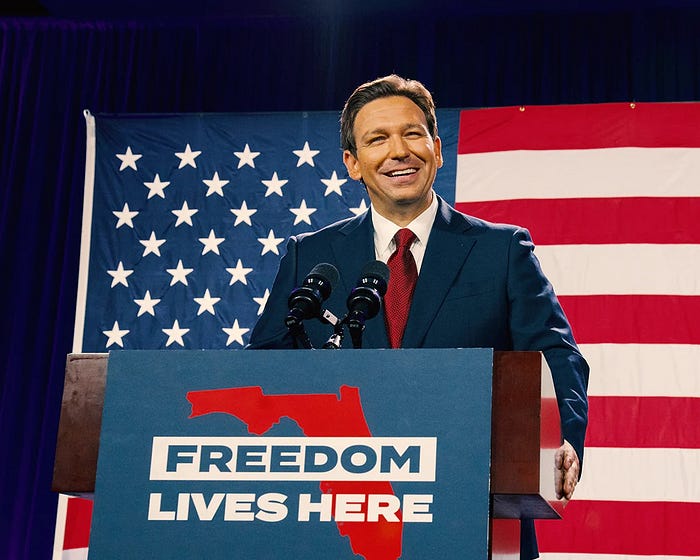
The most successful brand of the 21st century. It’s not Google, Apple, Facebook, or Tesla. It’s not even a country, like South Korea or America, making an historic comeback. It’s fascism. Only we don’t see it as such. Because this brand is made of many smaller ones. The crazy lady in Congress explaining that, why, no, “Jewish Space Lasers” weren’t part of an anti-semitic conspiracy theory — totally reasonable! The manfluencers sex trafficking young women — to global fame and fortune, no less. The governor of a sunshine state who thinks that history…shouldn’t be taught in school. The list grows every day now, and it spans the globe.
Fascism is the most successful brand of the 21st century, and it’s marketed itself as new, fresh, and exciting. It’s been able to do that because, well, our societies are playing a game of self-deceit. Let me give you a simple example before we dig in. A far right party rocketed to power recently in Sweden. It was literally founded by an SS member, as in, a literal Nazi. But the line that this party has pushed goes like this: “We’re not like that anymore!” And, gullibly, predictably, this line swallowed up by people who should know better, from columnists to pundits right down to politicians, and so…fascism gets legitimized, and we don’t see it as such.
Not nearly enough, anyways. When I point out that it’s not only misogynist to sex traffic young women, because you think they’re subhumans, and men of a certain kind of purity and faith belong on top, able to subjugate anyone, violently abuse them — a light goes off in people’s in minds. That’s fascism. The thread that connects all these sinister developments — and they are sinister, not in the conspiracists’ sense, but in civilization’s — is that they are all fascist, but, through a kind of self-deceit, our societies go on legitimizing all this. And so fascism has become, like I said, the most successful brand of the 21st century.
There’s a thing that happened recently in music. It’s weird, and it’s funny. Innovation kind of stopped, and people started rehashing old genres. So — me being a moonlight DJ sometimes — I trawl through records. In genres with names like “Nu Disco” or “Future House” or what have you. Mostly, they suck. Because they’re made of nostalgia for a bygone age, without the…musicianship, skill, ability…that made, for example, real disco so seductive. The “Nu” is funny, no? We can’t say “new,” because it’s not new. “Nu” means nostalgic, new in the sense of a return to the old.
The world’s being seduced by fascism all over again. Sometimes, in my head, I call it “Nu Fascism.” It’s not new…but it’s not exactly the old kind, either. It’s transmogrified and evolved, and that’s a bad thing. It’s grown more sophisticated, and for that reason, it’s been able to sweep through our societies while we watch. Too many of us wondering, “hey, what the hell is wrong with those people?” The answer to that question’s pretty simple, in the end. They’re fascists.
We play a game these days, or a game is played on us. Take your pick, choose your level of complicity. It goes like this. The bad guys say, do, something outrageous. Provocative. Not just “deliberately” so, in a kind of cynical sense, but because they really mean it. And then the denials begin. Oh, that person’s not so bad! Hey — people vote for them, like them, follow them, listen to them, and that’s democracy in action, right? Wrong.
Fascism sweeps through our societies like this, with barely a complaint, sound, whimper. Sure, you and I might talk about it, even a lot — but apart from us? Take a hard look. You’ll barely see the word fascism mentioned, officially, in newspapers, on networks, in columns, and so forth. So the bad guys go on pushing the boundaries, crossing the red lines, one step at a time, and they get away with it, because all this is said to be somehow OK. But is it?
Let’s take a simple example. The governor who’s banned everything from books to words to being gay as a teacher to, now, history itself. Is that…OK? In a democracy? Well, the justification for it doesn’t just come from his side. It comes from every angle. “Liberal” columnists and pundits will raise little complaint about it, at least in the ways they should, and so while it’s ugly, it gets a free pass, mostly. It’s legitimized, in other words. And so the slow creep goes on. It’s legitimized under a flimsy guise — this is democracy in action! Hey, people voted for this guy, and now he can do whatever he wants!
Hello, that’s not democracy at all. In a democracy, we have things called “inalienable rights.” The entire point of a democracy is to defend and protect them — not take them away. If all a putative democracy is doing is attacking people’s rights, it’s acting anti-democratically, which is perfectly possible, much like a doctor who’s also a drug addict. Democracy isn’t just “hey, the people want it! Anything goes!!” It’s precisely the idea that all of us have rights, and consent must be given in sophisticated ways, for institutions to breathe life into those rights.
See my point a little bit? Sure, you’ll hear murmurs, every now and then, that there’s an anti-democratic tide running through our societies. But those murmurs are not enough. They are too quiet and too disconnected. They happen when overt violence breaks out, in spectacular ways — Jan 6th. But the seeds of such events are sown long before that, in subtler ways. And so it’s not enough to just exclaim “that’s anti-democratic!” after the fact. Obviously it is — but the question is how we prevent the scourge of fascism from spreading.
The key to that, as minds explained to us, with great care and pain, after the Holocaust, after the last World War, was to recognize it. Arendt and Orwell thought long and hard about this, and understood a bitter truth — self-deceit was the soil in which fascism laid it’s poisoned roots. We’re vulnerable to fascism because self-deceit has set into our soceties, in ways that leave us shockingly, startlingly blind.
Let’s take the rise of the manfluencers as an example. There they’ve been, for years, spreading a gospel of hate. Incels take their cues from them, and invent whole cosmologies of their own — at the top are “Chads,” with perfect genetics, who monopolize sexual relationships, because, as we all know, all women are really interested in is good-looking guys, not, say interesting, mature, intelligent, sophisticated, real ones. No, women are inferiors — genetic robots — whose only real drive in this life is to have sex with “Chads.”
So of course incels then turn to violence, of bizarre, extreme kinds. They mutilate their own faces, trying to achieve the perfect dimensions of a Chad — and that, they made up, too. Or they go out there and shoot up women. Meanwhile, the manfluencers are telling generations of young men more or less the same thing. What do women really want? An age-old question, if you don’t think women are, wait for it, people. Money? Power? That’s misogyny. This? This is different. Women want to be violently abused, beaten, dominated — they can’t help it, the poor things, the subservience is in their genes. Just like Chad is in mine, say the manfluencers. Young men are being poisoned by this nonsense.
But we’re turning a blind eye. How long has it been since this stuff’s been going on? And our societies are more or less OK with it, because the manfluencers? Well, they have “freedom.” This isn’t freedom. Freedom isn’t me teaching you to go out there and violently abuse someone, because that’s what they deserve, as their destiny — and yours, too. That’s not free speech, expression, association, any of it. In the ends, it curtails all those things, sharply and severely. Instead of having a relationship, I’m an abuser. Instead of letting that person — a young woman — speak out about her own desire for liberation and purpose and self-determination, I send her death threats. Freedom? Don’t kid me, or yourself.
Perhaps you see my point. Under the flimsy excuses of things like “freedom” and “democracy,” we let fascism corrode our societies. But it’s the antithesis of all those. Sure, say what you like — but of course, there are limits. Nobody yells fire in a crowded room. Telling people you’re going to kill, rape, hurt, murder them — because their genetics are inferior to yours — that’s…fascism. It has no place — none — in a democracy, because, like I explained, it limits freedom for everyone else.
If you think I’m kidding, or I go too far, well, let’s go back to the sunshine state. Is the governor who banned words, books, attitudes, sexual orientations, right down to history…expanding freedom? Surely even a fool can see that, no, he’s not. That is because fascism is antithetical to freedom.
Now. I highlight that point because most of us partake in this fake, foolish debate. One side says, “hey, me being able to hate and threaten and intimidate is just free speech!” And our side confused, baffled, bewildered, not wishing to be an enemy of freedom, backs down, most of the time. Then that side says, “Now I’m going to use this ‘free speech’ of mine to try and take your rights away!! That’s my right, after all! It’s my right to take your rights away, burn them, throw them in the gutter!” And our side, by this point even more baffled and confused, doesn’t quite know how to retort, which way to turn, what to say, do, think — because, well isn’t it anti-democratic to object to that?
Of course it’s not. Let me say it again, because it needs to be said. Me taking your rights away isn’t democratic. It’s profoundly hostile to democracy. You can say that it’s democratic, because, hey, some vague justification or claim to populist power — but, like I said, democracy is about inalienable rights. For all. Being enacted universally, by institutions we all consent to be governed by. For some lunatic to come along and say “You don’t deserve rights!! You don’t deserve anything at all, because, well, you’re inferior, you woman, you minority, you liberal, you weakling, you subhuman!!”…that’s never democratic.
And yet this is the game we play. We’re afraid, at least our institutions and our halls of power are, to really get in there and mount a muscular defense of democracy and freedom. Saying something like, hey, in what universe does it expand freedom to take the rights away of… women… the LGBT… kids… an endless list of groups? How can that possibly be enlarging and growing freedom? If freedom is just your right to take mine away, to demean, abuse, belittle me…then how can democracy ever work? How can the word mean much at all?
The accusation that comes back if you even broach this set of ideas, instantaneously, is, LOL, “wokeness.” Me? I’m about as moderate as they come. I find wokers pretty annoying most of the time, with their insistence on semantics, and the way they get worked up about the smallest things. But hey, I also fully support your right to be called what you want. To live the life you want. To be the person you want to be. Because that is what democracy is. It’s not me taking away those rights. It never has been, and never will be.
“Wokeness” has become the great canard of the 2020s. But what does it really mean? Say the word to someone, and what do they really hear? They hear: they’re coming for your kids! They’re going to pervert them. They’re coming for your wives, who belong in the kitchen — and bedroom. Coming for your status in society, which is at the very top. They’re coming to change things. And hey, you don’t ever have to evolve, grow, change, in order to maximize freedom in society, which is the very enactment of democracy. You can just stay there, nursing yesterday’s biases and grievances and resentments. In fact, go right ahead — blow up at someone. Hate’s perfectly OK. That’s your right — to hate, to intimidate, threaten, to be violently abusive, to take away the freedoms and rights of all those groups who are just, for the first time, maybe, wide-eyed with wonder: we can have some freedom, too?
Say the word — and what do people hear? They hear the age-old conspiracy theories of fascism, basically.The Jews control the world — and they’re the ones keeping you down. The LGBT are after your kids — they want to end the bloodline. Immigrants? Refugees? Anyone not like you? They’re a threat, an existential one.
Say the word, and what do people hear? Freedom is a zero-sum game. If those people are freer — if they have self-determination, dignity, respect, if you call them what they want you to, if they can love the way they want to, if kids know they exist and think, hey, maybe I’m more like that than this, if they can go where they like, say what they like, hold hands, kiss, work, be themselves as they truly are — well, that’s the end of your freedom. Your freedom comes at the cost of theirs. The more that all those groups are liberated, to the point they enjoy self-determination — the less free you are.
And so the idea naturally springs up, snarling, in the mind of the one who’s been taught to believe all this — hey, I’d better not let them have any freedom!Because their freedom takes mine away! Why, they might get my kid, or my wife. They’re the reason I don’t have a girlfriend and can never get a date — not my own simmering rage and the way it poisons me. They’re what’s going to take my next job — not the billionaire laying me off. They’re the reason I struggle — not because we all don’t have enough freedom yet. But because freedom is a negative sum game, and their freedom costs mine.
It’s not true. It is the greatest myth of the 21st century, but not just that. It was the greatest one of the 20th, too. What did we learn in the last century? Precisely that freedom isn’t a zero or negative sum game. Women gaining the freedom, to work, to be educated — it turned out to be the single determinant of a successful society. Freeing everyone to have advanced public goods like healthcare and education and transport as basics? It created the European Miracle, and living standards exploded even ahead of America. What we learned in the last century, over and over again, was that freedom is never a negative sum game.
The most terrible, painful, and stupid way this lesson was learned was the Holocaust. The Nazis’ central idea was that the mere existence of Jews — and the LGBT, and other hated minorities — were making Germans less free. And so all that had to be done was to annihilate them. But that didn’t make Germany more free. It just made it…ashes. We have never, ever seen an example, not one, anywhere in history, of freedom being a negative or zero sum game, my freedom costing you yours.
Freedom is the opposite. It’s a positive sum game, a virtuous circle. The freer I am, the better off you are. You might resist it, because you believe the lies, in fear, in paranoia, because letting go of old hatred is uncomfortable. But in the end? When my kid becomes a scientist — even if he’s gay, brown, black, this, that, whatever — and cures your cancer, well, you’’re going to live, my friend. The examples are countless, and they don’t need dwelling on. The point does. Freedom is a virtuous circle. If it wasn’t, well, we would all have been better off as slave societies, warring with each other endlessly, but none of us are. We have modernity and its explosion in living standards precisely because freedom has been a virtuous circle — slow, unsteady, but there — for an era now, one group after the next struggling for liberation, and finding it.
We don’t tell this story enough. Our side. We don’t drum it into people the way that the other side drums their Big Lie into them — your freedom is under threat, from their freedom! It’s you or them!! This story is old. Today’s QAnon paranoid conspiracies are basically the same old Nazism, just rehashed, with a new gloss. They’ve got Space Lasers, this time, instead of just secret vaults of gold. They still drink the blood of kids, the purer and truer of faith the better, because that’s still the secret to eternal life. They still congregate in Satanic rituals, where they sacrifice kids for eternal power. In their minds, they’ve always been the ones keeping us down. It’s us or them. Their freedom is the end of ours.
You can see why the Big Lie works. It’s been told for millennia now, and so letting go of all that residue — even if its unconscious — is hard. That is why fascism became the most successful brand of the 21st century. It was incredibly rare in human history that democracy became its great success, for a time. And when we make the mistakes above — legitimizing fascism through self-deceit — my friends, we make a grave error. Because the Big Lie is easy to believe, and that means we must fight it all the harder. We must be vocal, much more so, in telling the real story of human history.
My freedom? It has never cost you yours. My freedom isn’t a gift you give me. It’s a gift I give you. Because freedom isn’t a negative or zero sum game. It’s a virtuous circle. My liberation is yours, too. You are freer when I can determine my own life, as paradoxical and strange as that might seem, because, in the end, freedom is a thing we create together. Nobody is free in a vacuum, in a jail cell, in an isolation tank. Freedom is a social good, the most foundational form of public good and common wealth of all.
What costs you your freedom, in the end? Believing that your one true job is to take mine away. Because, my friend, then, instead of making choices you really believe in, want, need, ache for — you waste your life trying to subjugate me, and the wheel of time? It grinds to a halt. It’s ground down into dust. And all that’s left is conflict, hate, violence, ignorance, all the forms of futility and folly. Trying to take my freedom away is the truest way to lose yours. That is why demagogues since time began have used this old trick to conquer both sides, at once.
Let us tell the story of history as it really is and was. Freedom is a subtler and truer thing than the Big Lie that’s made fascism the most successful brand of the 21st century. But telling that story is up to us.
Umair February 2023
Consciousness, sexuality, androgyny, futurism, space, the arts, science, astrology, democracy, humor, books, movies and more