Tag Archives: Paul Davies

Physicist Paul Davies States: “This universe is either a mystery, or it’s absurd.”

Paul Austin Murphy

Paul Austin Murphy

Oct 29, 2023 (Medium.com)

In his popular books, the physicist Paul Davies uses various rhetorical and/or vague words and phrases in philosophically-important contexts. This essay argues that such words and phrases actually help generate and publicise his own theory of cosmic “purpose”. They also help generate the scientific and philosophical problems Davies believes both he and his opponents must tackle.

(i) Introduction
(ii) Pedantry?
(iii) Examples of Paul Davies’s Rhetoric, Etc.
(iv) Our Universe Must Produce Life and Mind?

In basic terms, the main problem with Paul Davies’s claims and positions (or, more particularly, his belief in a cosmic “purpose”) is that he uses various words and phrases loosely, vaguely and/or rhetorically in philosophically-important contexts. These are words and phrases he’d never use in his technical physics papers.

Perhaps Davies would freely admit this. After all, he knows that he’s writing what’s called “popular science”.

In any case, in the books in which Davies discusses (cosmic) “purpose”, it can be assumed that he’d never claim to be doing actual physics. Instead, he may claim to be doing two things:

(1) Writing about physics and cosmology.
(2) Philosophising 
about physics and cosmology.

To spell things out.

Writing about physics isn’t physics. And philosophising about physics isn’t physics either. (Again, there’s a good chance that Davies would accept these statements — at least to some degree.)

So there’s no problem at all with Davies philosophising about physics and cosmology. That’s what (obviously) philosophers also do. Indeed, there’s no problem with scientists themselves doing philosophy either. (The problem often works in the opposite direction when scientists claim — if sometimes implicitly — that there aren’t any philosophical components to their scientific theories and statements at all.)

One other problem is that because Davies is a physicist, then that may mean that many of his readers (especially those who’re sympathetic to his views) will take all the words in his popular books to be actual physics. Yet, again, his books are mainly about physics and physical cosmology. And they also include a certain amount of philosophising about physics and physical cosmology.

So it must be said here that this essay isn’t an attempt to go through Davies’s books looking for rhetoric, vagueness, etc. (I use rhetoric myself.) Instead, the argument here is that such rhetorical, vague and loose words and phrases are vital to Davies’s overall philosophical position.

Pedantry?

It can be freely admitted that there is a problem with focussing too much on the actual (or precise) words Paul Davies uses. Specifically, there’s a danger of being “pedantic”. Worse, there’s a danger of being like those “boring” Oxbridge linguistic philosophers of the 1950s. [See here.]

It also needs to be said that many of those scientists who take diametrically opposed views to Davies’s own also use rhetorical and vague terms and phrases in their popular books. (Again, terms they’d never use in their physics papers.)

Take, for example, the following passage from the American theoretical physicist and Nobel laureate Steven Weinberg (1933–2021):

“It is almost irresistible for humans to believe that we have some special relation to the universe, that human life is not just a more-or-less farcical outcome of a chain of accidents reaching back to the first three minutes, but that we were somehow built in from the beginning [].”

[These words can be found in Weinberg’s book The First Three Minutes. See also my Life and the Universe are Neither Meaningless nor Meaningful’.]

Without spoon-feeding the reader, the relevant words above are “farcical outcome”. Indeed, Weinberg then goes on to state that the universe is “hostile”.

Interestingly enough, the passage above comes immediately before Weinberg expressed his very-often-quoted view that

“[t]he more the universe seems comprehensible, the more it also seems pointless”.

Here the relevant word is “pointless”.

So isn’t Weinberg himself falling into the same trap as those religious people he’s arguing against? That is, why accept the binary opposition set up between the universe being “comprehensible” and the universe being “pointless” at all?

Actually, Weinberg inverts the religious argument here.

In other words, the religious argument has it that because the Universe is comprehensible, then surely that must be because God has made it so. More correctly, God is responsible for the (human) minds that do the comprehending.

Alternatively, Paul Davies himself believes that the Universe is comprehensible primarily because it has a “purpose”.

Weinberg, on the other hand, believes that the Universe’s comprehensibility makes it (only seem?) pointless

It’s worth saying here that Weinberg explained (in the book Dreams of a Final Theory) his earlier controversial statement in the following way:

“As we have discovered more and more fundamental physical principles, they seem to have less and less to do with us.”

Yet Davies (despite him playing down his own anthropocentrism) wants cosmology to have more and more “to do with us”.

Weinberg, on the other hand, seems to be arguing that physics — even theoretical physics — should do the job of making things less profound and mysterious, not more so.

Weinberg also wrote the following:

“As long as we don’t know the fundamental rules, we can hope that we’ll find something like a concern for human beings, say, or some guiding divine plan built into the fundamental rules.”

However:

[W]hen we find out that the fundamental rules of quantum mechanics and some symmetry principles are very impersonal and cold, then it’ll have a very demystifying effect.”

Ironically, Weinberg referred to the time when Davies received a million-dollar prize for “advancing the public understanding of God and spirituality” from the John Templeton Foundation. [See my ‘Physicist Paul Davies’s Contributions to the Advancement of Religion, As Seen By Father Mariano Artigas Weinberg’.] Weinberg said:

“I was thinking of cabling [Paul] Davies and saying, ‘Do you know of any organization that is willing to offer a million-dollar prize for work showing that there is no divine plan?’”

Anyway, to get back on the track of those loose, vague and/or rhetorical words and phrases.

Examples of Paul Davies’s Rhetoric, Etc.

Surely Paul Davies stating that “the existence of this particular universe is either a mystery, or it is absurd” is a silly binary opposition. That said, if readers do accept this opposition in the first place, then much else of what Davies states may well follow.

(The binary opposition is elsewhere spelled out as the claim that the universe is either “absurd” or it has a “purpose”.)

When talking about the Universe, Davies also says that it is (or it at least it may be) “self-explaining” and a “self-creating system”. Clearly (at least to me), these words don’t belong to physics or to physical cosmology. Indeed, even if one accepts the arguments that Davies has offered his readers, then many of his statements and words still wouldn’t belong to physics and physical cosmology.

Another example from Davies is the statement that “perhaps existence doesn’t get bestowed from the outside”.

This is a very odd reference to existence.

Existence and the nature of existence are usually deemed to be ontological issues. More particularly, you certainly won’t find the word “existence” used in physics papers — at least not in Davies’s philosophically heavy sense.

Here’s another rhetorical statement.

Davies tells us that “some minds are capable of understanding the universe”. He then adds that other people (i.e., his “atheists”) take this understanding to be “yet another fluke”…

Well, that depends.

If the word “fluke” means not by God’s arrangement, then “some minds” understanding the universe surely must be a “fluke”. (That’s the outright monotheistic position.)

However, Davies’s doesn’t believe in what he calls the “Abrahamic God”. So, on his own terms, if such an understanding isn’t the result of some (non-monotheistic) cosmic purpose, then, again, it must be a fluke.

Yet the word “fluke” is very much like Davies’ other rhetorical word (which he uses a lot) “absurd”. (This word has already been mentioned.)

So do the words “fluke” and “absurd” mean “not necessary” in Davies’s eyes?

If that’s the case, then what would it be for “life and mind” to be necessary?

Is it that we have flukes and absurdities by virtue of the fact that there is no God? Alternatively, do we have flukes and absurdities if we don’t accept Davies’s cosmic purpose?

Of course, some physicists have noted the possibility (or reality) that the laws, constants, etc. we have are the only ones that could bring bring about our Universe. [See here.] Indeed, Davies himself speaks about the Universe’s “self-explanation” and “self-creation”. So perhaps it is in these places where we can find the necessity that Davies is looking (or yearning) for.

Let’s go into a little detail here.

Our Universe Must Produce Life and Mind?

Paul Davies states the following words:

“In this theory [actually, Davies accepts this theory], the bio-friendliness of the universe arises from an overarching law or principle that constrains the universe/multiverse to evolve towards life and mind. It has the advantage of ‘taking life seriously’ [].”

There’s a problem with knowing what the words “an overarching law or principle that constrains the universe/multiverse to evolve towards life and mind” mean. Some readers may believe that Davies has gone into detail elsewhere. However, that’s not really the case. (Not that I’ve read everything Davies has written.)

Grammatically, the words “constrains the universe to evolve towards” are problematic or at least vague.

Does they mean that the universe must evolve toward “life and mind”?

Alternatively, could these words mean that the universe is (as it were) free not to evolve toward life and mind? That is, even though the Universe has all the ingredients required to evolve toward life and mind, then it still might not have done so.

Anthropically, the Universe obviously must have all the ingredients required to evolve toward life and mind!

More particularly, even if the Universe does have all these necessary(?) ingredients, then it still needn’t have led to the minds of, specifically(!), Homo sapiens — or even to the minds of any species (or beings) around today.

Similarly with life.

Even if the Universe has always had all the ingredients required to bring about life (which, by definition or anthropically, it must have!), then the life it could have evolved to might have been very different to life as it is.

To repeat. Wasn’t it possible that even if the Universe has always had all the ingredients needed to move toward life and mind, then it still might not have done so?

After all, for over 3 billion years, the Universe hadn’t evolved toward life. As for mind, it took billions of years longer (i.e., at least if life and mind on earth are taken to be unique).

Consequently, doesn’t this (seemingly?) extreme contingency work against any religious interpretation of these facts?

What’s more, these possibilities seem to make Davies’s ideas less highfalutin and grand. And, indeed, surely they should make Davies’s views less appealing to those people who have religious views and proclivities.

To sum up.

If we accept the extreme contingency of life and mind (alongside happily accepting that the Universe must still have had all the ingredients needed for life and mind from the very beginning), then is there still something more to all this? More relevantly, is there still something genuinely purposeful in the Universe or nature?

Note

(1) Paul Davies is not a Christian. He’s not a follower of any other (to use his own words) “conventional religion” either. Indeed, Davies even says that his belief in a “directional principle” is a “far cry from the God of traditional monotheism”. However, Davies is still religious. Thus, Davies’s cosmic purpose may well be a far cry from the Abrahamic God, but it’s not a far cry from other notions of God, or from the beliefs of other religions dating back well over two thousand years. All this must mean that Davies is still betting on a non-Abrahamic horse in the very same religious race. [See my ‘Physicist Paul Davies’s Contributions to the Advancement of Religion, As Seen By Father Mariano Artigas’.]
Paul Austin Murphy

Written by Paul Austin Murphy

MY PHILOSOPHY: https://paulaustinmurphypam.blogspot.com/ My Flickr Account: https://www.flickr.com/photos/193304911@N06/
Physicist Paul Davies’s Faith in His Idea That Science is “Founded on Faith”

Paul Austin Murphy

Mar 9, 2023 (medium.com)

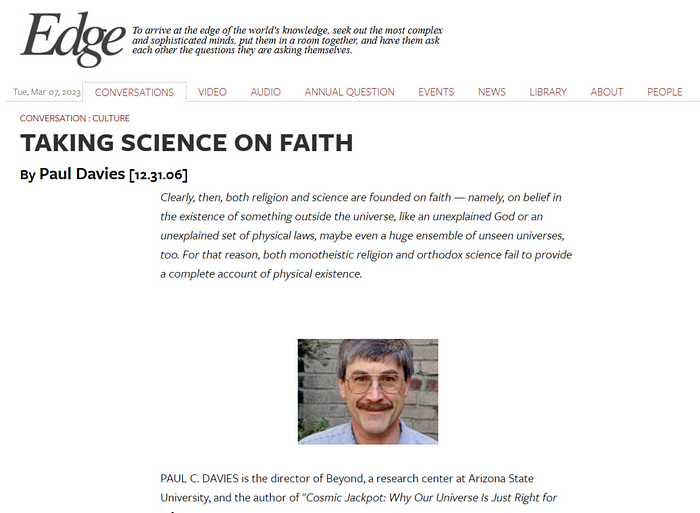
The following essay is a response to Paul Davies’s op-ed article ‘Taking Science on Faith’, which was published by the New York Times. The word “faith” (at least in this context) seems to have become almost (to use a word which Davies uses) meaningless. Indeed, it’s often used as a rhetorical gimmick. On the other hand, it’s much harder to use the word “faith” rhetorically against religious people or monotheists because they often use that word to refer to their own stances on what it is they believe.

(i) Introduction
(ii) Is Science “Founded on Faith”?
(iii) Paul Davies’s Rhetoric
(iv) Paul Davies and the Absurd Universe
(v) Conclusion

Paul Davies’s article is an old one. It was published in 2007. It was also published by Edge-org under the same title. That publication included ten responses from a group of scientists called The Reality Club. The responders included Jerry Coyne, Nathan Myhrvold, Lawrence Krauss, Scott Atran, Sean Carroll, Jeremy Bernstein, PZ Myers, Lee Smolin, John Horgan and Alan Sokal. (These responses, and Davies’s original article, can be found here.)

I decided not to read any of these responses until I’d finished my own response to Paul Davies’s article. I did that because I didn’t want to be too influenced or dependent on what these scientists had written. However, I did later come to note that it was odd that all the responses are negative (or critical) in nature. (Not all the responses are equally negative.) So you’d have thought that Edge-Org (or its founder and editor John Brockman) would have included at least one positive — even if only mildly so — response to Davies’s article.

In any case, Davies himself responded to the responders, and I didn’t read that either until after I’d finished my own response.

Is Science “Founded on Faith”?

There’s a big problem with the central idea in Paul Davies’s article.

If the word “faith” is applicable to all domains, then there’s virtually no point in using that word at all. That said, Davies didn’t apply the word “faith” to all domains in his article: he applied it only to science and religion. Yet surely any reliance on faith is less likely in science than in all other domains. Indeed, isn’t that (as it were) faithlessness deemed to be a central feature of science?

Clearly, Davies doesn’t believe that.

Thus, the word “faith” (at least in this and in similar contexts) seems to have become almost (to use a word that Davies himself often uses) meaningless. It lacks any semantic content. Indeed, it’s often used as a simple rhetorical gimmick. On the other hand, it’s hard to use the word “faith” rhetorically against religious people or monotheists because they use that word to refer to their own stances on what it is they believe.

Basically, then, Davies’s use of the words “faith in science” is an example of a tried-and-tested technique which many critics of science (along with critics of materialism/physicalism and evolution) employ on a frequent basis.

To put it in its most simple form.

If a scientist, “evolutionist” or atheist accuses a religious or “spiritual” person of x, then the latter will accuse the former of being x too. Thus, we have lots of critics who’ve accused scientists, materialists, evolutionists and/or atheists of having “faith” in materialism, evolution and atheism… or, in Davies’s case, faith in science. Indeed, some people have also claimed that science, atheism, evolution or materialism “is a religion”.

This happens at a lot at infant and junior schools. That is, when a little kid accuses another little kid of being x, then that other little kid accuses the accuser of being x too. Indeed, the author and businessman Deepak Chopra is a very good example of one of the people who adopt this strategy

Yet it can be argued that few religious or spiritual persons, New Agers, etc. genuinely do believe that science, materialism, atheism or evolution is literally a religion or that people “believe in” science, materialism, atheism or evolution purely on faith. Of course, it must be admitted that there will be exceptions to this in that at least some scientists, materialists, atheists or evolutionists will use science, materialism, atheism or evolutionary theory as a literal substitute for religion. Yet these comparisons between religion and people’s commitment to science, materialism, atheism and/or evolution are often so vague, tangential and rhetorical that, in most cases, I doubt that these claims are even believed by most of the people who actually state them.

Still, to claim that scientists, materialists, atheists and evolutionists have faith in what they believe (or that “science is founded on faith”) is extremely useful and it scores many ideological and psychological points. It will also help sell books, articles, etc.

More particularly, Davies tells us that

“both religion and science are founded on faith — namely, on belief in the existence of something outside the universe”.

Davies believes that the claim above is clear. (Davies writes: “Clearly, then, both religion and science are founded on faith.”So does Davies have faith in his idea that science is founded on faith?

In terms of detail.

It doesn’t follow that because one has no direct evidence for something (or that something hasn’t been observed), then believing in that something simply must be “founded on faith”. What’s more, it may not even be a case of believing in x: it may simply be a case of provisionally accepting x. (Unless, that is, these two phrases are taken to be synonymous.) On the other hand, religious people and monotheists (on the whole) don’t provisionally accept sacred texts, central doctrines, moral rules, the existence of God, etc. — they believe in these things. Indeed, they often take them to be categorically true.

It can be freely admitted that there are all sorts of things that non-religious people have no direct or indirect evidence for (or which we haven’t observed), but which they accept as being the case. However, can we also deem such provisional acts of acceptance to be (to use Davies’s words) founded on faith?

For example, no one can observe the historical past, the contents of other minds, numbers, the inner core of the Earth, etc. We may have indirect evidence for some of these things. However, the beliefs which most people (especially scientists) have about them still aren’t founded on faith. (Testimony is important in some — or even many —of these and similar cases.) Unless, that is, the word “faith” is being used so broadly and, perhaps, indiscriminately, that it hardly has any purchase.

All that said, some philosophers have indeed argued that most people do have (some kind of) faith in, say, “other minds”, numbers, the past, etc. (i.e., even when the word “faith” isn’t often used by such philosophers). That said, I don’t believe that Davies has these kinds of philosophical cases in mind.

So what do scientists have faith in?

Davies claims that scientists have faith in

“the existence of something outside the universe, like an unexplained God or an unexplained set of physical laws, maybe even a huge ensemble of unseen universes, too”.

Why does Davies believe that scientists believe “in the existence of something outside the universe”? More clearly, why must an “unexplained set of physical laws” be outside the universe? Has Davies logically and/or philosophically deduced that this is what scientists must (unconsciously?) believe? Alternatively, does Davies think that this is the consequence of what it is scientists do believe?

A logical (or otherwise) consequence of believing a set of things may not itself be believed. Thus, there’s little evidence that all, most or even many scientists (or physicists) believe in the existence of something outside the universe. (Unless the Platonic realm of mathematics is outside the universe — as we’ll see later.)

Another problem is that Davies often uses rhetorical and poetic words and phrases.

Paul Davies’s Rhetoric

Paul Davies’s rhetorical and poetical words/phrases muddy the water. That is, they simply don’t help. What’s more, in this particular debate at least, words like “meaningless”, “absurd”, etc. are often thrown around like confetti.

That said, this isn’t an argument against using poetry and rhetoric in prose about science, philosophy, religion, etc. (It’s probably virtually impossible to bypass such things anyway.) And it can be freely admitted that the kind of scientists Davies is arguing against sometimes use equal amounts — or even more — rhetoric and poetry. (Jerry Coyne is a good example.) The point is that readers and writers should always be aware that rhetoric and poetry can be very unhelpful because they’re designed to tap into the readers’ emotions (as well as sell books, etc.). And, as stated, they can also muddy the water.

[Some people argue that “colourful prose” actually enables understanding when it comes to scientific and philosophical matters.]

So now take this passage from Davies:

“You couldn’t be a scientist if you thought the universe was a meaningless jumble of odds and ends haphazardly juxtaposed.”

Why did Davies use the word “meaningless”? Indeed, why did he write the words “jumble of odds and ends haphazardly juxtaposed”?

If the universe isn’t “meaningless”, then it must be meaningful.

Yet that doesn’t help either because we now need to know what a meaningful universe is.

So what is a meaningful universe?

Davies does (kinda) explain what a meaningful universe is elsewhere in his writings. (Primarily in his book The Goldilocks Enigma: Why is the Universe Just Right for Life?, also called Cosmic Jackpot.) However, he doesn’t really do so in his article for the New York Times.

In that sense, then, Paul Davies can be compared to the author and strong critic of science David Berlinski. (The two share many views on the subjects tackled in this essay.) Thus, what the biologist Jerry Coyne (who was mentioned a moment ago) wrote about Berlinski can also be applied to Davies. Thus:

“Science has no answers to ‘The Big Questions’ like ‘why is there something instead of nothing?’ (the answer that ‘it was an accident’ is fobbed off by Berlinski as ‘failing to meet people’s intellectual needs’, which of course is not an answer but a statement about confirmation bias); ‘where did the Universe come from?’; ‘how did life originate?’; ‘what are we doing here?’, ‘what is our purpose?’, and so on. Apparently Berlinski doesn’t like ‘we don’t know’ as an answer, but as a nonbeliever I’d like to know his answer! He has none; all he does is carp about science’s ignorance.”

However, Davies isn’t an outright contrarian like David Berlinski. He’s also a fine physicist and writer. What’s more, Davies’s philosophical analyses and questions have much more meat in them than anything Berlinski has ever offered the public. Indeed, Berlinski often comes across as being all about contrarianism, literary style and politics. Davies, on the other hand, does use rhetoric, but he doesn’t exclusively rely on it.

To get back to Davies’s own rhetoric.

Davies also tells us that when “he was student, the laws of physics were regarded as completely off limits”. That’s clearly false. The laws couldn’t have been off limits because they’re at the heart of all physics.

So Davies must have meant the following:

Philosophising about the laws of physics was off limits.

Davies must have known that because he also told us that philosophical questions weren’t deemed to be “scientific question[s]” by the scientists he had in mind. He also claimed that other scientists (perhaps some of the same ones) believed that “nobody knows” the answers to his philosophical questions.

He may be right about all that. It depends…

Davies also used the word “absurdity”.

Paul Davies and the Absurd Universe

Davies wrote:

“If so, then nature is a fiendishly clever bit of trickery: meaninglessness and absurdity somehow masquerading as ingenious order and rationality.”

Again, why use the word “absurdity”? (Davies also used the words “reasonless absurdity”.)

The word “absurdity” (or “absurd”) is used all the time in this debate about the nature of the Universe and our relation to it. However, it’s very easy to view it as being rhetoric or poetry.

The word “absurd” can be defined as “extremely silly” and/or “ridiculous”. Thus, it would be silly and ridiculous for Davies to say the laws of nature (or the universe’s “order”) is extremely silly or ridiculous when viewed in the way Davies is arguing against.

So perhaps Davies had something else in mind.

Take the existentialist position on “absurdity” as the Universe “having no rational or orderly relationship to human life” (see here). Yet it can be presumed that Davies would say that this isn’t his position either. That’s primarily because he doesn’t like the term “anthropic” because it focuses (too much?) on human beings and their own relation to the Universe.

[In his book The Goldilocks Enigma, Davies wrote: “The term is an unfortunate misnomer, because ‘anthropic’ derives from the same Greek root as ‘man’, and nobody is suggesting that the principle has anything to do with humans per se. [] The British astrophysicist Brandon Carter, who first use the word in this context, once remarked that had he known the trouble it would cause, he would have suggested something else — the ‘biophilic’ principle.”]

Indeed, since existentialists have just been mentioned, I can’t help thinking that Davies’s take on the absurd (or on absurdity) chimes in very well with what absurdist playwrights and authors (see here) had in mind way back in the 1950s. To them, absurdity is the “condition in which human beings exist in an irrational and meaningless universe”. What’s more, in this irrational universe, “human life has no ultimate meaning”.

Ironically, it can be argued that the Absurdists were simply embracing religious ways of thinking. And, in parallel, Davies believes that the nature of the Universe is indeed absurd if what he believes is false. This means that the absurdists and/or existentialists embraced absurdity. Davies, on the other hand, is attempting to find an alternative to it. That is, he is searching for the Universe’s meaning.

Perhaps, then, Davies’s word “absurdity” is a simple synonym for “unreasonableness” or “reasonlessness”. Indeed, that may chime in with his position because he uses these words too.

Yet the word “absurd” isn’t often used as a simple synonym of “unreasonable” or “reasonless” — and Davies knows that.

[I personally believe that absurdity should neither be embraced nor rejected. The word “absurdity” simply isn’t useful or accurate in this context.]

Davies use of the word “absurdity” can also be tied in with his broader position on monotheism and its equally unacceptable (to him) alternatives.

Conclusion

Paul Davies’s overall aim is to offer us a cosmological alternative to both (religious) monotheism and absurd atheism. He writes:

“It seems to me there is no hope of ever explaining why the physical universe is as it is so long as we are fixated on immutable laws or meta-laws that exist reasonlessly or are imposed by divine providence.”

Then, immediately, Davies offers his own alternative:

“The alternative is to regard the laws of physics and the universe they govern as part and parcel of a unitary system, and to be incorporated together within a common explanatory scheme.”

More clearly, Davies says that “the laws should have an explanation from within the universe and not involve appealing to an external agency”. This clearly rules out any reliance on a monotheistic (or even Deistic) God. Yet many scientists, philosophers and others see Davies’s position as one which simply masquerades as not being religious or monotheistic. In other words, his detractors claim that Davies smuggles monotheism and religion back in through the back door…

That’s not a surprising position to take when seen within at least certain contexts. That’s primarily because “design arguments” have, after all, been used by theologians and religious scholars for centuries. (See ‘The Fine-Tuning Design Argument’ from the Discovery Institute, which classes all the positions which reject fine-tuning and the reality of design as “atheistic”.) Of course, Davies doesn’t believe that his arguments rely on God’s design. Yet, arguably, the long tradition which emphasises design is what Davies is attempting to update with new science and even new data.

*) See my ‘Physicist Paul Davies’s Deep — or Specious! — Questions About Life, the Universe and Everything’.

**) My flickr account and Twitter account.

Continue reading Physicist Paul Davies’s Faith in His Idea That Science is “Founded on Faith”