Tag Archives: Oppenheimer

Beyond Tortured Genius: Science and Conscience in Two Rediscovered Oppenheimer Films

Lauren Carroll Harris on the Sober Spectacle of The Day After Trinity and The Strangest Dream

By Lauren Carroll Harris


August 31, 2023 (lithub.com)

“Genius is no guarantee of wisdom,” says government official Lewis Strauss (Robert Downey Jr.) in Christopher Nolan’s Oppenheimer. It could be the blockbuster’s banner statement. Since the release of Nolan’s thrilling, bombastic film, the culture has been caught in the firestorm about how to explain the personality of the eloquent, esoteric J. Robert Oppenheimer and his creation of the first and only people-destroying atomic weapon to be used against civilians. Where Hollywood traffics in Oppenheimer’s ambiguity as a historical character, two small but potent nonfiction forebears ask a more pointed question: what is the responsibility of scientists to their societies?

The Day After Trinity (1981) and The Strangest Dream (2008) evacuate the mythical tropes of the tortured genius biopic that Hollywood loves to rehearse in films like The Imitation GameHawking, and A Beautiful Mind. Now enjoying a renaissance, the films are neither unforgiving nor hardline, but offer sharper moral clarity to the Oppenheimer dilemma, presenting a more complex (and condemning) portrait of the father of the atomic bomb: a patriot, philosopher-king, skilled public administrator, scientific collaborator with military and government, emotional naif, egotist, and polyglot.

Nolan’s story arcs towards Oppenheimer losing his naivete upon realizing that he has given humanity the power to destroy itself. Designed to wrap around each filmgoer’s own worldview and politics, the film is as politically open-ended as you might expect from a major blockbuster. In his press tour, Nolan articulated a more explicitly conservative stance that chimes both with the Great Man theory of history (another biopic favorite) and the Cold War military doctrine that justified the development and use of atomic arsenals against civilians.

“Is there a parallel universe in which it wasn’t him, but it was somebody else and that would’ve happened?” Nolan said in the New York Times. “Quite possibly. That’s the argument for diminishing his importance in history. But that’s an assumption that history is made simply by movements of society and not by individuals. It’s a very philosophical debate…. he’s still the most important man because the bomb would’ve stopped war forever. We haven’t had a world war since 1945 based on the threat of mutual assured destruction.”

That’s also the idea behind the official policy of the nuclear superpowers: deterrence. Horror, in other words, was necessary to prevent even greater horror. The very same doublethink led to Harry Truman’s honorary degree, conferred for ending the war.

How reluctant was Oppie? In Jon Else’s The Day After Trinity, a documentary originally made for public television in 1980, Oppenheimer’s collaborators deliver ambivalent, guilty testimony to a static, non-judgmental camera. Screening on the Criterion Channel, Else’s doc points to the great pleasure its subject took in being appointed the leader of the grandiose bomb project, with the cosmic job title of “Coordinator of Rapid Rupture.” The lens pans patiently across grainy, grayscale photographs that have the natural air of science fiction; the film feels more of a piece with Chris Marker’s La Jetee (1962) than a typical historical documentary. After all, Oppenheimer was not just the enabler of the weapons that could annihilate us all, but of the high-stakes hallmarks of modern spectacle itself. The awe-inspiring images of mushroom clouds over Trinity, Hiroshima, and Nagasaki are now instantly recognizable in the core visual grammar of contemporary entertainment and media. It’s hard to imagine an idea better suited to Nolan’s exalted, maximalist esthetic and his stories of obsessive male protagonists pressurized within towering patriarchal systems of power.

Oppenheimer positions the atomic bomb as the creation of a brilliant, creative personality. But The Day After Trinity revels in the administrative scale of the Los Alamos project necessary to make a mechanism to trigger, in a millionth of a second, a violent chain reaction with a flare brighter than a hundred suns. A walled city of six thousand staff, at a cost of $56 million. Seven scientific divisions: theoretical physics, experimental physics, ordinance, explosives, bomb physics, chemistry, and metallurgy. All of America’s industrial might and scientific innovation connected in this secret lab with its billions of dollars of military investment.

The Day After Trinity and The Strangest Dream evacuate the mythical tropes of the tortured genius biopic that Hollywood loves to rehearse.

“Somehow Oppenheimer put this thing together. He was the conductor of this orchestra. Somehow he created this fantastic esprit. It was just the most marvelous time of their lives,” says Freeman Dyson, a rather eccentric theoretical physicist who became Oppie’s colleague at the Institute for Advanced Study in Princeton. “That was the time when the big change in his life occurred. It must have been during that time that the dream somehow got hold of him, of really producing a nuclear weapon.”

In this vision of the A-bomb narrative, Dyson posits that Oppie’s aims switched from finding out “the deep secrets of nature” to producing “a mechanism that works. It was a different problem, and he completely changed to fit the new role.” We begin to see more clearly a portrait of an outsider with a wild desire to be at the center. All the work the whiz kids were doing over the years was always designed to contribute to the war. (All the films remove Oppie’s more demonstrably radical tendencies, his belief in a world government, for instance, which he mentioned offhandedly in the New York Review of Books in 1966.)

The closest we get to Oppenheimer himself is his pale-eyed, doppelganger brother, Frank, who gives the impression of a visionary living in a purely abstract realm. He stammers a little when he speaks of the moment when he and Oppie heard on the radio of their great bomb in action. “Thank God it wasn’t a dud… thank God it worked… Up to then, I don’t think we’d really, I’d really, thought about all those flattened people.” He still seems stunned. If nothing else, Frank gives weight to the storytelling trope of scientists as hyperintelligent but flakey space cadets at a remove from the humanity of it all. “Treating humans as matter,” as Los Alamos collaborator Hans Bethe puts it appallingly. Another contributing scientist says he vomited and lay down in depression. “I remember being just ill,” he says. “Just sick.”

The doc swirls with clips accumulated from Los Alamos Scientific Laboratories, National Atomic Museum, American Institute of Physics, and Fox and NBC newsreels, while Paul Free’s authoritative narration hovers like an omniscient voice from the depths of the Cold War itself. Then, there is Oppie: a figure of stricken elegance in his rakish pork pie hat. Typical of documentaries constructed in a postmodern style, what it all means is never explicated. Ambiguity presides over clarity.

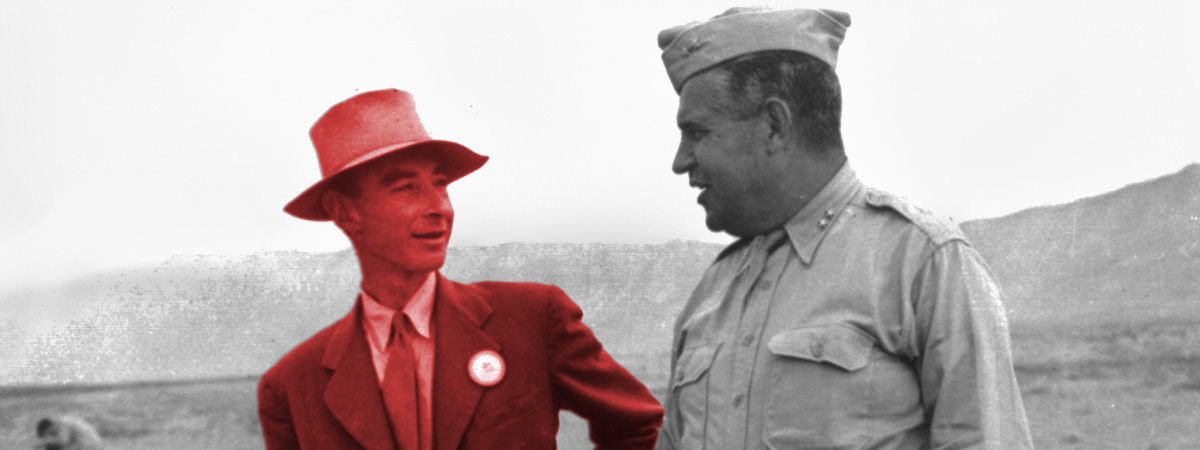
Most directive is Dyson’s testimony. “He made this alliance with the United States Army and the person of General Groves who gave him undreamed-of resources, huge armies of people, and as much money as he could possibly spend in order to do physics on the grand scale,” Dyson says with his flashlight perceptiveness. “We are still living with it. Once you sell your soul to the devil, there’s no going back on it.” Los Alamos, in this counternarrative, was not just an ivory tower but an irresistible paradise for genius-level scientists simply interested in new discoveries and mega-gadgets.Oppenheimer was not just the enabler of the weapons that could annihilate us all, but of the high-stakes hallmarks of modern spectacle itself.

Dyson is a dubious fellow to emerge as the truthteller, given the inconsistency of his own legacy. His unorthodox theories are worthy of their own Nolan-esque treatment. He advocated growing genetically modified trees on comets, so that they might land on other planets and create human-supporting atmospheres, and eventually became a climate change denier based on his distrust of mathematical models. But his intelligence is irrefutable, and his distance from the Manhattan Project gives him a guiltless perspective and authority absent in Oppie’s other colleagues. Dyson, a greater antagonist than can be found in any mere Marvel movie, diagnoses Oppie as the self-induced victim of a “Faustian bargain.”

“Why did the bomb get dropped?” Dyson asks, his tie a little too big, his combover a little too combed over. “It was almost inevitable. Simply because all the bureaucratic apparatus existed at that time to do it. The Air Force was ready and waiting… The whole machinery was ready.”

Dyson also refutes the refrain of Oppenheimer’s responsibility for the catastrophe. “It was no one’s fault that the bomb was dropped. As usual, the reason it was dropped was that nobody had the courage or the foresight to say no.” Dyson pauses to let this sink in, then looks down and wobbles his head tragically. “Certainly not Oppenheimer. Oppenheimer gave his consent in a certain sense. He was on a committee that advised the Secretary of War, and that committee did not take any kind of a stand against dropping the bomb.” This measured oral history is fatal to the view of Oppie as a gentle humanist.

Dorothy McKibben, who ran the Manhattan Project’s office, chimes in with crystal clarity: “I don’t think they would have developed that [bomb] to show at a garden party. I think they were going to do it.” In archival footage, General Leslie Groves plays the role of plainspoken pragmatist: “It would have come out, sooner or later, at a Congressional hearing, if nowhere else, just when we could’ve dropped the bomb if we didn’t use it. And then knowing American politics, you know as well as I do, if there had been an election fought on the basis of every mother whose son was killed after such-and-such a date, the blood is on the hands of the President.”

Through these testimonies, the convention of the conflicted scientist and the myth of an A-bomb created in self-defense give way to a mantra of winning the war, and winning quickly. Valuing American lives over other lives. Avoiding a bloody invasion of the Japanese mainland. Months before Hiroshima, orders had been given to leave several Japanese cities untouched, to provide virgin targets where the impact of the new bomb could be clearly seen. Afterwards, a scientific team from the US was sent to Japan to study the effects. Footage rolls, in The Day After Trinity, of news clips of hospitalized burn victims.This measured oral history is fatal to the view of Oppie as a gentle humanist.

In films on the Manhattan Project, questions of conscience are commonly seen through the assenting viewpoint—that of the scientists who continued to work on the bomb, even after Hitler’s defeat. One essential perspective is obscured, black-holed in subterfuge, even. Physicist and European refugee Joseph Rotblat made crucial discoveries in the fission process, and went on to specialize in nuclear fallout. He moved to Los Alamos in 1944 but defected from the project on grounds of conscience upon learning that the Nazis could not build such a bomb. He was the only scientist to turn his back.

“If my work is going to be applied, I would like myself to decide how it is applied,” Rotblat says in the 2008 Canadian documentary The Strangest Dream. Streaming on the National Film Board of Canada’s platform, the film traces his renunciation of A-bomb development and his role in the Pugwash Conferences, where scientists and statesmen gathered to discuss the reversal of nuclear proliferation. The film renders a fairly straight treatment of its quiet subject, with the visually rich backing of a vertiginous collage of disparate forms, including spooky Cold-War era footage and clips of the Trinity mushroom cloud. Oppie is not in the film, but the narrative takes place in the fissures he helped wrench open; he lurks like an ever-present ghost behind the character of Rotblat, who stands as his angelic nemesis as he tries to transform physics into a humanitarian project. Like Oppenheimer, Rotblat was also accused of espionage, but he was eventually awarded a Nobel Peace Prize for his contributions to the disarmament campaign.

Notably, Rotblat is entirely absent from Oppenheimer, despite being described as a brilliantly offbeat individual—a “mad Polish scientist”—by a former student in The Strangest Dream. It’s a curious historical erasure and a missed chance for a dramatic clash. Then again, perhaps Rotblat is too steady and untragic, incorruptible and unmemeable for his own big moment, let alone the blockbuster treatment. Oppie’s genius wasn’t just in his Faustian bargain but in the way that he spoke and the way he held himself, quoting Hindu philosophy and smoking till the end of time. I suppose film culture is more interested in the flawed, tortured luminary than the staunch, principled dissenter or the morally engaged scientist.

Prosecuting the melancholic drama of the ingenuous mastermind requires substantial historical selectivity. Most cinema narratives hew to the oft-cited rationale for the A-bomb’s development: its function as a deterrent to a Nazi explosive. But in his essay “Leaving the Bomb Project,” Rotblat wrote, “Groves said that, of course, the real purpose in making the bomb was to subdue the Soviets… Until then I had thought that our work was to prevent a Nazi victory, and now I was told that the weapon we were preparing was intended for use against the people who were making extreme sacrifices for that very aim.” With more than a dash of elegiac melancholy, the working thesis of The Strangest Dream is that Rotblat’s moral strength insulated him against Oppie-style tragedy.

Insofar as the The Strangest Dream and The Day After Trinity position the Manhattan Project as an unholy alliance of physics and the openly violent arm of the state, they do so via the absent presence of Oppenheimer, who, flush with government cash, personifies the uneasy collision of science and military. Today’s ventures in AI offer the same science-ethics conundrum, and we don’t seem to be any closer to resolving it than at the moment of Oppenheimer’s mythic quandary. Looking at the images of the Los Alamos exertions, you can almost faintly hear the words of today’s STEM bros: disruption, innovation, brilliance. Wondrous and diabolical, the A-bomb is presented in these documentaries as the freakish outcome of public-bureaucratic entrepreneurialism. (They are weaker on the tangled history of superpower competition and atomic technology.) It all depends, of course, on what humans do with the technology we develop.

If there’s such a thing as sober, mournful spectacle, these films manifest it.

Given what we know about capitalist society at present, things aren’t exactly looking up. Just a decade after The Day After Trinity, the Cold War victory lap was being run at the box office. A new, end-of-history generation of studio filmmakers was writing a euphoric, Fukuyama-esque version of reality into pop-culture lore: in blockbusters like Independence Day (1996), The Core (2003), and Armageddon (1998), American pluck saves humanity from wholesale destruction; anxiety surrounding US dominance over the international order is undetectable, and the US military is either prominent or necessary. Before them all, The Day After Trinity suggested that technology’s triumph is the very crux of the problem.

Today, Oppenheimer reifies a political crisis—superpower competition for atomic arsenal—as a conundrum of personality, tech, and naive genius, even as it centers the wild fraternity of science, military, and government vital to create the A-bomb. But the political arrangement of power and resources seems like more of an objective, inevitable fact about the world in The Day After Trinity and The Strangest Dream. If there’s such a thing as sober, mournful spectacle, these films manifest it.

Oppenheimer is long gone, but his legacy—the capacity of a self-destroying humanity, and the late-capitalist spectacle of that mushroom cloud’s bright flash of light—lingers. He did not sign the Einstein-Russell Manifesto against nuclear war. He never apologized for his role in bringing the bomb to life. Atomic technology is now standard. The world’s nuclear powers currently possess an estimated 12,512 active warheads. More than enough to wipe out the planet.

Lauren Carroll Harris

Lauren Carroll Harris has been published in LA Review of Books, Sydney Review of Books, Lit Hub, The Baffler, Mubi Notebook, Cineaste, and the Open Secrets book anthology (Giramondo) among others. She is the founding curator of the Prototype experimental film platform and has programmed moving image for the 10th Asia Pacific Triennial and Carriageworks. She has a PhD in film studies.
Oppenheimer: From Trinity to Doomsday

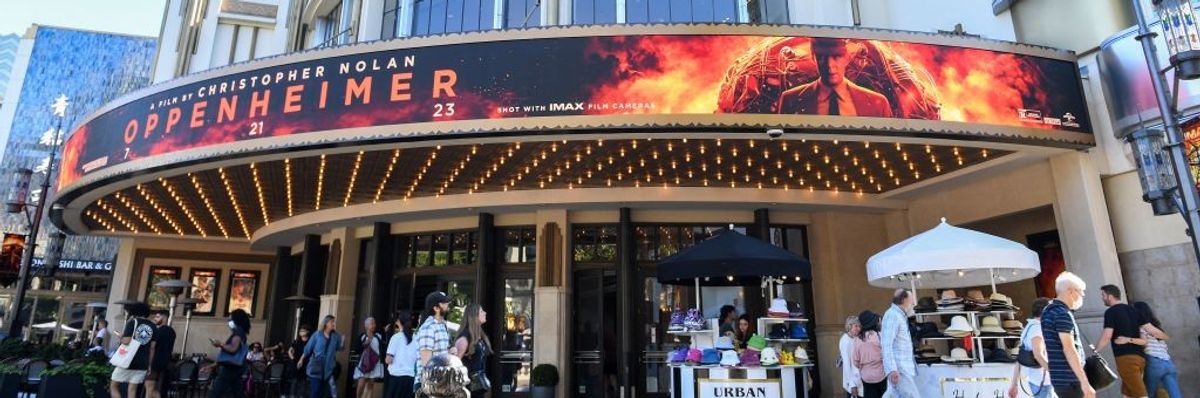
A theater marquee promoting Oppenheimer.

Grove’s Theater marquee announcing the opening of Oppenheimer is pictured in Los Angeles California, on July 20, 2023.

 (Photo: Valerie Macon/AFP via Getty Images)

The service that the new Christopher Nolan film has brought forth, providing public awareness about nuclear weapons, demands that we cannot remain silent.

ROBERT DODGE

Jul 24, 2023 Common Dreams

I attended this weekend’s Los Angeles opening of Christopher Nolan’s epic film, Oppenheimer. This must-see film provides a critical opening for an essential conversation about nuclear weapons and their role in our security and the fate of the planet. The film, notably released 78 years to the week after the Trinity test, chronicles Robert J. Oppenheimer’s life, both personal and scientific, from his vetting to direct the Los Alamos laboratory for the Manhattan Project, to the development of the first atomic bomb and through the difficult subsequent years and the active campaign to smear him.

The Film

The film does a remarkable job of raising public awareness in presenting the theoretical physicist’s brilliance and the struggles he and fellow project scientists dealt with in the application of that knowledge in developing the atomic bomb, its potential ramifications and risks, and even remorse that followed the Hiroshima and Nagasaki bombings that resulted in the deaths of roughly 200,000, mainly civilians. Close friend, colleague, and fellow physicist Isidor Isaac Rabi expressed reticence before joining the project, fearing their work would result in the “Culmination of three centuries of physics to be a weapon of mass destruction.”

Oppenheimer voiced fear that failing to immediately contain these weapons would lead to an unstoppable arms race. Realizing that this containment would not be a reality in the immediate aftermath of the Trinity test, Oppenheimer said, speaking from the Bhagavad Gita Hindu sacred script, “Now, I am become Death, the destroyer of worlds.” The film’s end recalls an earlier conversation with Oppenheimer questioning their calculations of the nuclear chain reaction set in place by the nuclear explosion possibly igniting the atmosphere, saying, “We thought we might start a chain reaction that might destroy the world.” Albert Einstein responds, “What of it?” To this, Oppenheimer responds, “I believe we did.”

Today’s reality 

That prescient fear plays out in today’s reality. We have entered a new arms race in recent years with the modernization of all global nuclear arsenals. With current global arsenals estimated at 12,500 weapons, many up to 80 times more powerful than the bombs dropped on Hiroshima and Nagasaki, the danger faced by all of humanity is greater than ever. This led the Bulletin of Atomic Scientists to reset their infamous Doomsday Clock this year in January to 90 seconds till midnight, with midnight representing nuclear Armageddon, the closest it has been since the dropping of the atomic bombs.

We now recognize that these bombs are far more dangerous than we had previously thought. The tremendous firestorms and radioactivity released with their explosion is only a small part of their devastation. While not burning up the atmosphere as feared by the Manhattan Project scientists, we now recognize the subsequent catastrophic climate change could lead to a global famine, following even a limited regional nuclear war, using less than 1/2% of the global arsenal. For example, a nuclear war between India and Pakistan, who have been on a war footing for decades, using 100 Hiroshima-size weapons, would potentially kill 2 billion people, or roughly 20% of the world’s population, by causing a nuclear famine. This has shifted the Cold War MAD doctrine of Mutually Assured Destruction to SAD, Self Assured Destruction, as any nuclear war threatens all of humanity, particularly those most vulnerable and food insecure.

If we are to survive, we must change the way we think and critically ask what role nuclear weapons play in our security.

This knowledge goes unheeded by global leaders, with the United States alone spending over $90.3 billion in tax dollars this fiscal year, or ~$172 thousand dollars every minute, on all nuclear weapons programs as we work to rebuild our entire nuclear arsenal with enhanced nuclear weapons. The myth of deterrence is at the core the main driver of this buildup. Not to be outdone, every other nuclear nation is following our lead, bringing us closer to nuclear apocalypse. We sleepwalk toward the fear expressed by Einstein when he said, “The unleashed power of the atom has changed everything save our modes of thinking, and we thus drift toward unparalleled catastrophe.” With this knowledge, if we are to survive, we must change the way we think and critically ask what role nuclear weapons play in our security. In reality, they do nothing to advance our security while robbing our communities of precious resources. Rather, they are the greatest threat to it.

The Demand 

This is a scenario that does not have to be. We have created nuclear weapons, and we know how to dismantle them. At the height of the Cold War we had over 60,000 weapons and today have 12,500. What is needed is the political will supported by the public demand to work toward a verifiable, time-bound, complete elimination of these weapons. While it’s easy to feel paralyzed and fall into a state of psychic numbing, as described by physician and abolitionist, Dr. Helen Caldicott, there is much that is being done, and each of us can be part of this and play a role. The service that this film has brought forth, providing public awareness, demands that we cannot remain silent.

The Response 

We must move back from the brink of nuclear war. There is a rapidly growing grassroots, community-based, intersectional movement that is happening across this country and working to prevent nuclear war called “Back from the Brink.” Heeding this call and acknowledging the significance and urgency of nuclear abolition, U.S. Representative Jim McGovern (D-Mass.) has put forth H. Res 77 that urges the U.S. government to lead an international effort to abolish nuclear weapons, supporting the Treaty on the Prohibition of Nuclear Weapons and common sense precautionary measures during this period of negotiations that include: no first use of a nuclear weapon, ending the sole presidential authority for any sitting president to independently launch a nuclear attack, removing our weapons from hair trigger alert, and finally canceling the $1.5 trillion rebuild of our nuclear arsenals with enhanced weapons.

As of this writing, there are now 35 additional cosponsors of this U.S. House resolution. In our democracy, when the people lead, the leaders will follow. Everyone is encouraged to contact their representatives to cosponsor this critical House resolution. Those interested in helping disseminate information about H. Res 77 or distributing information at screenings are invited to download flyers at this Back From the Brink resource page.

In the February 1949 edition of The Atlantic, Oppenheimer wrote in his “The Open Mind“ article, “It is in our hands to see the hope of the future not lost.” If you, like I, are concerned about climate change, economic, social, health, and environmental justice or peace, it’s essential to know that none of it matters in the aftermath of a nuclear war. We must realize the intersectionality of each of these concerns and work together to eliminate nuclear weapons before they eliminate us, so that we can continue our work for justice.

Our work is licensed under Creative Commons (CC BY-NC-ND 3.0). Feel free to republish and share widely.

ROBERT DODGE

Robert Dodge, a frequent Common Dreams contributor, writes as a family physician practicing in Ventura, California. He is the Co-Chair of the Full Bio >

The Trials of J. Robert Oppenheimer | AMERICAN EXPERIENCE | PBS

American Experience | PBS Premiered Jul 29, 2023 Official site:https://www.pbs.org/wgbh/americanexpe… J. Robert Oppenheimer was brilliant, arrogant, proud, charismatic — and a national hero. Under his leadership during World War II, the United States succeeded in becoming the first nation to harness the power of nuclear energy to create the ultimate weapon of mass destruction — the atomic bomb. But after the bomb brought the war to an end, in spite of his renown and his enormous achievement, America turned on him, humiliated him, and cast him aside. “The Trials of J. Robert Oppenheimer,” featuring Academy Award-nominated actor David Strathairn (“Good Night and Good Luck,” “The Bourne Ultimatum”) as Robert Oppenheimer and produced by multiple Emmy Award-winning producer David Grubin (“RFK,” “LBJ,” “Abraham and Mary Lincoln: A House Divided”), includes interviews with the scientist’s former colleagues and eminent scholars to present a complex and revealing portrait of one of the most important and controversial scientists of the twentieth century. The two-hour film traces the course of Oppenheimer’s life: his rarefied childhood, his troubled adolescence, his emergence as one of America’s leading nuclear physicists, his leadership of the Los Alamos laboratory, and his tragic humiliation.

‘Crybaby’: The disastrous meeting between Oppenheimer and Truman

By Katie Dowd July 20, 2023 (SFGate.com)

Director Christopher Nolan (center) stands behind actor Cillian Murphy (far right) on the set of “Oppenheimer.”Universal Pictures

Although President Harry Truman, the man who made the final decision to drop the world’s first atomic weapon on Hiroshima, appears for only a few minutes in “Oppenheimer,” his scene is a memorable one. (Minor spoilers ahead, if you want to go into “Oppenheimer” completely blind.)

In it, Cillian Murphy’s J. Robert Oppenheimer meets with Truman in the Oval Office after the bomb is dropped. Truman, played by Gary Oldman, is initially excited to meet the man in charge of the Manhattan Project, but his delight soon turns to anger when a nervous Oppenheimer says he feels he has “blood on my hands.” The meeting ends with Truman coldly offering his handkerchief and calling Oppenheimer a “crybaby” as they part ways.

But is that what actually happened when Oppenheimer met the president?

Remarkably, it really did go that poorly. In the weeks after Hiroshima, the reality of how the world had changed weighed heavily on Oppenheimer. On the recommendation of an acquaintance, Oppenheimer asked for a meeting with Truman. On Oct. 25, 1945, Truman was introduced for the very first time to the man who had headed the Manhattan Project. 

The meeting was convivial at first, but the tone shifted when Truman asked Oppenheimer when he thought the Soviet Union would have its first nuclear weapon. Oppenheimer replied that he didn’t know. “Never!” Truman boisterously responded.

Reporters gathered in the Oval Office on Aug. 14, 1945, to listen to President Harry Truman’s announcement that World War II was over. Historical/Corbis via Getty Images

This did not go over well with Oppenheimer, who was sure that scientists in other countries could certainly figure out what the Americans had. (Neither Oppenheimer nor Truman yet knew that spies at Los Alamos had already given the Soviets the critical information they needed for their nuclear weapons program.) Flustered, Oppenheimer then made a mistake.

“Mr. President,” he said, “I feel I have blood on my hands.”

Oppenheimer’s biographers in “American Prometheus” recounted how Truman would later retell the incident: “Over the years, Truman embellished the story. By one account, he replied, ‘Never mind, it’ll all come out in the wash.’ In yet another version, he pulled his handkerchief from his breast pocket and offered it to Oppenheimer, saying, ‘Well, here, would you like to wipe your hands?’”

Ultimately, “American Prometheus” posits the most likely response Truman gave to Oppenheimer was a bit less dramatic. “I told him the blood was on my hands — to let me worry about that,” Truman allegedly said to a colleague. 

However it went down, the exchange destroyed any collegiality the men might have formed. Truman stood up to signal the meeting was over, and Oppie walked out defeated. “Blood on his hands, dammit, he hasn’t half as much blood on his hands as I have,” Truman was overheard saying afterward. “You just don’t go around bellyaching about it.”

“I don’t want to see that son of a bitch in this office ever again,” Truman reportedly told Secretary of State Dean Acheson. In a letter to Acheson the next year, Truman referred to Oppenheimer as a “cry-baby scientist.”

FILE: Dr. J. Robert Oppenheimer is shown at his study in Princeton University’s Institute for Advanced Study, Princeton, N.J., Dec. 15, 1957.John Rooney

The failure was not just an interpersonal one. Oppenheimer “had the opportunity to impress the one man who possessed the power to help him return the nuclear genie to the bottle,” wrote Oppenheimer’s biographers, “and he had utterly failed.”

Instead, Truman and the presidents to come would rely on the advice of Ernest Lawrence and Edward Teller (played by Josh Hartnett and Benny Safdie in “Oppenheimer,” respectively). Unlike Oppenheimer, who came to believe the government should stay out of scientific study, these two Manhattan Project physicists believed in the union of government and nuclear weapons research. In partnership with the Truman administration, Lawrence and Teller continued nuclear weapons development under the oversight of the U.S. government.

Shown at the White House in 1957 are, from left to right, Dr. Ernest O. Lawrence; Atomic Energy Commission Chairman Lewis Strauss; Dr. Edward Teller, “father of the H-bomb”; and Dr. Mark Mills.Bettmann/Bettmann Archive

While Oppenheimer cautioned against the creation of the H-bomb, Teller went on to become the so-called “father of the hydrogen bomb,” a weapon far more destructive than the ones dropped on Japan. 

More on Oppenheimer

— Robert Oppenheimer’s stranger-than-Hollywood love life

— What really happened to Jean Tatlock, the love of Oppenheimer’s life

— What the people depicted in ‘Oppenheimer’ actually looked like

— What are the white badges characters wear in ‘Oppenheimer’?

— The spies at Los Alamos

— ‘Crybaby’: The disastrous meeting between Oppenheimer and Truman

— The real relationship between Oppenheimer and Albert Einstein

July 20, 2023

By Katie Dowd

Katie Dowd is the SFGATE managing editor.

How J. Robert Oppenheimer Was Influenced by the Bhagavad Gita

Alok A. Khorana on the Concept of Dharma, the Manhattan Project, and Oppenheimer’s Well-Worn Copy of the Gita

By Alok A. Khorana


July 10, 2023 (lithub.com)

My mother read the Bhagavad Gita every day as part of her morning rituals. Belonging to the last generation of Indians born into colonialism, she had trained as a clinical psychologist but learned Sanskrit both at home and in college. Modernity had begun but not yet broken millennia-old chains of generational transmission of indigenous knowledge.

Each morning, in her little prayer nook, she would quietly read two to three verses in the original Sanskrit, making her way through all seven hundred over the course of a year or so. When complete, she would go back to the beginning, cycling over and over for as long as I ever knew her.

I did not study the text with her during her lifetime. (The memory of this angsty adolescent rebellion still makes my heart sting in shame.) Yet, almost by osmosis, I absorbed the story and the lessons of the Gita through my childhood growing up in 1970s/1980s India. Like most Indian children, I knew the Gita as part of the epic Mahabharata appearing at the beginning of the Great War between two groups of warring cousins, scions of a storied dynasty.

I knew that it begins with Arjuna—perhaps the greatest warrior of them all—falling into despondency at the thought of having to kill his own relatives and teachers just when the battle lines are drawn. It is his decision to seek counsel from his friend and charioteer Krishna (unbeknownst to him, an avatar of the god Vishnu) that leads to a dialogue between the two, conducted in the no-man’s land between two puzzled, impatiently waiting armies. This conversation, written in sublime poetry, centers on this question: should Arjuna fight in a war that will inevitably lead to heartbreaking loss, or should he withdraw and relinquish his duty as a warrior?

I also understood—even as a child—that Krishna’s instructions to Arjuna were not intended solely for warriors amid a war. Rather, the war was a metaphor for the struggle that is life, and Krishna’s guidance to Arjuna was also for ordinary people. It would only be decades later that I would learn that the Gita is a masterful weaving together of the many different strands of Hindu philosophical thought that had preceded it, eliding seeming contradictions by a rich synthesis of all that is complementary between them. In philosopher Sri Aurobindo’s words, it is “a wide, undulating, encircling movement of ideas…a rich synthetic experience… It does not cleave asunder, but reconciles and unifies.”

Perhaps I would have learned more, but a rapidly changing world was calling to me. India’s several-thousand-year-old texts suddenly seemed archaic as the opening up of free markets in the early 1990s brought shopping malls on the streets outside and cable television on screens inside. Capitalism was it. An introduction to Ayn Rand’s books in medical school followed by a hasty decision to emigrate for training to the United States set me on a different sojourn altogether. Over the next two decades, I moved with an autodidact’s eclecticism from one Western philosopher to another, intrigued but always left wanting.

I would eventually return to my mother’s Gita, and its underlying philosophy of Advaita Vedanta or non-dualism. It was during this second phase of learning—still ongoing—that I delved deeper into the profound questions that were being asked and answered. I understood that the chief concern of the Gita was how best to follow one’s dharma—the untranslatable Sanskrit word incompletely referred to in English as duty. Individual sentient beings each have different dharmas, and these can change at different stages of life. (Consider, for instance, that the dharmas of a worker bee and a queen bee are quite different.)The war was a metaphor for the struggle that is life, and Krishna’s guidance to Arjuna was also for ordinary people.

The world is messy—right and wrong are not always clear. Withdrawing from the world, however, is not the answer for the space left behind may be filled by adharma, the opposite of dharma. How does one live a life that fully engages with the world yet remains detached from the vicissitudes of material successes and losses? How can one fight against wrong, even kill—as Arjuna is being asked to do—and yet accept the divine Oneness of all sentient beings?

These are the concerns of the GitaOne believes he is the slayer, another believes he / is the slain. Both are ignorant; there is neither slayer/nor slain (2.19, in Eknath Easwaran’s translation).

*

Robert Oppenheimer was born to Jewish parents affiliated with the Ethical Culture movement, in which he would receive his schooling. At Harvard, he was drawn to the Hindu philosophical classics—seemingly more interested in these than even physics. In his thirties, on the faculty at Berkeley, his curiosity deepened. He studied Sanskrit weekly with a Sanskrit professor. It was here that he was first introduced to the Gita, which he thought “quite marvelous”; later he would call it “the most beautiful philosophical song existing in any known tongue.”

He kept his worn version close at hand by his desk, and often gave copies to friends. Even late in life, he listed the Gita, along with another Sanskrit classic and Eliot’s The Waste Land—itself inspired by an Upanishad—among the ten books that most shaped his life.

I have often wondered what eerie prescience led Oppenheimer to the dilemma at the center of the Gita. Merely a decade later, Oppenheimer would find himself in nearly the same quandary—figuratively and literally. Asked to lead the Manhattan Project amid another Great War, he became a scientist given a warrior’s task. The War would continue whether Oppenheimer took part in it or not, as it had been for Arjuna. There would be loss of life with or without him.

Should he participate, or should he withdraw? Considering your dharma, you should not/vacillate. For a warrior, nothing is higher than a/war against evil. (2.31)

That Oppenheimer understood the concept of dharma is clear from an anecdote highlighted by historian James Hijiya. When, in 1943, Oppenheimer was being pushed by an Army intelligence officer to name potential security risks at Los Alamos, the officer wondered if Oppenheimer “picture[d] me as a bloodhound on the trail.” Oppenheimer responded, “That’s your duty…. [M]y duty ([s] not to implicate these people…. [M]y duty is to protect them.”

Hijiya is quite certain (other historians are not) that Oppenheimer used the same self-taught concept when leading the Manhattan Project. He separated his own dharma—to help create the bomb—from that of Government leaders, who would decide if, when and how it should be used. As he would later state, “I did my job which was the job I was supposed to do.” In Hijiya’s summary, “It was the duty of the scientist to build the bomb, but it was the duty of the statesman to decide how to use it. Oppenheimer clearly and repeatedly acknowledged these very different dharmas.”Even late in life, he listed the Gita, along with another Sanskrit classic and Eliot’s The Waste Land—itself inspired by an Upanishad—among the ten books that most shaped his life.

Oppenheimer remained certain about this decision for the remainder of his life. “At Los Alamos,” he would say two decades later to Newsweek, “there was uncertainty of achievement but not of duty.” In Oppenheimer’s mind, then, there was certainty about his dharma. Thus it was that Oppenheimer used his deep reading of the Gita to determine the most consequential decision made by a scientist in the twentieth century. The decision, however, was made in the abstract: how would Oppenheimer grapple with its earth-shattering consequences?

*

The footage is old and grainy, the black-and-white film flickering ominously like lights in a horror movie. A wizened-appearing Oppenheimer is the sole focus of the camera, as the clip begins ominously with his words: “We knew the world would not be the same.”

Millions of viewers have watched versions of this footage on YouTube, as I did for the first time one evening having disappeared down some now-forgotten internet rabbit-hole. The recording is two decades removed from the event, when the physicist is suffering from the throat cancer that will eventually take his life, but this fact is not immediately obvious to the casual viewer.

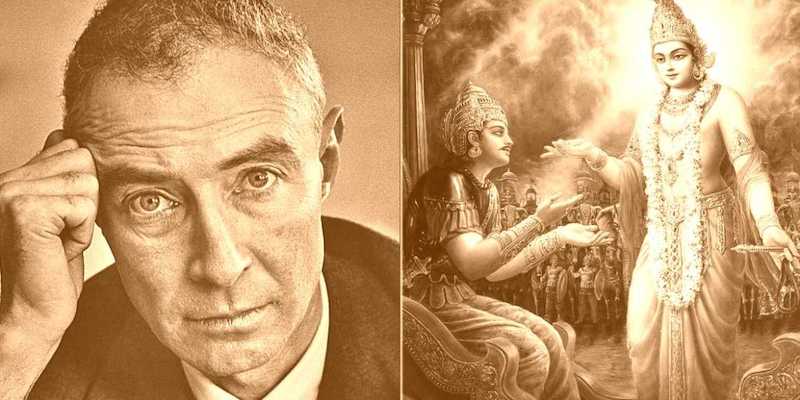
“A few people laughed, a few people cried, most people were silent,” Oppenheimer goes on. Then this quote, seemingly out of nowhere: “I remembered the line from the Hindu scripture, the Bhagavad Gita. Vishnu is trying to persuade the Prince that he should do his duty and to impress him takes on his multi-armed form and says, ‘Now, I am become Death, the destroyer of worlds.’”

The weight of those last words hangs in the air during the slightest of pauses. Then this: “I suppose we all thought that, one way or another.” The silence at the end of the clip is filled in by the observer’s foreknowledge of what happened a few weeks after the events being recounted, of the vast crematoriums created by the Little Boy and the Fat Man, cities teeming with life incinerated in a matter of seconds.

The teachings of Krishna reach a crescendo in the eleventh chapter of the Gita. In the preceding verses, Krishna has elevated Arjuna’s awareness of his purpose in life while revealing his own divinity. Now, Arjuna asks to see Krishna in his real form. The sublime language of the Gita ascends to an even higher plane, producing some of the most beautiful passages ever written in Sanskrit. Arjuna sees initially the splendor of Krishna’s supreme spirit as a divine light, as if a thousand suns were to rise in the heavens at the same time; then, within Krishna’s body Arjuna sees all the manifold forms of the universe / united as one (11.13).Once the war was over, Oppenheimer was no longer a warrior. He was a citizen of this planet. His dharma, he recognized, had changed.

Arjuna is initially awestruck, hair on end, in ecstasy. This initial response, however, transforms almost immediately into terror as he sees also the Lord’s destructive aspect: I see our warriors and all the kings… are passing into your fiery jaws; all creatures / rush to their destruction like moths into a flame… Filled with your terrible radiance / O Vishnu, the whole of creation bursts into flames. (11.26-30). Begging for mercy, he asks this “terrible” form, “Who are you?”

It is in response to this question that Krishna replies with the “I am become Death” quote. As we understand Oppenheimer’s deep absorption in the Gita, we see that with these words he was attempting to convey not hubris but rather the paradoxical sense of both awe and terror that he felt upon witnessing the Trinity test explosion.[1] Many human philosophies hide from the destructive aspect of Nature or God, but non-dualism has to acknowledge that creation and destruction alike are inseparable from the One.

As Indian philosopher Sri Aurobindo has articulated in his Essays on the Gita, “Nature devouring her children, Time eating up the lives of creatures, Death universal and ineluctable…are also the supreme Godhead in one of his cosmic figures.” Indeed, Krishna’s words immediately following “the destroyer of all” verse make this clear: …Even without your participation/all the warriors gathered here will die…I have already slain / all these warriors; you will only be my instrument (11.32-33).

Did Oppenheimer find solace in this aspect of the Gita’s teachings? In public, he remained steadfast. “I never regretted, and do not regret now, having done my part of the job,” he told the Times. In private, however, he is known to have infuriated President Truman by declaring that “I have blood on my hands.” (Truman called him a “cry-baby scientist.”) The rightness and wrongness of the government’s terrible decision has been debated endlessly and to my thinking is not, even today, fully measurable.

We are not even a century removed from the invention of the atomic bomb. We know neither what horrors may have been prevented because of its creation nor what horrors may yet occur. Similarly, it is not for us to judge whether someone else discharged their dharma well or poorly; following our own dharma is work enough. Nor is it possible to calculate the tragedy of each life lost in Hiroshima and Nagasaki, to weigh the pain of each one of those families and balk at the more recognized distress that Oppenheimer’s story elicits.

Yet, I think, one can also feel sympathy for the burden placed upon this singular scientist, a weight no lone human can or should carry. In the years that followed, Oppenheimer reverted to his pacifist nature, fighting to contain the very same forces of Death he had worked so hard to release, taking in stride persecution by the same government that had once valorized him. Some may view Oppenheimer’s continued lack of regret over his original decision as being in contradiction to his opposition to nuclear proliferation.

From a dharmic viewpoint, however, I can consider an alternate perspective. Once the war was over, Oppenheimer was no longer a warrior. He was a citizen of this planet. His dharma, he recognized, had changed. He would continue to follow it.

*

[1] The word translated by Oppenheimer as death is kaala, which does refer to Death but obliquely, through Time. Easwaran’s more accurate rendering has it as: I am time, the destroyer of all / I have come to consume the world (11.32). In the context of an atomic bomb explosion, I think it is safe to venture that Oppenheimer’s translation has the greater resonance.

Alok A. KhoranaBhagavad GitaDharmaEknath EaswaranJ. Robert OppenheimerJames HijiyaMahābhārataManhattan ProjectSri AurobindoT. S. EliotThe Waste LandWorld War II


Alok A. Khorana
Alok A. Khorana

Alok A. Khorana is a writer-physician in Cleveland, Ohio originally from Vadodara, India. His creative fiction and non-fiction work has been featured in Bellevue Literary Review, JAMA, Narrative Matters and The Bombay Review and included in Best American Medical Writing. He is currently working on a biographical memoir and a linked short story collection.