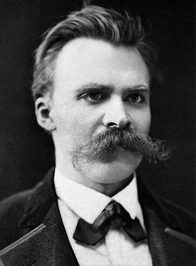
Friedrich Wilhelm Nietzsche (October 15, 1844 – August 25, 1900) was a German philosopher. He began his career as a classical philologist before turning to philosophy. Wikipedia
You must have heard that “Knowledge is power” right? Almost all of us think intelligence is a sign of strength, right? Most of us think that intelligence helps us in our survival, right; But up to what extent?
Then why most of the species in the world are still surviving even if they lack basic intelligence? Human beings can trap any species including lions or any big fish with their intelligence. But still, we have found that intelligence is very rare among most of species.
You may have heard about the fact that intelligent people work all day just for their survival and livelihood but there are many people who are less intelligent and do less work but make more money than intelligent people and these people are in the most powerful positions in our country including politics and topmost business positions.
You must have noticed that less intelligent people make more money in the stock market and live a more lavish lifestyle. Less intelligent people spend extravagantly and live a less stressful life than intelligent people.
As per my experience, wherever I have seen a highly intelligent man, I have seen a man with inborn frustration. A man who is ready to argue on any topic. A man who just wants to win the argument but does not appreciate the differences.
I can surely say that joyfulness and intelligence work against each other. The more intelligent you are, there is more chance that your body must be producing more cortisol (stress-producing Harmon) as compared to normal human beings.
These people take lots of stress about everything whatever is happening in the world. That is why they are more prone to lose their calm. I am not saying all people who are intelligent are not joyful people.
But I have found that people who are very intelligent live in their own subjective world. They have their limitations of topics and beyond those topics they do not want to hear and talk.
For example, when I was at IIT, I used to hear people just talking about conferences, exams, grades, and assignments all the time. I can understand that those things are important but there are many things and topics like philosophy and psychology where people do not want to talk but are of equal value.
People are stuck in their hyperspecialization field and only want to talk with people who have at least a little knowledge about those fields. The worst part is that most people think that their own profession is better than someone else.
For example; artists think that their work is more valuable, businessmen think that their work is more valuable and difficult, and writers, doctors, and engineers think with the same logic.
What I have understood is that “Thinking kills actions”. Most of the people who are very intelligent are less action taker, they takes very less and calculated risk, whereas people who have less knowledge are ready to do new things. They are ready to burn themself in the quest for new horizons. They are the one who really creates history.
People who are very intelligent always face the problem that their creative work has been stolen, these are the people who usually assuced other people to use their ideas and formulas. These are the people who file intellectual property rights claims on their business partners.
I am convinced that the more intelligent you are the more struggle you will face in making great connections with other people. The more intelligent you are, it is for sure more you are going to mess up with your relationships and sexual life.
Even Albert Einstein has been accused of not giving proper time to her wife and she was about to file divorce against him.
There is a problem with more intelligent people, they suffer a lot for no reason, and they are more prone to depression and other mental problems. They sleep less.
They sleep with sleeping pills and most of them use so many health supplements just to survive their normal day. They complain and criticize everything about this word. You can easily see them complaining about the system and life itself.
These people are the ones if you meet with them they are more likely to observe negative traits in you instead of talking about your positive traits. Most of the females must have observed this while dating so-called hyper-intellectuals.
These people are just looking for problems in the world because they claim themselves problem solvers. Therefore their brain is nurtured in a way to only see defects in the world.
But they have to understand that the world is more beautiful when things are not perfect. Perfection kills the real beauty.
For example, when we visit a forest or nature we feel more joyful as compared to when we visit a perfectly designed building or skyscraper.
An AI can write better and perfect articles but still, we prefer to read articles written by humans because in AI articles that imperfection is missing. That magic is missing that gives us the feeling of connection.
Now comes the main point of the story.
Our obsession with intelligence reveals our inner weakness. People who are less intelligent actually value more intelligent men. People who are cowardly enjoy action movies.
There is something that Sigmund Freud called death drives inside each of us. But due to societical constraints, we cannot enjoy this dead drive therefore we start loving people who love to fight because we are too weak to fight and therefore we enjoy someone else fighting and winning. For example, children love to play shooting and Death Valley games.
People who live boring lives enjoy comedy shows. In India, I have seen many people who work in great companies and are so-called very intelligent people who love to go to comedy shows on the weekend and they tend to laugh at even every stupid joke that reflects to me how lonely and boring their life is. That they need someone else to do lots of hard work and perform at comedy shows to make them laugh.
In India, parents who are less educated are obsessed with education and want to see their children studying in very prestige colleges because in their hearts they have this notion that they want their children to take such education that they were not able to take in their childhood days.
People who are poor are more desperate for money as compared to people who are rich. Still, both need money.
Friedrich Nietzsche saw this pursuit of knowledge, and intelligence as arising from a lack of courage to deal with reality.
Rather than appreciating and enjoying life, “highly intelligent people” trap themself in their own subjectivity and withdraw into abstraction, reason, and logic, avoiding too many risks and vulnerabilities.
Intelligent people just want to fight with everyone on a talking basis but they do not have any courage even to give any bold statement in front of powerful people.
These people are like those Instagram, Reddit, and Twitter Trollers or Army who just want to do only Talk! Talk! Talk! and no action in real life against any authority.
High intelligence acts as a buffer against the rawness of real actions and lived authentic and joyful experiences.
We see these archetypes of highly educated people endlessly gathering knowledge and studying about the world at a distance rather than directly participating in life.
These are the people who love to read books and watch movies on love stories and relationships and start thinking of themselves as relationship advisors but when the real love arrives in their own life, they mess up with it.
Society has the tendency to glorify the life of highly intellectual people while looking down on those who live a more primal and instinctual existence.
In Nietzsche’s view, the celebration and pursuit of intelligence is a sign of weakness and disguises a fear of life itself.
Those who pride themselves and label themself “highly intelligent” are wrapped up in concepts, logic, theories, logic, and mental construction.
There is a reason that highly intelligent people know everything about “How to reduce body fat” and “What diet is bad for them” but are still unable to reduce belly fat. They just go on Google and gather all the information about reducing visceral fat but when it comes to applying that knowledge into action they mess up.
This is why I said, “Knowledge kills action”.
While intelligence seeks calculated risks, safety, and predictability, true strength comes from embracing life’s contradictions and uncertainties. It means having the courage to trust one’s gut instinct and act spontaneously without always needing confirmation from a rational mind and reasoning justification.
This does not completely mean that we should reject our thoughts and knowledge and stop acquiring knowledge altogether. Nietzsche was not anti-intellectual but he was against the way we gather knowledge in our educational institutions and real life.
He did warn us against allowing our abstract ideas, logic, reasoning, and theories to dominate our direct life experience. The truth is found not just in books, Google, blogs, and facts, but in the wisdom of the body, its passions and directly engaging with life and people.
At worst, a fixation totally dependent on knowledge and intelligence can become a tool for the weak to criticize and complain to the strong. Those who feel powerless can compensate by claiming intellectual superiority over those who are actually in power and those they resent the most.
What you can see is a bullied intelligent but weak man who prides himself on being smarter than his athletic tormentors.
Nietzsche’s philosophy reminds us that true strength lies not in how much we know, but in our capacity to overcome resistance, capacity for awe, vulnerability, and commitment in the face of life’s mysteries. To taste the full human experience, we cannot remain protected behind a wall of logic, idea, reason, and technical analysis.
By acknowledging the limits of logic and rationality, we should open ourselves to forms of understanding beyond IQ. This could unleash a power, creativity, and new horizons that our cultural worship of intelligence rarely reaches and teaches.
The comfort of being intelligent and smart must be left behind for the exhilarating terror of being fully alive and joyful.
The solution may be a balance- valuing the authentic, imperfect, and raw experience but also engaging in contemplation when required to integrate with life. With creativity, art, joyfulness, authenticity, and courage, we can integrate heart and mind to fully experience and thrive.
Friedrich Nietzsche was a German philosopher who is renowned for his revolutionary ideas on morality, religion, and culture. Nietzsche was a major influence in the development of existentialism, post-structuralism, and deconstruction.
He rejected the traditional values of morality and religion, which he believed to be oppressive, and instead advocated for self-assertion and individualism.
Nietzsche believed in a will to power and the idea of the übermensch, or “superman,” who would go beyond the limits of traditional morality and create their own values. Nietzsche’s philosophy was also highly critical of modernity, which he believed to be too reliant on rationalism and science.
He proposed a return to an organic and spiritual existence, which would allow humans to embrace their own unique passions and values. Nietzsche’s philosophies have had a lasting impact on philosophical and cultural thought, and his ideas remain widely influential today.
The History and Context of Nietzsche’s Last Man
Friedrich Nietzsche’s concept of the “Last Man” has been the subject of much scholarly inquiry since the philosopher first introduced it in his work, Thus Spoke Zarathustra. The Last Man is a figure Nietzsche presents as the antithesis of “Superman”, a being capable of divine creativity and self-overcoming.
“Alas, the time of the most despicable man is coming, he that is no longer able to despise himself.
Behold, I show you the last man. ‘What is love? What is creation? What is longing? What is a star?’ — thus asks the last man, and he blinks.
The earth has become smaller, and on it hops the man who makes everything small…’We have invented happiness’ — say the last men, and they blink.”
Nietzsche saw the Last Man as the end result of a society that had become enslaved to comfort and complacency, a “slave morality” that was in direct opposition to the “master morality” of Superman.
The Last Man is an apathetic, amoral creature who lives a life of comfort and ease, without any real pursuit of purpose or striving for greatness.
Nietzsche saw the Last Man as a warning of what would come if society continued to abandon its traditional values and embrace nihilism and materialism.
Nietzsche’s concept of the Last Man has been used to explain the history of Western civilization and has been a source of inspiration for those seeking to break out of the mundane routines of everyday life.
What Does Nietzsche Mean by ‘The Last Man’?
Friedrich Nietzsche’s concept of the Last Man has long been a source of fascination and inquiry. In his work, Thus Spoke Zarathustra, Nietzsche presents the Last Man as the antithesis of Superman, a being capable of rising above the mediocrity of modern society and living life to its fullest potential.
“The opposite of the overman [Übermensch] is the last man: I created him at the same time with that. Everything superhuman appears to man as illness and madness. You have to be a sea to absorb a dirty stream without getting dirty.”
— Nietzsche— Fragments November 1882 — February 1883
The Last Man is an apathetic, amoral creature who lives a life of comfort and ease, without any real pursuit of purpose or striving for greatness.
The Last Man is a warning of what will come if society continues to abandon its traditional values and embrace nihilism and materialism.
“For this is how things are: the diminution and leveling of European man constitutes our greatest danger, for the sight of him makes us weary. — We can see nothing today that wants to grow greater, we suspect that things will continue to go down, down, to become thinner, more good-natured, more prudent, more comfortable, more mediocre, more indifferent, more Chinese, more Christian — there is no doubt that man is getting ‘better’ all the time.”
— Friedrich Nietzsche, On the Genealogy of Morals
The concept of the Last Man has been used to explain the history of Western civilization and has been a source of inspiration for those seeking to break out of the mundane routines of everyday life.
To quote Nietzsche, “Man is something that shall be overcome. Man is a rope, tied between beast and overman — a rope over an abyss.” By this, Nietzsche meant that man must strive to become something greater than himself and overcome his own mediocrity. Only by doing so can he hope to avoid the fate of the Last Man.
The Characteristics of the Last Man
Friedrich Nietzsche’s concept of the Last Man is not merely a warning of what will come if society continues to embrace materialism and nihilism, but also a critique of the values and attitudes of modern society.
According to Nietzsche, the Last Man is apathetic, complacent, and lacking in creativity and ambition. He is driven only by the pursuit of pleasure, comfort, and security, rather than a pursuit of excellence, greatness, and moral virtue.
“Everything around them decays and produces decay, that nothing will endure until the day after tomorrow, except one species of man, the incurably MEDIOCRE. The mediocre alone have a prospect of continuing and propagating themselves — they will be the men of the future, the sole survivors.”
— Friedrich Nietzsche, Beyond Good and Evil : 262
The Last Man is a symbol of an entire culture which has become enslaved to mediocrity, comfort and complacency. He is an individual who has abandoned any sense of purpose or striving and instead seeks nothing more than the attainment of the most basic of pleasures and comforts.
He is a person who is unwilling to challenge himself or to take risks, and who does not have any desire to contribute anything of value to society.
The Last Man is a result of a society that has become obsessed with materialism and consumerism, and which has abandoned any sense of morality or spiritual values.
He is an individual who has given up on striving for greatness and instead seeks only the attainment of the most basic of pleasures and comforts. He has become enslaved to a life of comfort and ease and has abandoned any sense of higher purpose or moral virtue.
The Last Man is a symbol of a culture that has given up on striving for greatness and instead seeks only the attainment of the most basic of pleasures and comforts.
It is a warning of what will come if society continues to embrace materialism and nihilism and if individuals continue to ignore their responsibility to create their own values and strive for something greater than themselves.
Implications of the Last Man in Modern Times
The implications of the Last Man in modern times are far-reaching and often unsettling. Nietzsche’s concept of the Last Man serves as a warning of what will come if society continues to abandon its traditional values and embrace nihilism and materialism.
In the modern world, this warning is particularly relevant as our society increasingly values convenience and comfort over striving for excellence and moral virtue.
“The sick are the greatest danger for the healthy; it is not from the strongest that harm comes to the strong, but from the weakest.” ― Friedrich Nietzsche, On the Genealogy of Morals
The Last Man is a symbol of an entire culture that has become enslaved to mediocrity and complacency. The modern world is increasingly becoming obsessed with materialism, consumerism, and the pursuit of pleasure and comfort.
This has led to a society where individuals are no longer driven by a desire to create something meaningful or to strive for greatness, but instead are content to just exist and take the path of least resistance.
Nietzsche’s concept of the Last Man also speaks to the dangers of a society that has become increasingly focused on technology and efficiency. This focus on efficiency has led to a world where the individual is often seen as nothing more than a cog in a machine, and where human interaction is replaced by automation and convenience.
This has led to a culture where humans have become increasingly disconnected from each other and from nature, leading to a society where human relationships are often superficial and lack any real depth or meaning.
Ultimately, Nietzsche’s concept of the Last Man serves as a warning of what will come if society continues to abandon its traditional values and embrace nihilism and materialism.
Nietzsche’s Solution to Overcoming the “Last Man”
Nietzsche’s solution to overcoming the Last Man starts with developing an individual morality and striving for greatness. Individuals should strive to create their own values and pursue meaningful goals, rather than merely settling for the status quo.
These values should be based on a personal code of ethics and should focus on striving for excellence and virtue, rather than merely seeking pleasure and comfort.
“Dreams. ― We have no dreams at all or interesting ones. We should learn to be awake the same way ― not at all or in an interesting manner.” ― Friedrich Nietzsche, On the Genealogy of Morals
Nietzsche also believed that individuals should strive for creativity. This could involve pursuing a passion or hobby, taking up a new skill or craft, or striving to make a positive impact on the world.
Nietzsche also believed in the importance of human connection and relationships. Humans need meaningful relationships in order to find purpose and meaning in life.
“But a spirit who is sure of himself speaks softly; he seeks secrecy, he lets himself be awaited.” ― Friedrich Nietzsche, On the Genealogy of Morals
This means seeking out meaningful relationships with friends, family, and even strangers, and engaging in activities that bring people together.
By surrounding ourselves with people who share our values and beliefs, we can create a sense of community and mutual support.
Final Reflection on Nietzsche’s Warning
Nietzsche’s warning of the Last Man serves as an important reminder of the dangers of complacency and nihilism. His concept of the Last Man serves as a stark reminder of what could become of our society if we continue to embrace a culture of superficiality and materialism.
The Last Man is a symbol of what happens when a society forsakes its traditional values and instead embraces convenience and comfort. It is a cautionary tale of what can happen if we do not strive for greatness and moral virtue.
Nietzsche’s concept of the Last Man is a warning to us all that we must take responsibility for our own lives and strive to create our own values.
We must also strive to make a positive impact on the world and push back against the forces of materialism and convenience.
Ultimately, Nietzsche’s concept of the Last Man serves as a warning to us all to strive for greatness, create meaningful lives and relationships, and pursue our own individual morality. Only by doing so can we hope to create a better world and avoid the fate of the Last Man.
“The world is deep, And deeper than day can comprehend. Deep is its woe, Joy—deeper than heart’s agony: Woe says: Fade! Go! But all joy wants eternity, Wants deep, wants deep eternity.”
–Friedrich Nietzsche
Friedrich Wilhelm Nietzsche (October 15, 1844 – August 25, 1900) was a German philosopher, prose poet, cultural critic, philologist, and composer whose work has exerted a profound influence on contemporary philosophy. He began his career as a classical philologist before turning to philosophy. Wikipedia
Gabor Maté (born 1944) is a Hungarian-Canadian physician and author. He has a background in family practice and a special interest in childhood development, trauma and potential lifelong impacts on physical and … Wikipedia
Consciousness, sexuality, androgyny, futurism, space, the arts, science, astrology, democracy, humor, books, movies and more