Tag Archives: Maslow

Could the Blackfoot Wisdom that Inspired Maslow Guide Us Now?

By Teju Ravilochan (contributing editors: Vidya Ravilochan and Colette Kessler)

GatherFor

GatherFor

Apr 4, 2021 (gatherfor.medium.com)

Siksika (“Blackfoot”) tipis. Photo from Siksika Nation.

Author’s Note: This is a complete revision of the post originally titled “Maslow Got It Wrong.” My earlier version included inaccuracies, as some readers pointed out, like the assumption Maslow depicted his theory in a pyramid shape. I have documented and attempted to correct these errors in this companion post called What I Got Wrong: Revisions to My Post About Maslow and the Blackfoot. I’ve updated the post you’ll read below, so it is more focused on what we can learn from the Blackfoot and from other Native cultures. I have retitled this post to reflect this emphasis more clearly.

Some months ago, I was telling my friend and GatherFor Board Member Roberto Carlos Rivera that I had come across unpublished papers by Abraham Maslow suggesting changes to his famous Hierarchy of Needs. Roberto, Executive Director of Alliance for the 7th Generation, was familiar with the subject and turned me on to something else I didn’t know: Maslow’s Hierarchy of Needs may have been inspired by the Siksika (Blackfoot) way of life. In reading follow-up materials he sent me, I learned Maslow spent six weeks living at Siksika — which is the name of the people, their language, and the Blackfoot Reserve — in the summer of 1938. His time there upended some of his early hypotheses and possibly shaped his theories. While I initially came to believe Maslow appropriated and misrepresented the teachings of the Blackfoot, I have learned that this narrative, while held by some, may not be accurate even according to Blackfoot scholars. Yet what has been far more valuable for me in this inquiry was learning what Maslow witnessed at Siksika. Whereas mainstream American narratives focus on the individual, the Blackfoot way of life offers an alternative resulting in a community that leaves no one behind.
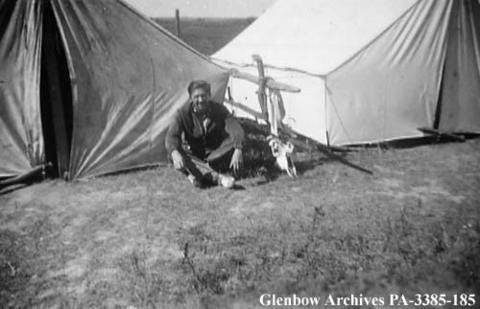
Abraham Maslow at Siksika in 1938. Photo by Jane and Lucien Hanks.

Research Methodology

Ryan Heavy Head (also known as Ryan FirstDiver) and the late Narcisse Blood, members of the Blackfoot Nation, received a grant from the Canadian Government’s Social Sciences and Humanities Research Council to research Blackfoot influences on Maslow. Their lectures summarize their findings and are stored in the Blackfoot Digital LibraryDr. Cindy Blackstock — a member of the Gitxsan First Nation tribe, a professor at McGill, and Executive Director of the First Nations Child and Family Caring Society — has conducted similar research. My primary investigation into this topic involved watching Blood and Heavy Head’s lectures; reading the works of and corresponding with Cindy Blackstock; speaking to and reviewing the writings and podcasts of the world’s foremost Maslow expert, Dr. Scott Barry Kaufman; speaking to Ryan Heavy Head on the phone; and consulting the sources cited at the end of this article.

What Maslow Encountered at Siksika

According to Blood and Heavy Head’s lectures (2007), 30-year-old Maslow arrived at Siksika along with Lucien Hanks and Jane Richardson Hanks. He intended to test the universality of his theory that social hierarchies are maintained by dominance of some people over others. However, he did not see the quest for dominance in Blackfoot society. Instead, he discovered astounding levels of cooperation, minimal inequality, restorative justice, full bellies, and high levels of life satisfaction. He estimated that “80–90% of the Blackfoot tribe had a quality of self-esteem that was only found in 5–10% of his own population” (video 7 out of 15, minutes 13:45–14:15). As Ryan Heavy Head shared with me on the phone, “Maslow saw a place where what he would later call self-actualization was the norm.” This observation, Heavy Head continued, “totally changed his trajectory.” (For the reader wondering what self-actualization is, Maslow offered this definition, influenced by Kurt Goldstein, in his 1943 paper: “This tendency might be phrased as the desire to become more and more what one is, to become everything that one is capable of becoming.” The word itself does not exist in the Siksika language, but the closest word is niita’pitapi, which Ryan Heavy Head told me means “someone who is completely developed, or who has arrived.”)

Deeply curious about the reason for the stark difference between Blackfoot culture and his own culture, Maslow sought out positive deviants, or unusually successful individuals. He started with the wealthiest members of the Blackfoot tribe. He discovered that “for the Blackfoot, wealth was not measured by money and property but by generosity. The wealthiest man in their eyes is one who has almost nothing because he has given it all away” (Coon, 2006). Maslow witnessed a Blackfoot “Giveaway” ceremony in his first week at SiksikaDuring the Giveaway, members of the tribe arranged their tipis in a circle and publicly piled up all they had collected over the last year. Those with the most possessions told stories of how they amassed them and then gave every last one away to those in greater need (Blood & Heavy Head, 2007, video 7 out of 15, minutes 13:00–14:00). By contrast, as shared by Maslow’s biographer Edward Hoffman, Maslow observed different qualities in members of his own culture:

To most Blackfoot members, wealth was not important in terms of accumulating property and possessions: giving it away was what brought one the true status of prestige and security in the tribe. At the same time, Maslow was shocked by the meanness and racism of the European-Americans who lived nearby. As he wrote, “The more I got to know the whites in the village, who were the worst bunch of creeps and bastards I’d ever run across in my life, the more it got paradoxical.”

Maslow continued his investigation by looking into negative deviants. He was curious how the Blackfoot might deal with lawbreakers without the strategy of dominance that he’d seen in his own culture. He found that “when someone was deviant, [the Siksika] didn’t peg them as deviant. A person who was deviant could redeem themselves in society’s eyes if they left that behavior behind” (Blood & Heavy Head, 2007, video 7 out of 15, minutes 15:44–16:08).

Maslow then wondered whether the answer to producing high self-actualization might lie in child-rearing. He found that children were raised with great permissiveness and treated as equal members of Siksika society, in contrast to a strict, disciplinary approach found in his own culture. Despite having great freedom, Siksika children listened to their elders and served the community from a young age (ibid, minutes 16:35–17:07).

According to Heavy Head, witnessing the qualities of self-actualization among the Blackfoot and diving into their practices led Maslow to deeper research into the journey to self-actualization, and the eventual publishing of his famous Hierarchy of Needs concept in his 1943 paper.

Differences Between Maslow’s Theories and Blackfoot Beliefs

Ryan Heavy Head shared with me that, while there are strong belief systems and long standing traditions in place, the Blackfoot don’t have a “model” for their worldview, neatly codified in a paper like Maslow’s. But to help explain the different emphases of the Western worldview and the views of First Nations, Dr. Cindy Blackstock, herself a member of the Gitxsan tribe who interviewed members of the Blackfoot Nation, created the illustration below (Michel, 2014):
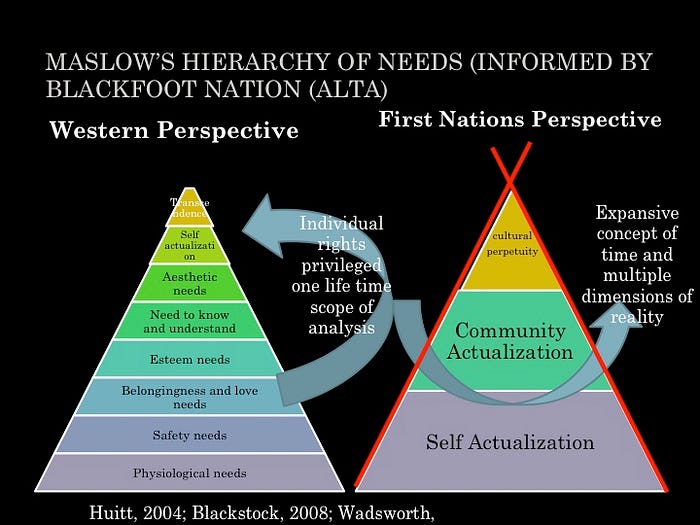
Because Maslow never himself depicted his hierarchy as a pyramid (Kaufman, 2019) and the Blackfoot did not draw their worldview on a tipi (Heavy Head, personal conversation, 2021), this diagram should not be read as an exact comparison or as capturing the nuances of both lenses. However, I have included it here to help those of us mired in Western thinking see the different emphasis of First Nations perspectives.

Blackstock makes clear that there is great diversity among First Nations, but the above diagram captures some of the similarities she’s found in her study of them, including the Blackfoot. I summarize my understanding of her diagram below.

Self-Actualization

Maslow appeared to ask, “how do we become self-actualized?”. Many First Nation communities, though they would not have used the same word, might be more likely to believe that we arrive on the planet self-actualized. Ryan Heavy Head explained the difference through the analogy of earning a college degree. In Western culture, you earn a degree after paying tuition, attending classes, and proving sufficient mastery of your area of study. In Blackfoot culture, “it’s like you’re credentialed at the start. You’re treated with dignity for that reason, but you spend your life living up to that.” While Maslow saw self-actualization as something to earn, the Blackfoot see it as innate. Relating to people as inherently wise involves trusting them and granting them space to express who they are (as perhaps manifested by the permissiveness with which the Siksika raise their children) rather than making them the best they can be. For many First Nations, therefore, self-actualization is not achieved; it is drawn out of an inherently sacred being who is imbued with a spark of divinity. Education, prayer, rituals, ceremonies, individual experiences, and vision quests can help invite the expression of this sacred self into the world. (As some readers have commented, this concept appears in other belief systems, such as Paulo Freire’s challenge to the “banking concept of education” and the Buddhist notion that all beings contain Buddha-nature.)

Community Actualization

As Maslow witnessed in the Blackfoot Giveaway, many First Nation cultures see the work of meeting basic needs, ensuring safety, and creating the conditions for the expression of purpose as a community responsibility, not an individual one. Blackstock refers to this as “Community Actualization.” Edgar Villanueva (2018) offers a beautiful example of how deeply ingrained this way of thinking is among First Nations in his book Decolonizing WealthHe quotes Dana Arviso, Executive Director of the Potlatch Fund and member of the Navajo tribe, who recalls a time she asked Native communities in the Cheyenne River territory about poverty:

“They told me they don’t have a word for poverty,” she said. “The closest thing that they had as an explanation for poverty was ‘to be without family.’” Which is basically unheard of. “They were saying it was a foreign concept to them that someone could be just so isolated and so without any sort of a safety net or a family or a sense of kinship that they would be suffering from poverty.” (p. 151)

Ryan Heavy Head explains that such communal cooperation is especially important for the Blackfoot because of their relationship to place, something Maslow entirely omitted in his theories:

the one thing that [Maslow] really missed was the Indigenous relationship to place. Without that, what he’s looking at as self-actualization doesn’t actually happen. There’s a reason people aren’t critical of their tribe: you’ve got to live with them forever.

In other words, having your life bound up with those around you for its whole duration can support creating a culture of generosity, trust, and cooperation, rather than one of inequality and individualism. Being in conflict with permanent neighbors, while also living in such a communal culture, can prove costly and stressful. Learning to cooperate, forgiving wrongdoing, and pursuing the sharing of resources and wisdom make life much more tolerable in these conditions.

Cultural Perpetuity

The skillfulness to nourish a community-wide family, keep each person fed, live in harmony with the land, and minimize internal and external conflicts is handed down from generation to generation in First Nations. Because knowledge can vanish as people pass on, each generation sees it as their responsibility to perpetuate their culture by adding to the tribe’s communal wisdom and passing on ancestral teachings to children and grandchildren. As Cindy Blackstock (2019) explains:

First Nations often consider their actions in terms of the impacts of the “seven generations.” This means that one’s actions are informed by the experience of the past seven generations and by considering the consequences for the seven generations to follow.

Many First Nations have developed both formal rituals and informal apprenticeships for the transfers of wisdom from elders to youngsters to ensure the community is able to support self-actualization and community-actualization in perpetuity.

As Blackfoot scholar Billy Wadsworth (of the Blood, or Kanai Tribe) summarizes in dialogue with Cindy Blackstock (2011), Maslow did not “fully situate the individual within the context of community.” If he had done so, and also more deeply integrated the Blackfoot perspective, “the model would be centered on multi-generational community actualization versus on individual actualization and transcendence.”

Maslow himself may have agreed with this critique. Scott Barry Kaufman (2020) shares an excerpt from an unpublished Maslow essay from 1966, 23 years after he published his paper on the Hierarchy of Needs, called “Critique of Self-Actualization Theory”,

self-actualization is not enough. Personal salvation and what is good for the person alone cannot be really understood in isolation. The good of other people must be invoked as well as the good for oneself. It is quite clear that purely inter-psychic individualist psychology without reference to other people and social conditions is not adequate.

What else emerges when we see the individual as deeply situated in community?

Circles, Not Triangles

The triangular models above suggest that there’s a place to start meeting our needs and a place we end up. But is it true that our needs follow Maslow’s hierarchy of “prepotency”, where some needs consistently take priority over others? Maslow (1943) himself indicates there are many exceptions to his hierarchy and Blackstock (2011) agrees, citing Seneca First Nation member and psychologist Terry Cross:

Cross (2007) argues that human needs are not uniformly hierarchical but rather highly interdependent […] [P]hysical needs are not always primary in nature as Maslow argues, given the many examples of people who forgo physical safety and well-being in order to achieve love, belonging, and relationships or to achieve spiritual or pedagogical objectives. The idea of dying for country is an example of this as men and women fight in times of war.

Blackstock represents Cross’ ideas in the circular model below:
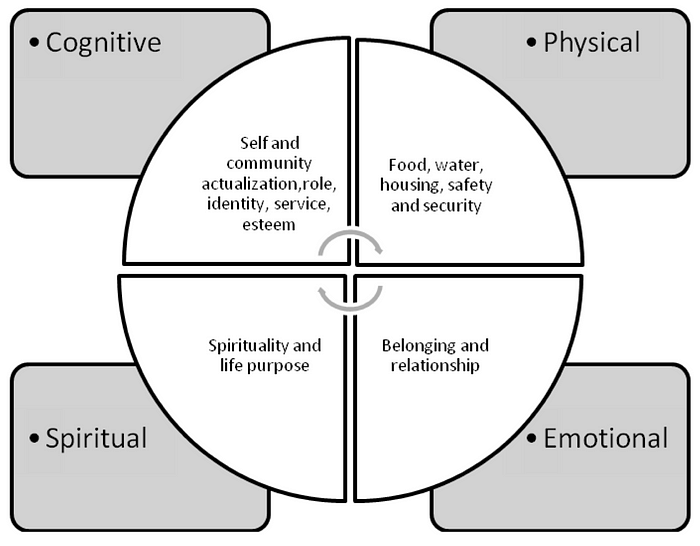
This circular model reveals thinking in line with many First Nations: depending on the situation, the order in which our needs must be met is subject to change. A circular model captures the inter-relatedness of our needs and helps highlight that we can experience needs simultaneously and in changing order. This way of viewing needs makes more sense when seeing an individual as deeply rooted in a community, especially because a community is capable of meeting multiple needs in parallel. While one individual is cooking, another may be keeping children safe, while another may be negotiating peace with people from other tribes.

When we organize a society as though each individual is primarily responsible for meeting their own needs, we may see results like Maslow predicted in his 1943 paper:

In actual fact, most members of our society who are normal, are partially satisfied in all their basic needs and partially unsatisfied in all their basic needs at the same time. A more realistic description of the hierarchy would be in terms of decreasing percentages of satisfaction as we go up the hierarchy of prepotency, For instance, if I may assign arbitrary figures for the sake of illustration, it is as if the average citizen is satisfied perhaps 85 per cent in his physiological needs, 70 per cent in his safety needs, 50 per cent in his love needs, 40 per cent in his self-esteem needs, and 10 per cent in his self-actualization needs.

In this hierarchical view and the subsequent execution of it in society, it’s rare to see individuals who have met their needs. Here’s Maslow again:

We shall call people who are satisfied in these needs, basically satisfied people […] Since, in our society, basically satisfied people are the exception, we do not know much about self-actualization, either experimentally or clinically.

But Maslow seemed to discover that basically satisfied people were the norm at Siksika, where community was primarily responsible for meeting the needs of its members.

Why Haven’t We Heard About The Blackfoot Worldview Before?

Though Maslow saw full bellies, low-inequality, and rates of self-actualization at 80–90%, why didn’t he alert the world to all we could be learning from the Blackfoot? He clearly held them in high regard, as he indicated in journals and in his biography.

It’s possible that Maslow may have faced dismissal if he had publicized Blackfoot teachings. Dr. Richard Katz, author of Indigenous Healing Psychology: Honoring the Wisdom of First Peoples, Harvard professor, and personal friend of Maslow’s speaks to this point in a podcast conversation with Scott Barry Kaufman (minutes 28:50–32:20). He says he never spoke directly with Maslow about this, but postulates that Maslow may have been concerned that elevating Siksika teachings might diminish the validity of the ideas he was putting forth. Such barriers to Indigenous contributions have remained in academia until today (Blackstock, 2019).

Despite the fallibility of our mainstream institutions, publicly challenging prevailing worldviews is risky business. Galileo’s elevation and defense of the Copernican heliocentric solar system, for example, led to his being labeled a heretic by the Catholic Church and placed under permanent house arrest.

By offering compelling alternatives, Indigenous worldviews pose a threat to our status quo. Lakota Medicine Man John Fire Lame Deer offers one poignant contrast between the world he grew up in and the world of “the white man”:

Before our white brothers came to civilize us we had no jails. Therefore we had no criminals. You can’t have criminals without a jail. We had no locks or keys, and so we had no thieves. If a man was so poor that he had no horse, tipi or blanket, someone gave him these things. We were too uncivilized to set much value on personal belongings. We wanted to have things only in order to give them away. We had no money, and therefore a man’s worth couldn’t be measured by it. We had no written law, no attorneys or politicians, therefore we couldn’t cheat. We really were in a bad way before the white men came, and I don’t know how we managed to get along without these basic things which, we are told, are absolutely necessary to make a civilized society. (Lame Deer: Seeker of Visions, p. 70)

Consider Lame Deer’s description and what Maslow witnessed at Siksika. Then consider the repetition of the idea that “the United States of America is the greatest country in the world” despite the facts that one in four US households experience food insecurity4 in 10 Americans can’t afford a $400 emergencythe richest 0.1 percent make 196x as much as the bottom 90 percent, and with 40 million in poverty, the US may be the most unequal nation in the Western world.

Precisely for whom is the United States the greatest country in the world?

The wealthiest Americans, unlike the Blackfoot during the Giveaway Ceremony — devote the smallest portion of their income to supporting those in need. As Ken Stern writes in The Atlantic:

In 2011, the wealthiest Americans — those with earnings in the top 20 percent — contributed on average 1.3 percent of their income to charity. By comparison, Americans at the base of the income pyramid — those in the bottom 20 percent — donated 3.2 percent of their income. […] Some experts have speculated that the wealthy may be less generous [than other classes] — that the personal drive to accumulate wealth may be inconsistent with the idea of communal support.

Since its inception, mainstream US culture has consistently failed to meet the basic needs of so many of its people. Who wins when, despite this shortcoming, we tell tales of American greatness? Who is left out?

Waking up from Our American Dream

As Seneca First Nation member and psychologist Terry Cross defines it in this keynote presentation, “culture is one group or people’s preferred way of meeting their basic human needs.” The American Dream tells us that we meet our basic needs by working hard to “pull ourselves up by our bootstraps.” That way, we become free from having to depend on anyone else.

Who benefits from this story being told? Is it even true? As Daniel Suelo says in The Man Who Quit Money, “There’s not a creature or even a particle in the universe that’s self-sufficient. We’re all dependent on everybody else” (p. 133). Who sewed the clothes you’re wearing right now? How many materials from how many different parts of the world are inside the device you’re reading this post on? How many hands touched the food you ate for lunch on its way to your table? How many living beings participated in the creation of your home, in your education, and in your emotional state? Even if you purchased these goods with money you earned, you are relying on a community to care for you. Our lives are inextricably tied up with one another. Indigenous communities offer us an example of what is possible when we embrace this reality.

Because it has affected us all and exposed fissures in our structural underpinnings, this pandemic may be our moment to interrupt our old story. It’s prompted us to embrace previously heretical ideas like reparations, universal basic income in the form of stimulus checks, and mutual aid. This is our moment to step out of our lonely struggle to fend for ourselves, a story maintained by those winning in the status quo. This is our moment not to create something new, but to return to an ancient way of being, known to the Blackfoot, the Lakota, the Natives of the Cheyenne River Territory, and other First Nations. It’s a story that leaves no one without family: a story in which we begin by offering each other belonging, and continue by teaching our descendants how we lived: together.
About the Author

For years, I’ve been wrestling with the American Dream — especially the part that tells us we should all be self-made. My parents immigrated to the US from India with $200 in their pockets. While they worked hard, they might not have been able to navigate life in a brand-new country if my Uncle Suresh hadn’t given them a place to stay or if a kind stranger named Dr. Bob Selker had made a call that landed my dad his first job at a hospital in Denver. My own family’s experience taught me that no one makes it on their own. My belief that no one makes it on their own led to creating GatherFor. We organize and resource teams of neighbors experiencing unemployment, housing and food insecurity, and other socioeconomic challenges to support each other like a family would. We provide them direct cash assistance and workshops as requested on the way to supporting them cultivate a “neighborhood safety net.” We’re currently piloting in Brownsville, Brooklyn, and you can learn more at gatherfor.org and support our direct cash assistance efforts here if you’d like.

Acknowledgements

Writing this post, especially after receiving a great deal of public feedback, involved multiple drafts, rewrites, and conceptual reorientations. You can see another post detailing my earlier inaccuracies and corrections here. I am sincerely grateful to Colette Kessler and Vidya Ravilochan for serving as thought partners and diligent editors for multiple drafts of this post. I also want to thank Roberto Rivera for teaching me about many of the concepts presented here; Ryan Heavy Head for his phone call with me and reviews of this draft; Scott Barry Kaufman for compassionate corrections to nuances about Maslow’s work; and Abby Nimz, Kamasamudram Ravilochan, 

Etan Kerr-Finell, and 

Sheryl Winarick for feedback. This post would not be possible without the work of Ryan Heavy Head and Narcisse Blood for telling the story of Maslow’s time at Siksika and Cindy Blackstock for the development of her Breath of Life Theory. Lastly, I want to convey my deepest thanks to the Siksika and other Native peoples for sharing the teachings that I believe we have so much to learn from.

Sources:

Barney, Anna. (2018, May 22). 40% of Americans can’t cover a $400 emergency expenseCNN Money.

Blackstock, Cindy. (2011). The Emergency of the Breath of Life TheoryJournal of Social Work Values and Ethics8, 1.

Blackstock, Cindy. (2019). Revisiting the Breath of Life Theory. British Journal of Social Work, 49, 854–849.

Blood, N., & Heavyhead, R. (2007). Blackfoot influence on Abraham Maslow (Lecture delivered at University of Montana). Blackfoot Digital Library. Accessed 25 April 2021.

Cross, T. (2007, September 20). Through indigenous eyes: Rethinking theory and practice. Paper presented at the 2007 Conference of the Secretariat of Aboriginal and Islander Child Care in Adelaide, Australia.

Coon, D. (2006). Abraham H. Maslow: Reconnaissance for eupsycia. In D.A. Dewsbury, L.T. Benjamin Jr. & M. Wertheimer (Eds). Portraits of Pioneers in Psychology, Vol. 6 (pp. 255–273). Washington, D.C. & Mahwah, N.J.: American Psychological Association and Lawrence Erlbaum Associates

Government of Canada (2007, December 17). Rediscovering Blackfoot Science, How First Nations Helped Develop a Keystone of Modern PsychologySocial Sciences and Humanities Research Council. Accessed on 26 April 2021.

Kaufman, S.B. (2019). Who Created Maslow’s Iconic Pyramid? Scientific American. Accessed on 24 April 2021.

Kaufman, S.B (Host), & Katz, R (Guest). (2019, January 10). Honoring the Wisdom of Indigenous Peoples with Richard Katz [Audio podcast episode]. In The Psychology Podcast. Accessed on 22 April 2021.

Kaufman, S.B. (2020). Transcend. TarcherPerigee.

Feigenbaum, K. D., & Smith, R. A. (2020). Historical narratives: Abraham Maslow and Blackfoot interpretationsThe Humanistic Psychologist, 48(3), 232–243.

Lame Deer, J. F., & Erdoes, R. (1994). Lame Deer: Seeker of Visions. Simon & Schuster.

Lokensgard, K.H. (2014). Blackfoot Nation. In: Leeming D.A. (eds) Encyclopedia of Psychology and Religion. Springer, Boston, MA.

Maslow, A.H. (1943). A Theory of Human Motivation. Psychological Review, 50, 370–396. Accessed on 27 April 2021.

Michel, K. L. (2014). Maslow’s Hierarchy Connected to Blackfoot Beliefs. Accessed on April 2, 2021.

Silva, Christina. (2020, September 27). Food Insecurity in the U.S. By the NumbersNPR.

Villanueva, Edgar. (2018). Decolonizing Wealth. Berrett-Koehler Publishers.

Maslow’s forgotten pinnacle: Self-transcendence

Abraham Maslow’s famous hierarchy of needs is depicted as a triangle with self-actualization at the very top. Right before his death, Maslow wanted to add another to the hierarchy: Self-transcendence.

Photo credit: Greg Rakozy on Unsplash

KEY TAKEAWAYS

  • A great deal of focus is paid to achieving self-actualization, the long-espoused pinnacle of Abraham Maslow’s hierarchy of needs. 
  • Maslow, however, didn’t believe this was the real pinnacle of human development: he averred that self-transcendence was. 
  • Maslow became ill and soon died after conceiving of this new pinnacle, which is why we hear little about it today.

Matt Davis

“A peculiar characteristic of the human organism when it is dominated by a certain need,” wrote psychologist Abraham Maslow, “is that the whole philosophy of the future tends also to change. For our chronically and extremely hungry man, … life itself tends to be defined in terms of eating.”

This serves as a good example of his model of human development, the now well-known “hierarchy of needs.” At the bottom of this hierarchy are the physiological needs — without a reliable source of food, human beings define their lives “in terms of eating.” But as those baser needs become satisfied, we find ourselves needing more and more sophisticated things: shelter, love, esteem, and then, at the pinnacle of the pyramid, self-actualization. This refers to our need to realize all our potential, to become everything that we can be.

But toward the end of his life, Maslow began to have some doubts about this model. In his personal journal, published only after his death in 1970, Maslow wrote:

“All sorts of insights. One big one about [self-actualization] stuff, brought on, I think, mostly by my deep uneasiness over articles. . . . I realized I’d rather leave it behind me. Just too sloppy & too easily criticizable. Going thru my notes brought this unease to consciousness. It’s been with me for years. Meant to write & publish a self-actualization critique, but somehow never did. Now I think I know why.”

What was this developing crisis about? Why did Maslow want to revise the hierarchy that he would ultimately become famous for? The answer is that he had realized the hierarchy was incomplete. Self-actualization wasn’t the pinnacle of his pyramid — self-transcendence was.

Maslow’s original hierarchy of needs without the addition of self-transcendence.

Shutterstock

WHAT’S WRONG WITH SELF-ACTUALIZATION?

Part of these criticisms that Maslow and others had with the idea of self-actualization was that it was directed entirely on the individual. Self-actualized people become what they are individually capable of being, but scholars have argued that this excludes a concern for others. A self-actualized person under this definition might care for others, but it is by way of satisfying their own need to be an individual that cares for others.

“In one individual,” wrote Maslow “[self-actualization] may take the form of the desire to be an ideal mother, in another it may be expressed athletically, and in still another it may be expressed in painting pictures or in inventions.” The “ideal mother” may have a genuine concern for their child, but they are not self-actualized because of that concern; they’re self-actualized because they were motivated to become as talented a mother as they could be.

Humanity’s Greatest Challenges Aren’t Technical – They’re Human | Nichol Bradford

www.youtube.com

WHAT’S NEW ABOUT SELF-TRANSCENDENCE?

When he initially developed the hierarchy of needs model, Maslow described several characteristics of self-actualized people, only to later realize that he had bundled the characteristics of self-transcendent people with those of self-actualized people. Specifically, Maslow thought that self-transcendence was more defined by peak experiences than self-actualization.

Maslow defined peak experiences as “feelings of limitless horizons opening up to the vision, the feeling of being simultaneously more powerful and also more helpless than one ever was before, the feeling of great ecstasy and wonder and awe, the loss of placing in time and space with, finally, the conviction that something extremely important and valuable had happened, so that the subject is to some extent transformed and strengthened even in his daily life by such experiences.”

While self-actualizers experience this, he believed that peak experiences were a means of becoming more than just the self:

“As [self-actualized individual] gets to be more purely and singly himself he is more able to fuse with the world, with what was formerly not-self, for example, the lovers come closer to forming a unit rather than two people, the I-Thou monism becomes more possible, the creator becomes one with his work being created, the mother feels one with her child.”

This accounts for a gap in Maslow’s humanist psychology tradition. Transcendent experiences are the focus of such a wide variety of world cultures — notably Eastern cultures and shamanistic traditions — that it would be an omission to ignore such a pursuit from any model of human development, like the hierarchy of needs. In his later thinking, Maslow realized how to reconcile the Western, individual-centric idea of self-actualization:

“The goal of identity [self-actualization] seems to be simultaneously an end-goal in itself, and also a transitional goal, a rite of passage, a step along the path to the transcendence of identity. … If our goal is the Eastern one of ego-transcendence and obliteration, of leaving behind self-consciousness and self-observation, … then it looks as if the best path to this goal for most people is via achieving identity, a strong real self, and via basic-need-gratification.”

Fields marked with an * are required

Thus, human beings may feel a strong need to become all that they can be, but once this need is met, some continue to feel needs beyond the self, to pursue goals that may in fact have little to do with the self at all.

HOW SELF-TRANSCENDENCE BECAME FORGOTTEN

Why is it that this revision to the hierarchy of needs, made by the creator of the concept himself, is not better known? There are a few reasons.

The first is simply bad timing. Maslow first began to conceptualize this additional level in 1967. Later that year, he had a major heart attack and was seriously weakened. He was busy with his convalescence, his other duties as the president of the American Psychological Association, and with lecturing at various colleges until a second, ultimately fatal heart attack struck him in 1970 while he was jogging.

Second, he only published his findings in a little-known journal at the time, and his personal journals were not published for some time after his death.

Third, the concept of self-transcendence dips its toes into the spiritual or mystical, something that psychologists avoid doing even to this day. Of course, one doesn’t have to embrace pseudoscience or the supernatural to study the human being’s predilection for the mystical. Human beings have a drive to become more than their individual selves, a desire that should be studied regardless of whether it manifests in religious, spiritual, or mystical settings.

The lack of such a study is arguably one of the reasons why Maslow felt his hierarchy to be incomplete.

What Maslow Overlooked: The Need to Feel Alive

Realizing that ADHD children and adults are being driven not by an urge to be bad, but rather by an inborn and unmet basic human need, we can view their plight with more compassion and understanding.

THOM HARTMANN

SEP 21, 2023 (hunterinafarmersworld.com)

Image by John Hain from Pixabay

Share

People say that what we’re all seeking is a meaning for life. I don’t think that’s what we’re really seeking. I think that what we’re seeking is an experience of being alive, so that our life experiences on the purely physical plane will have resonances within our own innermost being and reality, so that we actually feel the rapture of being alive.”
–Joseph Campbell, The Power of Myth (1988)

When Abraham Maslow wrote Motivation and Personality back in 1954, he didn’t have the advantage we do now of a reasonably thorough knowledge of neurochemistry. He observed people and the way they interacted with the world, and developed his theory of the “hierarchy of human needs,” which ranged from the need for safety to the need for social interaction to the need for what some may call religious experience.

But Maslow had his own particular neurochemistry, which colored his observations…and caused him to overlook a critical point. This overlooked basic human need may, in fact, be so critical to an understanding of human nature that understanding it gives us a revelatory flash of insight into the nature of personality disorders and specifically Attention Deficit Hyperactive Disorder (ADHD). This is what I call “The Need To Feel Aliveness,” and it also explains why some people have multiple jobs, mates, and lifestyles, whereas others settle into one fixed routine and stay with it their entire lives, apparently quite happy in their stasis.

To understand how Maslow could have overlooked a fundamental human need which drives the behaviors of as much as 30% of our population, it’s important to first understand how a part of the brain is wired. This particular part of the brain, and the way it works, can cause this need to come into being, or to remain unexpressed in a person’s life.

The part of the brain which most likely drives this process is called the thalamus.

Our sensory volume control

All of our senses except smell flow into a small structure near the base of the brain called the thalamus. When we hear, see, feel, or taste something, that information from the sensory organs and nerves is first passed along to the thalamus, before being relayed to the rest of the brain.

What our eyes see, for example, moves along as electrochemical impulses through the optic nerves (through the optic chiasma) to a part of the thalamus dedicated to vision. From there, the signals project to the part of our brain that actually sees, the primary visual cortex located in the occipital lobe of the cerebral cortex. The same occurs with sound, smell, and taste to their particular regions of the brain.

The thalamus acts in much the same way as a faucet does on a sink. Sensory inputs pass through it on the way to their final destination (much like water must pass through a faucet to reach the sink). The faucet of the thalamus controls how much of that information reaches its ultimate destination, and how quickly and at what level of strength.

Another model, suggested by Dr. Dale Hammerschmidt, is of the thalamus as a graphic equalizer on a stereo system. This is probably a more accurate way of looking at it, as the thalamus doesn’t apply the same amplification or attenuation to each sense: some people are more sensitive to sight, others to hearing, others to touch, and some to taste, or any combination of these four, and these anomalies are sometimes the result of thalamic variations. However, I’ll be using the faucet metaphor here both because of its simplicity and because not every reader may be familiar with a graphic equalizer.

Another important brain structure connected with the thalamus is the reticular formation (often called the Reticular Activating System or RAS).

The RAS is a large group of nerve cells which originate deep within the brain. Long nerve cells that look like fibers grow up from this area through the thalamus, and then extend on out into and throughout various parts of the cortex (our thinking brain). It’s as if the thalamus had a little curled-up porcupine underneath it, with disproportionately long quills which stick up into virtually every important part of the conscious brain.

Largely on orders from the thalamus, the RAS tells the conscious brain how alert it should be. The RAS is responsible for the startle reflex, and is one of the primary control systems for our general level of arousal or awakeness.

The thalamus and the RAS are the ever-vigilant doorkeepers of our senses, and, as part of our most ancient brain structures, they have as a primary responsibility to provide information to the brain for that most ancient of instincts: the fight-or-flight response. They are responsible for our safety and survival (at the most primal level of Maslow’s hierarchy, but more of that in a few minutes).

So the thalamus gets an unusual input from the eyes or ears — say a loud noise or the sight of something flying at us — and instead of just normally passing it along to the cortex so we could think about it, the thalamus does two things:

First, it turns up the volume level for that particular sight or sound, so our conscious brain will notice it more vividly. (People who’ve been in car accidents often relate how clearly they remember seeing the oncoming car, for example. This is the result, in part, of the thalamus having opened up the faucet, thus producing a more memorable impression on the brain.)

Second, the thalamus will activate the RAS, saying, “Hey, wake up the rest of the brain! Something important and maybe dangerous is happening out there!” The very long and super-efficient nerves of the RAS transmit a whoops!/startle impulse to the brain, that adds a huge dose of impact to the now-louder sight, sound, feeling, or taste.

The RAS and thalamus are so powerfully involved in maintaining and modulating our level of awareness or awakeness, that if either are accidentally damaged during surgery or in an accident the person will slip into a permanent coma. Similarly, it is believed that when somebody sustains a concussion which knocks them unconscious, it s because the RAS has been jarred hard enough to shut itself down as a defense strategy.

So, in combination, our thalamus and our RAS control how much of the world around us we sense, how fast and with what volume the input flows through the faucet of the thalamus, and how awake or aware we are as we process that input.

People with a wide-open thalamic faucet are awash in sensory input

One of the more interesting recent medical discoveries is that each one of us has a slightly different “normal” setting for how open or closed the faucet of our thalamus is, and how hair-triggered our RAS is at activating the rest of the brain.

Some people with a wide-open thalamic faucet experience sight, sound, touch, and taste as being strong and vivid: they’re flooded with sensory input. The result is that they often want to back away from the world. Their sensory experience is sometimes painfully bright: boisterous conversation or loud music overloads their brains, and they’re uncomfortable with strong touch or other intense physical sensation.

These people are sometimes referred to as introverts, although in the context of Carl Jung’s original meaning for the term this is a misnomer. Nonetheless, people with a very active thalamus and RAS tend to be quiet, withdrawn, and to dislike wild disruptions in their lives. Their primary life strategy is often avoidance of excess sensation, pain, emotion, or disruption.

So much input is flowing through the thalamus and RAS into the cortex that they necessarily step back from life and look for a little peace and quiet.

People with a more-closed thalamic faucet experience the world as “too quiet”

On the other end of the spectrum are those people whose thalamus and RAS are less open: less sensory information flows through it, or flows through with a lower intensity. Since the faucet is closed a bit tighter, there is less continuous sensory stimulation coming through, and it takes a much more dramatic event to punch through and activate their reticular startle response.

These people see, hear, taste, and feel (in terms of sensation, not emotion) less vividly, and so rather than trying to push themselves away from the world, they throw themselves into it, often with an intensity which is bewildering to the open-faucet-thalamus folks.

Since it takes a stronger sensory input to make it through the faucet of their thalamus and RAS and into their thinking/experiencing brain (the cortex), they are not overwhelmed by bright lights, strong colors, loud sounds, intense physical sensations, or strong tastes. If anything, they enjoy these things, because such sensations bring them, if only for a few moments, into a more close and intimate contact with a world that they may normally feel is a bit distant.

We’ve all known people who fit into the two extreme ends of this spectrum: they re stereotypes or clichés in our society and in popular literature.

Closed-faucet folks who crave stimulation live for the party, love to get up in front of people, are enthusiastic about skydiving or roller coasters, and consume hot peppers with an enthusiasm that baffles their friends.

Open-faucet folks are inundated by sensory input: they just want to be left alone, don’t generally speak up, appreciate subtle things such as fine art and classical music, and often are quick to dismiss the closed-faucet folks as boors or egomaniacs.

And then, of course, there are those people who fall in the middle between these two extremes. The world is vivid to them, but not painful. They have enough sensory input to satisfy them, so they don’t go out of their way to create more for themselves, yet they’re not so overpowered by it that they feel the need to withdraw. These people are the ones who some would consider “normal,” and Woody Guthrie loved to write and sing songs about them (e.g. “Little Boxes”).

But what, you may ask, does this have to do with basic human needs and things like ADHD?

A human basic need: to experience our own “aliveness”

Psychologist Abraham Maslow gave us a remarkable look into human behavior when he outlined his hierarchy of needs. Maslow pointed out that, “The human being is a wanting animal and rarely reaches a state of complete satisfaction except for a short time.” (Personality and Motivation, 1954,1987, Harper & Row, New York)

Similarly, one of the basic tenants of Buddhist thought is that humans are always wanting something. Buddha’s four noble truths are: (1) All life is suffering. (2) The cause of suffering is desire. (3) Give up desire and you end suffering. (4) The eight-fold path to end desire (right thought, action, livelihood, remembrance, mediation, belief, speech, and exertion).

This is such a basic and universal tenant of human nature that we find it in virtually all philosophies and religions. Jesus said, “Lay not up your treasures where moth and rust doth corrupt.” Rabbi Isaac Luria in Ten Luminous Emanations talks about the importance of separating self from desire for experience. In Hinduism, part of the Bodhisattva vow is to give up even the desire to give up desire. And, of course, Freud, Adler, Skinner, and others have pointed out that many of those behaviors we define as neurotic are really misdirected attempts to satisfy basic needs, or the result of unfulfilled basic needs.

Maslow wrote that our most basic need is for biological stasis. We need water, food, appropriate nutrition, to excrete, and to maintain our body at a constant temperature.

The second level he identified as the need for safety.

Once these basic physical needs are met, then we go off in search of our third need, which he identified as the need for love and belonging. When that’s met, we’ll start seeking self-esteem and status. And, finally, when all these physical and emotional needs are satisfied, a person will turn to what some might call spiritual needs, and which Maslow called the need for self-actualization.

Maslow’s insight into this hierarchy or pyramid of needs had a revolutionary impact on the field of psychology, creating a whole new school of psychological thought (called Humanistic Psychology), and was profoundly insightful. He shows us why a person who is starving will not care much about his social status (as I saw in northern Uganda when, in 1980, I went into a famine area to help set up a feeding center and hospital for starving refugees: not only did they not worry about their lipstick, many didn’t even care if they were wearing clothes).

And Maslow points out some misconceptions many people have: for example, what we describe in western society as hunger, he calls appetite. Few of us have ever experienced life-threatening hunger, which is at the foundation of the pyramid of needs; most of us simply crave a specific taste or flavor, or want that pleasant feeling of fullness in our stomach. This isn’t a stasis or survival need, it’s more likely a self-esteem or some other need.

Extending this concept, I believe an understanding of the thalamus and RAS, and the study of ADD, have revealed to us another basic human need, which Maslow didn’t include in his hierarchy. I define this as, “The need to experience aliveness: the need to feel that one is alive.”

Cogito, ergo sum, René Descartes wrote in 1637: I think, therefore I am. Yet merely thinking is not enough to create, in many people, the reality — the down-in-the-gut knowledge — that therefore I am.

To validate that therefore I am, we must also experience the fact of our aliveness. Ugo Betti wrote in 1944 (in The Inquiry): “At any given moment I open my eyes and exist. And before that, during all eternity, what was there? Nothing.”

We see that in different people, there are different thresholds of sensation that they must have in order to experience gratification of this basic human need to experience aliveness.

Rabindranath Tagore, for example, had a life devoted to quiet meditation and contemplation. He enjoyed sitting quietly and pondering the nature of things, living within his mind (so to speak), presumably because his need for sensory input was adequately satisfied. The faucet of his thalamus and RAS was probably wide open, and life came in at him full-force. So we read writings he left us which say things such as, “That I exist is a perpetual surprise which is life” (Stray Birds, 1916, p22). Similar descriptions of the naturalness of aliveness, the fulfillment of that “need to experience aliveness” simply from being alive, can be found in the writings of many others, from Thomas Merton to George Santayana.

These people had their “need to feel alive” satisfied from birth: their thalamus and RAS were open wide enough that they experienced the world constantly, in full Technicolor, and, like a person after a perpetual Thanksgiving dinner, felt full all their lives.

People with a thalamic faucet that’s less wide-open, however, need to periodically leap up through the baseline set by their thalamus to gasp in a full breath of aliveness. Their lives are characterized by a constant search for stimulation, and many are tortured by this basic need to feel alive on a daily basis.

Pascal, in 1670, wrote: “There is a pleasure in being in a ship beaten about by a storm, when we are sure that it will not founder.” Would Tagore have said the same? Probably not. Pascal would have probably enjoyed The Scream Machine at Six Flags Over Georgia; Tagore would have probably dismissed it as crude and overly stimulating.

So we have here now a final “basic human need,” one which Freud first came close to nailing down in 1933 when he wrote about the Id: “We can come nearer to the Id with images, and call it a chaos, a cauldron of seething excitement…. These instincts fill it with energy, but it has no organization and no unified will, only an impulsion to obtain satisfaction for the instinctual needs, in accordance with the pleasure principle.”

This is not to say that the “basic human need to experience aliveness” is the same as what Freud called the Id, but I do believe that Freud was close to touching this need when he embarked on an exploration of those driving and motivating forces which lie below our normal levels of waking consciousness. After all, consider how few people are sufficiently self-aware to say, for example, “I like to drive fast because it makes me feel more alive.”

Yet how else to explain this sort of behavior, unless we leap to the conclusion (as Freud and others sometimes have) that such behavior must demonstrate an unconscious death wish? The idea of an unconscious death wish is interesting (and, no doubt, occasionally true), but it doesn’t explain the liking of spicy foods, loud music, vivid colors, wild sex, and other types of sensation-seeking behavior that are often associated with the types of people who also drive like maniacs. They can’t all be trying to kill themselves.

So if these folks aren’t trying to kill themselves with all this sensation-seeking, what is their goal?

Perhaps it’s a Life Wish: To wake up, even if just for an instant a day, and viscerally know that they are alive.

Understanding this previously-undefined human need as the basis of these behaviors then gives us a whole new key to understanding both healthy high-stim activities as well as destructive and self-destructive stimulation-seeking behaviors. In both cases, the person is seeking the experience of aliveness: in the former case, they’ve found appropriate ways to get it (skydiving, public speaking, sales, politics, substitute teaching, being an emergency room physician), whereas in the latter case they’ve stumbled into — often by life circumstances which shut out the appropriate routes — destructive ways to get stimulation (mugging people, taking drugs, having frequent sex with a wide variety of people, starting fights, gambling).

And how does this help us understand ADD and other variations from the norm?

ADD and trout

Anybody who’s ever gone fly-fishing is familiar with the behavior of those fish who eat insects off the surface of the water. The pond or stream is perfectly still, then the surface is disturbed as a small bug touches the water and can’t fly off because its wings are wet. A small ripple emanates from the insect, as it struggles to use surface tension as a lever to free and dry a wing. Suddenly the water’s surface is shattered as a fish comes surging up from below, snaps the bug and a big gulp of air into its open mouth, and then crashes back through the surface to vanish into the water’s depths.

Similarly, people with ADD often appear hyperactive because they’re periodically leaping up through the surface of stimulus — a surface defined by the set-point of their thalamus and RAS — to try to grab a little bit of aliveness.

Little Howie is sitting in class, and the teacher is droning on about long division, a subject which Howie either has already mastered or doesn’t care about. Howie’s thalamus and RAS aren’t letting much information in, and the world is starting to seem rather gray and distant. The thinking cortex, the therefore, I am part of his brain, is gasping for air and wants to leap at that bug: “Give me sensation,” it’s saying, “so I’ll know that I’m still alive.”

The urge is overwhelming: a basic human need is unfulfilled. Something has to happen. The brain is screaming: “Break through the surface!!”

So Howie leans forward and pulls Sally’s pony tail, or lets out a loud burp, or flips a spitball at Billy.

Bang! The classroom erupts and now the world is back in vivid color.

This simple action has penetrated that thin membranous surface of sensation that, like the pond’s surface, the thalamus had inserted between Howie’s mind and his experience of the world.

As an adult, Howie may tell an off-color joke, or cut someone off in traffic, or start his own business: anything to propel the brain up through the surface to gasp that breath (or snatch that bug) of aliveness.

If we look at the three basic behaviors associated with ADHD, for example, we can reframe each of them in this context. They are: distractability, impulsivity, and sensation-seeking or risk-taking. ADD-H (hyperactive) adds the fourth of hyperactivity, which we just covered.

Distractability

The scanning behavior of distractability, viewed in this light, is the brain’s way of opening itself up to the experience of aliveness.

The boring teacher is droning on and on, but little Howie has already become distractible, looking around him to see that Sally is very concerned with how neatly her pony tail is cut, that Billy is carefully listening to the teacher, and that nobody else is paying attention to him.

If he’s learned some physical self-control and has an active imagination, Howie may drift off into daydreaming instead of acting out. He’s creating internally a vivid world that stimulates him. The Calvin And Hobbes cartoons virtually define this behavior, as we see Calvin’s internal world for several panels, only then to have that world shattered as Calvin is brought back to reality by Miss Wormwood standing over him with a ruler asking him to answer the question. Similarly, psychiatrist John Ratey of the Harvard Medical School points out that girls more often fit into this category of “internal distractibility” than do boys, both because of social conditioning and because of actual differences in male and female brains.

But whether Howie drifts into daydreaming, or moves into action, he starts out with distractability: his brain is seeking out new sources of incoming sensory information, in order to wake it back up.

Impulsivity

Since we’re talking about a basic human need here, all those erudite discussions you’ve heard about cognitive processes, disinhibition, and frontal lobes you can toss out the back door.

A truly hungry person will grab for food, often regardless of the consequences, as I learned in 1980. When my companion and I opened the trunk of the car we’d used to bring supplies from Kenya into the old Namalu Prison Farm (then turned into a refugee center) I was nearly trampled in the stampede of previously-docile teenagers and old women. People barely able to move because of disease or malnutrition were suddenly screaming, kicking, biting, and climbing over the tops of each other.

So, just as the unmet basic human need for biological stasis (food, in that example) will drive people to otherwise unthinkable behaviors, so will the basic human need to experience aliveness when it’s not met.

The brain is yelling, “Now, now, I need it now to be sure I’m still alive,” and it’s small wonder that Howie doesn’t take the time to consider the long-term consequences of cutting a loud fart. Or that Johnny and Sue don’t stop their progressively intense kissing to drive down to the drugstore for a condom. Or that Ralph tells his boss what he really thinks of him. Or that Bill leans over and tells Ruth what he heard about Ruth’s husband and that woman down in accounting.

Get a reaction. Get a response. Shake up the world. Make a decision and act…NOW. Wake up!

Restlessness or Risk-Taking

While most authorities cite the third primary symptom of ADD as restlessness, many are now including risk-taking, or “the restive search for high stimulation.”

In this context, however, the conventional symptom of restlessness is actually just stimulation-seeking — and risk-taking also fills precisely the same need. In fact if you combine stimulation-seeking with impulsivity, what you get is a virtually perfect definition of risk-taking.

The equation here is simple: the more risk, the more adrenaline. And, as you may have just guessed, adrenaline and its close relatives are the neurotransmitters to which the thalamus and RAS are most sensitive.

Some of us look at those people who are perpetual risk-takers and shake our head in amazement: How could Bill Clinton have put up with all that abuse in the primaries and during the election campaign, particularly after being accused of things such as marital infidelity and drug-use which had so recently sunk the presidential aspiration of Gary Hart and the Supreme Court aspiration of Judge Ginsberg? How could Lewis and Clark have persisted in their long voyage to map the interior of this wild nation despite hostile natives, disease, wild animals, and the combined threats of winter and starvation? How could the early settlers of America been willing to take the boat ride across the Atlantic in the 16th and 17th centuries when, on average, ten percent of the people who left Europe died during the trip here? How could a nurse or physician continue to work in an emergency room when every day, every hour, it’s one crisis after another? Or a police officer? Or a combat pilot? How could somebody engage in an extramarital affair, or in unprotected sex? How can they eat that lethally hot chili?

The answer, of course, is that people do these things because it satisfies a basic need in them. The experience of taking chances jolts them with sensation, and thus wakes up in them that feeling of aliveness: a need more basic and visceral than virtually any other except biological stasis. As André Gide wrote in his Journals in 1924, “It is only in adventure that some people succeed in knowing themselves, in finding themselves.”

This also explains why a compulsive gambler, sexually promiscuous person, or compulsive criminal will often continue to take those risks, even when they experience the negative consequences of them. The entrepreneur and the break-in artist are running off the same brain biochemistry.

“Everything is sweetened by risk,” said Alexander Smith in 1863. And John F. Kennedy, who took the nuclear-annihilation risk of staring down Kruschev during the Cuban Missile Crisis, and the risk of sleeping with a variety of women during his presidency, said in a 1961 speech, “Any danger spot is tenable if men — brave men — will make it so.”

The “Paradoxical Effect” explained

It’s been known for years that if you give stimulant drugs to hyperactive kids, they settle down. But no textbook on pharmacology or psychiatry can tell you why. Therefore, this oddity has been referred to in the literature as the “paradoxical effect.”

But, if this thalamic/RAS model is correct, the hyperactive kids are the ones whose brains are the most starved for stimulation. Their thalamus and RAS are closed down more than the average person, thus letting less stimulus into their brains. Their brains are begging to be awakened, to be stimulated, and so they incite stimulation by jumping out of the chair or speaking out of turn. They have a basic human need which is not being met by the boring classrooms or comfortable life of modern society.

Stimulant drugs, from Ritalin to amphetamine to caffeine to cocaine, open the faucet of the thalamus. They make the RAS more active, and more aggressive in sending wake-up signals to the cortex. In other words — to use the fish and water metaphor — they lift the person’s consciousness above the water level, into a place where it’s constantly bright and interesting, and the person then no longer experiences the need to leap up and crash through the surface.

Now that his basic human need of aliveness is satisfied, little Howie doesn’t need to scan his environment for interesting things. He’s no longer distractible, because the level of light, sound, touch, and taste around him have all jumped up a notch or two. This increasing flow of stimulus satisfies his need to experience aliveness, and, now that this basic need is met, he can now sit quietly in the chair and attend to the teacher’s instructions.

Similarly, when medicated with stimulants, he’s not feeling that underlying drivenness that comes from having a basic human need unfulfilled. Since he’s not feeling driven to fill a need any longer, it’s easy now to toss thoughts about actions over to the frontal lobes for deliberate and careful consideration…and no longer be impulsive. Thinking things through is not boring any more, simply because Howie himself — his baseline, his therefore, I am — is no longer experiencing an unfilled need. In other words, Howie is no longer bored…so things around him cease to be boring.

And Howie’s less likely to engage in risk taking, such as grabbing Sally’s pony tail, because he now has enough sensation in his world. In fact, he’ll soon discover that, when medicated, if he does things that increase the sensation level, he’ll experience discomfort, perhaps even panic. Those things that used to make him feel good, that once fulfilled his need for aliveness, now overwhelm him. And so he stops the risk-taking and settles down into becoming a “normal” citizen of his school or family or world.

This view of ADD also explains things like procrastination and overcommittment: both are simply ways of creating a crisis, thus bringing up the adrenaline levels so the sense of aliveness is more acute.

ADHD manifestations

By placing the “need to experience aliveness” on Maslow’s scale of human needs, we can see a variety of ways in which people will fulfill this need. While Maslow points out that people are rarely stuck in just one of the levels of his hierarchy of needs, but instead operate at different levels simultaneously, nonetheless we tend to have one primary place where we’re dealing with life’s issues at any given moment in time. And, for a closed-faucet person, that will always be colored by their need to feel aliveness, because this need is so primal.

It may be that we’re mostly struggling with the need for a place to live, or that the need to be loved is primary in our lives. Or even the need for self-actualization.

When we know if whether a person is closed- or open-faucet, we can predict how they’ll express or act out their other needs.

Closed-faucet people struggling with the need for love will be distracted by the opposite sex, make impulsive decisions about relationships, and take risky chances in those relationships. Those people struggling with the need for self-actualization, on the other hand, will leap from group to group, guru to guru, in the quest for new experience and insight. And, of course, you could apply this logic to any level of need and behavior.

Open-faucet people, on the other hand, will be more cautious in their seeking and be less likely to connect with high-stim situations, people, or relationships.

When I shared this concept of a new basic human need that Maslow may have overlooked with psychotherapist George Lynn, he replied: “Your emphasis on the additional human need (to feel alive) in Maslow’s Hierarchy makes a lot of sense. This explains the rage that my ADD clients’ parents tell me their kids experience in school. Rage may be a response to having a basic need suffocated or starved.” (Italics added.)

This is so common-sensible as to be intuitive, particularly for those people with a closed-faucet thalamus/RAS who have experienced this in their own lives: these kids (and adults) are different from the norm, and their core Self will instinctively resist being squashed into society’s proverbial round hole.

Is it learned or built-in?

This discussion of distractibility, impulsivity, and risk-taking in the context of the set-point of the thalamus and RAS may cause one to conclude that these behaviors are hard-wired into our brains, and therefore unchangeable with anything short of a drug or surgery which would reset the thalamus.

A careful look at it, though, will suggest otherwise. The thalamic set-point creates conditions where particular behaviors are most easily learned, but is not in and of itself responsible for those behaviors.

For example, if a baby with a closed-faucet thalamus is feeling the need for more input, he or she may start to look around the room in search of stimulus. This distractible behavior is rewarded when the baby sees the mobile over her bed, and the first step toward learning how to behave distractedly is formed in the young brain.

Similarly, if the baby is feeling the need for stimulation and impulsively reaches out and grabs a vase, shattering it on the floor, the reaction from mom (assuming it’s not too negative) and the sensation of the sound and appearance of the shattering vase all teach him that impulsive grabbing produces sensation, which equals reward. And the risk-taking of crawling into new areas, poking the cat, pulling on the tablecloth, etc., all produce more and more interesting stimuli, which reaffirm to the child that he is alive…thus fulfilling that basic need.

On the other hand, a child born with a high thalamic set-point, a wide-open faucet, may be content to simply lay in his crib and play with his fingers. That soft sensation is enough to fill his cortex with input, to affirm his aliveness, and he doesn’t then learn to behave in ways that we’d describe as distractible, impulsive, or risk-taking. If anything he’d learn the opposite: the crash of the vase that would delight the low-stim baby by arousing his brain would represent an overwhelming and unpleasant amount of input for the baby with a high-stim setting on his thalamus and RAS.

So we see that the behaviors most often associated with ADD are actually learned ways of getting a basic need fulfilled, but they’re more- or less-easily learned based on inherited brain chemistry and structure. And the needs for these brain-structure differences, these different thalamic set-points, could reasonably be traced back to those types of neurochemistry which would be most useful in hunting or farming societies.

That this is both a function of the neurological set-point and of learned ways to satisfy the basic human need it mediates, is clearly demonstrated by a twin study done in 1989 by Goodman and Stevenson. In this study, the look for symptoms of hyperactivity among 127 pairs of identical twins, and 111 fraternal twins. If what we call hyperactivity were purely biological with no learned component, one would expect to find a 100% concordance. If it was merely learned, it would probably be in the range found among the general population with a slight boost from the shared environment.

What they found was that among fraternal twins, the incidence of both twins being hyperactive was 33%. Among the identical twins, however, it jumped up to 51%. So clearly, even something as apparently baseline as hyperactivity contains both a nature and a nurture aspect.

And, since these behaviors contain a learned component, it’s reasonable to theorize that it should be possible to learn new, different, and more appropriate ways to get that need fulfilled…as did Abraham Maslow himself.

Why Maslow overlooked this need

In the last interview done with Abraham Maslow before he died in 1968, Psychology Today writer Mary Harrington Hall asked him about his own life and personality. He proudly spoke of how his father had hitchhiked all the way across Europe from Russia to arrive in America at the age of 15. And how he, himself, had dropped out of law school in his first year because, rather than studying one single topic, he wanted to study “everything.”

In a reprint of that interview in 1992, Psychology Today author Edward Hoffman noted that Maslow was “temperamentally restless and ceaselessly active,” and that he found convalescence at home from a major heart attack to be “almost painfully unbearable.”

When asked by Hall, “How would you describe yourself? …Who are you?” Maslow responded: “I’m someone who likes plowing new ground, then walking away from it. I get bored easily. For me, the big thrill comes with the discovering.”

It would seem, then, that perhaps Abraham Maslow himself was a relatively closed-faucet person. He eagerly described in the interview moments from his life when he reached out for sensation, acted impulsively, and took risks. Some might say that his putting forth audacious new theories of human nature was, in itself, a highly risky activity.

Yet we’re often blindest to our own nature. Without the context that the then-emerging field of neuropsychiatry could provide for his hierarchy of human needs, it would be easy for him to assume that his own drivenness was merely a quest for satisfaction of the basic needs or the cognitive needs (esthetic needs, and the desire to know and to understand).

He acknowledged this very tendency for us to overlook fundamental issues while buried in new work when he discussed his early research into sex. He’d studied the issue of human sexuality extensively for several years, and was considered by many as an expert in the field. Reflecting on this time, he said in the PT interview: “One day, it suddenly dawned on me that I knew as much about sex as any man living — in the intellectual sense. I knew everything that had been written; I had made discoveries with which I was pleased; I had done therapeutic work. This was about ten years before the Kinsey report came out. Then I suddenly burst into laughter. Here was I, the great sexologist, and I had never seen an erect penis except one, and that was from my own bird’s-eye view. That humbled me considerably.”

The other reason Maslow overlooked the need to feel aliveness as a basic human need was that his most passionate life studies were of what he called “self actualized” people. These men and women, who represent a fraction of one percent of the population, were those who had converted their drivenness up through the various levels of human needs all the way to the need for self-actualization. As such, they weren’t what most psychologists would consider dysfunctional.

Yet it’s in the study of dysfunctional people — those in the prisons, who are failing in schools, who can’t keep a job or marriage together for more than a few months at a time — that we find the basic human need to experience aliveness most vividly painted.

Because these people never learned to express this need in higher ways, to transmute the energy of this need into the search for new chemicals or new theories of psychology or new lands, they show it to us in its rawest and most primal form. And Maslow never looked at these people, even though they constitute a hugely larger population than his self-actualizers.

So it’s not only understandable that Maslow would overlook this basic human need: it’s predictable. While he breathed that atmosphere, he was unaware of its existence because breathing this type of life came so naturally to him.

Solutions

Realizing that ADD children and adults are being driven not by an urge to be bad, but rather by an inborn and unmet basic human need, we can view their plight with more compassion and understanding.

We can also look to ways to build more stimulation and variety into their lives, be it in the classroom, the workplace, at home, or in relationships.

Thank you for reading ADHD: Hunter in a Farmer’s World with Thom Hartmann. This post is public so feel free to share it.