
New Thinking Allowed with Jeffrey Mishlove Aug 15, 2023 Whitley Strieber is author of more than 40 books, including many novels. Among his non-fiction works are Communion: A True Story, Confirmation: The Hard Evidence of Aliens Among Us, Solving The Communion Enigma: What Is To Come?, The Secret School: Preparation for Contact, The Key: A True Encounter, and A New World. He is coauthor, with his late wife Anne Strieber, of The Communion Letters. He is coauthor, with Professor Jeffrey Kripal, of The Super Natural: A New Vision of the Unexplained. His newest book is simply titled Them. His website is http://www.strieber.com/. Here he continues his multi-decades exploration into the nature of the “Visitor” phenomena he has been confronting since 1985. 00:00:00 Introduction 00:10:22 Parasitic relationship 00:21:03 Reincarnation 00:32:22 Archives of the Impossible 00:38:42 UFO history 00:52:50 Demons 01:00:10 Spokesperson 01:11:27 Conclusion Edited subtitles for this video are available in Russian, Portuguese, Italian, German, French, and Spanish. New Thinking Allowed host, Jeffrey Mishlove, PhD, is author of The Roots of Consciousness, Psi Development Systems, and The PK Man. Between 1986 and 2002 he hosted and co-produced the original Thinking Allowed public television series. He is the recipient of the only doctoral diploma in “parapsychology” ever awarded by an accredited university (University of California, Berkeley, 1980). He is also the Grand Prize winner of the 2021 Bigelow Institute essay competition regarding the best evidence for survival of human consciousness after permanent bodily death. (Recorded on July 1, 2023)
Tag Archives: Gurdjieff
WHY DID OUSPENSKY LEAVE GURDJIEFF?
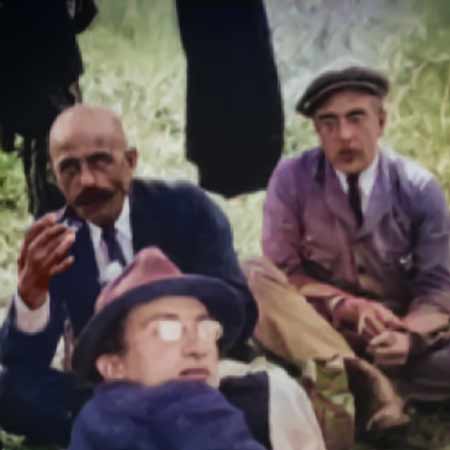

Question: I am finishing the reading of Ouspensky’s In Search of the Miraculous and am quite intrigued to know why did Ouspensky leave Gurdjieff. Why did he decide to distance himself at some point and work separately? The book is not clear about it; I sense that Ouspensky protects Gurdjieff by saying the minimum. Could you tell me what happened or direct me to some other sources on the topic?
Ouspensky indeed speaks minimally about why he decided to leave Gurdjieff. In the context of the book In Search of the Miraculous, I suspect it has to do with his aim in writing the book. If he digressed into criticism about Gurdjieff’s methods, or a long apology for why he decided to leave him, it would taint the entire book with the spirit of gossip and intrigue, and detract from the objectivity of the knowledge presented.
However, Ouspensky’s reluctance to speak about why he left Gurdjieff extended beyond his books. We are told that, at some point, he got tired of being asked about Gurdjieff and gave his students a task not to mention him. I suspect it might have been impossible for him to explain exactly what happened. He implies this in In Search of the Miraculous. Language has limitations. An experience put into words cannot capture the time and place in which it occurred. We, who were not there, fill in the blanks with our own imagination and corrupt the original event. In the spirit of remaining objective, it is often more prudent not to speak at all than to open the door to distortion.
What Ouspensky does tell us in In Search of the Miraculous is that the rift was gradual. In the summer of 1916, a year after Ouspensky met Gurdjieff, Gurdjieff took eight of his students to a country house in Finland for more concentrated work. This was a pivotal period for Ouspensky that deepened his understanding of the work and left him very hopeful that he might accomplish real inner change with Gurdjieff’s help. After this gathering, he wrote:
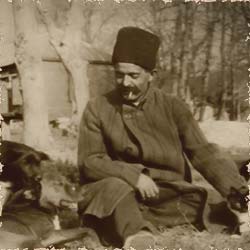
Gurdjieff (cir. 1917)
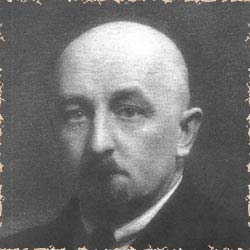
Thomas de Hartmann
[OUSPENSKY] “At this time certain very definite changes began in my views on myself, on those around me, and particularly on “methods of action” …they were not in any way connected with what was said in Finland but they had come as a result of the emotions which I had experienced there… Somewhere very deep down inside me I understood the esoteric principle of the impossibility of violence, that is, the uselessness of violent means to attain no matter what.” i
About a year later, in 1917, Gurdjieff gathered 13 of his students for six weeks at Essentuki, at the base of the Caucasus mountains in Russia. Again, Ouspensky singled out the knowledge and methods shared during this gathering as deeply significant. “We were given some general propositions by which I thought we could be guided later on,” he said. Surprisingly, however, the Essentuki gathering came to an abrupt and sour ending:
[OUSPENSKY] “And suddenly everything changed. For a reason that seemed to me to be accidental and which was the result of friction between certain members of our small group, Gurdjieff announced that he was dispersing the whole group and stopping all work.” i
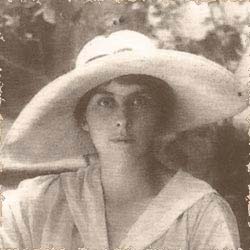
Needless to say, this incident was a big blow to everyone involved. It is impossible for us, who were not there, to comprehend the extent of the disappointment in seeing one’s investment in a teacher come to nothing, and for seemingly trifling reasons. We learn a little more about the circumstances behind this abrupt ending from the De Hartmanns, who are the only others present in Essentuki to later recount it in their memoir:
[THOMAS DE HARTMANN] “[Gurdjieff] had been trying Petrov (another student attending, not Peter Ouspensky) almost beyond endurance. At last Petrov could not hold out any longer. He forgot himself and answered Mr Gurdjieff angrily. Mr Gurdjieff turned and left the house, and an hour later it was announced that all further work was to stop for everyone because one of the senior pupils had manifested himself in this way towards his teacher.” ii
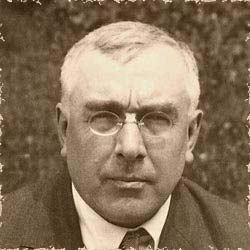
Peter Ouspensky
Olga de Hartmann
[OUSPENSKY] “All this surprised me very much. I considered the moment most inappropriate for “acting,” and if what Gurdjieff said was serious, then why had the whole business been started? During this period nothing new had appeared in us. And if Gurdjieff had started work with us such as we were, then why was he stopping it now?” i
The natural disappointment in realizing Gurdjieff was dispersing the whole group and stopping all work—coupled with Ouspensky’s earlier realization of the uselessness of using violence—give good grounds for understanding why a rift would form.
[OUSPENSKY] “And I have to confess that my confidence in Gurdjieff began to waver from this moment. What the matter was and what particularly provoked me is difficult for me to define even now. But the fact is that from this moment there began to take place in me a separation between Gurdjieff himself and his ideas. Until then I had not separated them.” i
The crack widened as events continued unfolding. Eventually, Ouspensky decided to break all contact with Gurdjieff and continue working independently. Many have subsequently tried to explain this rift without having been there. They reduced the complexity of the conflict—which Ouspensky himself admitted was difficult for him to define—into a black-and-white verdict that vindicated one side and condemned the other. Some ruled in favor of Gurdjieff, attributing his actions to his unique and inspired methods, and claiming that Ouspensky, in his intellectual blindness, missed the very lesson Gurdjieff intended to relay. Others ruled in favor of Ouspensky, taking such events as the sudden disbandment of the Essentuki group as proof that Gurdjieff was moody, violent, and manipulative, and that his students could not continue to acquiesce to his methods. Not having been there, we see what we want to see; we fill in the missing blanks to suit our own imaginary picture.
Be that as it may, to discard Gurdjieff and Ouspensky’s legacies because of their disagreements would be to throw out the baby with the bathwater. We are forced onto Ouspensky’s same conclusion: we must separate the message from its messengers. Gurdjieff himself always stressed that his teaching was rooted in ancient traditions. Part II of Seeker of Truth attempts to show that many of these are still widely available: Christianity, Buddhism, Judaism, etc. Gurdjieff’s unique contribution was twofold: he presented their original meaning in a fresh and accessible way, and offered practical tools for verifying that meaning. Once we verify an idea, we disconnect it from its messenger and make it our own.
Question: Has it ever crossed your mind to regret having ever met Gurdjieff?
Ouspensky: Never. Why? I got very much from him. I am always very grateful to myself that after the first evening I asked him when I could see him next time. If I had not, we would not be sitting here now.
Question: But you wrote two very brilliant books.
Ouspensky: They were only books. I wanted more. I wanted something for myself.iii

SOURCES
- In Search of the Miraculous by Peter Demianovich Ouspensky
- Our Life with Mr. Gurdjieff by Thomas and Olga de Hartmann
- Ouspensky’s Meeting Transcripts from the Yale Library
(ggurdjieff.com)
George Gurdjieff | Seeker of Truth | Part 1

Link to video: https://youtu.be/FwvuCO5n5pc
Premiered 4 hours ago01:20 – Gurdjieff’s Formative Years 04:14 – Gurdjieff’s Search for Truth 06:43 – Gurdjieff Begins Teaching in the West A documentary that traces Gurdjieff’s search for truth by revealing the sources of his main psychological ideas. It surveys his early career – gathering followers, navigating the turbulent 20th century, establishing the Chateau Prieuré, earning public acclaim in America – and argues that it could only have ended in the closure of his Institute. Gurdjieff ultimately followed the trajectory of the Fourth Way, a path of self-initiation, in which the teacher cannot do for his students what the students must do for themselves. Through presenting these aspects of Gurdjieff and his teaching, the documentary elucidates his role in the broader Fourth Way tradition, leaving the viewer with fresh insights and questions about where the Fourth Way may stand today. This is part one of a series of five. Watch the next parts on https://ggurdjieff.com/
The Rise of the Hasnamuss in Contemporary Politics
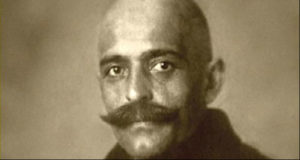
A ‘hasnamuss’ is a certain type of very dangerous person that Gurdjieff wrote about in Beelzebub’s Tales and Ouspensky spoke about in his lectures published in The Fourth Way and A Further Record. In order to understand what it is and what it means to us and to the world at large, we must understand three other terms used by Gurdjieff and Ouspensky. They are ‘householder,’ ‘tramp,’ and ‘lunatic.’ As it happens none of the words can be defined in relation to their ordinary meaning. A ‘householder’ does not necessarily own a house, a ‘tramp’ may be wealthy and admired, and a ‘lunatic’ may be the head of a corporation or an important politician.
These terms all refer not to the role that the person plays but to the values that motivate his actions, or, as it often is in the case of tramp, the lack of action. Put simply a householder has correct values, a tramp has no values, and a lunatic has wrong values. Unfortunately the word ‘values’ in the last forty years has been used so much by certain hypocritical conservative politicians in the United States that it has lost its meaning and has become an unfashionable topic, especially among intellectuals. The word ‘priorities’ has become a replacement word in many circles.
But what I mean here by values is not difficult to understand. A value is what is important to you. But again this has to be understood in relation to what motivates you to act. If you say that you value helping those that are less fortunate than you, but the efforts you make to help the poor are motivated by a desire to give the impression to others that you are a good person, then what you actually value is the opinion of others. A value is also a relative term in that a person can value one thing over another, and a third thing can be valued above the other two. A person may, for instance, value honesty but find that in some situations honesty may not be the most practical or compassionate action.
Two qualities that are characteristic of a householder are the ability to think in a practical way and having a certain amount of discipline. Thinking practically means being able to observe a situation and to formulate an action that secures the aim you have set for yourself, and being disciplined means being able to carry out that action, even if it difficult or unpleasant. In conscious evolution these two qualities are not only important but essential. Without a certain level of householder, the student of the way will find no meaning in his work, or he will turn his work into something wrong or destructive.
Tramp is easy to understand. Tramp is an attitude that nothing matters, that everything is relative to everything else and therefore nothing can be of more value than anything else. There are people who romanticize tramp; they believe that having no values is a kind of objectivity and that an attitude of tramp makes them superior to others; nothing could be further from the truth. Dostoevsky seemed interested in characters who were ruled by tramp (he thought of it as nihilism, a philosophy that states that all values are baseless and that there are no universal moral truths). If nothing matters, then a man may murder his landlady, as Raskolnikov did in Crime and Punishment, and believe that he will not be haunted by the consequences. You can see how such an attitude can lead to bad choices, but, in most people, tramp is less dramatic; it often means despondency in relation to the world or an inability to act. Why should I do anything if nothing matters? But things matter. The universe is constructed of lower and higher worlds, of which are, to some extent, reflected in our inner experience. To believe that higher and lower worlds are of the same value is a misunderstanding of the human experience.
A lunatic has values, but they are the wrong values. A politician, who values winning over everything else, will make choices that are morally wrong or even criminal because his peace of mind and conscience are less important to him than winning. Lunatic as a feature is also prevalent in the corporate world where greed is often seen as a virtue. Making money is valued even if the way the money is made exploits other people or destroys the planet where we all live. You can see that these values are wrong or in an incorrect order. There is nothing wrong with making money, but when it becomes more important than the wholesale suffering of a workforce or the health of the planet, then something is out of joint. Lunatics are also devoted to formatory thinking; that is, either-or thinking or absolute thinking. Much of the justification of a lunatic’s extreme behavior is based on formatory thinking. If you believe that you are absolutely right and that your opponents are wrong and that there is no gray area or middle ground, then it becomes possible for you to justify questionable actions. This is seen in many issues that are presently being debated in the United States. The firearm debate is a good example. People block a clear need for gun laws by believing that the second amendment of the U. S. Constitution is an absolute right, that no matter what the consequences, this amendment gives Americans the right to buy and use any gun that they like, even military-style weapons. There is no consideration of the reality of the situation, and no compromise is possible, no matter how many people die. The second amendment makes them right and their opponents wrong, and there is no higher right in their defense.
By definition, a hasnamuss is a lunatic and a tramp at the same time, which at first glance seems impossible. How can you have no values and wrong values at the same time? But when you begin to look at the examples you will see that it is possible. Another way to view a hasnamuss is that he is a lunatic given to extreme and unpredictable behavior who also has no values.
[A hasnamuss] never hesitates to sacrifice people or to create an enormous amount of suffering, just for his own personal ambitions. ~ P. D. Ouspensky
In order to understand how this works, we need to understand that we all have lunatic and tramp. For most people tramp and lunatic are just ‘I’s, or groups of ‘I’s, that are not believed or fought against, but in some people these same groups of ‘I’s grow strong and can, eventually, become crystallized. Both the lunatic and the tramp are unable to distinguish between higher and lower worlds, and as a result of his wrong crystallization, the hasnamuss is unable to manifest from higher worlds. He manifests from the lowest worlds experienced by man. Here we can add another characteristic of the hasnamuss: he does not experience positive emotions. Positive emotions require the burning of higher hydrogens (hydrogen 12), but the hasnamuss has lost his capacity to create hydrogen 12, he is, in Ouspensky’s words, crystallized in the wrong hydrogen.
The emotional function, when it works with its own energy, is an organ of perception, and the hasnamuss, who has only negative emotions, loses his ability to perceive from the emotional function. Part of what this means is that he has no conscience, no empathy, and no shame. In many important ways, it is exactly this that gives him his power over other people and his apparent strength. Since he has no conscience, he is not troubled by his lies or by his actions when they create suffering for other people. It is also his lack of shame that makes him attractive to a certain type of person. Many ordinary people are frustrated by the burden of conscience; shame and guilt keep these people from acting on their most base impulses, and the hasnamuss, when he achieves a position of power, gives them permission to manifest their prejudice, their hatred, and their violent desires. Here we come to another characteristic of the hasnamuss: he appeals to the lowest in his followers, and in doing so destroys whatever higher possibilities they have.
In ordinary conditions, in ordinary life, in ordinary times, they are just criminals or actual lunatics—nothing more. But in certain periods of history—in times like these, for example—such people very often play a leading part; they may become very important people. ~ Ouspensky
It’s not clear from the source that I have, but this statement by Ouspensky seems to have been made in 1935; that is, just after the rise of Hitler and Mussolini.
Gurdjieff believed that darker times were cyclical and that they were the result of planetary influences.
Somewhere up there two or three planets have approached too near to each other; tension results. Have you noticed how, if a man passes quite close to you on a narrow pavement, you become all tense? The same tension takes place between planets. For them it lasts, perhaps, a second or two. But here, on the earth, people begin to slaughter one another, and they go on slaughtering maybe for several years. ~ G. I. Gurdjieff
Clearly we are now in another such time. The instability in the United States caused by the rise of Trump certainly has the most potential for a large-scale disaster, but the figures of hasnamuss have appeared in other countries as well, as would be expected if Gurdjieff is right and this movement is the result of planetary influences that affect the earth as a whole.
In the United States we find politicians and business people who think that they can use Trump to get what they want while he is in power without falling prey to his sordidness; they are mistaken. History has shown us that people who support the hasnamuss are either betrayed by him or, if they hold out, are shunned by coming generations. It also has to be observed that when powerful people protect the hasnamuss, it only emboldens him to commit greater crimes. It is predictable that his crimes will eventually become so horrific that they will go beyond what the majority of his supporters can stomach. The hasnamuss lives his life in a downward spiral and is happy to pull others into his inevitable downfall.
Others in the United States believe they can change Trump; they too are mistaken. The hasnamuss is crystallized in the meanest human desires and the most degenerate behavior. By definition he cannot change. More than anything he fears higher emotions, like love and compassion and sympathy, because he cannot understand them. They are no longer within his range of experience, and so, like Trump, the first impulse of the hasnamuss, on encountering anyone manifesting from higher emotions, is to bring them down to his level, and, if he can’t do this, to do his best to destroy them.
The next natural question is: what can we do? But in this case, the most revealing question is: what would a householder do? A householder is more than anything practical. A householder knows what is possible for him to affect and what is not. He doesn’t enter into fights that he cannot win, yet at the same time he does what he can to support the institutions that are trying to counter the trends the hasnamuss has created, and he doesn’t expect those institutions to be perfect or run by perfect individuals. A householder acts when he sees any possibility of positive change, and doesn’t allow himself to be drawn into domains where he has no influence. He is disciplined when he needs to be and aloof when the situation is out of his control.
On a human level, a householder does what he can when he can do it and then withdraws. He understands his possibilities as well as his limitations.
A householder is a normal man, and a normal man, given favorable conditions, has the possibility of development. ~ Ouspensky
A householder has the possibility of development, but it is not a certainty. In many ways it comes down to luck. He must be in the right place at the right time when conditions allow for the teachings of esoteric ideas. Ouspensky believed that the development of a teaching needs a time of relative calm, despite Gurdjieff’s claim to the contrary.
I think they were both right in their own way. Ouspensky observed that in difficult times it becomes next to impossible to organize a teaching and attract new people, and Gurdjieff believed that hard times were beneficial to people who have already adopted the fourth way as a way of life. So if we take both of these as correct, we can say that what hurts the organization of esotericism as a whole may benefit the individual.
The system is designed in a way that we can profit, on a spiritual level, from difficulties by using the tools that are given. We can transform suffering, if we know how to do it and have the discipline to bring the appropriate tools to the situation in the moment. Non-identification, external considering, and self-remembering are powerful tools in ordinary situations and become more powerful in difficult or extraordinary situations.
The moment you suffer, try to remember yourself. ~ Ouspensky
Of course, a comparison to the 1930s and ‘40s to our time is not exactly correct. On a human level the stakes are much higher now in our time. The hasnamuss, the lunatic, and the tramp are not only in a position to slaughter many, many people, and make many more suffer, but are in a position to destroy the entire human experiment on earth. The fact of global warming, unchecked pollution, extreme weather, and massive amounts of stockpiled weapons in countries that are now unstable does make a happy ending, or even a sustainable path forward, less likely. The question for us is this: do we allow the reality of what is happening force us into a state of fear and instinctive desperation, or do we use the situation to better understand that we are in essence spiritual beings.
For a long time we have taken self-remembering too narrowly. We have thought of our self as this body in this life, and have used self-remembering to further our worldly aims. But self-remembering can be more. If we can reach higher centers even for short periods of time, we will uncover a different being, one based on the experience of many lifetimes, whose understanding is rooted in spiritual worlds. And this is the self we ultimately want to remember.
(Contributed by Gwyllm Llwydd)
Gurdieff on the True Sense of Life

“…I had given myself my word that during the whole of this time I wold do no writing whatsoever, but would only, for the well-being of the most deserving of these subordinate parts, slowly and gently drink down all the bottles of old calvados now at my disposal by the will of fate in the wine-cellar of the Prieué, and specially provided the century before last by people who understood the true sense of life.”
– From Meetings with Remarkable Men (p. 1), referring to the short break Gurdjieff took after finishing the first volume of his All and Everything trilogy. The expression “subordinate parts” refers to those parts of himself that had, of necessity, been subordinated to the writing process, and were thus in need of serious attention after the completion of such a major undertaking.
For more information on calvados, click here; for more on the difference between calvados and applejack, click here ad here.