Tag Archives: Google

Who’s most responsible for the monopolization of America?

As the United States moves against Google, antitrust law is still under the influence of Robert Bork

ROBERT REICH

SEP 12, 2023 (robertreich.substack.com)

Friends,

One of the most important initiatives of the Biden administration is its attack on corporate monopolies.

Today, the Justice Department’s case against Google goes to trial. The Department alleges that Google illegally abused its power over online search to throttle competition. It is the government’s first monopoly trial of the modern internet era.

Later this month, the Federal Trade Commission (FTC) will file its lawsuit against Amazon, alleging that Amazon favors its own products over competitors’ on its platforms and uses predatory tactics with outside sellers on Amazon.com. 

Whether it’s Ticketmaster and Live Nation consolidating control over live performances, Kroger and Albertsons dominating the grocery market, or Amazon and Google scooping up every operation in sight, corporate concentration is on the rise.

Over the past several decades, giant corporations have come to dominate most American industries, as this chart shows:

[Source: “100 Years of Rising Corporate Concentration” by Spencer Y. Kwon, Yueran Ma, Kaspar Zimmermann]

The social costs of corporate concentration are growing.

— The typical American household is paying more than $5,000 a year because corporations can raise their prices without fear that competitors will draw away consumers.

— Such corporate market power has also been a major force driving inflation.

— Huge corporations also suppress wages, because workers have fewer employers from whom to get better jobs.

— And corporate giants are also fueling massive flows of big money into politics (one of the major advantages of large size).

Yet the federal courts have been reluctant to do anything about this and are pushing back against the Biden administration’s efforts. Why? Because of a man named Robert Bork.

Let me explain.

I first met Bork in September 1971, when I took his class on antitrust at Yale Law School. I recall him as a large, imposing man, with a red beard and a perpetual scowl.

He was only in his mid-40s then, but he seemed impatient and bored with us (also in that class were Hillary Rodham and Bill Clinton).

We kept challenging his view that the only legitimate purpose of antitrust law was to lower consumer prices.

“What about the political power of giant corporations?” we asked.

His retort: “How do you expect courts to measure political power?”

“But what about the power of big corporations to suppress wages?”

“Employees are always free to find better jobs.”

“What about their power to undercut potential rivals with lower prices?”

“Lower prices are good for consumers.”

“What about the sheer power that comes from their gigantic size?”

“Also good for consumers. Large size means lower costs through efficiencies of scale.”

Bork had an answer to each of our objections, but we were never satisfied. He spouted economic theory based on dubious “Chicago School” assumptions that all economic players have perfect information and face no cost of entering or leaving markets (Bork had attended the University of Chicago and its law school).

Even in our mid-20s, we knew this was bullshit.

Bork refused to recognize power — even though antitrust laws emerged from the Gilded Age of the late 19th century, when a central concern was the untrammeled power of giant corporations.

A few years later, Bork wrote a book called The Antitrust Paradox that summarized his ideas. The staff of a conservative California governor bound for the White House read it and passed it along to their boss, and Bork’s book formed a basic tenet of Reaganomics.

Federal judges read it, too. Most judges didn’t (and still don’t) know much economics and hated getting bogged down in interminable and almost incomprehensible antitrust trials that could last for years. They found Bork’s simplicity and cogency helpful in limiting such lawsuits.
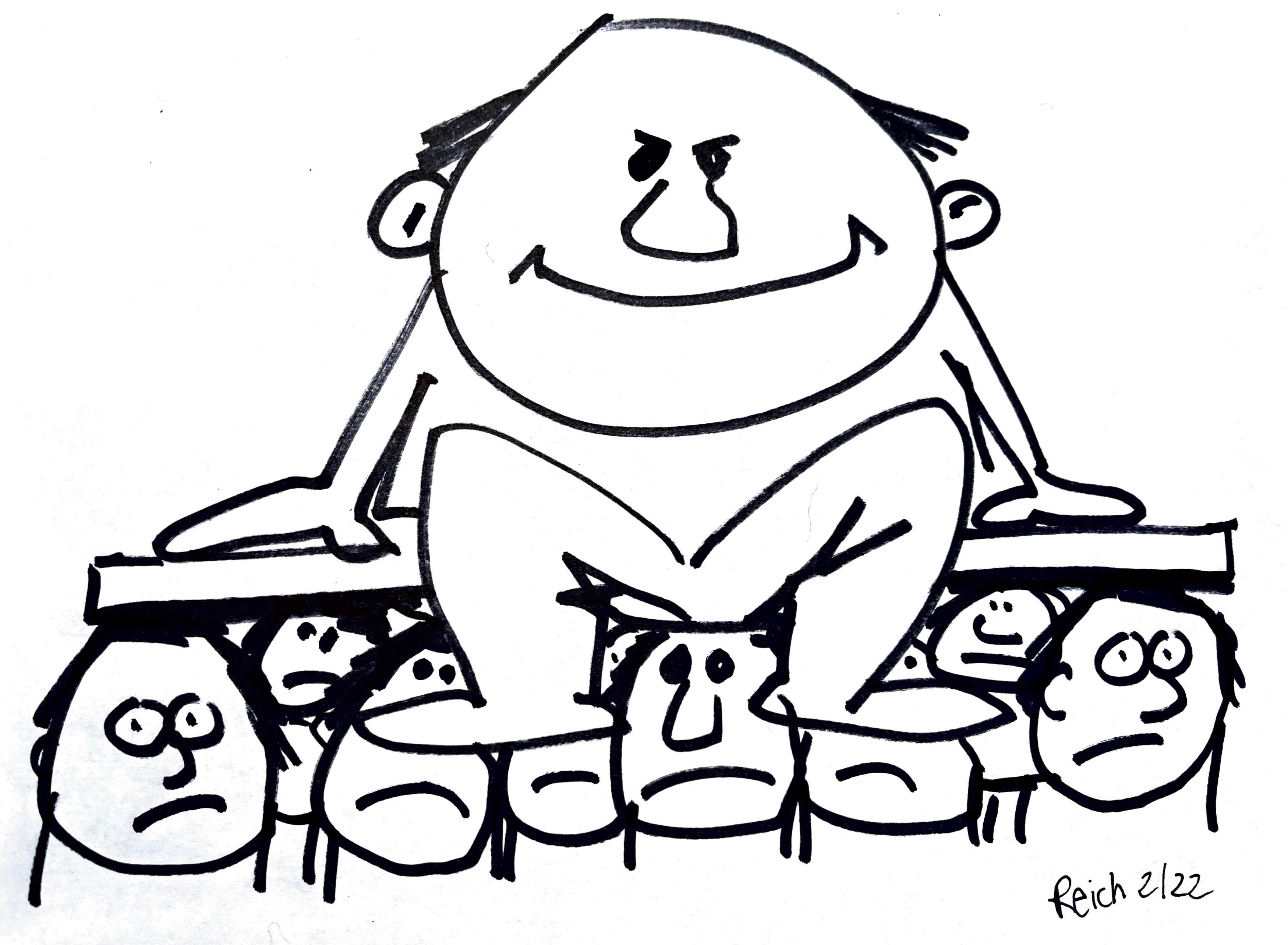
BORK’S INFLUENCE over the courts represented the culmination of years of work by the monied interests to kill off antitrust law. They’re still at it.

Which is why the new view of antitrust now being pioneered by the Biden administration through the FTC and the Antitrust Division of the Justice Department is so important.

This new view regards corporate concentration as a problem even if it provides economies of scale that might allow lower consumer prices in the short term. That’s because corporate concentration also means less innovation, more wage suppression, predatory behavior, price-push inflation, and increased political power.

Besides their lawsuits against Google and Amazon, the FTC and the Justice Department have proposed new merger guidelines to keep monopolies in check. Not surprisingly, giant corporations are doing whatever they can to stop these new protections from taking effect.

The optimist in me thinks that as the public becomes more aware of the close connections among corporate power, predation, inflation, wage suppression, and political corruption, the new antitrust movement will eventually succeed.

What do you think?

Google Unveils Plan to Demolish the Journalism Industry Using AI

This could change everything.

MAY 11 by MAGGIE HARRISON (futurism.com)

Getty / Futurism

Image by Getty / Futurism

Remember back in 2018, when Google removed “don’t be evil” from its code of conduct?

It’s been living up to that removal lately. At its annual I/O in San Francisco this week, the search giant finally lifted the lid on its vision for AI-integrated search — and that vision, apparently, involves cutting digital publishers off at the knees.

Google’s new AI-powered search interface, dubbed “Search Generative Experience,” or SGE for short, involves a feature called “AI Snapshot.” Basically, it’s an enormous top-of-the-page summarization feature. Ask, for example, “why is sourdough bread still so popular?” — one of the examples that Google used in their presentation — and, before you get to the blue links that we’re all familiar with, Google will provide you with a large language model (LLM) -generated summary. Or, we guess, snapshot.

“Google’s normal search results load almost immediately,” The Verge’s David Pierce explains. “Above them, a rectangular orange section pulses and glows and shows the phrase ‘Generative AI is experimental.’ A few seconds later, the glowing is replaced by an AI-generated summary: a few paragraphs detailing how good sourdough tastes, the upsides of its prebiotic abilities, and more.”

“To the right,” he adds, “there are three links to sites with information that Reid says ‘corroborates’ what’s in the summary.”

As it goes without saying, this format of search, where Google uses AI tech to regurgitate the internet back to users, is wildly different from how the search-facilitated internet works today. Right now, if you Google that same query — “why is sourdough bread still so popular?” — you’d be met with a more familiar scene: a featured excerpt from whichever website won the SEO race (in this case, that website was British Baker), followed by that series of blue links.

At first glance, the change might seem relatively benign. Often, all folks surfing the web want is a quick-hit summary or snippet of something anyway.

But it’s not unfair to say that Google, which in April, according to data from SimilarWeb, hosted roughly 91 percent of all search traffic, is somewhat synonymous with, well, the internet. And the internet isn’t just some ethereal, predetermined thing, as natural water or air. The internet is a marketplace, and Google is its kingmaker.

As such, the demo raises an extremely important question for the future of the already-ravaged journalism industry: if Google’s AI is going to mulch up original work and provide a distilled version of it to users at scale, without ever connecting them to the original work, how will publishers continue to monetize their work?

“Google has unveiled its vision for how it will incorporate AI into search,” tweeted The Verge’s James Vincent. “The quick answer: it’s going to gobble up the open web and then summarize/rewrite/regurgitate it (pick the adjective that reflects your level of disquiet) in a shiny Google UI.”

Research has shown that information consumers hardly ever make it to even the second page of search results, let alone even the bottom of the page. And worse, it’s not like Google’s taking clicks away from its longtime information merchants by hiring an army of human content writers to churn out summarization. Google’s new search interface, which is built on a model that’s already been trained by way of boatloads upon boatloads of unpaid-for human output, will seemingly be swallowing even more human-made content and spitting it back out to information-seekers, all the while taking valuable clicks away from the publishers that are actually doing the work of reporting, curating, and holding powerful interests like Google to account.

As of now, it’s unclear whether or how Google plans to compensate those publishers.

In an emailed statement to Futurism, a Google spokesperson said that “we’re introducing this new generative AI experience as an experiment in Search Labs to help us iterate and improve, while incorporating feedback from users and other stakeholders.”

“As we experiment with new LLM-powered capabilities in Search, we’ll continue to prioritize approaches that will allow us to send valuable traffic to a wide range of creators and support a healthy, open web,” the spokesperson added.

Asked specifically whether the company has plans to compensate publishers for any AI-regurgitated content, Google had little in response.

“We don’t have plans to share on this, but we’ll continue to work with the broader ecosystem,” the spokesperson told Futurism.

Publishers, however, are extremely wary of these changes.

“If this actually works and is implemented in a firm way,” wrote RPG Site owner Alex Donaldson, “this is literally the end of the business model for vast swathes of digital media lol.”

At the end of the day, there are a lot of questions that Google needs to answer here, not the least being that AI systems, Google’s includedspew fabrications all the time.

The Silicon Valley giant has long claimed that its goal is to maximize access to information. SGE, though, seemingly seeks to do something quite different — and if the company doesn’t figure out a way to compensate publishers for the labor it’ll be gleaning from the journalists, the effects on the public’s actual access to information could be catastrophic.

Updated with comment from Google.

READ MORE: The AI takeover of Google Search starts now [The Verge]

More on Google: We Interviewed the Engineer Google Fired for Saying Its AI Had Come to Life