Posted by Clint Sabom | Apr 10, 2018 (contemplativelight.org)
An Experiential Meditation on Evelyn Underhill’s 5 Stages Of Awakening. What is life like after awakening? What are some of the signposts of this process and the shifts of spirit that happen along the way? The stages, while laid out in the most helpful model I’ve seen, are still only that, a model. They are not set in stone, nor is it essential to locate yourself in the exact phase: growth is rarely linear.
Drawing on the tradition Benedictine model of Christian mysticism [1. Purgatio 2. Illuminatio 3. Unitio], Underhill expanded the Holy Road home to God into five territories that usually overlap:
1. Awakening 2. The Purgative Way 3. The Illuminative Way 4. The Dark Night Of The Soul 5. The Unitive Way
Her writings in her masterpiece work, Mysticism, utilize quotes from the saints and mystics of the past to illustrate the shifts and turns in consciousness that occur as our inner being awakens to the Presence of God everywhere all the time here NOW. Ultimately, it is a journey where Grace takes over our individual egos, and The Holy Spirit wakes up to Itself within us. We are only the vessels in which the transpersonal God makes Himself manifest in this earthly domain.
“God gives without stint all that the creature needs, but it must do its part. He gives the wheat: we must reap and grind and bake it.” â��Evelyn Underhill
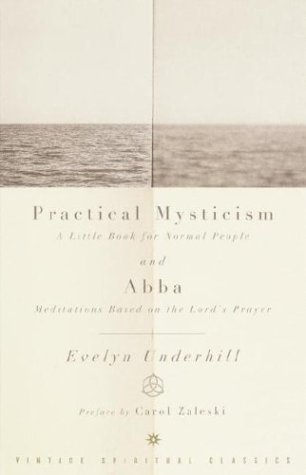
In these two classics, British poet and mystic Evelyn Underhill shows herself to be one of the most authoritative modern voices on mysticism. Written on the eve of World War I,Practical Mysticism reviews the works of the greatest Western mystics, including Teresa of Avila, Julian of Norwich, and Thomas à Kempis. Underhill�s goal is to guide her readers on a journey toward mystical consciousness, to teach them to see the �eternal beauty beyond and beneath apparent ruthlessness.�Abba, first published in 1940, takes as its starting point the seven phrases of the Lord�s Prayer, using them as a means to propel the self toward union with God. In these important works, Underhill brings an often esoteric subject onto a practical footing, showing that the profound gifts of mysticism are not only for the few but are within reach of us all.
Evelyn Underhill was an English Anglo-Catholic writer and pacifist known for her numerous works on religion and spiritual practice, in particular Christian mysticism.
Mysticism is Evelyn Underhill’s seminal work on the subject. The book is divided into two parts, “The Mystic Fact” and “The Mystic Way.” In the first part Underhill explores the theological, psychological, and philosophical underpinnings of mysticism from a historical perspective. In the second part Underhill examines the application of mysticism in one’s life as a means for spiritual growth. Evelyn Underhill’s Mysticism is both a fantastic introduction to the search for spirituality through mysticism and an almost encyclopedic examination of the subject.
Evelyn Underhill was an English Anglo-Catholic writer and pacifist known for her numerous works on religion and spiritual practice, in particular Christian mysticism.
In the English-speaking world, she was one of the most widely read writers on such matters in the first half of the twentieth century. No other book of its type—until the appearance in 1946 of Aldous Huxley’s The Perennial Philosophy—met with success to match that of her best-known work, Mysticism, published in 1911.