Tag Archives: Climate change

When It Comes To Climate Change, The Kids Are Not All Right

They worried they have no future.

Theresa Ann Story

Theresa Ann Story

4 days ago (Medium.com)

Photo by Richard Stachmann on Unsplash

Not long ago, a science teacher at a local middle school graciously gave me some time at the end of her day to discuss what students are learning about climate change.

When I arrived, two students were still in the classroom — young girls who were laughing and chatting as they helped tidy up the desks.

“Looks like you’re still working,” I said, standing in the doorway. “Is this still a good time to talk?”

“Yes, come on in,” she said, smiling and waving me in. “We’re just waiting for my daughter. I told them you were coming, and they might be interested in our meeting since the topic affects them, too.”

“Great!” I enthusiastically replied. I turned to the girls and blurted out, “So, what do you think of climate change?”

They froze like deer in headlights.

Their laughter abruptly stopped. An expression of unease washed over their faces as they shifted their gazes toward one another. After a moment of awkward silence, they drifted back to futzing with the desks.

In a low voice, the teacher explained, “It’s a scary subject for them. They don’t feel like they can make a difference, so it’s hard for them to talk about it.”

Crap, I thought. What have I done?

Young People are Terrified of the Future

A teenager’s weightiest worries should be along the lines of “How am I going to pass math?” or “I wonder if Tommy likes me?”

They shouldn’t be asking themselves “How am I going to survive global warming?”

And yet, they are.

Photo credit: Roy, Flickr

A study published in Lancet Planet Health in 2021 gathered responses from 10,000 children and young people (16–25 years old) in ten different countries. Findings indicated 59% of respondents were “very or extremely worried” about climate change.

More than 50% of those surveyed said they felt “sad, anxious, angry, powerless, helpless and guilty.” And, more than 75% saw the future as “frightening.”

There’s Been A Mindshift Among Students

In May 2022, Julia Steinberger, an ecological economist at the University of Lausanne, wrote about her experience giving a climate presentation at her old high school in Geneva.

In 2019, she noted how students showed unbridled enthusiasm and optimism. They were “excited” and “engaged.” The students had agency over their destinies.

Three years later, at a similar high school presentation, the students appeared bored and distracted. During the Q&A session, Steinberger learned why the assembly was so aloof.

A young girl took the mic and began her rapid-fire questioning. “Why are you here talking to us? We can’t do anything…”

Backed by the thunderous applause of her classmates, the student let it rip.

“Only politicians, only business leaders, can make the big changes you are talking about. Why aren’t you talking to them? … we have to act within just a few years — and nothing happens, nothing changes …”

The students’ indignation and sense of hopelessness shook Steinberger.

Photo Credit: Roy, Flickr

It’s An Uphill Fight Against Global Warming

In June 2023, Montana District Court Judge Seely ruled that “a provision of the Montana Environmental Policy Act (MEPA) prohibiting consideration of greenhouse gas emissions and corresponding climate change impacts in environmental reviews … violated the plaintiffs’ right to a clean and healthful environment under the Montana Constitution.

The lawsuit, brought on behalf of 16 plaintiffs ranging in age from 5 to 22 years old, represents hope in the fight against climate change. That’s the good news — the glass half-full view.

Unfortunately, on the flip side — this unprecedented victory for environmental protections against climate change only applies in Montana.

Another issue — it appears Judge Seely’s ruling will be appealed to the Montana Supreme Court where it could possibly be overturned.

The fight is not over.

It makes perfect sense that an environmental policy that does not take greenhouse gases into consideration is not worth the paper it’s written on. So, why would there be any pushback on such a logical conclusion to this lawsuit?

Greed. Status Quo. Greed.

No wonder young people are frustrated and angry.

Following the landmark decision in Montana, The New York Times engaged with high schoolers across the country asking them what they believed their role should be in the battle against climate change.

A student from Philadephia stated, “Climate change shouldn’t be our problem, but that doesn’t mean we shouldn’t be the solution.”

Another from Colorado admitted to being scared, saying, “I don’t know what to do.”

Today’s youth face a dilemma not of their doing, and they are not shy about putting the blame on the generations before them — where it belongs.

The Effort to Change the Narrative

You can’t discuss kids and climate change without bringing up Greta.

In September 2018, then 15-year-old, Greta Thunberg bravely put a stake in the ground and began her protest against climate change in front of the Swedish parliament. The “Fridays For Future” strike continues today.

It’s difficult to see any direct impact on how businesses and governments operate, but her efforts have not stopped. And, while Greta can be a controversial figure, her motivation is deeply rooted and her intent earnest. She continues to throw a spotlight on the dangers of climate change with every protest, every speech.

Greta at 2019 Climate Change protest. Photo credit: Leonhard Lenz, Creative Commons

Not every young person possesses the wherewithal of Greta, but that doesn’t mean they cannot contribute to the solution, and that’s the message young people need to hear.

Regardless of age, everyone can make a difference. Every step taken against climate change contributes to a bigger movement.

What Do The Youth Need? Hope! When Do They Need It? Now!

At her next climate presentation, the ecology economist Steinberger took a different tactic. She realized the students “didn’t need to hear about emission trajectories: they needed to hear about trajectories of popular struggle, when and how people without power changed the world.”

She put away her powerpoint and listened. She then went on to review the slides focused on solutions from the Intergovernmental Panel on Climate Change (IPCC) annual Synthesis Report.

She gave the students something positive to focus on.

We can’t just hand our youth a flyer saying “Welcome to the Apocalypse and, BTW, sorry.”

Photo Credit: Roy, Flickr

Hollow promises by government and business leaders cannot be the only messages reaching our young. Children need to believe they can still salvage a future on this planet. They need to see a path forward — one that’s paved, not with false hope and lies, but attainable goals and ways to ensure the earth is inhabitable for them and generations to come.

We Don’t Know What We Don’t Know

Optimism for the future has it’s critics. I’ve read many articles and reports lamenting we are doomed. I strongly believe this perspective is short-sighted and injurious.

A recent Medium piece by George Dillard adeptly summarized what I keep thinking. We don’t know what we don’t know.

Whatever You Think Climate Change Will Be Like, You’re Wrong

Predicting disaster is impossible but important

medium.com

Dillard recaps the speculation swirling around the pandemic that swept the planet in 2020. He points out all the things we imagined, as well as the things we could never have imagined.

He goes on to say, “Life in the age of climate change will likely be weirder in some ways than we anticipated, and more mundane in others.” In other words, we can only speculate (again) on what the future holds — as we try to bolster our minds and efforts against the impacts of climate change, let’s be open to all possibilities and not just catastrophize.

What Are You Prepared to Do?

Photo credit: John Englar, Creative Commons

While there are young people willing and able to take up the mantle against climate change, there’s a whole slew who suffer in silence. In either case, our kids need to know adults do care. They need to know adults are also trying to change the trajectory of this planet’s health.

Whether an educator, a parent, or just concerned adult, any grown-up can find some way to help reassure young people there is hope.

The Bottom Line

“It always seems impossible until it’s done.” — Nelson Mandela

Our kids don’t want to hear any more statistics. They know things are bad. They need to know all is not lost.

Children want to hear about successes and solutions, so let’s teach them about the wins and help them find answers.

And, everyone must understand — including our world’s youth — it is the greatest of mistakes to do nothing because you can only do a little. Do what you can.

Everyone needs to step up.

No matter how small a step taken, a step forward is progress.

Theresa Ann Story

Written by Theresa Ann Story

30-year-career in Healthcare | BA Economics, UC Davis | MBA, Cornell JGSM | Recycling researcher; believer we can do better https://medium.com/@theresaannstory

The unexpected way spirituality connects to climate change

Gopal D. Patel | TED Countdown Summit

• July 2023

Environmental activist Gopal D. Patel thinks the climate movement could learn a lot from one of the longest-standing social initiatives in human history: religion. Exploring three areas where frameworks from faith traditions could benefit the climate movement, Patel offers a playbook for discovering your big idea to build momentum towards powerful social change.

About the speaker

Gopal D. Patel

Environmental activist, campaignerSee speaker profile

Gopal D. Patel believes in the power of engaged religion and spirituality to transform our approaches to today’s biggest challenges.

Climate Change Is Keeping Therapists Up at Night

An illustration of a therapist’s chair on top of a stranded iceberg.
Credit…Photo illustration by Derek Brahney

How anxiety about the planet’s future is transforming the practice of psychotherapy.

Credit…Photo illustration by Derek Brahney

By Brooke Jarvis

  • Published Oct. 21, 2023 Updated Oct. 22, 2023 (NYTimes.com)

Andrew Bryant can still remember when he thought of climate change as primarily a problem of the future. When he heard or read about troubling impacts, he found himself setting them in 2080, a year that, not so coincidentally, would be a century after his own birth. The changing climate, and all the challenges it would bring, were “scary and sad,” he said recently, “but so far in the future that I’d be safe.”

That was back when things were different, in the long-ago world of 2014 or so. The Pacific Northwest, where Bryant is a clinical social worker and psychotherapist treating patients in private practice in Seattle, is a largely affluent place that was once considered a potential refuge from climate disruption. Climate change sometimes came up in therapy sessions in the context of other issues — say, a couple having arguments because they couldn’t decide if it was still ethical to have kids — but it was rare, and usually fairly theoretical. “We’re lucky to be buffered by wealth and location,” Bryant said. “We are lucky to have the opportunity to look away.”

The smoke was the first sign that things were starting to change. People who live in the coastal Northwest often joke that the brief, beautiful bluebird summers are the reason everyone puts up with so many months of chilly gloom. But starting in the mid-2010s, those beloved blue skies began to disappear. First, the smoke came in occasional bursts, from wildfires in Canada or California or Siberia, and blew away when the wind changed direction. Within a few summers, though, it was coming in thicker, from more directions at once, and lasting longer. The sun turned blood-red or was all but blotted out, disappearing along with the city skyline; the sky turned gray, or sepia, or eerily tangerine, and ash floated down like snow. Sometimes there were weeks when you were advised not to open your windows or exercise outside. Sometimes there were long stretches where you weren’t supposed to breathe the outside air at all.

Now lots of Bryant’s clients wanted to talk about climate change. They wanted to talk about how strange and disorienting and scary this new reality felt, about what the future might be like and how they might face it, about how to deal with all the strong feelings — helplessness, rage, depression, guilt — being stirred up inside them.

As a therapist, Bryant found himself unsure how to respond. He grew up deeply interested in science and nature — he was a biology major before his fascination with human behavior turned him toward social work — but he always thought of those interests as separate from the profession he would eventually choose. And while his clinical education offered lots of training in, say, substance abuse or family therapy, there was nothing about environmental crisis, or how to treat patients whose mental health was affected by it. He began reaching out to other counselors, who had similar stories. They came from a variety of clinical backgrounds and orientations, but none of their trainings had covered issues like climate change or environmental anxiety.


(Contributed by Michael Kelly, H.W.)

Climate action is on the cusp of exponential growth

275,510 views | Simon Stiell • TED Countdown Summit

Climate action is speeding up — and we each have the power to push that transformation forward. As the head of the UNFCCC, the UN’s entity supporting the global response to climate change, Simon Stiell points to clear social and technological signals that show we’re at the tipping points of a green revolution — and invites us all to apply our unique skills to defending the planet against the catastrophic impacts of the climate crisis.

About the speaker

Simon Stiell

Executive Secretary, United Nations Framework Convention on Climate ChangeSee speaker profile

Simon Stiell is the executive secretary of UN Climate Change, whose aim is to address the climate crisis by supporting countries to move towards climate resilience and low-emissions strategies.

‘The Climate Change Bomb Has Gone Off,’ Says Jay Inslee Amid Extreme Heat

Washington Gov. Jay Inslee

Democratic Washington Gov. Jay Inslee speaks prior to U.S. President Joe Biden at Green River College in Auburn on April 22, 2022.

 (Photo: Karen Ducey/Getty Images)

“What the scientific community is telling us now, is that the Earth is screaming at us,” said the Washington governor. “We need to stop using fossil fuels. That is the only solution to this massive assault on humanity.”

JESSICA CORBETT

Jul 23, 2023 (CommonDreams.org)

As record-shattering heat persists from Phoenix, Arizona to southern Europe, Democratic Washington Gov. Jay Inslee highlighted on Sunday that humanity already knows how to combat climate chaos: ditch planet-warming fossil fuels.

With tens of millions of Americans under heat alerts, Inslee—who ran a climate-focused 2020 presidential campaign—appeared on ABC‘s “This Week” to discuss current conditions and solutions with co-anchor Martha Raddatz.

“Look, the climate change problem, the fuse has been burning for decades, and now the climate change bomb has gone off,” Inslee said. “The scientists are telling us that this is the new age. This is the age of consequences because whatever we thought of climate change last year, we now understand that the beast is at the door. We knew this beast of climate change was coming for us, but now, it’s pounding on the door.”

“What the scientific community is telling us now, is that the Earth is screaming at us, and that is the situation,” he added. “I talked to a leading international scientist the other day who told me that we knew this was going to happen to us, but it’s happening to us maybe two decades earlier than we really thought could be in the realm of the possible.”

“We have to dramatically increase our efforts. That is necessary.”

Scientists have long warned that driving up the global temperature will make heatwaves worse—with dangerous consequences, including for the world’s food system. Last month was the hottest June on record and the trend is expected to continue during what Malta residents are calling the “summer of hell.”

Already, July has seen the warmest day and week ever recorded, and much of the Northern Hemisphere is still enduring extreme heat. Campaigners held an international day of action on Saturday as the “Climate Clock” dropped below six years, a warning of how close humanity is to using up the carbon budget and likely killing any hope for the Paris agreement’s 1.5°C limit for global temperature rise this century.

Greek authorities said Sunday that roughly 19,000 people were evacuated from the island of Rhodes due to wildfires. Reutersreported that “thousands spent the night on beaches and streets during what Greece said was its biggest safe transport of residents and tourists in emergency conditions.”

— (@)

“We have to dramatically increase our efforts. That is necessary,” Inslee said of action to cut emissions. “There’s good news here. We can do this. Look, we’re electrifying our transportation fleet. We’re electrifying our homes. This is a solvable problem, but we need to stop using fossil fuels. That is the only solution to this massive assault on humanity.”

The governor argued that the United States needs to lead on a global scale but also emphasized that “this is not just something for the federal government. States can act. Our state is acting. We have 23 states in the U.S. Climate Alliance. And this is necessary.”

“We’ve had tremendous action under President [Joe] Biden’s leadership with the Inflation Reduction Act. And, unfortunately, the Republicans are trying to repeal that now,” Inslee noted. “But we need to go further and faster. And states can go further and faster. And we are doing that.”

https://abcnews.go.com/video/embed?id=101587752

Biden, who is now seeking reelection in 2024, campaigned on bold climate pledges going into the 2020 contest. While he has taken some of those promised actions, the president has also faced criticism from green groups, voters, and some Democratic lawmakers for backing fossil fuel initiatives—from the Mountain Valley Pipeline to the Willow oil project—and so far declining to declare a climate emergency.

Meanwhile, many Republican lawmakers and presidential candidates—including former President Donald Trump and Florida Gov. Ron DeSantis—are pushing policies even more hostile to the climate and friendly to the fossil fuel industry.

Kyle Jones of the Center for Policy Advocacy at the Natural Resources Defense Council said earlier this week that legislation marked up by the GOP-controlled U.S. House Appropriations Committee “reads like a ‘how-to’ manual for destroying the planet.”

Raddatz asked how to convince people to care given that there are “candidates out there like Donald Trump, who mock the idea of climate change, and there are a vast number of Americans who ignore it, don’t care about it, or don’t believe it.”

Inslee insisted that “we can’t wait for Donald Trump to figure this out. We don’t have time to mess around to wait for this knucklehead to figure this out. We just got to make sure he’s not in office. And the way we do this is vote against climate deniers.”

“Vote against people who refuse to assist this moral and economic crisis that we have,” he advised. “You can’t wait for these folks, you’ve just got to make sure they’re not in office where they can do damage. Let them go off and play golf. We’ll solve this problem. It’s a solvable problem if we work together.”

“And people are coming around to this very, very rapidly because their homes are burning down. They’re choking on smoke from the Canadian fires,” he said. “When Ron DeSantis wants to go swimming, he can’t because the water is like a sauna, like a hot tub off his beaches. We’ve just got to make sure those folks are not in office. We don’t have the luxury of allowing these people to destroy the planet.”

This post has been updated with reporting on conditions in Greece.

Our work is licensed under Creative Commons (CC BY-NC-ND 3.0). Feel free to republish and share widely.

JESSICA CORBETT

Jessica Corbett is a senior editor and staff writer for Common Dreams.

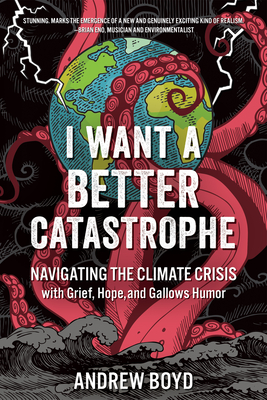
Book: “I Want a Better Catastrophe: Navigating the Climate Crisis with Grief, Hope, and Gallows Humor”

I Want a Better Catastrophe: Navigating the Climate Crisis with Grief, Hope, and Gallows Humor

Andrew Boyd

An existential manual for tragic optimists, can-do pessimists, and compassionate doomers

With global heating projected to rocket past the 1.5°C limit, lifelong activist Andrew Boyd is thrown into a crisis of hope, and off on a quest to learn how to live with the impossible news of our climate doom.

He searches out eight of today’s leading climate thinkers–from activist Tim DeChristopher to collapse-psychologist Jamey Hecht, grassroots strategist Adrienne Maree Brown, eco-philosopher Joana Macy, and Indigenous botanist Robin Wall Kimmerer–asking them: Is it really the end of the world, and if so, now what?

With gallows humor and a broken heart, Boyd steers readers through their climate angst as he walks his own. Boyd’s journey takes him from storm-battered coastlines to pipeline blockades and hopelessness workshops. Along the way, he maps out our existential options and tackles some familiar dilemmas: Should I bring kids into such a world? Can I lose hope when others can’t afford to? Why the fuck am I recycling?

He finds answers that will surprise, inspire, and maybe even make you laugh. Drawing on wisdom traditions Eastern, Western, and Indigenous, Boyd crafts an insightful and irreverent guide for achieving a better catastrophe. This is vital reading for everyone navigating climate anxiety and grief as our world hurtles towards an unthinkable crisis.

(Goodreads.com)

We Should Stop Calling It “Climate Change” — And Start Calling It Extinction

umair haque

Apr 22, 2023 (Medium.com)

The Words “Climate Change” May End Up Being The Biggest Lie Ever Told

Image Credit: Henry Nicholls. Follow him here.

1 in 3 people on Planet Earth are living through a record-breaking heatwave right now. Thailand has just recorded the hottest temperatures it’s ever had — 45ºC (113ºF) — and a record breaking heat index (“feels like” temperature) of 54ºC (130ºF).

130 degrees? The summer’s barely begun.

Meanwhile, the UN’s climate agency just released its State of Global Climate Report for last year, confirming the climate horror that was 2022.

Killer floods, droughts and heat waves hit around the world, costing many billions of dollars. Global ocean heat and acidity levels hit record highs and Antarctic sea ice and European Alps glaciers reached record low amounts, according to the United Nations’ climate agency’s State of Global Climate 2022 report released Friday.

This is the brutal, startling reality of climate change.

Of..wait..what?

“Climate change”? The climate isn’t changing. It’s heating. Rapidly. Faster than at any point in hundreds of millions of years. It’s heating so fast that this is the stuff entire geotemporal boundaries are made of — “ages” in geological history. So fast that it’s shattering scientists’ worst predictions — and making reality look like a sci-fi movie, where scores of people die off in Canada because of sweltering heat.

It’s not “change” of some symmetrical, anodyne, innocuous kind. The planet isn’t getting cooler. It’s rapid, sudden, potentially runaway, already lethal, discontinuous transformation in one direction. It’s getting hotter, fast.

We should stop calling it “climate change.” Now, before you object, bear with me, and let’s investigate the history of the term.

We used to call it “global warming.” Not so long ago. The big we, as in, all of us, because that is what the norm was. That’s the term which dominated public discourse, and you’d read it in papers and books and articles. Not the seemingly anodyne “climate change.”

That was a far, far more accurate term. And that was the problem.

Here’s little factoid for you. Do you know who invented the term “climate change”? Frank LuntzThe Republican “strategist.” Why?

Luntz played a role in turning the environment into a partisan battlefield. During President George W. Bush’s first term, his infamous memo warned Republican party leaders that they were losing “the environmental communications battle,” an issue on which Bush was “most vulnerable.” He advised them to emphasize a lack of scientific certainty around climate change and drop “global warming” for the less scary-sounding “climate change.”

“Global warming” was dangerous. Because it was true. Too frightening. Too true. Too real. To self-explanatory, powerful, and strong. It had to be Orwellianized. It had to memory-holed. Doublespeak had to be crafted — to create the impression that there was some “debate” on this topic.

Debate like what? Debate like: maybe the planet wasn’t just warming. Maybe the temperature and climate were just “changing.” Naturally. Not as a result of human influences. Not as a result of unbridled production, consumption, pollution. Maybe this was just something that happened according to the planet’s natural cycles and rhythms. Maybe, maybe, maybe.

Doubt had to be manufactured. That’s why Luntz invented the term “climate change.”

Luntz rebranded global warming as “climate change” because it sounds far, far less dangerous, problematic, severe, worrisome. The usual network of right-wing think tanks and media outlets immediately — as if by design — began to use it. And the rest is history. By now, all of us use a term that a Republican strategist came up with to make global warming sound less dangerous and wonder why we can’t fix the planet.

There we are, too many of us, still using it. It’s certainly all over the news today. We’re using terms designed by a Republican strategist who wanted to deny the truth of global warming to refer to it. What does that make us? Suckers, marks, rubes. Too many of us have fallen for a branding campaign. One designed to pull the wool over eyes about, oh, only the most urgent issue on earth, on which your life and prosperity very much depend, too. Just ask the 5 million people a year dying of climate cha — global warming. Oh wait, you can’t, because they’re dead.

Sorry to be harsh — but I feel we have to speak honestly about such matters. Because, of course, there is no doubt about what’s happening to the planetIt’s not cooling, it’s warming, it’s not natural, it’s profoundly unnatural, as in, human-made, and even at that, made by a certain lifestyle of rampant overconsumption, sprawl, greed, and materialism.

What does that make Luntz, by the way? Well, it’s not too hard to see that Luntz’s idea of rebranding global warming as climate change worked.

For decades, nobody much cared. Luntz’s rebranding took place in the early 2000s — when the window to stop the planet hitting severe warming was closing. And the window did close. Now, 2.3 degrees of warming is more or less locked in. We’re only at about one so far — and we’ve got killer heat domes in Canada. Want to venture a guess about what happens as the temperature goes on rising?

Luntz’s campaign worked brilliantly. Elites around the planet began using this new term — “climate change” — to sound smart. To please America, the most powerful nation on earth. To align their interests with it. And as elites changed their language, their attitudes and sentiments changed, too. No longer was anyone interested in really stopping runaway global warming. Why — did such a thing even exist?

It was Orwell’s great lesson writ large. If you can disappear a thing in language, you can make people stop thinking it, and it simply…vanishes. The point of Orwellian doublespeak is to veil the truth with doubt, to filigree it with the shadows of complacency, to make the lie seem real. And the truth is that thanks to Luntz, the GOP, American media, and elites around the world following their lead, the dire threat of global warming soon enough became the anodyne sounding “climate change.” And who really worries about that? It makes you think you might be sitting on a tropical beach sipping a Mai Tai — not boiled alive by a killer heat wave.

All the urgency and danger and severity went out of the issue, and the world simply dilly-dallied as if there was plenty of time to waste about a problem that probably wasn’t even going to be much of a problem.

Bang. And here we are, just a few short decades later. The planet has heated dramatically. People are dying from killer heat. We need a whole new vocabulary to describe how rapidly and badly the temperature’s rising. “Summer” doesn’t quite mean what it used to. It’s now a time of mortal danger for people, whether from “heat domes” or “megafires” or “megafloods” or “megafires” and so on.

And yet we’re still using the vocabulary of global-warming deniers to describe all this: “climate change.”

We’ve been made fools of, in such a deep and lasting way. It’s taken away our power — using the Orwellian language which was chosen for us — to fight the biggest and most urgent problem human civilisation has ever faced.

So if using the term “climate change” makes us apathetic, spineless, useful idiots, to elites who’d happily watch the world literally burn — what does that make Frank Luntz? Well, Luntz will — or perhaps should — probably go down as one of history’s great monsters. 5 million deaths a year linked to “climate change”? Climate change is going to claim tens, probably hundreds of millions of lives. As nations burn, cities sink, societies go up like tinderboxes, and the desperate and impoverished try to flee it all.

Nobody can really say how much of that death and despair can be ascribed to Luntz alone. But would you like have to played a hand in hundreds of millions of deaths?

Maybe that’s why Luntz himself is apologetic about his malign, Orwellian creation. Of course, apologies aren’t nearly enough. It’s like watching an abuser hit you and say “sorry.” Redress means a whole lot more, and it starts the true process of reparations.

You should care intensely about all this. Because, like I said, you’ve been made a fool ofYou’re using the language global warming deniers invented to try, futilely, to describe what’s happening to a dying planet. Of course, it doesn’t work very well, because they invented the very term “climate change” to stop any reality from entering the discussion, minds, societies, public spheres. Their goal was to kill the truth, and they succeeded.

“Climate change” might well prove the Biggest Lie ever told.

Luntz is now offering his messaging services to the cause of climate action. “I’m here before you to say that I was wrong in 2001,” Luntz told the Senate committee. “Just stop using something that I wrote 18 years ago, because it’s not accurate today.”

Don’t listen to me — listen to the strategist who invented the Lie. You should stop telling it, too. Even he regrets it, and he’s a Republican strategist. LOL.

It’s not “climate change.” It never was. It’s “global warming,” yes. But even more than that, it’s Extinction.

Extinction doesn’t mean “all the life on planet Earth dies,” it means that mass extinction happens on a scale we have yet to comprehend — across the planet, to all life, millions of species, in every biome and ecology. It means ecosystems collapse, and with them, everything we rely on, from the bees that pollinate the plants that provide us with the resources we need and the air we breathe, to our supply chains being destroyed by mega-weather. It means millions and millions of people die from the resulting chaos and collapse that ensues. And our civilization, and everything it entails — economy, society, democracy, culture — is hardly likely to survive an event like that intact.

Yes, it sounds dire. That’s because it contains power, resonance, urgency, forces a confrontation with reality. It has deep, serious, profound meaning. Yes, it’s frightening.

It should be. Because it’s true.

Umair
April 2023