Tag Archives: Barbie

From Barbie to Bernstein to Trump: The High Cost of Worshipping a Narcissist

The megalomaniacs of Oscar season and the man who would be king.

Jeremy Helligar

Jeremy Helligar

3 days ago (jeremyhelligar.medium.com)
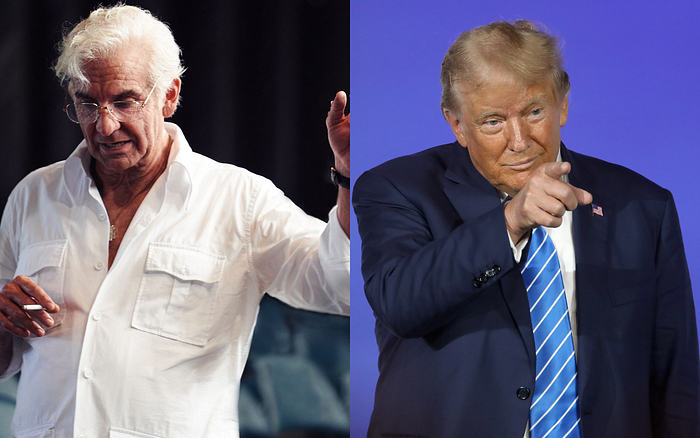
Bradley Cooper as Leonard Bernstein in Maestro (Photo: Netflix) and Donald Trump (Photo: flickr/Gage Skidmore).

There’s an early episode of the TV sitcom Will & Grace where one of the characters (it had to be Grace, but it was actually Will) makes an interesting analogy between relationships and gardening. The gist of it: In any successful relationship, he suggests, there’s the flower and there’s the gardener. The former — the above-the-title star of the romance — must be nurtured, tended to, and catered to by the latter, aka, the costar.

Two gardeners may have a solid shot at “happily ever after the end.” For them, love is a peaceful, easy, low-impact activity where they can feed off each other. However, when two flowers like Will and Grace cross-pollinate, love — and life — becomes a series of stalemates. It will almost always end in dehydration.

Love in the garden isn’t as simple, though, as Will & Grace made it sound. Look how it turned out for Adam and Eve. You can only stay on your knees for so long. Even if you apply the flower-gardener analogy to friendships and working relationships as well as to romance, a flower and a gardener might co-exist for decades (or for six seasons and two movies of Sex and the City), but love, like, tolerance, and devotion don’t necessarily bloom forever and for always.

But then, sometimes it does. How many people have gone down in service of Donald Trump? I don’t know what it is about our 45th president that turns his followers into totally submissive sheep, willing to suspend their common sense indefinitely and lose their freedom for him.

We’ve seen the videos of the January 5 attack on the U.S. Capitol. We’ve watched his gardeners go to prison. Domino dancing/watch them all fall down. Meanwhile, the twice-impeached, four-times-indicted Trump continues to run free, still standing, still blooming, and, inexplicably, still inspiring an insane level of devotion among his flock.

He’s probably more likely to return to the White House in 2025 than he is to ever be fitted for an orange jumpsuit to match his spray tan, all because his gardeners refuse to let him shrivel up and die. Are they getting anything of beauty in return? Since Trump burst onto the political scene a little under a decade ago, and especially since he lost the 2020 election, what has he really done for anyone other than himself and his kids?

The other day while I was watching Maestro, the new biopic of the legendary conductor and composer Leonard Bernstein directed by Bradley Cooper and starring Cooper as the titular master, I had a déjà vu feeling. I haven’t even made a dent in my Oscar-season screeners, and already I’m sensing a pattern: The Trump Effect is in full effect in Hollywood. Megalomaniacs have taken over the movies.

A number of the films I’ve screened in recent weeks — MaestroNyadPassagesPriscillaEileen and others — feature an overlapping dynamic: someone losing themself in someone else. One character at the center of each film is narcissistic and self-centered, like the star of their very own Trump Show — er, Truman Show. They’re the flowers, and in order for them to bloom, their gardeners must get lost in their talent, their skill, and their charisma until the garderners eventually disappear.

Agathe (Adèle Exarchopoulos) in Passages is enmeshed in a love triangle with a gay married couple, and she goes to extreme lengths to avoid that gardener fate. The object of her affection is Tomas (Franz Rogowski), a film director who needs constant watering by everyone who enters his orbit, much to the frustration and exhaustion of his husband Martin (Ben Whishaw). By the time Agathe makes a fateful decision that sets the destiny of the three central characters in motion, she’s already all but vanished.

Joe, a thirtysomething father of two, pulls a semi-disappearing act in May December, the dark comedy inspired by the true-crime story of Mary Kay Letourneau. The handsome man-child (perfectly played by Riverdale’s Charles Melton) gives his youth and, to some degree, his entire identity, to his significantly older wife Gracie (Julianne Moore) on a silver platter.

Meanwhile, in Eileen, Anne Hathaway’s killer kiss and Bette Davis eyes lead the title character (Thomasin Mackenzie) down a dark, twisted path not unlike the January 6 mob in service of Trump — which is also sort of what happens with Oxford University student Oliver (Barry Keoghan) in Saltburn the moment he catches a glimpse of Jacob Elordi as Felix, a beautiful and charming aristocrat.

In Maestro, Felicia Montealegre, the long-suffering wife of Leonard Bernstein, doesn’t go quite so far in her enthrallment. But in real life, Montealegre did stay married to the West Side Story composer for 27 years, ’til her death did they part, despite his string of flagrant affairs with various men and women. (Priscilla Presley knows when to cut Elvis loose in Priscilla, but has real-life Priscilla ever really let him go?)

Early in Maestro, Montealegre asks Bernstein to tell her a secret about himself, and he reveals that as a boy, he used to fantasize about killing his father. In hindsight, one might reinterpret the scene as presaging her own slow, decades-long “death” by vanishing at the hands of Bernstein’s ego and his voracious sexual appetite.

Thelonious “Monk” Ellison (Jeffrey Wright, in Oscar-caliber mode), the writer at the center of American Fiction, doesn’t inspire that kind of devotion from anyone during the movie’s 117-minute running time. But although we never meet his ex-wife, nor are we told exactly why their marriage ended, it’s not hard to imagine that their marriage couldn’t contain his ego, which he would probably mistake for creative genius.

The flower and the gardener even make an appearance in Barbie, the year’s biggest film, which takes an old-fashioned binary view of the battle of the sexes. In one pivotal scene, Ken tells Barbie that he only exists because she does. In the Mattel universe, he’s not wrong, but since Ryan Gosling and Margot Robbie, who play Ken and Barbie respectively, are human beings and not dolls, the moment of vulnerability teeters on the cusp of heartbreaking.

Ken: “I don’t know who I am without you!”

Barbie: “You’re Ken.”

Ken: “But it’s Barbie and Ken. There is no just Ken. That’s why I was created. I only exist within the warmth of your gaze. Without it, I’m just another blonde guy who can’t do flips.”
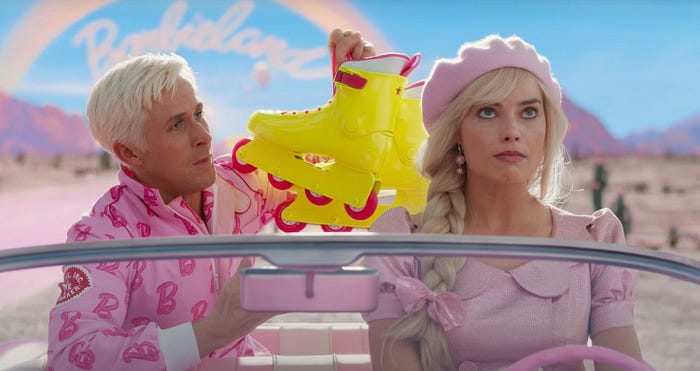
Ryan Gosling as “Just Ken” and Margot Robbie as “Stereotypical Barbie” in Barbie (Photo: YouTube/Warner Bros.)

Of all the flowers and gardeners I’ve seen in Oscar-season movies so far, only Bonnie Stoll, Jodie Foster’s supporting and supportive character in Nyad, emerges from her devotion fully in tact. She puts her life on hold — and remortgages her house — in order to help Diana Nyad (Annette Bening), her maddeningly self-involved bestie of 30 years, achieve her dream of being the first person to swim from Cuba to Florida.

After three failed attempts, Bonnie, fed up with the swimmer’s extreme narcissism, temporarily takes her leave, and for Diana, ain’t no sunshine when she’s gone. In a satisfying and fully earned character arc, Diana evolves without completely ditching the megalomaniac she is at her core. She remains an imperfect storm of stunning skill, massive ego, and incredible insecurity, but she also comes to realize there’s no “I” in “we.”

Diana’s journey becomes Bonnie’s, too. Could the 64-year-old have swum 110 miles from Cuba to Florida without Bonnie as her coach and wing-woman (fin-woman?)? As I watched Team Nyad’s MVP (that would be Bonnie) encouraging Diana to take those final few steps out of the water and onto the coast of Key West, I had my doubts.

In the end, I was just as impressed by Bonnie’s accomplishment as I was by Diana’s. She’s the constant gardener throughout Nyad, on dry land and on water, but at the finish line, she’s equally and fully in bloom.
Jeremy Helligar

Written by Jeremy Helligar

Brother Son Husband Friend Loner Minimalist World Traveler. Author of “Is It True What They Say About Black Men?” and “Storms in Africa” https://rb.gy/3mthoj

‘Barbie’ could face ban in Lebanon for ‘promoting homosexuality’

The Ministry of Culture in Lebanon may decide to ban “Barbie” after it accused the film of “promoting homosexuality” on Wednesday. Lebanon, normally perceived as relatively open and free in the Middle East, has seen its ruling elites unite around hardcore conservative values. 

Issued on: 13/08/2023 (France24.com)

Australian actress Margot Robbie poses on the pink carpet upon arrival for the European premiere of "Barbie" in central London, United Kingdom on July 12, 2023.
Australian actress Margot Robbie poses on the pink carpet upon arrival for the European premiere of “Barbie” in central London, United Kingdom on July 12, 2023. © Justin Tallis, AFP

Text by: Sophian Aubin

Anyone who has seen Greta Gerwig’s film knows that the character Barbie aspires to a world of peace and love. 

In Lebanon, however, this American comedy is fueling tensions.

Although the film is showing in Saudi Arabia, the United Arab Emirates and Bahrain, the heroine, played by Australian actress Margot Robbie, could be banned from the generally liberal Lebanon.

The release of “Barbie” in the Middle East was initially planned for August 31, but was recently brought forward to August 10, seemingly indicating that any censorship issues had been resolved. Films are often delayed in the region to allow time for production companies to censor them or gather committees to review them.

But the day before the planned release, Lebanese Culture Minister Mohammad Mortada announced that he had asked for the film to be banned, saying the film “promotes homosexuality and sexual transformation” and “contradicts values of faith and morality” by diminishing the importance of the family unit. Mortada is backed by the powerful Shiite militant group Hezbollah, whose head Sayyed Hassan Nasrallah recently gave a speech that made reference to Islamic texts calling for same-sex relations to be punished by death.

Following Mortada’s announcement, Interior Minister Bassam Mawlawi asked the General Security’s Censorship Committee, which falls under the Interior Ministry and is traditionally responsible for censorship decisions, to review the film.

Kuwait has already banned “Barbie” outright, saying that the film promotes “ideas and beliefs that are alien to Kuwaiti society and public order”, according to a statement published by the state-run KUNA news agency. 

According to L’Orient Today, the Film Censorship Committee in Lebanon saw no reason to ban the film on Friday. The final decision regarding Lebanon’s screening of Barbie rests with the General Security.

Barbie passed the billion-dollar mark at the global box office on July 21.  

‘He must not have seen the film’

Canadian actor Ryan Gosling has been widely praised for his comic portrayal of Ken, whose over-the-top masculinity is consistently mocked throughout the film. Gerwig’s comedy portrays a world run by women, reversing the roles of patriarchal society. And it concludes with an egalitarian message: let’s stop thinking of ourselves as “Ken” or “Barbie” and embrace the individuals we really are.

Although the cast of “Barbie” includes Kate McKinnon, who is a lesbian, and transgender actor Hari Nef, the movie does not contain any explicit references to homosexuality or transsexuality.

“He must not have seen the film,” says Ayman Mhanna, executive director of the Samir Kassir Foundation, an association that aims to “promote democratic culture” in Lebanon and the rest of the Middle East. “These comments come in the midst of a violent homophobic campaign launched a few weeks ago by the leader of Hezbollah Hassan Nasrallah. A similar movement had been previously promoted by extremist Christian groups.”

Lebanon’s political elite has been heavily targeting the LGBT community since Pride Month in June.

Nasrallah stated in July that, according to Islamic law, all gay people “should be killed” and called for a boycott of all rainbow-themed products.

Representatives from the country’s various Christian communities also widely reject homosexuality, which is condemned in both the Bible and the Koran.

Under pressure from religious dignitaries, the country has cancelled events organised by its LGBT community on several occasions in recent years.

The children’s animated feature film “Buzz Lightyear”, which features a lesbian couple, was banned last year.

‘Spiritual reasons, political manoeuvring’

When he announced his intention to ban the release of “Barbie”, Mortada brought up an informal ministerial meeting held on Tuesday at the summer residence of Bechara al-Rahi, head of the Maronite Church, an Eastern rite church that recognises the authority of the Roman Catholic Church while maintaining its own form of worship.

“Ideas that run counter to the divine order and the principles shared by all Lebanese people must be combatted,” said both the Maronite al-Rahi and Nasrallah at the end of the meeting.

Political divisions run deep between Lebanon’s Christian and Muslim communities. The practice of proportionately reserving key government posts for representatives from the country’s different religious communities since 1989 has frequently led to deadlocks in decision-making.

However, “the Lebanese authorities are very happy to agree when it comes to sharing homophobic positions, or more generally to oppose any civil law concerning marriage, inheritance, child custody or divorce”, says Mhanna.

Religious institutions often serve as a relay between political parties and Lebanese society. “They are very often exploited by the parties in power, which invoke spiritual reasons to disguise obvious political maneuvering,” he says.

A society more open than its rulers?

Compared to most countries in the region, Lebanon is a multi-faith society that is relatively open when it comes to moral issues. Prohibited in most of the Arab world, the 2022 Marvel film “Doctor Strange in the Multiverse of Madness”, which features a lesbian couple, was screened there. Festive, cosmopolitan and somewhat Westernised, the Lebanese capital Beirut is still seen by some as the “Paris of the Middle East”.

But Mhanna points out that the parties represented in Parliament reflect a somewhat conservative society.

“Nevertheless, I don’t think that the Lebanese people – including the more traditional ones – have a real problem with ‘Barbie’. They are not focused on moral issues, instead they are very worried about economic collapse, the justice system and the Lebanese state.”

Daily newsletterReceive essential international news every morningSubscribe

Weakened by endemic political instability, the country is facing the most serious economic crisis in its history, marked by hyperinflation, the falling value of its currency and banking restrictions. Social tensions are being exacerbated by the lack of basic services such as water and electricity.

The lack of a thorough investigation and resulting justice in the wake of the explosion at the Port of Beirut in August 2020 has added to the discontent. Furthermore, evidence of negligence and corruption involving the authorities resulted in a lack prosecutions.

In light of this crisis, the authorities are bringing up moral issues to distract its citizens, says Mhanna.

“Yesterday, they were blaming refugees,” he says. “Today, they’re blaming gay people.”

This article has been translated from the original in French

“Barbie” and Venus Retrograde

The Astrology Podcast Aug 12, 2023 Demetra George joins the podcast to talk about the connection between the ancient Mesopotamian goddess Inanna, the Venus retrograde cycle, and the Barbie movie! During the course of the episode we talk about the ancient Mesopotamian myth of the descent of the goddess Inanna into the underworld, and how it is connected to the Venus synodic cycle, and especially the retrograde phase of Venus. I saw Demetra give a lecture in 2005 connecting the myth of Inanna with Venus retrograde, and then I was really pleasantly surprised to see a number of parallels with the myth show up in the Barbie movie that was released recently right when Venus stationed retrograde. Some of these parallels between Barbie and Inanna were pointed out in an article by a writer named Meg Ellison titled “Barbie is the new Inanna”:   https://wildhunt.org/2023/07/barbie-i… Demetra and I have been talking about a lot of this for the past few weeks, and decided to record an episode on it, in order to dive deeper into some of these ancient myths surrounding the Venus retrograde cycle and talk about how they are still relevant today. In the process we covered a lot of interesting ground, and touched on a number of important and fascinating figures, including the first author in history who signed her name to her writings, a priestess of Inanna named Enheduanna that lived around 2300 BCE. In that way this episode builds a little bit on the previous discussion Demetra and I did earlier this year on Heliodora and the early history of women in astrology. We also talked about the nature of archetypes, planetary significations that have been lost through time, and a deeper understanding of the complex yet profound meanings of Venus and her cycles. We also delved into some Barbie astrology facts, and I should say that there are spoilers for the Barbie movie in this episode, so if you care about spoilers then maybe watch the movie first before listening to the episode. For more about Demetra visit her website: Demetra-george.com This is episode 412 of The Astrology Podcast:

COME ON BARBIE, LET’S SELL BARBIES

American Toy Companies, Led by Mattel, Have Entwined Marketing and Entertainment for Over Half a Century

It’s a Barbie world, and we’re all buying in. Columnist Jackie Mansky traces how the 2023 Barbie film (above) fits into the larger Mattel playbook to sell us on the plastic life. Courtesy of Warner Bros.

by JACKIE MANSKY | JULY 21, 2023 (ZocaloPublicSquare.org)

The year was 1997.

“Un-Break My Heart” by Toni Braxton dominated the radio waves. Wallet chains and JNCO jeans were red-carpet staples. And plastic? It was fantastic.

Cool Shoppin’ Barbie wasn’t just made of plastic, she was the first ever doll to come with her very own piece of it. She came equipped with a cash register, bar code scanner, credit card reader, and two credit cards—a life-sized cardboard Mastercard, and a doll-sized plastic one.

In a year where a record 1.35 million Americans filed for personal bankruptcy, and the director of the nonprofit Consumer Federation of America was warning Americans in the red to “consider spending only what they can afford to pay off in a month or two”—or better yet, “make purchases by cash, check, or debit card”—Mattel, the toy company behind Barbie, used her to sell consumers on the fantasy of limitless shopping. Push a button, and the doll could say the magic words: “credit approved.”

“It’s so a child can really pretend,” said a spokesperson for Mattel at the time, in defense of its partnership with Mastercard International. “We thought it would be fun for her to run the card through the scanner.”

Cool Shoppin’ Barbie had a short run, which now makes her, among a certain set, a collector’s item. But today, the doll best serves as a particularly blunt object in the long history of Mattel’s marketing strategy to sell not the doll itself, but the lifestyle she promises.

In the lead-up to the first-ever live-action Barbie movie, Mattel has drilled this message home again and again, partnering with over 100 brands to sell us everything from Barbie burgers to Barbie toothbrushes. Life, Mattel wants to remind us, is better in Barbie pink. But the biggest way Mattel is signaling this message is through the high-profile summer tentpole itself. The first of Mattel’s new film arm, which can be seen as a feature-length commercial for Barbie, is a big gamble for the toy company. But it’s one that it has made before. From the very beginning, Mattel has made its name, and Barbie an icon, by selling her lifestyle to us directly on the screen.

As the story goes, after World War II, husband-and-wife team Ruth and Elliot Handler and their friend Harold “Matt” Matson began building doll furniture, and then toys, from scraps of leftover wood from their picture frame business. Early on, the company, a fusion of Matt and Elliot’s names, gained a reputation for selling musical toys, like the Uke-A-Doodle, a plastic ukulele. But Mattel really took off in 1955, when it had the opportunity to buy advertising on a new national children’s program, Walt Disney’s The Mickey Mouse Club. No one had used a major campaign to speak right to kids before. There had been national ad pushes, with the Erector Set becoming the first to get a major newspaper treatment in 1913. But unlike today, where companies spend nearly $17 billion a year marketing to kids and young adults, postwar marketers were only just beginning to treat children themselves as consumers. Becoming a commercial sponsor for a year would cost Mattel $500,000 upfront, but it meant directly reaching kids all across the country. It was a pricy gamble, but one that paid off big. That October, children tuning into ABC to watch “M-I-C-K-E-Y-M-O-U-S-E” were hit with advertisements for Mattel’s new Thunder Burp toy machine gun. The frenzy that followed created an epoch shift.

The first of Mattel’s new film arm, which can be seen as a feature-length commercial for Barbie, is a big gamble for the toy company. But it’s one that it has made before. From the very beginning, Mattel has made its name, and Barbie an icon, by selling her lifestyle to us directly on the screen.

As Sydney Ladensohn Stern and Ted Schoenhaus put it in Toyland, their history of American toy companies, “Mattel’s decision to advertise toys to children on national television 52 weeks a year so revolutionized the industry that it is not an exaggeration to divide the history of the American toy business into two eras, before and after television.”

Were it not for The Micky Mouse Club, Barbie herself may never have become a phenomenon. Buyers had expressed little interest when Mattel brought its prototype to the 1959 American International Toy Fair. But the response was completely different when Mickey Mouse Club viewers got their first look at the 11-inch doll. As ad footage of Barbie and her accessories paraded across the screen, a woman’s voiceover said, “Barbie, beautiful Barbie, I’ll make believe that I am you.”

From the start, Barbie, in particular, was selling children not on a doll, but on an idea: You, yes you, could be Barbie. Kids demanded a Barbie of their very own to play out their fantasies, and Mattel sold more than 300,000 dolls that first year.

Mattel continued to find new ways to use television to reach its target demographic. In 1969, Bernard Loomis, a toy developer and marketer at the company, had the idea of looking beyond regular advertising and turning Mattel’s newest toy, Hot Wheels, into a Saturday morning cartoon. The strategy was an early attempt to channel what Loomis later famously referred to as “toyetics”—a media property’s power to create and sell toys.

Loomis understood that companies would one day sell toys through branded, popular entertainment, but he was ahead of the times. After the Federal Communications Commission received a complaint from a rival toy company against the Hot Wheels animated show, it concluded that it was a “program-length commercial,” under the rationale that the programming was woven “so closely with the commercial message that the entire program must be considered commercial.” The FCC required ABC to log parts of the show, including the theme song and audio and video references to the words “Hot Wheels,” as commercial advertising, and the program was soon canceled.

It took until the 1980s for toyetics to be fully unleashed when FCC deregulation opened the doors for what one member of Congress termed the “video equivalent of a ‘Toys-R-Us’ catalog” to hit TV screens. The term toyetics was, at this point, already in circulation. Loomis is said to have coined it while discussing merchandising rights for Close Encounters of the Third Kind. He’d decided to pass because he said the film wasn’t “toyetic” enough. What was toyetic enough? George Lucas’ new space opera.

Extending the Star Wars experience out of the movie theater and into the toy store opened the door for intellectual property to march its way into Hollywood. And now, with the launch of Mattel Films, Mattel is hoping to use Barbie to try and write the next chapter of this history.

From the dizzying heights of ’90s Barbie mania (Cool Shoppin’ Barbie, incidentally, came out during the year Barbie sales were at their zenith), Barbie’s cultural capital sagged in the 21st century. Like with The Mickey Mouse Club gamble, Mattel is hoping the new Barbie film will directly reach, and sell, a new generation on her story. But this time around, the company is hoping not just kids, but also adults buy into the idea of Barbie. In the long list of promotional collaborations, Mattel has been going after older age groups, partnering with brands such as the dating app Bumble to expand its customer base. The movie, too, is being marketed for all ages. “Everybody can have their own experience, and that’s the beauty of it. It’s kind of for everyone,” Ryan Gosling, who plays Ken, told Reuters, during the L.A. world premiere.

Early reports seem to suggest that Mattel’s bet will once again pay off. According to box office estimates, Barbie is on pace to take in at least $130 million over the weekend. Even in a moment when Americans are spending less, it seems Barbie is still able to sell us on the plastic life.

JACKIE MANSKYis senior editor at Zócalo Public Square.