
“I know that I know nothing” — Socrates
Steven Gambardella · Apr 25 · Medium.com
Philosophy isn’t a body of knowledge, it’s an activity.
To philosophise isn’t about spinning theories or explanations for things, it’s to reflect on the very structure of our knowledge – our own knowledge, and the collective knowledge.
It’s a way of keeping a discipline of thought: to not be gullible, to not be lazy or indulgent in our thoughts and actions.
In the modern world, philosophy is a practice that has largely retreated into academia. It’s associated with dense jargon and horrible writing. But that’s not to say there’s anything wrong with academic philosophers per se.
In many ways academic philosophers are like haute couture designers: their ideas, while seeming far out when debuting on the runway, will make it to the street in due course.
The bureaucracy of academia, which rewards original research, means that talented philosophers are forced to write jargon-filled articles and books to increase their citation counts.
It’s an industry of knowledge, with industrial levels of output. Most academic philosophers never come up with anything truly original at all, but the fundamental ideas still arise. Academic philosophy is productive, it’s just inefficient. You’ll find needles of wisdom in those haystacks of knowledge.
In the ancient world, very few philosophers were professional in the way they are now. They may have had day jobs, or were lucky enough to not need to work either through family wealth or patronage.
They may have founded their own schools too and doing as such would have made them more like entrepreneurs than the tenured academics of today. Many academics would seethe at that last sentence, but I’ll stand by it.
There was no “industry” of academia: no colleges, journals, specialist publishers or conferences. Philosophers were poorer, but unburdened by having to deal with all the distractions that come with a profession.
The over-complicated industry of academic philosophy is why people flock to the ancient writers rather than contemporary philosophers. The ancients are truer to the purpose of philosophy: a practice of wisdom, as opposed to a body of knowledge.
Socrates was the philosopher who initiated this definition. Philosophers like Pythagoras and Heraclitus before him resembled what we’d call scientists now. Their work was about the world and mathematics. They were working with a kind of speculative knowledge: why are we here? Why do things change? What is the world made of?
Socrates’s “work” was wholly concerned with how people ought to live their lives. His speculations were based on ideas themselves rather than things like the world, geometry or the elements.
But Socrates never told anybody how to conduct their affairs. Instead, he questioned their beliefs and motives. If people’s beliefs and motives did not stand up to reason it was plainly evident from the cross-examination Socrates put them through.
Socrates emerged as a philosophical sensation in Athens at a time of crisis. Athens had lost a long war with its arch rival Sparta. The defeat was the end of Athens as an ancient superpower. The Spartans installed a puppet government in Athens known as the “Thirty Tyrants”, their short but bloody rule humiliated the world’s first democracy. Imagine Russia winning the Cold War and installing a Stasi in the United States.
Despite coming from a humble background (the philosopher was a stonemason by profession), Socrates was well-known in Athenian society. He was a decorated war hero, but also an eccentric character who proved to be a nuisance to the authorities. It may have well been his record for bravery in battle that made him a public figure to be listened to.
The philosopher was lampooned a number of times in the plays of Aristophanes. These were big public events; it was the ancient equivalent of being lampooned on Saturday Night Live. Actually, it’s worse than that, people still put on the plays of Aristophanes so Socrates has been mocked for thousands of years.
It is the years after Athens’ disastrous defeat in the Peloponnesian war with Sparta that Socrates was taken seriously, to the extent that he was put to death on the charge of corrupting the youth.
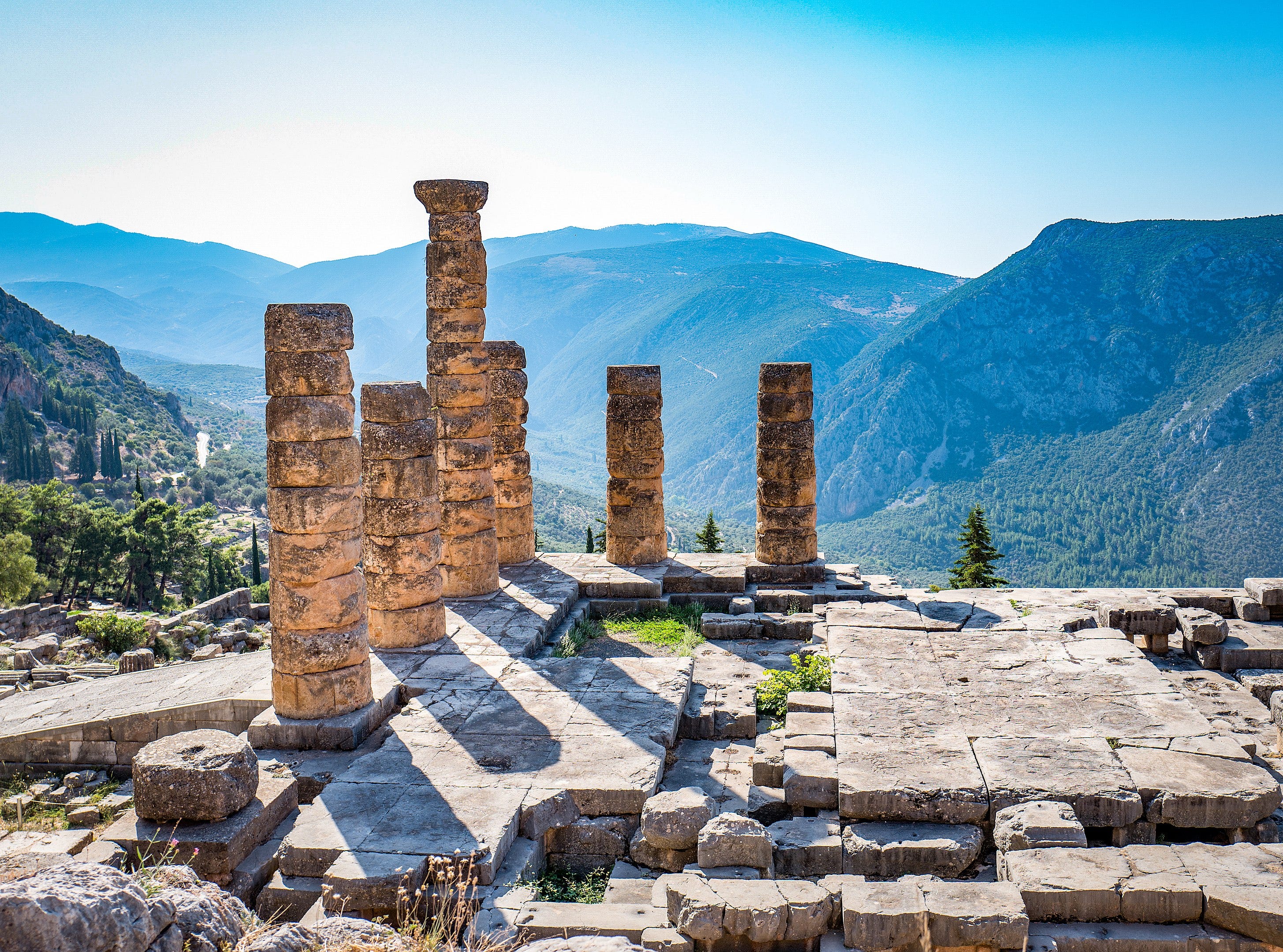
The Oracle of Delphi
How did it come to that? In a bizarre turn of events, Socrates’s eccentric behaviour suddenly became a moral mission when it was seemingly validated by the gods.
The ancient Greeks took oracles very seriously. The belief was that the gods communicated through priests in sacred places. The most sacred place was Delphi, the Ancient Greek equivalent of Rome, Jerusalem or Mecca.
People made visits to the Oracle of Delphi seeking sacred knowledge. The Oracle at Delphi made it known that there was no man wiser than Socrates. This surprised everyone, including Socrates himself.
Confused by the pronouncement of the Oracle, The philosopher decided to find out for himself what made him so wise. He spoke to men known to be wise from all walks of life from religious experts to politicians. In his examinations he found that those men were no wiser than he was about anything of importance.
By his own admission during his trial, Socrates discovered that what made him so wise was his admission that he knew so little. While the men he spoke to were haughty, smug and close-minded by their own sense of authority, Socrates was open-minded and curious.
He would continually question experts to show up their own ignorance. This gained him many powerful enemies. Socrates found himself entangled in the political turmoil in Athens in the wake of its defeat to Sparta.
Socrates was respected as a warrior on the battlefield, but hated as an enemy of the state for his war on arrogance.
Knowledge can deliver us great careers, wealth and popularity. Wisdom can kill all of that: Socrates embraced a life of poverty so that he may continue on his philosophical quest to understand what good is. He believed his mission forbade him from charging money for his teaching.
He had nothing to teach, after all: only the will to challenge received knowledge. The philosopher was liked and scorned in equal measure. But wisdom gave Socrates a superpower: happiness. People marvelled at his resilience, his cheerfulness in the face of the worst possible adversities.
Michel de Montaigne famously wrote “that to philosophise is to learn to die” — in other words how we accept death is a measure of our wisdom. Socrates took death with a calm poise. At his execution, he cheerfully comforted his own followers, who wept uncontrollably.
This is the kind of happiness everyone is looking for. We cannot achieve that kind of happiness by knowing anything in particular. I can learn everything about how serotonin works in the brain, it won’t necessarily make me happy. I can learn how to make millions, that won’t do the trick either.
But I can admit to how much I don’t know, accept my limits and my shortfalls. That in itself is a good start. The path to wisdom is to “know thyself” according to the maxim carved on the Temple of Apollo at Delphi.
If we fully accept — and take responsibility for — the limits of our knowledge, we can make better decisions and understand ourselves better. Expertise has its practical uses, but what use is expertise in matters of the spirit?
Thank you for reading.
If you enjoyed this article, you may also enjoy:Philosophy Books for Self-IsolationYour Reading List for a Better Life When We Come Out of This Crisis medium.com The Sophist
A Collection of Posts by Steven Gambardella
Sign up for The Sophist
By The Sophist
Lessons from history, philosophy and culture to help you get the best from work and life Take a look Get this newsletter
WRITTEN BY
Steven Gambardella
The lessons of philosophy and history, their practical benefits for your life and work. Say hello: stevengambardella@gmail.com
