James Russell Lowell/The Atlantic
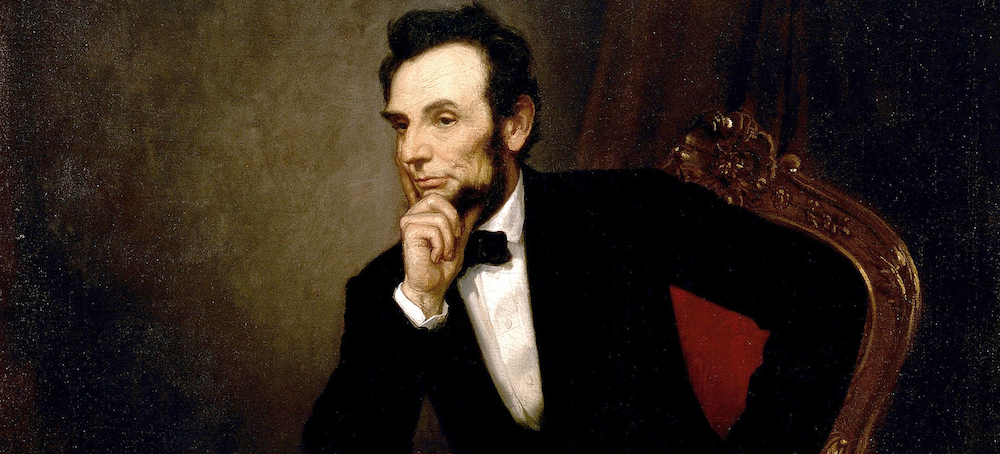 Abraham Lincoln. (photo: GraphicaArtis)
13 february 24 (RSN.org)
EDITOR’S NOTE: “The Atlantic’s editor endorsed Abraham Lincoln for the presidency in the 1860 election, correctly predicting that it would prove to be “a turning-point in our history.” (From 1860)”
While all of us have been watching, with that admiring sympathy which never fails to wait on courage and magnanimity, the career of the new Timoleon in Sicily,–while we have been reckoning, with an interest scarcely less than in some affair of personal concern, the chances and changes that bear with furtherance or hindrance upon the fortune of united Italy, we are approaching, with a quietness and composure which more than anything else mark the essential difference between our own form of democracy and any other yet known in history, a crisis in our domestic policy more momentous than any that has arisen since we became a nation. Indeed, considering the vital consequences for good or evil that will follow from the popular decision in November, we might be tempted to regard the remarkable moderation which has thus far characterized the Presidential canvass as a guilty indifference to the duty implied in the privilege of suffrage, or a stolid unconsciousness of the result which may depend upon its exercise in this particular election, did we not believe that it arose chiefly from the general persuasion that the success of the Republican party was a foregone conclusion.
In a society like ours, where every man may transmute his private thought into history and destiny by dropping it into the ballot-box, a peculiar responsibility rests upon the individual. Nothing can absolve us from doing our best to look at all public questions as citizens, and therefore in some sort as administrators and rulers. For, though during its term of office the government be practically as independent of the popular will as that of Russia, yet every fourth year the people are called upon to pronounce upon the conduct of their affairs. Theoretically, at least, to give democracy any standing-ground for an argument with despotism or oligarchy, a majority of the men composing it should be statesmen and thinkers. It is a proverb, that to turn a radical into a conservative there needs only to put him into office, because then the license of speculation or sentiment is limited by a sense of responsibility,–then for the first time he becomes capable of that comparative view which sees principles and measures, not in the narrow abstract, but in the full breadth of their relations to each other and to political consequences. The theory of democracy presupposes something of these results of official position in the individual voter, since in exercising his right he becomes for the moment an integral part of the governing power.
How very far practice is from any likeness to theory a week’s experience of our politics suffices to convince us. The very government itself seems an organized scramble, and Congress a boys’ debating-club, with the disadvantage of being reported. As our party-creeds are commonly represented less by ideas than by persons, (who are assumed, without too close a scrutiny, to be the exponents of certain ideas,) our politics become personal and narrow to a degree never paralleled, unless in ancient Athens or mediaeval Florence. Our Congress debates and our newspapers discuss, sometimes for day after day, not questions of national interest, not what is wise and right, but what the Honorable Lafayette Skreemer said on the stump, or bad whiskey said for him, half a dozen years ago. If that personage, outraged in all the finer sensibilities of our common nature, by failing to get the contract for supplying the District Court-House at Skreemeropolisville City with revolvers, was led to disparage the union of these States, it is seized on as proof conclusive that the party to which he belongs are so many Catalines,–for Congress is unanimous only in misspelling the name of that oft-invoked conspirator. The next Presidential Election looms always in advance, so that we seem never to have an actual Chief Magistrate, but a prospective one, looking to the chances of reelection, and mingling in all the dirty intrigues of provincial politics with an unhappy talent for making them dirtier. The cheating mirage of the White House lures our public men away from present duties and obligations; and if matters go on as they have gone, we shall need a Committee of Congress to count the spoons in the public plate-closet, whenever a President goes out of office,–with a policeman to watch every member of the Committee. We are kept normally in that most unprofitable of predicaments, a state of transition, and politicians measure their words and deeds by a standard of immediate and temporary expediency,–an expediency not as concerning the nation, but which, if more than merely personal, is no wider than the interests of party.
Is all this a result of the failure of democratic institutions? Rather of the fact that those institutions have never yet had a fair trial, and that for the last thirty years an abnormal element has been acting adversely with continually increasing strength. Whatever be the effect of slavery upon the States where it exists, there can be no doubt that its moral influence upon the North has been most disastrous. It has compelled our politicians into that first fatal compromise with their moral instincts and hereditary principles which makes all consequent ones easy; it has accustomed us to makeshifts instead of statesmanship, to subterfuge instead of policy, to party-platforms for opinions, and to a defiance of the public sentiment of the civilized world for patriotism. We have been asked to admit, first, that it was a necessary evil; then that it was a good both to master and slave; then that it was the corner-stone of free institutions; then that it was a system divinely instituted under the Old Law and sanctioned under the New. With a representation, three-fifths of it based on the assumption that negroes are men, the South turns upon us and insists on our acknowledging that they are things. After compelling her Northern allies to pronounce the “free and equal” clause of the preamble to the Declaration of Independence (because it stood in the way of enslaving men) a manifest absurdity, she has declared, through the Supreme Court of the United States, that negroes are not men in the ordinary meaning of the word. To eat dirt is bad enough, but to find that we have eaten more than was necessary may chance to give us an indigestion. The slaveholding interest has gone on step by step, forcing concession after concession, till it needs but little to secure it forever in the political supremacy of the country. Yield to its latest demand,–let it mould the evil destiny of the Territories,–and the thing is done past recall. The next Presidential Election is to say Yes or No.
But we should not regard the mere question of political preponderancy as of vital consequence, did it not involve a continually increasing moral degradation on the part of the Nonslaveholding States,–for Free States they could not be called much longer. Sordid and materialistic views of the true value and objects of society and government are professed more and more openly by the leaders of popular outcry, if it cannot be called public opinion. That side of human nature which it has been the object of all law-givers and moralists to repress and subjugate is flattered and caressed; whatever is profitable is right; and already the slave-trade, as yielding a greater return on the capital invested than any other traffic, is lauded as the highest achievement of human reason and justice. Mr. Hammond has proclaimed the accession of King Cotton, but he seems to have forgotten that history is not without examples of kings who have lost their crowns through the folly and false security of their ministers. It is quite true that there is a large class of reasoners who would weigh all questions of right and wrong in the balance of trade; but we cannot bring ourselves to believe that it is a wise political economy which makes cotton by unmaking men, or a far-seeing statesmanship which looks on an immediate money-profit as a safe equivalent for a beggared public sentiment. We think Mr. Hammond even a little premature in proclaiming the new Pretender. The election of November may prove a Culloden. Whatever its result, it is to settle, for many years to come, the question whether the American idea is to govern this continent, whether the Occidental or the Oriental theory of society is to mould our future, whether we are to recede from principles which eighteen Christian centuries have been slowly establishing at the cost of so many saintly lives at the stake and so many heroic ones on the scaffold and the battle field, in favor of some fancied assimilation to the household arrangements of Abraham, of which all that can be said with certainty is that they did not add to his domestic happiness.
We believe that this election is a turning-point in our history; for, although there are four candidates, there are really, as everybody knows, but two parties, and a single question that divides them. The supporters of Messrs. Bell and Everett have adopted as their platform the Constitution, the Union, and the enforcement of the Laws. This may be very convenient, but it is surely not very explicit. The cardinal question on which the whole policy of the country is to turn–a question, too, which this very election must decide in one way or the other–is the interpretation to be put upon certain clauses of the Constitution. All the other parties equally assert their loyalty to that instrument. Indeed, it is quite the fashion. The removers of all the ancient landmarks of our policy, the violators of thrice-pledged faith, the planners of new treachery to established compromise, all take refuge in the Constitution,–
“Like thieves that in a hemp-plot lie,
Secure against the hue and cry.”
In the same way the first Bonaparte renewed his profession of faith in the Revolution at every convenient opportunity; and the second follows the precedent of his uncle, though the uninitiated fail to see any logical sequence from 1789 to 1815 or 1860. If Mr. Bell loves the Constitution, Mr. Breckinridge is equally fond; that Egeria of our statesmen could be “happy with either, were t’other dear charmer away.” Mr. Douglas confides the secret of his passion to the unloquacious clams of Rhode Island, and the chief complaint made against Mr. Lincoln by his opponents is that he is TOO Constitutional.
Meanwhile the only point in which voters are interested is,–What do they mean by the Constitution? Mr. Breckinridge means the superiority of a certain exceptional species of property over all others, nay, over man himself. Mr. Douglas, with a different formula for expressing it, means practically the same thing. Both of them mean that Labor has no rights which Capital is bound to respect,–that there is no higher law than human interest and cupidity. Both of them represent not merely the narrow principles of a section, but the still narrower and more selfish ones of a caste. Both of them, to be sure, have convenient phrases to be juggled with before election, and which mean one thing or another, or neither one thing nor another, as a particular exigency may seem to require; but since both claim the regular Democratic nomination, we have little difficulty in divining what their course would be after the fourth of March, if they should chance to be elected. We know too well what regular Democracy is, to like either of the two faces which each shows by turns under the same hood. Everybody remembers Baron Grimm’s story of the Parisian showman, who in 1789 exhibited the royal Bengal tiger under the new character of national, as more in harmony with the changed order of things. Could the animal have lived till 1848, he would probably have found himself offered to the discriminating public as the democratic and social ornament of the jungle. The Pro-slavery party of this country seeks the popular favor under even more frequent and incongruous aliases: it is now national, now conservative, now constitutional; here it represents Squatter Sovereignty, and there the power of Congress over the Territories; but, under whatever name, its nature remains unchanged, and its instincts are none the less predatory and destructive.
Mr. Lincoln’s position is set forth with sufficient precision in the platform adopted by the Chicago Convention; but what are we to make of Messrs. Bell and Everett? Heirs of the stock in trade of two defunct parties, the Whig and Know-Nothing, do they hope to resuscitate them? or are they only like the inconsolable widows of Pere la Chaise, who, with an eye to former customers, make use of the late Andsoforth’s gravestone to advertise that they still carry on the business at the old stand? Mr. Everett, in his letter accepting the nomination, gave us only a string of reasons why he should not have accepted it at all; and Mr. Bell preserves a silence singularly at variance with his patronymic. The only public demonstration of principle that we have seen is an emblematic bell drawn upon a wagon by a single horse, with a man to lead him, and a boy to make a nuisance of the tinkling symbol as it moves along. Are all the figures in this melancholy procession equally emblematic? If so, which of the two candidates is typified in the unfortunate who leads the horse?–for we believe the only hope of the party is to get one of them elected by some hocus-pocus in the House of Representatives. The little boy, we suppose, is intended to represent the party, which promises to be so conveniently small that there will be an office for every member of it, if its candidate should win. Did not the bell convey a plain allusion to the leading name on the ticket, we should conceive it an excellent type of the hollowness of those fears for the safety of the Union, in case of Mr. Lincoln’s election, whose changes are so loudly rung,–its noise having once or twice given rise to false alarms of fire, till people found out what it really was. Whatever profound moral it be intended to convey, we find in it a similitude that is not without significance as regards the professed creed of the party. The industrious youth who operates upon it has evidently some notion of the measured and regular motion that befits the tongues of well-disciplined and conservative bells. He does his best to make theory and practice coincide; but with every jolt on the road an involuntary variation is produced, and the sonorous pulsation becomes rapid or slow accordingly. We have observed that the Constitution was liable to similar derangements, and we very much doubt whether Mr. Bell himself (since, after all, the Constitution would practically be nothing else than his interpretation of it) would keep the same measured tones that are so easy on the smooth path of candidacy, when it came to conducting the car of State over some of the rough places in the highway of Manifest Destiny, and some of those passages in our politics which, after the fashion of new countries, are rather corduroy in character.
But, fortunately, we are not left wholly in the dark as to the aims of the self-styled Constitutional party. One of its most distinguished members, Governor Hunt of New York, has given us to understand that its prime object is the defeat at all hazards of the Republican candidate. To achieve so desirable an end, its leaders are ready to coalesce, here with the Douglas, and there with the Breckinridge faction of that very Democratic party of whose violations of the Constitution, corruption, and dangerous limberness of principle they have been the lifelong denouncers. In point of fact, then, it is perfectly plain that we have only two parties in the field: those who favor the extension of slavery, and those who oppose it,–in other words, a Destructive and a Conservative party.
We know very well that the partisans of Mr. Bell, Mr. Douglas, and Mr. Breckinridge all equally claim the title of conservative: and the fact is a very curious one, well worthy the consideration of those foreign critics who argue that the inevitable tendency of democracy is to compel larger and larger concessions to a certain assumed communistic propensity and hostility to the rights of property on the part of the working classes. But the truth is, that revolutionary ideas are promoted, not by any unthinking hostility to the rights of property, but by a well-founded jealousy of its usurpations; and it is Privilege, and not Property, that is perplexed with fear of change. The conservative effect of ownership operates with as much force on the man with a hundred dollars in an old stocking as on his neighbor with a million in the funds. During the Roman Revolution of ’48, the beggars who had funded their gains were among the stanchest reactionaries, and left Rome with the nobility. No question of the abstract right of property has ever entered directly into our politics, or ever will, -the point at issue being, whether a certain exceptional kind of property, already privileged beyond all others, shall be entitled to still further privileges at the expense of every other kind. The extension of slavery over new territory means just this,–that this one kind of property, not recognized as such by the Constitution, or it would never have been allowed to enter into the basis of representation, shall control the foreign and domestic policy of the Republic.
A great deal is said, to be sure, about the rights of the South; but has any such right been infringed? when a man invests money in any species of property, he assumes the risks to which it is liable. If he buy a house, it may be burned; if a ship, it may be wrecked; if a horse or an ox, it may die. Now the disadvantage of the Southern kind of property is,–how shall we say it so as not to violate our Constitutional obligations?–that it is exceptional. When it leaves Virginia, it is a thing; when it arrives in Boston, it becomes a man, speaks human language, appeals to the justice of the same God whom we all acknowledge, weeps at the memory of wife and children left behind,–in short, hath the same organs and dimension that a Christian hath, and is not distinguishable from ordinary Christians, except, perhaps, by a simpler and more earnest faith. There are people at the North who believe, that, beside meum and tuum, there is also such a thing as suum,–who are old-fashioned enough, or weak enough, to have their feelings touched by these things, to think that human nature is older and more sacred than any claim of property whatever, and that it has rights at least as much to be respected as any hypothetical one of our Southern brethren. This, no doubt, makes it harder to recover a fugitive chattel; but the existence of human nature in a man here and there is surely one of those accidents to be counted on at least as often as fire, shipwreck, or the cattle-disease; and the man who chooses to put his money into these images of his Maker cut in ebony should be content to take the incident risks along with the advantages. We should be very sorry to deem this risk capable of diminution; for we think that the claims of a common manhood upon us should be at least as strong as those of Freemasonry, and that those whom the law of man turns away should find in the larger charity of the law of God and Nature a readier welcome and surer sanctuary. We shall continue to think the negro a man, and on Southern evidence, too, as long as he is counted in the population represented on the floor of Congress,–for three-fifths of perfect manhood would be a high average even among white men; as long as he is hanged or worse, as an example and terror to others,–for we do not punish one animal for the moral improvement of the rest; as long as he is considered capable of religious instruction,–for we fancy the gorillas would make short work with a missionary; as long as there are fears of insurrection,–for we never heard of a combined effort at revolt in a menagerie. Accordingly, we do not see how the particular right of whose infringement we hear so much is to be made safer by the election of Mr. Bell, Mr. Breckinridge, or Mr. Douglas,–there being quite as little chance that any of them would abolish human nature as that Mr. Lincoln would abolish slavery. The same generous instinct that leads some among us to sympathize with the sorrows of the bereaved master will always, we fear, influence others to take part with the rescued man.
But if our Constitutional Obligations, as we like to call our constitutional timidity or indifference, teach us that a particular divinity hedges the Domestic Institution, they do not require us to forget that we have institutions of our own, worth maintaining and extending, and not without a certain sacredness, whether we regard the traditions of the fathers or the faith of the children. It is high time that we should hear something of the rights of the Free States, and of the duties consequent upon them. We also have our prejudices to be respected, our theory of civilization, of what constitutes the safety of a state and insures its prosperity, to be applied wherever there is soil enough for a human being to stand on and thank God for making him a man. Is conservatism applicable only to property, and not to justice, freedom, and public honor? Does it mean merely drifting with the current of evil times and pernicious counsels, and carefully nursing the ills we have, that they may, as their nature it is, grow worse?
To be told that we ought not to agitate the question of Slavery, when it is that which is forever agitating us, is like telling a man with the fever and ague on him to stop shaking and he will be cured. The discussion of Slavery is said to be dangerous, but dangerous to what? The manufacturers of the Free States constitute a more numerous class than the slaveholders of the South: suppose they should claim an equal sanctity for the Protective System. Discussion is the very life of free institutions, the fruitful mother of all political and moral enlightenment, and yet the question of all questions must be tabooed. The Swiss guide enjoins silence in the region of avalanches, lest the mere vibration of the voice should dislodge the ruin clinging by frail roots of snow. But where is our avalanche to fall? It is to overwhelm the Union, we are told. The real danger to the Union will come when the encroachments of the Slave-Power and the concessions of the Trade-Power shall have made it a burden instead of a blessing. The real avalanche to be dreaded, are we to expect it from the ever-gathering mass of ignorant brute force, with the irresponsibility of animals and the passions of men, which is one of the fatal necessities of slavery, or from the gradually increasing consciousness of the non slaveholding population of the Slave States of the true cause of their material impoverishment and political inferiority? From one or the other source its ruinous forces will be fed, but in either event it is not the Union that will be imperiled, but the privileged Order who on every occasion of a thwarted whim have menaced its disruption, and who will then find in it their only safety.
We believe that the “irrepressible conflict”–for we accept Mr. Seward’s much-denounced phrase in all the breadth of meaning he ever meant to give it–is to take place in the South itself; because the Slave-System is one of those fearful blunders in political economy which are sure, sooner or later, to work their own retribution. The inevitable tendency of slavery is to concentrate in a few hands the soil, the capital, and the power of the countries where it exists, to reduce the non-slaveholding class to a continually lower and lower level of property, intelligence, and enterprise,–their increase in number adding much to the economical hardship of their position and nothing to their political weight in the communities where education induces refinement, where facility of communication stimulates invention and variety of enterprise, where newspapers make every man’s improvement in tools, machinery, or culture of the soil an incitement to all, and bring all the thinkers of the world to teach in the cheap university of the people. We do not, of course, mean to say that slaveholding states may not and do not produce fine men; but they fail, by the inherent vice of their constitution and its attendant consequences, to create enlightened, powerful, and advancing communities of men, which is the true object of all political organizations, and which is essential to the prolonged existence of all those whose life and spirit are derived directly from the people. Every man who has dispassionately endeavored to enlighten himself in the matter cannot but see, that, for the many, the course of things in slaveholding states is substantially what we have described, a downward one, more or less rapid, in civilization and in all those results of material prosperity which in a free country show themselves in the general advancement for the good of all and give a real meaning to the word Commonwealth. No matter how enormous the wealth centred in the hands of a few, it has no longer the conservative force or the beneficent influence which it exerts when equably distributed,—even loses more of both where a system of absenteeism prevails so largely as in the South. In such communities the seeds of an “irrepressible conflict” are surely, if slowly, ripening, and signs are daily multiplying that the true peril to their social organization is looked for, less in a revolt of the owned labor than in an insurrection of intelligence in the labor that owns itself and finds itself none the richer for it. To multiply such communities is to multiply weakness.
The election in November turns on the single and simple question, Whether we shall consent to the indefinite multiplication of them; and the only party which stands plainly and unequivocally pledged against such a policy, nay, which is not either openly or impliedly in favor of it, is the Republican party. We are of those who at first regretted that another candidate was not nominated at Chicago; but we confess that we have ceased to regret it, for the magnanimity of Mr. Seward since the result of the Convention was known has been a greater ornament to him and a greater honor to his party than his election to the Presidency would have been. We should have been pleased with Mr. Seward’s nomination, for the very reason we have seen assigned for passing him by,–that he represented the most advanced doctrines of his party. He, more than any other man, combined in himself the moralist’s oppugnancy to Slavery as a fact, the thinker’s resentment of it as a theory, and the statist’s distrust of it as a policy,–thus summing up the three efficient causes that have chiefly aroused and concentrated the antagonism of the Free States. Not a brilliant man, he has that best gift of nature, which brilliant men commonly lack, of being always able to do his best; and the very misrepresentation of his opinions which was resorted to in order to neutralize the effect of his speeches in the Senate and elsewhere was the best testimony to their power. Safe from the prevailing epidemic of Congressional eloquence as if he had been inoculated for it early in his career, he addresses himself to the reason, and what he says sticks. It was assumed that his nomination would have embittered the contest and tainted the Republican creed with radicalism ; but we doubt it. We cannot think that a party gains by not hitting its hardest, or by sugaring its opinions. Republicanism is not a conspiracy to obtain office under false pretenses. It has a definite aim, an earnest purpose, and the unflinching tenacity of profound conviction. It was not called into being by a desire to reform the pecuniary corruptions of the party now in power. Mr. Bell or Mr. Breckinridge would do that, for no one doubts their honor or their honesty. It is not unanimous about the Tariff, about State-Rights, about many other questions of policy. What unites the Republicans is a common faith in the early principles and practice of the Republic, a common persuasion that slavery, as it cannot but be the natural foe of the one, has been the chief debaser of the other, and a common resolve to resist its encroachments everywhen and everywhere. They see no reason to fear that the Constitution, which has shown such pliant tenacity under the warps and twistings of a forty-years’ proslavery pressure, should be in danger of breaking, if bent backward again gently to its original rectitude of fibre. “All forms of human government,” says Machiavelli, “have, like men, their natural term, and those only are long-lived which possess in themselves the power of returning to the principles on which they were originally founded.”
It is in a moral aversion to slavery as a great wrong that the chief strength of the Republican party lies. They believe as everybody believed sixty years ago; and we are sorry to see what appears to be an inclination in some quarters to blink this aspect of the case, lest the party be charged with want of conservatism, or, what is worse, with abolitionism. It is and will be charged with all kinds of dreadful things, whatever it does, and it has nothing to fear from an upright and downright declaration of its faith. One part of the grateful work it has to do is to deliver us from the curse of perpetual concession for the sake of a peace that never comes, and which, if it came, would not be peace, but submission,–from that torpor and imbecility of faith in God and man which have stolen the respectable name of Conservatism. A question which cuts so deep as the one which now divides the country cannot be debated, much less settled, without excitement. Such excitement is healthy, and is a sign that the ill humors of the body politic are coming to the surface, where they are comparatively harmless. It is the tendency of all creeds, opinions, and political dogmas that have once defined themselves in institutions to become inoperative. The vital and formative principle, which was active during the process of crystallization into sects, or schools of thought, or governments, ceases to act; and what was once a living emanation of the Eternal Mind, organically operative in history, becomes the dead formula on men’s lips and the dry topic of the annalist. It has been our good fortune that a question has been thrust upon us which has forced us to reconsider the primal principles of government, which has appealed to conscience as well as reason, and, by bringing the theories of the Declaration of Independence to the test of experience in our thought and life and action, has realized a tradition of the memory into a conviction of the understanding and the soul. It will not do for the Republicans to confine themselves to the mere political argument, for the matter then becomes one of expediency, with two defensible sides to it; they must go deeper, to the radical question of Right and Wrong, or they surrender the chief advantage of their position. What Spinoza says of laws is equally true of party-platforms,–that those are strong which appeal to reason, but those are impregnable which compell the assent both of reason and the common affections of mankind.
No man pretends that under the Constitution there is any possibility of interference with the domestic relations of the individual States; no party has ever remotely hinted at any such interference; but what the Republicans affirm is, that in every contingency where the Constitution can be construed in favor of freedom, it ought to be and shall be so construed. It is idle to talk of sectionalism, abolitionism, and hostility to the laws. The principles of liberty and humanity cannot, by virtue of their very nature, be sectional, any more than light and heat. Prevention is not abolition, and unjust laws are the only serious enemies that Law ever had. With history before us, it is no treason to question the infallibility of a court; for courts are never wiser or more venerable than the men composing them, and a decision that reverses precedent cannot arrogate to itself any immunity from reversal. Truth is the only unrepealable thing.
We are gravely requested to have no opinion, or, having one, to suppress it, on the one topic that has occupied caucuses, newspapers, Presidents’ messages, and congress, for the last dozen years, lest we endanger the safety of the Union. The true danger to popular forms of government begins when public opinion ceases because the people are incompetent or unwilling to think. In a democracy it is the duty of every citizen to think; but unless the thinking result in a definite opinion, and the opinion lead to considerate action, they are nothing. If the people are assumed to be incapable of forming a judgment for themselves, the men whose position enables them to guide the public mind ought certainly to make good their want of intelligence. But on this great question, the wise solution of which, we are every day assured, is essential to the permanence of the Union, Mr. Bell has no opinion at all, Mr. Douglas says it is of no consequence which opinion prevails, and Mr. Breckinridge tells us vaguely that “all sections have an equal right in the common Territories.” The parties which support these candidates, however, all agree in affirming that the election of its special favorite is the one thing that can give back peace to the distracted country. The distracted country will continue to take care of itself, as it has done hitherto, and the only question that needs an answer is, What policy will secure the most prosperous future to the helpless Territories, which our decision is to make or mar for all coming time? What will save the country from a Senate and Supreme Court where freedom shall be forever at a disadvantage?
There is always a fallacy in the argument of the opponents of the Republican party. They affirm that all the States and all the citizens of the States ought to have equal rights in the Territories. Undoubtedly. But the difficulty is that they cannot. The slaveholder moves into a new Territory with his institution, and from that moment the free white settler is virtually excluded. His institutions he cannot take with him; they refuse to root themselves in soil that is cultivated by slave-labor. Speech is no longer free; the post-office is Austrianized; the mere fact of Northern birth may be enough to hang him. Even now in Texas, settlers from the Free States are being driven out and murdered for pretended complicity in a plot the evidence for the existence of which has been obtained by means without a parallel since the trial of the Salem witches, and the stories about which are as absurd and contradictory as the confessions of Goodwife Corey. Kansas was saved, it is true; but it was the experience of Kansas that disgusted the South with Mr. Douglas’s panacea of “Squatter Sovereignty.”
The claim of equal rights in the Territories is a specious fallacy. Concede the demand of the slavery-extensionists, and you give up every inch of territory to slavery, to the absolute exclusion of freedom. For what they ask (however they may disguise it) is simply this,–that their local law be made the law of the land, and coextensive with the limits of the General Government. The Constitution acknowledges no unqualified or interminable right of property in the labor of another; and the plausible assertion, that “that is property which the law makes property,” (confounding a law existing anywhere with the law which is binding everywhere,) can deceive only those who have either never read the Constitution or are ignorant of the opinions and intentions of those who framed it. It is true only of the States where slavery already exists; and it is because the propagandists of slavery are well aware of this, that they are so anxious to establish by positive enactment the seemingly moderate title to a right of existence for their institution in the Territories,–a title which they do not possess, and the possession of which would give them the oyster and the Free States the shells. Laws accordingly are asked for to protect the inhabitants from deciding for themselves what their frame of government shall be. Such laws will be passed, and the fairest portion of our national domain irrevocably closed to free labor, if the Non-Slaveholding States fail to do their duty in the present crisis.
But will the election of Mr. Lincoln endanger the Union? It is not a little remarkable, that, as the prospect of his success increases, the menaces of secession grow fainter and less frequent. Mr. W. L. Yancey, to be sure, threatens to secede; but the country can get along without him, and we wish him a prosperous career in foreign parts. But Governor Wise no longer proposes to seize the Treasury at Washington,–perhaps because Mr. Buchanan has left so little in it. The old Mumbo-Jumbo is occasionally paraded at the North, but, however many old women may be frightened, the pulse of the stock-market remains provokingly calm. General Cushing, infringing the patent-right of the late Mr. James the novelist, has seen a solitary horseman on the edge of the horizon. The exegesis of the vision has been various, some thinking that it means a Military Despot,–though in that case the force of cavalry would seem to be inadequate,–and others the Pony Express. If it had been one rider on two horses, the application would have been more general and less obscure. In fact, the old cry of Disunion has lost its terrors, if it ever had any, at the North. The South itself seems to have become alarmed at its own scarecrow, and speakers there are beginning to assure their hearers that the election of Mr. Lincoln will do them no harm. We entirely agree with them, for it will save them from themselves.
To believe any organized attempt by the Republican party to disturb the existing internal policy of the Southern States possible presupposes a manifest absurdity. Before anything of the kind could take place, the country must be in a state of forcible revolution. But there is no premonitory symptom of any such convulsion, unless we except Mr. Yancy, and that gentleman’s throwing a solitary somerset will hardly turn the continent head over heels. The administration of Mr. Lincoln will be conservative, because no government is ever intentionally otherwise, and because power never knowingly undermines the foundation on which it rests. All that the Free States demand is that influence in the councils of the nation to which they are justly entitled by their population, wealth, and intelligence. That these elements of prosperity have increased more rapidly among them than in communities otherwise organized, with greater advantages of soil, climate, and mineral productions, is certainly no argument that they are incapable of the duties of efficient and prudent administration, however strong a one it may be for their endeavoring to secure for the Territories the single superiority that has made them what they are. The object of the Republican party is not the abolition of African slavery, but the utter extirpation of dogmas which are the logical sequence of the attempts to establish its righteousness and wisdom, and which would serve equally well to justify the enslavement of every white man unable to protect himself. They believe that slavery is a wrong morally, a mistake politically, and a misfortune practically, wherever it exists; that it has nullified our influence abroad and forced us to compromise with our better instincts at home; that it has perverted our government from its legitimate objects, weakened the respect for the laws by making them the tools of its purposes, and sapped the faith of men in any higher political morality than interest or any better statesmanship than chicane. They mean in every lawful way to hem it within its present limits.
We are persuaded that the election of Mr. Lincoln will do more than anything else to appease the excitement of the country. He has proved both his ability and his integrity; he has had experience enough in public affairs to make him a statesman, and not enough to make him a politician. That he has not had more will be no objection to him in the eyes of those who have seen the administration of the experienced public functionary whose term of office is just drawing to a close. He represents a party who know that true policy is gradual in its advances, that it is conditional and not absolute, that it must deal with fact and not with sentiments, but who know also that it is wiser to stamp out evil in the spark than to wait till there is no help but in fighting fire with fire. They are the only conservative party, because they are the only one based on an enduring principle, the only one that is not willing to pawn tomorrow for the means to gamble with today. They have no hostility to the South, but a determined one to doctrines of whose ruinous tendency every day more and more convinces them.
The encroachments of Slavery upon our national policy have been like those of a glacier in a Swiss valley. Inch by inch, the huge dragon with his glittering scales and crests of ice coils itself onward, an anachronism of summer, the relic of a bygone world where such monsters swarmed. But it has its limit, the kindlier forces of Nature work against it, and the silent arrows of the sun are still, as of old, fatal to the frosty Python. Geology tells us that such enormous devastators once covered the face of the earth, but the benignant sunlight of heaven touched them, and they faded silently, leaving no trace but here and there the scratches of their talons, and the gnawed boulders scattered where they made their lair. We have entire faith in the benignant influence of Truth, the sunlight of the moral world, and believe that slavery, like other worn-out systems, will melt gradually before it. “All the earth cries out upon Truth, and the heaven blesseth it; ill works shake and tremble at it, and with it is no unrighteous thing.”


THE TRUELOVE