Solving the Cause of Parkinson’s Disease, As An Academic in This Field

Building on and completing the “gut-first hypothesis” of Parkinson’s disease (PD).

Shin Jie Yong, MSc (Res)

Shin Jie Yong, MSc (Res)

1 day ago (shinjieyong.medium.com)

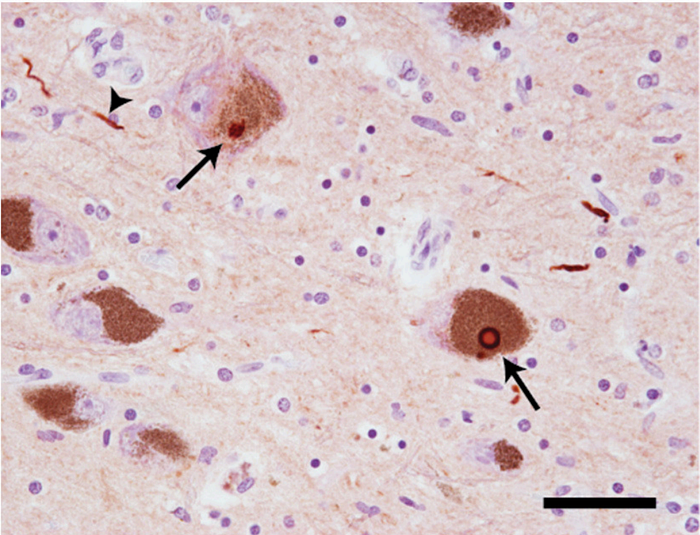
Figure 1. Neurotoxic Lewy bodies (arrowheads) and Lewy neurites (arrows) comprising α-synuclein aggregates in the brain of a PD patient. Source: Ingelsson (2016).

For my Master’s degree in Science (by research), my thesis was on Parkinson’s disease (PD), where I studied its disease mechanism and potential treatments in lab-grown neurons. Naturally, I knew a fair bit about PD in general from my 2–3 years of master’s research.

For those unfamiliar, PD is a motor disorder due to degenerated neurons in the brain that control movement. As a result, PD patients show motor deficit signs such as tremors (shaking) and bradykinesia (slow movement). PD is quite common, being the second most common neurodegenerative disease after Alzheimer’s disease (AD). Muhammad Ali, known as the greatest boxer of all time, for example, suffered from PD.

But to this day, the cause of PD remains unclear, and there’s no cure. One of the hot topics about the cause of PD is the gut-first hypothesis, where α-synuclein protein becomes misfolded in the gut and spreads to the brain via the vagus nerve (Figure 2). Misfolded α-synuclein then aggregates into neurotoxic Lewy bodies and neurites (Figure 1). To this day, this topic remains heavily discussed in academia and major news outlets.

As an academic who has studied this disease for years, let me tell you the fascinating story about the gut-first hypothesis and how it fits another lesser-known hypothesis to decode the cause of PD.
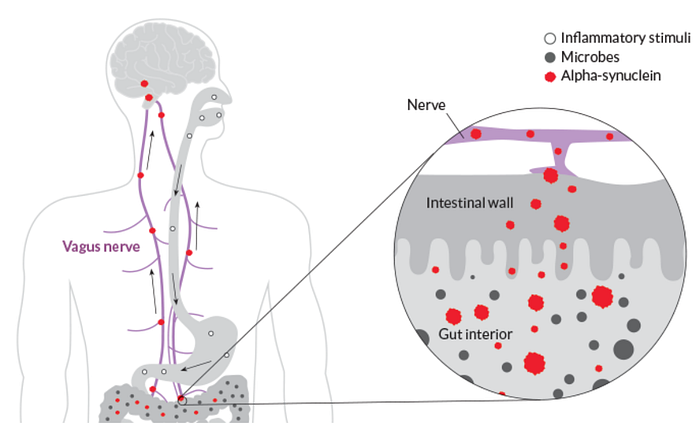
Figure 2. The gut-first hypothesis of PD, where misfolded α-synuclein originates from the gut and spreads to the brainstem via the vagus nerve. Source: Beil and Chang (2018).

The gut-first hypothesis of PD

Professor Heiko Braak, MD, is an ingenious German neuroanatomist known for characterizing the stages of disease progression of Alzheimer’s and Parkinson’s diseases (AD and PD), the two most common neurodegenerative diseases worldwide.

In a 2003 study, Braak et al. performed autopsy analyses on the brain samples of 110 people with PD and 58 healthy people. They found the earliest signs of α-synuclein aggregates were always at (i) the dorsal motor nucleus of the brainstem, where the vagus nerve connects, and (ii) at the olfactory bulb, though less frequent than the brainstem (Figure 3).

The vagus nerve is the longest nerve in the body. It connects the brainstem, the base of the brain, to various organs, including the enteric nervous system of the gastrointestinal tract. This allows for two-way communication between the brain and other organs.

Figure 3. Partial table of the autopsy study of Braak et al. (2003). The degree of α-synuclein aggregates is assessed semiquantitatively and indicated by: −, absent or not discernible, +, slight; ++, moderate; +++, severe; n.e.: not evaluated. Examined brain regions include the olfactory bulb (ol), dorsal motor nucleus (dm) of the brainstem, nucleus raphes magnus (rm), coeruleus complex (co), substantial nigra (sn), and others.

Subsequent studies managed to identify the presence of α-synuclein aggregates in the gutstomach wall, and lower esophagus, which are all connected to the enteric nervous system.

The enteric nervous system is basically nerves that innervate the walls of the entire gastrointestinal tract. It’s popularly known as the ‘second brain’ because it’s the most complex nervous system outside the brain.

Importantly, signs of α-synuclein aggregates in the gastrointestinal tract began to appear in the early stages of PD, before such aggregates even appeared in the brain. This rules out a common argument against the gut-first hypothesis of PD — that these aggregates still originate in the brain but spread to the enteric nervous system later. Put simply, α-synuclein seems to aggregate in the gastrointestinal tract first, not the brain.

Animal research further supports the gut-first hypothesis of PD. In a 2019 study, scientists from Johns Hopkins University injected misfolded α-synuclein into the stomach and gut of healthy mice. After a month, α-synuclein aggregates were found in the brainstem. By 10 months, such aggregates spread throughout the brain, and the mice exhibited symptoms of motor deficit similar to PD. Cutting the vagus nerve, however, prevented the spread of α-synuclein into the brain (Figure 4).

This study is valuable because it demonstrates cause-and-effect that’s not feasible in humans. After all, it’s unethical to inject a toxic substance into humans. So, this animal study convincingly showed that α-synuclein could spread from the gut to the brain via the vagus nerve.

Figure 4. Left: The spread of α-synuclein into the brain when it is injected into the stomach and gut of mice, as denoted by the red routes. Right: The spread of aggregated α-synuclein (purple) from the gut to brain is absent in mice that underwent vagotomy. Source: Kim et al. (2019).

Even in humans, studies found those whose vagus nerve is cut via vagotomy had a lower risk of developing PD than those with intact vagus nerve. But the effect size of this association is weak, and it doesn’t show whether the protective effect of vagotomy stems from preventing the spread of α-synuclein from the gut to the brain. Nevertheless, it implies the vagus nerve is important in PD development.

(Vagotomy, i.e., cutting the vagus nerve, is a last-resort medical intervention for severe cases of peptic ulcer, which reduces the secretion of stomach acid. But, depending on where it’s cut, vagotomy can cause some side effects, such as slowing peristalsis and decreasing bile and enzyme secretions from the liver, gallbladder, and pancreas.)

If α-synuclein aggregation begins in the gut, gastrointestinal symptoms should predate the onset of PD, which occurs when neurodegeneration in the brain is so extensive that the brain fails to control body movement. Indeed, multiple cohort studies, including a 2023 study, reported that gastrointestinal symptoms such as constipation, swallowing difficulty, and bloating increase the risk of developing PD later.

Overall, the evidence is convincing that the origin of PD begins in the gut. When Braak first proposed the gut-first hypothesis of PD in 2003, not many found it believable. But more than 20 years later, his hypothesis stands strong amidst further scientific scrutiny.

What triggers the misfolding?

Now, the big question is what triggers the misfolding and aggregation of α-synuclein in the gut? Akin to how β-amyloid aggregation is the distinct hallmark of AD, α-synuclein is the same for PD — this much is clear.

Braak hypothesized some sort of an enigmatic virus triggering the first misfolded α-synuclein, which then catalyzes further misfolding and eventually aggregation of α-synuclein that’s toxic to neurons. Alternatively, the virus could spread from the gut to the brain via the vagus nerve, seeding α-synuclein aggregation along the way (Figure 5).

In a 2003 paper, Braak et al. wrote PD “might originate outside of the central nervous system, caused by a yet unidentified pathogen that is capable of passing the mucosal barrier of the gastrointestinal tract.” This unidentified pathogen may then infiltrate the brain via the vagus nerve.

In a subsequent paper in 2007, Braak and colleagues proposed the “dual-hit hypothesis” to account for the early appearance of α-synuclein aggregates in the olfactory bulb in addition to the gut. The olfactory bulb is a brain region where the olfactory nerves connect to the nose.

“We propose that a neurotropic pathogen, probably viral, enters the brain via two routes: (i) nasal, with anterograde progression into the temporal lobe; and (ii) gastric, secondary to swallowing of nasal secretions in saliva,” Braak et al. wrote. “It is concluded that the most parsimonious explanation for the initial events of sporadic Parkinson’s disease is pathogenic access to the brain through the stomach and nose — hence the term ‘dual‐hit’.”
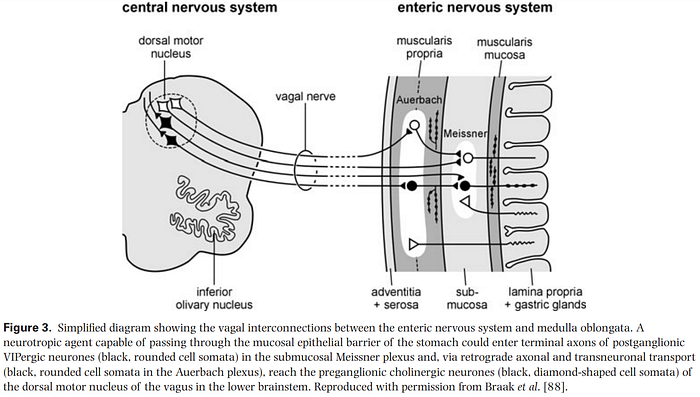
Figure 5. A diagram depicting a potential route for a pathogen to cross the stomach wall and infect enteric neurons that innervate the stomach wall. Such enteric neurons are connected to the vagus nerve, which is then connected to the dorsal motor or vagal nucleus of the brainstem. Source: Braack et al. (2007).

What pathogen or virus is capable of inducing α-synuclein aggregation then? Braak et al. aren’t sure of any specific pathogen but did point out that the influenza virus could be a culprit.

Influenza has been suspected to be a risk factor for PD for decades. This suspicion stems from the observation that PD incidence soared to 2.5–3% in the US in 1940–1950s after the 1918 influenza pandemic, which returned to baseline at 1–2% in the following decades.

In animal studiesnasal infection with influenza virus can induce α-synuclein aggregation and neurodegeneration in the brain reminiscent of PD. One study mapped the influenza virus’s infection trajectory, detecting the virus in the lungs first, followed by the enteric nervous system and the brainstem and other brain regions typically affected in PD. The virus was also detected in the vagal nucleus of the brainstem, suggesting the virus could use the vagus nerve as a conduit to infect the brain.

Another similar study showed that influenza can infiltrate the olfactory bulb and the brain of mice via the olfactory route as well, triggering α-synuclein aggregation along the way. However, this detrimental outcome can be prevented by administering antivirals beforehand.

(Despite being a respiratory virus, some influenza virus strains can infect the nervous system and gastrointestinal tract, similar to SARS-CoV-2).

Interestingly, animal studies also show that neurons in the key brain regions involved in PD continue to degenerate even after the influenza virus is cleared by the immune system. This may explain the absence of the influenza virus during the brain autopsy of deceased PD patients, as sufficient time had elapsed for the body to clear the virus.

A nationwide study further strengthens this case. Using data from Danish National Patient Registry between 1977 to 2016, a 2021 study identified every single case of PD, which was matched to five controls based on age and sex. They ended up with 10,271 PD patients and 51,355 controls for analyses, revealing that prior influenza diagnosis increased the risk of PD by 1.7-fold in later years, an effect not seen with other pathogens.

A more recent nationwide study in Finland and the U.K. also replicated the association between influenza and increased risk of PD (and AD). I covered this study in detail here: “The Case for Virus Origin of Neurodegenerative Diseases Is Getting Stronger and More Important.”

The influenza virus isn’t the sole suspect of PD. Several cohort studies have found consistent evidence of hepatitis C virus and Helicobacter pylori bacterium increasing the risk of PD in later years. One study found that Covid-19 survivors were also at a 1.5-fold elevated risk of PD. The gut microbiome has also been implicated in PD, although we don’t know what’s the precise microbe in the microbiome that’s responsible for this.

Evidence also suggests the risk of PD from pathogens adds up. A 2015 study found the more pathogens someone is positive for, the higher the risk of PD. For instance, testing positive for five or six pathogens increased the risk of PD by 7.8-fold compared to 1.9-fold when testing positive for one or two pathogens only. The pathogens examined were herpes simplex virus 1, cytomegalovirus, Epstein-Barr virus, B. burgdorferi, C. pneumoniae, and H. pylori. Unfortunately, the influenza virus wasn’t examined.

Compounding all this is the fact that α-synuclein also exhibits anti-microbial properties against clinically relevant pathogens. Deleting the α-synuclein gene in mice did not affect the usual nervous system function, but it made them more susceptible to life-threatening infections. Another mice study showed that α-synuclein colocalizes with viral capsids in neurons to prevent further replication and spread of the virus.

The anti-microbial activities of α-synuclein are an important piece of the puzzle as they suggest that α-synuclein aggregation could be a defense mechanism against pathogens that infect the nervous system.

What accelerates the misfolding?

However, not all individuals infected with the influenza virus or other pathogens will develop PD. There must be another contributing factor that hits the threshold for PD to develop.

During my master’s research, I cultured neurons in the lab. I then exposed them to neurotoxic agents to induce neurodegeneration and see what treatments can mitigate the neurodegeneration. Guess what neurotoxic agent I used? It’s rotenone, a natural compound used in pesticides.

In fact, it’s a common practice in laboratories to use neurotoxic agents to cause PD in animals and cells. Some neurotoxic agents are capable of targeting neurons important in PD, particularly dopaminergic neurons at the substantial nigra that’s responsible for movement control.

In an ingenious yet underappreciated 2017 study, Richard Smeyne, PhD, Chair of the Department of Neuroscience at Thomas Jefferson University, and colleagues showed that prior influenza virus infection could synergize with MPTP neurotoxicant to cause PD in mice. Like rotenone, MPTP is a known PD-inducing neurotoxic agent. Thankfully, influenza vaccination or antivirals were sufficient to thwart the development of PD in the mice.

According to the authors, the finding that MPTP produced greater neurodegeneration in mice previously infected with influenza suggests that “prior influenza infection, even if resolved, could increase the sensitivity of DA neurons to a second insult.” (DA means dopaminergic neurons, the main neurons in the substantia nigra that’re degenerating in PD.)

Smeyne and colleagues then proposed that “influenza infection can act as the first “hit” in a “multi-hit” model [of PD].” This means that influenza may trigger the very first misfolding and aggregation of α-synuclein — the first hit. Subsequently, exposure to environmental toxins like pesticides could be the next hit in triggering further aggregation of α-synuclein.

Chronic exposure to pesticides containing neurotoxic agents such as rotenone and paraquat explains why farmers are about 2.5-fold more likely to develop PD than non-farmers. Such pesticides are still being sold, and thousands of farmers with PD have sued pesticide manufacturers in the U.S. for prioritizing sales over communication of safety.

Other hits in PD development may include stress, physical inactivity, and improper diet. These factors are generally detrimental to health and contribute to all sorts of diseases by imposing a state of chronic inflammation and oxidative stress on the body, which are also favorable conditions for α-synuclein to aggregate (Figure 6).
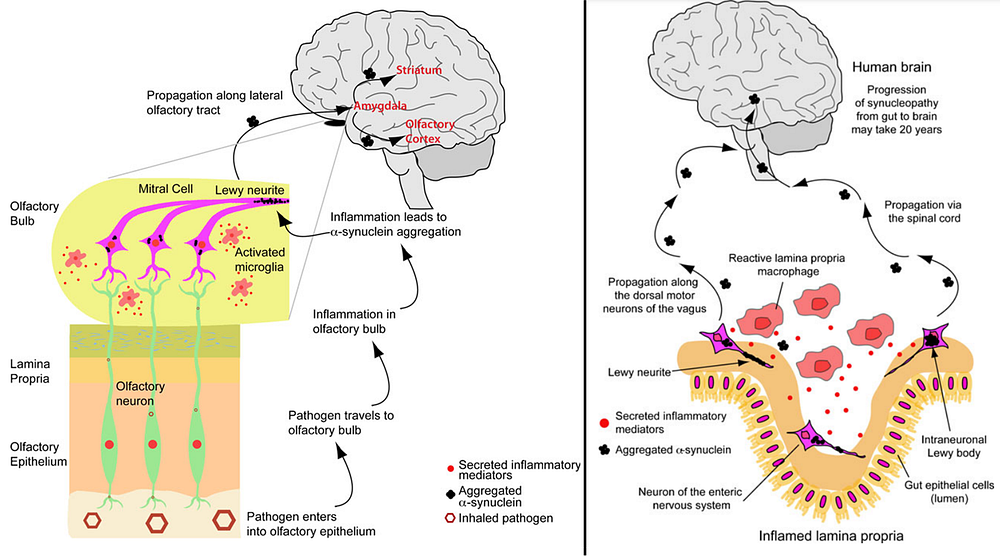
Figure 6. Inflammation and oxidative stress are conducive to the aggregation and spread of α-synuclein from the olfactory (left) and gastrointestinal (right) tracts to the brain. Source: Lema Tomé et al. (2013).

Genetics are also important in PD, although they can’t fully explain PD. Only about 15% of PD patients possess genetic risk factors for PD, such as the mutated PARK2 gene, which makes the protein parkin that helps degrade and recycle proteins. Other examples are PINK1 and LRRK2 genes, which code for protein kinases that protect the mitochondria.

One interesting study in 2019 showed that intestinal infection in mice lacking the PINK1 gene resulted in the development of PD compared to normal mice with the PINK1 gene — suggesting that genetic factors may also influence the impact of pathogens on the risk of PD.

It’s also possible that environmental, lifestyle, or genetic factors may serve as the first hit of PD rather than pathogenic agents. In this case, pathogens can still be the next hit in the multiple-hit hypothesis of PD.

Solving the cause of PD

The world has always been full of microbes, and they greatly influence the evolutionary trajectory of other living organisms, including humans. The gut microbiome is a prime example of this, where trillions of microbes reside therein in an intricate balance with the immune system.

The two most vulnerable body sites to the outside environment are the olfactory (inhale) and gastrointestinal (eat) tracts (Figure 6). Pathogens that manage to infiltrate the nervous system via these routes may trigger the misfolding and aggregation of α-synuclein as a defense mechanism. This may serve as the first hit in the threshold of PD development.

This is also consistent with the fact that PD is an age-related disease, which typically affects those over 60 years old. As we get older, our immune system naturally weakens — due to wear and tear like any other organ — making us prone to the onslaught of pathogens.

However, not all influenza patients will become PD patients. Subsequent hits — such as environmental, lifestyle, and genetic factors — are still needed to push the PD threshold even further and cause the disease.

The findings that influenza vaccination or antivirals can prevent PD in the animal studies I’ve discussed above are encouraging. But there’s a lack of data on how influenza vaccination affects the risk of PD in humans for some reason, probably due to the low awareness in this area. In AD, however, a meta-analysis has reported that those who received at least four annual influenza vaccines had a 49% lower risk of dementia.

Although it’s anti-climatic, there isn’t a single cause of PD, at least based on what’s currently known. In the end, the “multiple-hit” hypothesis appears to be the most plausible explanation of the cause of PD.
What do you think?

Shin Jie Yong, MSc (Res)

Written by Shin Jie Yong, MSc (Res)

Named Standford’s world top 1% scientists | Independent science writer and researcher | Powerlifter with national records | Medium boost program’s nominator

10 Spiritual Documentaries That Will Make You Reconsider Life

Enlightening works that you’ll want to watch at least once in your lifetime

Angelina Der Arakelian

Angelina Der Arakelian

Published in Soul Craft

Feb 1, 2024 (Medium.com)

Photo by Benjamin Child on Unsplash

Have you ever watched a documentary and felt like it wasn’t just entertainment, but an influential force that could shake up your whole perspective on life?

Well, that’s exactly what I’m here to talk about.

Every documentary in this list I’ve created is a doorway into a world where stories aren’t just stories, but more like intricate narratives that unravel the mysteries of our very existence.

These films are mentors guiding us on a journey through the depths of human experience. Watching them unfold before us, we’re not just spectators — we’re active participants, ready to be moved, challenged, and inspired.

Now, you may be wondering, why makes these documentaries so special?

It’s not just about their plots; it’s about the spiritual significance present deep within each narrative, like whispers of wisdom, gradually urging us to question, reflect, and grow.

Photo Source: IMDb

1. Samsara (2011)

Directed by Ron Fricke, Samsara is a non-narrative film that traverses the globe, capturing stunning visuals that reflect the cycle of birth, life, death, and rebirth.

Samsara draws from the ancient Sanskrit concept, emphasizing the cyclical nature of existence. Through mesmerizing visuals, it explores the interplay of humanity, nature, and the divine.

This documentary invites viewers to see life as a continuous flow, urging them to appreciate the interconnectedness of all beings, sparking a reevaluation of one’s personal actions within the broader context of the world.

Photo Source: MUBI

2. Baraka (1992)

Similar to SamsaraBaraka, directed by Ron Fricke, is a wordless journey through stunning visuals, transcending geographical and cultural boundaries.

Baraka captures the essence of the human experience, emphasizing the spiritual elements that bind diverse cultures together, exploring the shared rituals, struggles, and celebrations that define our collective existence.

Showcasing the universal aspects of the human experience, Baraka encourages viewers to transcend cultural differences, causing a shift from division to unity, fostering a sense of interconnected humanity.

Photo Source: Rotten Tomatoes

3. Awake: The Life of Yogananda (2014)

This documentary, directed by Paola di Florio and Lisa Leeman, chronicles the life of Paramahansa Yogananda, a spiritual teacher who introduced millions to the ancient practice of Kriya Yoga.

Awake explores the power of spirituality and the impact of Yogananda’s teachings on individuals seeking inner awakening, delving into the spiritual journey as a path to self-realization.

The documentary prompts a reconsideration of the significance of spiritual practices in daily life, making viewers want to explore their inner realms and seek a deeper connection with the divine, fostering personal growth and introspection.

Photo Source: Rotten Tomatoes

4. What the Bleep Do We Know!? (2004)

Directed by William Arntz, Betsy Chasse, and Mark Vicente, this documentary blends interviews, dramatizations, and animations to explore the intersection of quantum physics, spirituality, and consciousness.

What the Bleep Do We Know!? delves into the mysteries of consciousness, challenging conventional perceptions of reality, and introducing viewers to the concept that thoughts and emotions shape one’s experience of the world.

The documentary asks us to reconsider the nature of reality and the impact of consciousness on personal experiences, allowing viewers to uncover the spiritual dimensions of thought and emotion, reshaping their understanding of the world.

Photo Source: MUBI

5. The Salt of the Earth (2014)

Directed by Wim Wenders and Juliano Ribeiro Salgado, this documentary portrays the life and work of photographer Sebastião Salgado, whose lens captures the resilience and beauty of humanity amidst social and environmental challenges.

The Salt of the Earth reflects on the power of art and the human spirit’s capacity for resilience. Sebastião Salgado’s work can be regarded as an ode to the spiritual dimensions of human connection and empathy.

Viewers are prompted to contemplate the impact of art on their perceptions of the world. The documentary encourages us to recognize the spiritual connection between individuals, fostering empathy and a deeper understanding of shared humanity.

Photo Source: MUBI

6. I Am (2010)

Directed by Tom Shadyac, I Am traces the filmmaker’s road to self-discovery, questioning societal norms and exploring the interconnectedness of humanity.

I Am delves into the concept of interconnectedness and the transformative power of compassion, emphasizing the spiritual significance of recognizing the unity that binds all living beings.

The documentary invites viewers to reconsider their values and priorities, emphasizing the spiritual importance of compassion and cooperation. It encourages a shift towards collective well-being and fostering a sense of shared responsibility.

Photo Source: IMDb

7. Man on Wire (2008)

Directed by James Marsh, this documentary chronicles Philippe Petit’s daring high-wire walk between the Twin Towers in 1974, exploring the courage and transcendence of human potential.

Man on Wire captures the essence of human daring and the pursuit of dreams, reflecting on the spiritual dimensions of courage and the transcendence of self-imposed limitations.

Watching it, we are prompted to reflect on our own aspirations and the barriers we place on our own potential, indicating the transition from our 6self-limiting beliefs to the vast possibilities that life truly offers us.

Photo Source: film grimoire

8. Koyaanisqatsi (1982)

Directed by Godfrey Reggio, Koyaanisqatsi is a non-narrative film that explores the relationship between nature, technology, and humanity, offering a contemplative visual experience.

Koyaanisqatsi delves into the interplay between humanity and the environment, raising questions about the impact of modernity on the spiritual balance of life. The title itself, a Hopi word, translates to “life out of balance.”

The documentary prompts viewers to reflect on their role in the delicate equilibrium of existence, as well as the difference between mindless consumption and mindful coexistence with the natural world, which creates a deeper sense of spiritual interconnectedness.

Photo Source: Focus Features

9. Won’t You Be My Neighbor? (2018)

Directed by Morgan Neville, this heartwarming documentary takes an intimate look at the life and legacy of Fred Rogers, the beloved host of the children’s television program Mister Rogers’ Neighborhood.

The film goes beyond the iconic cardigan and explores the profound impact Rogers had on generations of children and the enduring principles of kindness, empathy, and acceptance that he promoted.

Won’t You Be My Neighbor? delves into the spiritual essence of human connection and compassion.

Through interviews, archival footage, and heartfelt anecdotes, the documentary prompts us to reflect on the simplicity of love and the power of genuine human connection.

In effect, Rogers’ life becomes a testament to the enduring value of kindness and the potential for positive change through understanding and acceptance.

Photo Source: MUBI

10. Minimalism: A Documentary About Important Things

This thought-provoking exploration directed by Matt D’Avella, delves into the philosophy of minimalism and its impact on people’s lives.

The documentary follows minimalism advocates Joshua Fields Millburn and Ryan Nicodemus as they share their personal journeys of adopting a minimalist lifestyle.

The film challenges societal norms and consumer-driven mindsets, urging viewers to reconsider the pursuit of material possessions in favor of a more intentional and meaningful life.

Through interviews with experts, authors, and everyday individuals who have embraced minimalism, the documentary highlights the potential for greater happiness and fulfillment by simplifying one’s life.

Minimalism encourages viewers to question the societal pressures of consumerism, emphasizing the spiritual dimensions of finding purpose beyond material wealth, leading to a reflection on the importance of values, relationships, and personal growth in the pursuit of a more meaningful existence.

Final Thoughts

And there you have it!

These special documentaries go beyond regular stories. They tell deep and meaningful tales that connect with what it means to be human.

Each movie, in its own way, asks you to think about life in a new light, focusing on the spiritual side of things.

Covering topics such as how everything in life is connected and the strength to bounce back from challenges, these films make you reflect on yourself and encourage you to start your own journey of self-discovery and spiritual growth.

So, as you watch these films, get ready to not just have fun but to feel deeply moved, think differently, and get motivated to see the world with a fresh, enlightened perspective.

P.S. If you’d like to contribute and be a part of the Soul Craft family, our doors are always open! Simply comment down below or on the Submissions Guidelines post. We would love to have you on board!

I always appreciate those who treat me to a coffee at https://ko-fi.com/angelinaderarakelian ☕

Angelina Der Arakelian

Written by Angelina Der Arakelian

·Editor for Soul Craft

An author who’s passionate about uplifting people and trying to make sense of a place we call the Universe. Say hi at angelinaderarakelian@gmail.com ?

Self Observe

by Heather Williams, H.W., M. (with permission)

SELF OBSERVE = To observe yourself without judging, blaming or denying what you see

QUESTION: How do you observe without judging?

STORY: I drew this self portrait in 1985. To draw a good portrait of yourself – you must learn to OBSERVE yourself without judgment. My book, Drawing as a Sacred Activity shares my approach to this most amazing practice! Then, in 2019, I created a zoom book club for anyone who may be interested in opening up to our Higher Self (the part of us that is formlessly present, observing the world within us and around us without judgment). In 2020 we began discussing the book, Self Observation, by Red Hawk. Self observation is an ancient practice that helps us to wake up to our Higher Self. It is very interesting that in the process of waking up to our Higher Self – we experience the horror of seeing our lower ego-capacities in action – such as our habitual fears and angry reactions. The key is to just OBSERVE without naming, labeling or judging whatever we are observing. When you do this, you are able to let go of old beliefs and habits PLUS you are able to experience the loving energy of Higher Self – because it is our Higher Self that OBSERVES. Learn more about my Ontology Work Chamber.

QUOTES

“Good teaching would help me to understand not that I have a soul but that I AM a Soul, and I exist for a brief moment in a human biological instrument.” ~ Red Hawk

“Without self knowledge, without understanding the working and functions of his machine, man cannot be free, he cannot govern himself and he will always remain a slave.” ~ G.I. Gurdjieff

“Knowing yourself is the beginning of all wisdom.” ~ Aristotle

EXERCISE

STOP.

Sit quietly.

Assume an erect posture. Sense the breath.

Sit calmly and observe any tension in your body. Let go of the tension.

Let go of any judgment.

Get your pen and paper and write words or draw lines expressing yourself in this NOW moment – without judgment. Move forward into your day willing to observe without judgment.

Weekly Invitational Translation

Translation is a 5-step process of “straight thinking in the abstract.” The first step is an ontological statement of being beginning with the syllogism: “Truth is that which is so. That which is not truth is not so. Therefore Truth is all there is.” The second step is the sense testimony (what the senses tell us about anything). The third step is the argument between the absolute abstract nature of truth from the first step and the relative specific truth of experience from the second step. The fourth step is filtering out the conclusions you have arrived at in the third step. The fifth step is your overall conclusion.

The claims in a Translation may seem outrageous, but they are always (or should always) be based on self-evident syllogistic reasoning. Here is one Translation from this week. 

!)    Truth is that which is so.  That which is not truth is not so.  Therefore Truth is all that is.  Truth being all is therefore total, therefore whole, therefore complete, therefore limitless (there can be no limit to all), therefore infinite, therefore eternal.  I think therefore I am.  Since I am and since Truth is all that is, therefore I, being, am Truth.  Since I, being, amTruth, therefore I, being, have all the attributes of Truth.  Therefore I, being, am total, whole, complete, limitless, infinite, eternal.  Since I, being, am Truth and since I, being, am consciousness, Therefore Truth is Consciousness.

2)    Emphysema and narrowing of blood vessels indicate trouble breathing and trouble being energized. 

Word-tracking:
emphysema:  trouble breathing
breath:  breath of fresh air, catch your breath, out of breath, take somebody’s breath away, hold your breath, life force
blood:  bleed, bless, life, 
heart:  carry blood throughout the body
oxygen:  element needed for combustion and life
element:  elementary, rudimentary, rude, basic

3)    Truth being all that is, therefore Truth is all that exists, all that lives.  Therefore Truth is Life.  Truth being all that is, therefore Truth is essence, therefore Truth is essential.  Truth being that which is essential is that which is rudimentary, elemental.  Truth being elemental and oxygen being an element, therefore Truth is Oxygen.  Since Truth is Oxygen and since Truth is all that is, there can be nothing to interrupt or narrow or block the supply of Truth/Oxygen.  Therefore the Life/Energy/Oxygen of Truth is readily-available, wide open and uninterrupted.   

4)    Truth is Life   
     Truth is essence,
        Truth is essential. 
        Truth is Oxygen.
        Life/Energy/Oxygen of Truth is readily-available, wide open and uninterrupted.   

5)    The oxygen of Consciousness is the breath of Life
.

For information about Translation or other Prosperos classes go to: https://www.theprosperos.org/teaching

Free Will Astrology: Week of February 15, 2024

BY ROB BREZSNY | FEBRUARY 13, 2024 (NewCity.com)

Photo: Jordan McDonald

ARIES (March 21-April 19): Some stories don’t have a distinct and orderly beginning, middle and end. At any one point, it may be hard to know where you are. Other tales have a clear beginning, middle and end, but the parts occur out of order; maybe the middle happens first, then the end, followed by the beginning. Every other variation is possible, too. And then there’s the fact that the beginning of a new story is implied at the end of many stories, even stories with fuzzy plots and ambiguous endings. Keep these ruminations in mind during the coming weeks, Aries. You will be in a phase when it’s essential to know what story you are living in and where you are located in the plot’s unfoldment.

TAURUS (April 20-May 20): As I meditate on your destiny in the near future, I sense you will summon extra courage, perhaps even fearless and heroic energy. I wonder if you will save a drowning person, or rescue a child from a burning building, or administer successful CPR to a stranger who has collapsed on the street. Although I suspect your adventures will be less dramatic than those, they may still be epic. Maybe you will audaciously expose corruption and deceit, or persuade a friend to not commit self-harm, or speak bold thoughts you haven’t had the daring to utter before.

GEMINI (May 21-June 20): Lately, you have been learning more than you thought possible. You have surpassed and transcended previous limits in your understanding of how the world works. Congratulations! I believe the numerous awakenings stem from your willingness to wander freely into the edgy frontier—and then stay there to gather in all the surprising discoveries and revelations flowing your way. I will love it if you continue your pilgrimage out there beyond the borders for a while longer.

CANCER (June 21-July 22): As I study the astrological omens for the coming weeks, I suspect you will feel more at home in a situation that has previously felt unnerving or alien. Or you will expedite the arrival of the future by connecting more deeply with your roots. Or you will cultivate more peace and serenity by exploring exotic places. To be honest, though, the planetary configurations are half-mystifying me; I’m offering my best guesses. You may assemble a strong foundation for an experimental fantasy. Or perhaps you will engage in imaginary travel, enabling you to wander widely without leaving your sanctuary. Or all of the above.

LEO (July 23-Aug. 22): Of your hundreds of wishes and yearnings, Leo, which is the highest on your priority list? And which are the next two? What are the sweet, rich, inspiring experiences you want more than anything else in life? I invite you to compile a tally of your top three longings. Write them on a piece of paper. Draw or paste an evocative symbol next to each one. Then place this holy document in a prominent spot that you will see regularly. According to my analysis of the astrological omens, you are in a phase when focusing and intensifying your intentions will bring big rewards.

VIRGO (Aug. 23-Sept. 22): Actor and travel writer Andrew McCarthy hiked across Spain along the famous pilgrimage route, Camino de Santiago. On the way, he felt so brave and strong that at one point he paradoxically had a sobbing breakdown. He realized how fear had always dominated his life. With this chronic agitation absent for the first time ever, he felt free to be his genuine self. “I started to feel more comfortable in the world and consequently in my own skin,” he testified, concluding, “I think travel obliterates fear.” I recommend applying his prescription to yourself in the coming months, Virgo—in whatever ways your intuition tells you are right. Cosmic forces will be aligned with you.

LIBRA (Sept. 23-Oct. 22): In the natural world, there are four partnership styles. In the parasitic variety, one living thing damages another while exploiting it. In the commensal mode, there is exploitation by one partner, but no harm occurs. In the epizoic model, one creature serves as a vehicle for the other but gets nothing in return. The fourth kind of partnership is symbiotic. It’s beneficial to both parties. I bring these thoughts to your attention, Libra, because the coming weeks will be an excellent time to take an inventory of your alliances and affiliations—and begin to de-emphasize, even phase out, all but the symbiotic ones.

SCORPIO (Oct. 23-Nov. 21): Scorpio author Dan Savage says, “I wish I could let myself eat and eat and eat.” He imagines what it would be like if he didn’t “have to monitor the foods I put in my mouth or go to the gym anymore.” He feels envious of those who have no inhibitions about being gluttonous. In alignment with astrological aspects, I authorize Savage and all Scorpios to temporarily set aside such inhibitions. Take a brief break. Experiment with what it feels like to free yourself to ingest big helpings of food and drink—as well as metaphorical kinds of nourishment like love and sex and sensations and entertainment. Just for now, allow yourself to play around with voraciousness. You may be surprised at the deeper liberations it triggers.

SAGITTARIUS (Nov. 22-Dec. 21): Dear Wise Gambler: You rank high in your spacious intelligence, intuitive logic and robust fantasy life. There’s only one factor that may diminish your ability to discern the difference between wise and unwise gambles. That’s your tendency to get so excited by big, expansive ideas that you neglect to account for messy, inconvenient details. And it’s especially important not to dismiss or underplay those details in the coming weeks. If you include them in your assessments, you will indeed be the shrewdest of wise gamblers.

CAPRICORN (Dec. 22-Jan. 19): Capricorn golfer Tiger Woods is one of the all-time greats. He holds numerous records and has won scores of tournaments. On twenty occasions, he has accomplished the most difficult feat: hitting a hole-in-one. But the weird fact is that there were two decades (1998–2018) between his nineteenth and twentieth holes-in-one. I suspect your own fallow time came in 2023, Capricorn. By now, you should be back in the hole-in-one groove, metaphorically speaking. And the coming months may bring a series of such crowning strokes.

AQUARIUS (Jan. 20-Feb. 18): Poet Anna Akhmatova (1889–1966) lived till age seventy-six, but her destiny was a rough ride. Her native country, the authoritarian Soviet Union, censored her work and imprisoned her friends and family. In one of her poems, she wrote, “If I can’t have love, if I can’t find peace, give me a bitter glory.” She got the latter wish. She came close to winning a Nobel Prize and is now renowned as a great poet and heroic symbol of principled resistance to tyranny. Dear Aquarius, I predict that your life in the coming months will be very different from Akhmatova’s. I expect you will enjoy more peace and love than you’ve had in a long time. Glory will stream your way, too, but it will be graceful, never bitter. The effects will be heightened if you express principled resistance to tyranny.

PISCES (Feb. 19-March 20): Piscean perfumer Sophia Grojsman says, “Our lives are quiet. We like to be disturbed by delight.” To that end, she has created over thirty best-selling fragrances, including Eternity Purple Orchid, Désir Coulant (Flowing Desire), Spellbound, Volupté (Pleasure) and Jelisaveta (“God is abundance”). I bring this up, Pisces, because I believe it’s now essential for you to be disturbed by delight—as well as to disturb others with delight. Please do what’s necessary to become a potent magnet for marvelous interruptions, sublime interventions and blissful intrusions. And make yourself into a provider of those healing subversions, too.

Homework: I dare you to forgive yourself for a past event you’ve never forgiven yourself for before. Newsletter.FreeWillAstrology.com

A rare look at the devastation caused by AR-15 shootings

By admin | February 15, 2024 Uncategorized

TERROR ON REPEAT

Editor’s note: The photos, videos and personal accounts below are extremely disturbing and may be too upsetting for some people. Read why The Post is publishing this story.

Icon: Scroll down to continue

When a gunman fires an AR-15 …

… a seemingly safe, familiar place instantly transforms into a hellscape ofchaos, destruction and mass death.

Three concertgoers, a man in jeans and a T-shirt and two young women in shorts, tank tops and cowboy boots, run amid water bottles strewn on a grassy surface. People at the back are huddled on the ground. Festival lights are on in the distance.
A church pew is raised off a red-carpeted floor and rests on top of another pew. The floor is stained with blood, and the church wall is riddled with bullet holes.
Body bags line an elementary school hallway with walls painted blue and green. Faint traces of blood dot the cream tiled floor, and student artwork and fliers are hung on the walls.

By Silvia Foster-Frau

N. Kirkpatrick and 

Arelis R. Hernández

Nov. 16 at 6:00 a.m. (WashingtonPost.com)

Mass shootings involving AR-15s have become a recurring American nightmare.

The weapon, easy to operate and widely available, is now used more than any other in the country’s deadliest mass killings.

Fired by the dozens or hundreds in rapid succession, bullets from AR-15s have blasted through classroom doors and walls. They have shredded theater seats and splintered wooden church pews. They have mangled human bodies and, in a matter of seconds, shattered the lives of people attending a concert, shopping on a Saturday afternoon, going out with friends and family, working in their offices and worshiping at church and synagogue. They have killed first-graders, teenagers, mothers, fathers and grandparents.

But the full effects of the AR-15’s destructive force are rarely seen in public.

AMERICAN ICON

A series examining the AR-15, a weapon with a singular hold on a divided nation

More stories

Press Enter to skip to end of carousel

The AR-15’s destructive force: A rare look at the weapon’s impact

Why are we showing graphic AR-15 content? A letter from the executive editor.

What does an AR-15 do to a human body? A visual examination of the deadly damage.

A letter from Executive Editor Sally Buzbee on the AR-15 series

Decades of marketing reinvented the AR-15 into a top-selling firearm

Sutherland Springs survivors haunted by an AR-15’s carnage, trauma

Magazine restrictions could reduce mass killings by AR-15s, but courts must decide

The AR-15’s impact in America: Here’s what The Post’s examination found

Why do people own AR-15s? 33% of owners cited self-defense, poll finds

Gunmakers’ growth in red states marks a divide on weapons like the AR-15

Armed with AR-15s, extremist and militia groups anticipate civil unrest

As guns saturate the United States, police turn to the AR-15

How the AR-15 became a powerful political, cultural symbol in America

As mass shootings rise, some senators are recanting their gun debate votes

The Louisville bank shooter bought a gun despite struggles with mental health

End of carousel

About the terminology  

The impact is often shielded by laws and court rulings that keep crime scene photos and records secret. Journalists do not typically have access to the sites of shootings to document them. Even when photographs are available, news organizations generally do not publish them, out of concern about potentially dehumanizing victims or retraumatizing their families.

Now, drawing on an extensive review of photographs, videos and police investigative files from 11 mass killings between 2012 and 2023, The Washington Post is publishing the most comprehensive account to date of the repeating pattern of destruction wrought by the AR-15 — a weapon that was originally designed for military combat but has in recent years become one of the best-selling firearms on the U.S. market.

This piece includes never-before-released pictures taken by law enforcement officials after shootings inside Robb Elementary School in Uvalde, Tex., in 2022, and the First Baptist Church in Sutherland Springs, Tex., in 2017, that were obtained by The Post. It is also based on Post interviews with survivors and first responders from multiple shootings as well as transcripts of official testimony provided by law enforcement officials who were among the first to witness the carnage. Read a note here from the executive editor about how The Post decided what to publish and why.

The review lays bare how the AR-15, a weapon that has soared in popularity over the past two decades as a beloved tool for hunting, target practice and self-defense, has also given assailants the power to instantly turn everyday American gathering places into zones of gruesome violence.

This is an oral history told in three parts that follows the chronological order of a typical AR-15 mass shooting. It weaves together pictures, videos and the recollections of people who endured different tragedies but have similar stories to tell.

PART 1

SHOTS ARE FIRED

To some it sounds like fireworks, to others a deafening roar. The initial burst from the AR-15 is often the first sign that something unusual is happening. Moments later, bullets riddle walls, windows, shelves and notebooks. Some people are shot and others scramble for safety. Later, investigators identify dozens or hundreds of bullet casings.

All of a sudden, out of nowhere, you just hear the loudest, most unbelievably piercing sound you’ve ever heard in your life. Danielle Gilbert, high school student. Marjory Stoneman Douglas High School, Parkland, Fla.

People started screaming, and there was hysteria and people were dropping to the ground. Heather Brown Sallan, vendor. Route 91 Harvest festival, Las Vegas.Play/pause button

Use Up/Down Arrow keys to increase or decrease volume.

​​Route 91 Harvest festival, Las Vegas. Oct. 1, 2017. 60 killed.

[Jason Aldean singing]

I turned around and … looked at the back doors, just trying to get my bearings and figure out, is this some kids throwing firecrackers? David Colbath, church congregant. First Baptist Church, Sutherland Springs, Tex.

I heard what sounded like metal chairs falling, and I figured that was for the holiday program or something.Abbey Clements, teacher. Sandy Hook Elementary School, Newtown, Conn.

I just saw things flying off the walls, and that’s when it hit me — that it was bullets, that it was a gun that was firing off. Arnulfo Reyes, teacher. Robb Elementary School, Uvalde, Tex.

Six rows of brown church pews are covered in dust and debris. One pew has a dark-red blood stain and the red carpet underneath has two large dark-red circles of blood. The church wall is riddled with bullet holes. Investigators stuck a pink rod on the back of one pew to determine a bullet’s trajectory. Text reads: “First Baptist Church, Sutherland Springs, Texas, November 5, 2017. 26 killed.”
First Baptist Church, Sutherland Springs, Tex. Nov. 5, 2017. 26 killed.
A glass window is shattered and glass fragments are scattered onto two chairs and a couch nearby, inside the lobby of a school. Text reads: “Sandy Hook Elementary School, Newtown, Connecticut. December 14, 2012. 26 killed.”
Sandy Hook Elementary School, Newtown, Conn. Dec. 14, 2012. 26 killed.
The wall of a room is riddled with bullet holes. A table with books is covered in dust and debris, as is the patterned brown-and-red carpet. Blood is smeared on the wall in the hallway just outside the room. Text reads; “Tree of Life synagogue, Pittsburgh, Pennsylvania. October 27, 2018. 11 killed.”
Tree of Life synagogue, Pittsburgh. Oct. 27, 2018. 11 killed.

The face my wife made the moment we heard shots and she started to run with the stroller … super tense — I don’t know how to describe it. Daniel Seijas, shopper. Allen Premium Outlets, Allen, Tex.

Smoke filled the place up from the constant shooting inside here. … You could smell the smoke. David Colbath, church congregant. Sutherland Springs.

Since it was pitch black, I could see the muzzle flashes coming from that left side. … There was drywall fragments falling from the ceiling. Anthony Burke, police detective and SWAT officer. Tree of Life Congregation, Pittsburgh.

A bullet hole pierces a classroom door, warping its flat surface. Text reads: “Robb Elementary School, Uvalde, Texas. May 24, 2022. 21 killed.”
Robb Elementary School, Uvalde, Tex. May 24, 2022. 21 killed.
A prayer book with Hebrew lettering on the cover. The upper corner of the book is torn and damaged. An evidence marker is on top of the book with a label reading “BH26.” Text reads, “Tree of Life synagogue, Pittsburgh.”
Tree of Life synagogue, Pittsburgh
Dark red blood collects at the base of a classroom file cabinet. There are two holes in the cabinet that have been tagged with evidence markers. Text reads, “Robb Elementary School, Uvalde.”
Robb Elementary School, Uvalde
Blood is mixed with spilled popcorn on top of dark movie theater carpet. A small card is folded in half and used as an evidence marker and is placed near a plastic cup lid with a red straw. The number 126 is written on the card.
Century 16 movie theater, Aurora, Colo. July 20, 2012. 12 killed.

To be able to cope with being in a position where I couldn’t do anything, I did the most useful thing that I can think of: I was counting rounds and reloads. Morgan Workman, church congregant. Sutherland Springs.

The bullets were ricocheting off the street. … You could hear the pinging and the ricocheting of them hitting the cars around you. It was the chaos of it — it just kept going and going and going. Heather Brown Sallan, vendor. Las Vegas.

Before he ever came in, there was really hardly anybody that could rise up and challenge him. But with these bullets just flying through the air, there was nobody going to be able to do it and nobody could. David Colbath, church congregant. Sutherland Springs.

NOTE TO READERS

THIS VIDEO WAS RECORDED BY DANIELLE GILBERT, MOMENTS AFTER A GUNMAN SHOT INTO CLASSROOM 1213 IN PARKLAND, WHERE SHE, MADDY WILFORD AND OTHER STUDENTS WERE TAKING AP PSYCHOLOGY. IN THE VIDEO, YOU’LL HEAR A LOUD ALARM, WOUNDED STUDENTS WHO ARE NOT VISIBLE CRYING FOR HELP AND ADDITIONAL GUNFIRE. IT IS UPSETTING.

Play/pause button

0:08 / 0:35Mute/unmute button

Marjory Stoneman Douglas High, Parkland, Fla. Feb. 14, 2018. 17 killed.

I got shot four times …I thought I got hit with a ton of bricks … so I looked behind me to try to see if there’s anyone to help me. And all I could see was blood. Maddy Wilford, high school student in classroom 1213, Parkland.

There’s dust everywhere. There’s debris. … I had like dust and debris coming off of my hands. … I was still just covered from head to toe. Danielle Gilbert, high school student. Parkland.

When I could hear the gunfire, I knew where he was. When I didn’t hear the gunfire, I’m thinking, ‘Oh my gosh, he’s coming this way.’ I kept thinking that everyone was dead. There’s no way they’re not all dead. Dallas Schwartz, employee. Old National Bank, Louisville.

I only thought he got shot one time, and it was five. … As the police and them come to us I just grab on my dad and just kept telling him I loved him before he died. Dion Green, bar patron. Oregon Historic District, Dayton, Ohio.

Dozens of yellow evidence tags are seen on a sidewalk. Police crime tape is wrapped around posts and a tree. A blue bike is lying on its side, chained to a post. Text reads: “Oregon Historic District, Dayton, Ohio, August 4, 2019. 9 killed.”
Oregon Historic District, Dayton, Ohio. Aug. 4, 2019. 9 killed.
Inside a Las Vegas hotel room, at least eight AR-15 and AR-10 rifles, along with 60 and 100 round rifle magazines, are strew on the floor and on the furniture. Text reads, “Route 91 Harvest festival, Las Vegas.”
Route 91 Harvest festival, Las Vegas
A drum magazine is seen on a carpeted floor. Six white cards used as evidence markers are placed next to unspent rounds. Text reads, “Century 16 movie theater, Aurora."
Century 16 movie theater, Aurora
Bullet casings litter the corner of a church floor. The red carpet is covered in debris. Text reads, “First Baptist Church, Sutherland Springs.”
First Baptist Church, Sutherland Springs

NOTE TO READERS

THE NEXT SECTION INCLUDES PHOTOGRAPHS WHERE YOU CAN SEE THE BLOOD AND DESTRUCTION THAT REMAIN AFTER BODIES HAVE BEEN REMOVED FROM THE SCENE OF AN AR-15 SHOOTING.

PART 2

THE ATTACK UNFOLDS

In minutes, injured and dead fall to the floor. Some are able to flee, others are rushed to safety by police. Smoke from the rifle fills the air. The Post obtained never-before-published photographs from Robb Elementary School classrooms 111 and 112 in Uvalde. They show the carnage left behind, including the large volume of blood that collects. The photos, along with personal accounts describing young children’s lifeless bodies, echo descriptions provided 11 years earlier by witnesses at Sandy Hook Elementary School.

Two children’s backpacks are seen hanging on a classroom wall under a whiteboard. One pack is black, has a Reebok logo and is covered in white dust. The other pack is decorated with hearts and the words “love yourself.” Below the backpacks, is a tiled floor covered in blood. Text reads, “Robb Elementary School, Uvalde.”
Robb Elementary School, Uvalde

He shot the students there under the table. And so, I didn’t hear any yelling or crying. But I think it was due to the bullets, the gun, being so loud. Arnulfo Reyes, teacher. Uvalde.

I was stunned. I was hurt. I couldn’t move. Two kids fell on my back. Another two kids fell on those two kids’ back. We were stacked up right here like cordwood. David Colbath, church congregant. Sutherland Springs.

I saw my right arm get blown open in two places and my right hand. The pain was the worst pain I ever felt. I looked at it as I felt it, and it looked like shredded raw meat. And there was a lot of blood. Andrea Wedner, synagogue congregant. Pittsburgh.

It was a war zone and there was injured, there was blood everywhere. There was magazines, there was bullets. Danielle Gilbert, high school student. Parkland.

I notice on the whiteboard it looked like somebody had taken, like, their hand and, like, it just, it was wrote in blood — it looked like they wrote LOL on the whiteboard. Travis Shrewsbury, Border Patrol agent. Uvalde.

Inside classroom 111, long streaks of blood are seen on a tiled floor. A basketball and school supplies and bullet casings are strewn on the floor. Above a whiteboard in the back of the room a sign reads, “Mr. Reyes” next to a Texas state flag. One the whiteboard in blood, reads “LOL.” Text reads, “Robb Elementary School, Uvalde.”
Robb Elementary School, Uvalde
Inside classroom 112, children’s desks are haphazardly pushed to one side. The desks are covered in a thin layer of dust. School paper, water bottles and other classroom supplies are seen on top of the desks and on the floor. Two bouquets of flowers sit on one desk. In the back left corner of the room is a dark red pool of blood. A shoe and yellow evidence markers are seen amid the blood. Text reads, “Robb Elementary School, Uvalde.”
Robb Elementary School, Uvalde
Wet and dried blood is seen on a classroom floor mixed with green evidence markers. The gloved hands and the covered shoes of two workers can been seen. A pair of Nike branded shoe is lying on the floor, its white surface covered in blood. Text reads, “Robb Elementary School, Uvalde.”
Robb Elementary School, Uvalde
A gold bullet casing is seen on a classroom floor surrounded by blood and an evidence marker in the shape of a ruler. The bullet appears to be about 5 millimeters in length. Text reads, “Robb Elementary School, Uvalde.”
Robb Elementary School, Uvalde
An AR-15, sprinkled with white dust, is seen discarded on top of school supplies inside a classroom closet. Orange evidence marks are placed next to the gun and a rifle magazine. Text reads, “Robb Elementary School, Uvalde.”
Robb Elementary School, Uvalde
Inside a hallway of an elementary school, blood is smeared on the tiled floor. A thin layer of white debris covers the edges of the floor and the top of a child’s desk. On the hallway walls are children’s artwork. One post is of a gum ball machine with cutout lettering that reads, “wel-gum to 4th grade.” Text reads, “Robb Elementary School, Uvalde.”
Robb Elementary School, Uvalde

I could hear a little girl say, ‘Officers come in, we’re in here,’ and she sounded far away so I knew it was in the other room. And she said that once. And then maybe two or three minutes later she said it again. And then I just heard him walk into that other room. And he shot some more. So after that I didn’t hear her no more. And so I had figured he had killed her. Arnulfo Reyes, teacher. Uvalde.

My breathing was changing, it was getting more shallow, more rapid. I was salivating. I was losing my ability to expand my lungs. I was drooling. The pressure in my abdomen was getting greater by the minute and through my rectum. I felt that I was leaving. … I felt that I was dying. Daniel Leger, synagogue congregant. Pittsburgh.

I could hear people screaming, and I could hear people — you know, last words were uttered, things that were — fear, and just really awful sounds. And then it eventually started getting quieter. And that was the worst part. Was knowing that the quiet meant the worst. Morgan Workman, church congregant. Sutherland Springs.

After a while, I could see she was shot and she wasn’t going to survive. … I kissed my fingers, and I touched my fingers to her skin. … I cried out, ‘Mommy.’ Andrea Wedner, synagogue congregant. Pittsburgh.

An AR-15 rests on the floor near a file cabinet and children’s workbooks that say, “Welcome to Modern Hebrew.” Text reads, “Tree of Life synagogue, Pittsburgh.
Tree of Life synagogue, Pittsburgh
Blood stains a sidewalk that is strewn with evidence markers, blue plastic gloves and a crumpled white cloth. A car parked near the sidewalk has a few streaks of blood on the passenger side door. Text reads, “Oregon Historic District, Dayton.”
Oregon Historic District, Dayton

One of my cousins — the cops dragged him in the hallway when they were taking us out. I saw the bullet in his head. Jaydien Canizales, elementary school student. Uvalde.

Two 6- or 7-years-old girls followed by two older, taller boys came out the east exit and approached. One little girl was heavily blood spattered and dazed. … Her friend said that she was all right and ‘stuff got on her.’ … I told the two to hold hands and go.Paul Lukienchuk, state trooper. Newtown.

The kids, some are scared, some are quiet, some are crying, some don’t know what’s going on. Some thought it was a practice fire drill. But they were ready to see us. … We told them: ‘Single file. Get your kids. Let’s go. Let’s go. Let’s go.’ Alexander Cuellar, Border Patrol agent. Uvalde.

Elementary school children in uniform, holding hands as they walk in a single file as police officers direct them. Text reads, “The Covenant School, Nashville, Tennessee. March 27, 2023. 6 killed.”
The Covenant School, Nashville. March 27, 2023. 6 killed.
Elementary school children walk in a single-file line, with their hands on each other’s shoulders as police officers direct them. Text reads: “Sandy Hook Elementary School. Newtown, Connecticut. December 14, 2012. 26 killed.
Sandy Hook Elementary School, Newtown, Conn. Dec. 14, 2012. 26 killed.

They came, these three police officers with long guns. … I was instructed to unlock the doorandto raisemy hands and we all came out at gunpoint and were evacuated. Marcus Kergosien, store manager. Allen.

As I exit the classroom, there’s two more bodies on the right-hand side in the hallway, a girl and a boy both face down. Danielle Gilbert, high school student. Parkland.Play/pause button

0:04 / 0:07Mute/unmute button

Marjory Stoneman Douglas High School, Parkland

It was emergency vehicle sounds, and I couldn’t even look up. I looked at my feet, and the cold air in my chest, we had no coats and we were running toward the firehouse and it was — we didn’t know that it was over, so the trauma continued there. And then it’s just the worst scene you can imagine. You had chaos, and kids couldn’t find their siblings. Abbey Clements, teacher. Newtown.

I remember when we ran out and there was the police. … The look on his face, the terror on his face. He had people under his car. In his car. And I remember him just screaming: ‘Run for your fucking lives. Do not stop.’ … I remember my mouth being bone dry and my lungs were burning and I was so physically uncomfortable and I was so thirsty and I couldn’t stop. I just kept running and running and running. Heather Brown Sallan, vendor. Las Vegas.

He threw me down on the ground and got on top of me. … I think that moment was him grabbing my face and saying, ‘This is happening, like there are actual bullets flying at us now.’ … I just remember that feeling, I swear it was the moment that photo was taken, when he opened my eyes to what was actually happening. Dani Westerman, concertgoer. Las Vegas.

Dani Westerman lies on her back on black pavement outdoors at night. A man in a red T-shirt and jeans lies on top of her, covering her body with his. He is brushing his hand over her cheek and leaning his face close to hers. Plastic water bottles and cups are strewn around them. Text reads, “Route 91 Harvest festival, Las Vegas.”
Route 91 Harvest festival, Las Vegas

PART 3

DEVASTATION

When the shooting ends, police, coroners and other first responders bear witness to the destruction. They check for signs of life, attempting to separate the barely living from the dead. They collect evidence, photograph the scene and remove the bodies. A once familiar place is now forever changed.

An exit door of a movie theater is partially open. On the floor stained with blood is an AR-15 and a pink flip flop. Text reads, “Century 16 movie theater, Aurora.”
Century 16 movie theater, Aurora
The inside of a movie theater where rows of blue seats are pierced with pink and silver rods, used to determine a bullet’s trajectory. Text reads, “Century 16 movie theater, Aurora.”
Century 16 movie theater, Aurora

It was dim. The movie was still playing. The alarm was going off. … I could smell the gas. … Then I began to notice the bodies. … There was blood on seats, blood on the wall, blood on the emergency exit door. Pools of blood on the floor. Annette Brook, police officer. Century 16 movie theater, Aurora, Colo.

I walked in there, and you’re, like, slipping and sliding, trying not to slip because it was bad. And just the thing I won’t forget is the smell. Alexander Cuellar, Border Patrol agent. Uvalde.

There were shoes scattered, blood in the street, bodies in the street. Straight out of a nightmare. Dion Green, bar patron. Dayton.

It looked like a bomb went off in there. When you can tell the difference between, you know, when somebody is alive and somebody is dead, it’s because there were pieces of people just laying everywhere. And those were the dead ones. The ones that were alive were barely moving but were moving. Rusty Duncan, volunteer firefighter. Sutherland Springs.

A field at an outdoor concert venue is seen emptied at night. Bodies are spread across the ground, some huddled together. They are seen at a distance and it is not clear if the people are dead, wounded or aiding others. The field is also strewn with trash and abandoned items. There is a fence alongside the field. Just outside of the fence are two groups of people crouching down. One group is surrounding another person on the ground. In the background is the Las Vegas skyline. Text reads, “Route 91 Harvest festival, Las Vegas.”
Route 91 Harvest festival, Las Vegas

We were standing there looking at the scene and the phones kept ringing and ringing and ringing in the backpacks and on the desk of the parents calling their children. … They kept calling and calling and calling.Eulalio Diaz, justice of the peace and coroner. Uvalde.

As we were clearing the rooms, we came across a classroom which I thought at first was an art room because I saw a lot of red paint all over the walls and in the far left corner I thought I observed a pile of dirty laundry. … As I continued to stare at the room not being able to figure out what I was looking at, I realized that the red paint was actually blood and the pile of dirty laundry were actually dead bodies. Carlo Guerra, state trooper. Newtown.

As I stared in disbelief, I recognized the face of a little boy on top of a pile. … I then began to realize that there were other children around the little boy and that this was actually a pile of dead children. … I tried to count the number of dead between rooms #10 and #8, but my mind would not count beyond the low teens and I kept getting confused. William Cario, police sergeant. Newtown.

You can only imagine that gun being pointed down and shooting as much as you can into a body, what it would do. It’ll make you unrecognizable in a heartbeat. So, yes, I believe it, because I saw it with my own eyes. Rusty Duncan, volunteer firefighter. Sutherland Springs.

Body bags line an elementary school hallway with walls painted blue and green. Faint traces of blood dot the cream tiled floor and student artwork and fliers are hung on the walls. Text reads, “Robb Elementary School, Uvalde.”
Robb Elementary School, Uvalde

See how other readers responded to this story and share your own thoughts.5753 Comments

ABOUT THIS STORY

Reporting by Silvia Foster-Frau, N. Kirkpatrick and Arelis R. Hernández. Additional reporting by Jon Gerberg, Holly Bailey, Robert Klemko, John Harden, Jon Swaine, Elyse Samuels, Sarah Cahlan, Joyce Lee and John Woodrow Cox. Public records requests by Nate Jones.

Design and development by Shikha Subramaniam and Aadit Tambe. Design editing by Madison Walls and Matthew Callahan. Visual editing by Kainaz Amaria. Additional photo editing by Robert Miller and Natalia Jimenez. Additional video editing by Angela M. Hill.

Editing by Peter Wallsten, Rosalind S. Helderman, Kainaz Amaria and Wendy Galietta. Additional editing by Jordan Melendrez, Brian Cleveland, Kim Chapman and Tom Justice. Additional support from Sarah Murray, Ashleigh Wilson, Kyley Schultz and Brandon Carter.

The following people were interviewed by The Post: Jaydien Canizales, Abbey Clements, David Colbath, Eulalio Diaz, Rusty Duncan, Danielle Gilbert, Dion Green, Marcus Kergosien, Arnulfo Reyes, Heather Brown Sallan, Dallas Schwartz, Daniel Seijas, Dani Westerman, Maddy Wilford and Morgan Workman. Seijas was interviewed in Spanish.

Comments from Annette Brook, Anthony Burke, Daniel Leger and Andrea Wedner are drawn from court testimony. Comments from William Cario, Alexander Cuellar, Carlo Guerra, Paul Lukienchuk and Travis Shrewsbury are drawn from police investigative files.

While other weapons, including various types of semiautomatic rifles, are used in violent crimes, AR-15s have been used in 10 of the 18 shootings since 2012 in which 10 or more people were killed — making it the most commonly used weapon in the country’s deadliest mass killings.This data is drawn from a databasemaintained by the AP, USA Today and Northeastern University and analyzed by The Post.

Photo and video credits:

Introduction: Office of the District Attorney for the 18th Judicial District of Colorado; David Becker/Getty Images; and Texas Department of Public Safety/Obtained by The Post.

Part 1: Texas Department of Public Safety/Obtained by The Post; Connecticut State Police; U.S. Justice Department; Dayton Police Department; Las Vegas Metropolitan Police Department; and Office of the District Attorney for the 18th Judicial District of Colorado. Videos by Las Vegas Video Archive/YouTube; Danielle Gilbert.

Part 2: Texas Department of Public Safety/Obtained by The Post; Dayton Police Department, Jonathan Mattise/AP; Shannon Hicks/Newtown Bee/Polaris; David Becker/Getty Images. Video by Ryan Deitsch via Storyful.

Part 3: Office of the District Attorney for the 18th Judicial District of Colorado; Texas Department of Public Safety/Obtained by The Post.

Texas Department of Safety photographs were not released by the agency but were separately obtained by The Post.

Crime scene photos from the Tree of Life synagogue in Pittsburgh have been cropped to remove labels placed by investigators.

The video provided by Danielle Gilbert from Marjory Stoneman Douglas High School in Parkland was originally played in open court during the trial of the gunman. The Post spoke to four people who were in the classroom including Maddy Wilford, who identified herself as one of the wounded students who can be heard in the video.

The photograph of the large field strewn with bodies from the Route 91 Harvest festival in Las Vegas was posted on Reddit and 4chan on Oct. 2, 2017, the day after the shooting. The Post verified the time and location of the photograph by comparing it to body-camera footage, social media videos, police reports and other pictures taken at the scene. The Post could not determine the original online post or the photographer. The Post consulted Siwei Lyu, a computer science and engineering professorat the University at Buffalo and an expert on photo and video manipulation, who found no signs of manipulation.

Why we are publishing disturbing content from AR-15 mass shootings

Silvia Foster-Frau photo

By Silvia Foster-FrauSilvia Foster-Frau writes for The Washington Post about the nation’s emergence as a predominantly multicultural society, exploring its changing racial, ethnic and cultural demographics, and telling the stories of everyday Americans affected by and a part of such change. Twitter

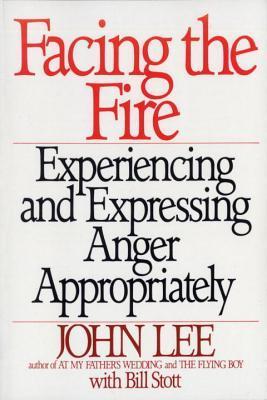
Book: “Facing the Fire: Experiencing and Expressing Anger Appropriately”

Facing the Fire: Experiencing and Expressing Anger Appropriately

John H. LeeBill StottWilliam Stott (Contribution by)

The author of  The Flying Boy  describes how repressing anger can have profound effects on personal health and guides readers step by step through the process of getting past their fears.

“ Facing the Fire  is the best book on anger I have read; it is responsible, honest, practical, and a good read. I know the techniques Lee describes work, and the exercises alone make it a valuable book. I will use Facing the Fire  personally and professionally.”—Dr. Patricia Love, author of The Emotional Incest What to Do When a Parent’s Love Rules Your Life

Do you Anger is a “negative” emotion? “Nice” or “emotionally sophisticated” people don’t get angry? Anger will disappear when you have understood intellectually what causes it? You won’t be angry if you just learn to forgive? If so, you are not alone. Anger is the most misunderstood and, consequently, painful of all our emotions. But denying, suppressing, and avoiding our own and others’ anger can have unfortunate weakened immune systems, numbing addictions, stormy relationships, lowered self-esteem.

Now, John Lee, the nationally renowned speaker, teacher, and author, shows you a better way of dealing with anger. Based on his work with clients and his own experiences with anger,  

• Uses real-life scenarios to help you understand what anger is, what causes it, and why it cannot and should not be avoided
• Carefully guides you through a process of confronting and getting past the fears—of losing control, of alienating people, of hurting yourself or someone you love—that keep you from honestly experiencing and accepting your anger
• Gently demonstrates ways in which you can express anger constructively—from talking it out to pounding your pillow
• Demonstrates why another person’s anger, if it is expressed appropriately, need not be threatening or harmful to you—but in fact can help you

“Anger is our most misunderstood emotion. It is a fire that will either consume or purify. In this book, through effective and practical exercises, John Lee carefully guides the reader into a healthy relationship with this powerful emotion.”—Wayne Kritsberg, author of The Invisible Wound


About the author

Profile Image for John H. Lee.

John H. Lee

John Lee is a pioneer in the fields of self-help, anger management, co-dependency, emotional regression, recovery, emotional intelligence, relationships, and men’s issues. His highly innovative work in these fields has made him an in-demand consultant, teacher, trainer, life coach, and speaker. His contributions in these fields have put him in the national spotlight for over 35 years.

(Goodreads.com)

Knowledge Isn’t Power, It’s A Burden

Getting it off your shoulders is true power

Rami Dhanoa

Rami Dhanoa

Published in Orient Yourself

Feb 2, 2024 (Medium.com)

Photo by Kenshi Kingami on Unsplash

Your attention span may not be strong enough to take in what I’m about to share about why attention spans are being hijacked.

But that’s okay. The following is for the select few who realize the so-called knowledge that takes up our headspace is actually dangerous. Because it isn’t knowing, but mere mental stimulation.

Information is the drug, and our attentional balance is the victim. All the while, true wisdom is lost, and our life purpose along with it.

But there is a deep, ancient way out of this mess.

In Indian philosophy, there are three levels of knowledge:

  • Hearing-borne-wisdom (shruta-mayi-prajna) which is like remembering facts and theories from an external source
  • Reflecting-borne-wisdom (chinta-mayi-prajna) which is like seeing how the knowledge applies to your life
  • Experience-borne-wisdom (bhavana-mayi-prajna) which is full realization of the experience that produced the words in the first place

Obviously, the goal is to not just be a brainy intellectual, but to transform the first into the last, with deep practice.

This happens by three steps:

  • Hearing: Clearly receiving exactly what is being taught, as it is taught, and then not forgetting it.
  • Reflecting: Keeping it in the mind as it is being interrogated, tested, brainstormed, and planned upon.
  • Meditation: Applying our insights into daily life after ‘digesting’ the insight, to non-conceptually feel what the words are actually pointing to.

In Vedanta, this process is called nidhi-dhyasana, or placing oneself, meditatively, very close to what is being studied.

In Buddhism, it’s the standard educational process of developing wisdom.

All the Buddha’s teachings are not for intellectual satisfaction, they are signposts pointing to something profound, far beyond written or conceptualized ideas!

Now contrast this process of developing experience with Western education: we seem to think that a sharp mind, strong memory, and elaborate theorization is the be all and end all of learning.

Is it any wonder we’re not producing geniuses en masse, such as India during its classical/ancient era, or Europe during its Renaissance?

In the Information Age, knowledge has become a deadweight – even something toxic overloading your mind, with its insistent flooding of memory, mental depth, and attentional balance.

Stop reading, stop watching, stop consuming.

Fully hear, reflect, and feel/see.

Not what you think you should be working on, but what you know that you need to realize, fast, or else your life will be wasted.

Make knowledge power again by actually applying it with action, rather than letting it rot into toxic inertia.

Rami Dhanoa

Written by Rami Dhanoa

·Editor for Orient Yourself

Re-thinking human potential with meditation & Indic philosophy.

Consciousness, sexuality, androgyny, futurism, space, the arts, science, astrology, democracy, humor, books, movies and more